17C Cyber Operations Specialist
The Army’s 17C is one of the few military jobs where your weapon is a keyboard. You defend Pentagon networks, hunt foreign hackers in real time, and run authorized offensive operations against adversary systems. The training pipeline is brutal, over a year long, and demands a Top Secret/SCI clearance before you even graduate. But the payoff is a skillset that civilian employers will pay six figures for the day you leave.
Qualifying requires specific ASVAB line scores — our ASVAB study guide covers what to target and how to prepare.
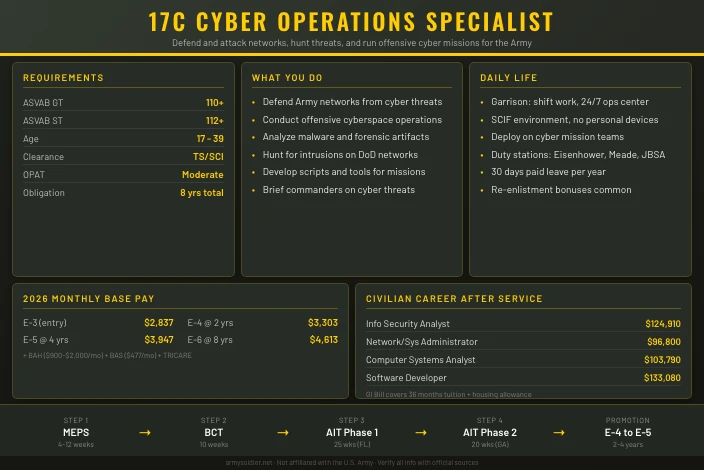
Job Role and Responsibilities
You plan and execute cyberspace operations for the U.S. Army. That means defending military networks against intrusion, conducting authorized offensive cyber missions against adversary targets, performing digital forensics and malware analysis, and advising commanders on the cyber threat picture.
Most of your work happens inside a Sensitive Compartmented Information Facility (SCIF). No personal phones. No smartwatches. You log into classified systems and monitor network traffic for signs of compromise. When something looks wrong, you investigate. That could mean tracing an intrusion back to its source, isolating malware, or locking down a compromised server before the damage spreads.
Offensive operations are the other side of the job. Under proper authority, you develop and deploy tools that disrupt, deny, or degrade adversary networks. This work is tightly controlled and requires legal approval at every step. You write after-action reports for each operation.
Specialized Roles
The 17C is part of Career Management Field 17 (Cyber). Related positions within the cyber branch include:
| Designation | Code | Role |
|---|---|---|
| MOS | 17C | Cyber Operations Specialist (enlisted) |
| MOS | 17E | Electronic Warfare Specialist (enlisted) |
| AOC | 17A | Cyber Warfare Officer |
| AOC | 17B | Cyber & Electronic Warfare Officer |
| Warrant | 170A | Cyber Warfare Technician |
| Warrant | 170D | Cyber Capabilities Developer |
Some 17C soldiers earn Additional Skill Identifiers (ASIs) for advanced training in areas like interactive on-net operations. These ASIs open doors to specialized billets within U.S. Cyber Command and the 780th Military Intelligence Brigade (Cyber).
Technology and Equipment
You work with enterprise network defense tools, intrusion detection systems, Security Information and Event Management (SIEM) platforms, packet capture and analysis software, and classified mission-specific tools that don’t have civilian names. Programming and scripting are part of the job. Python, Bash, and PowerShell are common. So are Linux and Windows system administration at an advanced level.
The Army also trains you on digital forensics suites for analyzing hard drives, memory dumps, and network logs. Offensive toolkits vary by mission and classification level.
Salary and Benefits
Financial Benefits
Military pay is based on rank and time in service, not MOS. Because of the long AIT pipeline (45+ weeks), most 17C soldiers reach their first duty station as an E-3 or E-4.
| Rank | Pay Grade | Monthly Base Pay (2026) |
|---|---|---|
| Private First Class | E-3 | $2,837 |
| Specialist (2 yrs) | E-4 | $3,303 |
| Sergeant (4 yrs) | E-5 | $3,947 |
| Staff Sergeant (8 yrs) | E-6 | $4,613 |
BAH (Basic Allowance for Housing) adds $900 to $2,000+ per month depending on your duty station and dependency status. BAS (Basic Allowance for Subsistence) adds $476.95 monthly for food. Cyber soldiers at Fort Meade, MD, or the Washington, D.C. area get some of the highest BAH rates in the country.
Additional Benefits
TRICARE covers you and your family at zero cost for doctor visits, hospital stays, prescriptions, dental, vision, and mental health. Tuition Assistance pays up to $4,500 per year toward college classes while you serve.
After separating, the Post-9/11 GI Bill covers up to 36 months of tuition (full in-state rate at public schools, or up to $29,920.95 per year at private schools) plus a monthly housing allowance and $1,000 annual book stipend.
Retirement runs through the Blended Retirement System (BRS):
- 40% pension after 20 years (based on your highest 36 months of base pay)
- Government matches up to 5% of your Thrift Savings Plan (TSP) contributions
- Continuation pay at the 8-12 year mark (typically 2.5x monthly base pay for a 3-year commitment)
Work-Life Balance
You earn 30 days of paid leave per year. Cyber operations centers run 24/7, so shift work is common. Some rotations are 12-hour shifts for weeks at a time, especially during active missions. Garrison work outside of operations tempo is closer to normal hours, though on-call status can pull you back in.
Qualifications and Eligibility
Basic Qualifications
The 17C has some of the highest entry barriers of any enlisted MOS. You need strong ASVAB scores and must qualify for a Top Secret/SCI clearance.
| Requirement | Details |
|---|---|
| Age | 17-39 years old |
| Citizenship | U.S. citizen only (no permanent residents) |
| Education | High school diploma or GED, plus 1 year of high school algebra or equivalent |
| AFQT (ASVAB) | Minimum 31 (diploma) or 50 (GED) |
| General Technical (GT) | Minimum 110 |
| Skilled Technical (ST) | Minimum 112 |
| Security Clearance | Top Secret with SCI access |
| OPAT Category | Moderate |
| Vision | Correctable to 20/20 |
| Background | Clean record; drug use or financial problems can disqualify your clearance |
The GT composite comes from Verbal Expression + Arithmetic Reasoning. The ST composite combines General Science, Verbal Expression, Math Knowledge, and Mechanical Comprehension. Both thresholds are well above average, so study hard for the ASVAB.
Application Process
Start at a recruiting station. Your recruiter checks your ASVAB scores and basic eligibility, then sends you to MEPS (Military Entrance Processing Station) for a medical exam and background screening. If your GT and ST scores qualify, the recruiter books a 17C training slot.
The clearance investigation starts after you sign your contract. You fill out the SF-86 (Standard Form 86), which covers every address, employer, foreign contact, and legal issue from the past 10 years. Investigators interview your references and run financial checks. The whole MEPS-to-ship timeline is typically 4 to 12 weeks, but clearance processing can stretch longer.
Selection Criteria and Competitiveness
This MOS is competitive. The Army needs cyber operators, but the high ASVAB threshold and TS/SCI requirement filter out most applicants. Prior IT experience, civilian certifications (CompTIA Security+, Network+), or a computer science background all help. College credits in STEM fields can also give you an edge.
The 17C is open to both initial entry soldiers and in-service reclassification from other MOSs. Soldiers already serving must meet the same ASVAB and clearance requirements, plus get command approval.
Upon Accession into Service
New enlistees enter as E-1 (Private) and promote to E-2 after Basic. Given the 45-week AIT, most soldiers reach E-3 (Private First Class) or E-4 (Specialist) before arriving at their first duty station. The standard service obligation is 8 years total, typically split between active duty and the Reserve or Individual Ready Reserve. Longer initial contracts (5-6 years) may be required to secure a training slot.
See our ASVAB study guide for strategies to hit these line scores, or take the PiCAT from home if you are a first-time tester.
Work Environment
Setting and Schedule
Nearly all 17C work takes place inside a SCIF. These are secure rooms with no windows, no cell signal, and strict access controls. Your personal phone stays in a locker outside the door.
Operations centers run around the clock. Shift schedules vary by unit:
- Day shift: 0600-1800, typically Monday through Friday during low-tempo periods
- Night shift: 1800-0600, rotating every few weeks
- Mission surges: extended hours or 7-day weeks when an active threat or operation demands it
Outside of shift work, you attend mandatory training, physical fitness sessions, and unit formations. The pace depends heavily on whether your team is actively engaged in a cyber mission.
Leadership and Communication
Your chain of command runs through the cyber unit’s officer in charge (usually a Captain or Major) and your senior NCO (E-6 or above). Within a Cyber Protection Team (CPT) or Cyber Mission Team, you work alongside officers, warrant officers, and other enlisted specialists. The team structure is flat compared to most Army units because technical expertise matters more than rank during operations.
Annual NCOERs (NCO Evaluation Reports) and counseling sessions provide formal feedback. Day-to-day, your team lead reviews your work product and mission performance directly.
Team Dynamics and Autonomy
Cyber missions are team efforts. A typical Cyber Protection Team has 39 members covering different specialties: analysis, tool development, exploitation, and defense. You contribute your piece, but the team leader coordinates the overall mission.
That said, individual skill matters. When you’re tracing an intrusion at 0300 and the rest of the team is working other threads, you make calls on your own. Strong analysts get more autonomy as they prove themselves. Junior soldiers work under closer supervision until they demonstrate they can be trusted with sensitive operations.
Job Satisfaction and Retention
The Army struggles to keep 17C soldiers past their first enlistment. Civilian cybersecurity jobs pay $100,000+ for the same skills, often without the shift work or security restrictions. Re-enlistment bonuses help, but many soldiers use their training and clearance as a launchpad into private-sector careers.
Those who stay cite the mission. Defending national security networks and running operations against real adversaries is work you can’t replicate at a private company. The soldiers who re-enlist tend to value that mission focus over higher civilian pay.
Training and Skill Development
Initial Training
The 17C has one of the longest training pipelines in the Army. From BCT through AIT graduation, expect over a year of continuous training.
| Training Phase | Location | Duration | Focus |
|---|---|---|---|
| BCT | Fort Jackson, SC; Fort Moore, GA; Fort Leonard Wood, MO | 10 weeks | Soldier fundamentals: marksmanship, fitness, tactics |
| AIT Phase 1 (JCAC) | Corry Station, Pensacola, FL | 25 weeks | Joint Cyber Analysis Course: networking, OS fundamentals, scripting, defensive ops |
| AIT Phase 2 | Fort Eisenhower, GA | 20 weeks | Army-specific cyber operations, offensive techniques, mission planning |
Phase 1 takes place at the Navy’s Information Warfare Training Command in Pensacola. You attend the Joint Cyber Analysis Course (JCAC) alongside Navy, Air Force, and Marine students. The curriculum covers Windows and Linux system administration, computer networking (TCP/IP, routing, switching), scripting and programming, and network defense techniques.
Phase 2 moves to the Cyber Center of Excellence at Fort Eisenhower (formerly Fort Gordon) in Augusta, Georgia. This phase focuses on Army-specific cyber operations: offensive tools, malware analysis, digital forensics, mission planning, and working within Army cyber doctrine. You must hold an interim TS/SCI clearance to start Phase 2.
Advanced Training
After AIT, the learning doesn’t stop. The Army invests heavily in keeping cyber soldiers current because threats change fast.
- CompTIA certifications: Security+, Network+, and A+ are commonly earned during or shortly after AIT
- SANS/GIAC courses: Advanced training in penetration testing, forensics, and incident response
- Certified Ethical Hacker (CEH): Offensive security certification funded by the Army
- CISSP and CCNA: Available through Army COOL (Credentialing Opportunities On-Line) funding
- Cyber exercises: Participate in joint and international cyber competitions and red team/blue team events
Soldiers who want to go deeper can apply for advanced cyber courses at Fort Eisenhower or pursue a degree through Tuition Assistance and the GI Bill while serving.
Everything starts with qualifying ASVAB scores — our study guide covers what to study first.
Career Progression and Advancement
Career Path
Promotion through E-4 is mostly automatic if you meet time-in-service requirements. E-5 and above require a promotion board, strong evaluations, and military education.
| Rank | Pay Grade | Typical Years | Typical Role |
|---|---|---|---|
| Private First Class | E-3 | 0-1 | AIT graduate, junior analyst |
| Specialist | E-4 | 1-3 | Cyber operator, mission team member |
| Sergeant | E-5 | 3-5 | Team lead, senior operator |
| Staff Sergeant | E-6 | 5-8 | Section NCOIC, mission planner |
| Sergeant First Class | E-7 | 8-12 | Platoon sergeant, operations NCO |
| Master Sergeant | E-8 | 12+ | Senior cyber leadership |
Because the 17C pipeline is so long, soldiers often reach E-4 faster than in other MOSs. Promotion to E-5 is competitive but the field is smaller, so strong performers can move up quickly.
Role Flexibility and Transfers
Lateral moves within CMF 17 are possible. Some 17C soldiers transition to 17E (Electronic Warfare Specialist) or apply for Warrant Officer MOS 170A (Cyber Warfare Technician). Warrant officers focus on technical expertise rather than troop leadership and can earn significantly higher pay over a career.
Transferring outside of cyber is harder because the Army invested heavily in your training. You need command approval and an open slot in the new MOS. Intelligence MOSs (35-series) are the most natural fit for lateral transfers.
Performance Evaluation
NCOs receive an annual NCOER rated by their immediate supervisor and senior rater. The evaluation covers leadership, technical competence, and training effectiveness. Strong NCOERs are the biggest factor in promotion to E-6 and above.
What actually gets you promoted in cyber: proven mission performance, certifications earned, soldiers mentored, and willingness to take on tough assignments. Cyber teams are small, so your reputation builds fast, for better or worse.
Physical Demands and Medical Evaluations
Physical Requirements
Cyber operations is not a physically demanding MOS compared to combat arms. You sit at a workstation for most of your shift. But you’re still a soldier, and the Army holds everyone to the same fitness standards.
Every soldier takes the Army Fitness Test (AFT) at least once per year. The AFT has 5 events, each scored 0 to 100 points. You need 60 per event and 300 total to pass.
| Event | Male Min (17-21) | Female Min (17-21) |
|---|---|---|
| 3-Rep Max Deadlift (MDL) | 140 lbs | 80 lbs |
| Hand-Release Push-Up (HRP) | 10 reps | 10 reps |
| Sprint-Drag-Carry (SDC) | 2:40 | 3:40 |
| Plank (PLK) | 2:00 | 2:00 |
| Two-Mile Run (2MR) | 15:54 | 18:54 |
The OPAT (Occupational Physical Assessment Test) category for 17C is Moderate, the lightest tier. You take the OPAT once during the enlistment process. It includes a standing long jump, seated power throw, strength deadlift, and interval aerobic run. The moderate standard is the easiest to pass.
Medical Evaluations
After enlistment, you get an annual Periodic Health Assessment (PHA): weight, blood pressure, vision, hearing, and a provider conversation. Deployment requires a separate medical clearance. Any unresolved condition gets treated first, or you stay behind.
Sitting at a desk for 12-hour shifts takes a different toll than carrying a ruck. Back problems, eye strain, and wrist issues are common in cyber units. Stay on top of ergonomics and keep up your fitness outside of work hours.
Deployment and Duty Stations
Deployment Details
Cyber deployment looks different from infantry deployment. You don’t always ship overseas with a rifle. Many cyber missions happen remotely from CONUS (continental U.S.) locations. Your team can project effects anywhere on the globe from a SCIF at Fort Meade.
That said, Cyber Protection Teams do deploy forward to support combatant commanders. These deployments typically last 6 to 9 months and take you to the Middle East, Europe, or the Pacific. The rotation cycle depends on your unit and the operational demand at the time.
Some 17C soldiers also support Special Operations or Intelligence units on shorter deployments or temporary duty (TDY) assignments lasting weeks to a few months.
Location Flexibility
Duty station assignments are driven by the Army’s needs, not your preference. You can submit a wish list, but the cyber community is small and positions are concentrated at a few installations.
Primary duty stations:
- Fort Eisenhower, GA – Cyber Center of Excellence, training and operational units
- Fort Meade, MD – U.S. Cyber Command, NSA, 780th MI Brigade (Cyber)
- Joint Base San Antonio, TX – 780th MI Brigade elements, cyber support units
- Overseas: Germany, Italy (USAREUR-AF), Hawaii (USINDOPACOM), Guam
Fort Meade and Fort Eisenhower account for the majority of 17C billets. Expect to spend at least one assignment at one of these two installations.
Risk, Safety, and Legal Considerations
Job Hazards
The physical risks are low compared to combat MOSs. You work in climate-controlled buildings. Nobody is shooting at you in a SCIF.
The real hazards are mental and legal:
- Burnout: 12-hour shifts staring at screens, high-stakes missions, and constant alertness take a toll
- Insider threat scrutiny: You have access to some of the most sensitive systems in the U.S. government, and counterintelligence watches you closely
- Psychological stress: Offensive operations and incident response carry real pressure, especially during active engagements
- Sedentary lifestyle: Desk work for long shifts can lead to weight gain, back problems, and repetitive strain injuries
Safety Protocols
SCIFs have strict physical security: badge access, armed guards, and no electronic devices inside. Cybersecurity protocols govern everything you do on classified systems. Incident reporting is mandatory for any anomaly, whether it’s a phishing email or a suspicious USB drive.
Soldiers who deploy forward follow standard force protection measures: body armor, convoy procedures, and perimeter security.
Security and Legal Requirements
The TS/SCI clearance is the defining requirement of this MOS. The investigation process takes 4 to 12 months and involves a deep look at your finances, criminal history, drug use, foreign contacts, and personal conduct. You submit an SF-86 and sit for a personal interview with an investigator.
Your clearance requires periodic reinvestigation (every 5 years for Top Secret). Any changes in your life, new debt, arrests, foreign travel, or foreign contacts, must be reported immediately. Failing to report can cost you your clearance and your MOS.
All soldiers follow the Uniform Code of Military Justice (UCMJ). Cyber operators have additional legal obligations around the handling of classified information, rules of engagement for cyberspace operations, and Title 10/Title 50 authorities. Unauthorized access to systems, even friendly ones, is a criminal offense.
Impact on Family and Personal Life
Family Considerations
The long training pipeline means you’ll be away from home for over a year before reaching your first duty station. That’s hard on spouses and families. After training, shift work and potential deployments add more time apart.
Support resources available at most installations:
- Family Readiness Groups (FRGs) – peer support through your unit
- Military OneSource – free counseling, financial planning, and family services
- Spouse employment assistance – job help at each duty station
- Exceptional Family Member Program (EFMP) – support for families with special needs members
- On-post childcare – CDC (Child Development Center) at larger installations
Relocation and Flexibility
The good news: cyber duty stations are concentrated at a few large installations, so you may not move as often as soldiers in other MOSs. Some soldiers spend two back-to-back tours at Fort Meade or Fort Eisenhower.
The bad news: you go where the Army sends you. PCS (Permanent Change of Station) moves happen every 2 to 4 years. The Army pays for the move, but each relocation disrupts your spouse’s career and your kids’ school. OCONUS assignments to Germany or Hawaii sound appealing but come with their own adjustment challenges.
Reserve and National Guard
The 17C MOS is available in both the Army Reserve and the Army National Guard. Cyber Protection Teams exist in both components, and demand is growing fast. The Army stood up Reserve and Guard cyber units in the early 2010s and has been expanding them ever since. If you want to keep operating in the cyber domain without staying on active duty full-time, there are real billets for you.
Component Availability
Both the Army Reserve and the National Guard have 17C positions, primarily in cyber protection units and information operations elements. Guard cyber units have taken on homeland defense missions, including protecting state and federal infrastructure from adversary intrusion. These missions are not just training exercises. Guard units have been activated for real-world cyber defense operations.
That said, the number of 17C slots in the Reserve components is smaller than in the active Army, and competition for those slots is genuine. Your TS/SCI clearance must remain active and adjudicated to hold the position.
Drill Schedule and Extra Training
Standard drill is one weekend per month plus two weeks of Annual Training (AT) per year. For 17C soldiers, that baseline understates the actual time commitment.
Cyber skills atrophy fast. You won’t stay sharp on offensive tools and network defense techniques with one drill weekend a month. Most 17C units in the Reserve and Guard require soldiers to:
- Maintain active CompTIA Security+, CEH, or equivalent certifications
- Complete periodic cyber range exercises and training events that add extra training days beyond standard drill
- Attend network defense or cyber mission force training exercises, sometimes at Fort Eisenhower or USCYBERCOM facilities
Plan for additional unpaid or orders-based training days throughout the year if you want to stay operationally credible in this MOS.
Pay and Benefits Comparison
Part-time service pays based on drill attendance, not a monthly salary.
An E-4 with four years of service earns roughly $488 for a standard drill weekend (four drill periods across Saturday and Sunday). That is a fraction of the $3,659 monthly base pay an active-duty E-4 at the same experience level earns. The pay gap is real.
Healthcare is the other significant difference. Active-duty soldiers get TRICARE at no cost. Reserve and Guard soldiers who are not on active-duty orders use Tricare Reserve Select, which costs $57.88 per month for the member alone or $286.66 per month for the member plus family. That is affordable compared to civilian insurance, but it is not free.
Education benefits for part-time service come through the Montgomery GI Bill Selected Reserve (MGIB-SR, Chapter 1606), which pays $493 per month for full-time students. Federal Tuition Assistance is also available: up to $250 per credit hour, capped at $4,500 per year. Guard members may also qualify for state tuition waivers, and many states cover 100% of tuition at public in-state universities for Guard soldiers.
Deployment and Mobilization
Cyber units in the Reserve and Guard are mobilized at a moderate-to-high rate compared to most Reserve component MOSs. The Army has a genuine need for cyber operators to support combatant commands, and Reserve and Guard units fill that gap. Expect the possibility of deployment for 6 to 12 months on orders under Title 10 authority.
USERRA protects your civilian job when you are mobilized. Your employer must hold your position and restore your seniority, benefits, and compensation when you return. This protection applies regardless of how long the mobilization lasts.
Civilian Career Integration
The 17C Reserve or Guard path is one of the strongest dual-career options in the military. Your clearance and cyber credentials are valuable every day in the civilian job market, not just on drill weekends. Cybersecurity analysts, SOC operators, penetration testers, and incident responders with TS/SCI clearances earn $90,000 to $130,000+ in the private sector. Serving part-time keeps your skills current, maintains your clearance, and adds to your reserve retirement points.
Reserve retirement is points-based. You accumulate points through drill weekends, AT, and any active-duty orders. At age 60, you begin drawing a pension calculated on your career points, with the eligibility age reduced by three months for every 90 days of qualifying active-duty mobilization after January 28, 2008, down to a minimum of age 50.
| Feature | Active Duty | Army Reserve | Army National Guard |
|---|---|---|---|
| Duty Status | Full-time | Part-time (1 wknd/mo + 2 wks/yr) | Part-time (1 wknd/mo + 2 wks/yr) |
| Monthly Pay (E-4, 4 yrs) | $3,659/mo | ~$488/drill weekend | ~$488/drill weekend |
| Healthcare | TRICARE (no premium) | Tricare Reserve Select ($57.88/mo) | Tricare Reserve Select ($57.88/mo) |
| Education | Post-9/11 GI Bill, TA | MGIB-SR ($493/mo), TA | MGIB-SR ($493/mo), TA, state tuition waivers |
| Deployment | Per unit rotation | When mobilized | When mobilized |
| Retirement | 20-year pension | Points-based, age 60 | Points-based, age 60 |
Post-Service Opportunities
Transition to Civilian Life
The 17C is one of the strongest military-to-civilian pipelines in the entire armed forces. Your combination of TS/SCI clearance, hands-on cyber operations experience, and industry certifications makes you extremely marketable.
The Transition Assistance Program (TAP) provides resume help, interview coaching, and benefits counseling during your last year on active duty. But 17C soldiers rarely struggle to find work. Defense contractors, intelligence agencies, and private cybersecurity firms actively recruit separating cyber operators. Many soldiers line up six-figure offers months before their discharge date.
The GI Bill covers up to 36 months of tuition (full in-state rate at public schools) plus a monthly housing allowance and $1,000 annual book stipend. Some soldiers use it to finish a computer science or cybersecurity degree that complements their operational experience.
Civilian Career Prospects
17C experience maps directly to some of the highest-paying tech careers in the country.
| Civilian Job | Median Annual Salary (2024) | 10-Year Outlook |
|---|---|---|
| Information Security Analyst | $124,910 | +29% |
| Software Developer | $133,080 | +15% |
| Computer Systems Analyst | $103,790 | +9% |
| Network/Systems Administrator | $96,800 | -4% |
The growth rate for information security analysts, 29% over the next decade, is one of the fastest of any occupation tracked by the Bureau of Labor Statistics. Demand for people with offensive cyber skills and active clearances pushes salaries even higher at defense contractors and intelligence agencies. Senior penetration testers and red team operators with government experience regularly earn $150,000 to $200,000+.
Post-Service Policies
An honorable discharge gives you lifetime access to VA healthcare, disability compensation (if applicable), and education benefits. Your TS/SCI clearance remains active for up to 2 years after separation if you move into a cleared position quickly. After that, you’d need a new investigation.
Separating after your initial obligation is straightforward. Talk to your career counselor at least 12 months before your ETS date to start transition planning.
Is This a Good Job for You?
Ideal Candidate Profile
The best 17C soldiers are curious, detail-oriented, and comfortable staring at a screen until something makes sense.
Traits that predict success:
- Genuine interest in computers, networking, or programming (not just “I like video games”)
- Patience to troubleshoot problems that take hours or days to solve
- Strong study habits, because the AIT failure rate is real
- Comfort with ambiguity and incomplete information
- Ability to keep classified information to yourself, permanently
Prior IT experience helps but isn’t required. Some of the best cyber operators came in with zero background and learned everything in training. What matters more is your aptitude for learning technical concepts quickly.
Potential Challenges
This MOS is a poor fit if you:
- Hate sitting at a desk for long periods
- Need predictable, 9-to-5 hours
- Can’t pass a TS/SCI background investigation
- Struggle with math or abstract problem-solving
- Want a job where you can talk about your work freely (you can’t)
The security restrictions are real. You can’t tell your spouse what you did at work. You can’t post about it online. You can’t even hint at it. That level of secrecy wears on some people over time.
Career and Lifestyle Alignment
If you want a high-paying tech career but can’t afford a four-year computer science degree, the 17C is one of the fastest routes in. The Army trains you for free, pays you while you learn, and hands you certifications and a clearance that would cost tens of thousands to obtain on your own.
The trade-off: you commit years of your life to military service. Shift work, potential deployments, and strict security rules are part of the deal. The pay is modest compared to what you’ll earn as a civilian, especially in your first few years.
This job works best for people who want to serve their country and build a cybersecurity career at the same time. If you just want the paycheck, you’ll burn out. If you’re drawn to the mission and the technical challenge, this is one of the best opportunities the military offers.
More Information
Talk to an Army recruiter about the 17C. Ask about current bonus amounts, training wait times, and whether your ASVAB scores qualify. The recruiter can also walk you through the TS/SCI clearance process so you know what to expect.
Take the MOS Finder quiz at goarmy.com
Schedule an ASVAB at your nearest MEPS to see where your scores land
Visit the Army Cyber Center of Excellence site for official training details
Prepare for the ASVAB with our study guide to make sure your line scores qualify
This site is not affiliated with the U.S. Army or any government agency. Verify all information with official Army sources before making enlistment or career decisions.
Explore more Army cyber and signal careers such as 25B IT Specialist and 25S Satellite Communication Systems Operator.