17E Electronic Warfare Specialist
Few Army jobs put you at the intersection of physics, intelligence, and combat the way 17E does. Electronic Warfare Specialists control the electromagnetic spectrum – jamming enemy communications, protecting friendly systems, and hunting for electronic signatures in real time. The job requires a Top Secret/SCI clearance, three line scores of 105 or higher on the ASVAB, and 28 weeks of some of the most technical training in the enlisted Army. The civilian payoff is just as strong: defense contractors compete for soldiers who leave with 17E on their record.
Qualifying requires specific ASVAB line scores — our ASVAB study guide covers what to target and how to prepare.
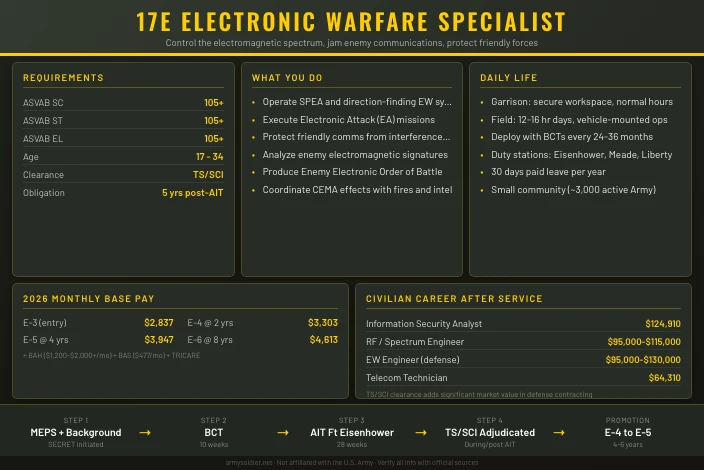
Job Role and Responsibilities
The Electronic Warfare Specialist (MOS 17E) plans, coordinates, and executes electronic warfare operations across three domains: Electronic Attack (EA), Electronic Protection (EP), and Electronic Warfare Support (ES). Soldiers in this role operate and maintain specialized EW equipment, advise commanders on electromagnetic spectrum management, and integrate EW effects into every phase of military planning and execution.
What You Do Every Day
Day-to-day tasks shift depending on whether you’re in garrison or deployed, but the core work stays consistent.
- Operate Special Purpose Electronic Attack (SPEA) systems, direction-finding equipment, and counter-RCIED (radio-controlled IED) systems
- Monitor and analyze the electromagnetic spectrum to detect enemy emitters
- Prepare Enemy Electronic Order of Battle products and EW threat briefs
- Execute Electronic Attack missions to jam or disrupt enemy command and control
- Conduct Electronic Protection tasks to harden friendly communications against interference
- Assist in targeting and effects packets for joint operations
- Operate and maintain vehicles and prime power units assigned to EW systems
At junior levels (17E1O), you’re the operator – running systems, executing EA missions, and feeding intelligence products up the chain. As a Staff Sergeant (17E2O), you lead an EW team or serve as a battalion-to-brigade staff NCO. Senior NCOs at the 17E4O and 17E5O levels become primary planners for Cyberspace Electromagnetic Activities (CEMA) at division and above.
Specializations and Identifiers
| Identifier | Type | Description |
|---|---|---|
| L8 | ASI | Joint Operational Fires and Effects (JOFE) – skill level 4 only, effective 2026 |
| P4 | ASI | Tactical Information Operations Planner |
| Y2 | ASI | Transition (personnel only) |
Mission Contribution
EW Specialists sit inside the CEMA section at every echelon from battalion through corps. In contested environments, controlling the electromagnetic spectrum means the difference between a commander who can communicate and one who can’t. When an IED network uses radio-frequency triggers, 17E is the job that defeats it. When an enemy air defense radar goes active, 17E provides the warning and the jamming solution.
Equipment and Technology
The equipment list changes as systems are fielded and upgraded, but 17E soldiers routinely work with:
- DUKE, THOR, and related counter-RCIED systems
- Tactical EW systems mounted on ground vehicles
- Direction-finding arrays and spectrum analyzers
- Software-defined radios and signal intelligence tools
- EW modeling and simulation software
- Test, Measurement, and Diagnostic Equipment (TMDE)
This is not a wrench-turning maintenance job. You spend your time analyzing spectrum data, programming jamming parameters, and coordinating effects with intelligence and fires cells.
Salary and Benefits
Base Pay and Special Pay
17E soldiers enter service as Private First Class (E-3) or Specialist (E-4) after AIT. All 2026 pay figures are from DFAS.
| Rank | Years of Service | Monthly Base Pay |
|---|---|---|
| E-3 (PFC) | Less than 2 | $2,837 |
| E-4 (SPC) | 2 years | $3,303 |
| E-5 (SGT) | 4 years | $3,947 |
| E-6 (SSG) | 8 years | $4,613 |
| E-7 (SFC) | 12 years | $5,537 |
Base pay is the floor, not the ceiling. Most soldiers receive additional allowances that push total compensation well above the base figure.
Allowances and Additional Benefits
Basic Allowance for Housing (BAH) covers off-post housing costs and varies by duty location, pay grade, and dependent status. An E-4 without dependents at Fort Eisenhower, Georgia draws roughly $1,200 per month; the same soldier at a high-cost installation like Fort Meade, Maryland draws considerably more.
Basic Allowance for Subsistence (BAS) is a flat $476.95 per month for all enlisted soldiers.
TRICARE Prime provides zero-cost medical, dental, vision, and prescription coverage for active-duty soldiers and their families.
The Army’s Blended Retirement System (BRS) combines a pension worth 40% of your high-36 average base pay at 20 years with Thrift Savings Plan (TSP) matching of up to 4% of base pay. The government also contributes an automatic 1% regardless of whether you contribute.
Continuation Pay in the BRS is available between 7 and 12 years of service, typically worth 2.5 times your monthly base pay in exchange for a 3-year extension.
Enlistment Bonus
The Army has offered bonuses for 17E in recent recruitment cycles. Bonus availability and amounts change frequently based on Army needs. Ask your recruiter for the current 17E incentive package at the time you enlist.
Work-Life Balance
Active-duty soldiers accrue 30 days of paid leave per year, with a maximum carryover of 60 days. Eleven federal holidays are observed. Work schedules vary – garrison duty typically follows normal business hours except during field exercises or unit deployments. EW missions can involve long hours and overnight watch rotations, particularly in deployed environments.
Qualifications and Eligibility
Requirements at a Glance
| Requirement | Standard |
|---|---|
| ASVAB SC (Surveillance & Communications) | 105 minimum |
| ASVAB ST (Skilled Technical) | 105 minimum |
| ASVAB EL (Electronics) | 105 minimum |
| Security Clearance | Top Secret/SCI (SECRET + T5 initiated to begin training) |
| Citizenship | U.S. citizen only – no waivers |
| Color Vision | Normal color vision required |
| Physical Profile | 222221 |
| OPAT Category | Moderate (Gold) |
| Education | High school diploma or GED; minimum one year of algebra |
| Service Obligation | 5 years upon completion of the 17E course |
| Polygraph | Counterintelligence scope polygraph may be required by unit |
All three ASVAB line score minimums are from DA Pam 611-21 (effective January 2026). The SC composite is Verbal Expression + Arithmetic Reasoning + Auto and Shop + Mechanical Comprehension. EL is General Science + Arithmetic Reasoning + Math Knowledge + Electronics Information. ST is General Science + Verbal Expression + Math Knowledge + Mechanical Comprehension.
OPAT Standards
The Occupational Physical Assessment Test (OPAT) screens soldiers before AIT to confirm they can handle the physical demands of the job. For the Moderate (Gold) category, you must meet:
- Standing Long Jump: 120 cm or more
- Seated Power Throw: 350 cm or more
- Strength Deadlift: 120 lbs or more
- Interval Aerobic Run: 36 shuttles or more
Application Process
- Meet with an Army recruiter and take the ASVAB. All three scores must meet the 105 minimums.
- Complete the MEPS physical and OPAT assessment.
- Pass a background investigation sufficient to initiate a Top Secret clearance (T5 investigation).
- Sign a contract for MOS 17E with the 5-year service obligation noted.
- Ship to Basic Combat Training, then to AIT at Fort Eisenhower, Georgia.
The background investigation for TS/SCI can take months. Recruiters will often start this process before you ship, but full adjudication typically happens during or after AIT. The clearance to begin training is SECRET with a T5 investigation initiated.
Competitiveness
17E is not an easy qualification. Most applicants struggle with all three ASVAB composites simultaneously. Strong algebra, physics, and electronics knowledge helps. Prior experience with amateur radio, electronics repair, or computer networking is an advantage. The polygraph requirement and TS/SCI process also eliminate candidates with significant foreign contacts, financial issues, or drug history.
See our ASVAB study guide for strategies to hit these line scores, or take the PiCAT from home if you are a first-time tester.
Work Environment
Setting and Schedule
17E soldiers work in a range of environments. In garrison, the CEMA section typically occupies a secure workspace inside the S6 or G6 shop. Field exercises put you in a tactical operations center or vehicle-mounted in an EW system. Deployments can involve long periods inside forward operating bases or, in some units, close support to maneuver elements.
Shift work is common in operational environments where spectrum monitoring runs 24 hours. During exercises, duty days of 12 to 16 hours are not unusual.
Team Dynamics
EW Specialists work closely with intelligence (S2/G2), fires (S3/G3), and signal (S6/G6) sections. Much of the coordination work involves briefing commanders and writing effects requests that integrate with other kinetic and non-kinetic fires. At lower skill levels, you execute tasks under direct supervision. Senior NCOs operate with significant autonomy and serve as the primary EW advisor to the commander.
Performance Feedback
The Army uses the NCOER (Non-Commissioned Officer Evaluation Report) system starting at E-5. E-4 and below receive counseling through their rater. Evaluation cycles for NCOs happen annually at a minimum, with mandatory counseling quarterly. Performance in this MOS is measured partly on technical proficiency (are your systems operational, are your products accurate) and partly on leadership and staff contribution.
Job Satisfaction
17E has a relatively small community – fewer than 3,000 soldiers hold the MOS across the active Army. That small size means rapid visibility, faster-than-average promotion potential for high performers, and tight community cohesion. The technical complexity keeps the job engaging for soldiers who like problem-solving, but it can frustrate those who prefer predictable, physical work.
Training and Skill Development
Training Pipeline Overview
| Phase | Location | Length | Focus |
|---|---|---|---|
| Basic Combat Training (BCT) | Various installations | 10 weeks | Basic soldiering, physical fitness, weapons |
| Advanced Individual Training (AIT) | Fort Eisenhower, GA (Cyber School) | 28 weeks | EW theory, EA/EP/ES operations, CEMA planning, equipment operation |
Basic Combat Training
BCT is 10 weeks and the same for all Army MOS. You’ll learn basic soldier tasks, rifle qualification, land navigation, and physical fitness. Nothing in BCT is specific to 17E, but the physical conditioning standard you build here carries into AIT.
Advanced Individual Training
The 17E AIT at Fort Eisenhower runs 28 weeks and is among the longest enlisted AIT programs in the Army. The curriculum covers:
- Electromagnetic spectrum fundamentals and EW theory
- Electronic Attack operations and equipment operation
- Electronic Protection concepts and communications hardening
- Electronic Warfare Support – signal collection, analysis, and reporting
- CEMA planning and integration with the MDMP
- EW system maintenance and PMCS
- Joint EW operations and deconfliction procedures
Training is both classroom-based and hands-on. Students operate actual EW systems in simulated operational environments and produce real intelligence products. The course grants nationally recognized certifications that carry direct value in the civilian defense sector.
Continued Development
After AIT, continued learning happens at your permanent duty station and through follow-on courses:
- Cyber Operations Planners Course
- Electronic Warfare Officer Course (for E-6 and above)
- Joint Electronic Warfare Training at Eglin Air Force Base, Florida
- National Security Agency (NSA) technical courses available at higher clearance levels
- The Asymmetric Warfare Group and other specialized units offer advanced EW training through assignment
Everything starts with qualifying ASVAB scores — our study guide covers what to study first.
Career Progression and Advancement
Rank Progression
| Rank | Grade | Typical Time |
|---|---|---|
| Private First Class (PFC) | E-3 | Enter after BCT; promoted to E-4 within 6 months typically |
| Specialist (SPC) | E-4 | ~12-18 months after AIT |
| Sergeant (SGT) | E-5 | ~4-6 years total service |
| Staff Sergeant (SSG) | E-6 | ~7-10 years |
| Sergeant First Class (SFC) | E-7 | ~12-16 years |
| Master Sergeant (MSG) | E-8 | ~18-22 years |
| Sergeant Major (SGM) | E-9 | ~22-26 years |
Career Paths
The 17E community is organized under CMF 17 alongside 17C (Cyber Operations Specialist). At senior grades, 17E NCOs can move into:
- Brigade Combat Team CEMA section staff positions
- Division-level EW staff at G6 or CEMA sections
- Joint EW assignments with multi-service organizations
- Warrant Officer (170A – Cyber Operations Technician) after applying and attending WOCS
- Reserve/National Guard 17E positions with federal civilian EW work as a parallel career
Reclassification into 17E requires three years of service remaining and a current or initiatable Top Secret investigation.
Performance Evaluation
NCOs are evaluated through the Army NCOER system. Raters assess performance in five areas: Character, Presence, Intellect, Leads, and Achieves. For 17E, technical proficiency (are your EW products accurate, are your systems operational) weighs heavily alongside leadership and Army Values. Top-block ratings drive early promotion and competitive assignment selection.
Physical Demands and Medical Evaluations
Daily Physical Demands
The 17E physical profile is 222221 and the OPAT category is Moderate (Gold). Day-to-day physical demands include:
- Moving and setting up vehicle-mounted EW systems and antennas in field environments
- Carrying equipment loads during dismounted operations
- Working in tactical vehicles for extended periods
- Potential exposure to high-altitude antenna work and confined spaces
The job is not infantry-level physical, but it is not a desk job either. Soldiers deploy with maneuver units and must meet the same field standards as everyone else in the formation.
Army Fitness Test Standards
The Army Fitness Test (AFT) replaced the ACFT on June 1, 2025. It has five events scored 0-100 points each, for a maximum of 500 points. The general passing standard is 300 total (60 per event, sex- and age-normed). 17E is not among the 21 designated combat MOSs, so soldiers need the 300-point general standard rather than the 350-point combat standard.
| AFT Event | Abbreviation |
|---|---|
| 3 Repetition Maximum Deadlift | MDL |
| Hand Release Push-Up – Arm Extension | HRP |
| Sprint-Drag-Carry | SDC |
| Plank | PLK |
| Two-Mile Run | 2MR |
Exact minimum scores by age and sex are published at army.mil/aft. Failing the AFT affects promotion eligibility and can result in administrative action.
Medical Standards
Initial enlistment requires a standard MEPS physical. Periodic occupational health screenings are required throughout service. The TS/SCI clearance process includes a thorough background investigation and, in some unit assignments, a counterintelligence scope polygraph. Any medical condition affecting the 222221 physical profile must be resolved before the MOS can be awarded or maintained.
Deployment and Duty Stations
Deployment Likelihood
17E soldiers serve in units across the Army – from infantry brigade combat teams to special operations support elements. Deployment frequency depends heavily on unit assignment. BCTs deploy on a 24 to 36 month cycle, typically for 9 to 12 months per rotation. CEMA-specific elements may deploy on shorter, more frequent rotations.
Both combat and non-combat deployments are common. EW capabilities are in demand across a range of operations, from high-intensity conflict to persistent engagement missions.
Common Duty Stations
Units with significant EW requirements include:
- Fort Eisenhower, GA – Cyber Center of Excellence, training and operational units
- Fort Liberty, NC – XVIII Airborne Corps elements
- Fort Campbell, KY – 101st Airborne Division
- Fort Wainwright, AK – 11th Airborne Division
- Fort Meade, MD – Army Cyber Command and NSA-adjacent positions
- Germany and Korea – EUCOM and USFK-assigned BCT rotations
Assignment preferences can be submitted through the assignment system, but the Army fills requirements based on needs. High-priority EW billets often mean competitive assignment boards for senior NCO positions.
Risk, Safety, and Legal Considerations
Job Hazards
EW Specialists face several occupational risks:
- Radio-frequency (RF) energy exposure from operating high-power transmitters – proper standoff distances and PPE mitigate this
- Physical risks of deploying with maneuver units in combat environments
- Electromagnetic interference with medical devices in the vicinity of EW systems (operational safety protocols govern this)
Safety Protocols
RF safety programs govern transmitter operation procedures and exclusion zones. Soldiers receive RF hazard training during AIT and annually at unit level. Vehicle and dismounted operations safety applies the same protocols as any combat arm.
Security and Legal Obligations
The TS/SCI clearance comes with legal obligations under the National Security Act and AR 380-5. Soldiers must report foreign contacts, foreign travel, financial changes, and any conduct that could affect clearance eligibility. Unauthorized disclosure of classified information carries federal criminal penalties.
The 5-year service obligation from the 17E course is binding. Separation before the obligation is complete may result in recoupment of training costs.
Impact on Family and Personal Life
Family Considerations
The TS/SCI clearance investigation involves family members to some extent – investigators may interview close associates, and foreign national family members can complicate the adjudication process. Families should be aware of this before the soldier enlists for 17E.
Deployment cycles affect family life the same as any combat-support MOS. Fortunately, the Army’s Family Readiness Groups (FRGs), TRICARE family coverage, and on-post support services provide a strong network during separations.
Relocation
Army reassignments happen every 2 to 3 years on average. The PCS (Permanent Change of Station) process includes a moving allowance and advance pay, but geographic stability is not guaranteed. Spouses and dependents who need stable employment should factor this into the decision. Duty stations with high concentrations of 17E billets – Fort Eisenhower and Fort Meade – sit near active civilian defense industry job markets, which can help working spouses.
Reserve and National Guard
MOS 17E is available in both the Army Reserve and the Army National Guard. Electronic Warfare units exist in both components, though the total number of 17E slots in the Reserve and Guard is limited compared to the active force. Positions are growing as the Army pushes EW capability deeper into the Reserve component force structure.
Component Availability
Reserve and Guard 17E soldiers typically serve in EW teams embedded in signal, military intelligence, or CEMA-designated units. The number of positions varies by state for the Guard, and some states have stronger EW capacity than others. If you separate from active duty as a 17E and want to continue in the Reserve component, work with your transition counselor and HRC to identify available billets before your ETS date.
Both components have filled some 17E slots through prior service soldiers reclassifying from other CMF 17 or signal MOSs. New direct-enlistment into the Reserve or Guard as a 17E is possible but less common than active-duty accessions.
Drill Schedule and Extra Training
Standard Reserve and Guard service requires one weekend per month plus two weeks of Annual Training. For 17E, that baseline is not enough to stay technically current.
EW systems change. Spectrum environments shift. Mission sets evolve. 17E soldiers in the Reserve and Guard face similar training currency pressures as their active-duty counterparts:
- EW system proficiency must be maintained through periodic training exercises beyond standard drill
- Spectrum analysis skills and electronic attack planning procedures require regular practice on actual systems
- Security clearance maintenance obligations do not pause between drills
Expect additional training days scheduled around field exercises and EW-specific events. Some units conduct multi-day EW exercises at dedicated training ranges that go beyond the standard two-week AT cycle.
Pay and Benefits Comparison
Part-time service pays per drill period, not a monthly salary. An E-4 with four years of service earns approximately $488 for a standard drill weekend. That compares to the $3,659 per month an active-duty E-4 at four years receives. The pay difference is significant, but the trade is time. You give two days a month rather than all of them.
Healthcare for part-time service comes through Tricare Reserve Select at $57.88 per month for the member alone, or $286.66 per month for the member and family. Active-duty TRICARE costs nothing. Both options are substantially cheaper than typical civilian employer health plans.
Education benefits for Reserve and Guard soldiers include the Montgomery GI Bill Selected Reserve (MGIB-SR, Chapter 1606), paying $493 per month for full-time students. Federal Tuition Assistance covers up to $250 per credit hour with a $4,500 annual cap. Guard soldiers may also receive state tuition waivers, and many states offer full coverage at in-state public universities.
Deployment and Mobilization
EW units mobilize at a moderate rate. Electronic attack and protection capabilities are in demand across combatant command operations, and Reserve and Guard EW teams have deployed to support active-duty formations. Mobilizations typically run 6 to 12 months under Title 10 federal authority.
USERRA protects civilian employment during any federally ordered mobilization. Your employer must hold your position and reinstate you with full seniority and benefits upon return.
Civilian Career Integration
The 17E skill set translates well to defense contractor careers in electronic warfare engineering, spectrum management, and signals intelligence support. Most civilian positions require the same TS/SCI clearance you hold. Defense contractors actively recruit 17E veterans for EW test and evaluation, RF systems design, and electronic attack program support.
Serving in the Reserve or Guard after active duty keeps that clearance active, maintains your proficiency on EW systems, and builds toward a reserve retirement. At age 60, you become eligible for a points-based pension calculated on your total career point accumulation. The eligibility age drops by three months for every 90 days of qualifying active-duty mobilization after January 28, 2008, to a minimum of age 50.
| Feature | Active Duty | Army Reserve | Army National Guard |
|---|---|---|---|
| Duty Status | Full-time | Part-time (1 wknd/mo + 2 wks/yr) | Part-time (1 wknd/mo + 2 wks/yr) |
| Monthly Pay (E-4, 4 yrs) | $3,659/mo | ~$488/drill weekend | ~$488/drill weekend |
| Healthcare | TRICARE (no premium) | Tricare Reserve Select ($57.88/mo) | Tricare Reserve Select ($57.88/mo) |
| Education | Post-9/11 GI Bill, TA | MGIB-SR ($493/mo), TA | MGIB-SR ($493/mo), TA, state tuition waivers |
| Deployment | Per unit rotation | When mobilized | When mobilized |
| Retirement | 20-year pension | Points-based, age 60 | Points-based, age 60 |
Post-Service Opportunities
Civilian Career Transition
The defense industry has a significant appetite for soldiers who leave service with a TS/SCI clearance and EW experience. Many transition directly into contractor positions without a gap in employment. The GoArmyEd Tuition Assistance program covers up to $4,500 per year while on active duty, and the Post-9/11 GI Bill covers up to 36 months of education at the rate of full in-state tuition (public school) or $29,920.95 per year (private school cap for AY 2025-2026), plus a monthly housing allowance.
The Army’s Transition Assistance Program (TAP) provides resume writing, interview prep, and job placement support starting 6 months before end of service.
Civilian Career Prospects
| Civilian Job Title | Median Annual Salary (May 2024) | Outlook (2024-2034) |
|---|---|---|
| Information Security Analyst | $124,910 | +29% (much faster than average) |
| Electronic Warfare Engineer (defense) | ~$95,000-$130,000 | Strong demand; defense sector |
| Telecommunications Technician | $64,310 | Declining overall, stable in defense |
| RF / Spectrum Engineer | ~$85,000-$115,000 | Growing in commercial and defense |
Information security analyst salary from Bureau of Labor Statistics. Defense-sector EW engineer salaries vary by contractor and clearance level – TS/SCI adds significant market value.
The certifications earned during the 17E course are nationally recognized and give veterans a head start on credentials relevant to the EW and cybersecurity job markets.
Is This a Good Job for You? The Right (and Wrong) Fit
Who Thrives Here
The ideal 17E candidate is analytically sharp, patient enough for detailed technical work, and comfortable operating in a classified environment. You need:
- Strong math and science foundation – the ASVAB minimums reflect real content you’ll use in training and on the job
- An interest in how electronic systems work at a fundamental level
- The discipline to maintain a TS/SCI clearance throughout your career
- Ability to brief commanders and write intelligence products clearly
Prior exposure to amateur radio (ham radio licensing), software-defined radio hobbyist work, or electronics coursework gives applicants a genuine advantage in AIT.
Who Struggles
If you want a job where you stay in one place for years, 17E is probably not it. Deployments with BCTs are frequent. If you have significant financial issues, foreign contacts, or a history of drug use, the TS/SCI process is a real barrier – not a formality.
The 5-year service obligation is also longer than many enlisted contracts. Soldiers who are unsure about long-term Army commitment should factor this in before signing.
Long-Term Fit
For soldiers who stay, 17E builds toward a career in one of the most in-demand technical fields in both the military and the private sector. The clearance alone is worth six figures in the defense contracting market. Combined with actual operational EW experience, the transition potential is strong.
More Information
Talk to an Army recruiter about current 17E availability, bonus eligibility, and assignment options. The Electronic Warfare Specialist community is small, positions fill quickly, and the recruiting pipeline for TS/SCI MOSs moves slower than for non-clearance jobs – so starting early matters.
- Prepare for the ASVAB with our study guide to make sure your line scores qualify
This site is not affiliated with the U.S. Army or any government agency. Verify all information with official Army sources before making enlistment or career decisions.
Explore more Army Cyber & Signal careers such as 17C Cyber Operations Specialist and 25D Cyber Network Defender.