25B Information Technology Specialist
Every Army unit runs on networks, servers, and computers. When a brigade’s email goes down, a command post loses connectivity, or a classified system needs patching at 0200, the 25B is the person who gets the call. You’re the Army’s IT department, and there’s no ticket queue. You fix it now.
Qualifying requires specific ASVAB line scores — our ASVAB study guide covers what to target and how to prepare.
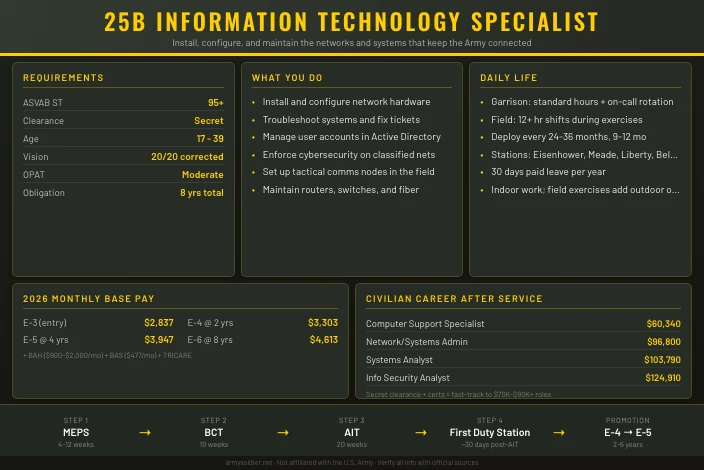
Job Role and Responsibilities
As a 25B Information Technology Specialist, you install, configure, and maintain the computer systems and networks that keep Army units communicating and operational. You troubleshoot hardware and software problems, manage user accounts, enforce cybersecurity policies, and keep classified and unclassified networks running around the clock.
Daily Tasks
Your day depends on where you’re assigned. In a battalion S-6 (signal) shop, you spend mornings checking network status, running system updates, and responding to trouble tickets from soldiers who can’t log in or print. Afternoons might involve imaging new workstations, running cable, or configuring switches.
At a division or corps headquarters, the scope gets bigger. You manage servers, monitor network traffic for anomalies, and coordinate with other signal sections during exercises. Field operations add another layer. You set up tactical network nodes, connect command posts, and keep everything working on generator power in a tent.
No two days look exactly alike, which is part of what makes this job different from a civilian help desk.
Specific Roles
The base MOS is 25B, but you can pick up Additional Skill Identifiers (ASIs) that open specialized positions:
| Identifier | Type | Role |
|---|---|---|
| 25B | Primary MOS | Information Technology Specialist |
| ASI 1C | Additional Skill | Allied Trades Specialist |
| ASI 2A | Additional Skill | Non-Standard Equipment |
| SQI P | Special Qualification | Parachutist |
| SQI 5 | Special Qualification | Ranger |
Some 25B soldiers serve in Cyber Protection Teams, working alongside 17C Cyber Operations Specialists on defensive cyber missions. Others get assigned to Joint Communications or work in Network Operations Centers (NOCs) that monitor entire theater-level networks.
Mission Contribution
Signal is the backbone of command and control. Without functioning networks, commanders can’t issue orders, units can’t coordinate fires, and intelligence can’t move. Every operational plan assumes the network works. When it doesn’t, the mission stalls. That pressure falls directly on 25B soldiers.
During large-scale exercises or real-world operations, you’re part of the team that keeps the common operating picture alive. If a commander’s chat system drops during a live-fire exercise, that’s your problem to solve in minutes, not hours.
Technology and Equipment
You’ll work with both commercial IT systems and Army-specific platforms:
- Windows Server, Active Directory, Group Policy, and DNS/DHCP management
- Cisco routers, switches, and network infrastructure
- Army Battle Command Systems and tactical radios that feed into the network
- Satellite communication terminals and microwave links
- Army cybersecurity tools for monitoring, patching, and vulnerability scanning
- Fiber optic cable termination and copper wiring
The mix of civilian-equivalent technology and military-specific systems gives you a broader skill set than most entry-level IT jobs in the private sector.
Salary and Benefits
Financial Benefits
Military pay is based on rank and time in service. Most 25B soldiers enter as E-2 or E-3 after Basic and AIT.
| Rank | Pay Grade | Years of Service: 2 | Years of Service: 4 | Years of Service: 6 | Years of Service: 8 |
|---|---|---|---|---|---|
| Private First Class (PFC) | E-3 | $3,015 | $3,198 | $3,198 | $3,198 |
| Specialist (SPC) | E-4 | $3,303 | $3,659 | $3,816 | $3,816 |
| Sergeant (SGT) | E-5 | $3,599 | $3,947 | $4,109 | $4,299 |
| Staff Sergeant (SSG) | E-6 | $3,743 | $4,069 | $4,236 | $4,613 |
Source: DFAS 2026 pay tables. Figures reflect the 2026 pay raise.
On top of base pay, you get allowances. BAH (Basic Allowance for Housing) depends on your duty station and whether you have dependents. A single E-4 at Fort Eisenhower, GA gets about $1,359 per month. At higher-cost locations like Fort Meade, MD or the Pentagon, BAH runs higher. BAS adds about $477 monthly for food.
The 25B currently qualifies for a signing bonus of up to $10,000 depending on contract length and availability. Bonus amounts change frequently, so confirm the current figure with your recruiter.
Additional Benefits
You and your family get TRICARE health coverage at no cost on active duty. That covers doctor visits, hospital stays, prescriptions, dental, vision, and mental health.
While serving, Tuition Assistance pays up to $4,500 per year for college courses. After you leave, the Post-9/11 GI Bill covers up to 36 months of tuition at a public university (full in-state rate) plus a monthly housing allowance and $1,000 annual book stipend. For private schools, the cap is $29,920.95 per academic year.
Retirement runs through the Blended Retirement System (BRS):
- Serve 20 years and you get a pension worth 40% of your base pay
- The government matches up to 5% of your Thrift Savings Plan (TSP) contributions
- Continuation pay at the 8-12 year mark provides a lump sum for extending your commitment
Work-Life Balance
You earn 30 days of paid leave per year. In garrison, signal soldiers usually work standard hours with on-call rotations for network emergencies. Some positions require shift work because networks run 24/7. During field exercises or deployments, expect 12-hour shifts or longer.
The 25B has a better work-life balance than most combat MOSs. You’re still subject to field training and deployments, but garrison life tends to be more predictable than what infantry or armor soldiers experience.
Qualifications and Eligibility
Basic Qualifications
You need to be a U.S. citizen between 17 and 39 years old. High school grads need at least a 31 on the AFQT. GED holders need a 50. The 25B requires one ASVAB line score:
- Skilled Technical (ST): 95 minimum
The ST composite adds your General Science, Verbal Expression, Math Knowledge, and Mechanical Comprehension subtests. A 95 is reachable with moderate preparation. It’s lower than the medical MOSs (which require 101+) but higher than many combat arms jobs.
You also need to qualify for a Secret security clearance. That means passing a background investigation covering your criminal record, financial history, and personal references. Drug use, serious debt, or a felony conviction can disqualify you or require a waiver.
| Requirement | Details |
|---|---|
| Age | 17-39 years old |
| Citizenship | U.S. citizen |
| Education | High school diploma or GED |
| AFQT (ASVAB) | Minimum 31 (diploma) or 50 (GED) |
| Skilled Technical (ST) | Minimum 95 |
| Security Clearance | Secret |
| OPAT | Moderate physical demand |
| Vision | Correctable to 20/20 |
| Background | No disqualifying criminal history or serious financial problems |
Application Process
Start at a local recruiting station. Your recruiter will confirm your ASVAB scores qualify for 25B and check whether training slots are open.
At MEPS (Military Entrance Processing Station), you take the ASVAB if you haven’t already, complete a full medical exam, and pass the OPAT at the Moderate level. The Moderate category requires a 120-pound strength deadlift, 3-foot-11-inch standing long jump, 11-foot-6-inch seated power throw, and a 10:27 interval aerobic run.
From your first recruiter visit to swearing in takes 4 to 12 weeks. Background investigations for the Secret clearance can run concurrently but sometimes delay your ship date.
Selection Criteria and Competitiveness
The 25B is one of the most common Signal MOSs, so slots are usually available. The ST 95 score is moderate. You don’t need prior IT experience, but recruiters notice candidates with CompTIA certs, home lab experience, or college IT coursework. Those credentials won’t change your ASVAB requirement, but they can help during classification counseling.
Upon Accession into Service
Most recruits enter as E-1 (Private) and promote to E-2 after Basic. College credits or JROTC participation can bump you to E-3 or E-4 on entry. The standard service obligation is 8 years total, split between active duty (typically 3-6 years depending on your contract) and the Individual Ready Reserve.
See our ASVAB study guide for strategies to hit these line scores, or take the PiCAT from home if you are a first-time tester.
Work Environment
Setting and Schedule
Most 25B soldiers work indoors in server rooms, network operations centers, or office environments. Temperature-controlled buildings, fluorescent lights, and the hum of cooling fans are your normal backdrop. Field exercises change that. You’ll set up and maintain tactical network equipment in tents, vehicles, or command posts under whatever weather conditions exist.
Garrison schedules run roughly 0630 to 1700 on weekdays, with on-call rotations for after-hours network issues. Some NOC positions run 24-hour shift schedules (day shift, night shift, days off). In the field, you work until the network is up and stays up.
Leadership and Communication
Your chain of command runs through the S-6 (signal officer) and a senior NCO, usually a Staff Sergeant or Sergeant First Class. In larger organizations, you might fall under a signal company or battalion with its own command structure.
Feedback comes through formal counseling sessions (monthly for junior soldiers, quarterly for NCOs) and annual evaluations. Most signal leaders also give informal feedback after exercises and incidents because IT problems are visible and time-sensitive.
Team Dynamics and Autonomy
Signal sections are small. A typical battalion S-6 shop has 3 to 8 soldiers handling everything from helpdesk support to server administration. Everyone carries a heavy workload, which means you get responsibility early.
Junior 25B soldiers usually have a senior NCO reviewing their work. By E-4, you’re running projects solo: imaging machines, configuring equipment for field exercises, or managing a subnet. E-5 and above lead the section and make decisions about network design and prioritization.
Job Satisfaction and Retention
Re-enlistment rates for 25B soldiers are moderate. The MOS teaches highly marketable skills, so many soldiers leave after their first contract for better-paying civilian IT jobs. Those who stay often cite the variety of assignments, security clearance advantages, and the structure of military life.
The biggest complaints from 25B soldiers are doing non-IT work (details, motor pool, unit taskings) and the pay gap compared to civilian IT roles. Soldiers in high-speed assignments like Cyber Protection Teams or joint units tend to report higher satisfaction than those stuck running helpdesk in a garrison S-6 shop.
Training and Skill Development
Initial Training
Training comes in two phases: Basic Combat Training (BCT) and Advanced Individual Training (AIT).
| Training Phase | Location | Duration | Focus |
|---|---|---|---|
| BCT | Fort Jackson, SC; Fort Moore, GA; Fort Leonard Wood, MO | 10 weeks | Soldier fundamentals: marksmanship, tactics, fitness, discipline |
| AIT | Fort Eisenhower, GA (U.S. Army Cyber Center of Excellence) | 20 weeks | IT skills: networking, systems administration, cybersecurity basics |
BCT is the same for every MOS. You learn to shoot, move, communicate, and operate as a soldier. Physical training, drill and ceremony, land navigation, and basic first aid fill 10 intense weeks.
AIT at Fort Eisenhower is where the IT training starts. The 20-week course covers hardware fundamentals, Windows operating systems, networking concepts (TCP/IP, DNS, DHCP, subnetting), router and switch configuration, Active Directory, and Army-specific network systems. The curriculum aligns with CompTIA A+ and Network+ exam objectives. You get hands-on lab time configuring real equipment, not just classroom lectures.
By the end of AIT, you have enough knowledge to sit for the CompTIA A+ and Network+ certification exams. The Army pays for these through voucher programs.
Advanced Training
After AIT, your learning accelerates at your first duty station. Senior NCOs teach you the systems and procedures specific to that unit. You also have access to several training paths:
- CompTIA Security+ is required for any soldier working on DoD networks in an Information Assurance Technician (IAT) Level II role. Most 25B soldiers earn this within their first 2 years through Army-funded training.
- Cisco CCNA training is available at some installations and through Army distance learning.
- CISSP (Certified Information Systems Security Professional) becomes relevant for senior NCOs and warrant officer candidates.
- Army COOL (Credentialing Opportunities On-Line) funds certification exams and prep materials for dozens of IT certifications.
Signal soldiers also compete for Functional Courses at Fort Eisenhower that teach advanced networking, satellite communications, or cyber defense skills. These courses are typically 4 to 12 weeks and can lead to ASI qualifications.
Everything starts with qualifying ASVAB scores — our study guide covers what to study first.
Career Progression and Advancement
Career Path
Promotion to E-4 (Specialist) is mostly automatic after about 2 years if you meet the requirements. E-5 (Sergeant) requires passing a promotion board, meeting point cutoffs, and completing the Basic Leader Course. At E-5, you shift from doing IT work to leading other IT soldiers while still staying hands-on.
| Rank | Pay Grade | Typical Years | Typical Role |
|---|---|---|---|
| Private (PV2) | E-2 | 0-1 | AIT graduate, helpdesk and entry-level support |
| Private First Class | E-3 | 1-2 | System imaging, basic network troubleshooting |
| Specialist | E-4 | 2-3 | Network administration, independent project work |
| Sergeant | E-5 | 4-6 | Section leader, senior network admin |
| Staff Sergeant | E-6 | 6-9 | S-6 NCOIC, network operations supervisor |
| Sergeant First Class | E-7 | 9-12 | Signal platoon sergeant, technical manager |
| Master Sergeant | E-8 | 12+ | Senior signal NCO, operations management |
25B soldiers who want to go deeper into cyber can apply for reclassification to 17C (Cyber Operations Specialist) or compete for Warrant Officer MOS 255A (Information Services Technician). The 255A path is popular because it keeps you technical instead of pushing you into pure leadership.
Role Flexibility and Transfers
Lateral moves within CMF 25 (Signal) are common. You can reclassify to 25S (Satellite Communications), 25U (Signal Support), or 25N (Nodal Network Systems Operator). Moving to 17C (Cyber Operations) requires meeting that MOS’s prerequisites and completing additional training.
Transfers outside the signal field are possible but harder. You need your commander’s approval, an available slot, and the ASVAB scores for the new MOS. Most 25B soldiers who leave the field go into intelligence or cyber roles because the skill sets overlap.
Performance Evaluation
NCOs get rated through the NCOER (NCO Evaluation Report) once a year. Your rater and senior rater score you on leadership, training, and technical skills. Strong NCOERs are the single biggest factor in getting promoted to E-6 and above.
What actually sets you apart in this MOS: earning industry certifications, solving high-visibility network problems, training junior soldiers effectively, and volunteering for tough assignments. Signal leaders notice soldiers who go beyond the helpdesk and dig into network architecture, scripting, or cybersecurity.
Physical Demands and Medical Evaluations
Physical Requirements
The 25B carries a Moderate OPAT physical demand rating. Compared to combat MOSs, the daily physical load is lighter. You’re lifting server equipment, running cable through ceilings, and occasionally carrying communication gear in the field. Expect to handle 20 to 40 pounds regularly, with heavier lifts during equipment setup.
Field exercises add physical demands. You’ll load and unload vehicles, set up antenna masts, and sometimes dig in positions for tactical network nodes. Deployments can put you in body armor for extended periods.
Every soldier takes the Army Fitness Test (AFT) once a year. Here are the minimum standards for ages 17 to 21:
| Event | Male Minimum | Female Minimum |
|---|---|---|
| 3-Rep Max Deadlift (MDL) | 140 lbs | 80 lbs |
| Hand-Release Push-Up (HRP) | 10 reps | 10 reps |
| Sprint-Drag-Carry (SDC) | 2:40 | 3:40 |
| Plank (PLK) | 2:00 | 2:00 |
| Two-Mile Run (2MR) | 15:54 | 18:54 |
Each event is scored 0 to 100. You need at least 60 per event and a 300 total to pass. The AFT uses sex- and age-normed standards for non-combat MOSs like the 25B.
Medical Evaluations
After enlistment, you get an annual Periodic Health Assessment: weight, blood pressure, vision, hearing, and a conversation with a provider. Before deployment, you go through a separate medical screening. Any condition that limits your ability to deploy gets addressed first.
Vision matters for this MOS. You spend long hours staring at screens and reading fine print on equipment labels. The Army monitors this through regular optometry checks.
Deployment and Duty Stations
Deployment Details
25B soldiers deploy wherever the Army operates networks, which is everywhere. Most active-duty units rotate through deployments every 24 to 36 months for 9 to 12 months. Signal soldiers generally deploy with their assigned unit rather than as individual augmentees.
Common deployment regions include:
- Middle East (Kuwait, Iraq, Syria, Jordan)
- Europe (Poland, Romania, Germany for rotational forces)
- Pacific (South Korea, Japan)
During deployments, you maintain and defend the network in austere conditions. That might mean running fiber across a base in 120-degree heat or troubleshooting satellite links in a sandstorm. The upside: deployed IT work is often the most technically challenging and rewarding experience in the MOS.
Location Flexibility
The Army decides where you go, but 25B soldiers have more options than most MOSs because every installation needs IT support.
Common CONUS duty stations:
- Fort Eisenhower, GA (Cyber Center of Excellence)
- Fort Meade, MD (NSA/CYBERCOM)
- Fort Liberty, NC
- Fort Campbell, KY
- Fort Belvoir, VA
- The Pentagon, Washington, DC
OCONUS assignments:
- Germany (Wiesbaden, Stuttgart, Grafenwoehr)
- South Korea (Camp Humphreys)
- Japan (Camp Zama)
- Italy (Vicenza)
You submit a preference list through the Assignment Interactive Module (AIM), but the Army fills needs first. Soldiers with good evaluations and specialized skills tend to get better assignments.
Risk, Safety, and Legal Considerations
Job Hazards
IT work in the Army is lower-risk than combat arms, but it’s not zero-risk.
In garrison:
- Electrical hazards from server rooms and wiring
- Repetitive strain injuries from extended keyboard and mouse use
- Heat stress in poorly ventilated server rooms or communications shelters
In the field and on deployment:
- Exposure to the same threats as the unit you support (indirect fire, IEDs on convoys)
- Carrying heavy equipment across rough terrain
- Fatigue from extended shift work during operations
Safety Protocols
Standard Army safety procedures apply. Server rooms have fire suppression systems and electrical safety protocols. You wear eye protection when terminating fiber optic cable. In the field, you follow your unit’s tactical SOP and wear appropriate protective equipment.
Security and Legal Requirements
The 25B requires a Secret security clearance. You handle classified systems and information daily. Maintaining your clearance means avoiding financial problems, drug use, and other behaviors that create vulnerabilities.
All soldiers follow the Uniform Code of Military Justice (UCMJ). As a 25B, you also follow Army Regulation 25-2 (Army Cybersecurity) and DoD Directive 8570 (now 8140) for information assurance workforce requirements. Violations of cybersecurity policy can result in administrative action, loss of clearance, or criminal charges depending on severity.
Your service contract obligates you for 8 years total. Breaking that contract without authorization has serious legal consequences.
Impact on Family and Personal Life
Family Considerations
Signal soldiers have a more predictable schedule than combat arms, but the Army still comes first. After-hours network emergencies, field exercises, and deployments disrupt family routines. Expect your phone to ring at odd hours when something breaks.
Support resources at most installations:
- Family Readiness Groups (FRGs) for peer support through your unit
- Military OneSource for free counseling and family services
- Spousal employment assistance at each new duty station
- Exceptional Family Member Program (EFMP) for families with special needs
The frequent moves (every 2-4 years) are hard on families. Your spouse’s career gets interrupted. Kids change schools. You rebuild your social network from scratch at every duty station.
Relocation and Flexibility
PCS (Permanent Change of Station) moves happen every 2 to 4 years. The Army covers moving costs, but each relocation disrupts your household. Overseas assignments to Germany, Korea, or Japan can be exciting but add logistical complexity for families.
You can request preferred duty stations, but there are no guarantees. Soldiers with in-demand skills or strong evaluations have a better shot at getting their preferred location.
Reserve and National Guard
The 25B is one of the most widely available MOS in the Reserve component. Nearly every unit type needs IT support – infantry brigades, aviation battalions, logistics units, medical commands. That demand translates to 25B slots at Reserve and Guard units across the country. If you want to serve part-time in this field, you will have options.
Component Availability
Both the Army Reserve and the Army National Guard have 25B positions in abundance. Signal companies, battalion S6 shops, and corps-level IT organizations all carry 25B billets. The broad distribution of this MOS means you can often find a unit near where you live, which is not always possible with more specialized MOSs.
Guard units also fill state IT and network support roles during natural disasters, emergency activations, and domestic operations. A 25B in the Guard might support a hurricane relief operation or a state-level cybersecurity response event in addition to standard federal training.
Drill Schedule and Extra Training
Standard Reserve and Guard service is one weekend per month plus two weeks of Annual Training per year. For 25B soldiers, the standard drill schedule generally covers routine maintenance tasks, system updates, and unit IT support. This MOS does not require the same volume of extra training days as cyber-specific MOSs like 17C or 25D.
That said, you should pursue certifications on your own time. CompTIA Security+ is required for soldiers in DoD 8140 Information Assurance Technician Level II roles, and Reserve and Guard 25B soldiers in those billets must maintain the same certification standard as active-duty counterparts. Army COOL funding is available to help pay for certification exams.
Pay and Benefits Comparison
Part-time service with the Reserve or Guard pays per drill period. An E-4 with four years of service earns approximately $488 for a standard drill weekend (four drill periods across Saturday and Sunday). That is a meaningful income supplement for a civilian IT worker, not a living wage on its own.
Active-duty E-4 base pay at four years is $3,659 per month. The trade-off is time: Reserve and Guard service costs roughly four days per month rather than full-time commitment.
Healthcare for Reserve and Guard soldiers comes through Tricare Reserve Select. The cost is $57.88 per month for member-only coverage or $286.66 per month for member plus family. Active-duty TRICARE has no premium. Both options are affordable compared to typical civilian health insurance, but the gap is real if you are comparing total compensation.
Education benefits include the Montgomery GI Bill Selected Reserve (MGIB-SR, Chapter 1606) at $493 per month for full-time students, plus Federal Tuition Assistance at up to $250 per credit hour with a $4,500 annual cap. Guard soldiers may also qualify for state tuition assistance, which covers 100% of tuition at many state universities depending on the state.
Deployment and Mobilization
25B soldiers mobilize at a moderate rate. IT support is needed across all deployed headquarters and units, so Reserve and Guard 25B soldiers have deployed to Kuwait, Germany, South Korea, and other locations in support of active-duty formations. Mobilizations are typically 6 to 12 months.
USERRA protects your civilian job during any federally ordered mobilization. Your employer must restore your position, seniority, and benefits when you return, regardless of the duration.
Civilian Career Integration
The 25B is one of the best MOSs for a part-time military and full-time civilian IT career. The skills you use at your civilian IT job directly support your effectiveness on drill weekends. Your security clearance stays active as long as you remain in the unit and maintain eligibility. Defense contractors and federal agencies will pay a premium for IT professionals with active clearances, so the clearance benefit compounds over time.
CompTIA certifications earned during active duty or through Army COOL transfer directly to civilian IT roles. A cleared 25B veteran in the D.C. metro, San Antonio, or Colorado Springs defense corridors can earn $70,000 to $90,000+ in civilian IT without much additional training.
Reserve retirement accumulates through service points: drill periods, AT days, and any active-duty mobilization orders all count. At age 60, you begin drawing a pension based on your total point accumulation. The minimum retirement age drops by three months for every 90 days of qualifying active-duty mobilization after January 28, 2008, down to a minimum of age 50.
| Feature | Active Duty | Army Reserve | Army National Guard |
|---|---|---|---|
| Duty Status | Full-time | Part-time (1 wknd/mo + 2 wks/yr) | Part-time (1 wknd/mo + 2 wks/yr) |
| Monthly Pay (E-4, 4 yrs) | $3,659/mo | ~$488/drill weekend | ~$488/drill weekend |
| Healthcare | TRICARE (no premium) | Tricare Reserve Select ($57.88/mo) | Tricare Reserve Select ($57.88/mo) |
| Education | Post-9/11 GI Bill, TA | MGIB-SR ($493/mo), TA | MGIB-SR ($493/mo), TA, state tuition waivers |
| Deployment | Per unit rotation | When mobilized | When mobilized |
| Retirement | 20-year pension | Points-based, age 60 | Points-based, age 60 |
Post-Service Opportunities
Transition to Civilian Life
The 25B is one of the most directly transferable military jobs. Your daily work, managing networks, troubleshooting systems, and maintaining infrastructure, maps straight to civilian IT roles. The Secret clearance is a major asset for government contractor and federal positions.
The Transition Assistance Program (TAP) provides resume help, interview prep, and benefits counseling during your last 12 months on active duty. Many 25B soldiers line up IT jobs before they separate because recruiters at defense contractors actively seek soldiers with active clearances and hands-on experience.
The Post-9/11 GI Bill covers up to 36 months of tuition (full in-state rate at public schools, or up to $29,920.95 per year at private schools) plus a housing allowance and $1,000 annual book stipend. Many veterans use this for bachelor’s or master’s degrees in IT, cybersecurity, or computer science.
Civilian Career Prospects
| Civilian Job | Median Salary (BLS, May 2024) | 10-Year Outlook |
|---|---|---|
| Computer Support Specialist | $60,340 | -3% (declining) |
| Network/Systems Administrator | $96,800 | -4% (declining) |
| Computer Systems Analyst | $103,790 | +9% (faster than avg) |
| Information Security Analyst | $124,910 | +29% (much faster) |
The declining outlook for basic support and admin roles reflects automation and cloud migration, not lack of jobs. About 50,500 support specialist openings and 14,300 network admin openings still appear annually from retirements and transfers. Cybersecurity is where the growth is. Your clearance plus Security+ certification puts you ahead of most civilian applicants for those roles.
Defense contractors like Booz Allen Hamilton, Leidos, ManTech, and SAIC hire former 25B soldiers constantly. Starting salaries for cleared IT professionals in the D.C. metro area often exceed $70,000 to $90,000.
Is This a Good Job for You?
Ideal Candidate Profile
The best 25B soldiers like solving problems more than following scripts. When a network goes down, you need to think through the issue logically, test hypotheses, and fix it under pressure.
Traits that predict success:
- Genuinely curious about how computers and networks work
- Comfortable learning new systems and software on your own
- Patient enough to troubleshoot a problem for hours without giving up
- Organized (documenting your work matters in IT)
- Good communicator who can explain technical problems to non-technical people
You don’t need a computer science degree to succeed. Many of the best 25B soldiers came in with zero IT experience and learned everything in AIT and at their first duty station.
Potential Challenges
This MOS is a poor fit if you:
- Hate sitting at a desk or working on computers for extended periods
- Get frustrated when you can’t find the answer quickly
- Want a physically active outdoor job
- Struggle with attention to detail (one wrong IP address can take down a whole subnet)
The pay gap is real. A civilian IT specialist with 4 years of experience often earns more than an E-5 with the same experience. Soldiers who stay need to value the benefits, job security, and career breadth the Army offers beyond the paycheck.
Is the Fit Right?
If you want a tech career and you’re willing to serve for 3 to 6 years, the 25B gives you paid training, industry certifications, a security clearance, and real-world experience that civilian IT programs can’t match. The GI Bill covers a degree afterward.
The trade-off: you’re a soldier first and an IT specialist second. You’ll do pushups, pull guard duty, go to the field, and follow orders from people who may not understand what you do. If you can live with that structure, the 25B sets you up for a strong civilian career.
More Information
Talk to an Army recruiter about the 25B. Ask about current signing bonuses, training dates, and whether your ASVAB scores qualify. If possible, ask to speak with a 25B soldier at your nearest installation.
Take the MOS Finder quiz at goarmy.com
Check your ASVAB eligibility at your nearest MEPS
Browse certifications at Army COOL
Prepare for the ASVAB with our study guide to make sure your line scores qualify
This site is not affiliated with the U.S. Army or any government agency. Verify all information with official Army sources before making enlistment or career decisions.
Explore more Army cyber and signal careers such as 25S Satellite Communication Systems Operator and 25U Signal Support Systems Specialist.