25D Cyber Network Defender
Foreign adversaries probe Army networks every day. Someone has to be on the other side of that fight, watching traffic patterns for anomalies, catching intrusions before they reach classified systems, and hunting down threats before a commander ever knows they existed. That’s the 25D Cyber Network Defender. This isn’t an entry-level job you get straight out of high school. It’s a career track reserved for experienced NCOs who have already proven themselves in IT or signal roles. If you’ve put in the time in CMF 25 and want to specialize in network defense, the 25D is the natural next step.
Qualifying requires specific ASVAB line scores — our ASVAB study guide covers what to target and how to prepare.
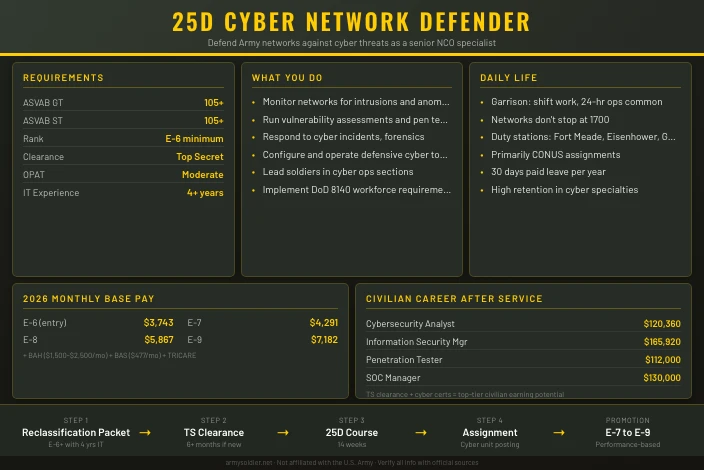
Job Role and Responsibilities
As a 25D Cyber Network Defender, you protect Army computer networks and information systems from unauthorized access, cyberattacks, and exploitation. You monitor networks for intrusions, analyze threats, respond to security incidents, conduct vulnerability assessments, and manage defensive cybersecurity infrastructure across military systems.
Daily Tasks
Your day centers on network defense operations. In a Cyber Protection Team or a unit network operations center, you monitor intrusion detection systems, review security logs, and investigate anomalies that automated tools flag. Not every alert is a real threat, and distinguishing a misconfigured device from an active intrusion is a core skill you develop quickly.
Incident response is a major part of the job. When something gets through, you isolate the affected system, assess the damage, identify the attack vector, and develop a response plan. That process involves detailed documentation, coordination with the unit S-6, and often reporting up to Army Cyber Command elements.
Beyond monitoring and response, you conduct vulnerability assessments on unit systems and advise commanders on cybersecurity posture. You’re the technical expert in the room when a commander needs to understand whether their network is ready for an operation.
Specific Roles
The 25D MOS sits within the Cyber and Signal career field (CMF 25). Soldiers can pick up Additional Skill Identifiers (ASIs) that reflect specialized capabilities:
| Identifier | Type | Description |
|---|---|---|
| 25D | Primary MOS | Cyber Network Defender |
| ASI 1C | Additional Skill | Allied Trades Specialist |
| SQI P | Special Qualification | Parachutist |
| SQI 5 | Special Qualification | Ranger |
Within the 25D specialty, soldiers work across five function areas: Infrastructure Support, Analyst, Incident Responder, Auditor, and Manager. Where you fall depends on your assignment and experience level.
Mission Contribution
Army networks carry operational orders, intelligence reports, personnel records, and logistics data. If an adversary can read that traffic or disrupt that flow, they gain an advantage before the first shot is fired. The 25D is the technical layer standing between Army information systems and everyone who wants to compromise them.
Cyber defense has become as critical as physical security. Commanders rely on 25D NCOs the same way they rely on physical security teams. When a network is compromised during a major exercise or real-world operation, the consequences for command and control are immediate and serious.
Technology and Equipment
25D soldiers work with a range of both commercial and Army-specific tools:
- Intrusion detection and prevention systems (IDS/IPS) including Army-deployed variants
- Security Information and Event Management (SIEM) platforms
- Vulnerability scanning tools and penetration testing frameworks
- Firewalls, proxies, and network access control systems
- Army Battle Command Systems and tactical network infrastructure
- Classified network enclaves including SIPRNet and JWICS environments
- Digital forensics and malware analysis tools
The technical depth here goes well beyond the 25B role. You’re not troubleshooting printers. You’re analyzing packet captures and reverse-engineering malware behavior.
Salary and Benefits
Financial Benefits
The 25D is a reclassification MOS for NCOs, so soldiers enter the role at E-6 (Staff Sergeant) or above. Pay at those grades reflects years of service already accumulated.
| Rank | Pay Grade | Monthly Base Pay (2 yrs in grade) |
|---|---|---|
| Staff Sergeant | E-6 | $3,743 |
| Sergeant First Class | E-7 | $4,291 |
| Master Sergeant | E-8 | $5,867 |
| Sergeant Major | E-9 | $7,182 |
All figures are 2026 rates per DFAS. Most soldiers entering the 25D have 6 to 10 years of service, so their actual pay will be higher based on their time-in-service bracket.
BAH adds a substantial amount on top of base pay. A single E-6 at Fort Meade, MD or Fort Eisenhower, GA receives BAH that varies by location and dependency status. BAS adds $476.95 per month for food. Neither BAH nor BAS is taxable income.
The 25D qualifies for Special Duty Assignment Pay (SDAP) in some assignments and may be eligible for Cyber Retention Bonuses based on HRC guidance. Bonus amounts change frequently; confirm current figures with your career manager at HRC.
Additional Benefits
TRICARE covers medical, dental, vision, mental health, and prescriptions for you and your family at no cost on active duty. There are no enrollment fees, no deductibles, and no copays for in-network care.
Tuition Assistance pays up to $4,500 per year for college courses while you’re serving. The Post-9/11 GI Bill covers up to 36 months of tuition at a public university (full in-state rate) or up to $29,920.95 per year at private institutions after you leave. The housing allowance and $1,000 annual book stipend come with it.
Retirement through the Blended Retirement System (BRS) works like this:
- Serve 20 years and collect a pension worth 40% of your average basic pay
- The government matches up to 5% of your Thrift Savings Plan (TSP) contributions
- Continuation pay at the 8 to 12 year mark provides a lump sum in exchange for an additional service commitment
Work-Life Balance
You earn 30 days of paid leave per year. Cyber positions often involve shift work because networks run continuously, and some 25D assignments at major cyber commands run 24-hour rotations. In garrison, a standard duty day is typical, but surge periods during exercises or elevated threat conditions can extend hours.
The predictability of this MOS depends heavily on the assignment. A 25D at a divisional S-6 shop works different hours than one assigned to a Cyber Protection Team supporting deployed operations.
Qualifications and Eligibility
Basic Qualifications
The 25D is not a direct-enlistment MOS. You cannot join the Army as a 25D fresh from high school. It requires reclassification as an experienced NCO.
ASVAB line scores must meet both minimums:
- General Technical (GT): 105 minimum
- Skilled Technical (ST): 105 minimum
The GT composite is derived from Verbal Expression and Arithmetic Reasoning. The ST composite adds General Science, Math Knowledge, and Mechanical Comprehension. Scoring 105 on both is a meaningful threshold. For reference, the national average AFQT percentile score is 50, and high GT/ST scores require strong performance across several subtests.
| Requirement | Details |
|---|---|
| Rank | Staff Sergeant (E-6) minimum |
| Age | 17-39 at enlistment; no upper limit for reclassification |
| Citizenship | U.S. citizen |
| Education | High school diploma or GED |
| ASVAB GT | 105 minimum |
| ASVAB ST | 105 minimum |
| IT/IA Experience | 4 years minimum (verified by personnel officer) |
| Security Clearance | Top Secret |
| Commander Recommendation | Required from Battalion Commander |
| OPAT | Moderate physical demand category |
Application Process
Reclassification to 25D runs through your unit career counselor and HRC. The typical path:
The Top Secret clearance investigation runs concurrently. If you already hold a TS from a prior assignment, the process is faster. Starting from scratch, the investigation can take six months or longer.
Selection Criteria and Competitiveness
The 25D is competitive. Not because there are thousands of applicants, but because the prerequisites filter out most candidates before the packet even gets submitted. Soldiers who get selected typically have strong NCOERs, verifiable hands-on IT experience (not just supervising IT soldiers), and existing security clearances.
The experience requirement is waiverable in limited cases, but waivers are not automatic. If you’re close but not quite at four years of IT/IA experience, talk to your career counselor about whether a waiver makes sense for your situation.
Upon Accession into Service
Since 25D is a reclassification MOS, soldiers enter the specialty at their current rank, typically E-6. The 14-week course at Fort Eisenhower is the formal training requirement. After graduation, soldiers receive new orders and begin performing 25D duties at their assigned unit.
See our ASVAB study guide for strategies to hit these line scores, or take the PiCAT from home if you are a first-time tester.
Work Environment
Setting and Schedule
Most 25D soldiers work in controlled environments: network operations centers, Sensitive Compartmented Information Facilities (SCIFs), or secure server rooms. Temperature-controlled spaces, multiple monitors, and classified terminals are standard. Personal electronics are prohibited in many work areas for security reasons.
Field environments change the picture. Cyber Protection Teams deploy and set up in tactical command post environments, working in vehicles or tents with generator power. The technical mission doesn’t change; the physical conditions do.
Shift work is common. Networks don’t stop at 1700, and many cyber units run 24-hour operations. Your schedule depends on the unit. Some 25D soldiers work standard garrison hours; others rotate through shifts covering nights and weekends.
Leadership and Communication
The 25D sits in a technical NCO role. Your chain of command typically runs through a Signal or Cyber officer and a senior NCO. At the E-6 and E-7 level, you’re responsible for both the technical mission and leading junior soldiers in your section.
Performance counseling runs monthly for junior soldiers and quarterly for NCOs, with annual NCOER evaluations that carry significant weight in promotion decisions. In cyber units, technical performance is measurable. If you catch threats and document them well, that shows up clearly in your evaluation.
Team Dynamics and Autonomy
Cyber teams are small by design. A typical Cyber Protection Team has 40 to 50 soldiers total, and the NCOs work closely with both officers and warrant officers. You’re expected to contribute technical expertise, not just execute orders. When an incident happens, the team relies on the senior NCO to read the situation correctly and make fast technical judgments.
Junior 25D soldiers work alongside senior NCOs and learn from close mentorship. By E-7, you’re the one setting the technical standard for the section and advising the officer on network defense posture.
Job Satisfaction and Retention
Re-enlistment rates in cyber specialties run higher than in many other signal MOSs. The work is technically engaging, the assignments are interesting, and the pay gap compared to civilian cybersecurity jobs is at least partially offset by the total compensation package and the mission value.
The most common frustrations: the reclassification process is slow and bureaucratic, assignments don’t always match experience, and administrative duties pull time away from technical work. Soldiers in high-performing Cyber Protection Teams assigned to active missions tend to report the highest satisfaction.
Training and Skill Development
Initial Training
Soldiers reclassifying to 25D complete the formal 25D course at Fort Eisenhower, Georgia. Since this is a reclassification, there is no BCT requirement for existing soldiers.
| Training Phase | Location | Duration | Focus |
|---|---|---|---|
| Reclassification Course (AIT) | Fort Eisenhower, GA (Cyber Center of Excellence) | 14 weeks | Computer network defense, intrusion detection, incident response, vulnerability assessment, offensive/defensive cyber operations |
The 14-week course combines classroom instruction with hands-on lab work. You work through realistic network environments, configure and operate defensive tools, respond to simulated attacks, and practice digital forensics. The curriculum aligns with DoD 8140 (formerly DoDD 8570) workforce requirements.
Soldiers entering with a Top Secret clearance can access more training scenarios. Those without one may have limited access to some classified systems during the course until their clearance adjudicates.
Advanced Training
After reclassification, your training doesn’t stop. The Army funds several paths for 25D soldiers to stay current:
- CompTIA Security+ is the baseline DoD 8140 IAT Level II certification. Most 25D soldiers already have this before reclassification. If not, the Army funds exam prep and testing.
- Certified Ethical Hacker (CEH) training is funded through Army COOL (Credentialing Opportunities On-Line) for eligible 25D soldiers.
- CISSP (Certified Information Systems Security Professional) becomes the target cert for senior NCOs and is a common credential among E-7 and above cyber NCOs.
- CompTIA Cybersecurity Analyst (CySA+) and CompTIA PenTest+ align directly with 25D job functions and are funded through Army COOL.
- Certified Information Security Manager (CISM) is relevant for E-8 and above moving into management roles.
The Army Cyber Center of Excellence runs additional courses for 25D soldiers beyond the reclassification course, including specialized defensive operations and threat hunting training. Soldiers can also compete for joint training at NSA or USCYBERCOM facilities.
Everything starts with qualifying ASVAB scores — our study guide covers what to study first.
Career Progression and Advancement
Career Path
The 25D career path runs from E-6 through E-9, with each grade adding leadership and technical responsibility. Promotion to E-7 requires meeting standard Army promotion points and completing the Advanced Leader Course. E-8 and E-9 require HRC selection boards.
| Rank | Pay Grade | Typical Time in Grade | Role |
|---|---|---|---|
| Staff Sergeant | E-6 | 0-3 years in MOS | Network defender, team NCO |
| Sergeant First Class | E-7 | 3-6 years in MOS | Section NCOIC, technical lead |
| Master Sergeant | E-8 | 6-10 years in MOS | Cyber unit operations sergeant |
| Sergeant Major | E-9 | 10+ years in MOS | Senior cyber advisor, command SGM track |
Experienced 25D soldiers can also apply for Warrant Officer programs. The 255A (Information Services Technician) path is particularly common, keeping soldiers in the technical lane rather than moving into pure leadership. Officers and warrant officers in cyber units regularly seek out strong 25D NCOs for their teams.
Role Flexibility and Transfers
Within CMF 25, 25D soldiers can transfer to other signal roles or reclassify to 17C (Cyber Operations Specialist) if they meet that MOS’s requirements and pass the Cyber Aptitude Assessment. Movement into intelligence roles (CMF 35) is possible for soldiers with strong analytical backgrounds.
Transfers outside the cyber and signal field are harder. Your ASVAB scores likely qualify for many MOSs, but your commander and HRC need to agree the transfer serves the Army’s needs. Most 25D soldiers who leave the field move into civilian cybersecurity rather than a different military specialty.
Performance Evaluation
NCOs are evaluated annually through the NCOER. Your rater assesses leadership and technical performance; your senior rater provides an overall assessment that carries heavy weight in promotion boards.
What matters most for advancement in this MOS:
- Strong technical performance that’s documented and visible, not just competent background work
- Certifications that meet DoD 8140 requirements and demonstrate continued professional development
- Leading junior soldiers effectively while maintaining your own technical skills
- Seeking out challenging assignments, including Cyber Protection Teams and joint billets
- Building a record of solving hard problems, not just maintaining steady-state operations
The soldiers who make E-7 and above in this MOS are technically sharp and demonstrate they can operate at the leader level, not just the operator level.
Physical Demands and Medical Evaluations
Physical Requirements
The 25D carries a Moderate OPAT physical demand rating. Day-to-day, the job is not physically strenuous. You’re sitting at workstations, reviewing screens, and managing network infrastructure. The physical demands come in the field: loading communications equipment, setting up tactical network nodes, and wearing body armor during deployments.
Every soldier takes the Army Fitness Test (AFT) annually. The AFT replaced the ACFT on June 1, 2025. It has five events scored 0 to 100 each, with a 300-point minimum to pass (60 per event). Non-combat MOSs like the 25D use sex- and age-normed standards.
| Event | Description | Min Score (Any Soldier) |
|---|---|---|
| Deadlift (MDL) | 3-rep maximum deadlift | 60 points |
| Hand-Release Push-Up (HRP) | Full arm extension each rep | 60 points |
| Sprint-Drag-Carry (SDC) | 5-exercise shuttle run | 60 points |
| Plank (PLK) | Timed hold | 60 points |
| Two-Mile Run (2MR) | Distance run | 60 points |
The AFT uses sex- and age-normed scoring tables for non-combat MOSs. Exact minimum raw scores vary by age group and sex. The Army Fitness Test standards are published at army.mil/aft.
Medical Evaluations
As with all Army NCOs, 25D soldiers complete an annual Periodic Health Assessment covering weight, blood pressure, vision, hearing, and a medical interview. Pre-deployment health screenings are also required before any overseas assignment.
Vision matters more in this MOS than in many others. Long hours in front of screens in low-light environments accelerate eye fatigue. Correctable vision to 20/20 is standard. Soldiers who develop vision issues that affect their ability to work on classified systems may face assignment limitations.
The Top Secret clearance requires ongoing mental health and financial fitness. If a medical or psychological condition arises that could affect your clearance, it must be reported and evaluated.
Deployment and Duty Stations
Deployment Details
25D soldiers deploy with their assigned units and also support Army Cyber Command missions that send cyber teams into theater. Most active-duty units deploy every 24 to 36 months. Cyber Protection Teams may deploy on shorter rotational cycles depending on mission demand.
Common deployment environments include:
- U.S. Central Command area (Middle East, supporting Army network defense in theater)
- U.S. European Command area (Poland, Germany, Romania for NATO missions and rotational forces)
- U.S. Indo-Pacific Command area (South Korea, Japan)
Unlike infantry or armor deployments, 25D soldiers typically operate from fixed facilities or command posts rather than forward operating positions. The physical risk is lower, but the operational tempo during a cyber surge can be intense.
Location Flexibility
Cyber specialties concentrate at specific installations where Army Cyber Command and related organizations are based.
Primary CONUS assignments:
- Fort Eisenhower, GA (Cyber Center of Excellence, home of Army Cyber and Signal training)
- Fort Meade, MD (Army Cyber Command headquarters, NSA, USCYBERCOM)
- Fort Liberty, NC
- Fort Gordon is now Fort Eisenhower (name change completed 2023)
- The Pentagon, Arlington, VA
- Fort Belvoir, VA
OCONUS assignments:
- Germany (Wiesbaden, Stuttgart)
- South Korea (Camp Humphreys)
- Japan (Camp Zama)
Assignment preferences go through the Assignment Interactive Module (AIM), but HRC fills needs first. 25D soldiers with active Top Secret clearances and strong evaluation records tend to have more assignment options than those without.
Risk, Safety, and Legal Considerations
Job Hazards
The 25D works primarily in controlled environments, so physical hazards are minimal. The primary risks are occupational:
- Repetitive strain from long hours at keyboards and workstations
- Eye strain from extended screen time in secure facilities
- Psychological stress from working in high-stakes incident response situations
- Occupational health risks common to shift workers (sleep disruption, irregular schedules)
On deployment, 25D soldiers face the same indirect fire and force protection risks as anyone else in a deployed environment, though typically from more secure locations than combat arms personnel.
Safety Protocols
Secure facilities follow strict access control procedures. Classified systems require authentication at multiple levels. Server rooms have fire suppression and electrical safety protocols. In the field, 25D soldiers follow their unit’s tactical SOP and wear appropriate protective equipment.
Security and Legal Requirements
The 25D requires a Top Secret security clearance. Some assignments require Top Secret/SCI access. The clearance investigation covers your financial history, criminal record, foreign contacts, drug use, and personal references going back 10 years.
Maintaining your clearance is an ongoing obligation. Financial problems, drug use, foreign travel to certain countries, and significant personal conduct issues must be reported. Losing your clearance ends your ability to perform 25D duties.
All soldiers are bound by the Uniform Code of Military Justice (UCMJ). As a 25D, you also work under Army Regulation 25-2 (Army Cybersecurity), DoD Directive 8140 (Cyberspace Workforce Management), and applicable federal laws governing computer systems. Unauthorized access to systems, even Army systems outside your authorization, is a federal crime.
Your service contract creates a legal obligation. Reclassification to 25D typically triggers a service commitment. Breaking that commitment without authorization has serious legal consequences.
Impact on Family and Personal Life
Family Considerations
NCOs bring their families to each assignment, and the 25D assignment pattern means regular relocations. Families get access to the full suite of Army support programs:
- Family Readiness Groups (FRGs) for unit-level support during deployments and exercises
- Military OneSource for free counseling, financial advice, and family services
- Exceptional Family Member Program (EFMP) for families with special needs members
- Spousal employment assistance at each installation
- School Liaison Officers to help children transition between school systems
Shift work and deployment affect family routines. Cyber units don’t always have predictable schedules, especially during surge operations or elevated threat environments. Families benefit from the stability that comes with base access, commissary, and installation housing options, but the unpredictability of cyber operations hours can be a source of friction.
Relocation and Flexibility
PCS moves happen every 2 to 4 years. The Army covers moving costs, but each move disrupts careers, schools, and social networks. Cyber assignments concentrate at a smaller number of installations than signal MOSs generally, so families may spend multiple tours in the same geographic areas (Fort Eisenhower and Fort Meade are the two main hubs).
OCONUS assignments to Germany, South Korea, or Japan are available. Accompanied tours let you bring your family, which most soldiers in stable family situations prefer. Unaccompanied tours (typically Korea) run 12 months and are harder on families, but they build promotion points and broaden your assignment history.
The concentration of cyber billets at Fort Eisenhower and Fort Meade has a practical upside for families: both areas have strong military communities, established school systems, and active spouse employment networks in defense contracting. BAH rates at Fort Meade reflect the higher Washington-Baltimore corridor cost of living, while Fort Eisenhower’s Augusta-area BAH is lower but housing costs are more manageable on a single NCO income. Families who plan for consecutive tours at the same hub can build stability that offsets the disruption of the initial reclassification move.
Reserve and National Guard
The 25D MOS is available in both the Army Reserve and the Army National Guard. Cyber units in both components have expanded significantly over the past decade, and the Army continues to grow its Reserve component cyber capacity. If you complete the 25D reclassification while on active duty and then separate, you can continue serving in this specialty part-time.
Component Availability
Reserve and Guard cyber units include signal battalions, network defense elements, and cyber protection teams. Both components have invested in standing up dedicated cyber mission units alongside their traditional signal formations. Guard cyber units also take on state-level missions – protecting government networks, responding to ransomware attacks on public infrastructure, and supporting law enforcement cyber investigations when requested.
The 25D fills network defense roles in these formations. Because it is a reclassification MOS requiring prior IT experience and a Top Secret clearance, the Reserve and Guard pipeline is almost entirely prior service. New direct-enlistment into a Reserve or Guard 25D billet is uncommon.
Drill Schedule and Extra Training
Standard Reserve and Guard service is one weekend per month plus two weeks of Annual Training. For 25D soldiers, the minimum standard does not maintain the technical currency this MOS demands.
Network defense techniques evolve constantly. Adversary tactics change. Threat hunting and incident response require regular practice on real systems, not just annual refreshers. Most Reserve and Guard 25D units schedule additional training events beyond standard drill:
- Cybersecurity certification maintenance (Security+, CySA+, CASP+) must be kept current
- Network defense exercises and cyber range events often require additional days on orders
- Top Secret clearance maintenance obligations continue regardless of part-time status
Soldiers who take the Reserve or Guard path seriously in this MOS budget for extra training commitments each year. Those who show up only for standard drill will fall behind technically.
Pay and Benefits Comparison
Reserve and Guard drill pay for an E-4 at four years of service is approximately $488 per drill weekend. An active-duty E-4 at the same experience level earns $3,659 per month. The 25D is a reclassification MOS filled primarily by E-6 NCOs, so drill pay is higher, but the active-versus-Reserve gap is still substantial at every grade.
Healthcare for part-time service uses Tricare Reserve Select: $57.88 per month for the member alone or $286.66 per month for the member and family. Active-duty TRICARE has no premium. Both options are far cheaper than most employer-sponsored civilian plans.
Education benefits for Reserve and Guard members include the MGIB-SR (Chapter 1606) at $493 per month for full-time students and Federal Tuition Assistance at up to $250 per credit hour with a $4,500 annual cap. Guard members may also receive state tuition waivers, with many states covering full in-state tuition at public universities.
Deployment and Mobilization
Cyber defenders are increasingly mobilized across all components. Reserve and Guard 25D soldiers have supported active-duty cyber commands during exercises and real-world operations. Mobilization frequency is moderate-to-high compared to most Reserve component MOSs because the demand for network defense expertise in theater routinely exceeds active-duty capacity.
USERRA protects your civilian job during any federally ordered mobilization. Your employer must restore your position, benefits, and seniority when you return, regardless of how long the mobilization lasts. For cybersecurity professionals working in government or defense contracting, this protection is particularly important.
Civilian Career Integration
The 25D part-time path pairs well with civilian cybersecurity careers. A 25D soldier who works as an information security analyst, SOC analyst, or penetration tester in the civilian sector brings directly relevant skills to every drill weekend. The clearance stays active, the resume stays current, and the military service adds credibility.
Cleared cyber professionals in major defense markets earn $90,000 to $130,000+ in civilian roles. Reserve service adds drill pay on top of that, maintains the clearance, and builds toward a reserve retirement at age 60 – reduced by three months for every 90 days of qualifying active-duty mobilization after January 28, 2008, with a minimum eligibility age of 50.
| Feature | Active Duty | Army Reserve | Army National Guard |
|---|---|---|---|
| Duty Status | Full-time | Part-time (1 wknd/mo + 2 wks/yr) | Part-time (1 wknd/mo + 2 wks/yr) |
| Monthly Pay (E-4, 4 yrs) | $3,659/mo | ~$488/drill weekend | ~$488/drill weekend |
| Healthcare | TRICARE (no premium) | Tricare Reserve Select ($57.88/mo) | Tricare Reserve Select ($57.88/mo) |
| Education | Post-9/11 GI Bill, TA | MGIB-SR ($493/mo), TA | MGIB-SR ($493/mo), TA, state tuition waivers |
| Deployment | Per unit rotation | When mobilized | When mobilized |
| Retirement | 20-year pension | Points-based, age 60 | Points-based, age 60 |
Post-Service Opportunities
Transition to Civilian Life
A 25D who separates after 8 to 12 years leaves with a Top Secret clearance, 14 weeks of formal cyber training, years of practical network defense experience, and multiple industry certifications. That combination is exactly what defense contractors and federal agencies actively recruit.
The Transition Assistance Program (TAP) provides resume help, interview coaching, and federal benefits counseling in the final 12 months before separation. Many 25D soldiers line up civilian positions before their ETS date because cleared cyber professionals are in constant demand.
Defense contractors specifically seek veterans with active clearances. A former 25D with a current TS and Security+ can expect starting offers well above the national median for cybersecurity roles, particularly in the D.C. metro, San Antonio, Colorado Springs, and Huntsville defense corridors.
Civilian Career Prospects
| Civilian Job | Median Annual Salary (BLS, May 2024) | 10-Year Outlook |
|---|---|---|
| Information Security Analyst | $124,910 | +29% (much faster than avg) |
| Network and Computer Systems Administrator | $96,800 | -4% (declining) |
| Computer Systems Analyst | $103,790 | +9% (faster than avg) |
| Computer and Information Systems Manager | $169,510 | +17% (much faster than avg) |
The basic network admin role is declining due to cloud migration, but demand for security-specific roles is strong. The 29% growth projection for information security analysts reflects demand that far outpaces the supply of qualified candidates, and veterans with clearances and operational experience fill that gap.
The GI Bill covers up to 36 months of additional education for a bachelor’s or master’s degree in cybersecurity or computer science, which further strengthens civilian positioning.
Is This a Good Job for You?
Ideal Candidate Profile
The 25D attracts soldiers who want technical depth and find the cat-and-mouse dynamic of network defense genuinely interesting. You’re not just maintaining systems. You’re actively defending them against smart adversaries.
Traits that predict success:
- Analytical thinker who can spot patterns in large volumes of data
- Patient under pressure during active incidents when the answers aren’t immediately clear
- Detail-oriented enough to document work precisely and completely
- Comfortable working in strict, procedural environments where rules exist for serious reasons
- Continuously curious about how attackers think, not just how defenders respond
You need to already have the NCO foundation. This isn’t a place to figure out military leadership. Soldiers who come in solid at E-6, with strong technical fundamentals from their 25B or similar background, tend to transition well into the 25D role.
Potential Challenges
This MOS is a poor fit if you:
- Prefer outdoor, physically active work
- Find documentation and procedural compliance frustrating rather than necessary
- Are not willing to maintain strict security discipline at work and in your personal life
- Want immediate assignment after enlistment rather than building toward a specialty over years
- Struggle with the ambiguity of threat analysis, where you often work with incomplete information
The clearance process itself can be a barrier. Past financial problems, drug use, or foreign contacts can disqualify or significantly delay candidates. The financial scrutiny is ongoing for the entire length of your clearance.
Career and Lifestyle Alignment
This MOS fits well if your plan is a long Army career in cyber followed by a high-paying civilian cybersecurity role. The combination of clearance, certifications, and verifiable operational experience is genuinely valuable. Soldiers who spend 10 to 15 years in the 25D path often exit into six-figure contractor positions with strong career trajectories.
It’s a poor fit if you’re looking for broad field experience, frequent overseas travel in operational environments, or the kind of variety that comes with combat arms and combat support roles. Your career will be largely office-based, facilities-based, and specialized.
More Information
Talk to your unit career counselor if you’re a Signal NCO interested in reclassifying to 25D. Bring your current NCOER packet, document your IT/IA experience clearly, and ask about current HRC availability in the MOS. Army COOL lists the certifications that align with the 25D and shows which ones the Army funds. The Cyber Center of Excellence at Fort Eisenhower publishes course information and prerequisites for the 25D reclassification course.
- Prepare for the ASVAB with our study guide to make sure your line scores qualify
This site is not affiliated with the U.S. Army or any government agency. Verify all information with official Army sources before making enlistment or career decisions.
Explore more Army cyber and signal careers such as 17C Cyber Operations Specialist and 25B Information Technology Specialist.