25E Electromagnetic Spectrum Manager
Every radio, radar, drone, and GPS system the Army uses operates on a slice of the electromagnetic spectrum. When two friendly systems step on each other’s frequencies, communications collapse, jamming goes unchallenged, and commanders lose the ability to synchronize fires or maneuver. The 25E Electromagnetic Spectrum Manager is the person who prevents that from happening. It’s one of the smallest and most technically demanding MOSs in the Signal Corps, and the Army guards access to it carefully.
Qualifying requires specific ASVAB line scores — our ASVAB study guide covers what to target and how to prepare.
Job Role and Responsibilities
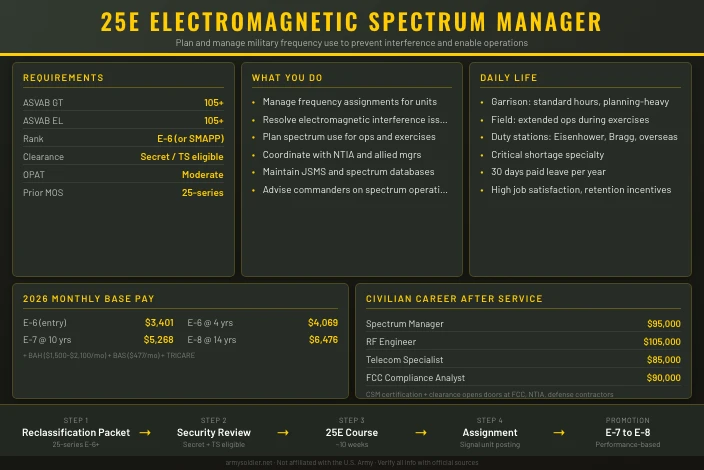
As a 25E Electromagnetic Spectrum Manager, you manage the Army’s use of radio frequencies across the operational environment. You assign frequencies to units, resolve interference between friendly systems, coordinate spectrum use with joint and allied forces, and advise commanders on electromagnetic warfare threats and mitigation strategies.
Daily Tasks
The day-to-day work centers on frequency assignment and deconfliction. You receive requests from units that need spectrum to operate their radios, radars, or unmanned systems, then run those requests through automated planning tools and check them against existing allocations to avoid conflict. That process involves maintaining a live database of every frequency assignment in your area of operations.
Interference resolution is the most urgent part of the job. When a unit reports that their communications are degraded, you pull logs, compare frequencies, identify the source of the conflict, and coordinate a fix. In a contested environment, distinguishing between unintentional interference and deliberate jamming is itself a tactical task. You document every incident and track patterns over time.
At the operational level, the scope grows. You develop frequency plans that support brigade- and division-level maneuvers, coordinate spectrum use through the joint frequency management office, and brief commanders on electromagnetic spectrum operations (EMSO) during mission planning. The Army Communicator journal noted in 2025 that the 25E role is increasingly expected to integrate with electronic warfare and cyber operations, not just manage administrative frequency records.
Specific Roles
The 25E is a low-density specialty within CMF 25 (Signal Corps). Unlike most enlisted MOSs, it has no Team Chief, Platoon Sergeant, First Sergeant, or Command Sergeant Major positions. It’s a technical expert role, not a command track.
| Identifier | Type | Description |
|---|---|---|
| 25E | MOS (Primary) | Electromagnetic Spectrum Manager |
| 25E3O | Skill Level 3 | Sergeant through Staff Sergeant positions |
| 25E4O | Skill Level 4 | Senior Sergeant First Class and above positions |
| Z5 | ASI (Additional Skill Identifier) | Information Systems Operations |
Soldiers assigned to 25E positions work within signal battalions, division G6 staff sections, corps-level headquarters, and joint electromagnetic spectrum operations cells (JEMSOCs).
Mission Contribution
Army operations depend on the electromagnetic spectrum the same way they depend on roads and fuel. A unit that can’t communicate or navigate because its frequencies are jammed or conflicted is combat-ineffective. The 25E provides the technical expertise that keeps friendly spectrum use organized and protected. As adversary nations invest in electronic warfare, the job has grown from administrative frequency management to active spectrum dominance planning.
Technology and Equipment
The primary tool is the Spectrum XXI (SXXI) automated spectrum management system, which the Army uses for frequency planning and coordination. You also work with the Joint Spectrum Management and Planning Tool (JSMAPT), tactical radio systems, and electronic warfare planning systems. The job requires proficiency in both classified and unclassified planning networks.
Salary and Benefits
Base pay is set by pay grade and years of service. Because 25E is a reclassification MOS entered at Staff Sergeant (E-6) or with promotion upon graduation through SMAPP, most 25E soldiers earn E-6 pay or higher from the start.
| Pay Grade | Years of Service | Monthly Base Pay |
|---|---|---|
| E-6 (SSG, entry) | Less than 2 | $3,401 |
| E-6 (SSG) | 4 years | $4,069 |
| E-6 (SSG) | 8 years | $4,613 |
| E-7 (SFC) | 10 years | $5,268 |
| E-7 (SFC) | 12 years | $5,537 |
| E-8 (MSG) | 14 years | $6,476 |
Figures reflect the DFAS 2026 military pay tables.
Additional Benefits
Base pay is only part of the compensation picture. All active-duty soldiers receive:
- BAS: $476.95 per month for food (2026 rate)
- BAH: Varies by duty station, pay grade, and dependent status. An E-6 at Fort Eisenhower receives approximately $1,500-$2,100 per month without dependents depending on local housing market rates.
- TRICARE: Full medical, dental, and vision coverage at no cost for active-duty soldiers. Family members enroll under TRICARE Prime with zero enrollment fees and a $1,000 annual catastrophic cap.
The Post-9/11 GI Bill covers full in-state tuition at public universities after service, plus a monthly housing allowance based on the E-5 with-dependents BAH rate at the school’s ZIP code and up to $1,000 per year in book stipends. Private school tuition is capped at $29,920.95 for the 2025-2026 academic year.
Army Tuition Assistance pays up to $4,500 per year (capped at $250 per semester hour) toward college courses while on active duty.
The Blended Retirement System (BRS) combines a pension starting at 40% of your high-36 average base pay after 20 years with a Thrift Savings Plan (TSP). The Army automatically contributes 1% of base pay to your TSP after 60 days of service and matches up to 4% of what you contribute beginning in your third year.
Work-Life Balance
Soldiers earn 30 days of paid leave per year, accruing 2.5 days per month. The 25E workday in garrison typically follows normal duty hours, though field exercises and deployments shift that rhythm considerably. Because this is a low-density specialty, some 25E soldiers are the only spectrum manager in their unit, which means being the primary on-call resource for spectrum issues.
Qualifications and Eligibility
The 25E is not an entry-level MOS. The Army awards it through reclassification, meaning you must already be serving in a related Signal MOS before you can apply.
Basic Qualifications Table
| Requirement | Standard |
|---|---|
| ASVAB GT | 105 minimum |
| ASVAB EL | 105 minimum |
| Citizenship | U.S. citizen |
| Security Clearance | Secret (initial award); Top Secret eligibility required to maintain MOS |
| Vision | Normal color vision required (no color blindness) |
| Prior MOS | Must be qualified in 25C, 25F, 25L, 25N, 25P, 25Q, 25S, or 25U |
| Rank | SSG with less than 10 years of service, or SGT (promotable) with ALC/SSD II complete |
| Course | Completion of the MOS 25E Course at the Signal School is mandatory |
The GT score of 105 and EL score of 105 are sourced from DA Pam 611-21 and confirmed by Army Signal School training requirements.
Application Process
Selection Criteria and Competitiveness
This is a highly competitive specialty. The Army limits the number of slots based on manning documents, and reclassification slots are released based on force structure needs. Soldiers with strong evaluation reports, signal operational experience, and a demonstrated aptitude for technical work are most competitive.
Color vision is non-negotiable. Any form of color blindness disqualifies you because spectrum management work involves reading color-coded planning products and frequency displays.
Service Obligation
Reclassification into 25E typically incurs a service obligation of three years from the date of MOS award. Soldiers who accept enlistment or reenlistment bonuses may have additional obligations tied to those incentives.
See our ASVAB study guide for strategies to hit these line scores, or take the PiCAT from home if you are a first-time tester.
Work Environment
Setting and Schedule
Most 25E soldiers work in unit signal sections, division G6 staff sections, or joint spectrum management cells. The physical workspace varies from garrison signal offices with desktop planning systems to tactical operations centers in the field using ruggedized laptops.
| Environment | Schedule | Workspace |
|---|---|---|
| Garrison | Standard duty hours (0630-1700) | Signal office, desktop planning systems |
| Field exercise | 12+ hour days, irregular rest | Tactical operations center, ruggedized laptops |
| Deployed | Extended ops, rotating shifts | JEMSOC or division-level spectrum cell |
Soldiers assigned to joint electromagnetic spectrum operations cells (JEMSOCs) may work with Air Force, Marine Corps, and allied spectrum managers in combined environments.
Leadership and Communication
Because 25E is a technical expert specialty without dedicated leadership positions at every echelon, soldiers often work directly for the battalion or brigade S-6 officer or the unit signal officer. Performance feedback comes through the standard NCO Evaluation Report (NCOER) process, reviewed annually or upon change of rater.
The job requires regular coordination with units outside your own. You communicate with frequency managers at higher headquarters, allied spectrum managers, and the National Telecommunications and Information Administration (NTIA) when coordinating spectrum use with civilian agencies.
Team Dynamics and Autonomy
Because there’s usually one 25E per unit, the role demands a high degree of individual judgment. You’re the subject matter expert, and commanders will rely on your technical recommendations without having the background to second-guess them. That autonomy is one of the reasons experienced signal soldiers pursue this reclassification. It also means that errors in frequency assignments or interference resolution advice have direct operational consequences.
Job Satisfaction and Retention
The 25E is a critical shortage specialty within the Signal Corps. Retention incentives exist partly because the training investment is significant and the pool of qualified candidates is small. Soldiers in this role consistently report high job satisfaction tied to the direct operational impact and technical challenge of the work. The role also translates cleanly into well-paid civilian careers, which makes it attractive even for soldiers who don’t plan a 20-year career.
Training and Skill Development
Initial Training
Before reaching 25E school, soldiers complete Basic Combat Training (BCT) as they would for any Army MOS. Because 25E is a reclassification specialty, soldiers applying already have their BCT behind them and are serving in a qualifying Signal MOS.
| Phase | Location | Length | Focus |
|---|---|---|---|
| BCT (prior to any Army service) | Various installations | 10 weeks | Soldier skills, weapons, physical conditioning |
| Initial Signal AIT (prior 25-series MOS) | Fort Eisenhower, GA | Varies by MOS | Communications systems operation |
| 25E MOS Course | Fort Eisenhower, GA | ~10 weeks | Spectrum planning, frequency management, interference resolution |
The 25E course at the U.S. Army Signal School covers frequency planning using Spectrum XXI, joint spectrum coordination procedures, interference analysis, and electromagnetic warfare integration. The curriculum has expanded in recent years to reflect the Army’s push toward electromagnetic spectrum operations (EMSO) as a unified warfighting function rather than a purely administrative frequency management task.
Advanced Training
Soldiers who advance in the 25E specialty can attend joint-level electromagnetic spectrum operations courses through the Joint Spectrum Center in Annapolis, MD. These courses cover theater-level spectrum coordination, joint EMSO planning, and working within NATO frequency management frameworks.
At higher skill levels, 25E soldiers attend the Battle Staff NCO Course and, depending on assignment, may attend joint professional military education courses related to electronic warfare and information operations. The Army also sponsors select 25E soldiers for graduate-level programs in telecommunications engineering or systems management through programs like the Advanced Civil Schooling (ACS) program.
Certifications pursued by 25E soldiers include the Certified Spectrum Manager (CSM) credential offered through the Association of Old Crows (AOC), which is recognized by both military and civilian employers in the spectrum management field.
Everything starts with qualifying ASVAB scores — our study guide covers what to study first.
Career Progression and Advancement
The career path for 25E is narrower than most CMF 25 MOSs because of the specialty’s low-density structure. There are no formal leadership positions at the Team Chief or Platoon Sergeant level tied exclusively to 25E. Instead, soldiers progress through technical depth, staff assignments, and eventual conversion to senior staff roles.
Career Path
| Rank | Grade | Typical Timeframe | Focus |
|---|---|---|---|
| Staff Sergeant (SSG) | E-6 | Entry via reclassification | Unit-level spectrum management, frequency assignment |
| Sergeant First Class (SFC) | E-7 | 8-12 years total service | Brigade/division G6 spectrum advisor |
| Master Sergeant (MSG) | E-8 | 14-18 years | Corps/Army-level EMSO cell, joint assignments |
| Sergeant Major (SGM) | E-9 | 20+ years | Army or joint headquarters, EMSO senior advisor |
Promotion from SSG to SFC depends on the Army’s centralized selection list process. Because 25E soldiers compete in a small population, promotion rates can be favorable but are still competitive. High-performing soldiers seek assignments at division G6 sections, Army component headquarters, and joint commands to build competitive promotion packets.
Role Flexibility and Transfers
Soldiers who hold 25E and later decide to pursue a leadership track can request reclassification into a 25-series MOS with traditional NCO leadership positions, such as 25U or 25B. The process runs through HRC and requires a reclassification packet similar to the original 25E application. In practice, most 25E soldiers stay in the specialty because of the civilian career value and the retention incentives the Army offers for the position.
Performance Evaluation
NCO performance is evaluated through the NCOER system. The 25E’s evaluation criteria focus on technical expertise, mission impact, and professional development rather than direct leadership of subordinate soldiers. Raters are typically the unit signal officer or S-6. Senior raters are the battalion or brigade commander or XO. Soldiers who accumulate strong evaluations, joint assignments, and formal education credentials are most competitive for promotion.
Physical Demands and Medical Evaluations
Physical Requirements
The 25E is primarily an office and operations center job. Daily physical demands are low compared to combat arms. You’re not carrying heavy equipment or conducting foot patrols in this role. That said, field exercises and deployments involve ruck marches, equipment setup, and extended duty cycles that require a functional fitness base.
All Army soldiers must pass the Army Fitness Test (AFT), which replaced the ACFT on June 1, 2025. The AFT has five events scored 0-100 points each, with a total maximum of 500 points.
| Event | Abbreviation | Minimum Score (Any Age/Sex) |
|---|---|---|
| 3 Rep Maximum Deadlift | MDL | 60 |
| Hand Release Push-Up | HRP | 60 |
| Sprint-Drag-Carry | SDC | 60 |
| Plank | PLK | 60 |
| Two-Mile Run | 2MR | 60 |
| Total | 300 minimum |
The AFT uses sex- and age-normed scoring for the general standard (300 minimum). The 25E is not a designated combat specialty, so soldiers must meet the general 300-point standard rather than the 350-point combat specialty standard.
Color vision is a hard medical requirement for 25E. No waiver is available for color blindness. Vision must be correctable to 20/20.
Medical Evaluations
Standard Army periodic health assessments (PHAs) are required annually. Because 25E soldiers require Top Secret security clearance eligibility, they also undergo periodic polygraph and lifestyle-related security reviews. Any change in personal circumstances that could affect clearance eligibility, such as financial problems or foreign contacts, must be reported promptly.
Deployment and Duty Stations
Deployment Details
The 25E follows the deployment cycle of the unit it supports. Brigade combat teams and division headquarters deploy regularly, typically on 9-12 month rotations with 12-24 months at home station between deployments. Soldiers assigned to joint headquarters or EMSO cells may see shorter but more frequent rotational deployments to combatant commands in Europe, the Pacific, or the Middle East.
25E soldiers may also serve on temporary duty (TDY) assignments for joint exercises, frequency coordination conferences, and interoperability testing events with allied nations.
Location Flexibility
Duty stations are driven by where signal and headquarters units are assigned. Common installations for 25E soldiers include:
- Fort Eisenhower, GA (Signal School and related units)
- Fort Liberty, NC (XVIII Airborne Corps)
- Fort Campbell, KY (101st Airborne Division)
- Fort Wainwright, AK (25th Infantry Division elements, JBER)
- Fort Shafter, HI (USARPAC)
- Joint Base Lewis-McChord, WA (I Corps)
- Overseas rotational assignments at EUCOM and INDOPACOM
Soldiers can submit a DA Form 4651 to request preferred duty stations during reenlistment negotiations, though assignment is ultimately based on Army needs and available positions coded for 25E.
Risk, Safety, and Legal Considerations
Job Hazards
The 25E role carries lower day-to-day physical risk than combat arms jobs. The primary operational risks are tied to deployments in conflict zones, where signals and communications personnel can be targeted because degrading an enemy’s spectrum management capability has direct military value. In garrison, the main occupational hazard is electromagnetic field exposure during antenna and radio system operations, which is managed through standard RF safety protocols.
Safety Protocols
Army RF safety standards follow AR 385-10 and relevant ANSI/IEEE standards for human exposure to radiofrequency electromagnetic fields. Soldiers working near high-power transmitters use power density meters and maintain safe separation distances.
For classified system operations, strict information security protocols govern access, handling, and storage. Violations of these protocols carry serious legal consequences under the Uniform Code of Military Justice (UCMJ).
Security and Legal Requirements
The initial MOS award requires Secret clearance. To maintain 25E status, soldiers must remain eligible for Top Secret access. The clearance investigation is conducted by the Defense Counterintelligence and Security Agency (DCSA) and involves a background check covering finances, foreign contacts, and personal conduct.
Soldiers must report the following to their security manager on an ongoing basis:
- Foreign contacts and relationships
- Overseas travel (personal or professional)
- Significant financial changes (bankruptcy, large debts, windfalls)
- Any legal incidents or arrests
Losing clearance eligibility results in reclassification out of the MOS. The service obligation tied to the MOS reclassification remains in effect regardless of clearance status changes.
Impact on Family and Personal Life
Family Considerations
The 25E lifestyle is closer to a staff officer’s schedule than a combat arms soldier’s. Garrison life involves predictable hours, which gives families more stability than many Army jobs. Deployments follow unit cycles and are typically announced well in advance. Army Family Support Groups, Military Family Life Counselors, and installation services through Army Community Service (ACS) provide support resources during deployments and permanent change of station (PCS) moves.
TRICARE Prime covers family members at no enrollment fee, with no copay for in-network care and a $1,000 annual catastrophic cap for out-of-pocket costs.
Relocation and Flexibility
PCS moves occur approximately every 2-3 years. Each move is funded by the Army through the Defense Personal Property Program, which arranges household goods shipping and provides a dislocation allowance. Soldiers with dependents receive BAH commensurate with their rank and family status at each installation.
Reserve and National Guard
The 25E MOS is available in both the Army Reserve and the Army National Guard through signal battalions and electromagnetic spectrum operations cells. Signal units at division and corps level in both components carry 25E billets. Because this is a low-density specialty with a reclassification pathway, the vast majority of Reserve and Guard 25E soldiers are prior service from active duty or another signal MOS.
Component Availability
Reserve and Guard signal battalions at brigade, division, and corps support levels have spectrum manager positions. Joint Electromagnetic Spectrum Operations (JEMSO) cells, which exist in some Reserve and Guard formations, also carry 25E slots. The total number of positions is small compared to most signal MOSs, but they are real billets with genuine mission requirements.
Guard units with spectrum management capability may also be tasked for state emergency activations where radio frequency coordination is needed – disaster relief, civil support operations, or planned large-scale events requiring spectrum deconfliction.
Drill Schedule and Extra Training
Standard drill is one weekend per month plus two weeks of Annual Training. For 25E soldiers, maintaining proficiency in spectrum management software and frequency coordination procedures requires more than the standard minimum.
Spectrum XXI and related planning tools receive updates. Joint frequency management doctrine evolves. Guard and Reserve 25E soldiers should expect to:
- Maintain working proficiency with automated spectrum management systems through self-directed practice and unit training events
- Attend periodic exercises that include spectrum operations, which may require extra training days on orders beyond standard AT
- Keep Top Secret eligibility current, as it is required to hold the MOS
Annual Training often involves joint exercises where spectrum coordination across multiple components and allied units is a live mission requirement. These exercises provide the most realistic training but also demand more preparation than routine drill weekends.
Pay and Benefits Comparison
Reserve and Guard drill pay for an E-4 at four years of service runs approximately $488 per drill weekend. The 25E is a reclassification MOS filled primarily by E-6 and above NCOs, so actual drill pay is higher than the E-4 baseline, but the active-duty versus part-time gap exists at every grade. An active-duty E-4 at four years earns $3,659 per month in base pay.
Healthcare for Reserve and Guard members not on active-duty orders comes through Tricare Reserve Select. The cost is $57.88 per month for member-only coverage or $286.66 per month for member and family. Active-duty TRICARE has no premium. Both Tricare Reserve Select tiers are still affordable compared to civilian insurance.
Education benefits for Reserve and Guard members include the Montgomery GI Bill Selected Reserve (MGIB-SR, Chapter 1606) at $493 per month for full-time students. Federal Tuition Assistance provides up to $250 per credit hour with a $4,500 annual cap. Guard soldiers may also qualify for state tuition waivers, with many states offering full in-state tuition at public universities to Guard members.
Deployment and Mobilization
Spectrum operations support every deployed communications network. When a division or corps deploys, the G6 spectrum section deploys with it. Reserve and Guard 25E soldiers attached to deploying formations mobilize at a moderate rate, typically for 6 to 12 months on federal orders.
USERRA protects your civilian job during any federally ordered mobilization. Your employer must restore your position with full seniority and benefits upon your return.
Civilian Career Integration
The 25E skill set is genuinely rare in the civilian market. Frequency spectrum analysts, NTIA coordinators, FCC compliance specialists, and defense contractor spectrum managers are all plausible career paths after active service. Serving part-time in the Reserve or Guard keeps your Top Secret clearance active, maintains your spectrum management proficiency, and adds to your reserve retirement points.
Civilian spectrum management positions at federal agencies or defense contractors pay $80,000 to $110,000+ for candidates with clearances and operational experience. Serving in the Reserve or Guard extends the career value of the clearance and skill set while building toward a pension at age 60 – reduced by three months for every 90 days of qualifying active-duty mobilization after January 28, 2008, down to a minimum of age 50.
| Feature | Active Duty | Army Reserve | Army National Guard |
|---|---|---|---|
| Duty Status | Full-time | Part-time (1 wknd/mo + 2 wks/yr) | Part-time (1 wknd/mo + 2 wks/yr) |
| Monthly Pay (E-4, 4 yrs) | $3,659/mo | ~$488/drill weekend | ~$488/drill weekend |
| Healthcare | TRICARE (no premium) | Tricare Reserve Select ($57.88/mo) | Tricare Reserve Select ($57.88/mo) |
| Education | Post-9/11 GI Bill, TA | MGIB-SR ($493/mo), TA | MGIB-SR ($493/mo), TA, state tuition waivers |
| Deployment | Per unit rotation | When mobilized | When mobilized |
| Retirement | 20-year pension | Points-based, age 60 | Points-based, age 60 |
Post-Service Opportunities
The skills developed as a 25E translate directly into some of the most in-demand technical roles in the federal government and defense industry. Spectrum management is a specialized field with a small talent pool, which means veterans with this background consistently find strong civilian demand.
Civilian Career Prospects
| Civilian Job Title | Median Annual Salary | 10-Year Job Outlook |
|---|---|---|
| Information Security Analyst | $124,910 | +29% (much faster than average) |
| Computer Systems Analyst | $103,800 | +11% (faster than average) |
| Operations Research Analyst | $91,290 | +21% (much faster than average) |
| Telecommunications Technician | $64,310 | -3% (declining) |
Job outlook data from the BLS Occupational Outlook Handbook (May 2024).
The most direct career path leads to frequency spectrum analyst and spectrum manager positions with the Federal Communications Commission (FCC), the National Telecommunications and Information Administration (NTIA), and the Department of Defense. Defense contractors supporting joint spectrum management and electronic warfare programs actively recruit veterans with 25E experience and active clearances.
Many 25E veterans also move into information security roles. The analytical skills from spectrum management, combined with an active or recently held Top Secret clearance, make this population competitive for roles that require understanding how networks and electronic systems behave under adversarial conditions.
The Army COOL program maps 25E skills to civilian credentials and certifications, including the Certified Spectrum Manager (CSM) and various CompTIA and GIAC certifications relevant to network and security roles.
The GI Bill provides 36 months of education benefits. For soldiers pursuing a bachelor’s or master’s degree in telecommunications engineering, electrical engineering, or cybersecurity, this covers full in-state tuition at public universities plus a monthly housing stipend.
The Army Transition Assistance Program (TAP) provides pre-separation career counseling, resume writing support, and employer connections specifically for separating soldiers.
Is This a Good Job for You? The Right (and Wrong) Fit
Ideal Candidate Profile
The 25E attracts soldiers who have already spent time in a signal MOS and want to move deeper into technical work rather than broader into leadership. You need genuine curiosity about how radio systems interact, why interference happens, and how to solve frequency conflicts under operational pressure.
Traits that predict success in 25E:
- Methodical and detail-oriented with data
- Background in electronics, amateur radio, or networking
- Comfortable as the sole technical expert in the room
- Self-directed learner who stays current without prodding
- Motivated by technical depth over positional authority
The ASVAB requirements for GT 105 and EL 105 reflect that this is a cognitively demanding technical specialty. If those scores don’t come naturally, this MOS will be a struggle to get into and harder to excel in.
Potential Challenges
There’s no traditional leadership path built into 25E. If your Army career goal is to command a platoon, lead soldiers through a progression of NCO positions, and compete for Command Sergeant Major, this MOS doesn’t support that track. Soldiers who thrive in 25E are those who find deep technical expertise more satisfying than positional authority.
The low density of the specialty also means you may be the only 25E at your installation. Self-directed professional development matters more here than in MOSs with large peer groups and established NCO mentorship pipelines. If you need close mentorship or peer community to stay motivated, that can be harder to find.
Deployments follow the unit’s cycle, not the MOS. If you’re attached to a BCT that deploys frequently, you deploy frequently. The work itself is not combat-facing, but the operational environment is.
Good Fit vs. Poor Fit
The 25E is a strong fit for soldiers who want to build expertise that pays off both in uniform and afterward. The clearance, the technical depth, and the federal-sector demand for spectrum managers create a civilian career path that is both financially rewarding and relatively straightforward to enter. Veterans with Top Secret clearances and active spectrum management experience are rare and valuable.
It’s a poor fit for soldiers who are primarily motivated by physical challenge, direct combat, or leading soldiers in field environments. The desk-to-field ratio leans heavily toward the desk.
More Information
Talk to an Army recruiter or your unit career counselor to confirm current reclassification slot availability, bonus eligibility, and any changes to ASVAB or clearance requirements since this article was written. Requirements for 25E are updated periodically, and your recruiter has access to the most current DA Pam 611-21 and HRC guidance.
- Prepare for the ASVAB with our study guide to make sure your line scores qualify
This site is not affiliated with the U.S. Army or any government agency. Verify all information with official Army sources before making enlistment or career decisions.
Explore more Army Cyber & Signal careers such as 25B IT Specialist and 17C Cyber Operations Specialist.