25H Network Communication Systems Specialist
The Army runs on connectivity. Every fire mission, logistics request, and command decision depends on network infrastructure that someone installed, configured, and kept running. MOS 25H – Network Communication Systems Specialist – is that someone. This MOS consolidated three legacy signal jobs into one in 2022, creating a soldier who can handle everything from fiber cable to satellite terminals to IP-based nodal systems. If you want Army IT work with real field exposure and a clear path into civilian networking careers, 25H deserves a close look.
Qualifying requires specific ASVAB line scores — our ASVAB study guide covers what to target and how to prepare.
Job Role and Responsibilities
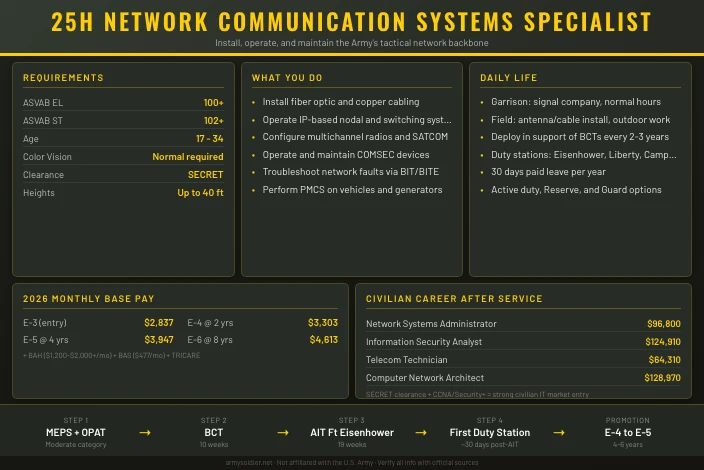
The Network Communication Systems Specialist (MOS 25H) supervises, installs, operates, and performs field-level maintenance on tactical and commercial network systems. This includes fiber and copper cabling, IP-based high-speed nodal systems, multichannel line-of-sight radios, tropospheric scatter communications, tactical satellite terminals, COMSEC devices, and all associated network management infrastructure.
What You Do Every Day
The daily rhythm depends on your skill level and current mission status, but the core tasks run across all 25H soldiers.
- Install and configure fiber optic and copper cabling for tactical network nodes
- Operate and maintain IP-based nodal assemblages and integrated network control centers
- Configure and operate multichannel line-of-sight radios and associated relay equipment
- Set up and maintain COMSEC devices, perform strapping and re-strapping procedures
- Troubleshoot network faults using BIT/BITE diagnostics and software analysis tools
- Perform Preventive Maintenance Checks and Services (PMCS) on assigned vehicles and power generators
- Compile operational statistics and submit network status reports up the chain of command
At the entry level (25H1O), you’re doing hands-on installation and operation under a team leader’s supervision. As a Sergeant (25H2O), you lead or participate as a team leader, coordinate remote trunking operations, and implement network changes from the operations center. Senior NCOs (25H3O and 25H4O) plan and supervise all phases of network construction, manage nodal databases, and develop training programs for subordinates.
Specializations and Identifiers
| Identifier | Type | Description |
|---|---|---|
| J7 | ASI | WHCA Console Control Operations |
| Q6 | ASI | Protection Cell Operations – skill levels 4-6 only (effective October 2024) |
Mission Contribution
Without the network node team, the tactical internet goes dark. 25H soldiers provide the backbone that connects battalion command posts to brigade and division-level systems, enabling voice, data, and video communications across the battlefield. The job exists at the intersection of commercial networking technology and Army tactical doctrine – the systems look familiar to anyone with a networking background, but the operational environment demands a different skill set entirely.
Equipment and Technology
25H soldiers work with a wide range of systems that span the commercial and military network world.
- IP Nodal Systems: JNN (Joint Network Node), WIN-T (Warfighter Information Network-Tactical) hardware
- Satellite terminals: Tactical terrestrial satellite systems and anti-jam reliable tactical terminals
- Multichannel radios: Line-of-sight and tropospheric scatter systems
- COMSEC equipment: KG-175D, KG-250 and similar NSA Type 1 encryption devices
- Cable systems: Fiber optic, CAT6, and tactical cabling with associated tools
- Network management: Army tools for network monitoring, troubleshooting, and reconfiguration
This is hands-on technical work. You spend time outdoors configuring antenna systems, inside vehicles operating terminals, and in network operations centers analyzing traffic data.
Salary and Benefits
Base Pay and Special Pay
25H soldiers typically enter the workforce at E-3 after BCT or E-4 after demonstrated aptitude. All 2026 pay figures are from DFAS.
| Rank | Years of Service | Monthly Base Pay |
|---|---|---|
| E-3 (PFC) | Less than 2 | $2,837 |
| E-4 (SPC) | 2 years | $3,303 |
| E-5 (SGT) | 4 years | $3,947 |
| E-6 (SSG) | 8 years | $4,613 |
| E-7 (SFC) | 12 years | $5,537 |
Base pay is just the start. Most active-duty soldiers draw significant additional allowances.
Allowances and Additional Benefits
Basic Allowance for Housing (BAH) varies by duty location, pay grade, and whether you have dependents. A single E-4 at Fort Eisenhower, Georgia pulls roughly $1,200 per month; the same soldier at a higher-cost installation would draw more. Check the DoD BAH rate lookup tool for exact figures by zip code.
Basic Allowance for Subsistence (BAS) is $476.95 per month for all enlisted soldiers – a flat national rate.
TRICARE Prime covers all active-duty soldiers and their families at zero enrollment cost, with no copays for care received in the military system.
The Blended Retirement System (BRS) combines a 20-year pension at 40% of average high-36 base pay with TSP matching of up to 4% of base pay (plus an automatic 1% government contribution). Continuation Pay, typically 2.5 times monthly base pay, is available between years 7 and 12 with a 3-year re-up.
Tuition Assistance (TA) covers up to $4,500 per year and $250 per semester credit hour while on active duty for college coursework.
Enlistment Bonus
The Army has periodically offered bonuses for signal MOS jobs. Whether 25H carries a current bonus depends on Army accession needs at the time you enlist. Ask your recruiter for the current incentive table.
Work-Life Balance
Active-duty soldiers earn 30 days of paid leave annually, accruing at 2.5 days per month. The Army observes 11 federal holidays. In garrison, signal units generally work normal duty hours outside of exercises and deployments. Field exercises involve irregular hours and potential 12-plus-hour days. The 25H community is not typically subject to the same persistent operational tempo as combat arms, but deployments happen, especially in support of BCTs.
Qualifications and Eligibility
Requirements at a Glance
| Requirement | Standard |
|---|---|
| ASVAB EL (Electronics) | 100 minimum |
| ASVAB ST (Skilled Technical) | 102 minimum |
| Security Clearance | SECRET |
| Citizenship | U.S. citizen |
| Color Vision | Normal color vision required |
| Physical Profile | 212221 |
| OPAT Category | Moderate (Gold) |
| Height Work | Must work at heights up to 40 feet for extended periods |
| Confined Space | Must work underground in low-light conditions for extended periods |
| Language | Must read, comprehend, and clearly enunciate English |
ASVAB line score requirements are from DA Pam 611-21 (effective October 2025). The EL composite is General Science + Arithmetic Reasoning + Math Knowledge + Electronics Information. ST is General Science + Verbal Expression + Math Knowledge + Mechanical Comprehension.
OPAT Standards
The Occupational Physical Assessment Test (OPAT) for Moderate (Gold) requires:
- Standing Long Jump: 120 cm or more
- Seated Power Throw: 350 cm or more
- Strength Deadlift: 120 lbs or more
- Interval Aerobic Run: 36 shuttles or more
The height and confined-space requirements are specific to 25H given the nature of antenna work and underground cable installation.
Application Process
Selection Criteria
25H is moderately competitive – the EL and ST minimums screen out candidates without solid math and electronics fundamentals, but the thresholds are lower than the 17C or 17E requirements. The SECRET clearance has a real adjudication process, so candidates with significant financial problems, drug history, or serious criminal records face meaningful risk.
Army Reserve and National Guard components also offer 25H positions, which allow soldiers to serve part-time while maintaining civilian employment.
See our ASVAB study guide for strategies to hit these line scores, or take the PiCAT from home if you are a first-time tester.
Work Environment
Setting and Schedule
25H soldiers operate in a range of settings. Garrison assignments put you in a signal company’s maintenance and operations area, often with access to well-equipped shops for equipment maintenance. Field training puts you outdoors, installing cable, raising antenna systems, and operating nodes from tactical vehicles or shelter systems. Deployments replicate field conditions in an operational context.
Height work is a routine part of the job. Installing antennas on towers, vehicles, and elevated positions is standard. Underground cable work in low-light conditions is also within scope. Soldiers uncomfortable with heights or confined spaces should consider another signal MOS.
Shifts vary by unit and mission. Network operations centers often run 24-hour watches, which means rotating shifts are common in deployed environments.
Leadership and Communication
Signal companies are organized around platoons of 20 to 40 soldiers. As a junior 25H, you work under a team leader (typically an E-5 or E-6) and platoon sergeant. Performance feedback is provided through formal counseling sessions required at least quarterly.
Communication within the unit is direct and technical. Network status briefs, trouble tickets, and shift-change handoff reports are routine products you’ll produce.
Team Dynamics
25H work is inherently team-based. Node installation requires multiple soldiers working in coordination. Troubleshooting complex faults draws on the team’s collective knowledge. Soldiers who thrive in collaborative technical environments find the job rewarding. Those who prefer solo work or pure desk-based computing may find the field exposure unexpected.
Job Satisfaction
The 25H community is relatively new as a consolidated MOS, but the underlying signal specialties have long histories in the Army. Soldiers who enjoy working with both physical infrastructure and digital network systems tend to find the job engaging. The civilian market alignment is strong – the skills translate directly to networking careers without significant retraining.
Training and Skill Development
Training Pipeline Overview
| Phase | Location | Length | Focus |
|---|---|---|---|
| Basic Combat Training (BCT) | Various installations | 10 weeks | Basic soldiering, physical fitness, weapons qualification |
| Advanced Individual Training (AIT) | Fort Eisenhower, GA (Signal School) | 19 weeks | Network systems installation, nodal operations, COMSEC, fiber and cable work |
Basic Combat Training
The standard 10-week BCT program applies to all Army MOS. 25H soldiers attend BCT at installations including Fort Jackson (SC), Fort Leonard Wood (MO), or Fort Moore (GA). BCT covers basic soldier skills and physical fitness, with nothing MOS-specific.
Advanced Individual Training
The 25H AIT runs 19 weeks at the U.S. Army Signal School, Fort Eisenhower, Georgia. The Signal School is part of the Cyber Center of Excellence (CCoE), which also hosts training for cyber MOS. The curriculum covers:
- Fiber optic and copper cable installation and testing
- IP-based nodal system configuration and operation
- Multichannel radio operation and maintenance
- Satellite terminal setup and troubleshooting
- COMSEC device operation, strapping, and re-strapping
- Network management software and fault isolation procedures
- BIT/BITE diagnostic techniques
- Vehicle and generator PMCS
The course combines classroom instruction with practical exercises on actual tactical systems. Graduates of the first 25H course received their AIT training on the consolidated curriculum that merged content from the former 25L, 25N, and 25Q courses.
Certifications and Advanced Training
The Army’s COOL (Credentialing Opportunities On-Line) program identifies civilian certifications relevant to 25H. These include:
- CompTIA Network+
- CompTIA Security+
- Certified Fiber Optic Technician (CFOT)
- Cisco CCNA
- DoD 8570 baseline certifications tied to the SECRET clearance requirement
Most of these certifications can be earned while on active duty through Army TA funding. After AIT, soldiers may attend:
- Nodal Systems NCO Course (for E-5 and above)
- Advanced Signal Leaders Course
- Network Management courses through the Signal School resident program
Everything starts with qualifying ASVAB scores — our study guide covers what to study first.
Career Progression and Advancement
Rank Progression
| Rank | Grade | Typical Time |
|---|---|---|
| Private First Class (PFC) | E-3 | Enter after BCT; E-4 within 6-12 months |
| Specialist (SPC) | E-4 | ~1-2 years |
| Sergeant (SGT) | E-5 | ~4-6 years total service |
| Staff Sergeant (SSG) | E-6 | ~7-10 years |
| Sergeant First Class (SFC) | E-7 | ~12-16 years |
| Master Sergeant (MSG) | E-8 | ~18-22 years |
| Sergeant Major (SGM) | E-9 | ~22-26 years |
Career Path Options
25H soldiers have multiple directions available as they progress.
Within Signal Corps: Senior NCOs move into network operations center leadership, signal company platoon sergeant and first sergeant roles, and brigade S6 positions. The CMF 25 career management field includes a broad range of related MOS – experience in 25H provides familiarity with systems that adjacent specialties (25B, 25D, 25E) also touch.
Warrant Officer: The 255A (Information Services Technician) and 255S (Information Protection Technician) warrant officer MOS are natural transitions for technically strong 25H NCOs. Warrant officers apply through WOCS and serve as technical experts and advisors at higher headquarters.
Lateral to Cyber: Soldiers with strong aptitude and a Secret clearance can pursue upgrade to TS/SCI and apply for 25D (Cyber Network Defender) or other high-demand MOS. This usually requires additional testing and a service remaining requirement.
Performance Evaluation
The Army NCOER system for E-5 and above assesses five areas: Character, Presence, Intellect, Leads, and Achieves. For 25H, technical proficiency is a major factor – can your node stay operational during a field exercise, can you train your subordinates on new equipment. Soldiers who take ownership of their certifications, track their equipment readiness, and produce quality network products for commanders get the top-block ratings that drive promotion.
Physical Demands and Medical Evaluations
Daily Physical Demands
The 25H physical profile is 212221 and OPAT category is Moderate (Gold). On a typical day, soldiers can expect:
- Carrying equipment loads during installation tasks (cable reels, antenna components, generator fuel cans)
- Climbing towers or elevated structures up to 40 feet for antenna installation
- Working in crawl spaces, utility tunnels, or underground conduits in low-light conditions
- Operating in full gear during field exercises and deployments
The 212221 profile indicates no running limitation and full upper body and lower body mobility requirements. This is physical work, especially during installation phases of a network node setup.
Army Fitness Test Standards
The Army Fitness Test (AFT) has five events with a maximum of 500 points (100 per event). The general passing standard is 300 points total with at least 60 points per event, scored sex- and age-normed. 25H is not among the 21 designated combat MOSs, so soldiers need the general 300-point standard rather than the 350-point combat standard.
| AFT Event | Abbreviation |
|---|---|
| 3 Repetition Maximum Deadlift | MDL |
| Hand Release Push-Up – Arm Extension | HRP |
| Sprint-Drag-Carry | SDC |
| Plank | PLK |
| Two-Mile Run | 2MR |
Medical Standards
Standard MEPS physical at enlistment. The SECRET clearance investigation covers financial, criminal, and personal conduct history. Normal color vision is required and verified at MEPS. Annual physical readiness requirements remain in effect throughout service.
Deployment and Duty Stations
Deployment Likelihood
Signal units support nearly every Army formation, which means 25H soldiers can expect deployment as part of a BCT or division-level support element. BCTs typically deploy on a 24 to 36 month cycle for rotations of 9 to 12 months. Some signal units have higher operational tempos based on their parent command.
Domestic deployments in support of National Guard activations, disaster relief, or training exercises are also common for reserve component soldiers.
Common Duty Stations
25H soldiers serve across the Army wherever there are signal units. Common locations include:
- Fort Eisenhower, GA – CCoE and 15th Signal Brigade
- Fort Liberty, NC – XVIII Airborne Corps and 35th Signal Brigade
- Fort Campbell, KY – 101st Airborne Division
- Fort Hood (Fort Cavazos), TX – III Corps elements
- Fort Wainwright, AK – 11th Airborne Division
- Korea and Germany – USFK and EUCOM BCT assignments
Assignment preferences can be requested but are filled based on Army requirements. First-term soldiers generally go where the vacancies are.
Risk, Safety, and Legal Considerations
Job Hazards
The main physical risks in 25H work are fall hazards from elevated antenna work and electrical hazards from working with power distribution systems. COMSEC mishandling carries both legal and operational risk.
- Falls from antenna towers or elevated positions
- Electrical shock during power generator and equipment hookup
- RF energy exposure when working near transmitting antenna systems
- Heat and cold stress during extended field operations
Safety Protocols
Tower and elevated work requires safety harness equipment and training. Electrical safety procedures govern all power hookups. RF safety standoff distances apply when working near active transmitters. Soldiers receive safety training for all these hazards during AIT and refreshers at unit level.
Security and Legal Requirements
The SECRET clearance creates legal obligations under federal security regulations. Soldiers must report unauthorized access attempts, unusual contacts, foreign travel, and any conduct that could affect clearance status. Unauthorized disclosure of classified network architecture or COMSEC procedures carries serious legal consequences.
There is no special extended service obligation for 25H beyond the standard enlisted contract length.
Impact on Family and Personal Life
Family Considerations
Signal unit deployments affect families similarly to other support branch MOS. The Army’s Family Readiness Groups, TRICARE family healthcare, and on-post community resources provide support during separations. TRICARE enrollment covers family members at zero cost while the soldier is on active duty.
The SECRET clearance background investigation is generally straightforward for most candidates, but financial issues or foreign national close family members can extend the adjudication timeline.
Relocation
PCS moves happen roughly every 2 to 3 years. The Army pays a moving allowance and provides advance pay to offset relocation costs. Fort Eisenhower (Augusta, GA), Fort Liberty (Fayetteville, NC), and Fort Campbell (Clarksville, TN) are common first duty stations with active military communities and reasonable cost of living.
Civilians with networking or IT backgrounds should know that most of the larger 25H duty stations are near technology-sector job markets, which can be an asset for employed spouses.
Reserve and National Guard
The 25H MOS is available in both the Army Reserve and the Army National Guard through signal companies and battalions. Nearly every division and corps in the Reserve component has signal units that carry 25H positions. If you want to serve part-time after an active-duty enlistment, or if you want to enlist directly into the Reserve or Guard as a 25H, options are available.
Component Availability
Signal companies and battalions in the Reserve and Guard have 25H billets covering nodal operations, cable installation, and transmission systems. The MOS consolidated three legacy jobs (25L, 25N, 25Q) in 2022, so Reserve and Guard units now carry 25H positions where those older identifiers previously appeared.
Guard units may also activate for domestic missions – communications support for disaster relief, emergency response, or state-level exercises – where 25H soldiers provide network infrastructure in austere conditions outside the traditional federal training cycle.
Drill Schedule and Extra Training
Standard Reserve and Guard service is one weekend per month plus two weeks of Annual Training. For 25H soldiers, that baseline covers routine equipment maintenance, system checks, and unit training tasks.
The broad scope of 25H – fiber, satellite, multichannel radio, nodal systems, COMSEC – means proficiency requires practice. Soldiers who want to stay technically sharp should pursue certifications through Army COOL on their own time:
- CompTIA Network+ and Security+ are the primary certifications for 25H soldiers and can be pursued with Army-funded exam vouchers
- Cisco CCNA builds additional marketability for civilian networking roles
- CompTIA Security+ is mandatory for soldiers serving in DoD 8140 IAT Level II billets, including many network administration roles in Reserve and Guard units
Annual Training often involves field exercises where 25H soldiers set up tactical network nodes, establish satellite links, and run real fiber cable under time pressure. These exercises are the most realistic training available in the part-time cycle and are worth treating as a priority.
Pay and Benefits Comparison
Reserve and Guard drill pay is based on rank and time in service. An E-4 with four years of service earns approximately $488 per standard drill weekend. Active-duty E-4 base pay at four years is $3,659 per month. Part-time service pays significantly less, but the time commitment is also significantly smaller – roughly four days per month rather than full-time.
Healthcare for Reserve and Guard members not on active-duty orders uses Tricare Reserve Select: $57.88 per month for member-only coverage or $286.66 per month for member and family. Active-duty TRICARE has no enrollment fee. Both Reserve Select tiers cost far less than typical civilian group health plans.
Education benefits include the MGIB-SR (Chapter 1606) at $493 per month for full-time students, plus Federal Tuition Assistance at up to $250 per credit hour with a $4,500 annual cap. Guard soldiers frequently benefit from state tuition waivers, with many states covering 100% of tuition at public in-state universities.
Deployment and Mobilization
Signal units deploy to support every type of Army formation, which means 25H soldiers in the Reserve and Guard face a moderate mobilization rate. Communication systems support is needed across all types of deployments, from sustained combat operations to theater-level exercises and humanitarian missions.
USERRA protects your civilian employment during any federally ordered mobilization. Your employer must reinstate you with full seniority and benefits when you return.
Civilian Career Integration
The 25H technical foundation – fiber, IP networking, satellite terminals, COMSEC – pairs well with civilian networking and telecommunications careers. A 25H soldier who works as a network technician or telecommunications installer in civilian life brings current, relevant skills to every drill weekend. The Secret clearance maintained through Reserve or Guard service is an asset in the cleared contractor market.
Network technicians and field engineers at defense contractors and commercial telecom companies earn $50,000 to $85,000+ depending on location and certifications. Cisco and CompTIA credentials, combined with clearance and military experience, push compensation higher in the defense sector.
Reserve retirement is points-based, with a pension beginning at age 60 (reduced by three months for every 90 days of qualifying active-duty mobilization after January 28, 2008, to a minimum of age 50).
| Feature | Active Duty | Army Reserve | Army National Guard |
|---|---|---|---|
| Duty Status | Full-time | Part-time (1 wknd/mo + 2 wks/yr) | Part-time (1 wknd/mo + 2 wks/yr) |
| Monthly Pay (E-4, 4 yrs) | $3,659/mo | ~$488/drill weekend | ~$488/drill weekend |
| Healthcare | TRICARE (no premium) | Tricare Reserve Select ($57.88/mo) | Tricare Reserve Select ($57.88/mo) |
| Education | Post-9/11 GI Bill, TA | MGIB-SR ($493/mo), TA | MGIB-SR ($493/mo), TA, state tuition waivers |
| Deployment | Per unit rotation | When mobilized | When mobilized |
| Retirement | 20-year pension | Points-based, age 60 | Points-based, age 60 |
Post-Service Opportunities
Civilian Career Transition
The skills built in 25H translate cleanly into commercial networking careers. Fiber installation, IP network configuration, satellite communications, and COMSEC operations all have direct civilian equivalents in telecom companies, defense contractors, ISPs, and government IT contractors. The SECRET clearance, combined with hands-on networking experience, opens doors to cleared IT positions that pay a premium.
The Post-9/11 GI Bill covers 36 months of education – full in-state tuition at public schools or up to $29,920.95 per year at private institutions (AY 2025-2026 cap), plus a monthly housing allowance. Many 25H veterans use the GI Bill to complete a bachelor’s degree in network engineering or cybersecurity while working as cleared contractors.
TAP (Transition Assistance Program) provides resume writing support, interview coaching, and job fairs oriented toward veterans, starting 6 months before separation.
Civilian Career Prospects
| Civilian Job Title | Median Annual Salary (May 2024) | Outlook (2024-2034) |
|---|---|---|
| Network and Computer Systems Administrator | $96,800 | -4% overall; ~14,300 openings/year from attrition |
| Information Security Analyst | $124,910 | +29% (much faster than average) |
| Telecommunications Technician | $64,310 | -3% overall; stable in defense sector |
| Computer Network Architect | ~$128,970 | Moderate growth |
Network administrator and security analyst figures from the Bureau of Labor Statistics. Despite the declining outlook for general network admins, cleared and defense-sector candidates face a very different market than the overall statistics reflect.
Soldiers who pursue Security+ and CCNA certifications during service enter the civilian market with credentials that employers recognize immediately.
Is This a Good Job for You? The Right (and Wrong) Fit
Who Thrives Here
The best-fit candidates for 25H combine technical curiosity with practical hands-on skill. This is not a pure desk job, and it’s not pure wrench-turning either.
You’re probably a good fit if you:
- Enjoy working with both physical infrastructure and digital systems
- Have a basic foundation in electronics or networking (even amateur radio or home networking experience helps)
- Are comfortable working outdoors in field conditions, including at heights
- Want a clear civilian career path in IT or networking after service
- Can maintain a SECRET clearance without complications
Potential Challenges
The consolidated nature of 25H means you’re expected to know fiber, satellite, radio, IP networking, and COMSEC – a broad technical scope. The job is not plug-and-play; troubleshooting in a field environment without Google is the real test. Soldiers who struggle with systematic problem-solving or get frustrated by complex technical work may find the MOS demanding.
Field exercises and deployments mean the work is not always predictable. Signal units support combat formations, which means you may be operating in environments that are less comfortable and less safe than a data center.
Career and Lifestyle Alignment
If you want a 4-year enlistment that sets up a civilian IT career with a recognized certification, active clearance, and real hands-on experience, 25H delivers that. Soldiers who re-enlist have access to an increasingly specialized career path with senior leadership opportunities. For those who prefer a more comfortable, indoor, predictable work environment from day one, other signal MOS might be worth comparing.
More Information
A local Army recruiter can tell you current 25H availability, bonus eligibility, and which duty stations have active vacancies. Because the SECRET clearance process takes time, starting the conversation early gives you more options when you ship.
- Prepare for the ASVAB with our study guide to make sure your line scores qualify
This site is not affiliated with the U.S. Army or any government agency. Verify all information with official Army sources before making enlistment or career decisions.
Explore more Army Cyber & Signal careers such as 25B Information Technology Specialist and 25N Nodal Network Systems Operator-Maintainer.