25N Nodal Network Systems Operator-Maintainer
Every brigade combat team depends on a network of nodes – tactical hubs that route voice, data, and video across an entire area of operations. When a command post loses its connection at 0300, when a commander’s common operating picture goes dark mid-exercise, the 25N is the soldier who fixes it. You build and maintain the backbone that everything else runs on.
Qualifying requires specific ASVAB line scores — our ASVAB study guide covers what to target and how to prepare.
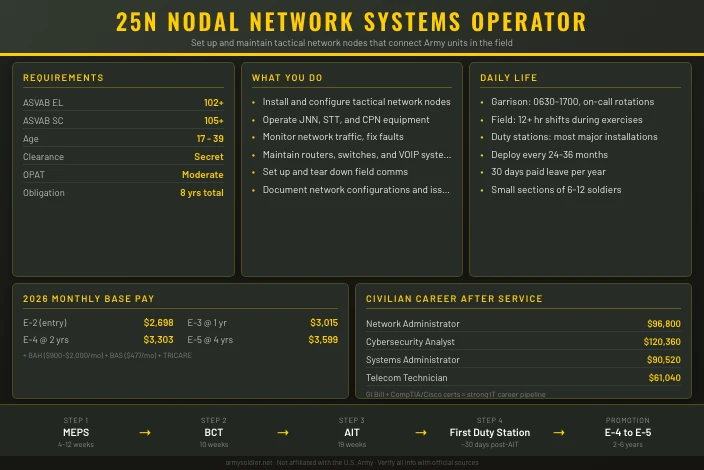
Job Role and Responsibilities
As a 25N Nodal Network Systems Operator-Maintainer, you install, operate, and maintain the nodal network systems that form the Army’s tactical communications backbone. You configure Joint Network Nodes (JNN), Command Post Nodes (CPN), and associated transmission assemblages, troubleshoot signal degradation and equipment faults, and keep multi-echelon data networks running in garrison and deployed environments.
Daily Tasks
In garrison, a typical day starts with system checks on the JNN and any transmission links the section manages. You verify connectivity, check error logs, replace degraded components, and coordinate with higher and lower headquarters about any planned maintenance windows. Paperwork matters here: equipment readiness reports, maintenance forms, and PMCS (Preventive Maintenance Checks and Services) logs fill the morning.
In the field, the job looks completely different. You convoy to a new site, establish a network node from scratch, align satellite terminals and microwave links, and verify the command post has connectivity before the commander sets foot in the tent. Tear-down is just as demanding as set-up. Equipment has to be packed, staged, and ready to move on short notice.
At larger installations or corps-level units, 25N soldiers work in Network Operations and Security Centers (NOSCs), monitoring traffic across multiple echelons, identifying bottlenecks, and managing bandwidth allocation for the entire theater network.
Specific Roles
The 25N functions within CMF 25 (Signal Corps). The skill level system tracks progression from entry operator to senior supervisor:
| Identifier | Type | Description |
|---|---|---|
| 25N | Primary MOS | Nodal Network Systems Operator-Maintainer |
| 25N10 | Skill Level 1 | Entry-level operator (E-1 through E-4) |
| 25N20 | Skill Level 2 | Team leader/supervisor (E-5) |
| 25N30 | Skill Level 3 | Section chief/senior NCO (E-6) |
| 25N40 | Skill Level 4 | Senior network supervisor (E-7 and above) |
| ASI 1C | Additional Skill Identifier | Allied Trades Specialist |
| SQI P | Special Qualification Identifier | Parachutist (airborne-qualified units) |
Soldiers who complete additional qualifications may serve in airborne signal companies, Rapid Deployment Communications teams, or Joint Communications Support Elements.
Mission Contribution
The Army’s tactical network is not a single system. It’s a layered architecture of nodes, links, and protocols that commanders rely on for command and control at every echelon. Without functional nodes, fires cannot be coordinated, intelligence cannot flow, and logistics cannot be tracked. The 25N is the technical expert responsible for keeping those nodes online.
During a brigade-level field exercise or real-world operation, the nodal network section is one of the first elements to arrive at a new site and one of the last to leave. The network has to be up before anyone else can work, and it has to stay up through 24-hour operations, weather changes, and equipment failures.
Technology and Equipment
The equipment list for a 25N is long and spans both legacy and current systems:
- Joint Network Node (JNN) – the primary tactical command post network hub, providing voice, data, and video services to brigade and battalion command posts
- Command Post Node (CPN) and Tactical Command Post Node (TCN) – smaller nodes supporting battalion and company-level command posts
- TRILOS (Tri-Band Line-of-Sight) microwave transmission assemblage for long-haul data links
- HCLOS (High-Capacity Line-of-Sight) microwave systems for point-to-point links
- SMART-T (Secure Mobile Anti-Jam Reliable Tactical Terminal) for satellite-based beyond-line-of-sight communications
- STT (SATCOM Transportable Terminal) for wideband satellite access
- T2C2 (Transportable Tactical Command Communications) system
- Fiber optic cable and fusion splicing equipment for local area networks
You also work with standard Army network management tools, spectrum management software, and cryptographic equipment for securing classified communications.
Salary and Benefits
Financial Benefits
Military pay is based on rank and time in service. Most 25N soldiers enter at E-2 following Basic and begin receiving full pay and allowances immediately.
| Rank | Pay Grade | Monthly Base Pay (2026) |
|---|---|---|
| Private (PV2) | E-2 | $2,698 |
| Private First Class (PFC) | E-3 | $3,015 |
| Specialist (SPC) | E-4 | $3,303 |
| Sergeant (SGT) | E-5 | $3,599 |
| Staff Sergeant (SSG) | E-6 | $3,743 |
Base pay is only part of total compensation. BAH (Basic Allowance for Housing) adds $900 to $2,000+ per month depending on your duty station and dependency status – it varies significantly by location. BAS (Basic Allowance for Subsistence) adds $476.95 per month for food. Signal MOSs in the 25 series have historically qualified for enlistment bonuses, with specific amounts varying by contract length and Army needs. Verify current figures with your recruiter because bonus charts change frequently.
Additional Benefits
TRICARE covers you and your family at no cost while on active duty. Doctor visits, prescriptions, dental, vision, mental health services, and hospital stays are all included with no premiums or deductibles.
Tuition Assistance pays up to $4,500 per year for college courses while you serve. After separation, the Post-9/11 GI Bill covers up to 36 months of tuition (full in-state rate at public schools, or up to $29,920.95 per academic year at private schools) plus a monthly housing allowance and $1,000 annual book stipend.
Retirement runs through the Blended Retirement System (BRS):
- Serve 20 years and earn a pension worth 40% of your high-36 average base pay
- The government contributes up to 5% of base pay to your Thrift Savings Plan (TSP)
- Continuation pay at the 7-12 year mark provides a lump sum in exchange for extending your service commitment
Work-Life Balance
You earn 30 days of paid leave per year. Garrison life for signal soldiers is generally structured around a regular weekday schedule, though on-call rotations for network emergencies are common. Field exercises and deployments push that to 12-hour shifts or longer.
Compared to combat arms MOSs, the 25N has more predictable garrison hours. The trade-off is that network outages don’t follow business hours. A failed node at 0200 on a Sunday is still your responsibility.
Qualifications and Eligibility
Basic Qualifications
You must be a U.S. citizen between 17 and 39 years old. High school graduates need a minimum AFQT score of 31. GED holders need at least 50. The 25N has two ASVAB line score requirements:
- Electronics (EL): 102 minimum – derived from General Science (GS), Arithmetic Reasoning (AR), Mathematics Knowledge (MK), and Electronics Information (EI)
- Surveillance and Communications (SC): 105 minimum – derived from Verbal Expression (VE), Arithmetic Reasoning (AR), Auto and Shop Information (AS), and Mechanical Comprehension (MC)
Both scores must meet the minimum. Scoring 102 on EL but 104 on SC does not qualify you. These are among the highest line score requirements in CMF 25, reflecting the technical complexity of nodal network systems.
| Requirement | Details |
|---|---|
| Age | 17-39 years old |
| Citizenship | U.S. citizen |
| Education | High school diploma or GED |
| AFQT (ASVAB) | Minimum 31 (diploma) or 50 (GED) |
| Electronics (EL) | Minimum 102 |
| Surveillance & Comms (SC) | Minimum 105 |
| Security Clearance | Secret |
| OPAT | Moderate physical demand (Gold level) |
| Vision | Correctable to 20/20 |
Application Process
Start at a local Army recruiting station. Your recruiter will pull your ASVAB scores and confirm whether you qualify for 25N (or the consolidated 25H MOS for new accessions). If you haven’t taken the ASVAB yet, your recruiter schedules you at a Military Entrance Processing Station (MEPS).
At MEPS, you complete a full physical exam, take the ASVAB if needed, and pass the OPAT at the Moderate (Gold) level. The Moderate OPAT requires:
- Strength deadlift: 120 pounds
- Standing long jump: 3 feet 11 inches
- Seated power throw: 11 feet 6 inches
- Interval aerobic run: 10:27 (36 shuttles)
The background investigation for the Secret clearance runs concurrently with your application but can extend your timeline. From your first recruiter visit to swearing in typically takes 4 to 12 weeks.
Selection Criteria and Competitiveness
The dual line score requirement (EL 102 and SC 105) makes this more selective than many Signal MOSs. Most candidates who qualify for 25N also qualify for 25B (IT Specialist, ST 95 only) and 25S (SATCOM Operator, EL 98/SC 98), but not necessarily the reverse.
Prior experience in electronics, networking, or telecommunications is not required but helps during AIT. Candidates with CompTIA A+ or Network+ certifications, amateur radio licenses, or vocational electronics training tend to absorb the curriculum faster.
Upon Accession into Service
Most recruits enter at E-1 (Private) and promote to E-2 after Basic. College credits or JROTC participation can bump you to E-3 or E-4 on entry. The standard service obligation is 8 years total, divided between active duty (typically 3 to 6 years depending on your contract) and the Individual Ready Reserve (IRR).
See our ASVAB study guide for strategies to hit these line scores, or take the PiCAT from home if you are a first-time tester.
Work Environment
Setting and Schedule
The 25N works across a wide range of environments:
| Environment | Setting | Schedule |
|---|---|---|
| Garrison | Server rooms, comms facilities | 0630-1700, on-call rotations |
| Field exercise | Tents, vehicle-mounted systems | 12+ hr shifts, no fixed schedule |
| Deployed | Austere sites, command posts | Continuous ops, rotating shifts |
In garrison, you spend time on equipment maintenance, system configuration, and training. Field exercises change everything: you operate in austere conditions with no power, shelter, or climate control beyond what you bring. Deployments add operational security requirements and potentially hostile environments.
Leadership and Communication
Your chain of command runs through the signal officer (S-6 or signal battalion) and the section’s senior NCO. In a brigade combat team, the nodal network section typically falls under a signal company. At division and corps level, the structure is larger with more specialization.
Counseling sessions happen monthly for junior soldiers and quarterly for NCOs. After-action reviews follow major exercises and maintenance periods. Signal problems are visible and high-stakes, so feedback from leadership tends to be direct and timely when something goes wrong.
Team Dynamics and Autonomy
Nodal network sections are small, usually 6 to 12 soldiers covering multiple system operator and maintainer roles. Every person carries a significant workload. Junior soldiers (E-3 through E-4) work under close supervision during set-up operations but handle routine maintenance tasks independently.
At E-5, you shift into a team leader role. You’re responsible for your team’s equipment readiness, training, and performance during operations. By E-6, you’re the section’s primary technical authority and the first call when something breaks.
Job Satisfaction and Retention
Retention in signal MOSs is mixed. The technical skills the Army teaches are highly marketable, so many soldiers leave after one contract for better-paying civilian networking or IT jobs. Those who stay tend to cite the variety of assignments, the quality of training, and the value of a Secret clearance on their civilian resume.
The most common frustrations: non-technical duties (guard rosters, motor pool, unit taskings) and the pay gap relative to civilian network engineers with the same experience. Soldiers in high-visibility assignments at division or corps level, or those who land a slot at a joint unit, generally report higher satisfaction than those in smaller tactical units with limited technical scope.
Training and Skill Development
Initial Training
Training runs in two phases: Basic Combat Training (BCT) followed by Advanced Individual Training (AIT). Under the consolidated 25H structure, 25N-track soldiers complete the same AIT pipeline.
| Training Phase | Location | Duration | Focus |
|---|---|---|---|
| BCT | Fort Jackson, SC; Fort Moore, GA; Fort Leonard Wood, MO | 10 weeks | Soldier fundamentals: weapons qualification, land navigation, physical fitness, tactics |
| AIT (25H/25N track) | Fort Eisenhower, GA | 19 weeks | Nodal systems, transmission assemblages, fiber optic cable, satellite terminals, network operations |
BCT is identical for all Army MOSs. Ten weeks of physical training, marksmanship, land navigation, first aid, and soldier skills. No technical training happens here.
AIT at Fort Eisenhower is where the real training starts. The 19-week course covers the full range of nodal and transmission skills: JNN and CPN configuration, microwave link planning and alignment, SATCOM terminal setup, fiber optic splicing, and network troubleshooting under operational conditions. You spend significant time in field exercises that simulate real deployments, not just classroom instruction.
The Army article on the first 25H graduating class noted that graduates trained to “operate multiple nodes (JNN, TCN, CPN), transmission assemblages (TRILOS, HCLOS, STT, T2C2, SMART-T) and develop/splice fiber cables.” That is a wide technical foundation.
Advanced Training
After AIT, your first duty station is where deep proficiency develops. Senior NCOs mentor junior soldiers on unit-specific systems, local network architecture, and operational procedures. Several formal training paths are available:
- CompTIA Network+ and Security+ certifications align directly with 25N work and are funded through Army COOL. Security+ is required for soldiers in Information Assurance roles under DoD Directive 8140.
- Cisco CCNA training is available through some installations and Army distance learning programs.
- CCNP and advanced Cisco certifications become relevant for senior NCOs and those moving into network operations center roles.
- Functional courses at Fort Eisenhower cover advanced transmission systems, SATCOM operations, and cyber defense. These are 4 to 12 weeks and can lead to ASI qualifications.
Soldiers with strong evaluations and relevant certifications are competitive for assignments at joint units, CYBERCOM, or NSA-adjacent positions that significantly expand technical scope.
Everything starts with qualifying ASVAB scores — our study guide covers what to study first.
Career Progression and Advancement
Career Path
Promotion to E-4 (Specialist) is mostly time-based in the first two years if you meet conduct and fitness standards. E-5 (Sergeant) requires passing a promotion board, completing the Basic Leader Course, and meeting point cutoffs. The shift at E-5 is significant: you lead people, not just operate equipment.
| Rank | Pay Grade | Typical Timeline | Typical Role |
|---|---|---|---|
| Private (PV2) | E-2 | 0-1 year | AIT graduate, supervised system operations |
| Private First Class (PFC) | E-3 | 1-2 years | Routine maintenance, assisted node operations |
| Specialist (SPC) | E-4 | 2-3 years | Independent system operator, section equipment |
| Sergeant (SGT) | E-5 | 4-6 years | Team leader, node operations supervisor |
| Staff Sergeant (SSG) | E-6 | 6-9 years | Section NCOIC, technical authority |
| Sergeant First Class (SFC) | E-7 | 9-13 years | Platoon sergeant, signal operations manager |
| Master Sergeant (MSG) | E-8 | 13+ years | Senior signal NCO, battalion-level advisor |
25N soldiers who want a longer technical career have two strong options. Reclassification to 17C (Cyber Operations Specialist) is possible for soldiers who meet the additional prerequisites. The Warrant Officer path to 255A (Information Services Technician) is popular because it lets you stay technical rather than transitioning into pure leadership.
Role Flexibility and Transfers
Within CMF 25, lateral moves are common. A 25N can reclassify to 25B (IT Specialist), 25S (SATCOM Operator), or 25U (Signal Support Systems Specialist) with commander approval and available slots. Moving into the cyber field (17 series) requires meeting that MOS’s specific requirements.
Transfers outside CMF 25 are harder. You need ASVAB scores for the target MOS and commander approval. Most soldiers who leave the signal field move into intelligence or cyber roles where the technical background transfers well.
Performance Evaluation
NCOs get rated annually through the NCOER (Non-Commissioned Officer Evaluation Report). Your rater and senior rater score leadership, training, and technical competence. Strong NCOERs are the primary driver of promotion above E-5.
What separates competitive soldiers in this MOS: industry certifications, leading successful field operations, training junior soldiers effectively, and volunteering for technically demanding assignments. A soldier who fixes the JNN in the middle of a brigade exercise gets noticed. One who earns CCNA on their own time gets noticed twice.
Physical Demands and Medical Evaluations
Physical Requirements
The 25N carries a Moderate (Gold) OPAT physical demand rating. Daily physical demands are lighter than combat arms but not trivial. You move antenna systems, lift server components and battery packs (20 to 40 pounds routinely, occasionally heavier), run cable through difficult terrain, and set up equipment under time pressure.
Field operations add intensity. You load and unload heavy equipment from vehicles, maneuver antenna masts on uneven ground, and work extended shifts in body armor during deployed operations. The physical load is real; it’s just more equipment-handling than sustained athletic exertion.
All soldiers take the Army Fitness Test (AFT) once per year. The AFT has five events, each scored 0 to 100 points:
| Event | Male Minimum (17-21) | Female Minimum (17-21) |
|---|---|---|
| 3-Rep Max Deadlift (MDL) | 140 lbs | 80 lbs |
| Hand-Release Push-Up (HRP) | 10 reps | 10 reps |
| Sprint-Drag-Carry (SDC) | 2:40 | 3:40 |
| Plank (PLK) | 2:00 | 2:00 |
| Two-Mile Run (2MR) | 15:54 | 18:54 |
You need at least 60 points per event and 300 total to pass. The 25N is not a designated combat MOS, so the general standard (300 total, sex- and age-normed) applies.
Medical Evaluations
After enlistment, you complete an annual Periodic Health Assessment: weight, blood pressure, vision, hearing, and a medical review. Pre-deployment screenings happen separately and assess any conditions that could limit your ability to serve in theater.
Color vision matters for this MOS. Reading signal diagrams, identifying wiring color codes, and interpreting indicator lights on equipment all require adequate color discrimination. Your recruiter and MEPS examiner will assess this during the initial physical.
Deployment and Duty Stations
Deployment Details
25N soldiers deploy with their units, which means deployment cycles tied to brigade combat team or signal battalion rotations. Most active-duty units deploy every 24 to 36 months for 9 to 12 months. The nodal network section is among the first to arrive in theater because command posts need network connectivity before operations begin.
Common deployment regions include:
- Middle East (Kuwait, Iraq, Jordan, Syria rotational forces)
- Europe (Poland, Romania, Germany for NATO rotational deployments)
- Pacific (South Korea, Japan, Australia exercises and rotational forces)
Deployed work is often the most technically demanding and satisfying in the MOS. You’re solving real problems with real stakes, not simulating scenarios in a field exercise. The downside is the separation from family and the austere living conditions during forward operations.
Location Flexibility
Signal soldiers have more location options than many MOSs because every installation needs network support. The Army determines your assignment, but soldiers with strong evaluations and in-demand skills carry more weight when requesting their next assignment.
Common CONUS duty stations:
- Fort Eisenhower, GA (Cyber Center of Excellence, home of the Signal School)
- Fort Meade, MD (NSA/CYBERCOM – competitive, clearance-heavy billets)
- Fort Liberty, NC
- Fort Campbell, KY
- Fort Cavazos, TX
- Fort Stewart, GA
OCONUS assignments:
- Germany (Wiesbaden, Stuttgart, Grafenwoehr)
- South Korea (Camp Humphreys)
- Japan (Camp Zama, Torii Station)
- Italy (Vicenza)
- Hawaii (Schofield Barracks)
You submit preferences through the Assignment Interactive Module (AIM2), but the Army fills its needs first.
Risk, Safety, and Legal Considerations
Job Hazards
The 25N operates equipment that carries real physical risks, even in garrison.
In garrison:
- High-voltage electrical systems in communications shelters and generator sets
- Radio frequency (RF) exposure near active antenna systems
- Repetitive strain from keyboard work and cable runs
- Falls from antenna masts and elevated platforms
In the field and deployed:
- Exposure to the same indirect fire, IED, and convoy threats as the unit you support
- Heat and cold injuries during extended outdoor set-up operations
- Fatigue-related errors during sustained 24-hour network operations
Safety Protocols
Army safety regulations cover all of these hazards. High-voltage systems require proper lockout/tagout procedures. RF safety zones are marked around active transmitters. Personal protective equipment (hard hats, eye protection, gloves) is required during antenna work. In the field, your unit’s tactical SOP governs movement and position security.
Security and Legal Requirements
The 25N requires and must maintain a Secret security clearance. You handle classified information and operate on classified networks daily. Maintaining the clearance means avoiding behaviors that create security vulnerabilities: excessive debt, drug use, unauthorized foreign contacts, or criminal activity.
All soldiers fall under the Uniform Code of Military Justice (UCMJ). Signal soldiers also operate under Army Regulation 25-2 (Army Cybersecurity) and DoD Instruction 8140 (Cyberspace Workforce Management), which governs what certifications and training are required for your specific role on Army networks.
Your service contract obligates you to the full term. Breaking it without authorization carries legal consequences under the UCMJ.
Impact on Family and Personal Life
Family Considerations
Signal soldiers have a more predictable garrison schedule than combat arms, but the Army still takes priority. Network emergencies, field exercises, and deployment cycles disrupt family routines. Your phone can ring at any hour when a critical system goes down.
Support resources at most installations include:
- Family Readiness Groups (FRGs) organized by your unit for peer support during deployments
- Military OneSource for free counseling, financial advice, and referral services
- Army Community Service (ACS) for relocation help, financial counseling, and employment assistance for spouses
- Exceptional Family Member Program (EFMP) for families with special needs dependents
PCS moves happen every 2 to 4 years, which means your family rebuilds its support network at each new duty station. Spouses face interrupted careers and recurring school changes for children.
Relocation and Flexibility
The Army covers PCS moving expenses, but each relocation is a disruption. Overseas assignments to Germany, Korea, or Japan are popular for the life experience but require significant logistical planning for families. You can submit preference requests, but the Army fills operational needs before personal preferences.
Soldiers with strong evaluations and specialized skills – particularly those with active Secret clearances and advanced certifications – tend to have more influence over where they’re assigned next.
Reserve and National Guard
The 25N MOS – and its successor the 25H – is available in both the Army Reserve and the Army National Guard through signal units at every echelon. Every division and corps structure in the Reserve component needs nodal network capability. If you want to continue serving part-time after an active-duty contract, or if you want to start directly in the Guard or Reserve, there are positions available.
Component Availability
Signal companies and battalions in the Reserve and Guard carry 25N and 25H billets. These units support division and corps headquarters by providing the same nodal network infrastructure in training that active-duty units use in operations. Reserve and Guard network node teams practice full field deployments during Annual Training, including JNN set-up, satellite terminal alignment, and network operations center operations.
Guard units may also receive state activation orders for domestic support missions – natural disaster relief, emergency communications support, or large-scale civil support events – where nodal network capability is needed outside the federal training cycle.
Drill Schedule and Extra Training
Standard Reserve and Guard service requires one weekend per month plus two weeks of Annual Training. For 25N soldiers, the minimum schedule covers equipment checks, preventive maintenance, and unit training tasks.
Nodal network proficiency – particularly JNN configuration, satellite terminal alignment, and transmission link management – benefits from hands-on practice. Soldiers who want to stay technically sharp between drills should pursue certifications through Army COOL:
- CompTIA Network+ and Security+ are the primary certifications that align with 25N work and can be funded through Army COOL exam vouchers
- Cisco CCNA builds additional depth for soldiers interested in network operations roles
- Security+ is required for soldiers in DoD 8140 IAT Level II billets, including some network administration positions in Reserve and Guard units
Annual Training is where the most realistic training happens. Full node set-up, satellite link establishment, and network operations exercises provide hands-on practice that standard drill weekends cannot replicate. Treat AT as a priority.
Pay and Benefits Comparison
Reserve and Guard drill pay for an E-4 with four years of service is approximately $488 per standard drill weekend. Active-duty E-4 base pay at four years is $3,659 per month. The part-time pay is a meaningful income supplement for a civilian worker, not a standalone salary.
Healthcare for Reserve and Guard members not on active-duty orders uses Tricare Reserve Select: $57.88 per month for member-only or $286.66 per month for member plus family. Active-duty TRICARE has no premium. Both Reserve Select tiers are substantially cheaper than most employer-sponsored civilian insurance.
Education benefits for Reserve and Guard members include the MGIB-SR (Chapter 1606) at $493 per month for full-time students, plus Federal Tuition Assistance at up to $250 per credit hour with a $4,500 annual cap. Guard soldiers may also qualify for state tuition assistance programs, and many states offer full tuition coverage at in-state public universities.
Deployment and Mobilization
Network nodes are required for any deployed tactical internet. Reserve and Guard 25N soldiers mobilize when their unit deploys in support of combatant commands or when the Army needs to augment active-duty signal capability. Mobilizations are typically 6 to 12 months at a moderate frequency over a career.
USERRA protects your civilian employment during any federally ordered mobilization. Your employer must reinstate you with full seniority and benefits when you return.
Civilian Career Integration
The 25N technical foundation – IP networking, satellite communications, transmission systems – maps directly to civilian networking and telecommunications careers. A soldier who works as a network administrator or data center technician in the civilian sector reinforces the same skills used on drill weekends. The Secret clearance maintained through Reserve or Guard service adds value in the defense contractor market.
Network administrators and telecommunications technicians in the defense sector with active clearances earn $60,000 to $100,000+ depending on location and certifications. Cisco and CompTIA credentials accelerate civilian career placement.
Reserve retirement is points-based, with a pension beginning at age 60 – reduced by three months for every 90 days of qualifying active-duty mobilization after January 28, 2008, down to a minimum of age 50.
| Feature | Active Duty | Army Reserve | Army National Guard |
|---|---|---|---|
| Duty Status | Full-time | Part-time (1 wknd/mo + 2 wks/yr) | Part-time (1 wknd/mo + 2 wks/yr) |
| Monthly Pay (E-4, 4 yrs) | $3,659/mo | ~$488/drill weekend | ~$488/drill weekend |
| Healthcare | TRICARE (no premium) | Tricare Reserve Select ($57.88/mo) | Tricare Reserve Select ($57.88/mo) |
| Education | Post-9/11 GI Bill, TA | MGIB-SR ($493/mo), TA | MGIB-SR ($493/mo), TA, state tuition waivers |
| Deployment | Per unit rotation | When mobilized | When mobilized |
| Retirement | 20-year pension | Points-based, age 60 | Points-based, age 60 |
Post-Service Opportunities
Transition to Civilian Life
The 25N builds a technical foundation that maps directly to civilian networking, telecommunications, and IT infrastructure roles. Employers in defense contracting, federal IT, and commercial enterprise networking actively seek veterans with hands-on experience on large-scale systems and active clearances.
The Transition Assistance Program (TAP) provides resume help, interview coaching, and benefits counseling in your final 12 months of active duty. Many signal veterans line up jobs before separation because defense contractors recruit actively at installations like Fort Eisenhower and Fort Meade.
The Post-9/11 GI Bill covers up to 36 months of tuition (full in-state rate at public schools, up to $29,920.95 annually at private schools) plus a housing allowance and $1,000 book stipend. Bachelor’s degrees in network engineering, computer science, or cybersecurity are common choices for 25N veterans who use the benefit.
Civilian Career Prospects
| Civilian Job Title | Median Annual Salary | 10-Year Outlook |
|---|---|---|
| Network/Computer Systems Administrator | $96,800 | -4% (automation impact, but ~14,300 openings/yr) |
| Telecommunications Equipment Installer | $60,440 | -5% (stable for experienced technicians) |
| Computer Systems Analyst | $103,790 | +9% (faster than average) |
| Information Security Analyst | $120,360 | +29% (much faster than average) |
The declining outlook for basic network admin roles reflects automation and cloud migration – not a shortage of jobs. Bureau of Labor Statistics data shows tens of thousands of openings annually from turnover and retirements. Cybersecurity is where the long-term growth is, and your Secret clearance plus Security+ certification puts you ahead of most civilian applicants for those roles.
Defense contractors like Booz Allen Hamilton, Leidos, SAIC, and ManTech hire former 25N and 25H soldiers regularly. Starting salaries for cleared network professionals in the D.C. metro market often exceed $80,000 to $100,000.
Is This a Good Job for You?
Ideal Candidate Profile
The 25N is a technical role that rewards a specific type of thinking. You have to enjoy working through problems methodically – when a node is down, there are dozens of possible causes, and you have to isolate them logically without panicking.
Traits that predict success:
- Curious about how networks and communications systems work at a technical level
- Comfortable working with physical equipment, not just software
- Calm under pressure when a system failure has operational consequences
- Detail-oriented (one misconfigured IP route can take down a command post network)
- Able to learn new systems quickly without formal classroom instruction
You don’t need to be an electronics engineer coming in. The Army trains you from scratch at AIT. But people who have tinkered with electronics, built computers, or worked in IT tend to hit the ground running.
Potential Challenges
This MOS is a poor fit if you:
- Want a predictable 9-to-5 schedule with no after-hours calls
- Have no patience for repetitive maintenance tasks between operational periods
- Dislike working outdoors in harsh conditions during field training
- Struggle with the technical depth required (both EL and SC scores need to be strong)
The pay gap relative to civilian network engineers is real. A civilian network administrator with four years of experience at a major company often earns more than an E-5 with equivalent skill. Soldiers who stay for a full career do so for the benefits, the variety of assignments, the clearance, and the mission – not the paycheck.
The dual ASVAB requirement also filters out a significant portion of candidates. If you score 102 on EL but only 103 on SC, you won’t qualify. Both composites require genuine preparation across multiple ASVAB subtests.
Career and Lifestyle Fit
If you want a hands-on technical career building and operating large-scale communications infrastructure – and you’re willing to do it in uniform for a few years – the 25N delivers training, certifications, clearance, and operational experience that most civilian networking programs can’t replicate. The GI Bill funds a degree afterward.
The trade-off is real: you’re a soldier first. Field exercises, deployments, physical training, and military customs are not optional. Candidates who see the Signal Corps as a path to technical credentials and veteran status – rather than a career detour – tend to thrive here.
More Information
Talk to an Army recruiter about whether your ASVAB scores qualify for the 25N or 25H MOS. Ask about current signing bonuses, AIT seat availability, and duty station options for new accessions. If possible, connect with a current or former 25N soldier to get a firsthand picture of what the job actually looks like.
Visit goarmy.com to explore Signal Corps career options
Check certification funding at Army COOL
Review training pipeline details at the Cyber Center of Excellence
Prepare for the ASVAB with our study guide to make sure your line scores qualify
This site is not affiliated with the U.S. Army or any government agency. Verify all information with official Army sources before making enlistment or career decisions.
Explore more Army cyber and signal careers such as 25B Information Technology Specialist and 25S Satellite Communication Systems Operator-Maintainer.