25S Satellite Communication Systems Operator-Maintainer
Somewhere in Georgia, a soldier points a 20-foot dish at an invisible satellite 22,000 miles above the equator. If the link drops, a brigade loses voice, data, and video across an entire theater. The 25S is the person who keeps that connection alive. You install, operate, and maintain the satellite ground terminals that carry military communications around the world.
Qualifying requires specific ASVAB line scores — our ASVAB study guide covers what to target and how to prepare.
Job Role and Responsibilities
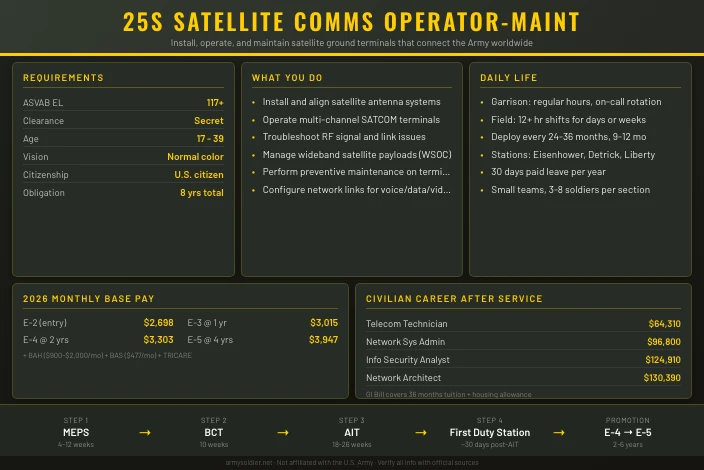
As a 25S, you operate and maintain the Army’s satellite communication ground terminals and networks. You install antenna systems, align dishes to specific satellites, configure wideband and narrowband links, troubleshoot signal problems, and keep multi-channel SATCOM systems running 24/7 in garrison and deployed environments.
Your day-to-day work depends on your assignment. In a tactical unit, you set up transportable satellite terminals in the field, establish links, and tear down equipment when the mission moves. You run signal checks, swap out faulty components, and coordinate with network operations centers to keep traffic flowing.
At a Wideband Satellite Communications Operations Center (WSOC), the work shifts to payload management. You monitor and control the Wideband Global SATCOM (WGS) constellation from a fixed facility, managing bandwidth allocation and satellite transponder configurations for users across the globe.
Specific Roles
| Identifier | Type | Description |
|---|---|---|
| 25S | Primary MOS | Satellite Communication Systems Operator-Maintainer |
| 25S10 | Skill Level 1 | Entry-level operator (E-1 through E-4) |
| 25S20 | Skill Level 2 | Team leader/supervisor (E-5) |
| 25S30 | Skill Level 3 | Section chief/senior NCO (E-6) |
| 25S40 | Skill Level 4 | Senior SATCOM supervisor (E-7 and above) |
Every combat brigade, division, and corps headquarters needs satellite links. You provide the backbone that connects a forward operating base in a remote valley to higher headquarters thousands of miles away. When ground-based networks fail or don’t exist, satellite is the only option. That makes this MOS critical to Army command and control.
Technology and Equipment
You work with some of the most expensive communications equipment in the Army inventory. Transportable terminals like the AN/TSC-156 Phoenix and the STT (SATCOM Transportable Terminal) weigh several thousand pounds and require precise alignment to satellites in geostationary orbit. You also operate smaller tactical terminals, including the AN/TSC-198 SMART-T for beyond-line-of-sight communications.
On the fixed-facility side, WSOC operators use the Global SATCOM Management System to control WGS satellite payloads. The tools include spectrum analyzers, bit error rate testers, and network monitoring software. You’ll learn how radio frequency propagation works, how to calculate link budgets, and how to troubleshoot signal degradation caused by weather, interference, or equipment failure.
Salary and Benefits
Financial Benefits
Military pay depends on rank and time in service. Most 25S soldiers enter at E-1 or E-2 and promote steadily with time and performance.
| Rank | Pay Grade | Monthly Base Pay (2026) |
|---|---|---|
| Private (PV2) | E-2 | $2,698 |
| Private First Class | E-3 | $3,015 |
| Specialist | E-4 | $3,303 |
| Sergeant | E-5 | $3,599 |
| Staff Sergeant | E-6 | $3,743 |
Base pay is only part of the package. BAH (Basic Allowance for Housing) adds $900 to $2,000+ per month depending on your duty station and whether you have dependents. BAS (Basic Allowance for Subsistence) adds about $477 per month for food. The 25S has historically qualified for enlistment bonuses, with amounts varying by enlistment length and the Army’s current needs. Check with your recruiter for the latest figures.
Additional Benefits
TRICARE covers you and your family at zero cost while on active duty. Doctor visits, hospital stays, prescriptions, dental, vision, mental health – all included with no premiums, deductibles, or copays.
Education benefits stack up fast:
- Tuition Assistance: Up to $4,500 per year while serving
- Post-9/11 GI Bill: 36 months of tuition (full in-state rate at public schools, up to $29,921/year at private schools) plus a monthly housing allowance and $1,000/year book stipend
- Certifications: Army COOL (Credentialing Opportunities On-Line) funds industry certifications like CompTIA Security+, CCNA, and others relevant to SATCOM work
Work-Life Balance
You earn 30 days of paid leave per year. Garrison work usually follows a regular schedule, though on-call rotations are common for SATCOM sections since satellites don’t take weekends off. Field exercises and deployments change the picture. Expect 12-hour shifts or longer during operations, sometimes for weeks at a stretch.
Qualifications and Eligibility
Basic Qualifications
The 25S requires a minimum score of 117 on the Electronics (EL) ASVAB composite. The EL score combines General Science, Arithmetic Reasoning, Mathematics Knowledge, and Electronics Information. That’s a moderately high bar – you need solid math and science fundamentals.
| Requirement | Details |
|---|---|
| Age | 17-39 years old |
| Citizenship | U.S. citizen (required for Secret clearance) |
| Education | High school diploma or GED |
| AFQT (ASVAB) | Minimum 31 (diploma) or 50 (GED) |
| Electronics (EL) | Minimum 117 |
| Color Vision | Normal color vision required |
| Security Clearance | Secret |
| Background | No disqualifying criminal history; clean financial record for clearance |
Application Process
Visit your local Army recruiting station first. The recruiter checks your qualifications and explains available options – Active Duty, Army Reserve, or National Guard.
At MEPS (Military Entrance Processing Station), you take the ASVAB (if you haven’t already), complete a full medical exam, and begin the background check process. If your EL score hits 117 and you pass medical, the recruiter books your training slot. The whole process from first visit to swearing in typically takes 4 to 12 weeks. Security clearance investigations can run concurrently.
Selection Criteria and Competitiveness
The EL 117 requirement filters out a significant portion of applicants. If you scored well in science and math, you’re in good shape. Prior experience with electronics, amateur radio, or IT work strengthens your profile but isn’t required.
High school algebra and science coursework helps prepare for both the ASVAB and AIT academics. Having an EMT cert or previous military family experience won’t move the needle here – what matters is your aptitude for electronics and communications systems.
Upon Accession into Service
You enter as E-1 (Private) and promote to E-2 after Basic Combat Training. The standard total military service obligation is 8 years: typically 3 to 6 years on active duty, with the remainder in the Reserve or Individual Ready Reserve. Soldiers who accept enlistment bonuses usually commit to longer active-duty terms.
See our ASVAB study guide for strategies to hit these line scores, or take the PiCAT from home if you are a first-time tester.
Work Environment
Setting and Schedule
Your work environment depends heavily on your unit type.
Fixed-facility assignments (WSOC): Climate-controlled operations centers where you monitor satellite payloads on screens and manage bandwidth in shifts. Think mission control, not foxholes. These positions exist at Fort Detrick, MD and a handful of other installations worldwide.
Tactical unit assignments: You set up transportable satellite terminals in the field, sometimes in austere conditions. Rain, heat, cold, dust – the equipment still needs to work. Field exercises run for days or weeks at a time.
Garrison: Standard duty hours with periodic on-call rotations. You maintain equipment, run preventive maintenance, attend training, and prepare for field exercises or deployments.
Leadership and Communication
Your chain runs through the unit’s signal officer (usually a Captain) and a senior SATCOM NCO. Within your section, the team chief assigns tasks and manages the equipment schedule. During operations, the signal officer and S6 staff coordinate your section’s priorities.
Annual evaluations and regular counseling sessions provide formal feedback. Informal mentoring from senior 25S soldiers is often where the real learning happens.
Team Dynamics and Autonomy
SATCOM sections are small – typically 3 to 8 soldiers per team. Everyone has a role during setup and teardown. Once systems are running, operators often work alone or in pairs monitoring equipment and troubleshooting issues.
In the field, you make quick decisions about antenna positioning, link troubleshooting, and equipment swaps. There’s no time to wait for someone to tell you what to do when a link goes down and a battalion loses comms. That independence grows as you gain experience and rank.
Job Satisfaction and Retention
Signal soldiers generally re-enlist at moderate rates. The technical skills transfer well to civilian careers, which pulls some soldiers out after their first term. Those who stay often cite the variety of assignments, the chance to work with advanced technology, and the satisfaction of being the person who restores communications when everything else fails.
The biggest complaints: long hours during field problems, the frustration of maintaining aging equipment alongside new systems, and the stress of being responsible when a link goes down during a real-world operation.
Training and Skill Development
Initial Training
The 25S training pipeline starts with Basic Combat Training and continues through a lengthy AIT focused entirely on satellite systems.
| Training Phase | Location | Duration | Focus |
|---|---|---|---|
| BCT | Fort Jackson, SC; Fort Moore, GA; Fort Leonard Wood, MO | 10 weeks | Soldier skills: marksmanship, tactics, fitness, discipline |
| AIT | Fort Eisenhower, GA (U.S. Army Signal School) | 18-26 weeks | SATCOM systems: installation, operations, maintenance, troubleshooting |
BCT is the same for every MOS. You learn to shoot, move, communicate, and function as a soldier.
AIT at Fort Eisenhower covers satellite communication theory, radio frequency fundamentals, antenna alignment, terminal operations, and preventive maintenance. Training mixes classroom instruction with hands-on work on actual SATCOM terminals. You practice setting up and tearing down transportable systems, establishing satellite links, and diagnosing signal problems.
The course also covers network operations basics, documentation, and the software tools used to manage SATCOM resources. A multi-day field exercise at the end puts everything together. You and your classmates set up terminals, establish links, and solve problems under simulated operational conditions.
Advanced Training
After AIT, your learning accelerates at your first duty station. Soldiers assigned to WSOCs attend additional payload management training. Those in tactical units get specialized courses on the specific terminal systems their unit operates.
Common follow-on training opportunities:
- Wideband Satellite Operations course for WSOC-bound soldiers
- Network+ and Security+ certifications funded through Army COOL
- Warrant Officer path: 225N Network Management Technician or 948B Electronic Systems Maintenance Warrant Officer (with waiver)
- Senior leader courses: Advanced Leader Course, Senior Leader Course, and Master Leader Course as you promote
The Army also sends 25S soldiers to vendor-specific training when new equipment fields to their unit. You won’t stop learning – satellite technology changes constantly, and the Army invests in keeping operators current.
Everything starts with qualifying ASVAB scores — our study guide covers what to study first.
Career Progression and Advancement
Career Path
| Rank | Pay Grade | Typical Years | Typical Role |
|---|---|---|---|
| Private (PV2) | E-2 | 0-1 | AIT graduate, entry-level operator |
| Private First Class | E-3 | 1-2 | Experienced operator, assists with maintenance |
| Specialist | E-4 | 2-3 | Senior operator, mentors junior soldiers |
| Sergeant | E-5 | 4-6 | Team chief, supervises SATCOM section |
| Staff Sergeant | E-6 | 6-9 | Section NCOIC, manages multiple teams |
| Sergeant First Class | E-7 | 10-14 | Platoon sergeant, signal operations supervisor |
| Master Sergeant | E-8 | 14-18 | Senior signal NCO, battalion/brigade level |
| Sergeant Major | E-9 | 18+ | Command-level communications leadership |
Promotion to E-4 is semi-automatic around the 2-year mark if you meet requirements. E-5 requires passing a promotion board, and competition varies by year. The 25S promotion points have historically been moderate compared to overcrowded MOSs – the technical nature of the job keeps the applicant pool smaller.
At E-5, your role shifts from operating equipment to leading a team. You train junior soldiers, manage maintenance schedules, and coordinate with network operations during exercises and deployments.
Role Flexibility and Transfers
Within the signal field, lateral moves are straightforward. Common transitions include 25B (IT Specialist), 25N (Network Switching Systems Operator), or 25U (Signal Support Systems Specialist). Moving outside CMF 25 requires leadership approval and retraining.
The warrant officer track is a strong option for experienced 25S soldiers. The 255N (Network Management Technician) warrant path keeps you in the technical lane without shifting to pure leadership. Some soldiers pursue officer commissioning through OCS or Green to Gold programs.
Performance Evaluation
NCOs receive annual NCOER (NCO Evaluation Report) ratings from their rater and senior rater. The report covers leadership, training, technical proficiency, and character. Strong NCOERs are the single biggest factor in promotion to E-6 and above.
What sets top 25S soldiers apart: maintaining high equipment readiness rates, earning civilian certifications, mentoring junior operators, and performing well during field exercises. Signal units track metrics like link uptime and mean time to restore – your numbers tell the story.
Physical Demands and Medical Evaluations
Physical Requirements
The 25S is more physically demanding than most people expect from a technology job. Transportable satellite terminals weigh thousands of pounds and require manual setup. Individual components – antenna feeds, junction boxes, cable reels, power distribution panels – regularly exceed 50 pounds. You lift, carry, and position these parts in mud, sand, snow, or gravel while wearing body armor and a helmet.
Field setup also involves driving stakes, digging cable trenches, and leveling antenna platforms. Teardown is the same process in reverse, often at night under blackout conditions. Add rucking to and from the site, and you’ll understand why SATCOM soldiers need to stay in shape.
WSOC assignments are lighter physically. You spend most of your time at a workstation monitoring systems. But you still need to pass the fitness test, maintain deployment readiness, and be prepared to rotate back to a tactical unit.
Every soldier takes the Army Fitness Test (AFT) at least once a year. The AFT has 5 events, each scored 0 to 100:
| Event | Male Minimum (17-21) | Female Minimum (17-21) |
|---|---|---|
| 3-Rep Max Deadlift (MDL) | 140 lbs | 80 lbs |
| Hand-Release Push-Up (HRP) | 10 reps | 10 reps |
| Sprint-Drag-Carry (SDC) | 2:40 | 3:40 |
| Plank (PLK) | 2:00 | 2:00 |
| Two-Mile Run (2MR) | 15:54 | 18:54 |
You need at least 60 points per event and 300 total to pass. These standards apply to all soldiers regardless of MOS. The AFT replaced the ACFT in June 2025. It uses 5 events (the Standing Power Throw was removed) and is scored on sex- and age-normed scales for the general standard.
Medical Evaluations
Normal color vision is required for 25S soldiers because you read color-coded wiring, fiber optic connectors, and status indicators daily. The Army checks this during your MEPS physical, and there’s no waiver for this requirement in the 25S.
After enlistment, you complete an annual periodic health assessment covering weight, blood pressure, vision, and hearing. Deployments require separate medical clearance that screens for conditions incompatible with austere environments – uncontrolled asthma, severe allergies, or orthopedic limitations that prevent lifting. Any flagged condition gets resolved before you ship, or you stay behind.
Deployment and Duty Stations
Deployment Details
SATCOM operators deploy wherever the Army sends communications support. Active-duty units typically rotate on a 24 to 36 month cycle, with deployments lasting 9 to 12 months. Units on high-readiness status deploy with shorter notice windows.
The 25S deploys to every theater where the Army operates. Middle East, Europe, the Pacific, and Africa all need satellite communications. Your deployment experience depends on the unit you’re assigned to. A 25S in a tactical signal company might run a transportable terminal at a forward operating base, sleeping in a tent next to the antenna. A 25S on a WSOC rotation might manage bandwidth from a climate-controlled facility on a well-established base.
Combat deployments put you closer to the fight than most technology jobs. Your terminal provides the communications link that commanders depend on. That makes your site a target, and it means you need to be ready to defend it while keeping the link up.
Domestic deployments happen for natural disasters or homeland defense missions. Reserve and National Guard 25S soldiers may also get activated for state emergencies.
Location Flexibility
The Army picks your duty station based on its needs. You can submit a preference list during assignment selection, but there are no guarantees. The signal field has slots across dozens of installations, which gives you more geographic variety than some MOSs.
Common CONUS installations for 25S soldiers:
- Fort Eisenhower, GA – Signal School, training assignments
- Fort Detrick, MD – Wideband SATCOM Operations Center
- Fort Liberty, NC – XVIII Airborne Corps, 82nd Airborne Division
- Fort Campbell, KY – 101st Airborne Division
- Fort Carson, CO – 4th Infantry Division
- Fort Cavazos, TX – III Corps
- Fort Meade, MD – Cyber Command and NSA support
Overseas assignments include Germany, South Korea, Japan, Italy, and Kuwait. Expect to move every 2 to 4 years. Overseas tours last 2 to 3 years depending on accompanied or unaccompanied status.
Risk, Safety, and Legal Considerations
Job Hazards
The technical nature of this MOS brings specific risks that differ from most Army jobs.
Technical hazards:
- RF radiation exposure around active antenna feeds – standing in the beam path of a transmitting dish can cause tissue burns and eye damage
- High-voltage electrical systems inside terminal shelters and power distribution panels
- Falls from antenna platforms and shelter roofs during installation and maintenance
- Musculoskeletal injuries from lifting heavy components in awkward positions
Field and combat hazards:
- IEDs and small arms fire (SATCOM terminals are high-value targets because they enable command and control)
- Vehicle accidents during convoy movement of heavy terminal equipment
- Extreme heat, cold, and altitude at deployed locations
- Sleep deprivation during extended operations
The psychological stress is real too. When your link goes down, an entire unit may lose its only connection to higher headquarters. That pressure follows you through every shift.
Safety Protocols
RF hazard zones are marked and enforced around all active terminals. You learn safe distances during AIT and follow strict procedures before energizing any system. Lockout/tagout procedures prevent accidental power-up during maintenance. These aren’t suggestions – violations result in immediate corrective action.
In tactical environments, you wear body armor and follow unit security procedures. Terminal positions get camouflaged and defended because losing comms can be catastrophic for the mission. Fall protection is mandatory when climbing antenna structures. Hearing protection is required around generator sets that power the terminals.
The Army tracks safety incidents by MOS, and signal units conduct after-action reviews when injuries occur. Your unit safety officer runs periodic inspections of equipment and procedures.
Security and Legal Requirements
The 25S requires a Secret clearance. The investigation covers your financial history, criminal background, foreign contacts, and personal conduct. Expect the process to take 2 to 6 months. Maintaining your clearance means avoiding debt problems, criminal charges, and unauthorized foreign contacts throughout your career.
All soldiers follow the Uniform Code of Military Justice (UCMJ). SATCOM operators handle classified communications traffic and must follow information security protocols at all times. Unauthorized disclosure of satellite frequencies, link parameters, or operational details is a serious offense under both the UCMJ and federal law. You’ll receive annual information security training and sign nondisclosure agreements that extend beyond your service.
Impact on Family and Personal Life
Family Considerations
Military life affects families in predictable ways. You move every 2 to 4 years, which disrupts your spouse’s career and your kids’ schooling. Deployments mean 9 to 12 months away from home. Field training exercises pull you out for days or weeks at a time with little advance notice.
Support resources available at most installations:
- Family Readiness Groups (FRGs) – unit-based peer support
- Military OneSource – free counseling and family services
- Spousal employment assistance – job help at each new duty station
- Exceptional Family Member Program (EFMP) – support for families with special needs members
- Child Development Centers – on-post childcare
Relocation and Flexibility
PCS (Permanent Change of Station) moves happen every 2 to 4 years. The Army pays for the move, but each relocation disrupts your family’s routine. You can request preferred locations, but the Army’s manning needs take priority. Overseas tours in Germany or South Korea typically last 2 to 3 years. Some are accompanied (family comes with you), others are not.
Single soldiers have more geographic flexibility but still go where they’re told. The upside: you’ll live in places most civilians never visit.
Reserve and National Guard
The 25S MOS is available in both the Army Reserve and the Army National Guard. Signal units in both components carry SATCOM capability, and Reserve and Guard 25S soldiers have mobilized to provide satellite communications support across combatant commands. If you want to continue serving part-time after active duty or enter directly into the Reserve or Guard, there are slots available.
Component Availability
Reserve and Guard signal companies and battalions include SATCOM sections that operate transportable satellite terminals for field training and mobilized operations. Some Reserve and Guard units also have Wideband Satellite Communications Operations Center (WSOC) functions, though fixed-facility WSOC positions are primarily concentrated in the active Army.
National Guard units in states with significant federal facilities or military infrastructure may have stronger SATCOM capability and correspondingly more 25S billets.
Drill Schedule and Extra Training
Standard Reserve and Guard service is one weekend per month plus two weeks of Annual Training. For 25S soldiers, that baseline is generally sufficient for routine equipment proficiency, but satellite link quality and terminal operation are skills that benefit from regular hands-on time.
During Annual Training, Guard and Reserve signal units typically conduct full terminal set-up, satellite link establishment, and teardown exercises. These AT periods provide the most realistic training available in the part-time cycle.
Additional training may include:
- Equipment-specific certification courses when new systems are fielded
- Wideband satellite operations courses for soldiers assigned to higher-level signal elements
- CompTIA Network+ and Security+ certifications, which are funded through Army COOL and directly applicable to civilian telecommunications careers
The Secret clearance requirement applies in the Reserve and Guard the same as on active duty. Background reinvestigations occur on a regular cycle regardless of part-time status.
Pay and Benefits Comparison
Reserve and Guard drill pay is based on rank and time in service. An E-4 with four years of service earns approximately $488 per standard drill weekend. Active-duty E-4 base pay at four years is $3,659 per month. Part-time service pays significantly less, but requires far less of your time.
Healthcare for Reserve and Guard members not on active-duty orders is available through Tricare Reserve Select: $57.88 per month for member-only coverage or $286.66 per month for member and family. Active-duty TRICARE has no enrollment fee. Both options cost less than most civilian employer health plans.
Education benefits for Reserve and Guard members include the MGIB-SR (Chapter 1606) at $493 per month for full-time students, plus Federal Tuition Assistance at up to $250 per credit hour with a $4,500 annual cap. Guard soldiers may also receive state tuition assistance, and many states provide full in-state tuition at public universities to Guard members.
Deployment and Mobilization
SATCOM provides the communications backbone for all deployed forces. When active-duty units deploy, satellite capacity is essential, and Reserve and Guard SATCOM units mobilize to support that demand. Mobilization frequency for 25S soldiers in the Reserve and Guard is moderate, with deployments typically lasting 6 to 12 months on federal orders.
USERRA protects your civilian job during any federally ordered mobilization. Your employer must reinstate you with full seniority and benefits upon your return.
Civilian Career Integration
The 25S skill set translates well to civilian telecommunications and defense contractor careers. Satellite communications technicians and RF systems engineers are in demand at defense contractors supporting SATCOM ground systems and commercial satellite operators. A soldier who stays current in the Reserve or Guard maintains the Secret clearance, keeps hands-on proficiency with SATCOM equipment, and builds toward a reserve retirement.
Defense contractors like Lockheed Martin, Raytheon, and Northrop Grumman hire former SATCOM operators for satellite ground terminal operation, RF systems testing, and communications engineering support. Starting salaries for cleared candidates with hands-on SATCOM experience range from $65,000 to $90,000+, with higher compensation in the Washington, D.C., Colorado Springs, and Huntsville defense corridors.
Reserve retirement is points-based, with a pension beginning at age 60 – reduced by three months for every 90 days of qualifying active-duty mobilization after January 28, 2008, to a minimum of age 50.
| Feature | Active Duty | Army Reserve | Army National Guard |
|---|---|---|---|
| Duty Status | Full-time | Part-time (1 wknd/mo + 2 wks/yr) | Part-time (1 wknd/mo + 2 wks/yr) |
| Monthly Pay (E-4, 4 yrs) | $3,659/mo | ~$488/drill weekend | ~$488/drill weekend |
| Healthcare | TRICARE (no premium) | Tricare Reserve Select ($57.88/mo) | Tricare Reserve Select ($57.88/mo) |
| Education | Post-9/11 GI Bill, TA | MGIB-SR ($493/mo), TA | MGIB-SR ($493/mo), TA, state tuition waivers |
| Deployment | Per unit rotation | When mobilized | When mobilized |
| Retirement | 20-year pension | Points-based, age 60 | Points-based, age 60 |
Post-Service Opportunities
Transition to Civilian Life
Your SATCOM skills translate directly to the telecommunications and IT industries. You leave with hands-on experience operating complex communications systems, troubleshooting RF issues, and managing network resources – skills that civilian employers struggle to find.
The Transition Assistance Program (TAP) provides resume help, interview coaching, and benefits counseling during your last 12 months on active duty. Your Secret clearance stays active for 2 years after separation if you move into a cleared civilian position, which opens doors at defense contractors.
Industry certifications earned during service (CompTIA Security+, Network+, CCNA) give you a head start. Many 25S veterans land jobs without additional schooling. Those who want degrees use the Post-9/11 GI Bill – 36 months of tuition at public schools (full in-state rate) plus a housing allowance and book stipend.
Civilian Career Prospects
| Civilian Job | Median Annual Salary (2024) | 10-Year Outlook |
|---|---|---|
| Telecom Equipment Technician | $64,310 | -3% (declining) |
| Network/Computer Systems Administrator | $96,800 | +3% |
| Information Security Analyst | $124,910 | +33% |
| Computer Network Architect | $130,390 | +4% |
Defense contractors like Lockheed Martin, Raytheon, Northrop Grumman, and General Dynamics actively recruit former 25S soldiers for satellite ground system positions. Your clearance and equipment-specific experience give you an advantage over civilian applicants who lack hands-on military SATCOM time.
Post-Service Policies
An honorable discharge gives you lifetime access to VA healthcare, disability compensation (if applicable), survivor benefits, and education benefits. Separating after your service obligation is straightforward. Talk to your career counselor 12 months before your ETS date to plan the transition.
Is This a Good Job for You?
Ideal Candidate Profile
The best SATCOM operators combine patience with problem-solving. Satellite links are finicky. Weather, equipment age, interference, and orbital mechanics all play a role. You need the temperament to troubleshoot methodically when the pressure is on.
Traits that predict success:
- Strong math and science aptitude (you need that EL 117 for a reason)
- Comfort with electronics, wiring, and tools
- Willingness to work outdoors in bad weather setting up heavy equipment
- Ability to focus during monotonous monitoring shifts at a WSOC
- Interest in how communications networks actually work, not just using them
Prior amateur radio experience, electronics hobbies, or IT tinkering are good indicators. But plenty of successful 25S soldiers had no technical background before enlisting – AIT teaches you from the ground up.
Potential Challenges
This MOS may not fit if you:
- Dislike repetitive technical work (monitoring a satellite link for 12 hours tests your patience)
- Can’t handle heavy lifting and outdoor setup in rough conditions
- Struggle with math and physics concepts
- Want a job where you interact with large groups of people all day
The work can be isolating. SATCOM sections are small, and operators sometimes work alone during off-shifts. Field setups mean sleeping next to your terminal in a tent. If you need constant social interaction, this role may feel lonely.
Career and Lifestyle Alignment
If you want a career in telecommunications, networking, or cybersecurity after the Army, 25S gives you a running start. The technical foundation, security clearance, and industry certifications translate into civilian jobs paying $65,000 to $130,000+ within a few years of separation. Defense contractor positions start fast with minimal additional training.
The trade-off: you move frequently, deploy regularly, and spend time in the field doing physical work that doesn’t match the “tech job” image. This is a military job first and a technology job second. You carry a rifle, pull guard duty, and sleep in the mud alongside the rest of your unit.
For someone who wants both technical skills and military experience, 25S delivers. For someone who just wants a tech career, civilian IT programs get you there without the deployments and PCS moves.
More Information
Talk to an Army recruiter about the 25S. Ask about current enlistment bonuses, training dates, and whether your ASVAB scores qualify. If possible, ask to speak with a 25S soldier to hear what the job looks like day-to-day at their installation.
Take the MOS Finder quiz at goarmy.com
Schedule an ASVAB at your nearest MEPS to see where your scores land
Talk to military families in your area for an honest picture of Army life
Prepare for the ASVAB with our study guide to make sure your line scores qualify
This site is not affiliated with the U.S. Army or any government agency. Verify all information with official Army sources before making enlistment or career decisions.
Explore more Army cyber and signal careers such as 17C Cyber Operations Specialist and 25B IT Specialist.