25U Signal Support Systems Specialist
Every command post, convoy, and forward operating base runs on radios and networks. When those systems go down, the mission stops. The 25U Signal Support Systems Specialist is the person who keeps tactical communications running at the battalion and brigade level. You install, operate, and troubleshoot the radio and data systems that commanders depend on to track and direct their units.
Qualifying requires specific ASVAB line scores — our ASVAB study guide covers what to target and how to prepare.
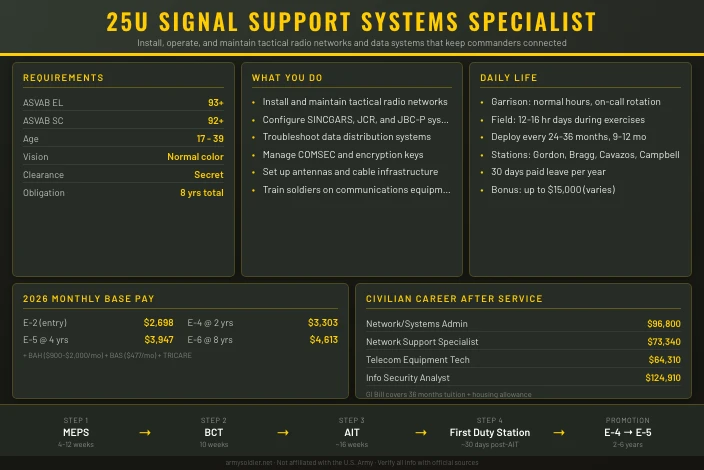
Job Role and Responsibilities
You are your unit’s signal backbone. You install, configure, and maintain tactical radio networks, data distribution systems, and terminal devices. When a commander needs to talk to higher headquarters or track troop movements on a digital map, your equipment makes that happen. In the field, you troubleshoot communications failures under pressure and keep the signal flowing.
Most days in garrison revolve around the S6 (signal) shop. You run diagnostics on radios, update software, configure network settings, and maintain inventories of communications equipment. Soldiers walk in with broken radios, laptops that won’t connect, or terminals throwing error codes. You fix them or escalate to higher-level maintenance.
Field exercises change the pace. You set up communications nodes, string antenna cables, and establish radio nets before the operation starts. Once things are moving, you monitor signal strength, swap frequencies when jammed, and troubleshoot connectivity problems on the fly. Sleep comes in short windows between radio checks.
Specialized Roles
The Army tracks signal specializations through Additional Skill Identifiers (ASIs) and Special Qualification Identifiers (SQIs).
| Identifier Type | Code | Description |
|---|---|---|
| Primary MOS | 25U | Signal Support Systems Specialist |
| ASI | Various | System-specific qualifications (JCR, SINCGARS, satellite terminals) |
| SQI | P | Parachutist (Airborne-qualified signal soldiers) |
Some 25U soldiers specialize in specific platforms like Joint Capabilities Release (JCR), Joint Battle Command-Platform (JBC-P), or satellite communications terminals. Others earn ASIs for network security or specific tactical systems.
Equipment and Technology
Your daily toolkit includes SINCGARS radios, JCR terminals, JBC-P systems, and various tactical radios. You also work with power generators, antenna systems, encryption devices, and network switches. The Army is constantly fielding new digital communications gear, so the equipment list evolves.
At the battalion level, you might manage a dozen radio systems and several computer terminals. Brigade-level positions add satellite links and more complex network architectures. Either way, you carry a multimeter, crimping tools, and cable testers alongside your weapon.
Mission Contribution
Signal soldiers sit at the center of every operation. Without your systems, the commander can’t issue orders, receive reports, or track friendly forces. A platoon that loses comms in hostile territory is isolated. A logistics convoy without radio contact can’t call for support. Your work isn’t glamorous, but a single broken radio at the wrong moment can cost lives.
Salary and Benefits
Financial Benefits
Military pay depends on rank and time in service, not your MOS. Most 25U soldiers start at E-1 or E-2 after completing training.
| Rank | Pay Grade | Monthly Base Pay |
|---|---|---|
| Private (PV2) | E-2 | $2,698 |
| Specialist (SPC) | E-4 (2 yrs) | $3,303 |
| Sergeant (SGT) | E-5 (4 yrs) | $3,947 |
| Staff Sergeant (SSG) | E-6 (8 yrs) | $4,613 |
These are 2026 base pay rates from DFAS. On top of this, you receive Basic Allowance for Housing (BAH), which ranges from about $900 to $2,000+ monthly depending on your duty station and dependent status. Basic Allowance for Subsistence (BAS) adds $476.95 per month for food.
The 25U has qualified for enlistment bonuses up to $15,000 depending on contract length and the Army’s current needs. Bonus availability changes frequently.
Additional Benefits
TRICARE covers you and your family at zero cost while on active duty. Doctor visits, hospital stays, prescriptions, dental, vision, and mental health are all included.
Tuition Assistance pays up to $4,500 per year for college courses while you serve. After separation, the Post-9/11 GI Bill covers up to 36 months of tuition at a public university (full in-state rate) plus a monthly housing allowance and $1,000 annual book stipend.
The Blended Retirement System (BRS) builds your long-term savings:
- Pension at 20 years: 40% of your highest 36-month average base pay
- TSP matching: the government contributes up to 5% of your base pay to your Thrift Savings Plan
- Continuation pay: a lump-sum bonus at 7-12 years of service in exchange for an additional 3-year commitment
Work-Life Balance
You earn 30 days of paid leave per year, accruing 2.5 days monthly. Garrison signal shops mostly run normal duty hours, though on-call rotations for network emergencies are common. Field exercises and deployments push you to 12-16 hour days. The general deployment rotation is roughly 1 year deployed, 2 years home, but operational tempo can compress that.
Qualifications and Eligibility
Basic Qualifications
You need to be a U.S. citizen or permanent resident, ages 17 to 39. High school diploma holders need at least a 31 on the AFQT. GED holders need a 50. The 25U requires two ASVAB line scores:
- Electronics (EL): 93 minimum
- Surveillance and Communications (SC): 92 minimum
The EL composite combines General Science, Arithmetic Reasoning, Math Knowledge, and Electronics Information. The SC composite uses Verbal Expression, Arithmetic Reasoning, Auto and Shop Information, and Mechanical Comprehension.
You must have normal color vision (no color blindness) and pass a standard medical exam. A Secret security clearance is required, which means a background investigation. Drug use, serious criminal history, or significant debt can delay or prevent clearance approval.
| Requirement | Details |
|---|---|
| Age | 17-39 years old |
| Citizenship | U.S. citizen or permanent resident |
| Education | High school diploma or GED |
| AFQT (ASVAB) | Minimum 31 (diploma) or 50 (GED) |
| Electronics (EL) | Minimum 93 |
| Surveillance & Communications (SC) | Minimum 92 |
| OPAT Category | Moderate (Gold) |
| Color Vision | Normal color vision required |
| Security Clearance | Secret |
Application Process
Start at your local Army recruiting station. The recruiter walks you through options for Active Duty, Reserve, or National Guard.
Next comes MEPS (Military Entrance Processing Station). You take the ASVAB if you haven’t already, complete a full medical exam, and start the background investigation for your Secret clearance. If everything checks out, your recruiter books a training slot. The whole process from first recruiter visit to shipping out takes 4 to 12 weeks. Security clearance processing can stretch that timeline.
Selection Criteria and Competitiveness
The 25U is a mid-range MOS in terms of competition. The Army needs signal soldiers across every type of unit, so slots are usually available. Your EL and SC scores are the primary gatekeepers. Prior experience with radios, networking, or IT helps but isn’t required. Having CompTIA certifications or a background in electronics makes you a stronger candidate without changing the formal requirements.
Upon Accession into Service
You enter at E-1 (Private) and typically promote to E-2 after Basic Combat Training. The standard service obligation is 8 years total, split between active duty (usually 3-6 years depending on your contract) and the Reserve or Individual Ready Reserve. Enlistment bonuses, if offered, may require a longer active-duty commitment.
See our ASVAB study guide for strategies to hit these line scores, or take the PiCAT from home if you are a first-time tester.
Work Environment
Setting and Schedule
Signal soldiers work in three main settings:
- Garrison – the S6 shop at battalion or brigade headquarters. Normal duty hours with on-call rotations for network problems.
- Field training – tactical operations centers, command posts, and vehicle-mounted comms setups. Hours follow the exercise schedule, often 12+ hours.
- Deployment – forward operating bases, patrol bases, and mobile command posts. Twelve to 16 hour shifts are standard. Equipment failures don’t wait for convenient timing.
The physical environment varies. In garrison, you work indoors with air conditioning and proper tools. In the field, you set up antennas in rain, run cable through mud, and troubleshoot electronics in extreme heat or cold. Noise from generators is constant.
Leadership and Communication
Your chain of command typically runs through the battalion or brigade S6 officer (a Signal Captain) and the senior signal NCO. Within your section, you report to the Signal Support NCOIC, usually an E-6 or E-7.
Performance feedback comes through annual evaluations and informal counseling sessions. Units with good leadership hold regular training meetings where signal soldiers share technical lessons learned.
Team Dynamics and Autonomy
In the S6 shop, you work alongside other signal MOSs and IT specialists. Troubleshooting often becomes a group effort when a complex network problem surfaces. But at the company level or on a convoy, you might be the only signal soldier for miles. The radio goes down, and you figure it out alone.
That balance between team problem-solving and solo troubleshooting defines the 25U experience. You need strong technical skills and the confidence to make decisions when nobody else understands the equipment.
Job Satisfaction and Retention
25U soldiers frequently describe the satisfaction of being the person everyone calls when comms go down. The frustration side includes working with aging equipment, dealing with systems that don’t integrate well, and being blamed when communications fail for reasons outside your control. The skills you build transfer directly to civilian IT and networking careers, which gives many soldiers a clear exit strategy after one enlistment.
Training and Skill Development
Initial Training
Training has two phases: Basic Combat Training (BCT) and Advanced Individual Training (AIT).
| Training Phase | Location | Duration | Focus |
|---|---|---|---|
| BCT | Fort Jackson, SC; Fort Benning, GA; Fort Leonard Wood, MO | 10 weeks | Soldier fundamentals: marksmanship, land navigation, tactics, fitness |
| AIT | Fort Gordon, GA (Army Cyber Center of Excellence) | ~16 weeks | Tactical radio operations, network configuration, signal security, IT troubleshooting |
BCT turns you into a soldier. Rifle qualification, squad tactics, first aid, and physical conditioning. Every MOS does this phase.
AIT at Fort Gordon is where you learn signal. The curriculum covers radio theory, antenna installation, SINCGARS operation, network fundamentals, and communications security (COMSEC) procedures. You practice configuring tactical radios, setting up data distribution systems, troubleshooting network faults, and managing encryption keys.
The classroom portions cover mechanical and electrical principles, line installation and wiring techniques, and preventive maintenance procedures. Field exercises put those skills to work in realistic scenarios where you set up and tear down communications networks under time pressure.
Advanced Training
After AIT, several training paths open up. The most common certifications for 25U soldiers are CompTIA Security+ and CompTIA Network+. The Army often funds these through credentialing programs at your duty station.
Other opportunities include:
- Airborne School (3 weeks, Fort Benning) for paratroopers in airborne units
- Air Assault School (10 days, Fort Campbell) for helicopter-insertion qualified soldiers
- Warrior Leader Course and NCO academies for promotion-track soldiers
- System-specific courses for new platforms as the Army fields updated equipment
Some soldiers pursue a lateral move to 17C (Cyber Operations Specialist) after gaining experience, though that requires additional screening and training. Strong performers can apply for warrant officer programs in the signal field, like 255A (Information Technology Technician).
Everything starts with qualifying ASVAB scores — our study guide covers what to study first.
Career Progression and Advancement
Career Path
Promotion to E-4 (Specialist) is semi-automatic at around 2 years if you meet the requirements. E-5 (Sergeant) requires a promotion board and shifts your role toward managing other signal soldiers rather than just fixing equipment.
| Rank | Pay Grade | Typical Years | Typical Role |
|---|---|---|---|
| Private (PV2) | E-2 | 0-1 | AIT graduate, radio operator |
| Specialist (SPC) | E-4 | 2-3 | Senior operator, system troubleshooter |
| Sergeant (SGT) | E-5 | 4-6 | Signal team leader, section NCOIC |
| Staff Sergeant (SSG) | E-6 | 6-9 | Senior signal NCO, training supervisor |
| Sergeant First Class (SFC) | E-7 | 10-14 | Signal platoon sergeant, operations NCOIC |
| Master Sergeant (MSG) | E-8 | 14+ | Senior signal leadership, staff positions |
At E-6, you manage multiple signal teams and shape your unit’s communications plan. E-7 and above positions are highly competitive and require a strong record of leadership, military education, and technical expertise.
Role Flexibility and Transfers
Lateral moves within the 25-series are the easiest path. Common transitions include 25B (IT Specialist), 25S (Satellite Communication Systems Operator), or 25N (Nodal Network Systems Operator). Jumping to 17C (Cyber Operations) is possible but requires higher ASVAB scores and a competitive screening process.
Any MOS change means completing that job’s AIT and possibly taking on additional service time. Signal soldiers with strong evaluations and clean records generally have more options when requesting a transfer.
Performance Evaluation
NCOs are rated through the NCOER (NCO Evaluation Report) annually. Your rater and senior rater score you on leadership, training effectiveness, and technical competence. Strong NCOERs are the single biggest factor in promotions to E-6 and above.
What sets you apart: keeping your unit’s communications running at a high readiness rate, earning industry certifications, mentoring junior soldiers, and performing well during field exercises and deployments. Signal soldiers who can solve problems under pressure get noticed fast.
Physical Demands and Medical Evaluations
Physical Requirements
The 25U falls in the OPAT Moderate (Gold) category. You won’t carry the same loads as an infantry soldier, but the job gets physical. Antenna masts weigh 40 to 80 pounds. Cable drums, generators, and radio racks require lifting and carrying over uneven terrain. In the field, you dig antenna base holes, climb onto vehicles to mount equipment, and haul gear between positions.
Garrison work is lighter. Most days involve bench-level repairs, computer work, and equipment inventories. Field training and deployments are where the physical demands spike.
Every soldier takes the Army Fitness Test (AFT) once a year. Here are the minimum standards for ages 17 to 21:
| Event | Male Minimum | Female Minimum |
|---|---|---|
| 3-Rep Max Deadlift (MDL) | 140 lbs | 80 lbs |
| Hand-Release Push-Up (HRP) | 10 reps | 10 reps |
| Sprint-Drag-Carry (SDC) | 2:40 | 3:40 |
| Plank (PLK) | 2:00 | 2:00 |
| Two-Mile Run (2MR) | 15:54 | 18:54 |
Each event scores 0 to 100. You need at least 60 per event and 300 total to pass. The AFT standards are the same for all soldiers and do not vary by MOS.
Medical Evaluations
After enlistment, you get annual health screenings covering weight, blood pressure, vision, and hearing. Before deployment, a separate medical clearance confirms you’re fit for the operational environment. The color vision requirement applies throughout your career since signal work involves color-coded wiring and connectors.
Deployment and Duty Stations
Deployment Details
Active-duty signal soldiers typically deploy every 24 to 36 months for 9 to 12 months. Every type of Army unit needs signal support, so 25U soldiers deploy with infantry brigades, aviation battalions, logistics units, and headquarters elements.
Common deployment regions include the Middle East (Kuwait, Iraq, Syria), Europe (Poland, Germany, Romania), and the Pacific (South Korea, Japan). Domestic deployments happen for disaster relief and homeland security missions.
Signal soldiers in combat units face the same deployment tempo as the rest of their brigade. Those assigned to strategic signal units or garrison-level support roles deploy less frequently.
Location Flexibility
The Army assigns your duty station based on unit needs. You can submit a preference list, but there are no guarantees. Expect to move every 2 to 4 years.
Common CONUS duty stations:
- Fort Gordon, GA
- Fort Bragg, NC
- Fort Cavazos, TX
- Fort Campbell, KY
- Joint Base Lewis-McChord, WA
Common OCONUS duty stations:
- Germany (multiple installations)
- South Korea (Camp Humphreys)
- Japan (Camp Zama)
- Italy (Vicenza)
- Hawaii (Schofield Barracks)
Because every brigade and battalion needs signal support, 25U positions exist at nearly every Army installation worldwide. That gives you more location options than many MOSs.
Risk, Safety, and Legal Considerations
Job Hazards
Signal soldiers face a different risk profile depending on assignment.
In garrison:
- Electrical shock from power generators and wiring
- Radio frequency exposure during antenna operations
- Repetitive strain from bench-level repair work
- Hearing damage from prolonged generator noise
In the field and on deployment:
- Climbing vehicle roofs and antenna masts in bad weather
- Carrying heavy equipment over rough terrain
- Exposure to extreme heat, cold, and altitude
- Indirect fire and IED risks when deployed with combat units
Safety Protocols
Standard safety equipment includes hearing protection around generators, electrical gloves for high-voltage work, and eye protection during soldering and cable work. Field operations add body armor, helmets, and tactical vehicle safety procedures. Radio frequency safety protocols limit exposure time near high-power antennas.
Security and Legal Requirements
The 25U requires a Secret security clearance because you handle encrypted communications and COMSEC material. The investigation covers your financial history, criminal record, drug use, and foreign contacts. Processing takes 2 to 6 months. Losing your clearance means losing your MOS.
All soldiers follow the Uniform Code of Military Justice (UCMJ). Signal soldiers have additional responsibilities around COMSEC handling, classified material storage, and information security procedures. Mishandling encryption keys or leaving classified equipment unsecured can result in formal action under the UCMJ.
Impact on Family and Personal Life
Family Considerations
Military families adjust to irregular hours, frequent training exercises, and deployments lasting 9 to 12 months. The S6 shop’s on-call rotations mean occasional late-night calls when network problems hit. Field exercises can pull you away for 2 to 4 weeks at a time.
Support resources at most installations:
- Family Readiness Groups (FRGs) for peer support through your unit
- Military OneSource for free counseling and family services
- Spousal employment assistance at each duty station
- Exceptional Family Member Program (EFMP) for families with special needs
Relocation and Flexibility
PCS (Permanent Change of Station) moves happen every 2 to 4 years. The Army covers moving costs, but each relocation disrupts your spouse’s career, your kids’ schools, and your community. You can request preferred locations through the assignment process, but the Army’s needs come first.
The silver lining: 25U positions exist at nearly every installation, which gives the assignment system more flexibility to accommodate your preferences compared to MOSs concentrated at a handful of posts.
Reserve and National Guard
The 25U is the most widely distributed signal MOS in the Reserve component. Nearly every unit type at every echelon carries 25U positions – infantry battalions, aviation brigades, logistics commands, medical units. If you want to serve part-time while maintaining a civilian career, and you want to find a unit close to home, the 25U gives you more geographic options than almost any other MOS.
Component Availability
Both the Army Reserve and the Army National Guard have 25U slots across their formations. Because every battalion-level and above unit needs signal support, the number of available billets is large and spread across the country. You can often find a 25U position within a reasonable commute from wherever you live.
Guard units carry 25U soldiers for the same tactical radio and network support mission as active-duty units. Guard 25U soldiers also respond to state emergency activations – natural disaster response, civil support operations – where communications support is needed outside the regular federal training cycle.
Drill Schedule and Extra Training
Standard Reserve and Guard service is one weekend per month plus two weeks of Annual Training per year. For 25U soldiers, the standard drill schedule covers radio maintenance, system configuration, and unit communication training. This MOS does not typically require the heavy supplemental training load that cyber-specific MOSs demand.
That said, you should stay current on certifications and equipment:
- CompTIA Security+ is required for soldiers in DoD 8140 IAT Level II roles, and some 25U billets in the Reserve and Guard carry that designation
- CompTIA Network+ builds civilian marketability at minimal cost through Army COOL funding
- New radio systems and software updates require proficiency maintenance, which your unit’s training schedule should cover
Annual Training is where realistic field communications exercises happen. Full tactical radio net set-up, data distribution system configuration, and communications during simulated operations are worth treating as genuine training opportunities rather than checkboxes.
Pay and Benefits Comparison
Reserve and Guard drill pay for an E-4 with four years of service is approximately $488 per standard drill weekend (four drill periods across Saturday and Sunday). Active-duty E-4 base pay at four years is $3,659 per month. The gap is significant in dollar terms, but the time commitment is proportionally smaller – roughly four days per month rather than full-time.
Healthcare for Reserve and Guard members not on active-duty orders is available through Tricare Reserve Select: $57.88 per month for member-only coverage or $286.66 per month for member and family. Active-duty TRICARE has no enrollment fee. Either Reserve Select option is far more affordable than typical civilian employer-sponsored insurance.
Education benefits for Reserve and Guard members include the MGIB-SR (Chapter 1606) at $493 per month for full-time students. Federal Tuition Assistance provides up to $250 per credit hour with a $4,500 annual cap. Guard soldiers often qualify for state tuition waivers, and many states cover 100% of tuition at public in-state universities for Guard members.
Deployment and Mobilization
Signal support is needed wherever the Army deploys, which means 25U soldiers in the Reserve and Guard mobilize at a moderate rate. Units deploy to provide communications support for active-duty formations across the Middle East, Europe, and the Pacific. Domestic activations for disaster relief are also part of the Guard picture.
Mobilizations typically run 6 to 12 months. USERRA protects your civilian job throughout. Your employer must restore your position with full seniority and benefits when you return, regardless of the length of the mobilization.
Civilian Career Integration
The 25U is one of the most practical dual-career MOSs in the signal field. Your civilian IT or telecommunications skills reinforce your effectiveness on drill weekends, and your military training adds credibility to your civilian resume. The Secret clearance, maintained through part-time service, is a consistent advantage in the cleared government contractor market.
IT support specialists and network technicians with active clearances earn $55,000 to $80,000+ in civilian roles, with higher pay in major defense markets. CompTIA certifications earned through Army COOL and active clearance translate directly to government contractor and federal IT positions.
Reserve retirement accumulates through points: drill periods, AT days, and any active-duty mobilization orders. At age 60, you draw a pension calculated on your total career points, with the eligibility age reduced by three months for every 90 days of qualifying active-duty mobilization after January 28, 2008, down to a minimum of age 50.
| Feature | Active Duty | Army Reserve | Army National Guard |
|---|---|---|---|
| Duty Status | Full-time | Part-time (1 wknd/mo + 2 wks/yr) | Part-time (1 wknd/mo + 2 wks/yr) |
| Monthly Pay (E-4, 4 yrs) | $3,659/mo | ~$488/drill weekend | ~$488/drill weekend |
| Healthcare | TRICARE (no premium) | Tricare Reserve Select ($57.88/mo) | Tricare Reserve Select ($57.88/mo) |
| Education | Post-9/11 GI Bill, TA | MGIB-SR ($493/mo), TA | MGIB-SR ($493/mo), TA, state tuition waivers |
| Deployment | Per unit rotation | When mobilized | When mobilized |
| Retirement | 20-year pension | Points-based, age 60 | Points-based, age 60 |
Post-Service Opportunities
Transition to Civilian Life
Your signal training translates directly to civilian IT and telecommunications careers. You leave with hands-on experience in network administration, radio systems, troubleshooting, and information security that civilian technicians take years to accumulate. CompTIA certifications earned during service are recognized industry-wide.
The Transition Assistance Program (TAP) provides resume help, interview coaching, and benefits counseling during your last 12 months on active duty. The Post-9/11 GI Bill covers up to 36 months of tuition plus a housing allowance and book stipend, which many 25U veterans use to finish IT degrees or earn advanced certifications like CCNA or CISSP.
Civilian Career Prospects
Signal experience opens several career paths. Here’s what 25U veterans typically move into:
| Civilian Job | Median Annual Salary (2024) | 10-Year Outlook |
|---|---|---|
| Network/Systems Administrator | $96,800 | -4% (stable replacement demand) |
| Computer Network Support Specialist | $73,340 | -3% (stable replacement demand) |
| Telecom Equipment Installer/Repairer | $64,310 | -3% (stable replacement demand) |
| Information Security Analyst | $124,910 | +29% (strong growth) |
Salary data from the Bureau of Labor Statistics (May 2024 estimates). The negative outlook percentages reflect automation trends, but tens of thousands of replacement openings are projected annually across these fields.
Veterans with Security+ certification and a Secret clearance are especially competitive for government contractor positions, where cleared IT professionals command premium pay.
Post-Service Policies
An honorable discharge gives you lifetime access to VA healthcare, disability compensation (if applicable), and education benefits. You can separate after fulfilling your service obligation. Talk to your career counselor about options at least 12 months before your end date.
Is This a Good Job for You?
Ideal Candidate Profile
The best signal soldiers are natural problem-solvers who stay patient when a system that worked fine yesterday now refuses to power on.
Traits that predict success:
- Comfortable with electronics, computers, and technical troubleshooting
- Self-directed learner who reads manuals and figures things out without waiting for instruction
- Patient enough to trace a cable fault through a 200-meter run
- Good communicator who can explain technical problems to non-technical officers
- Comfortable working alone at the company level or as part of a team in the S6 shop
If you like taking things apart to see how they work, this MOS will feel natural. Prior experience with ham radio, home networking, or PC building helps but isn’t required.
Potential Challenges
This MOS is a poor fit if you:
- Hate troubleshooting and get frustrated when things don’t work the first time
- Need clear boundaries between work and personal time (on-call rotations blur that line)
- Dislike working with equipment that’s sometimes outdated or poorly documented
- Want a purely combat-focused role with no administrative duties
Signal soldiers sometimes serve as the unit’s unofficial IT helpdesk, handling tasks that stretch well beyond their formal job description. Printer issues, email problems, and random computer questions will find their way to you.
Career and Lifestyle Alignment
If you want to work in IT, cybersecurity, or telecommunications after the Army, the 25U gives you a running start. You earn real-world experience, industry certifications, and a security clearance that civilian employers value. The GI Bill funds a bachelor’s or master’s degree afterward.
The trade-off is standard Army life: moves every few years, months-long deployments, and modest pay compared to civilian IT workers with equivalent experience. Pay catches up once you factor in BAH, BAS, TRICARE, and the tax advantages of military allowances. But if you’re mainly in it for the money, civilian IT careers offer faster salary growth without the deployments.
This job works best for people who want structured technical training, don’t mind military life for a few years, and plan to turn their experience into a civilian career. The skills are portable and the clearance is valuable.
More Information
Talk to an Army recruiter about the 25U. Ask about current bonuses, training dates, and whether your ASVAB scores qualify. If you can, ask to speak with a signal soldier to hear what the daily work is actually like.
Take the MOS Finder quiz at goarmy.com
Schedule an ASVAB at your nearest MEPS to see where your scores land
Talk to military families in your area for an honest picture of Army life
Prepare for the ASVAB with our study guide to make sure your line scores qualify
This site is not affiliated with the U.S. Army or any government agency. Verify all information with official Army sources before making enlistment or career decisions.
Explore more Army Cyber and Signal careers such as 25B IT Specialist and 25S Satellite Communication Systems Operator.