12B Combat Engineer
Combat engineers blow things up and build things under fire. You clear minefields, demolish obstacles, and construct fighting positions while rounds are flying. When the infantry needs a path through a wall, a wire obstacle, or a bridge that no longer exists, they call you.
Qualifying requires specific ASVAB line scores — our ASVAB study guide covers what to target and how to prepare.
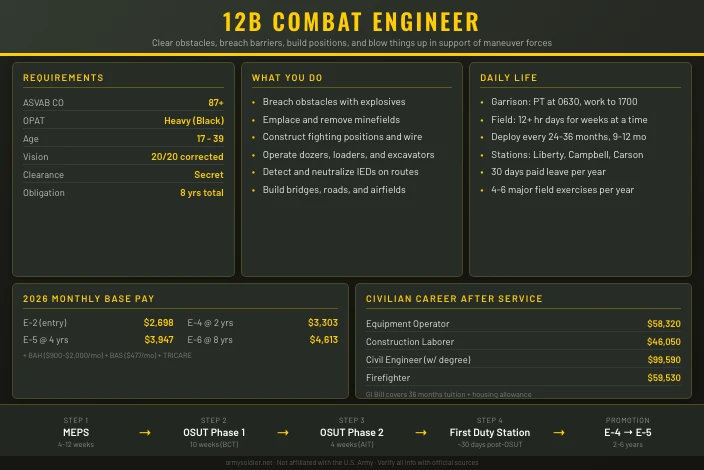
Job Role and Responsibilities
Combat engineers support maneuver forces by building, destroying, and clearing obstacles on the battlefield. You construct defensive positions, emplace and remove mines, breach barriers with explosives, and operate heavy equipment in both combat and peacetime environments.
Most days in garrison start with physical training, then shift to maintaining equipment or rehearsing demolition procedures. You might spend a morning rigging C4 charges on a training range, then spend the afternoon inspecting a bulldozer. Equipment checks eat up a lot of time because broken gear in the field can get people killed.
Specialized Roles
The 12B is the base MOS, but combat engineers branch into specialized positions through Additional Skill Identifiers (ASIs) and Special Qualification Identifiers (SQIs):
| Identifier | Type | Description |
|---|---|---|
| Sapper (SQI S) | SQI | 28-day Sapper Leader Course; small unit tactics and advanced demolitions |
| Engineer Diver | ASI | Underwater construction, salvage, and demolition |
| Pathfinder (SQI P) | SQI | Air assault and airborne operations navigation |
| Airborne (SQI P) | SQI | Parachute-qualified for airborne engineer units |
| Air Assault (SQI 2) | SQI | Helicopter insertion and sling load operations |
Not every 12B pursues these. Most spend their first enlistment in a standard combat engineer platoon.
Mission Contribution
Engineers shape the battlefield before anyone else shows up. Countermobility means slowing the enemy down with obstacles, wire, and mines. Mobility means punching holes through those same things for friendly forces. Survivability means digging fighting positions and building fortifications so your people stay alive.
In peacetime, engineer units build roads, bridges, and airfields. They respond to natural disasters. After hurricanes or floods, combat engineers are often the first military units on the ground clearing debris and restoring access.
Technology and Equipment
You operate heavy machinery that most soldiers never touch. Bulldozers, front-end loaders, and excavators are standard. The Armored Combat Earthmover (ACE) lets you dig fighting positions under enemy fire. Route-clearance teams use mine detectors, ground-penetrating radar, and the Husky Mine Detection Vehicle.
Demolitions training covers everything from shaped charges to cratering charges. You learn how much C4 it takes to drop a bridge, cut a steel beam, or breach a concrete wall. In the field, you also work with the M58 Mine Clearing Line Charge (MICLIC) to blow lanes through minefields.
Salary and Benefits
Financial Benefits
Military pay is based on rank and time in service. Most 12B soldiers enter as E-1 or E-2 after OSUT.
| Rank | Pay Grade | Years of Service: 2 | Years of Service: 4 | Years of Service: 6 | Years of Service: 8 |
|---|---|---|---|---|---|
| Private (PV1) | E-1 | $2,407 | $2,407 | $2,407 | - |
| Private First Class (PFC) | E-3 | $3,015 | $3,198 | $3,198 | $3,198 |
| Specialist (SPC) | E-4 | $3,303 | $3,659 | $3,816 | $3,816 |
| Sergeant (SGT) | E-5 | $3,599 | $3,947 | $4,109 | $4,299 |
| Staff Sergeant (SSG) | E-6 | $3,743 | $4,069 | $4,236 | $4,613 |
Source: DFAS 2026 pay tables. Figures reflect the 2026 pay raise.
BAH (Basic Allowance for Housing) depends on your duty station and whether you have dependents. A single E-4 receives roughly $900 to $2,000+ per month depending on location. BAS adds about $477 monthly for food. The Army periodically offers enlistment bonuses for 12B, though amounts change. Ask your recruiter for current figures.
Additional Benefits
TRICARE covers you and your family at no cost while on active duty. Doctor visits, prescriptions, dental, vision, mental health, and hospital stays are all included. Active-duty soldiers can use Tuition Assistance ($4,500 per year) to take college classes during service.
After separation, the Post-9/11 GI Bill pays up to 36 months of tuition at a public university (full in-state rate) plus a monthly housing allowance and $1,000 annual book stipend.
Retirement runs through the Blended Retirement System (BRS):
- 40% pension after 20 years of service (based on your highest 36 months of pay)
- Government matches up to 5% of your Thrift Savings Plan (TSP) contributions
- Continuation pay at 8 to 12 years (typically 2.5x monthly base pay for a 3-year commitment)
Work-Life Balance
You earn 30 days of paid leave per year. Garrison schedules usually run from PT at 0630 to 1700, Monday through Friday. Field exercises break that pattern. Combat engineers spend more time in the field than most MOSs because their skills require constant hands-on practice with heavy equipment and explosives.
Expect 4 to 6 major field exercises per year, each lasting 1 to 3 weeks.
Qualifications and Eligibility
Basic Qualifications
You need a minimum score of 87 on the Combat (CO) composite of the ASVAB. The CO score combines Arithmetic Reasoning, Coding Speed, Auto and Shop Information, and Mechanical Comprehension. That’s a moderate threshold compared to other combat MOSs.
The OPAT requirement is Heavy (Black), the highest physical demand category. You need to hit these minimums before shipping to training:
| Requirement | Details |
|---|---|
| Age | 17-39 years old |
| Citizenship | U.S. citizen or permanent resident |
| Education | High school diploma or GED |
| AFQT (ASVAB) | Minimum 31 (diploma) or 50 (GED) |
| Combat (CO) line score | Minimum 87 |
| OPAT category | Heavy (Black) |
| OPAT Standing Long Jump | 5 ft 3 in minimum |
| OPAT Seated Power Throw | 14 ft 9 in minimum |
| OPAT Strength Deadlift | 160 lbs minimum |
| OPAT Interval Aerobic Run | 43 shuttles minimum |
| Security clearance | Secret (required for some assignments) |
| Vision | Correctable to 20/20 |
| Color vision | Normal color vision required |
Application Process
Walk into a recruiting station and tell them you want 12B. Your recruiter checks your ASVAB scores, criminal history, and basic medical eligibility.
At MEPS (Military Entrance Processing Station), you take the ASVAB if you haven’t already, complete a full physical exam, and take the OPAT. The Heavy category standards are the toughest of the four OPAT tiers, so train for them beforehand. If everything checks out, you pick a ship date.
The whole process from first recruiter visit to swearing in takes 4 to 12 weeks. Medical waivers or background issues can add time.
Selection Criteria and Competitiveness
The 12B is one of the Army’s larger MOSs with slots across many units, so it’s not as competitive as smaller specialties. A strong ASVAB score and clean record go a long way. Prior construction or mechanical experience helps but isn’t required. Recruiter access to available training dates matters more than anything else, since the Army needs a steady pipeline of combat engineers.
Upon Accession into Service
Standard enlistment is 8 years total: typically 3 to 4 years active duty plus the remainder in the Reserve or Individual Ready Reserve (IRR). You enter OSUT as an E-1 (Private) and finish as an E-2 (Private) or E-3 (Private First Class) depending on performance, college credits, or referral bonuses you brought in.
See our ASVAB study guide for strategies to hit these line scores, or take the PiCAT from home if you are a first-time tester.
Work Environment
Setting and Schedule
Combat engineers work in three environments:
- Garrison – motor pools, training ranges, and maintenance bays. Regular hours with occasional weekend duty.
- Field training – construction sites, demolition ranges, obstacle courses, and bivouac positions. Twelve-hour days for weeks.
- Deployment – route clearance missions, forward operating bases, and combat outposts. Sleep is scarce and the work is constant.
You spend more time outdoors than most MOSs. Even garrison work involves equipment operation in motor pools and range time with explosives. Weather doesn’t cancel work. You train in rain, snow, and 100-degree heat.
Leadership and Communication
Your chain of command runs through your squad leader (E-5 or E-6), platoon sergeant (E-7), and platoon leader (a Lieutenant). Engineer platoons are tight units. Squad leaders know every soldier’s strengths and weaknesses because you train together constantly.
Communication in the field relies on radio, hand signals, and face-to-face briefings. Demolition operations require clear verbal commands and positive control of all explosive materials. Miscommunication around explosives gets people killed.
Team Dynamics and Autonomy
Engineer squads work as a team on nearly everything. Placing a minefield, building a fighting position, or breaching a wall requires coordinated effort. Junior soldiers handle specific tasks under supervision. As you gain experience, you lead those tasks.
Autonomy grows with rank. An E-4 running a bulldozer makes real-time decisions about grading and positioning. An E-5 leading a breaching team decides where to place charges and when to detonate. In route-clearance operations, the lead vehicle operator makes split-second calls about suspected IEDs.
Job Satisfaction and Retention
Combat engineers tend to re-enlist at moderate rates. The hands-on nature of the work and the camaraderie in engineer units keep people around. The biggest complaints are the physical toll, frequent field time, and the maintenance grind. Soldiers who love working with their hands and breaking things generally stay. Those who want a desk or a predictable schedule move on.
Training and Skill Development
Initial Training
The 12B uses One Station Unit Training (OSUT), which combines Basic Combat Training and Advanced Individual Training into a single 14-week course at Fort Leonard Wood, Missouri.
| Training Phase | Location | Duration | Focus |
|---|---|---|---|
| OSUT Phase 1 (BCT) | Fort Leonard Wood, MO | 10 weeks | Soldier basics: marksmanship, land navigation, fitness, discipline |
| OSUT Phase 2 (AIT) | Fort Leonard Wood, MO | 4 weeks | Engineer skills: demolitions, explosives, mine warfare, heavy equipment, obstacle construction |
Phase 1 covers what every soldier learns: rifle qualification, physical training, first aid, and tactical movement. Phase 2 shifts to combat engineer tasks. You train on demolition techniques, mine detection, obstacle emplacement, bridge construction, and heavy equipment operation. Training includes live demolitions and hands-on equipment time.
Advanced Training
After OSUT, several paths open depending on your unit and ambition:
- Sapper Leader Course – 28 days at Fort Leonard Wood. Covers advanced demolitions, small unit tactics, and leadership under pressure. This is the most respected qualification in the engineer community.
- Airborne School – 3 weeks at Fort Moore, GA. Required for airborne engineer units.
- Air Assault School – 10 days at Fort Campbell, KY. Covers helicopter operations and rappelling.
- Route Clearance Course – teaches IED detection and counter-IED operations for units deploying to threat areas.
- Heavy Equipment Operator Training – formal certification on dozers, loaders, graders, and excavators.
The Army also sends combat engineers to civilian certifications in hazardous materials handling and explosive safety. These transfer directly to post-service careers.
Everything starts with qualifying ASVAB scores — our study guide covers what to study first.
Career Progression and Advancement
Career Path
Promotion through the junior ranks is mostly automatic if you stay out of trouble and complete required training. The pace picks up after E-4, when promotion depends on board results, evaluations, and competition.
| Rank | Pay Grade | Typical Years | Typical Role |
|---|---|---|---|
| Private (PV2) | E-2 | 0-1 | OSUT graduate, entry-level engineer tasks |
| Private First Class (PFC) | E-3 | 1-2 | Equipment operator, demolitions team member |
| Specialist (SPC) | E-4 | 2-3 | Team leader for specific tasks, heavy equipment operator |
| Sergeant (SGT) | E-5 | 4-6 | Squad leader, demolition team leader |
| Staff Sergeant (SSG) | E-6 | 6-9 | Section sergeant, senior engineer NCO |
| Sergeant First Class (SFC) | E-7 | 9-14 | Platoon sergeant, operations NCO |
| Master Sergeant (MSG) | E-8 | 14-18 | First Sergeant or senior staff position |
Earning your Sapper tab accelerates advancement. Soldiers with that qualification stand out on promotion boards and get first pick of leadership positions.
Role Flexibility and Transfers
You can transfer within the 12-series to other engineer MOSs: 12C (Bridge Crewmember), 12N (Horizontal Construction Engineer), or 12W (Carpentry and Masonry). These lateral moves require approval and may involve additional training. Crossing to a completely different career field means going through that MOS’s AIT and taking on a new service commitment.
Engineers who want to go officer can apply for Officer Candidate School (OCS) or Green to Gold (a commissioning program that puts you through college). Warrant officer paths exist for technical specialists, particularly in construction and utilities.
Performance Evaluation
NCOs receive an annual NCOER (NCO Evaluation Report). Your rater and senior rater score you on leadership, training, technical competence, and character. Strong NCOERs drive promotions from E-6 onward.
What separates top performers: leading live demolition operations without incident, maintaining a perfect equipment readiness rate, earning the Sapper tab, and mentoring junior soldiers. Boards want to see soldiers who volunteered for the hard assignments.
Physical Demands and Medical Evaluations
Physical Requirements
This is one of the most physically demanding MOSs in the Army. You carry 60 to 80 pounds of gear over rough ground. Digging fighting positions by hand, loading demolitions, and operating heavy equipment all day wears you down fast.
Route clearance patrols last 8 to 12 hours in body armor, with constant dismounted checks of suspected IEDs. Bridge construction requires lifting steel beams and panels in coordinated teams. Training exercises often involve 3 to 5 days of continuous operations with minimal sleep.
Every soldier takes the Army Fitness Test (AFT) at least once a year. Combat MOSs like the 12B require a minimum total score of 350 (sex-neutral, age-normed). The five events:
| Event | Description |
|---|---|
| 3-Rep Max Deadlift (MDL) | Lower body and grip strength |
| Hand-Release Push-Up (HRP) | Upper body pushing endurance |
| Sprint-Drag-Carry (SDC) | Total body anaerobic power |
| Plank (PLK) | Core endurance |
| Two-Mile Run (2MR) | Aerobic endurance |
Each event is scored 0 to 100. You need at least 60 per event and 350 total to meet the combat arms standard (500 maximum).
Medical Evaluations
Beyond the initial physical at MEPS, you get annual health assessments: weight, blood pressure, vision, hearing, and a general check. Pre-deployment physicals are more thorough. Any condition that limits your ability to wear body armor, carry equipment, or work around explosives needs resolution before you deploy.
Hearing conservation is a big deal for engineers. Demolitions and heavy equipment expose you to high noise levels. You’ll get regular hearing tests throughout your career.
Deployment and Duty Stations
Deployment Details
Active-duty combat engineers deploy on the same rotation as their parent unit, typically 9 to 12 months every 24 to 36 months. Engineer units attached to Infantry or Armor brigades deploy wherever those brigades go.
Route clearance is one of the most common deployment missions. Engineer platoons clear roads of IEDs and explosive hazards for convoys and patrols. Construction missions also come up: building forward operating bases, improving airfields, and hardening defensive positions.
Location Flexibility
The Army assigns your duty station based on its needs. You can list preferences, but no guarantees.
CONUS stations: Fort Liberty (NC), Fort Campbell (KY), Fort Cavazos (TX), Fort Carson (CO), Fort Drum (NY), Fort Stewart (GA), Fort Riley (KS), Fort Moore (GA), Fort Leonard Wood (MO), Joint Base Lewis-McChord (WA), Fort Bliss (TX), Fort Johnson (LA), Fort Irwin (CA), Fort Knox (KY), Fort Belvoir (VA)
OCONUS stations: Fort Wainwright (AK), USAG Bavaria (Germany), USAG Hawaii, USAG Italy
Expect to PCS every 2 to 4 years. The Army pays for the move, but each relocation disrupts your life.
Risk, Safety, and Legal Considerations
Job Hazards
Combat engineers face specific risks in every environment:
- Explosives handling – demolition training and operations carry inherent blast and fragmentation risk
- Heavy equipment – rollovers, crush injuries, and struck-by hazards
- Route clearance – IED exposure during deployment
- Mine warfare – emplacement and removal of live munitions
- Environmental hazards – extreme heat, cold, dust, and noise
- Structural collapse – during breaching operations or construction
Safety Protocols
Every demolition operation follows strict Army safety procedures: range control, blast radius calculations, personnel accountability, and positive control of all explosives. Two-person integrity rules apply to explosive materials at all times. Heavy equipment operators complete formal licensing before operating any vehicle.
In garrison, safety briefings happen before every range day and field exercise. During deployments, route clearance teams follow standardized procedures for identifying and neutralizing explosive hazards. Personal protective equipment includes body armor, hearing protection, eye protection, and blast-resistant gear.
Security and Legal Requirements
Most 12B positions require a Secret security clearance, particularly for assignments involving classified demolition plans, obstacle overlays, or route clearance intelligence. The investigation takes 2 to 6 months and covers your financial history, criminal record, and personal references.
All soldiers follow the Uniform Code of Military Justice (UCMJ). Combat engineers have additional legal obligations around explosive materials: strict accountability, storage regulations, and destruction procedures. Mishandling explosives results in serious consequences.
Impact on Family and Personal Life
Family Considerations
Combat engineers deploy at the same rate as the combat units they support. That means 9 to 12 months away from family every 2 to 3 years. Frequent field exercises add another 60 to 90 days away from home per year on top of deployments.
Support resources available at most installations:
- Family Readiness Groups (FRGs) – unit-based peer support network
- Military OneSource – free counseling and family services (24/7 hotline)
- Spousal employment assistance – job search help at each new duty station
- Exceptional Family Member Program (EFMP) – support for families with special needs members
- Child Development Centers – subsidized childcare on post
Relocation and Flexibility
You will move multiple times during your career. The Army covers relocation costs, but each PCS disrupts your spouse’s employment, your kids’ schooling, and your community ties.
Larger installations like Fort Liberty and Fort Cavazos offer 3 to 4 year tours. Smaller posts or overseas assignments tend to be 2 years. You can request locations through your assignment manager, but the Army’s needs take priority.
Reserve and National Guard
Component Availability
The 12B MOS is one of the most common engineer jobs in both the Army Reserve and Army National Guard. Engineer battalions and companies exist in nearly every state, so finding a unit close to home is realistic. Both components have positions at all enlisted skill levels, from E-1 through senior NCO.
Drill Schedule and Training Commitment
Standard commitment is one weekend per month (Battle Assembly) plus two weeks of Annual Training each year. Combat engineers in the Reserve and Guard regularly schedule additional field training days for demolition qualification ranges and live-fire exercises – these certifications have expiration dates and require recurrent training to stay current. Expect one or two extra training weekends per year beyond the baseline minimum.
Part-Time Pay
An E-4 with roughly three years of service earns about $422 for a drill weekend (four drill periods). Over 12 drill weekends per year, that works out to around $5,064. Add two weeks of Annual Training and you pick up another $1,583, bringing total annual pay to roughly $6,647. That is not a living wage, but it is meaningful supplemental income when paired with a civilian construction job.
Benefits Differences
Active-duty soldiers get TRICARE at zero cost. Reserve and Guard members qualify for Tricare Reserve Select – $57.88 per month for member-only coverage or $286.66 per month for member plus family in 2026. It is one of the most affordable family health plans available to any working American.
Education benefits vary by component:
- Federal Tuition Assistance: $4,500 per year for all drilling members (Reserve and Guard)
- MGIB-SR: roughly $416 per month while enrolled
- Post-9/11 GI Bill: requires 90+ days of federal activation; benefit percentage scales with total cumulative active time
- State tuition waivers (Guard only): many states cover 100% of tuition at state schools; Army Reserve members do not get state waivers since Reserve is a federal component
Retirement under the Reserve/Guard uses a points-based system. Your pension does not pay out at 20 years – it draws at age 60, though that minimum age can drop by 90 days for every qualifying 90-day mobilization, potentially as low as age 50. The Blended Retirement System also applies, with TSP matching up to 5% of base pay.
Deployment and Mobilization
Engineer units in the Reserve and Guard mobilize at a moderate rate. Combat engineers have been deployed for route clearance operations, base construction, and humanitarian engineering missions. Typical mobilization runs 9 to 12 months including pre-deployment training. Most Reserve and Guard 12Bs mobilize once every three to five years, though this varies with operational demand.
Civilian Career Integration
The 12B skill set pairs well with nearly every construction-related civilian career – heavy equipment operation, demolition, general contracting, site prep, and project supervision. Many Reserve and Guard combat engineers work full time in construction during the week and drill one weekend a month. USERRA protects your civilian job while you are mobilized, requiring your employer to hold your position and restore your seniority and benefits when you return.
| Feature | Active Duty | Army Reserve | Army National Guard |
|---|---|---|---|
| Commitment | Full-time | One weekend/month + 2 weeks/year | One weekend/month + 2 weeks/year |
| Monthly Pay (E-4, ~3 yrs) | $3,166/month | ~$422/drill weekend | ~$422/drill weekend |
| Healthcare | TRICARE, $0 premiums | TRS, $57.88/month (member) | TRS, $57.88/month (member) |
| Education | TA + Post-9/11 GI Bill | Federal TA, MGIB-SR; Post-9/11 after activation | Federal TA, MGIB-SR, state tuition waivers |
| Deployment | Regular rotation | Mobilization every 3-5 years | Mobilization every 3-5 years |
| Retirement | BRS pension at 20 years | Points-based, age 60 | Points-based, age 60 |
Post-Service Opportunities
Transition to Civilian Life
Your demolition, construction, and heavy equipment skills transfer directly to civilian work. Many former combat engineers walk into construction management, heavy equipment operation, or hazardous materials jobs with minimal additional training. The hands-on experience you build operating dozers, loaders, and excavators is exactly what construction companies need.
The Transition Assistance Program (TAP) provides resume workshops, interview coaching, and benefits counseling during your last 12 months of service. Certifications you earned in the Army (heavy equipment licenses, HAZMAT, explosive safety) carry weight with civilian employers.
Civilian Career Prospects
| Civilian Job | Median Annual Salary (BLS, May 2024) | 10-Year Outlook |
|---|---|---|
| Construction Equipment Operator | $58,320 | +4% |
| Construction Laborer/Supervisor | $46,050 | +7% |
| Civil Engineer (with degree) | $99,590 | +5% |
| Firefighter | $59,530 | +3% |
| Hazardous Materials Removal Worker | $48,490 | +1% |
The GI Bill covers tuition for a civil engineering degree if you want to go that route. Construction management programs also credit military experience. Federal agencies like the Army Corps of Engineers, FEMA, and DHS actively recruit veterans with combat engineer backgrounds.
Post-Service Policies
An honorable discharge gives you VA healthcare, disability compensation (if applicable), and education benefits. Your 8-year service obligation includes both active and reserve time. If you don’t want to re-enlist, coordinate with your career counselor well before your ETS date.
Is This a Good Job for You?
Ideal Candidate Profile
The best combat engineers like working with their hands and don’t mind getting dirty. This is a physical job that rewards problem-solving under pressure.
Traits that predict success:
- Comfortable with loud, dirty, dangerous work environments
- Mechanical aptitude – you’ve fixed things, built things, or taken things apart
- Physically strong and willing to stay that way
- Calm under stress (explosives require steady hands and clear thinking)
- Team-oriented but capable of independent judgment
If you grew up working construction, doing automotive repair, or hunting and camping in rough conditions, this job will feel natural.
Potential Challenges
This MOS is a poor fit if you:
- Want a climate-controlled office and a predictable schedule
- Have a low tolerance for physical discomfort (heat, cold, mud, exhaustion)
- Struggle with strict safety procedures and attention to detail
- Don’t want to deploy to combat zones
The physical demands are real and sustained. Back injuries, hearing damage, and knee problems are common among long-serving engineers. Deployments to route clearance missions carry significant risk. Think seriously about whether you’re prepared for that before you sign.
Career and Lifestyle Alignment
If you want a trade skill that pays well after the Army, the 12B delivers. Heavy equipment operation, demolition expertise, and construction experience translate directly to civilian careers paying $50,000 to $100,000+ depending on your path. The GI Bill can push you into a civil engineering degree and a six-figure salary.
The trade-off: you move frequently, deploy to dangerous places, and work in harsh conditions. The pay during service is modest compared to civilian construction. And the physical wear on your body is cumulative.
This job works for people who want hands-on work, don’t mind risk, and plan to turn their skills into a construction or engineering career after service.
More Information
Talk to an Army recruiter about the 12B Combat Engineer. Ask about current enlistment bonuses, training dates, and whether your ASVAB scores qualify. Request to speak with a current combat engineer so you get an honest picture of day-to-day life.
Take the MOS Finder quiz at goarmy.com
Schedule an ASVAB at your nearest MEPS to see where your CO score lands
Visit Fort Leonard Wood’s training page for current OSUT information
Prepare for the ASVAB with our study guide to make sure your line scores qualify
This site is not affiliated with the U.S. Army or any government agency. Verify all information with official Army sources before making enlistment or career decisions.
Explore more Army engineer careers such as 12C Bridge Crewmember and 12N Horizontal Construction Engineer.