12C Bridge Crewmember
Rivers, canals, and destroyed infrastructure stop armies cold. The 12C Bridge Crewmember keeps them moving. You build floating bridges under pressure, operate bridge erection boats in fast-moving water, and assemble structures that carry 70-ton tanks across gaps that would otherwise halt an entire brigade. This is one of the most physically demanding jobs in the Corps of Engineers, and it puts you outdoors in every kind of weather doing work that matters on day one.
Qualifying requires specific ASVAB line scores — our ASVAB study guide covers what to target and how to prepare.
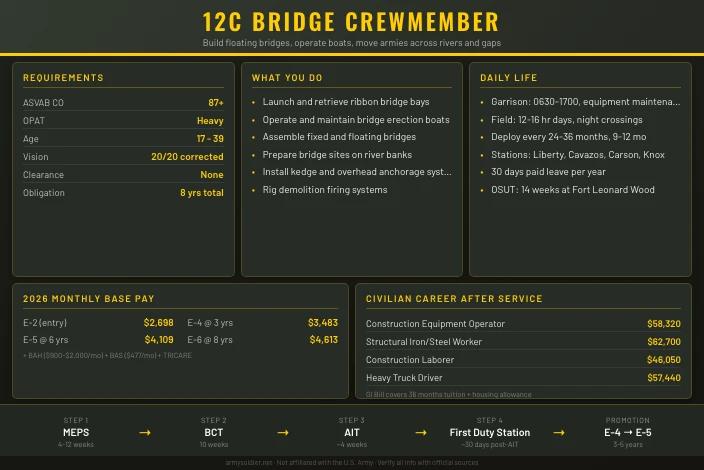
Job Role and Responsibilities
Bridge Crewmembers construct, maintain, and operate military bridging systems that allow troops, vehicles, and heavy equipment to cross rivers, gaps, and other obstacles. You work as part of a multi-role bridge company, building both fixed and floating bridges in training and combat environments.
What You Do Day to Day
Garrison days start with physical training at 0630, followed by equipment maintenance and bridge drills. You spend a lot of time on preventive maintenance for bridge erection boats (BEBs), ribbon bridge bays, and the trucks that haul them. Classroom blocks on bridging doctrine, water safety, and demolitions fill the gaps between field exercises.
Field training is where this MOS earns its reputation. You launch ribbon bridge bays into rivers, connect them into floating bridges or rafts, and operate BEBs to push rafts loaded with vehicles across the water. Exercises can run 12-16 hours a day for weeks at a time. Night crossings are standard because real-world gap crossings happen under cover of darkness.
- Launch and retrieve ribbon bridge bays
- Operate and maintain bridge erection boats
- Assemble fixed bridges (Bailey-type panel bridges)
- Prepare bridge sites on both banks of a river
- Install kedge and overhead anchorage systems
- Rig demolition firing systems for bridge denial operations
- Drive trucks and operate heavy equipment to transport bridging assets
Specialized Roles
| Identifier | Type | Description |
|---|---|---|
| 12C | Primary MOS | Bridge Crewmember (all skill levels) |
| 12C20 | Skill Level 2 | Team leader for bridge operations |
| 12C30 | Skill Level 3 | Squad leader, supervises bridge site operations |
| 12C40 | Skill Level 4 | Platoon sergeant, manages company-level bridging assets |
Bridge companies also work with 12B Combat Engineers during combined engineer operations. Some 12C soldiers pick up ASIs through specialized training in areas like combat diving or airborne operations, depending on their unit assignment.
Mission Contribution
A single destroyed bridge can stop a division-sized element. Bridge crews restore mobility by putting temporary crossings in place, sometimes within hours. During offensive operations, you build bridges under fire so maneuver units can maintain their tempo. In humanitarian missions and disaster response, the same skills get people and supplies across flooded rivers and washed-out roads.
Technology and Equipment
The Improved Ribbon Bridge (IRB) is the primary floating bridge system. Each bay weighs about 8,300 pounds and unfolds from a truck into the water. Connected bays form a bridge rated for Military Load Class 96, meaning it can handle M1 Abrams tanks.
Bridge erection boats are aluminum-hulled workboats that push and position bridge bays in the water. You also work with the Dry Support Bridge (DSB), a rapidly deployable fixed bridge launched from a truck, and Bailey-type panel bridges for longer gaps. GPS, communication radios, and laser range finders round out your kit.
Salary and Benefits
Base Pay
Your pay is based on rank and time in service, not your MOS. These figures come from the 2026 military pay tables.
| Rank | Time in Service | Monthly Base Pay |
|---|---|---|
| E-1 (PV1) | Entry | $2,407 |
| E-2 (PV2) | Entry | $2,698 |
| E-3 (PFC) | 2 years | $3,015 |
| E-4 (SPC) | 3 years | $3,483 |
| E-5 (SGT) | 6 years | $4,109 |
| E-6 (SSG) | 8 years | $4,613 |
Allowances and Bonuses
On top of base pay, you receive Basic Allowance for Subsistence (BAS) of $476.95/month for food. Basic Allowance for Housing (BAH) varies by duty station and dependency status. A single E-4 can expect roughly $900-$2,000/month depending on location.
The 12C MOS is eligible for enlistment bonuses up to $40,000 depending on contract length and availability. Bonus amounts change frequently, so confirm the current offer with your recruiter before signing.
Healthcare and Education
TRICARE Prime covers all medical, dental, vision, and mental health care at zero cost to active duty soldiers. Your family members also receive TRICARE coverage with no enrollment fees.
The Post-9/11 GI Bill pays full in-state tuition at public universities or up to $29,920.95/year at private schools, plus a monthly housing allowance and $1,000/year book stipend for 36 months. Tuition Assistance provides up to $4,500/year while you are still serving, so you can start college courses during your enlistment.
Retirement
The Blended Retirement System (BRS) combines a pension with TSP matching. The Army automatically contributes 1% of your base pay to the TSP and matches up to 4% more if you contribute 5% of your own pay. After 20 years, you receive a pension worth 40% of your highest 36 months of base pay.
Leave
You earn 30 days of paid leave per year, plus 11 federal holidays. Leave accrues at 2.5 days per month from day one.
Qualifications and Eligibility
Requirements at a Glance
| Requirement | Details |
|---|---|
| ASVAB Line Score | CO (Combat) 87 or higher |
| OPAT Category | Heavy |
| Age | 17-39 (17 requires parental consent) |
| Education | High school diploma or GED (AFQT 31 with diploma, 50 with GED) |
| Citizenship | U.S. citizen or permanent resident |
| Security Clearance | None required |
| Driver’s License | Valid state license required before shipping |
| Vision | Correctable to 20/20 |
| Physical Profile | Must meet heavy-duty physical demands |
The CO (Combat) composite is calculated from Arithmetic Reasoning + Coding Speed + Auto & Shop Information + Mechanical Comprehension. An 87 is moderate by engineer standards. Scoring well on the mechanical and math sections of the ASVAB is the fastest path to qualifying.
How to Apply
Competitiveness and Selection
The CO score of 87 is reachable for most applicants who prepare, and 12C slots are usually available because this MOS has smaller numbers than infantry or other combat arms jobs. Having a driver’s license before you enlist is not optional. Without one, you cannot ship to training.
The standard first enlistment is a 4-year active duty contract with a total 8-year military service obligation (the remaining years are in the Individual Ready Reserve). You enter as an E-1 (PV1) unless you have college credits or a referral bonus that qualifies you for an advanced rank.
See our ASVAB study guide for strategies to hit these line scores, or take the PiCAT from home if you are a first-time tester.
Work Environment
Setting and Schedule
Forget office work. This MOS keeps you outside. In garrison, you maintain equipment in motor pools and practice bridge drills on local waterways. Field training exercises take you to rivers and lakes where you build full-scale crossings.
Garrison schedules run roughly 0630-1700, Monday through Friday. Field rotations blow that up. During exercises at the National Training Center (Fort Irwin), Joint Readiness Training Center (Fort Johnson), or overseas training areas, you work around the clock for days at a time.
Weather does not cancel bridge operations. You will build bridges in rain, snow, extreme heat, and darkness. Water operations add another layer because river currents and cold water are constant safety concerns.
Leadership and Communication
You report to a team leader (E-5) who reports to a squad leader (E-6). Bridge companies are tight units because the work demands coordination. Every bay launch requires a boat crew, a bank crew, and a downstream safety team all communicating by radio and hand signals.
Performance feedback comes through NCOERs (Non-Commissioned Officer Evaluation Reports) for NCOs and counseling packets for junior soldiers. Your first-line leader is supposed to counsel you monthly and provide a written evaluation annually.
Teamwork and Autonomy
Bridge work is almost entirely team-based. You cannot launch a ribbon bridge bay by yourself. A single raft operation requires at least 8-12 soldiers working in sync. Individual initiative matters most during equipment maintenance, troubleshooting, and when you are the boat operator making real-time calls on the water.
As you progress to E-5 and E-6, you gain more decision-making authority. Squad leaders pick bridge sites, set up traffic control, and manage safety zones. That autonomy grows at each rank.
Retention
Engineer MOS retention rates fluctuate with bonus availability and deployment tempo. When bonuses are high, re-enlistment picks up. Soldiers who enjoy the physical outdoor work and the camaraderie of a small, specialized unit tend to stay. Those who want a desk job or a more transferable technical skill sometimes reclassify after their first contract.
Training and Skill Development
Initial Training Pipeline
12C soldiers attend One Station Unit Training (OSUT) at Fort Leonard Wood, Missouri. OSUT combines Basic Combat Training and Advanced Individual Training into a single 14-week course.
| Phase | Duration | Location | Focus |
|---|---|---|---|
| BCT (Red/White/Blue phases) | 10 weeks | Fort Leonard Wood, MO | Marksmanship, drill, land navigation, first aid, field craft |
| AIT (Bridge training) | ~4 weeks | Fort Leonard Wood, MO | Bridge construction, boat operations, rigging, demolitions |
During the AIT portion, you get hands-on time with the Improved Ribbon Bridge system, bridge erection boats, and fixed bridging. Classroom instruction covers basic engineering principles, water safety, and bridging doctrine. You practice launching bays, building full bridges, and operating boats on the rivers and training areas around Fort Leonard Wood.
Advanced Training Opportunities
After your first duty station, you can attend additional courses that expand your skill set:
- Assault Climber Course at Fort Leonard Wood
- Airborne School at Fort Moore, GA (3 weeks, earns the parachutist badge)
- Air Assault School at Fort Campbell, KY (10 days)
- Combat Diver Qualification Course for assignment to special operations engineer units
- Small Craft Operator Course for advanced boat handling
- Sapper Leader Course at Fort Leonard Wood (28 days, one of the Army’s toughest leadership courses)
The Army also funds civilian certifications and college courses through Tuition Assistance while you serve. Many 12C soldiers work toward commercial driver’s licenses (CDLs) or construction management degrees during their enlistment.
Everything starts with qualifying ASVAB scores — our study guide covers what to study first.
Career Progression and Advancement
Rank Timeline
| Pay Grade | Rank | Typical Time in Service | Role |
|---|---|---|---|
| E-1 | PV1 (Private) | Entry | Trainee |
| E-2 | PV2 (Private) | 6 months | Bridge crew member |
| E-3 | PFC (Private First Class) | 12 months | Experienced crew member |
| E-4 | SPC (Specialist) | 2 years | Team member, vehicle operator |
| E-5 | SGT (Sergeant) | 3-5 years | Team leader |
| E-6 | SSG (Staff Sergeant) | 6-9 years | Squad leader |
| E-7 | SFC (Sergeant First Class) | 12-16 years | Platoon sergeant |
| E-8 | MSG (Master Sergeant) | 18-20 years | Operations NCOIC or First Sergeant |
Promotion to E-4 is automatic based on time in service and time in grade. E-5 and above require promotion points earned through military education, awards, physical fitness scores, and college credits. 12C is a smaller MOS, so promotion rates can be either faster or slower depending on the year’s needs.
Lateral Moves
If your goals change, you can apply to reclassify into another MOS after your first enlistment. Many 12C soldiers move to 12B (Combat Engineer), 12N (Horizontal Construction Engineer), or 12W (Carpentry and Masonry Specialist) within CMF 12. You can also apply for Warrant Officer programs if you have the required time in service and recommendations.
Performance Evaluation
The Army uses the NCOER (NCO Evaluation Report) for E-5 and above, and DA Form 2166-9 series counseling for all ranks. Evaluations measure leadership, technical competence, and adherence to Army values. Strong evaluations are the single most important factor in getting promoted to E-6 and above.
Build a reputation as the soldier who knows the equipment cold, can run a bridge site safely, and takes care of their team. That combination drives promotion boards more than anything else.
Physical Demands and Medical Evaluations
Daily Physical Demands
This is one of the most physically punishing MOS options in the engineer branch. Ribbon bridge bays weigh thousands of pounds. You manhandle them into position with cables, ramps, and brute force. BEB operations put you on the water in all conditions, including cold rivers and strong currents.
A typical field day involves:
- Lifting and carrying bridging components (individual parts can exceed 100 lbs)
- Standing for hours on wet, unstable surfaces
- Swimming or wading in rivers during bridge construction
- Loading and unloading bridge bays from trucks
- Operating in extreme temperatures (the metal bridge bays absorb heat in summer and freeze in winter)
The OPAT Heavy category exists for a reason. If you are not comfortable with sustained physical labor in water and adverse conditions, this MOS is the wrong fit.
Army Fitness Test (AFT)
All soldiers must pass the AFT, which replaced the ACFT in June 2025. The AFT has five events scored 0-100 each, with a maximum score of 500.
| Event | Abbreviation | Minimum (60 pts) |
|---|---|---|
| 3 Repetition Maximum Deadlift | MDL | Varies by age/sex |
| Hand Release Push-Up | HRP | Varies by age/sex |
| Sprint-Drag-Carry | SDC | Varies by age/sex |
| Plank | PLK | Varies by age/sex |
| Two-Mile Run | 2MR | Varies by age/sex |
The general passing standard is 300 total (60 per event, sex- and age-normed). Combat MOS soldiers, including 12C, must meet the 350 total combat specialty standard (sex-neutral, age-normed). You take the AFT at least twice per year.
Medical Standards
You need to pass a full medical exam at MEPS before enlisting. Color vision deficiency is generally not disqualifying for this MOS, but you must have correctable vision and no conditions that prevent heavy physical labor or water operations. After training, you complete a Periodic Health Assessment (PHA) annually and a more thorough physical every five years.
Deployment and Duty Stations
Where You Could Be Stationed
12C soldiers serve with engineer battalions and multi-role bridge companies across the Army.
CONUS (Continental U.S.):
- Fort Liberty, NC
- Fort Cavazos, TX
- Fort Carson, CO
- Fort Knox, KY
- Fort Leonard Wood, MO
- Fort Moore, GA
- Fort Bliss, TX
- Fort Johnson, LA
- Joint Base Lewis-McChord, WA
OCONUS (Overseas):
- Bavaria, Germany
- Vicenza, Italy
- Schofield Barracks, HI
- Joint Base Elmendorf-Richardson, AK
Deployment Patterns
Engineer bridge units deploy on rotational schedules, typically every 24-36 months for 9-12 month tours. Deployments go to wherever the Army needs gap-crossing capability. That has included the Middle East, Eastern Europe, and the Pacific theater in recent years.
Training rotations to the National Training Center in California and the Joint Multinational Readiness Center in Germany are common and last 3-6 weeks. These are not deployments, but they take you away from your home station.
Duty station preferences go on your “wish list” during assignment, but the Army fills slots based on unit needs first. Your branch manager makes the final call.
Risk, Safety, and Legal Considerations
Job Hazards
Water operations are the biggest safety concern. Fast-moving rivers, cold water immersion, and heavy equipment near the water’s edge create real drowning risks. Bridge bay handling can cause crush injuries. Demolition operations add explosive hazards.
During deployments, bridge sites are high-value targets. The enemy knows that a crossing point concentrates troops and vehicles. Bridge crews operate under threat of indirect fire, IEDs, and direct attack during combat crossings.
Safety Protocols
Every water operation requires a downstream safety boat with rescue swimmers. Personal flotation devices are mandatory on or near the water. Bridge site commanders enforce safety zones to keep personnel clear of moving bays and vehicles.
Demolitions training follows strict range safety protocols. All live demolitions require a certified range safety officer and multiple safety checks before any charge is fired.
Legal Obligations
No security clearance is required for 12C, which simplifies the enlistment process. Your legal obligations include your enlistment contract (typically 4 years active + 4 years IRR), compliance with the Uniform Code of Military Justice (UCMJ), and deployability at all times.
The Army can deploy you anywhere in the world on short notice. That is the fundamental trade-off of military service. In conflict zones, bridge crews operate under the same rules of engagement as other combat arms soldiers.
Impact on Family and Personal Life
Family Considerations
Field time is the biggest strain. 12C soldiers spend more time away from home than many other MOS options because bridge training requires access to rivers and lakes that are not always near your duty station. Training rotations, field exercises, and deployments add up to several months away from home each year.
Single soldiers live in barracks on post. Married soldiers receive BAH and can live off post with their families. Army installations provide family support through Army Community Service (ACS), child development centers, and spouse employment programs.
Relocation
Expect to PCS (Permanent Change of Station) every 2-3 years. Each move means your family relocates to a new city. The Army covers moving costs and provides temporary housing allowances during transitions. For dual-military couples, the Army tries to co-locate you but cannot guarantee it.
The upside is that many 12C duty stations are at major installations with good schools, commissaries, and recreational facilities. Fort Liberty, Fort Carson, and JBLM consistently rank among soldiers’ preferred assignments.
Reserve and National Guard
Component Availability
The 12C MOS exists in both the Army Reserve and Army National Guard, but positions are less common than general combat engineer (12B) slots. Dedicated bridge companies and floating bridge units make up a smaller slice of the engineer force structure. You may need to look harder to find a unit near you, and some states have only one or two bridge units total. If you live near a major engineer installation like Fort Leonard Wood, your options improve.
Drill Schedule and Training Commitment
The standard drill schedule – one weekend per month plus two weeks of Annual Training – applies. Bridge crewmembers have an additional layer: the specialized equipment (Improved Ribbon Bridge, Assault Float Bridge) requires hands-on qualification exercises that go beyond what a two-day drill weekend can cover. Bridge units typically schedule one to two additional training periods per year to run erection and recovery exercises on the actual equipment. These sessions are operationally necessary, not optional.
Part-Time Pay
An E-4 at roughly three years of service earns about $422 per drill weekend. Across 12 drill weekends that is roughly $5,064 per year. Two weeks of Annual Training adds approximately $1,583. Total comes to around $6,647 annually – solid supplemental pay for someone already working in heavy construction or crane operation.
Benefits Differences
Active-duty TRICARE costs nothing. Reserve and Guard members pay for Tricare Reserve Select – $57.88 per month for individual coverage or $286.66 per month for a family plan in 2026.
Education benefits by component:
- Federal Tuition Assistance: $4,500 per year available to all drilling members
- MGIB-SR: roughly $416 per month while enrolled
- Post-9/11 GI Bill: requires 90+ days of qualifying federal activation; the percentage of benefits you receive scales with total cumulative active service
- State tuition waivers (Guard only): some states waive 100% of tuition at in-state public schools; Army Reserve members are a federal component and do not receive state waivers
Reserve and Guard retirement uses a points system. You do not collect your pension at the 20-year mark – it pays out at age 60. That minimum age can be reduced by 90 days for each qualifying 90-day mobilization period, down to age 50 at the earliest. TSP matching up to 5% of base pay is available under the Blended Retirement System.
Deployment and Mobilization
Bridge units deploy less frequently than general-purpose engineer units but are still subject to mobilization for major operations. When the Army needs bridging capability in theater – river crossings, infrastructure repair, humanitarian response – Reserve and Guard bridge companies get the call. Typical mobilizations run 9 to 12 months. The tempo for most 12C soldiers in the Reserve and Guard is lower than active duty, with mobilizations typically spacing out every four to six years.
Civilian Career Integration
The 12C skill set maps directly to crane operation, rigging, heavy equipment operation, and structural steel work. Many bridge crewmembers find work in marine construction, pile driving, or waterfront infrastructure. The USERRA protects your civilian job during any mobilization – your employer must restore your position, seniority, and benefits when you return.
| Feature | Active Duty | Army Reserve | Army National Guard |
|---|---|---|---|
| Commitment | Full-time | One weekend/month + 2 weeks/year | One weekend/month + 2 weeks/year |
| Monthly Pay (E-4, ~3 yrs) | $3,166/month | ~$422/drill weekend | ~$422/drill weekend |
| Healthcare | TRICARE, $0 premiums | TRS, $57.88/month (member) | TRS, $57.88/month (member) |
| Education | TA + Post-9/11 GI Bill | Federal TA, MGIB-SR; Post-9/11 after activation | Federal TA, MGIB-SR, state tuition waivers |
| Deployment | Regular rotation | Mobilization every 4-6 years | Mobilization every 4-6 years |
| Retirement | BRS pension at 20 years | Points-based, age 60 | Points-based, age 60 |
Post-Service Opportunities
Civilian Career Transition
Bridge crewmembers leave the Army with practical construction skills: heavy equipment operation, rigging, crane signaling, and project coordination. These translate directly to civilian construction and infrastructure jobs.
The Army’s Soldier for Life program and Transition Assistance Program (TAP) provide resume help, job fairs, and interview coaching starting 12 months before your separation date. Your GI Bill benefits remain available for 15 years after separation.
Many veterans pursue civilian certifications after discharge. A Commercial Driver’s License (CDL) is a quick credential to earn because you already have experience driving military trucks. OSHA safety certifications and crane operator certifications are also natural fits.
Civilian Career Prospects
| Civilian Job Title | Median Annual Salary | Job Outlook (2024-2034) |
|---|---|---|
| Construction Equipment Operator | $58,320 | 4% (as fast as average) |
| Structural Iron/Steel Worker | $62,700 | 4% (as fast as average) |
| Construction Laborer | $46,050 | 7% (faster than average) |
| Heavy/Tractor-Trailer Truck Driver | $57,440 | 4% (as fast as average) |
Salary data from the Bureau of Labor Statistics, May 2024.
Veterans with leadership experience (E-5 and above) often move into construction supervisor or project coordinator roles that pay well above median. The combination of management experience and hands-on skills is hard to find in civilian candidates.
Is This a Good Job for You? The Right (and Wrong) Fit
Who Thrives in This MOS
You will do well as a 12C if you like physical outdoor work and do not mind getting wet, muddy, and cold. The ideal bridge crewmember is mechanically inclined, comfortable around water, and able to stay calm when heavy equipment is moving in tight spaces.
People who played team sports, worked construction, or grew up on farms tend to adapt quickly. The work is blue-collar and hands-on. If you prefer books to wrenches, this probably is not your MOS.
- Strong swimmers and water-confident individuals
- People who enjoy working with their hands and heavy equipment
- Team players who communicate clearly under stress
- Soldiers who want a combat arms-adjacent role with a construction twist
Who Should Look Elsewhere
This MOS is a poor fit if you:
- Dislike prolonged outdoor work in bad weather
- Are uncomfortable in or around water
- Want a skill that translates directly to a high-paying tech career
- Prefer working independently rather than as part of a large crew
- Have physical limitations that make heavy lifting or swimming difficult
Career and Lifestyle Fit
A 12C enlistment works best for someone who wants a physically active military experience, plans to use the GI Bill for education after service, and does not mind the field time that comes with combat engineer units. If your long-term goal is civilian construction management or trades work, this MOS gives you a running start. If you want to stay in the Army long-term, the engineer branch offers a solid NCO career path with good promotion rates at the senior levels.
Young soldiers without family obligations get the most out of this MOS because the field schedule and deployment tempo are easier to handle without dependents. That said, plenty of married 12C soldiers make it work with the right expectations.
More Information
Your local Army recruiter can pull up the latest bonus amounts, available ship dates, and slot availability for MOS 12C. Walk in, ask about bridge crewmember, and they will run your ASVAB scores against the CO 87 requirement on the spot.
- Prepare for the ASVAB with our study guide to make sure your line scores qualify
This site is not affiliated with the U.S. Army or any government agency. Verify all information with official Army sources before making enlistment or career decisions.
Explore more Army engineer careers such as 12B Combat Engineer and 12N Horizontal Construction Engineer.