12D Diver
The Army has divers. Most people don’t know that. Army engineer divers conduct underwater reconnaissance, demolition, and salvage in some of the most dangerous environments on the planet, and they’ve done it since the Spanish-American War in 1898. The training pipeline has a roughly 23% graduation rate. If you make it through, you join one of the smallest and most specialized communities in the entire Army.
Qualifying requires specific ASVAB line scores — our ASVAB study guide covers what to target and how to prepare.
Job Role and Responsibilities
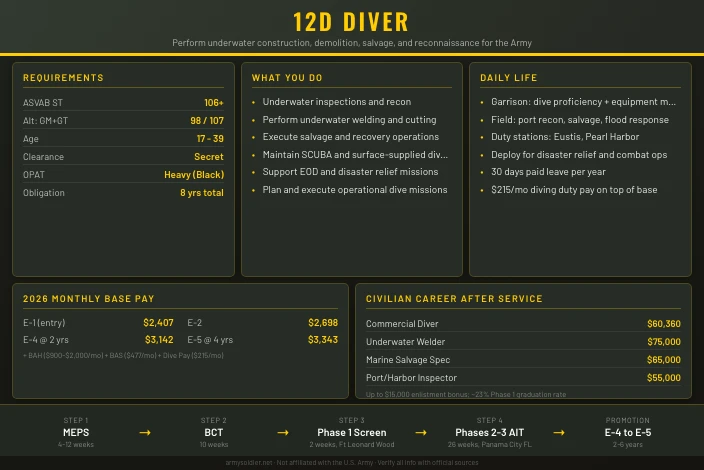
Army Divers (MOS 12D) conduct underwater operations supporting combat engineering missions including underwater reconnaissance, demolition, salvage, and construction. They survey waterways for obstacles, support bridge reconnaissance, and assist with harbor and pier construction using both SCUBA and surface-supplied diving systems.
A typical week in an engineer dive detachment looks nothing like a standard Army unit. Divers spend significant time in the water maintaining proficiency across diving modes, inspecting underwater structures, and rehearsing salvage procedures. Garrison days include equipment maintenance, dive plan reviews, and physical conditioning.
Daily Tasks
On a standard duty day, a 12D might:
- Conduct bottom surveys and hydrographic mapping of waterways
- Inspect bridge foundations, piers, and harbor infrastructure underwater
- Perform search-and-recovery operations for submerged equipment or personnel
- Plan and brief dive operations to the chain of command
- Maintain diving equipment: helmets, manifolds, umbilicals, regulators, and SCUBA rigs
- Rehearse underwater demolition and mine-clearing procedures
Field missions add complexity. Divers respond to flood events and disaster relief operations. They support EOD teams by locating and identifying underwater threats. On deployments, they have conducted port reconstruction, waterway clearance, and salvage operations in Iraq, Afghanistan, Somalia, and Haiti.
Specialized Roles
Army engineer divers earn progression badges based on rank and operational experience:
| Badge | Level | Notes |
|---|---|---|
| 2nd Class Diver | Entry level | Awarded upon completion of training |
| Salvage Diver | Intermediate | Salvage operations qualification |
| 1st Class Diver | Senior | Expanded operational qualifications |
| Master Diver | Senior NCO | Highest qualification; course at Panama City |
The 12D also uses Additional Skill Identifiers (ASIs) and Special Qualification Identifiers (SQIs) to denote capabilities such as airborne qualification (SQI P) for divers assigned to airborne-capable engineer units.
Mission Contribution
Engineer divers give ground commanders options that no other unit can provide. They clear waterways before river-crossing operations. They inspect bridges to determine load capacity. They recover sensitive equipment that goes into rivers or harbors. When ports are destroyed in combat, it’s often engineer divers who go underwater first to assess what’s recoverable and what needs to be rebuilt.
Technology and Equipment
The 12D operates two distinct diving systems. Surface-supplied diving uses a hard-hat helmet or full-face mask with an umbilical line connecting the diver to a surface-supplied air source, allowing deeper and longer dives. SCUBA operations use self-contained tanks for shallower work requiring greater diver mobility.
Tools in the water include hydraulic cutting equipment, underwater welding and burning rigs, pneumatic tools, and demolition materials. On the surface, divers operate dive control stations, air compressors, and small watercraft. Underwater inspection work involves video cameras, sonar equipment, and precision survey tools.
Salary and Benefits
Financial Benefits
Pay follows the standard military pay table based on rank and years of service. Most soldiers enter the 12D pipeline as E-1 or E-2 after Basic Combat Training, though reclassifying soldiers enter at their current grade.
| Rank | Pay Grade | Monthly Base Pay (2026) |
|---|---|---|
| Private | E-1 | $2,407 |
| Private | E-2 | $2,698 |
| Private First Class | E-3 | $2,837 - $3,198 |
| Specialist | E-4 | $3,142 - $3,816 |
| Sergeant | E-5 | $3,343 - $4,422 |
| Staff Sergeant | E-6 | $3,401 - $5,044 |
| Sergeant First Class | E-7 | $3,932 - $5,537 |
Figures reflect the 2026 DFAS military pay tables.
Beyond base pay, divers receive special diving pay. Enlisted divers earn $215 per month in special pay (Diving Duty Pay) at the basic rate, with rates increasing for more qualified divers. This stacks on top of standard allowances.
Basic Allowance for Housing (BAH) depends on your duty station and dependency status. Divers stationed at Joint Base Langley-Eustis, Virginia, or Joint Base Pearl Harbor-Hickam, Hawaii will find BAH rates differ significantly by location. A single E-4 at most CONUS installations receives roughly $900 to $2,000+ per month in BAH. Basic Allowance for Subsistence (BAS) adds $476.95 monthly.
Additional Benefits
TRICARE covers active-duty soldiers and their families at no cost. Doctor visits, prescriptions, dental, vision, mental health care, and hospitalization are all included. Active-duty soldiers can use Tuition Assistance ($4,500 per year, $250 per semester hour) to take college courses during service.
The Post-9/11 GI Bill provides up to 36 months of tuition coverage at a public university (full in-state rate), a monthly housing allowance, and a $1,000 annual book stipend after separation. Private school tuition is capped at $29,920.95 per academic year for AY 2025-2026.
Retirement under the Blended Retirement System (BRS):
- 40% pension after 20 years of active service (based on highest 36 months of pay)
- Government automatically contributes 1% of base pay to your Thrift Savings Plan (TSP), beginning after 60 days
- Government matches up to 4% of base pay in TSP contributions starting in year 3
- Continuation pay available at 7 to 12 years of service (typically 2.5x monthly base pay for a 3-year commitment)
Work-Life Balance
All soldiers earn 30 days of paid leave per year, accruing at 2.5 days per month. The small size of dive units means a tight-knit team environment, but also means each diver carries significant responsibility. Expect regular dive days, equipment maintenance cycles, and periodic field exercises that extend beyond normal duty hours. The hazardous nature of the work demands a high standard of physical readiness year-round.
Qualifications and Eligibility
Basic Qualifications
The ASVAB requirements for 12D are demanding. You must hit one of two qualifying combinations:
| Requirement | Details |
|---|---|
| Age | 17-39 years old |
| Citizenship | U.S. citizen only (no permanent residents) |
| Education | High school diploma or GED |
| AFQT (ASVAB) | Minimum 31 (diploma) or 50 (GED) |
| ASVAB Option 1 | Skilled Technical (ST): 106 minimum |
| ASVAB Option 2 | General Maintenance (GM): 98 AND General Technical (GT): 107 |
| OPAT Category | Heavy (Black) – highest physical demand tier |
| Vision | Correctable to 20/20 (documented on DD 2808) |
| Swimming | Must demonstrate basic water competency |
| Medical | Must meet diver medical standards per AR 40-501, Section 5-11 |
| Security clearance | Secret |
The ST composite on the ASVAB combines scores from General Science, Verbal Expression, Mathematics Knowledge, and Mechanical Comprehension. The GM composite combines General Science, Auto and Shop Information, Mathematics Knowledge, and Electronics Information. Either path requires strong math and science fundamentals.
Application Process
The 12D selection process differs from most Army MOSs because of the phased screening structure:
Selection Criteria and Competitiveness
The 12D is one of the most competitive enlisted MOS assignments in the Army. Fewer than 200 active-duty Army divers exist at any given time. Phase 1 attrition alone eliminates roughly 75-80% of candidates who show up. Strong swimming ability, calm demeanor under stress, and above-average physical fitness are the best predictors of success. Prior swimming or diving experience is not required but gives candidates a meaningful edge.
Upon Accession into Service
Standard enlistment is 8 years total: typically 4 years active duty plus the remainder in the Reserve or Individual Ready Reserve (IRR). You enter BCT as an E-1 (Private) and may finish training as an E-2 (Private) or E-3 (Private First Class) depending on college credits or other enlistment incentives. Phase 1 attrition means not all 12D enlistees complete training. Soldiers who fail out of Phase 1 may be reclassified to a different MOS.
See our ASVAB study guide for strategies to hit these line scores, or take the PiCAT from home if you are a first-time tester.
Work Environment
Setting and Schedule
Engineer divers work in environments most Army soldiers never see:
- Garrison dive operations – scheduled dive days in local waterways, harbors, or training pools. Standard duty hours but with frequent dive planning and equipment prep.
- Field exercises – river crossing operations, bridge reconnaissance missions, and disaster response exercises. Extended duty days in outdoor environments.
- Deployment – port operations, inland waterway surveys, and salvage missions. Work happens regardless of weather, visibility, or water temperature.
Units are small. An engineer dive detachment has a handful of divers, which means you carry significant individual responsibility. There’s no sitting back and letting someone else handle it.
Leadership and Communication
Dive detachments are lean. Your immediate chain runs through your dive supervisor (typically a Staff Sergeant or Sergeant First Class) and detachment officer. Because operations involve life safety, communication is explicit and deliberate. Every dive operation runs with a formal dive plan, a safety standby diver, and a surface tender monitoring the umbilical or communications line.
Performance feedback in small units is constant. Your supervisor knows your capabilities and limitations. Informal feedback comes daily through dive operations; formal written evaluations happen annually through the NCOER (NCO Evaluation Report) system for NCOs.
Team Dynamics and Autonomy
Divers work in buddy pairs at minimum. The standby diver is always present. Every operation is a team effort, even when only one person goes into the water. Junior divers handle equipment prep and line tending. As you advance, you plan and supervise dive operations and eventually qualify as a dive supervisor.
Experienced divers make real-time decisions underwater with no direct communication possible in some conditions. Reading environmental hazards, managing air supply, and staying oriented in low-visibility water are skills that develop with practice and personal judgment.
Job Satisfaction and Retention
The 12D community is small enough that individual satisfaction varies sharply depending on the unit. Divers who stay report high job satisfaction driven by the uniqueness of the work and the professional pride of an elite qualification. The primary complaints are the limited number of billet locations (only a few duty stations), frequent TDY, and the physical toll of regular diving operations. Reenlistment rates trend higher than average because there are few civilian equivalents that offer the same operational variety.
Training and Skill Development
Initial Training
The 12D pipeline is one of the longest in the enlisted Army. From BCT through completion of Phase 3, plan on roughly 10 months before arriving at your first unit.
| Training Phase | Location | Duration | Focus |
|---|---|---|---|
| BCT | Various Army BCT installations | 10 weeks | Basic soldier skills: marksmanship, physical fitness, land navigation, discipline |
| Phase 1 (Screening) | Fort Leonard Wood, MO | 2 weeks | Diving physics, basic dive medicine, pool conditioning, stress inoculation, screening |
| Phases 2 and 3 (AIT) | Naval Diving and Salvage Training Center, Panama City, FL | 26 weeks | SCUBA, surface-supplied systems, underwater welding, cutting, demolition, salvage, equipment maintenance |
Phase 1 is the hardest gate to clear. Pool sessions begin on day one and include 1,000-yard swims, breath-hold drills, gear removal underwater, and mask-clearing exercises with instructors deliberately introducing distraction. Students who panic or freeze don’t continue. Candidates who pass Phase 1 are not guaranteed to finish Phases 2 and 3, but Phase 1 is where most attrition occurs.
Phase 2 and 3 at the Naval Diving and Salvage Training Center runs the full civilian equivalents of commercial diving programs, compressed into a military structure. Students learn SCUBA from the ground up, then progress to surface-supplied systems. Underwater welding and burning, demolition techniques, and salvage rigging round out the AIT.
Advanced Training
After completing AIT and settling into your first unit, additional training opportunities include:
- Master Diver Course – the highest qualification in Army diving; requires extensive experience and is available only to senior NCOs
- Airborne School – 3 weeks at Fort Moore, GA; required for divers assigned to airborne units
- Air Assault School – 10 days at Fort Campbell, KY; useful for divers supporting airmobile operations
- Sapper Leader Course – 28 days at Fort Leonard Wood; advanced demolitions and small-unit tactics, respected across the engineer community
- Hydrographic Survey Training – specialized instruction in waterway mapping and survey methodology
- Combat Diver Upgrade – available to some Army divers working in combat-oriented roles
The Army also sends divers to relevant civilian programs for equipment certifications, particularly for specialized underwater tools and inspection techniques used in infrastructure work.
Everything starts with qualifying ASVAB scores — our study guide covers what to study first.
Career Progression and Advancement
Career Path
Promotion through E-4 follows the standard Army automatic-promotion timeline. From E-5 onward, advancement depends on centralized promotion board results, evaluation reports, and competition within your career management field.
| Rank | Pay Grade | Typical Time in Service | Typical Role |
|---|---|---|---|
| Private (PV2) | E-2 | 0-1 year | Completing BCT and Phase 1 |
| Private First Class (PFC) | E-3 | 1-2 years | Phase 2 and 3 student |
| Specialist (SPC) | E-4 | 2-3 years | Entry diver, equipment maintenance, assisting dive operations |
| Sergeant (SGT) | E-5 | 3-6 years | Dive team leader, dive supervisor for limited operations |
| Staff Sergeant (SSG) | E-6 | 6-9 years | Senior diver, detachment NCO, dive supervisor |
| Sergeant First Class (SFC) | E-7 | 9-14 years | Dive detachment senior NCO, operations planner |
| Master Sergeant (MSG) | E-8 | 14-18 years | Senior staff position, Master Diver-qualified |
Earning the Master Diver badge is the pinnacle of the enlisted diver career path. It requires years of operational experience and a separate qualification course. Master Divers are the technical authority in their unit for all diving operations.
Role Flexibility and Transfers
Because the 12D community is so small, lateral transfers within the career field are limited. Engineers qualified in other MOSs (12B, 12C, 12N) can apply to reclassify into 12D through a formal reclassification packet, subject to passing the same Phase 1 screening. Divers who want to move into a different career field can request reclassification, though the process takes time and Army approval.
Officers who served in engineer units sometimes pursue warrant officer diving specialties, though the Army has no dedicated warrant officer diving MOS. Enlisted divers who want to commission can apply through Green to Gold or OCS.
Performance Evaluation
Junior enlisted soldiers (E-1 through E-4) are assessed by NCO counseling sessions and unit-level performance tracking. NCOs receive formal annual NCOERs that evaluate leadership, technical competence, training contribution, and character. In dive units, technical credibility matters as much as leadership ability. A strong NCOER for a 12D shows proficiency across both diving modes, safe dive supervision, and mentorship of junior divers.
What separates top performers: consistently executing zero-incident dive operations, earning advanced diver badges ahead of peers, completing Airborne or Sapper qualifications voluntarily, and demonstrating the ability to operate in low-visibility or high-current conditions.
Physical Demands and Medical Evaluations
Physical Requirements
Diving is physically demanding in ways that differ from standard combat MOSs. You carry heavy equipment to the water’s edge, enter with 60 to 100 pounds of gear in some configurations, and work against currents and water resistance. Surface-supplied diving requires tending lines, managing air systems, and staying in communication with a diver while monitoring the environment.
Day-to-day physical demands include:
- Carrying and transporting dive equipment across uneven terrain
- Performing controlled entries and exits in full gear from various platforms
- Working in cold water for extended periods (hypothermia is a real risk)
- Conducting physically intense salvage rigging and recovery operations underwater
- Staying fit enough to respond as the standby diver at any moment
Every soldier takes the Army Fitness Test (AFT) at least once per year. The AFT has five events, each scored 0 to 100 points:
| Event | Description |
|---|---|
| 3-Rep Max Deadlift (MDL) | Lower body and grip strength |
| Hand-Release Push-Up (HRP) | Upper body pushing endurance |
| Sprint-Drag-Carry (SDC) | Anaerobic and total-body power |
| Plank (PLK) | Core endurance |
| Two-Mile Run (2MR) | Aerobic endurance |
The AFT general passing standard is 300 points total (minimum 60 per event), sex- and age-normed. The 12D is not among the 21 designated combat MOSs requiring the 350-point sex-neutral standard, but divers routinely train well above minimum to meet operational demands.
Medical Evaluations
Divers have more extensive medical monitoring than standard Army soldiers. Initial screening for diving medical fitness follows AR 40-501, Section 5-11, which covers pulmonary function, cardiac health, inner-ear integrity, sinus health, and psychological fitness. Any condition that affects pressure tolerance can disqualify a candidate.
Ongoing medical evaluations include an annual dive physical that checks ears, sinuses, lung function, and cardiovascular status. Divers who experience barotrauma (pressure injuries to ears or sinuses), decompression sickness, or any condition affecting their ability to dive safely must be cleared by the unit dive medical officer before returning to the water. Hyperbaric oxygen treatment is available at Army medical facilities for decompression incidents.
Deployment and Duty Stations
Deployment Details
Army engineer divers deploy with their detachment to support theater-wide engineering requirements. Deployments run on the same general cycle as other Army units: typically 9 to 12 months every 24 to 36 months. In deployed environments, divers support port operations, inland waterway surveys, and salvage missions alongside combat engineer missions.
Historical deployments have taken Army divers to Iraq, Afghanistan, Somalia, Haiti, and various Pacific theater locations. The type of work varies by theater: port reconstruction and harbor clearing in some locations, river crossing reconnaissance and bridge inspection in others.
Location Flexibility
The 12D has the fewest duty station options of any engineer MOS. All active-component Army divers are assigned to one of six engineer dive detachments:
East Coast / CONUS:
- 74th, 86th, 511th, and 569th Engineer Dive Detachments – Joint Base Langley-Eustis (Fort Eustis), Virginia. Divers here operate throughout the continental United States, Europe, and the Middle East.
Pacific:
- 7th Engineer Dive Detachment – Joint Base Pearl Harbor-Hickam (Fort Shafter), Hawaii. Divers here operate in the Pacific Ocean and the Far East.
These are the only active-duty billet locations. If you want this MOS, you will be stationed at one of these two installations. PCS moves between them are possible, but options are limited by the total number of positions. The Army pays for all government-directed moves.
Risk, Safety, and Legal Considerations
Job Hazards
Diving is inherently hazardous, and Army diving adds operational complexity on top of standard diving risks:
- Decompression sickness – ascending too fast causes nitrogen bubbles in the bloodstream; potentially fatal or permanently disabling
- Nitrogen narcosis – at depth, nitrogen creates disorientation similar to intoxication
- Barotrauma – pressure injuries to ears, sinuses, and lungs during ascent or descent
- Drowning risk – equipment failure, entanglement, or incapacitation underwater
- Hypothermia – cold-water operations without adequate thermal protection
- Low visibility – murky water increases disorientation and entanglement risk
- Underwater demolition – handling explosive materials in a dynamic environment
- Current and surge – moving water can overwhelm even experienced divers
Safety Protocols
Every Army dive operation requires a formal dive plan, a qualified dive supervisor, a surface tender, and a standby diver ready to enter the water immediately. Two-person integrity rules apply to all explosives handled in or near the water. Dive supervisors are responsible for weather monitoring, current assessment, and abort criteria.
Decompression tables and dive computers govern depth and time limits. Any diver showing signs of decompression illness is treated as a medical emergency and transported to the nearest hyperbaric chamber. The Army trains all dive supervisors in dive medicine and emergency oxygen administration.
Security and Legal Requirements
The 12D requires a Secret security clearance. The background investigation covers your financial history, criminal record, foreign contacts, and personal references. The process takes 2 to 6 months. Any adverse information (felonies, serious debt, foreign national family members) can delay or disqualify the investigation.
All soldiers operate under the Uniform Code of Military Justice (UCMJ). Divers have additional legal responsibilities around explosive materials, classified operational planning documents, and safe handling of diving equipment. Mishandling dive gear that results in injury or death carries serious consequences under both military law and Army safety regulations.
Impact on Family and Personal Life
Family Considerations
Dive detachments deploy on the same general rotation as other Army engineer units: 9 to 12 months away every 2 to 3 years. Between deployments, TDY missions for training and support operations add additional time away from home. Annual training cycles keep divers in the field more than most support MOSs.
Support resources at both major duty stations:
- Family Readiness Groups (FRGs) – unit-based peer support networks for families during deployments
- Military OneSource – free counseling and family services available 24/7
- Spousal employment assistance – job search support at each duty station
- Exceptional Family Member Program (EFMP) – support for families with special medical or educational needs
- Child Development Centers – subsidized childcare on post at both Langley-Eustis and Pearl Harbor-Hickam
Relocation and Flexibility
With only two active duty billet locations, relocation flexibility is limited compared to most Army MOSs. Fort Eustis and JBPHH are your options. The Army covers government-directed PCS moves, but each relocation still disrupts your family’s routine, your spouse’s employment, and your children’s schooling.
Both installations are near large metropolitan areas (Hampton Roads and Honolulu), which helps with spousal employment options compared to more remote posts. Hampton Roads has a large defense contracting community and relatively affordable housing. Honolulu offers a higher BAH rate but a significantly higher cost of living, and spousal employment options outside the military community are more limited.
The Military Spouse Employment Partnership (MSEP) connects spouses with employers committed to hiring military families, which matters when your PCS options are limited to two locations. Installation family readiness groups at both posts maintain active support networks for families dealing with the deployment tempo and TDY cycles that come with the dive community.
Reserve and National Guard
Component Availability
The 12D MOS is rare in the Reserve and Guard components. A small number of Army Reserve dive detachments exist – primarily attached to engineer units with underwater construction or salvage missions. The National Guard has almost no 12D positions. If you want to maintain your dive skills in the part-time force, you will likely need to search for a Reserve unit specifically, and slots are limited. Soldiers transitioning from active duty to the Reserve after serving as divers should contact Human Resources Command early to identify available units before committing to a location.
Drill Schedule and Training Commitment
The standard one-weekend-per-month, two-weeks-per-year schedule applies on paper. In practice, maintaining dive qualifications requires more time. Dive certifications have expiration dates, and keeping them current means regular in-water training that a two-day drill weekend cannot always accommodate. Reserve dive detachments often schedule additional training periods – sometimes at the Naval Diving and Salvage Training Center or similar facilities – to keep soldiers qualified. If you join a Reserve dive unit, expect to train more than the minimum.
Part-Time Pay
An E-4 with around three years of service earns approximately $422 for a drill weekend. That adds up to roughly $5,064 over 12 drill weekends per year. Annual Training adds about $1,583, putting total annual pay at around $6,647. Dive pay – $150 to $340 per month on active duty – does not apply at the same rate in the Reserve component unless you are on active orders.
Benefits Differences
Active-duty soldiers pay nothing for TRICARE. Reserve and Guard members pay for Tricare Reserve Select – $57.88 per month for individual coverage or $286.66 per month for a family in 2026. For a commercial diver earning good civilian wages, TRS can still be the best health insurance deal available.
Education benefits by component:
- Federal Tuition Assistance: $4,500 per year for all drilling members
- MGIB-SR: roughly $416 per month while enrolled
- Post-9/11 GI Bill: requires 90+ days of qualifying federal activation; scales with total cumulative active service time
- State tuition waivers (Guard only): many states cover 100% at in-state public schools; Army Reserve members do not receive state waivers
Retirement is points-based for Reserve and Guard members. The pension does not pay out at 20 years – it draws at age 60, reduced by 90 days for every qualifying 90-day mobilization period, with a minimum draw age of 50. TSP matching up to 5% of base pay is available under BRS.
Deployment and Mobilization
Reserve dive units mobilize infrequently compared to general engineer units. When they do deploy, it tends to be for specific underwater construction, salvage, or reconnaissance missions. Typical mobilizations run 6 to 9 months. The gap between activations for most Reserve 12D soldiers can be long, but when the mission comes up, this is a highly specialized capability that gets called on.
Civilian Career Integration
Commercial diving is a natural fit. Former Army divers typically have certifications and training hours that civilian commercial dive schools take years to build. The civilian commercial diving industry – offshore oil and gas, marine salvage, underwater inspection, port construction – values that background. Most commercial dive employers are familiar with military dive credentials. USERRA protects your civilian position during any mobilization, which matters when a commercial dive contractor has invested in your training.
| Feature | Active Duty | Army Reserve | Army National Guard |
|---|---|---|---|
| Commitment | Full-time | One weekend/month + 2 weeks/year (plus extra dive qual training) | Rarely available |
| Monthly Pay (E-4, ~3 yrs) | $3,166/month | ~$422/drill weekend | N/A (limited positions) |
| Healthcare | TRICARE, $0 premiums | TRS, $57.88/month (member) | TRS, $57.88/month (member) |
| Education | TA + Post-9/11 GI Bill | Federal TA, MGIB-SR; Post-9/11 after activation | Federal TA, MGIB-SR, state tuition waivers |
| Deployment | Regular rotation | Mobilization every 5+ years, 6-9 months | Very limited |
| Retirement | BRS pension at 20 years | Points-based, age 60 | Points-based, age 60 |
Post-Service Opportunities
Transition to Civilian Life
Commercial diving is a direct civilian equivalent that pays well and is in demand. Former Army divers qualify for commercial diving certifications faster than civilians entering the field, since their training at the Naval Diving and Salvage Training Center meets or exceeds most commercial dive school standards. The Association of Diving Contractors International (ADCI) Consensus Standards form the basis of most commercial diving certifications, and Army dive training maps directly to those standards.
The Transition Assistance Program (TAP) provides resume writing, interview coaching, and benefits counseling during your final 12 months of active duty. Certifications earned during service carry significant weight with offshore oil and gas companies, marine construction firms, and government contracting agencies.
Civilian Career Prospects
| Civilian Job | Median Annual Salary (BLS, May 2024) | 10-Year Job Outlook |
|---|---|---|
| Commercial Diver | ~$61,130 | +8.5% |
| Construction Equipment Operator | $58,320 | +4% |
| Welder / Underwater Welder | $51,000 | +2% |
| Civil Engineer (with degree) | $99,590 | +5% |
| EOD Technician / Hazmat Worker | $48,490 | +1% |
Commercial divers are in demand in offshore oil and gas, wind energy infrastructure, bridge and dam inspection, and marine salvage. Experienced Army divers who go into commercial work offshore can earn significantly above the median, particularly in the Gulf of Mexico where saturation divers command premium rates. The Post-9/11 GI Bill can fund a civil engineering or marine science degree if you want to move into a supervisory or engineering role after service.
Post-Service Policies
An honorable discharge gives you access to VA healthcare, disability compensation (if applicable), and education benefits. Army divers who develop service-connected hearing loss or joint injuries from repeated diving operations should file VA disability claims at separation. Your 8-year service obligation includes both active and reserve time. Coordinate separation plans with your career counselor well before your ETS date.
Is This a Good Job for You?
Ideal Candidate Profile
The Army Diver is not for people looking for a military job with broad options and predictable duty stations. It’s for a specific type of person.
Traits that predict success:
- Comfortable in the water and genuinely confident swimming
- Calm under physical stress – the ability to slow your heart rate and think clearly when things go wrong underwater
- Mechanically inclined and comfortable maintaining complex equipment
- Comfortable in a small, high-accountability unit where there’s nowhere to hide
- Patient with long training pipelines and high attrition rates
If you grew up swimming competitively, scuba diving recreationally, or working on boats and watercraft, this MOS will feel like a natural fit. Prior water experience doesn’t guarantee success in Phase 1, but it dramatically improves your odds.
Potential Challenges
This MOS is a poor fit if you:
- Are not a strong swimmer or have anxiety about being underwater
- Want broad duty station options or geographic flexibility
- Have a family situation that makes two specific duty station locations impractical
- Expect typical Army unit structure and work patterns
- Have any history of ear, sinus, or pulmonary conditions that affect pressure tolerance
The Phase 1 washout rate is not a scare tactic. It’s a real feature of the pipeline. Most people who enlist with a 12D contract do not become Army divers. Think honestly about whether you’re prepared for reclassification if Phase 1 doesn’t go your way.
Fit Assessment
This job works for people who want a rare, technically demanding specialty with a direct path to a well-paying civilian career in commercial diving. The trade-offs are real: two duty stations, limited career field size, significant time away from home, and physical risk inherent to every dive operation.
If you want to do something in the Army that almost no one else does, and you’re a strong swimmer who stays calm when things get uncomfortable, the 12D career path is worth pursuing. The training is long, the attrition is high, and the job itself is genuinely unique.
More Information
Talk to an Army recruiter about current availability of 12D training seats and enlistment bonus amounts. Ask specifically about your ASVAB scores relative to the ST (106) and GM/GT (98/107) requirements. Request to speak with an actual 12D diver if possible. The Naval Diving and Salvage Training Center at Panama City, FL, publishes information on Army student training that gives you a realistic look at what Phase 2 and 3 involve.
The goarmy.com 12D page and your local recruiting station are the best starting points for current bonus figures and available ship dates.
- Prepare for the ASVAB with our study guide to make sure your line scores qualify
This site is not affiliated with the U.S. Army or any government agency. Verify all information with official Army sources before making enlistment or career decisions.
Explore more Army engineer careers such as 12B Combat Engineer and 12C Bridge Crewmember.