12H Construction Engineering Supervisor
You don’t start as a 12H. You earn it. Construction Engineering Supervisors are senior NCOs who come up through the Army’s technical engineer trades, spending years learning to build, wire, and plumb before they’re handed a platoon to lead. If you’re already in a 12-series MOS and you want to run construction operations instead of just executing them, this is the career track that gets you there.
Qualifying requires specific ASVAB line scores — our ASVAB study guide covers what to target and how to prepare.
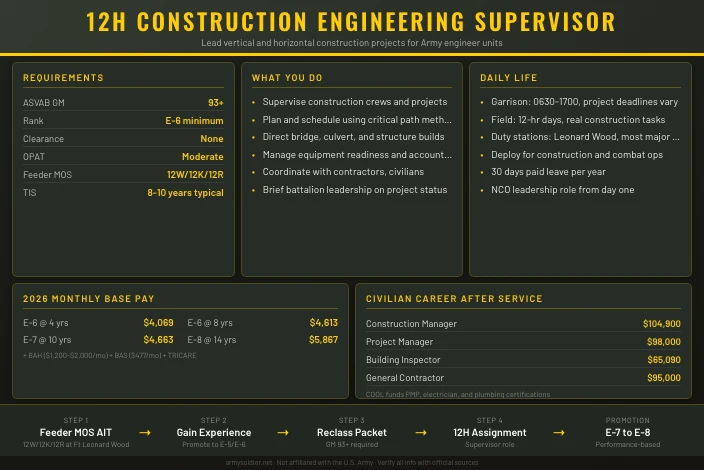
Job Role and Responsibilities
The 12H Construction Engineering Supervisor plans, directs, and inspects construction, repair, and utility projects for the U.S. Army. These soldiers supervise teams of carpenters, plumbers, and electricians building structures that range from forward operating base facilities to fixed bridges and pipeline systems. They read blueprints, estimate labor and materials, manage combat engineering missions, and ensure every project meets Army and contract specifications.
Daily Tasks
Work for a 12H looks different depending on the environment. In garrison, you’re managing active construction projects on post, running daily work call for your platoon, coordinating with engineers and contracting officers, and tracking readiness data for every soldier under your command. You might spend the morning reviewing Facilities Investment Plan (FIP) submissions and the afternoon walking a project site to inspect concrete placement or electrical rough-in work.
In the field, the pace changes completely. You develop network flow diagrams using critical path methodology to sequence construction tasks across multiple work sites. You direct bridge construction, culvert installation, and protective structure work under time pressure, often with reduced resources and no civilian contractor support. Combat engineering missions require you to coordinate fire support, route reconnaissance, and demolition operations alongside the build mission.
On deployment, Construction Engineering Supervisors are responsible for base camp construction, facility repairs, and utility system installation. You manage the work of multiple teams, track material consumption, and brief command on project status. When something breaks, you troubleshoot it. When a project falls behind, you fix the schedule.
Specialized Roles
The 12H is a supervisory MOS within CMF 12. Army skill identifiers add depth to the base qualification:
| Identifier | Type | Description |
|---|---|---|
| Sapper (SQI S) | SQI | Advanced demolitions and small-unit tactics at the Sapper Leader Course |
| Airborne (SQI P) | SQI | Parachute qualification for engineer units requiring airborne insertion |
| Air Assault (SQI 2) | SQI | Helicopter operations and sling load for air assault engineer units |
| Engineer Diver | ASI | Underwater construction, bridge inspection, and salvage operations |
Not every 12H pursues additional qualifiers. Most focus on the technical and leadership depth of the primary MOS.
Mission Contribution
Engineer units provide three things to combat commanders: mobility, countermobility, and survivability. As a supervisor, the 12H owns the technical execution of vertical construction and utility work that keeps forward bases and garrison installations operational. When a brigade combat team needs billeting, water systems, or hardened facilities, the 12H ensures those projects get built to standard and on time.
In peacetime, engineer units take on military construction projects, disaster response missions, and humanitarian aid operations. After hurricanes and floods, construction engineering supervisors often lead the military’s initial response to restore access and repair public infrastructure.
Technology and Equipment
A 12H works with the full suite of construction tools and systems used in the Army’s engineer trades. Blueprint reading, construction layout instruments, and concrete testing equipment are constants. On the utilities side, you supervise the installation of electrical panels, plumbing rough-in and fixtures, and petroleum pipeline systems.
Heavy equipment is part of the environment. You coordinate with 12N operators running bulldozers, graders, and excavators, and you’re responsible for the readiness of equipment assigned to your section. Vehicles in a vertical construction platoon can exceed $500,000 in value. Tracking that accountability falls to you.
Salary and Benefits
Financial Benefits
Army pay is based on rank and years of service. Because 12H is an NCO-level MOS, soldiers reclassifying into it typically hold E-6 through E-8 rank. The table below shows 2026 monthly base pay at the grades most common for 12H soldiers.
| Rank | Pay Grade | Monthly Base Pay (4 yrs) | Monthly Base Pay (8 yrs) |
|---|---|---|---|
| Staff Sergeant (SSG) | E-6 | $4,069 | $4,613 |
| Sergeant First Class (SFC) | E-7 | $4,663 | $5,105 |
| Master Sergeant (MSG) | E-8 | – | $5,867 |
Figures reflect the 3.8% DFAS pay-chart increase effective January 1, 2026.
Beyond base pay, soldiers receive:
- BAH (Basic Allowance for Housing): Varies by duty location and dependency status. A single E-6 at many CONUS installations receives $1,200 to $2,000+ per month. Use the DoD BAH Rate Lookup for exact figures at your duty station.
- BAS (Basic Allowance for Subsistence): $476.95 per month (2026 enlisted rate), flat across all locations and ranks.
- Specialty Pay: Soldiers in certain engineer assignments or hazardous duty environments may qualify for additional pays. Ask your career counselor.
Additional Benefits
TRICARE Prime covers active-duty soldiers and their families at no cost. Doctor visits, prescriptions, dental, vision, mental health, and hospital stays are all included with zero enrollment fee and zero deductible for in-network care.
The Army’s Blended Retirement System (BRS) combines a traditional pension with a Thrift Savings Plan (TSP) contribution:
- Pension: 40% of your high-36 average basic pay after 20 years of service
- TSP match: Government automatically contributes 1% of base pay; matches up to 4% additional when you contribute at least 5%
- Continuation pay: Typically 2.5x monthly base pay in exchange for a 3-year commitment, available at the 7 to 12 year mark
Tuition Assistance allows active-duty soldiers to take college courses during service, with the Army paying up to $4,500 per year. After separation, the Post-9/11 GI Bill covers up to 36 months of in-state tuition at public schools, plus a monthly housing allowance and $1,000 annual book stipend.
Work-Life Balance
You earn 30 days of paid leave per year, accruing at 2.5 days per month. Garrison life for a construction engineering supervisor runs roughly 0630 to 1700 on weekdays, though project deadlines and field exercises break that schedule regularly.
Construction units spend substantial time in the field. A 12H platoon sergeant can expect 60 to 90 days per year away from home on training exercises, plus additional time during deployments. That’s a real commitment to factor into family planning.
Qualifications and Eligibility
Basic Qualifications
The 12H is not an entry-level MOS. You cannot enlist directly as a 12H. Soldiers reach this designation by reclassifying from one of three feeder MOSs after reaching NCO rank.
Feeder MOSs for 12H reclassification:
- 12W – Carpentry and Masonry Specialist
- 12K – Plumber
- 12R – Interior Electrician
You must meet the qualifications of your feeder MOS first, then apply to reclassify into 12H. The process typically occurs around 8 to 10 years of service, when soldiers are at the Staff Sergeant (E-6) or higher level.
| Requirement | Details |
|---|---|
| Feeder MOS | 12W (Carpentry/Masonry), 12K (Plumber), or 12R (Interior Electrician) |
| Minimum rank | Typically Staff Sergeant (E-6) |
| Typical service length | 8-10 years before reclassification |
| ASVAB | General Maintenance (GM): minimum 93 |
| PULHES | 111221 |
| Security clearance | None required |
| Citizenship | No U.S. citizenship requirement |
| Physical demands | Moderate (OPAT category) |
| Education | High school diploma or GED (initial entry); NCO leadership courses required for advancement |
Application Process
Soldiers interested in reclassifying to 12H submit a request through their unit career counselor. The process involves:
- Verify your feeder MOS qualifies (12W, 12K, or 12R)
- Confirm your GM ASVAB score meets the minimum of 93
- Submit a Personnel Action Request through your S1 shop
- Attend any required transition training or bridge courses identified by HRC
- Report to your new 12H position at your next duty station or within your current unit
The timeline varies. Some reclassifications happen within a few months. Others take longer depending on Army manning needs and your re-enlistment timing. Coordinate early with your career counselor to align reclassification with a re-enlistment or PCS move.
Selection Criteria and Competitiveness
The 12H fills manning gaps across a range of engineer units. Competitiveness depends on Army-wide shortfalls in vertical construction leadership at any given time. Soldiers with strong NCOER records, relevant construction experience outside the Army, and completed Professional Military Education (PME) are stronger candidates.
Prior civilian construction credentials, like licensed journeyman electrician or plumbing contractor experience, carry genuine weight. They signal technical depth that Army training alone may not provide.
Upon Accession into Service
Because 12H is a reclassification MOS, you enter it at your current pay grade and rank. You don’t restart your service obligation from zero. A re-enlistment tied to reclassification typically carries a 3-year obligation. Specific terms depend on the Army’s offer at the time of your re-enlistment contract.
See our ASVAB study guide for strategies to hit these line scores, or take the PiCAT from home if you are a first-time tester.
Work Environment
Setting and Schedule
Construction engineering supervisors work in three distinct environments:
- Garrison: Construction sites on military installations, motor pools, and command offices. Work call at 0900 after morning PT and formation; typical day runs to 1700 with variations based on project demands.
- Field training: Multi-week exercises involving real construction tasks under simulated combat conditions. Twelve-hour days are standard. Projects must meet specifications despite compressed timelines and resource constraints.
- Deployment: Forward operating base construction, base camp expansion, and repair of combat-damaged infrastructure. Work continues around the clock on high-priority projects.
You’re outside most of the time. Construction doesn’t move indoors because of weather. You work in summer heat, winter cold, mud, and dust. The physical environment is demanding even for a supervisory role.
Leadership and Communication
As a 12H, you sit in the NCO chain directly above the skilled tradespeople in your section. Your subordinate NCOs run the day-to-day work of carpenters, plumbers, and electricians. You manage their performance, track their readiness, and make sure their soldiers are trained and equipped to execute.
Your chain runs upward through the company first sergeant and company commander, and then to the battalion engineer staff. For large construction projects, you also interface with contracting officers, civilian project managers, and host-nation personnel. Communication has to be clear at every level, from a verbal handoff to a soldier on your crew to a written status brief for the battalion commander.
Team Dynamics and Autonomy
A 12H platoon sergeant typically supervises 20 to 40 soldiers across multiple squads. Each squad runs a trade specialty. Your job is to integrate those trades into a coherent construction effort. That means coordinating sequencing, resolving conflicts between work crews, and making decisions when the project hits an obstacle.
Autonomy is real but bounded. You make daily operational decisions on your own. Major resource calls, timeline changes, and mission modifications flow up through command. As you gain experience, the scope of your independent decision-making expands.
Job Satisfaction and Retention
Construction engineering supervisors tend to stay. The combination of technical mastery, leadership responsibility, and visible mission impact keeps NCOs in this career field. You can point at the building your platoon constructed. That matters.
The main friction points are the same as any senior NCO billet: administrative load, constant readiness requirements, and the weight of caring for soldiers’ personal and professional issues alongside the technical mission. Soldiers who thrive as 12Hs generally love construction work and find the leadership side just as rewarding.
Training and Skill Development
Initial Training
Because 12H is a reclassification MOS, there is no dedicated entry-level AIT pipeline. Your technical foundation comes from your feeder MOS training (12W, 12K, or 12R). What changes at 12H is the leadership framing around that technical knowledge.
| Training Phase | Location | Focus |
|---|---|---|
| Feeder MOS AIT (12W/12K/12R) | Fort Leonard Wood, MO | Trade-specific skills: carpentry, plumbing, or electrical |
| Basic Leader Course (BLC) | Various installations | NCO fundamentals: leadership, communication, planning |
| Advanced Leader Course (ALC) | Fort Leonard Wood, MO (NCO Academy) | Construction supervision, project management, multi-unit coordination |
| Senior Leader Course (SLC) | Fort Leonard Wood, MO (NCO Academy) | Senior NCO leadership, staff operations, battalion-level engineer planning |
ALC and SLC are milestone requirements for promotion to E-7 and E-8 respectively. Both include engineer-specific content at the Maneuver Support Center of Excellence NCO Academy at Fort Leonard Wood.
Advanced Training
Several schools sharpen a 12H’s capabilities beyond the core PME pipeline:
- Sapper Leader Course: 28 days at Fort Leonard Wood. Covers advanced demolitions, obstacle breaching, and small-unit tactics. The tab is competitive and respected across the engineer community.
- Construction Project Management: Formal training on critical path methodology, scheduling software, and materials management. Offered through Army Continuing Education and civilian programs.
- Airborne School: 3 weeks at Fort Moore, GA. Required for assignment to airborne engineer units.
- Air Assault School: 10 days at Fort Campbell, KY. Required for air assault engineer positions.
- Engineer Diver Course: Available for select 12-series soldiers. Covers underwater bridge inspection, pier construction, and salvage operations.
The Army also funds civilian technical certifications through Credentialing Opportunities Online (COOL). Credentials in project management, electrical work, and plumbing are commonly sponsored for 12H soldiers.
Everything starts with qualifying ASVAB scores — our study guide covers what to study first.
Career Progression and Advancement
Career Path
Most soldiers enter 12H as a Staff Sergeant (E-6), having already built several years in a feeder MOS. Progression from that point follows the standard NCO track, but the 12H brings specific technical weight that helps on promotion boards.
| Rank | Pay Grade | Typical Timeline | Typical Role |
|---|---|---|---|
| Staff Sergeant (SSG) | E-6 | 6-10 years | Squad leader, crew supervisor; first 12H assignment |
| Sergeant First Class (SFC) | E-7 | 10-14 years | Platoon sergeant, construction operations NCO |
| Master Sergeant (MSG) | E-8 | 14-18 years | First Sergeant, senior engineer staff NCO |
| Sergeant Major (SGM) | E-9 | 18-24 years | Operations SGM, senior advisor to battalion or brigade commander |
Earning the Sapper tab as an E-6 or E-7 signals to promotion boards that you can operate in austere environments beyond the construction lane. It’s not required, but it helps.
Role Flexibility and Transfers
Soldiers in 12H can pursue lateral moves to related engineer and technical positions. The 12X (General Engineering Supervisor) MOS is closely related. Warrant officer paths exist for experienced 12-series NCOs: the 120A (Construction Engineering Technician) warrant officer MOS draws heavily from 12H backgrounds.
Crossing to a completely different career field requires approval, additional AIT or reclassification training, and potentially a new service obligation. Most 12Hs stay in the engineering lane because their technical credentials are most valuable there.
Performance Evaluation
NCOs receive an annual NCOER (NCO Evaluation Report). Your rater and senior rater assess leadership, training, technical competence, and character. The written comments matter as much as the ratings. For a 12H, strong NCOERs describe specific construction outcomes: projects completed on time and within spec, readiness rates for equipment and personnel, and demonstrated ability to train subordinates in technical skills.
What gets noticed at promotion boards: completed PME, additional qualifications like the Sapper tab, and a record of leading increasingly large construction efforts without safety incidents.
Physical Demands and Medical Evaluations
Physical Requirements
The 12H carries a Moderate OPAT category, reflecting a supervisory role that involves site inspections, equipment coordination, and occasional manual labor rather than the sustained heavy lifting of the feeder trades.
That said, you’re on construction sites. You climb scaffolding, lift materials to check quality, and work in all weather conditions. The job is not sedentary. You need to be physically capable of operating in the same environment as your soldiers.
Daily physical demands at a typical construction site:
- Walking uneven terrain and active construction areas for extended periods
- Climbing ladders and scaffolding during site inspections
- Lifting and carrying up to 40 lbs during materials checks and supervision tasks
- Standing for long periods outdoors in varying weather conditions
Every soldier takes the Army Fitness Test (AFT) at least twice a year. The AFT has five events scored 0 to 100 each, with a 500-point maximum. The general standard (non-combat arms) requires 60 points per event and 300 total.
| AFT Event | Full Name |
|---|---|
| MDL | 3 Repetition Maximum Deadlift |
| HRP | Hand-Release Push-Up (Arm Extension) |
| SDC | Sprint-Drag-Carry |
| PLK | Plank |
| 2MR | Two-Mile Run |
The AFT replaced the ACFT on June 1, 2025, per Army Directive 2025-06. Standards are sex- and age-normed for general MOSs like 12H. Do not reference ACFT standards.
Medical Evaluations
Initial medical standards are set by your PULHES profile (111221 for 12H). You get annual health assessments covering weight, blood pressure, vision, and hearing. Pre-deployment physicals are more detailed.
Hearing protection is mandatory on construction sites. Noise from power tools, heavy equipment, and explosives exposure in the field creates real cumulative hearing risk. Annual audiograms track changes throughout your career. Any condition that limits your ability to climb, lift, or work in outdoor environments requires review before deployment or assignment to a field unit.
Deployment and Duty Stations
Deployment Details
Construction engineering units deploy on similar cycles to other engineer organizations: roughly 9 to 12 months every 24 to 36 months on the active component side. Mission types vary by conflict and command requirements.
Common deployment missions for vertical construction units:
- Base camp establishment and expansion at forward operating bases
- Repair and hardening of combat-damaged facilities
- Humanitarian assistance construction projects (schools, clinics, water systems)
- Host-nation capacity building for local construction units
Combat deployments place 12H supervisors in the same operating environment as their soldiers. That means exposure to the same threats, same living conditions, and the same risk profile as any other deployed unit.
Location Flexibility
Engineer units exist across the active Army, National Guard, and Army Reserve, giving 12H soldiers a broad range of possible duty stations.
CONUS installations with significant engineer presence: Fort Leonard Wood (MO), Fort Cavazos (TX), Fort Liberty (NC), Fort Campbell (KY), Fort Stewart (GA), Fort Carson (CO), Fort Drum (NY), Joint Base Lewis-McChord (WA), Fort Bliss (TX), Fort Johnson (LA)
OCONUS options: USAG Bavaria (Germany), USAG Hawaii, Fort Wainwright (AK), USAG Italy
Assignment preferences can be submitted, but the Army fills positions based on its needs. Expect to PCS every 2 to 4 years. Each move is paid by the Army, but relocation disrupts spouse employment and family routines.
Risk, Safety, and Legal Considerations
Job Hazards
Construction sites carry inherent risk. As the supervisor, you’re responsible for identifying and mitigating those risks before anyone gets hurt.
Common hazards for 12H soldiers:
- Falls: Scaffolding, ladders, and elevated work platforms
- Struck-by: Heavy equipment movement, falling materials, swinging crane loads
- Electrical: Live circuit exposure during utility installation and repair
- Trench collapse: Excavation and foundation work without proper shoring
- Hazardous materials: Asbestos abatement, lead paint, petroleum products
- Explosives: Combat engineering missions involving demolition and obstacle breaching
- Noise: Extended exposure on power tool-intensive work sites
Safety Protocols
The Army’s Safety Management System (SMS) requires a risk assessment before every mission and construction operation. As a 12H, you write and review those assessments. Two-person integrity rules apply around electrical panels and certain utility systems.
Job hazard analysis, personal protective equipment requirements, and safety briefings are daily responsibilities, not optional add-ons. A construction site injury reflects directly on the supervisor’s NCOER.
Security and Legal Requirements
Most 12H assignments do not require a security clearance. Some positions, particularly on classified construction projects or installations with sensitive facilities, may require a Secret clearance. If your assignment requires one, your unit’s security manager initiates the investigation.
All soldiers operate under the Uniform Code of Military Justice (UCMJ). Construction supervisors have additional accountability under Army safety regulations and environmental compliance rules (including HAZMAT handling and disposal). Project cost overruns or specification failures on government contracts can generate serious administrative consequences.
Impact on Family and Personal Life
Family Considerations
Senior NCOs in construction engineering deploy at the same frequency as the units they’re assigned to. Add field exercises, training events, and TDY for advanced courses, and you can expect 90 to 150 days away from home in a typical year, with more during deployment cycles.
Support resources available at most installations:
- Family Readiness Groups (FRGs): Unit-based peer support, especially active during deployments
- Military OneSource: Free counseling, financial advising, and family services (24/7 hotline)
- Spousal Employment Assistance Program: Job search help and resume support at each new duty station
- Exceptional Family Member Program (EFMP): Enrollment required if a family member has special medical or educational needs
- Child Development Centers: Subsidized childcare on post, prioritized for active-duty families
Relocation and Flexibility
A 12H career typically involves 4 to 6 permanent change of station (PCS) moves over a 20-year career. The Army pays for household goods shipment and temporary lodging, but each move comes with disruption. Spouses who work in licensed professions (nursing, teaching, contracting) face recurring license transfer hurdles across state lines.
Larger posts like Fort Cavazos and Fort Liberty offer 3 to 4 year tour lengths, giving families more stability. Overseas tours and smaller installations tend to run 2 years.
Reserve and National Guard
Component Availability
The 12H MOS is a senior NCO position – E-7 and above – and slots exist in both the Army Reserve and Army National Guard. Because this is a supervisory billet rather than an entry-level MOS, total positions are limited. Engineer construction battalions and companies in both components need experienced construction supervisors, but they do not need them in large numbers. Soldiers looking to affiliate after active duty at the E-7 or above level will find this a more viable path than junior enlisted personnel trying to enter the 12H MOS directly.
Drill Schedule and Training Commitment
The standard drill schedule applies – one weekend per month and two weeks of Annual Training per year. For a 12H, Annual Training is where the real work happens. Reserve and Guard engineer units run actual construction projects during AT, and the 12H leads those projects. You may be overseeing a small construction site, coordinating subcontractor-equivalent coordination between squads, or managing safety and compliance for a military construction mission on a Guard installation. The supervisory work is real, not simulated.
Part-Time Pay
An E-7 with around eight years of service earns significantly more per drill period than junior enlisted soldiers. E-7 base pay at 8 years is approximately $3,997 per month on active duty; drill weekend pay for four drill periods works out to roughly $665. Over 12 drill weekends that comes to around $7,980. Annual Training adds approximately $1,999. Total annual Reserve or Guard pay for an E-7 comes to roughly $9,979 – meaningful supplemental income for someone already earning a senior salary in civilian construction.
Benefits Differences
Active-duty soldiers pay nothing for TRICARE. Reserve and Guard members qualify for Tricare Reserve Select at $57.88 per month for individual coverage or $286.66 per month for family coverage in 2026.
Education benefits by component:
- Federal Tuition Assistance: $4,500 per year for all drilling members
- MGIB-SR: roughly $416 per month while enrolled
- Post-9/11 GI Bill: requires 90+ days of federal activation; benefit scales with total cumulative active service
- State tuition waivers (Guard only): some states cover 100% of tuition at in-state public schools; Army Reserve members are federal and do not receive state waivers
Retirement for Reserve and Guard uses a points-based system. The pension does not pay at the 20-year mark – it draws at age 60, reduced by 90 days for each qualifying 90-day mobilization, down to a minimum of age 50. TSP matching up to 5% of base pay is available under the Blended Retirement System.
Deployment and Mobilization
Construction supervisors in the Reserve and Guard deploy for military construction missions overseas, disaster recovery operations, and humanitarian engineering projects. The mobilization rate is moderate – not every year, but not rare either. When the Army needs military construction expertise in theater, units with experienced 12H NCOs are essential. Typical mobilizations run 9 to 12 months including pre-deployment preparation.
Civilian Career Integration
The 12H background lines up well with construction superintendent, project manager, and site supervisor roles. A Reserve or Guard 12H who works in civilian construction during the week brings that experience directly into their military role on drill weekends – and vice versa. USERRA protects your civilian position during any mobilization, requiring your employer to restore your role, seniority, and benefits when you return.
| Feature | Active Duty | Army Reserve | Army National Guard |
|---|---|---|---|
| Commitment | Full-time | One weekend/month + 2 weeks/year | One weekend/month + 2 weeks/year |
| Monthly Pay (E-7, ~8 yrs) | $3,997/month | ~$665/drill weekend | ~$665/drill weekend |
| Healthcare | TRICARE, $0 premiums | TRS, $57.88/month (member) | TRS, $57.88/month (member) |
| Education | TA + Post-9/11 GI Bill | Federal TA, MGIB-SR; Post-9/11 after activation | Federal TA, MGIB-SR, state tuition waivers |
| Deployment | Regular rotation | Mobilization every 3-5 years | Mobilization every 3-5 years |
| Retirement | BRS pension at 20 years | Points-based, age 60 | Points-based, age 60 |
Post-Service Opportunities
Transition to Civilian Life
The 12H career produces NCOs with real, marketable construction management skills. You’ve supervised crews of 20 to 40 workers, managed project schedules and budgets, read structural and utility blueprints, and ensured code compliance on government construction. Those are exactly the skills civilian construction firms need in project managers and site supervisors.
The Transition Assistance Program (TAP) runs during your last year of service. It covers resume writing, interview preparation, VA benefits enrollment, and employment workshops. Many 12H veterans enter construction management roles, general contractor positions, or government project oversight jobs with VA, Army Corps of Engineers, or FEMA.
Military construction certifications translate directly. If you earned credentials through the Army COOL program, licensed electrician or journeyman plumber credentials from your feeder MOS carry state licensing reciprocity in many jurisdictions.
Civilian Career Prospects
| Civilian Job | Median Annual Salary (BLS, May 2024) | 10-Year Outlook |
|---|---|---|
| First-Line Supervisor, Construction Trades | $78,900 | +6% |
| Construction Manager | $106,980 | +9% |
| Civil Engineer (with degree) | $99,590 | +5% |
| Construction Equipment Operator | $58,320 | +4% |
Construction managers typically need a bachelor’s degree for the higher-paying positions, but Army veteran status and demonstrated supervisory experience routinely substitute for part of that requirement at many firms. The GI Bill covers a construction management or civil engineering degree if you want to formalize your credentials.
Federal hiring preference gives veterans a 5-point advantage on competitive civil service exams. Veterans with service-connected disabilities receive 10 points. Federal construction oversight roles with agencies like the Army Corps of Engineers, GSA, and NAVFAC are common destinations for 12H veterans.
Post-Service Policies
An honorable discharge unlocks VA healthcare, education benefits, and disability compensation (if applicable). Your retirement pension eligibility starts at 20 years of active federal service. If you separate before 20 years, TSP contributions are yours to keep. Work with your unit career counselor well before your ETS date to ensure a clean separation and access to all earned benefits.
Is This a Good Job for You?
Ideal Candidate Profile
The best 12H soldiers combine genuine love of construction with the patience and people skills to lead others doing that work. This is not a job for someone who wants to stay on the tools indefinitely. It’s a job for someone who’s ready to step back from doing and take responsibility for how well the team does it.
Traits that predict success:
- Deep technical competence in at least one construction trade (carpentry, plumbing, or electrical)
- Strong written and verbal communication skills for briefings and inspection reports
- Ability to manage multiple concurrent projects without losing track of any
- Comfort with safety management and regulatory compliance
- Patience and consistency in developing subordinate NCOs
If you’ve been a 12W or 12K or 12R for 6 years and your squad leaders keep asking you how things work, you’re probably ready for this role.
Potential Challenges
This MOS is a poor fit if you:
- Want to stay hands-on in a single trade rather than supervise multiple disciplines
- Prefer a predictable schedule with minimal administrative work
- Are uncomfortable with accountability for other people’s safety and performance
- Don’t want the weight of NCOER responsibility and soldier welfare
The administrative side of this job is significant. Tracking readiness, writing evaluations, managing training calendars, and interfacing with contracting officers eat up time you might rather spend on the construction site. Senior NCOs who struggle with paperwork struggle as 12Hs.
Who This Path Works For
If your 6-year goal is to lead a construction platoon and your 20-year goal is to retire and run a construction company, the 12H path makes sense. You’ll spend your service years building skills that translate directly into the civilian construction market, collecting leadership credentials, and networking with engineers and project managers across the Army.
The trade-offs are the same ones every senior NCO faces: frequent moves, deployment cycles, and the weight of caring for soldiers. But the skills compound over time. A 12H with 15 years of service walks out with credentials and experience that most civilian construction supervisors spend a lifetime building.
More Information
Talk to your unit career counselor about the 12H reclassification process and current availability. For official MOS qualification criteria, refer to DA Pam 611-21 through HRC. The Army COOL program lists funded civilian certifications available to 12H soldiers, including PMP and construction management credentials. Visit goarmy.com for general enlistment information or call 1-888-550-ARMY to reach a recruiter.
- Prepare for the ASVAB with our study guide to make sure your line scores qualify
This site is not affiliated with the U.S. Army or any government agency. Verify all information with official Army sources before making enlistment or career decisions.
Explore more Army engineer careers such as 12W Carpentry and Masonry Specialist and 12N Horizontal Construction Engineer.