12K Plumber
Military installations need water. Showers, latrines, fire suppression systems, kitchens, and medical facilities all depend on working plumbing. In the field, units need clean water distribution and waste management no matter where they operate. The 12K Army Plumber designs, installs, repairs, and maintains those systems. You’ll leave the Army with a skilled trade that pays well and has more open jobs than the industry can fill. The Bureau of Labor Statistics projects tens of thousands of plumber openings per year for the foreseeable future.
Qualifying requires specific ASVAB line scores — our ASVAB study guide covers what to target and how to prepare.
Job Role and Responsibilities
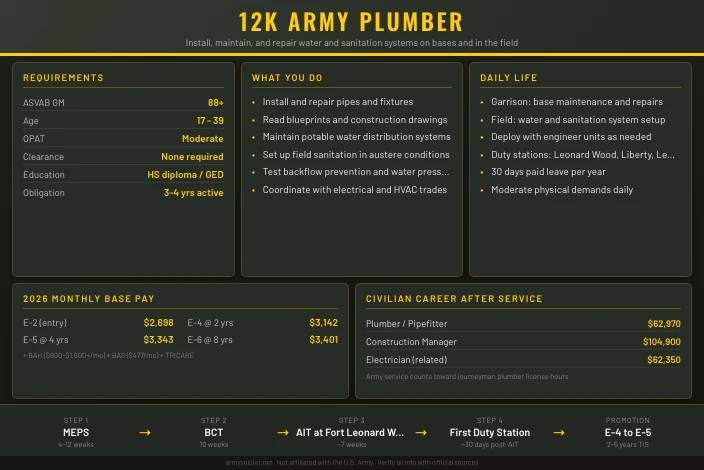
The 12K Plumber installs, maintains, and repairs water supply, drainage, and waste management systems on Army installations and in field environments. You read blueprints, cut and join pipe, install fixtures, troubleshoot system faults, and ensure potable water and sanitation systems meet Army and EPA standards.
Garrison work is steady and varied. You might spend a morning replacing a failing water heater in the barracks, then an afternoon installing new pipe for an addition to a command facility. Emergency calls come in when pipes burst, drains back up, or a backflow preventer fails inspection. Each job requires reading construction drawings, selecting materials, and executing the repair to code.
Field operations add a different dimension. Combat support units need water purification points connected to distribution systems, and waste from field latrines has to be managed. The 12K sets up those systems in austere conditions without the luxury of a parts warehouse around the corner.
Specific Roles
The base MOS is 12K. Soldiers can build additional qualifications through the Army COOL program and civilian licensure:
| Identifier | Description |
|---|---|
| Journeyman Plumber | State-level licensure earned through apprenticeship hours and exam |
| Master Plumber | Advanced state licensure after journeyman experience |
| Backflow Prevention Technician | EPA-related certification for cross-connection control |
Mission Contribution
Installations without clean water and working sanitation shut down. In field operations, waterborne disease has historically killed more soldiers than enemy fire. The 12K keeps both problems from happening. A functioning shower and a clean water supply have direct effects on soldier readiness and morale.
Equipment
You’ll work with pipe cutters, reamers, soldering equipment, threading machines, pipe wrenches, drain augers, water pressure test gauges, and backflow prevention test kits. Field environments add water purification equipment and portable waste management systems to the toolkit.
Salary and Benefits
Monthly base pay is determined by rank and years of service. The 2026 figures below are current DFAS rates.
| Rank | Grade | Monthly Base Pay (entry) |
|---|---|---|
| Private (PV2) | E-2 | $2,698 |
| Private First Class (PFC) | E-3 | $2,837 |
| Specialist (SPC) | E-4 | $3,142 |
| Sergeant (SGT) | E-5 | $3,343 |
| Staff Sergeant (SSG) | E-6 | $3,401 |
Source: DFAS 2026 military pay chart.
Beyond base pay, most soldiers receive:
- BAH: Tax-free housing allowance that varies by duty location, pay grade, and dependent status. A single E-4 at most CONUS installations receives roughly $900-$1,600+ per month.
- BAS: $476.95/month food allowance for all enlisted soldiers (2026 rate).
- TRICARE: Full health, dental, and vision coverage for you and dependents on active duty at no cost.
Additional Benefits
The Blended Retirement System (BRS) provides a 20-year pension at 40% of your high-36 basic pay with TSP matching up to 5% of basic pay. Army Tuition Assistance covers up to $4,500 per year for college. After separation, the Post-9/11 GI Bill covers full in-state tuition at public schools plus a monthly housing allowance for up to 36 months.
Work-Life Balance
Soldiers earn 30 days paid leave per year. Engineer construction units follow standard garrison duty days with field exercise rotations. Deployments and humanitarian assistance missions can extend hours significantly, but garrison periods offer reasonable predictability.
Qualifications and Eligibility
| Requirement | Details |
|---|---|
| ASVAB Score | GM: 88 (General Maintenance composite) |
| Citizenship | U.S. citizen or permanent resident alien |
| Age | 17-39 (waiver possible) |
| Education | High school diploma or GED |
| Physical | OPAT: Moderate category |
| Security Clearance | None required |
| Driver’s License | Required for operating vehicles and equipment |
The GM (General Maintenance) composite draws from four subtests: General Science (GS), Auto and Shop Information (AS), Mathematics Knowledge (MK), and Electronics Information (EI). A score of 88 is achievable with solid mechanical and math preparation. Candidates with construction or shop background tend to hit this comfortably.
Application Process
Start with the ASVAB at MEPS. If you meet the GM composite and pass the physical, your recruiter can contract you for this MOS. Ask your recruiter about current seat availability and whether any enlistment bonus is tied to this specialty.
Selection and Competitiveness
The 12K is not an oversubscribed MOS, so qualified applicants generally have a good chance of contracting for it. Prior experience in construction, maintenance work, or plumbing trades strengthens your application.
Service Obligation
Most enlistments carry a three-to-four year active duty obligation for construction-related MOSs.
See our ASVAB study guide for strategies to hit these line scores, or take the PiCAT from home if you are a first-time tester.
Work Environment
Plumbers in the Army work in permanent facilities, construction sites, and field environments. You’ll encounter anything from a modern barracks to a tent city in the desert. Weather exposure is common. When pipes freeze or a latrine system backs up in the field, you’re the solution regardless of conditions.
Army engineer units are primarily stationed at installations with large physical infrastructure footprints. Fort Leonard Wood, Missouri is the training base for engineer MOSs and has a strong engineer unit presence. Other major engineer installation include Fort Bragg/Liberty, Fort Irwin, and Joint Base Lewis-McChord.
Leadership and Communication
NCOs supervise most work crews and are responsible for technical quality and safety compliance. Soldiers receive feedback through regular counseling and NCOERs. Engineer units typically have a close-knit culture around trade skills, and soldiers who demonstrate technical competence earn recognition quickly.
Team Dynamics
Plumbing jobs frequently require coordination with carpenters, electricians, and HVAC specialists when renovation or construction involves multiple trades. You’ll often work with a small team of two to four soldiers, balancing physical labor with technical precision.
Training and Skill Development
| Phase | Location | Duration | Focus |
|---|---|---|---|
| Basic Combat Training (BCT) | Various installations | 10 weeks | Soldier skills, weapons, fitness |
| Advanced Individual Training (AIT) | Fort Leonard Wood, MO | ~7 weeks | Pipe installation, fixture work, blueprints, field sanitation systems |
AIT takes place at Fort Leonard Wood under the U.S. Army Engineer School. The curriculum covers reading plumbing blueprints, pipe materials and joining methods, fixture installation, drainage system design, water supply systems, and basic field sanitation equipment.
Advanced Training
After AIT and time at a first duty station, soldiers can pursue:
- Apprenticeship hours tracked through Army COOL toward journeyman plumber licensure
- State plumber licensure exams funded through Army Credentialing Assistance
- EPA backflow prevention certification available through civilian licensing bodies
- Senior Leader Course (SLC) at promotion to SSG
- Construction Engineering Supervisor (12H) reclassification for senior NCOs who want a supervisory track
The Army’s COOL program specifically identifies plumbing certifications that qualify for Army funding through Credentialing Assistance.
Everything starts with qualifying ASVAB scores — our study guide covers what to study first.
Career Progression and Advancement
| Rank | Grade | Typical Time in Service | Role |
|---|---|---|---|
| Private First Class (PFC) | E-3 | First year | Working under journeyman supervision |
| Specialist (SPC) | E-4 | 1-2 years | Completing jobs with increasing independence |
| Sergeant (SGT) | E-5 | 2-5 years | Work crew leader, task supervision |
| Staff Sergeant (SSG) | E-6 | 5-8 years | Section NCOIC, project coordination |
| Sergeant First Class (SFC) | E-7 | 8-14 years | Platoon Sergeant, engineer company |
| Master Sergeant (MSG) | E-8 | 14-20+ years | Senior NCO, battalion or brigade level |
Promotion to E-4 is largely time-based in the first two years. Promotion to E-5 and above is competitive through the Army’s centralized promotion board system. Military education completion, NCOERs, and AFT scores are the primary factors.
Specialization Opportunities
Senior 12K NCOs can pursue reclassification to the 12H Construction Engineering Supervisor MOS, which focuses on project management and construction oversight rather than hands-on trade work. Some senior NCOs move into facility engineering roles at installations.
Performance Evaluation
NCOs receive annual NCOERs. Technical proficiency on the job is specifically rated, alongside leadership, training of subordinates, and adherence to Army values.
Physical Demands and Medical Evaluations
The OPAT category for 12K is Moderate. Daily physical demands include:
- Lifting and carrying pipe sections, fixtures, and tools (30-50 lbs regularly)
- Working in crawl spaces, trenches, and confined mechanical rooms
- Kneeling, bending, and lying in awkward positions during installations
- Digging and trenching in field environments
The Army Fitness Test (AFT), effective June 1, 2025, has five events: 3-Rep Max Deadlift (MDL), Hand Release Push-Up (HRP), Sprint-Drag-Carry (SDC), Plank (PLK), and Two-Mile Run (2MR). Minimum passing score is 60 per event and 300 total for the general standard. The AFT is sex- and age-normed.
Medical Evaluations
Standard Army periodic health assessments apply. There are no aviation-specific or special medical requirements for this MOS. Soldiers working with lead-based pipe materials or hazardous waste systems may receive occupational health monitoring.
Deployment and Duty Stations
Engineer construction support units deploy to support base construction, infrastructure repair, and humanitarian assistance operations. Plumbers have deployed with engineer units to Iraq, Afghanistan, and multiple humanitarian assistance missions throughout Africa, Central America, and the Pacific.
Major 12K duty stations include Fort Leonard Wood (Missouri), Fort Liberty (North Carolina), Joint Base Lewis-McChord (Washington), Fort Cavazos (Texas), and overseas engineer positions in Korea, Germany, and Japan.
Risk, Safety, and Legal Considerations
Plumbing work in the Army carries standard construction trade hazards:
- Confined space entry: Work in tanks, crawl spaces, and underground vaults requires confined space training and equipment
- Electrical hazards: Proximity to electrical systems during construction requires awareness and lockout/tagout procedures
- Chemical hazards: Pipe joint compounds, flux, and solvents require PPE
- Trenching and excavation: Cave-in risk requires competent person oversight per OSHA standards
Army safety regulations and EM 385-1-1 (Army Safety and Occupational Health Manual) govern construction work. Supervisors are responsible for ensuring soldiers use proper PPE and follow procedures.
Legal Requirements
No security clearance is required for this MOS. Standard UCMJ service obligations apply. Some construction work on restricted facilities may require a favorable background check for access.
Impact on Family and Personal Life
Engineer construction units deploy for extended periods during major operations or humanitarian missions. Garrison periods at a stable installation like Fort Leonard Wood provide good family stability. On-post housing, family support programs, and childcare facilities are available at most major engineer installations.
PCS moves occur roughly every two to three years. The Army covers household goods relocation costs. Assignment preference submissions are processed through the Army’s assignment system.
Reserve and National Guard
Component Availability
The 12K MOS is available in both the Army Reserve and Army National Guard. Plumbers are assigned to engineer construction companies and utilities detachments in both components. Positions exist at all enlisted skill levels. If you are a licensed plumber or pipefitter in civilian life and want to serve part-time, this MOS is one of the cleaner fits in the entire Army – your civilian skills carry directly into your military role.
Drill Schedule and Training Commitment
Standard commitment is one weekend per month plus two weeks of Annual Training each year. The 12K drill schedule is generally straightforward. Annual Training often involves construction projects on Guard installations or training sites where plumbing and utilities work needs to be done. Your civilian plumbing certifications and licenses may need periodic renewal, and staying current with those is your responsibility – the military does not manage state licensing for you.
Part-Time Pay
An E-4 with about three years of service earns roughly $422 per drill weekend. That is approximately $5,064 across 12 drill weekends. Annual Training adds about $1,583. Combined, that comes to around $6,647 per year. For a journeyman or apprentice plumber earning $25 to $35 per hour in civilian work, Reserve or Guard pay is genuine supplemental income – not pocket change.
Benefits Differences
Active-duty soldiers get TRICARE at no cost. Reserve and Guard members have access to Tricare Reserve Select for $57.88 per month (individual) or $286.66 per month (family) in 2026. For a self-employed plumber or small contractor without employer-sponsored insurance, TRS can be the best deal available.
Education benefits by component:
- Federal Tuition Assistance: $4,500 per year for all drilling members – useful if you are working toward a journeyman license or associate degree
- MGIB-SR: roughly $416 per month while enrolled
- Post-9/11 GI Bill: requires 90+ days of qualifying federal activation; scales with total cumulative active service
- State tuition waivers (Guard only): many states cover 100% of tuition at in-state public schools; Army Reserve is a federal component and does not offer state tuition waivers
Reserve and Guard retirement uses a points-based system. The pension does not pay at the 20-year mark – it draws at age 60, reduced by 90 days for each qualifying 90-day mobilization period, to a minimum of age 50. TSP matching up to 5% of base pay is available under BRS.
Deployment and Mobilization
Plumbers in engineer units deploy for military construction and utilities missions – setting up water distribution systems, installing field sanitation infrastructure, and maintaining plumbing at forward operating bases. Mobilization frequency is low to moderate; 12K soldiers are not deployed as frequently as combat-arms MOSs, but construction and utilities needs arise on nearly every major deployment. Typical mobilizations run 9 to 12 months.
Civilian Career Integration
The 12K MOS offers one of the most direct civilian skill transfers in the Army. Plumbers, pipefitters, and steamfitters are in short supply nationwide, and military plumbing experience counts toward apprenticeship hours in many states. The United Association (UA) – the main plumbing and pipefitting union – has a veterans transition program (Veterans in Piping) that connects service members with apprenticeship slots. USERRA protects your civilian job during any mobilization.
| Feature | Active Duty | Army Reserve | Army National Guard |
|---|---|---|---|
| Commitment | Full-time | One weekend/month + 2 weeks/year | One weekend/month + 2 weeks/year |
| Monthly Pay (E-4, ~3 yrs) | $3,166/month | ~$422/drill weekend | ~$422/drill weekend |
| Healthcare | TRICARE, $0 premiums | TRS, $57.88/month (member) | TRS, $57.88/month (member) |
| Education | TA + Post-9/11 GI Bill | Federal TA, MGIB-SR; Post-9/11 after activation | Federal TA, MGIB-SR, state tuition waivers |
| Deployment | Regular rotation | Mobilization every 4-6 years | Mobilization every 4-6 years |
| Retirement | BRS pension at 20 years | Points-based, age 60 | Points-based, age 60 |
Post-Service Opportunities
The civilian plumbing industry has a well-documented shortage of licensed tradespeople. The Bureau of Labor Statistics projects continued demand for plumbers, pipefitters, and steamfitters, with median annual pay of $62,970 and roughly 48,600 openings per year through 2034.
| Civilian Job Title | Median Annual Salary (BLS, May 2024) | Job Outlook (2024-2034) |
|---|---|---|
| Plumber, Pipefitter, Steamfitter | $62,970 | +6% |
| Electrician (related trade) | $62,350 | +11% |
| Construction Manager | $104,900 | +8% |
Army service counts toward the apprenticeship hours many states require for journeyman licensure. The Army COOL program identifies specific funding for the exams and fees. Veterans who earn their journeyman and master plumber licenses can earn well above the median, particularly running their own contracting businesses.
Is This a Good Job for You? The Right (and Wrong) Fit
This MOS fits candidates who want a trade skill they own for life, prefer hands-on physical work over desk work, and like solving practical problems. You don’t need to be a math genius, but you need to read blueprints accurately and understand how water systems function.
The wrong fit is someone who dislikes physical labor, wants to work in an office, or isn’t willing to crawl into a mechanical room to diagnose a leak. Plumbing work is unglamorous but essential, and skilled plumbers are always in demand.
Career alignment is strong for anyone interested in construction contracting, facilities management, or starting their own trade business. Veterans who earn licensure while in the Army often leave service ready to earn significantly above the civilian median within a few years.
More Information
Talk with an Army recruiter to confirm 12K seat availability and any current enlistment incentives. You can find a local recruiter at goarmy.com or by calling 1-888-550-ARMY.
- Prepare for the ASVAB with our study guide to make sure your line scores qualify
This site is not affiliated with the U.S. Army or any government agency. Verify all information with official Army sources before making enlistment or career decisions.
Explore more Army engineer careers such as 12B Combat Engineer and 12P Prime Power Production Specialist.