12M Firefighter
Army firefighters respond to structure fires, aircraft crashes, and hazardous materials incidents on military installations worldwide. The 12M MOS is one of the few Army jobs where your daily work directly parallels the civilian profession – and the training at Goodfellow Air Force Base is the same pipeline that produces Department of Defense firefighters across all branches. If you want a career that’s physically demanding, technically skilled, and genuinely useful after the Army, this is worth looking at closely.
Qualifying requires specific ASVAB line scores — our ASVAB study guide covers what to target and how to prepare.
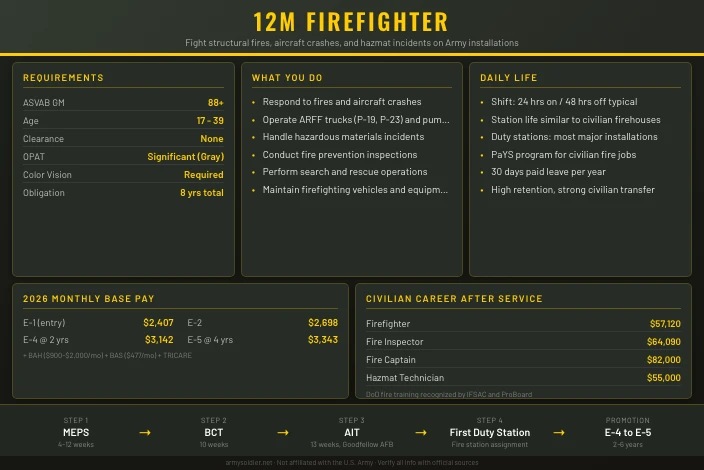
Job Role and Responsibilities
Army Firefighters (MOS 12M) control and prevent fires in Army structures, aboard aircraft, and in vehicle emergencies. They conduct rescue operations, respond to hazardous materials incidents, perform fire prevention inspections, and teach fire protection procedures to other soldiers. The 12M is part of Career Management Field (CMF) 12, the Engineer branch.
Daily Tasks
Most days in garrison don’t involve active fires. Firefighters spend the bulk of their time maintaining equipment, inspecting vehicles and aircraft for fire hazards, and conducting training. A typical shift might include morning vehicle checks, a structural drill, and fire extinguisher inspections across post buildings. When the alarm sounds, that routine stops immediately.
On an active emergency, 12M soldiers operate pumper trucks and aerial equipment, rescue personnel from burning structures, and administer emergency medical care. Aircraft rescue is a specific focus – Army airfields have their own fire crews, and crash response is a high-stakes, high-speed operation that requires constant practice.
Specific Roles
The 12M MOS uses skill level designators that track career progression:
| Skill Level | Title | Primary Duty |
|---|---|---|
| 12M10 | Firefighter | Operates under Lead Firefighter; handles structural and vehicle fires |
| 12M20 | Lead Firefighter | Leads team at emergency scenes; conducts and records unit training |
| 12M30 | Fire Station Chief | Supervises station operations; serves as senior officer at initial response |
| 12M40 | Senior NCOIC | Advises commanders at division/corps level; manages major incident command |
The Army does not use a separate ASI system for most 12M specializations. Career advancement runs through these skill level designations and professional certifications (Firefighter I, Firefighter II, Fire Officer) aligned with National Fire Protection Association (NFPA) standards.
Mission Contribution
Every Army installation with aircraft, fuel storage, or large troop concentrations needs fire protection. The 12M provides that coverage around the clock. When a Black Hawk crashes on the airfield or a fuel depot catches fire, Army firefighters are the first responders. In that role, they directly protect the installations and equipment that the rest of the Army depends on.
Beyond emergencies, 12M soldiers run fire prevention programs that reduce the risk of accidents before they happen. Inspections, training for other units, and hazard reporting all fall under this mission.
Technology and Equipment
Army firefighters operate a range of vehicles and systems that mirror civilian fire service equipment but at a larger scale. Structural firefighting uses Class A pumpers and foam systems. Aircraft rescue relies on Oshkosh P-19 and P-23 aircraft rescue and firefighting (ARFF) trucks, which carry significant quantities of foam and dry chemical agent.
Personal protective equipment includes fire-resistant turnout gear, self-contained breathing apparatus (SCBA), and specialized thermal imaging cameras. 12M soldiers also work with hazmat response kits and technical rescue equipment for vehicle extrication and confined-space operations.
Salary and Benefits
Financial Benefits
Military pay is based on rank and years of service, not MOS. A 12M soldier entering at Private First Class earns the same base pay as any other E-3, with additional allowances on top.
| Rank | Pay Grade | Monthly Base Pay (2026) |
|---|---|---|
| Private (PV1) | E-1 | $2,407 |
| Private (PV2) | E-2 | $2,698 |
| Private First Class (PFC) | E-3 | $2,837 |
| Specialist (SPC) | E-4 | $3,142 |
| Sergeant (SGT) | E-5 | $3,343 |
| Staff Sergeant (SSG) | E-6 | $3,401 |
Pay rates are set by DFAS and reflect the 3.8% across-the-board raise effective January 1, 2026.
Additional Benefits
Beyond base pay, soldiers receive a Basic Allowance for Subsistence (BAS) of $476.95 per month for food, plus Basic Allowance for Housing (BAH) that varies by duty station, pay grade, and dependent status. An E-4 at Fort Sam Houston, Texas receives $1,359 per month without dependents and $1,728 with dependents. Installations in higher cost-of-living areas pay significantly more.
Healthcare through TRICARE Prime covers the soldier and eligible family members with no enrollment fee, no deductible, and no copays at military treatment facilities. Dental and vision are included.
The Post-9/11 GI Bill covers full in-state tuition at public universities after 36 months of active duty, plus a monthly housing allowance and up to $1,000 per year in book stipends. The Army also offers Tuition Assistance of up to $4,500 per year for college courses taken while on active duty.
The Blended Retirement System (BRS) combines a pension worth 40% of your high-36 average pay at 20 years with a Thrift Savings Plan (TSP) that includes government matching up to 5% of basic pay starting in your third year.
Work-Life Balance
Army firefighters work shift schedules, typically 24 hours on followed by 48 hours off, similar to civilian fire departments. The rotation varies by installation, but the structure generally provides more predictable off time than many other Army jobs. Soldiers accrue 30 days of paid leave per year.
Qualifications and Eligibility
Basic Qualifications
| Requirement | Standard |
|---|---|
| Citizenship | U.S. citizen or permanent resident |
| Age | 17-34 at enlistment |
| Education | High school diploma (AFQT 31+) or GED (AFQT 50+) |
| ASVAB Score | General Maintenance (GM): 88 |
| Vision | Normal color vision required |
| Driver’s License | Valid state driver’s license required |
| Security Clearance | Not required |
| OPAT Category | Significant (Gray) |
The GM line score measures general maintenance aptitude, calculated from General Science (GS), Auto and Shop Information (AS), Mathematics Knowledge (MK), and Electronics Information (EI) subtests. A score of 88 is moderate by Army standards; strong performance in mechanical and science sections helps.
Claustrophobia and pyrophobia (fear of fire) are also disqualifying conditions. These are assessed during medical processing.
Application Process
The OPAT for the Significant category requires candidates to demonstrate above-moderate strength, endurance, and load-bearing capacity. Exact OPAT minimums are set by Army Recruiting Command; your recruiter has the current score charts.
Selection Criteria
The 12M is not considered a high-competition MOS in terms of test scores, but open slots can be limited. Active duty positions are fewer than many other engineer MOSs because not every installation has an Army fire department. Applying during high-recruitment periods and being flexible on duty station improves your odds.
The Army PaYS program includes some fire service partnerships, which can provide guaranteed job interviews with participating civilian fire departments after service.
Service Obligation
Active duty enlistments for 12M typically require a 3- or 4-year service obligation. Army Reserve and National Guard options are available at some locations, with weekend drill plus annual training commitments.
See our ASVAB study guide for strategies to hit these line scores, or take the PiCAT from home if you are a first-time tester.
Work Environment
Setting and Schedule
Army firefighters work from fire stations on military installations. The physical environment is similar to a civilian firehouse: sleeping quarters, bay areas for vehicles, and training spaces. Work happens indoors and outdoors across all weather conditions.
The shift schedule – typically 24 on, 48 off – is consistent across most installations. But “on duty” means genuinely ready to respond, not just clocking in. Firefighters may run calls at 2 a.m. or spend a quiet overnight cleaning gear. The unpredictability is part of the job.
Leadership and Communication
New firefighters work under a Lead Firefighter (12M20) and report to a Fire Station Chief (12M30). Performance evaluations use the Army’s NCOER (Non-Commissioned Officer Evaluation Report) system at E-5 and above. Counseling sessions at 30, 60, and 90 days after assignment are standard, with quarterly or semi-annual reviews after that.
The fire service culture within Army stations tends to be close-knit. Small crews work together for long shifts and depend on each other in emergencies. Communication during incidents follows incident command system (ICS) protocols, the same framework used by civilian departments.
Team Dynamics and Autonomy
Firefighting is a team sport. You don’t operate alone at an emergency scene; every action is coordinated with your crew. New firefighters have limited autonomy and operate under direct supervision until they build experience and certifications. Lead firefighters and station chiefs have significant decision-making authority at an incident scene before command officers arrive.
Job Satisfaction and Retention
The 12M has a solid retention rate driven partly by how well the skills transfer to civilian fire departments. Soldiers who want to stay in the Army can build a strong career through NCO ranks. Those who plan to separate after one enlistment have a clear employment path waiting.
Many 12M soldiers report high job satisfaction tied to the practical, hands-on nature of the work and the shift schedule. The main complaints are the same as civilian fire service: long hours during active incidents, physical wear over time, and occasional tedium during slow garrison periods.
Training and Skill Development
Initial Training
| Phase | Location | Length | Focus |
|---|---|---|---|
| Basic Combat Training (BCT) | Various installations | 10 weeks | Army fundamentals, land navigation, weapons qualification, basic tactics |
| Advanced Individual Training (AIT) | Goodfellow AFB, Texas | 13 weeks | Structural firefighting, aircraft rescue, hazmat response, emergency medical care |
AIT at the Louis F. Garland Department of Defense Fire Academy includes live fire drills from week one. You’ll handle actual aircraft rescue firefighting scenarios, run structural fire attack evolutions, and certify on emergency medical procedures. The training is physically demanding and closely mirrors civilian firefighter recruit academies.
The DoD Fire Academy trains firefighters from all military branches, so you’ll train alongside Air Force and Navy recruits. This cross-branch environment reflects how military fire departments operate – DoD installations often use joint fire protection crews.
Advanced Training
Soldiers who advance to Lead Firefighter and above pursue professional certifications through the National Fire Protection Association (NFPA) and the International Fire Service Accreditation Congress (IFSAC):
- Firefighter I / Firefighter II – entry and intermediate operational certifications
- Hazardous Materials Awareness and Operations – required for hazmat response
- Fire Officer I / II – leadership-level certifications for NCO progression
- Fire Inspector – supports prevention program management at higher skill levels
The Army COOL (Credentialing Opportunities On-Line) program provides funding for soldiers to pursue civilian-recognized certifications while on active duty. For 12M soldiers, this means you can exit the Army with NFPA-certified credentials that civilian fire departments accept directly.
Everything starts with qualifying ASVAB scores — our study guide covers what to study first.
Career Progression and Advancement
Career Path
| Rank | Pay Grade | Typical Time in Service | Role |
|---|---|---|---|
| PV1-PFC | E-1 to E-3 | 0-18 months | Entry-level firefighter |
| Specialist (SPC) | E-4 | 18 months-3 years | Firefighter, building operational skills |
| Sergeant (SGT) | E-5 | 3-5 years | Lead Firefighter; NCO duties |
| Staff Sergeant (SSG) | E-6 | 5-10 years | Fire Station Chief |
| Sergeant First Class (SFC) | E-7 | 10-16 years | Chief Firefighter Supervisor / Fire Chief at brigade level |
| Master Sergeant (MSG) | E-8 | 16-22 years | Senior fire officer at installation level |
Promotion through Sergeant (E-5) and Staff Sergeant (E-6) is competitive Army-wide. 12M soldiers compete within CMF 12 promotion boards. Meeting key developmental (KD) requirements – specifically serving as a successful Fire Station Chief at the SSG level – is a prerequisite for promotion to SFC.
Role Flexibility and Transfers
Soldiers can request reclassification to other MOSs after their initial enlistment, though approval depends on Army needs. Moving from 12M to other CMF 12 jobs (12B Combat Engineer, 12N Horizontal Construction Engineer) is the most common internal path if a soldier wants to stay in the engineer branch but change specialties.
Some 12M soldiers transition to officer through the Warrant Officer program or Limited Duty Officer programs, though no specific warrant MOS directly aligns with fire protection.
Performance Evaluation
E-5 and above are evaluated through the NCOER system, which rates NCOs on character, competence, and fitness. At the 12M career level, evaluators specifically look at fire scene command decisions, prevention program outcomes, and training effectiveness. Soldiers who build a strong record as Fire Station Chiefs and can document measurable improvements to installation fire readiness tend to be competitive for SFC promotion.
The best career strategy for 12M is straightforward: get certified ahead of your peers, volunteer for additional training (hazmat, technical rescue), and document every significant incident and prevention initiative you led.
Physical Demands and Medical Evaluations
Physical Requirements
Firefighting is physically brutal during active incidents. Firefighters carry 50+ pounds of gear, drag casualties, force entry through barriers, and work in extreme heat while breathing from an SCBA. Conditioning matters every day, not just on test days.
The OPAT categorizes 12M at the Significant (Gray) level, reflecting above-moderate physical demands. This is not the maximum (Heavy/Black) category, but it’s a step above the baseline for most Army jobs.
The Army Fitness Test (AFT) replaced the ACFT on June 1, 2025. All soldiers, regardless of MOS, must pass the AFT. The test has five events scored 0-100 points each:
| Event | Abbreviation |
|---|---|
| 3 Repetition Maximum Deadlift | MDL |
| Hand Release Push-Up – Arm Extension | HRP |
| Sprint-Drag-Carry | SDC |
| Plank | PLK |
| Two-Mile Run | 2MR |
General standard: 300 total points (60 minimum per event), sex- and age-normed. Scores are calibrated by age and sex, so the raw performance numbers differ by demographic. The 12M is not among the 21 designated combat MOSs requiring the higher 350-point sex-neutral standard.
Medical Evaluations
Beyond initial entry screening, active duty soldiers complete periodic medical readiness checks. Firefighters face specific respiratory health monitoring given frequent SCBA use and smoke exposure over a career. Army medical staff conduct occupational health evaluations that track hearing, pulmonary function, and general readiness.
Maintaining a valid driver’s license is an ongoing requirement because operating fire vehicles is a core duty.
Deployment and Duty Stations
Deployment Details
The 12M is primarily a garrison-support MOS, not a forward-deployed combat position. Most Army firefighters serve at permanent installations with assigned fire departments. Deployment does occur, but it typically means supporting an installation or forward operating base that needs fire protection rather than direct combat operations.
When 12M soldiers deploy, the mission usually involves standing up or maintaining fire protection at an airfield or base camp. In Iraq and Afghanistan, Army firefighters staffed ARFF crash stations at forward operating bases with regular helicopter and fixed-wing traffic. Typical deployments for 12M run 9 to 12 months, matching the standard Army rotation cycle.
Deployment frequency is lower than combat arms MOSs. Expect one to two deployments over a 10-year career on average, though this varies by unit, Army needs, and global conditions. OCONUS permanent duty assignments (not deployments) are also available, including Germany, South Korea, Japan, and Hawaii.
Location Flexibility
12M duty stations are installation fire departments at Army posts with aircraft or large troop populations. Common assignments include:
- Fort Liberty, NC (formerly Fort Bragg)
- Fort Campbell, KY
- Fort Carson, CO
- Fort Hood, TX
- Fort Drum, NY
- Joint Base Lewis-McChord, WA
- Fort Stewart, GA
- Camp Humphreys, South Korea (OCONUS)
- Grafenwoehr, Germany (OCONUS)
Soldiers can submit preference statements through the Assignment Satisfaction Key (ASK) system, but assignments depend on Army needs and open billets. Aviation-heavy posts (Campbell, Rucker/Novosel) tend to have higher 12M demand because aircraft rescue firefighting is a dedicated, continuous requirement. OCONUS tours are typically two to three years for accompanied soldiers and one year for unaccompanied tours in Korea.
Risk, Safety, and Legal Considerations
Job Hazards
The most obvious hazard is fire itself. Army firefighters enter burning structures, operate around jet fuel, and respond to crashes involving aircraft with live ordnance or fuel loads. Hazmat incidents add chemical and biological exposure risk.
Physical injuries from firefighting operations fall into predictable categories: musculoskeletal strains from carrying gear and dragging hose, burns from structural flashovers or equipment failures, and respiratory damage from smoke inhalation. Falls from ladders and rooftops account for a significant share of DoD firefighter injuries annually.
The long-term health impacts of firefighting are well documented in the civilian world. Chronic respiratory issues and elevated cancer risk from repeated smoke exposure are recognized occupational hazards. The Army provides annual occupational health screenings including pulmonary function tests and hearing evaluations, but soldiers should understand that cumulative exposure over a 15-20 year career carries real risk.
Safety Protocols
All 12M operations follow established incident command system procedures and NFPA standards. Personal protective equipment – turnout gear, SCBA, thermal cameras – is maintained and inspected on documented schedules. Two-person accountability during interior firefighting operations is a hard rule, not a suggestion.
HAZMAT responses follow OSHA Hazardous Waste Operations and Emergency Response (HAZWOPER) standards. Soldiers receive specific training at three levels: awareness (all 12M soldiers), operations (standard for active crews), and technician (specialized response teams). Each level authorizes different actions at a hazmat scene.
Safety stand-downs occur after significant incidents or near-misses. The Army’s safety reporting system requires documentation of all injuries and close calls, which feeds into installation risk management programs.
Security and Legal Requirements
No security clearance is required for MOS 12M. Standard background checks apply at enlistment. Soldiers who later move into roles requiring installation access at higher-security facilities may need clearance upgrades, but this is not typical for the MOS.
Service obligations are set in your enlistment contract, typically 3 to 4 years of active duty plus the remainder of an 8-year total obligation in the Individual Ready Reserve. Early separation requires a formal request through your chain of command and approval from the separation authority. Soldiers who received an enlistment bonus and separate before completing their contracted term may be required to repay a prorated portion of that bonus.
Impact on Family and Personal Life
Family Considerations
The shift schedule works in your family’s favor compared to many military jobs. With a typical 24/48 rotation, firefighters are home for two days after every shift day. TDY travel is minimal compared to combat MOSs.
The 24/48 rotation gives dual-income families more flexibility than standard Army schedules. Spouses can hold regular jobs knowing the soldier’s days off are predictable and frequent. Childcare logistics are simpler when one parent is home two out of every three days, though the 24-hour on-duty period does require a backup plan for overnight coverage.
The mental health dimension of firefighting is worth acknowledging. Responding to crashes, structure fires, and medical emergencies takes a cumulative toll. The Army’s Military and Family Life Counseling (MFLC) program and Army OneSource provide free, confidential counseling for soldiers and family members dealing with stress from emergency response work.
Relocation and Flexibility
PCS (Permanent Change of Station) moves happen roughly every 2-3 years for most active duty soldiers. Army fire departments are at fixed installations, so your next PCS will be another installation fire station. The Army covers moving expenses through the Dislocation Allowance (DLA) and government-arranged transportation of household goods.
Family-oriented duty stations with good school systems are common among the major 12M assignments. Soldiers with family connections to a particular region can submit “compassionate reassignment” requests, though approval is not guaranteed. The limited number of 12M billets means fewer options overall, but the installations that have fire departments tend to be large, well-resourced posts with strong family support programs.
Reserve and National Guard
Component Availability
The 12M MOS exists in both the Army Reserve and Army National Guard. Fire departments operate at military installations, and both components maintain fire protection elements to support those installations during drills, activations, and missions. The total number of positions is smaller than many other engineer MOSs – fire departments at Reserve and Guard installations are not large. That said, there is a well-established pattern of 12M soldiers working as civilian firefighters during the week and drilling one weekend a month in the same specialty. Many local fire departments actively support this arrangement.
Drill Schedule and Training Commitment
Standard drill is one weekend per month plus two weeks of Annual Training. The bigger factor for 12M soldiers is certification currency. Army firefighters must maintain IFSAC (International Fire Service Accreditation Congress) and DoD Fire Academy certifications, and those have renewal requirements. Reserve and Guard 12M soldiers may need additional training days to stay current – especially if their civilian fire department uses different certification standards than the military. Coordinate with your unit and your civilian employer to avoid scheduling conflicts.
Part-Time Pay
An E-4 at roughly three years of service earns about $422 per drill weekend. Twelve drill weekends totals approximately $5,064. Annual Training adds around $1,583, bringing total annual Reserve or Guard pay to roughly $6,647. For a firefighter already earning a full-time salary from a civilian department, this is straightforward supplemental income. For someone who drills while working toward a civilian firefighter job, it builds both the resume and the bank account simultaneously.
Benefits Differences
Active-duty soldiers get TRICARE at no cost. Reserve and Guard members pay for Tricare Reserve Select – $57.88 per month for individual coverage or $286.66 per month for family coverage in 2026. Many civilian fire departments also offer health insurance, so Reserve and Guard firefighters often have choices about which plan to use.
Education benefits by component:
- Federal Tuition Assistance: $4,500 per year for all drilling members – applicable toward fire science degrees or EMT/paramedic certifications
- MGIB-SR: roughly $416 per month while enrolled
- Post-9/11 GI Bill: requires 90+ days of qualifying federal activation; scales with total cumulative active service
- State tuition waivers (Guard only): many states cover 100% of tuition at in-state public schools; Army Reserve is a federal component with no state tuition waivers
Reserve and Guard retirement uses a points-based system. The pension does not pay at the 20-year mark – it draws at age 60, with that age reduced by 90 days per qualifying 90-day mobilization, down to a minimum of 50. TSP matching up to 5% of base pay is available under BRS.
Deployment and Mobilization
Military fire protection is needed at deployed bases. When major installations are established in theater, fire departments follow. Reserve and Guard 12M soldiers mobilize at a moderate rate – not on every deployment cycle, but when a large-scale operation requires base infrastructure support. Typical mobilizations run 9 to 12 months. The dual civilian-military firefighter career model means USERRA protection is especially relevant here – your civilian department must hold your job while you are mobilized.
Civilian Career Integration
The 12M MOS has one of the strongest civilian transfer rates in the Army. Firefighter I, Firefighter II, HAZMAT Operations, and emergency medical certifications from military service are recognized directly by civilian departments in most states. Many states have expedited licensing processes for veterans with military fire service training. The overlap between military and civilian firefighting standards is high enough that most 12M veterans enter civilian departments with significant credit toward full certification.
| Feature | Active Duty | Army Reserve | Army National Guard |
|---|---|---|---|
| Commitment | Full-time | One weekend/month + 2 weeks/year | One weekend/month + 2 weeks/year |
| Monthly Pay (E-4, ~3 yrs) | $3,166/month | ~$422/drill weekend | ~$422/drill weekend |
| Healthcare | TRICARE, $0 premiums | TRS, $57.88/month (member) | TRS, $57.88/month (member) |
| Education | TA + Post-9/11 GI Bill | Federal TA, MGIB-SR; Post-9/11 after activation | Federal TA, MGIB-SR, state tuition waivers |
| Deployment | Regular rotation | Mobilization every 3-5 years | Mobilization every 3-5 years |
| Retirement | BRS pension at 20 years | Points-based, age 60 | Points-based, age 60 |
Post-Service Opportunities
Transition to Civilian Life
The 12M training pipeline at Goodfellow AFB produces certifications that civilian employers recognize. Firefighter I and II certifications, HAZMAT Operations, and emergency medical credentials earned on active duty all carry over. Many states have expedited licensing processes for veterans with military fire service training.
The Army PaYS program partners with civilian employers, including fire departments and public safety organizations, to provide guaranteed job interviews for soldiers approaching separation. Enrollment during service is free.
The GI Bill covers education costs for soldiers who want to pursue fire science degrees, emergency management, or related fields. Many community colleges have fire technology programs that accept military training credits, which can reduce degree completion time.
Civilian Career Prospects
| Civilian Career | Median Annual Wage (May 2024) | Job Outlook |
|---|---|---|
| Firefighter | $59,530 | +3% (2024-2034) |
| Fire Inspector / Investigator | $66,680 | +4% (2024-2034) |
| Emergency Medical Technician / Paramedic | $41,480 | +4% (2024-2034) |
| Hazardous Materials Removal Worker | $48,120 | +5% (2024-2034) |
Wage data from the Bureau of Labor Statistics Occupational Outlook Handbook. About 27,100 firefighter openings are projected annually, driven largely by retirements and career transitions.
Federal firefighter positions with the Department of Defense, Forest Service, or National Park Service are another strong path. Veterans’ preference points give former military members a significant advantage in federal hiring.
Is This a Good Job for You? The Right (and Wrong) Fit
Ideal Candidate Profile
The best fit for 12M is someone who wants physical, hands-on work with a clear public service purpose. You should be comfortable with unpredictability – long quiet stretches followed by sudden, high-stakes responses.
Signs this MOS fits you:
- You’re comfortable with emergency calls at any hour
- Mechanical aptitude comes naturally – you like maintaining equipment
- You want a civilian firefighting career after the Army
- Working in small, tight-knit crews appeals to you
- Physical fitness is something you maintain without being told
Potential Challenges
The physical demands compound over time. Firefighting takes a toll on joints, lungs, and hearing over a 15-20 year career. Soldiers who don’t maintain strong fitness will find the job increasingly difficult.
Concrete drawbacks to weigh:
- Limited billets mean less control over duty station
- Physical wear accumulates over a full career
- Deployments happen, even if less often than combat arms
- Slow shifts can feel monotonous between emergencies
Who This MOS Is and Isn’t For
If you want a career that directly translates to civilian employment without additional schooling, 12M delivers that better than most Army jobs. The skills, certifications, and work culture are nearly identical to civilian fire service. A 12M veteran walks into a civilian department with live-fire experience, NFPA certifications, and federal hiring preference – advantages that civilian applicants who paid for their own academy training simply don’t have.
If you’re uncertain about firefighting as a career and are mainly looking at the Army for benefits or adventure, a different MOS might serve you better. The 12M is a specialty MOS with a specific career path, not a general-purpose stepping stone.
More Information
Talk to an Army recruiter about current 12M slot availability, duty station options, and any active enlistment incentives. Recruiters can confirm your ASVAB eligibility and walk you through what to expect at MEPS, including the color vision screening and OPAT requirements specific to this MOS. Call 1-888-550-ARMY or visit goarmy.com to connect with a local recruiter.
- Prepare for the ASVAB with our study guide to make sure your line scores qualify
This site is not affiliated with the U.S. Army or any government agency. Verify all information with official Army sources before making enlistment or career decisions.
Explore more Army engineer careers such as 12B Combat Engineer and 12N Horizontal Construction Engineer.