12N Horizontal Construction Engineer
Most soldiers fire rifles. A 12N fires up a D7 bulldozer and reshapes the ground everyone else fights on. Horizontal Construction Engineers run the heaviest equipment in the Army’s inventory, building roads, airfields, and fighting positions that keep units moving and supplied. If you’d rather drive a 40-ton grader than sit behind a desk, this MOS puts you in the operator’s seat from day one of AIT.
Qualifying requires specific ASVAB line scores — our ASVAB study guide covers what to target and how to prepare.
Job Role and Responsibilities
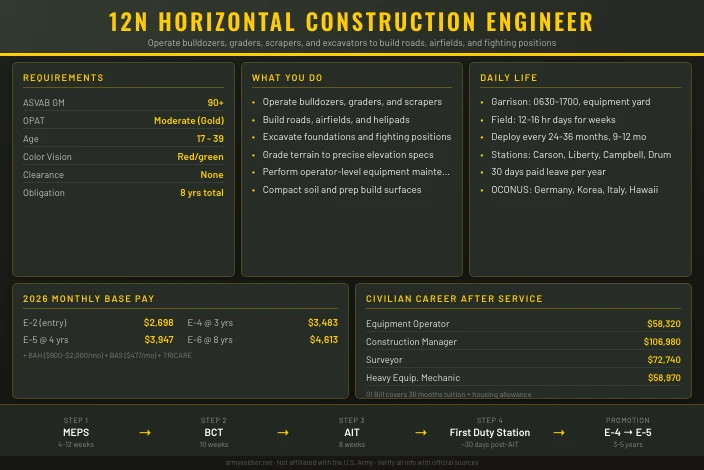
A 12N Horizontal Construction Engineer operates heavy construction equipment to build and maintain roads, airfields, helipads, gun positions, and earthwork fortifications. These soldiers grade terrain, excavate foundations, clear obstacles, and move massive volumes of earth so that combat units and logistics convoys can operate on stable ground.
What You Do Day to Day
Garrison days start with equipment checks. You walk around your assigned machine, inspect fluid levels, tracks or tires, hydraulic lines, and attachments before anything moves. After morning formation, most of your shift goes to active construction or operator training on the equipment yard.
A typical week mixes seat time on different machines with classroom periods on soil composition, grade stakes, and safety procedures. You might spend Monday and Tuesday on a scraper cutting a roadbed, then switch to a front-end loader or excavator on Wednesday. When equipment breaks down, you assist mechanics with troubleshooting and minor repairs.
Field training exercises flip the schedule. Days stretch to 12-16 hours. You build fighting positions, hasty airfields, and supply routes under simulated combat conditions, often working at night with limited lighting.
Specialized Roles
The 12N MOS feeds into several specialized positions as you gain rank and training:
| Identifier | Type | Description |
|---|---|---|
| 12N | Primary MOS | Horizontal Construction Engineer |
| H8 | ASI | Asphalt Equipment Operator (awarded after additional training) |
| P5 | ASI | Master Fitness Trainer |
| 12Z | Senior MOS | Combat Engineering Senior Sergeant (E-8/E-9 level) |
Some 12Ns pick up the H8 ASI for asphalt operations, qualifying them to run paving equipment on major road projects. Others earn the P5 Master Fitness Trainer identifier.
Mission Contribution
Every Army operation depends on mobility. Tanks, trucks, and helicopters need solid surfaces to operate from. A 12N builds those surfaces. During deployments, horizontal construction engineers cut main supply routes through rough terrain, build forward operating base perimeters, and grade helicopter landing zones. Without this work, combat units stall and logistics chains break.
Equipment and Technology
You operate some of the largest machines the Army fields:
- Bulldozers (D7R, D6K) for pushing earth and clearing vegetation
- Graders (120M, 140M) for cutting precise road grades
- Scrapers (621G) for high-volume earth moving
- Excavators (John Deere 270G, 350G) for digging and trenching
- Front-end loaders (966M, 950M) for material handling
- Compactors and rollers for soil compaction
- GPS-enabled grade control systems on newer machines for precision grading
Modern Army construction equipment increasingly uses GPS machine control, which lets operators hit exact elevation targets without manual surveying stakes. You learn both traditional and tech-assisted methods.
Salary and Benefits
Base Pay
All Army pay follows the same DFAS pay tables regardless of MOS. Your monthly income depends on rank and time in service.
| Rank | Time in Service | Monthly Base Pay |
|---|---|---|
| E-1 (PV1) | Entry | $2,407 |
| E-2 (PV2) | Entry | $2,698 |
| E-3 (PFC) | 2 years | $3,015 |
| E-4 (SPC) | 3 years | $3,483 |
| E-5 (SGT) | 4 years | $3,947 |
| E-6 (SSG) | 8 years | $4,613 |
Base pay is only part of the picture. You also receive Basic Allowance for Subsistence (BAS) at $476.95/month for food and Basic Allowance for Housing (BAH) that varies by duty station. A single E-4 at Fort Carson might receive around $1,500-$1,800/month in BAH, while someone stationed at Fort Drum could see a different rate. BAH changes every year based on local housing costs.
Additional Benefits
TRICARE Prime covers all your medical, dental, vision, and prescription costs at zero premium and zero copay while on active duty. Your family members get the same coverage at no enrollment fee.
The Post-9/11 GI Bill pays full in-state tuition at public universities, up to $29,920.95/year at private schools, plus a monthly housing allowance and $1,000/year book stipend. You earn 36 months of benefits total. After six years of service with a four-year extension, you can transfer those benefits to a spouse or children.
Tuition Assistance covers up to $4,500/year while you serve, so you can start college courses during your enlistment without touching GI Bill months.
Work-Life Balance
You earn 30 days of paid leave per year, accruing at 2.5 days per month. The Army also observes 11 federal holidays. Garrison schedules typically run from 0630 to 1700, Monday through Friday. Field rotations, deployments, and training exercises break that routine, but the days off bank up whether you use them right away or not.
Qualifications and Eligibility
Requirements at a Glance
| Requirement | Detail |
|---|---|
| ASVAB Line Score | GM (General Maintenance): 90 |
| OPAT Category | Moderate (Gold) |
| Age | 17-39 (17 requires parental consent) |
| Citizenship | U.S. citizen or permanent resident |
| Education | High school diploma (AFQT 31+) or GED (AFQT 50+) |
| Security Clearance | None required |
| Color Vision | Must distinguish red and green |
| Physical | No disqualifying medical conditions per MEPS screening |
The GM composite adds your General Science, Auto & Shop, Mathematics Knowledge, and Electronics Information subtest scores. A 90 is moderate by Army standards. Solid math skills and some mechanical aptitude will get you there.
Application Process
The path to becoming a 12N follows the standard Army enlistment process:
- Meet with a recruiter and take the ASVAB (or use existing qualifying scores)
- Pass the physical exam and OPAT at MEPS (Military Entrance Processing Station)
- Select 12N from available MOS options during job counseling
- Sign your enlistment contract
- Ship to Basic Combat Training
The entire process from first recruiter meeting to shipping can take 4-12 weeks depending on MEPS scheduling, waiver processing, and ship date availability.
Selection Criteria
The 12N is not one of the Army’s most competitive MOS codes. The GM 90 requirement sits in the middle range, and slots are usually available across active duty, Army Reserve, and National Guard components. Prior experience operating heavy equipment or holding a Commercial Driver’s License (CDL) won’t lower the ASVAB requirement, but it can make your training phase easier.
Upon Entry
Most recruits enter at E-1 (Private) through E-3 (Private First Class) depending on education credits, JROTC participation, or referral programs. The total service obligation is eight years, split between active duty (typically three to six years) and Individual Ready Reserve for the remainder.
See our ASVAB study guide for strategies to hit these line scores, or take the PiCAT from home if you are a first-time tester.
Work Environment
Setting and Schedule
Garrison life centers on the equipment yard and motor pool. You spend most working hours outdoors, either in the cab of a machine or performing maintenance underneath one. Summer heat and winter cold come with the job. Climate-controlled cabs on newer equipment help, but older machines and ground-level tasks don’t offer that luxury.
Standard garrison hours are roughly 0630-1700 with a lunch break. When a construction deadline hits, expect extended hours. Field training and deployment schedules run longer, often 12-hour shifts or more, sometimes rotating day and night operations.
Chain of Command
A 12N typically falls under an engineer company within an engineer battalion. Your immediate leaders are your team leader (E-5 Sergeant) and squad leader (E-6 Staff Sergeant). The platoon sergeant (E-7) and platoon leader (a lieutenant) oversee the platoon. Communication flows through that chain daily at formations, work calls, and after-action reviews.
Formal feedback comes through monthly counseling sessions at minimum, with quarterly and annual reviews. Your team leader writes these, and they build the record that follows you to promotion boards.
Teamwork and Autonomy
Construction is inherently a team effort. A single road project might need a bulldozer operator clearing, a grader cutting the surface, a roller compacting, and a dump truck hauling material, all working in sequence. You coordinate constantly with other operators, ground guides, and the project NCO.
That said, once you prove your skills on a machine, you get real autonomy in the cab. Your supervisor sets the grade stakes and project specs. How you cut to grade, how you manage passes, and how you handle changing soil conditions is your call. Experienced operators earn trust and independence quickly.
Retention
Engineer MOS retention rates hover near the Army average. The biggest draw for re-enlistment is the direct transfer of skills to civilian construction. Soldiers who enjoy equipment operation tend to stay for a second term or move into the Reserves to keep their skills current while working civilian construction jobs simultaneously.
Training and Skill Development
Initial Training Pipeline
| Phase | Location | Length | Focus |
|---|---|---|---|
| Basic Combat Training (BCT) | Fort Jackson, Fort Moore, or Fort Leonard Wood | 10 weeks | Rifle marksmanship, drill, first aid, land navigation, fieldcraft |
| AIT: 12N Course | Fort Leonard Wood, MO | 8 weeks | Heavy equipment operation across 8 annexes |
BCT turns you into a soldier. You learn to shoot, move, communicate, and survive. Every MOS goes through it.
AIT at Fort Leonard Wood is where the real job training starts. The 12N course is split into eight annexes, each focused on a different piece of heavy equipment. You start with basic operation and safety, then progress through increasingly complex machines. By the end, you can operate a bulldozer, grader, scraper, loader, and excavator at an apprentice level.
Training mixes classroom instruction on soil types, cut-and-fill calculations, and equipment maintenance with hours of seat time on the equipment. The pace is fast. You get evaluated on each machine before moving to the next annex.
Advanced Training Opportunities
After AIT, skill development continues at your first duty station through on-the-job training with experienced operators. Beyond that, the Army offers several paths:
- Horizontal Construction Supervisor Course for E-5s moving into leadership roles
- Asphalt Equipment Operator Course (awards the H8 ASI) for paving specialization
- Master Driver Course for soldiers who want to manage unit vehicle programs
- Jumpmaster/Airborne School at Fort Moore for engineers assigned to airborne units
- Sapper Leader Course at Fort Leonard Wood for combat engineering leadership
- Warrant Officer path to 120A (Construction Engineering Technician) for soldiers wanting to become technical experts
The Army also funds civilian certifications through the Credentialing Assistance (CA) program. Many 12Ns use this to earn a CDL, OSHA safety certifications, or National Center for Construction Education and Research (NCCER) credentials while still serving.
Everything starts with qualifying ASVAB scores — our study guide covers what to study first.
Career Progression and Advancement
Rank Progression
| Rank | Grade | Typical Time in Service | Role |
|---|---|---|---|
| Private (PV1) | E-1 | Entry | Apprentice operator |
| Private (PV2) | E-2 | 6 months | Apprentice operator |
| Private First Class (PFC) | E-3 | 12 months | Equipment operator |
| Specialist (SPC) | E-4 | 24 months | Equipment operator, team member |
| Sergeant (SGT) | E-5 | 3-5 years | Team leader, project NCO |
| Staff Sergeant (SSG) | E-6 | 6-9 years | Squad leader, construction supervisor |
| Sergeant First Class (SFC) | E-7 | 12-16 years | Platoon sergeant, operations NCO |
| Master Sergeant (MSG) | E-8 | 18-22 years | First sergeant or operations sergeant major |
| Sergeant Major (SGM) | E-9 | 22+ years | Senior enlisted advisor |
Promotions to E-4 are essentially automatic with time in service. E-5 and E-6 promotions use the Army’s point-based system, where your score comes from military education, awards, physical fitness, and a promotion board appearance. Engineer MOS promotion points fluctuate monthly, but 12N typically sits in the mid-range, meaning promotions are neither the fastest nor the slowest in the Army.
Specialization Options
At the NCO level, experienced 12Ns can reclassify into related MOS codes or pursue the 120A Construction Engineering Technician warrant officer track. The 120A path is popular because it keeps you in the construction field with higher pay, more technical authority, and a longer career runway.
Transfers and Flexibility
Reclassifying to a different MOS is possible but depends on the needs of the Army, your rank, and slot availability. Common lateral moves for 12Ns include 12B (Combat Engineer), 12W (Carpentry and Masonry Specialist), or other CMF 12 positions. The process involves submitting a reclassification packet through your unit’s personnel office.
Performance Evaluation
The NCOER system evaluates sergeants and above on competence, commitment, and character. Ratings are “met standard,” “exceeded standard,” or “far exceeded standard.” Strong evaluations drive promotions. Junior enlisted receive formal counseling instead of NCOERs, but those counseling records still influence promotion board outcomes.
Success in this career comes down to three things: master your equipment, maintain it like your paycheck depends on it (because it does), and develop the ability to read terrain and soil conditions before the first blade hits the ground.
Physical Demands and Medical Evaluations
Daily Physical Reality
Operating heavy equipment sounds like sitting in a chair all day. It isn’t. You climb in and out of cabs dozens of times per shift. Ground-guide duties mean walking alongside moving equipment in heat, cold, mud, and dust. Maintenance tasks involve lifting track pads, turning wrenches in awkward positions, and hauling fuel cans. Field construction adds digging, sandbagging, and manual labor between machine tasks.
The OPAT category for 12N is Moderate (Gold), meaning you must demonstrate the ability to frequently lift up to 40 pounds and handle occasional heavier loads. At MEPS, you complete four OPAT events: Standing Long Jump, Seated Power Throw, Deadlift, and Interval Aerobic Run.
Army Fitness Test (AFT) Standards
Every soldier must pass the AFT regardless of MOS. The test has five events, each scored 0-100 points:
| Event | Description | Minimum per Event |
|---|---|---|
| MDL | 3 Repetition Maximum Deadlift | 60 points |
| HRP | Hand Release Push-Up (Arm Extension) | 60 points |
| SDC | Sprint-Drag-Carry | 60 points |
| PLK | Plank | 60 points |
| 2MR | Two-Mile Run | 60 points |
The general passing standard is 300 total (60 per event), sex- and age-normed. Maximum score is 500. The AFT replaced the ACFT on June 1, 2025, removing the Standing Power Throw.
Ongoing Medical Requirements
After initial entry, you complete a Periodic Health Assessment (PHA) annually. This screening checks vision, hearing, blood pressure, and overall fitness to continue serving. Dental readiness checks happen twice a year. If you develop a condition that affects your ability to operate equipment safely, a medical evaluation board reviews your status.
Deployment and Duty Stations
Where You Could Be Stationed
12N slots exist across the Army, giving you a decent spread of locations:
CONUS: Fort Liberty (NC), Fort Campbell (KY), Fort Carson (CO), Fort Cavazos (TX), Fort Drum (NY), Fort Riley (KS), Fort Bliss (TX), Fort Belvoir (VA), Joint Base Lewis-McChord (WA)
OCONUS: Germany, South Korea, Italy, Hawaii, Alaska, and some rotational deployments to Guantanamo Bay and the Middle East
Deployment Patterns
Engineer units deploy regularly. Rotations typically last 9-12 months, with 24-36 months of dwell time between deployments. Your unit might deploy to build forward operating bases, repair infrastructure, or support humanitarian assistance missions.
Location preferences go on your “wish list” during assignment coordination, but the Army fills slots based on unit needs first. Your branch manager at Human Resources Command makes the final call. A high-demand ASI or specialized training can sometimes help you land a preferred station.
Risk, Safety, and Legal Considerations
Job Hazards
Heavy equipment operation carries inherent risks. Rollovers, struck-by incidents, and caught-between hazards are the primary dangers. Noise exposure from diesel engines and hydraulic systems is constant. Dust and exhaust fumes add respiratory concerns, especially in arid deployment environments.
In combat zones, the risks multiply. Engineers build roads and clear obstacles in areas that may contain improvised explosive devices (IEDs). Route clearance and construction missions put you near the front edge of operations.
Safety Protocols
The Army enforces strict safety measures for equipment operations:
- Ground guides required whenever equipment moves in confined areas
- Personal protective equipment (PPE): hearing protection, eye protection, steel-toed boots, reflective vests
- Composite Risk Management (CRM) assessments before every mission
- Equipment operators must complete certification on each machine type
- Rollover Protective Structures (ROPS) on all construction equipment
- Speed limits and operating restrictions during reduced visibility
Legal Obligations
Your enlistment contract obligates you to eight years of total military service. Active duty terms typically run three to six years, with the remainder served in the Individual Ready Reserve. You follow the Uniform Code of Military Justice (UCMJ) for the duration. No security clearance means no additional background investigation requirements beyond the standard enlistment screening.
Impact on Family and Personal Life
Family Considerations
Deployments and field training pull you away from home regularly. A typical year might include one or two multi-week field exercises plus annual training rotations, on top of any deployment. Families adjust to this rhythm, but it takes effort.
The Army provides support through Family Readiness Groups (FRGs) in each unit, on-post childcare centers (Child Development Centers), and Military OneSource counseling. Spouse employment programs help partners find jobs near your duty station. If both spouses serve, the Army tries to co-locate you through the Married Army Couples Program, though it doesn’t guarantee the same installation.
Relocation
Expect to PCS (Permanent Change of Station) every two to three years. The Army covers moving costs, provides temporary housing allowances during transitions, and offers Dislocation Allowance (DLA) to offset relocation expenses. Some soldiers love the travel. Others find the constant uprooting stressful, especially families with school-age children.
Reserve and National Guard
Component Availability
The 12N MOS is available in both the Army Reserve and Army National Guard. Engineer construction companies in both components need heavy equipment operators for road-building, grading, and earthmoving missions. Positions exist at all enlisted grades, and most states with engineer units carry 12N slots.
Drill Schedule and Training Commitment
The standard commitment is one weekend per month plus two weeks of Annual Training each year. 12N soldiers in the Reserve and Guard spend much of their Annual Training operating bulldozers, scrapers, and graders on real construction projects, often on military installations or through Innovative Readiness Training partnerships with local communities. Equipment operator certifications need periodic renewal, which may add a training day or two each year.
Part-Time Pay
An E-4 with roughly three years of service earns about $422 per drill weekend in 2026. Over 12 weekends, that totals around $5,064 per year. Two weeks of Annual Training adds another $1,583, bringing the annual total to roughly $6,647. Compare that to the active-duty E-4 monthly base pay of $3,166.
Benefits Differences
Reserve and Guard members pay for Tricare Reserve Select instead of receiving free active-duty TRICARE. TRS costs $57.88 per month for member-only coverage or $286.66 for member plus family in 2026.
Education benefits include:
- Federal Tuition Assistance: $4,500 per year for all drilling members
- MGIB-SR: roughly $416 per month while enrolled in school
- Post-9/11 GI Bill: requires 90 or more days of federal activation; benefit scales with total active time
- State tuition waivers (Guard only): some states cover full tuition at state schools; Reserve members do not receive state waivers
Retirement uses a points-based system. You earn points through drills, Annual Training, and correspondence courses. The pension draws at age 60, though qualifying mobilizations can reduce that minimum by 90 days per qualifying 90-day period, potentially down to age 50.
Deployment and Mobilization
Reserve and Guard engineer construction units mobilize periodically for overseas construction missions, base building, and disaster response. Typical mobilizations last 9 to 12 months. Most 12N soldiers in the Reserve or Guard can expect one mobilization during a six-year enlistment, though operational demand varies.
Civilian Career Integration
The 12N skill set transfers directly to civilian heavy equipment operation. Many Reserve and Guard 12N soldiers work full time as heavy equipment operators, road construction workers, or earthmoving contractors. Civilian employers value the equipment hours and operator certifications you build during drill and Annual Training. USERRA protects your civilian job when you are called to duty, requiring your employer to hold your position and restore benefits when you return.
| Feature | Active Duty | Army Reserve | Army National Guard |
|---|---|---|---|
| Commitment | Full-time | One weekend/month + 2 weeks/year | One weekend/month + 2 weeks/year |
| Monthly Pay (E-4, ~3 yrs) | $3,166/month | ~$422/drill weekend | ~$422/drill weekend |
| Healthcare | TRICARE, $0 premiums | TRS, $57.88/month (member) | TRS, $57.88/month (member) |
| Education | TA + Post-9/11 GI Bill | Federal TA, MGIB-SR; Post-9/11 after activation | Federal TA, MGIB-SR, state tuition waivers |
| Deployment | Regular rotations | Mobilization every 4-6 years | Mobilization every 4-6 years + state missions |
| Retirement | BRS pension at 20 years | Points-based, age 60 | Points-based, age 60 |
Post-Service Opportunities
Civilian Career Transition
The 12N MOS translates directly to civilian heavy equipment operation, one of the cleaner military-to-civilian skill transfers in the Army. You leave with thousands of hours of seat time on dozers, graders, loaders, and excavators. Most civilian contractors recognize that experience.
The Army COOL program helps you earn civilian credentials before you separate. Common certifications include CDL Class A or B, OSHA 10 and 30-hour safety cards, and NCCER Heavy Equipment Operations credentials.
Programs like the Soldier for Life Transition Assistance Program (SFL-TAP) provide resume workshops, interview coaching, and job fairs. The Skillbridge program lets you do a civilian internship during your last 180 days of service while still collecting military pay.
Civilian Career Prospects
| Civilian Job | Median Salary (May 2024) | Job Outlook (2024-2034) |
|---|---|---|
| Construction Equipment Operator | $58,320 | 4% (as fast as average) |
| Construction Manager | $106,980 | 9% (faster than average) |
| Surveyor | $72,740 | 4% (as fast as average) |
Construction equipment operators with military training often start at the higher end of the pay range because they arrive with verified experience and safety discipline that civilian training programs don’t always match. Union membership through the International Union of Operating Engineers (IUOE) can push earnings well above the median in metro areas.
With a degree funded by the GI Bill, the construction manager path opens up. That jump from $58,000 to $107,000 median salary is why many 12Ns pursue a construction management or civil engineering degree after service.
Is This a Good Job for You? The Right (and Wrong) Fit
Who Thrives as a 12N
This MOS fits people who like working with their hands and seeing physical results when the shift ends. You should be comfortable spending long hours outdoors in all weather. Mechanical aptitude matters because you need to understand how your machine works, not just how to steer it.
Good spatial awareness helps. Operating a grader to within a fraction of an inch on grade stakes requires patience and a feel for the machine. If you get frustrated easily or need constant variety in your tasks, the repetitive nature of construction passes will wear on you.
Signs this MOS fits you well:
- You’d rather be outside than at a desk
- You enjoy operating machinery or working on engines
- Seeing a finished road or building pad gives you satisfaction
- You want a civilian-transferable skill from day one
- Physical work doesn’t bother you
Potential Challenges
The work is physically taxing over time. Years of climbing in and out of cabs, absorbing vibration, and working in dust take a toll. Hearing loss is common among long-serving equipment operators despite protective measures.
Deployments to austere locations mean operating in extreme heat, sand, and limited maintenance support. If you prefer predictable schedules and climate-controlled environments, this is not your MOS.
Career Alignment
For someone who wants to serve four to six years and walk into a well-paying civilian construction career, the 12N is one of the best options in the Army. The skills transfer is almost one-to-one. For soldiers who want a 20-year military career, the promotion path is steady but not fast. Branching into the 120A warrant officer track can solve that by giving you higher pay and technical authority without switching career fields.
If your long-term goal involves technology, healthcare, or office work, the 12N won’t move you in that direction. Pick an MOS that aligns with where you want to end up.
More Information
Talk to your local Army recruiter to check current 12N availability, bonus eligibility, and ship dates. They can pull up real-time slot inventory and walk you through the enlistment process. Call 1-888-550-ARMY (2769) or visit goarmy.com to get started.
- Prepare for the ASVAB with our study guide to make sure your line scores qualify
This site is not affiliated with the U.S. Army or any government agency. Verify all information with official Army sources before making enlistment or career decisions.
Explore more Army engineer careers such as 12B Combat Engineer and 12W Carpentry and Masonry Specialist.