12P Prime Power Production Specialist
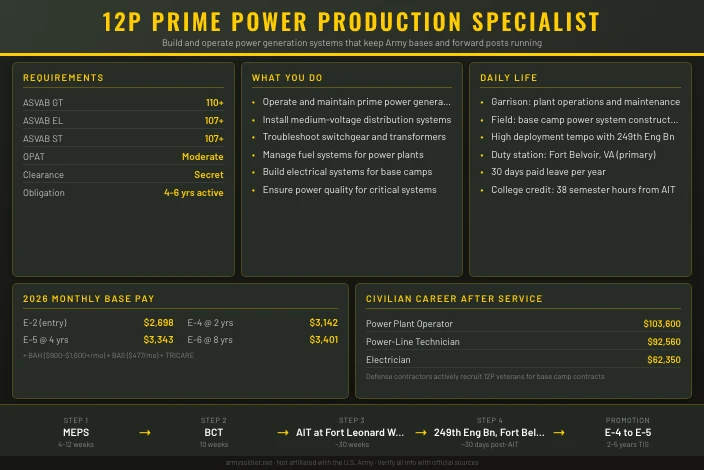
The Army’s forward operating bases, command posts, hospitals, and data centers all run on electricity. When the commercial grid goes down or the mission goes somewhere there is no grid at all, the 12P Prime Power Production Specialist builds, operates, and maintains the power generation systems that keep everything running. This is the Army’s only medium-voltage electrical specialty. The ASVAB line score requirements are among the highest in the engineer career field, and the AIT is nearly a year long. What you get in return is a civilian-transferable skill set worth well over six figures in the private sector.
Qualifying requires specific ASVAB line scores — our ASVAB study guide covers what to target and how to prepare.
Job Role and Responsibilities
The 12P Prime Power Production Specialist designs, installs, operates, and maintains high-capacity power generation systems ranging from 30 kilowatts to megawatt-scale prime power plants. You work with generator sets, transformers, switchgear, distribution panels, and medium-voltage electrical systems. Prime Power soldiers are the Army’s technical experts for contingency electrical power.
Garrison work includes inspecting and maintaining prime power equipment at installations, testing protection systems, performing scheduled generator maintenance, and managing fuel systems. You’ll read single-line electrical diagrams, troubleshoot faults using multimeters and power analyzers, and update maintenance records.
Deployed operations put you at the center of base camp power management. When a forward operating base is established, the 12P designs the electrical distribution system, installs the generators, connects the grid, and manages power quality for the entire facility. Medical equipment, communications, refrigeration for medications, and lighting in surgical suites all run off systems you built.
Specific Roles
The base MOS is 12P. After completing AIT, all 12P soldiers earn one of three Additional Skill Identifiers (ASIs) based on their specialization in the final phase of training:
| Identifier | Description |
|---|---|
| ASI S2 | Prime Power Production Mechanical Specialist |
| ASI S3 | Prime Power Production Electrical Specialist |
| ASI E5 | Prime Power Production Instrumentation Specialist |
Mission Contribution
Power is not a luxury in modern military operations. Communications systems, medical equipment, command and control networks, and surveillance systems all require reliable, consistent electrical power. The 249th Engineer Battalion (Prime Power) is the Army’s premier unit for this mission and has supported operations on every continent. The 12P is the reason the lights stay on when everything else is uncertain.
Equipment
You’ll work with tactical and commercial generator sets, medium-voltage switchgear, power distribution units, uninterruptible power supply (UPS) systems, automatic transfer switches, and power quality analysis equipment. The Army operates fixed, semi-fixed, and mobile power plants. Some systems generate 100 kilowatts; others produce multiple megawatts for large base camps.
Salary and Benefits
Monthly base pay is set by rank and years of service. The 2026 figures below come from the current DFAS pay schedule.
| Rank | Grade | Monthly Base Pay (entry) |
|---|---|---|
| Private (PV2) | E-2 | $2,698 |
| Private First Class (PFC) | E-3 | $2,837 |
| Specialist (SPC) | E-4 | $3,142 |
| Sergeant (SGT) | E-5 | $3,343 |
| Staff Sergeant (SSG) | E-6 | $3,401 |
Source: DFAS 2026 military pay chart.
Most soldiers also receive:
- BAH: Tax-free housing allowance based on duty location, pay grade, and dependent status. A single E-4 at most CONUS installations receives roughly $900-$1,600+ per month.
- BAS: $476.95/month food allowance (2026 rate) for all enlisted soldiers.
- TRICARE: Full health, dental, and vision coverage for you and dependents on active duty.
Additional Benefits
The Blended Retirement System (BRS) combines a 20-year pension at 40% of high-36 basic pay with government TSP matching up to 5% of basic pay starting in year three. Army Tuition Assistance covers up to $4,500 per year for college courses taken while serving. The Post-9/11 GI Bill covers in-state tuition at public schools plus a monthly housing allowance for up to 36 months after leaving service.
The 12P MOS has historically qualified for selective reenlistment bonuses at various career points. Ask your recruiter about current bonus eligibility at enlistment.
Work-Life Balance
Soldiers earn 30 days paid leave annually. Prime Power units carry a high operational tempo because power generation is always in demand, both at home station and on deployments. The 249th Engineer Battalion at Fort Belvoir has a particularly demanding deployment schedule given global mission requirements.
Qualifications and Eligibility
| Requirement | Details |
|---|---|
| ASVAB Score | GT: 110, EL: 107, AND ST: 107 (all three required) |
| Citizenship | U.S. citizen |
| Age | 17-39 (waiver possible) |
| Education | High school diploma or GED |
| Physical | OPAT: Moderate category |
| Security Clearance | Secret (required; initiated at accession) |
| Color Vision | Required (wire identification and electrical systems) |
The triple line score requirement is the most demanding in the engineer career field. GT (General Technical), EL (Electronics), and ST (Skilled Technical) all need to meet minimums simultaneously. GT tests verbal and arithmetic reasoning. EL tests electronics knowledge and math. ST tests general science, verbal, math, and mechanical reasoning. Strong math and basic electronics knowledge are the most important preparation areas.
Application Process
Take the ASVAB and ensure all three composites meet minimums before contracting. A Secret clearance investigation runs concurrently with the enlistment process. Non-citizens are not eligible for this MOS because of the clearance requirement.
Selection and Competitiveness
12P is genuinely hard to qualify for because of the triple line score requirement. The Army also has a limited number of 12P seats. Candidates who qualify are often actively recruited by the Army because the need for Prime Power specialists consistently exceeds supply. If your scores qualify, you’re in a strong position.
Service Obligation
Most 12P enlistments carry a four-to-six year active duty obligation given the length and cost of training.
See our ASVAB study guide for strategies to hit these line scores, or take the PiCAT from home if you are a first-time tester.
Work Environment
Prime Power soldiers work in power plants, generator yards, electrical distribution systems, and field construction environments. The work is both technical and physical. You’ll spend time at a workbench troubleshooting components and time in the field pulling cable through conduit in 100-degree heat.
The 249th Engineer Battalion (Prime Power) at Fort Belvoir, Virginia is the primary operational unit. The U.S. Army Prime Power School is located at Fort Leonard Wood, Missouri. After AIT, most 12P soldiers are assigned to the 249th or its detachments, though some positions exist at other engineer units.
Leadership and Communication
Prime Power detachments deploy as small teams that operate with significant autonomy. Senior NCOs and warrant officers provide technical oversight, but junior specialists often execute complex electrical work independently. Communication with civilian contractors, foreign military partners, and local national staff is common on deployed missions.
Job Satisfaction
Prime Power soldiers consistently report high job satisfaction tied to the critical nature of their work, the technical depth of the specialty, and the significant civilian career value. The MOS attracts technically-minded soldiers who want real skills, and most find those expectations met.
Training and Skill Development
| Phase | Location | Duration | Focus |
|---|---|---|---|
| Basic Combat Training (BCT) | Various installations | 10 weeks | Soldier skills, weapons, fitness |
| Advanced Individual Training (AIT) | Fort Leonard Wood, MO | ~30 weeks (one year total program) | Electrical theory, power generation systems, distribution, transformers, ASI specialization |
The Prime Power AIT is one of the longest enlisted courses in the Army. The first phase covers math, physics, electrical theory, safety, and power generation fundamentals. The second phase is platform-specific: generator sets, distribution systems, switchgear, and medium-voltage work. The final phase covers the soldier’s chosen ASI specialization (mechanical, electrical, or instrumentation).
The Army has opened this MOS to new accessions (soldiers who have not previously served), which means you can contract directly for 12P from civilian life rather than needing to be an existing 12B first.
Advanced Training
After AIT and experience at an operational unit, 12P soldiers can pursue:
- Medium-voltage electrical licensure through state licensing boards using Army training documentation
- NFPA 70E Arc Flash safety certification for high-voltage work
- Warrant Officer Candidate School (WOCS) for soldiers targeting the 120A Construction Engineering Technician warrant officer path
- Senior Leader Course (SLC) at promotion to SSG
The Army COOL program specifically identifies power generation and electrical certifications that align with this MOS and can be funded through Army Credentialing Assistance.
Everything starts with qualifying ASVAB scores — our study guide covers what to study first.
Career Progression and Advancement
| Rank | Grade | Typical Time in Service | Role |
|---|---|---|---|
| Private First Class (PFC) | E-3 | First year | AIT graduate, learning unit procedures |
| Specialist (SPC) | E-4 | 1-2 years | Plant operator under supervision |
| Sergeant (SGT) | E-5 | 2-5 years | Team leader, shift supervisor |
| Staff Sergeant (SSG) | E-6 | 5-8 years | Section sergeant, detachment NCO |
| Sergeant First Class (SFC) | E-7 | 8-14 years | Platoon sergeant, senior technical advisor |
| Master Sergeant (MSG) | E-8 | 14-20+ years | Battalion-level prime power NCO |
Promotion through E-4 is time-based for soldiers meeting standards. Competitive promotions above E-4 require completing military education, maintaining AFT passing scores, and building NCOERs that reflect strong technical performance and leadership.
Specialization Opportunities
Senior 12P NCOs are in demand as technical advisors for foreign military assistance programs, USACE prime power projects, and large-scale base camp design missions. Some NCOs transition into Department of Army Civilian (DAC) positions managing power infrastructure at Army installations.
Performance Evaluation
NCOs are evaluated annually on NCOERs. Technical proficiency is rated specifically, alongside leadership, adaptability, and unit contribution.
Physical Demands and Medical Evaluations
The OPAT category for 12P is Moderate. Daily physical demands include:
- Lifting and carrying generator components, cable reels, and tools (30-60 lbs regularly)
- Working around energized electrical equipment requiring careful movement
- Pulling cable through conduit in confined and outdoor environments
- Climbing on generator systems and working at height on distribution infrastructure
The Army Fitness Test (AFT), effective June 1, 2025, has five events: 3-Rep Max Deadlift (MDL), Hand Release Push-Up (HRP), Sprint-Drag-Carry (SDC), Plank (PLK), and Two-Mile Run (2MR). Minimum passing score is 60 per event and 300 total for the general standard. The AFT is sex- and age-normed.
Medical Evaluations
Standard Army periodic health assessments apply. Electrical systems work creates an occupational need for electrical safety training that the Army addresses through documented qualification courses. Hearing protection is required around running generator sets.
Deployment and Duty Stations
The 249th Engineer Battalion (Prime Power) at Fort Belvoir, Virginia is the primary duty station for most 12P soldiers. Detachments of the 249th are positioned globally, with elements regularly deployed in support of theater operations, humanitarian assistance, and contingency base camp construction.
Deployment frequency for the 249th is higher than average because electrical power is needed in every contingency. Lengths vary from short-duration missions of thirty to ninety days to year-long base camp construction support deployments.
Other 12P positions exist at installation power plants managed by U.S. Army Corps of Engineers and at some large training installations.
Risk, Safety, and Legal Considerations
Prime Power work carries significant electrical hazards:
- Arc flash: Medium-voltage electrical systems can produce arc flash events with fatal energy levels. All 12P soldiers receive arc flash safety training and use properly rated PPE.
- Electrocution: Working on energized systems requires strict lockout/tagout (LOTO) procedures and verification of de-energized state before contact.
- Generator exhaust: Carbon monoxide from running generators is immediately dangerous. Ventilation requirements are non-negotiable.
- Fuel handling: Generator fuel systems present fire and spill hazards requiring trained handling procedures.
OSHA 29 CFR 1910.269 and NFPA 70E set the safety standards that Prime Power operations follow. Technical compliance is enforced by quality control NCOs and safety officers.
Security Requirements
The Secret clearance is required at accession and carries ongoing responsibilities. Prime Power operations often take place in classified or sensitive environments where the location and capability of power systems are themselves sensitive information. Clearance maintenance requires responsible personal conduct, financial responsibility, and prompt reporting of foreign contacts or other relevant circumstances.
Impact on Family and Personal Life
Fort Belvoir, Virginia is located in the greater Washington, D.C. metro area, one of the most expensive housing markets in the country. BAH rates at Fort Belvoir are among the highest in the Army, which partially offsets the cost of living. The installation has full family support infrastructure including housing, childcare, and schools.
The 249th’s deployment pace can be demanding for families. Family Readiness Group support and Military OneSource counseling are available. The Army’s Strong Bonds program provides family and relationship support resources specifically for deployed soldier families.
Reserve and National Guard
Component Availability
The 12P Prime Power Production Specialist MOS is rare in the Reserve and National Guard. The 249th Engineer Battalion (Prime Power) at Fort Belvoir is the Army’s primary prime power unit, and it is an active-duty organization. A small number of Army Reserve positions exist – primarily within engineer support units that maintain generator and power generation equipment – but 12P billets in the Reserve are limited compared to most other engineer MOSs. The National Guard does not maintain dedicated prime power units, so this MOS is effectively not available as a Guard option. If you want to serve as a 12P in a part-time capacity, the Reserve is your only realistic path, and seat availability is not guaranteed.
Drill Schedule and Training Commitment
Reserve 12P soldiers follow the standard one weekend per month (Battle Assembly) and two weeks per year (Annual Training) commitment. However, because prime power is a highly specialized technical skill, Reserve units are likely to require additional training days to maintain certification on power generation and distribution equipment. Expect periodic technical recertification requirements beyond the standard drill calendar, especially for medium-voltage systems and the equipment-specific ASI qualifications you earned in AIT.
Part-Time Pay
Reserve and National Guard soldiers are paid for each drill period, with four drill periods per Battle Assembly weekend. An E-4 with approximately three years of service earns roughly $422 per drill weekend in 2026. That works out to about $5,064 per year from drill weekends alone, plus roughly $1,583 from the two-week Annual Training. Active-duty monthly base pay for the same rank is $3,166 – nearly 7.5 times more per month. The part-time pay structure works for soldiers who are earning strong civilian wages from their prime power skills, which many are.
Benefits Differences
The benefits gap between active duty and Reserve status is significant for this MOS:
- Healthcare: Active duty TRICARE costs $0 in premiums. Reservists who are not activated use Tricare Reserve Select at $57.88 per month for member-only or $286.66 per month for member plus family (2026 rates).
- Education: Federal Tuition Assistance ($4,500 per year) is available to drilling reservists. The Montgomery GI Bill Selected Reserve (MGIB-SR) provides roughly $416 per month while enrolled. The Post-9/11 GI Bill requires 90 or more days of federal activation; the benefit percentage scales with cumulative active time, so reservists who deploy or are activated for extended periods build eligibility faster.
- Retirement: Active duty BRS provides a pension of 40% of the highest 36-month average base pay after 20 years, with TSP matching up to 5%. Reserve retirement is points-based – you earn points for each drill, annual training day, and active duty day. The pension draws at age 60, though qualifying mobilizations of 90 or more days can reduce that floor to as low as age 50.
Deployment and Mobilization
Reserve 12P soldiers can expect occasional mobilization, particularly for contingency base camp operations and disaster response power missions. The 249th is active duty, but Reserve units supporting engineer operations can be called up under Title 10 authority. Deployment lengths for Reserve prime power elements range from 30 to 90 days for short-duration missions to longer periods for major contingency operations. Mobilization frequency is lower than active duty 249th soldiers but not rare – power generation is a critical need every time the Army deploys anywhere.
Civilian Career Integration
The 12P MOS builds civilian skills that are genuinely valuable in the power generation industry, and Reserve service lets you maintain those skills part-time while working as a power plant operator, utility technician, or electrical contractor. Many civilian employers in the energy sector view Reserve service as a sign of ongoing technical currency. USERRA protects your civilian job position if you are mobilized, requiring your employer to hold your position for the duration of qualifying service.
| Feature | Active Duty | Army Reserve | Army National Guard |
|---|---|---|---|
| Commitment | Full-time | One weekend/month + 2 weeks/year | Not typically available |
| Monthly Pay (E-4, ~3 yrs) | $3,166/month | ~$422/drill weekend | N/A |
| Healthcare | TRICARE, $0 premiums | TRS, $57.88/month (member) | N/A |
| Education | TA + Post-9/11 GI Bill | Federal TA, MGIB-SR; Post-9/11 after activation | N/A |
| Deployment | High frequency, global prime power missions | Occasional mobilization for contingency power support | N/A |
| Retirement | BRS pension at 20 years | Points-based, age 60 | N/A |
Post-Service Opportunities
The civilian power generation and electrical infrastructure industry has a significant shortage of skilled workers. Prime Power veterans with hands-on generator, distribution, and medium-voltage experience are in high demand.
| Civilian Job Title | Median Annual Salary (BLS, May 2024) | Job Outlook (2024-2034) |
|---|---|---|
| Power Plant Operator | $103,600 | Declining; ~3,800 openings/yr |
| Stationary Engineer / Boiler Operator | $75,190 | +2% |
| Electrician | $62,350 | +11% |
| Electrical Power-Line Technician | $92,560 | Stable |
Source: Bureau of Labor Statistics.
Defense contractors including AECOM, KBR, and Fluor Corporation actively recruit 12P veterans for base camp construction and operations and maintenance contracts. The Army’s Credentialing Assistance program and COOL program identify state electrical licenses and certifications that this training directly supports.
The GI Bill can fund an electrical engineering technology degree or journeyman electrician apprenticeship program, both of which build on the AIT training foundation.
Is This a Good Job for You? The Right (and Wrong) Fit
This MOS fits candidates who scored very well across the ASVAB composites, like working with electrical and mechanical systems at a deep technical level, and are willing to commit to a long training pipeline before reaching their first unit. If you’ve studied physics or electronics, have mechanical aptitude, and want skills that command strong civilian wages, this MOS delivers on that.
The wrong fit is someone who wants a short training pipeline, dislikes technical documentation, or isn’t comfortable with the serious safety obligations that come with medium-voltage electrical work. This isn’t a job you can fake your way through, and errors have serious consequences.
Long-term, 12P is one of the Army’s strongest MOSs for civilian transition. Power generation specialists, plant operators, and electricians with military training backgrounds earn well above average civilian wages and have no shortage of employers interested in their skills.
More Information
Talk with an Army recruiter to confirm 12P seat availability. This MOS has limited seats and specific score requirements, so early planning and ASVAB preparation matter. Find a local recruiter at goarmy.com or by calling 1-888-550-ARMY.
- Prepare for the ASVAB with our study guide to make sure your line scores qualify
This site is not affiliated with the U.S. Army or any government agency. Verify all information with official Army sources before making enlistment or career decisions.
Explore more Army engineer careers such as 12B Combat Engineer and 12K Plumber.