12Q Power Distribution Specialist
Most people don’t think about where electricity comes from until it stops. In the Army, that problem belongs to 12Q Power Distribution Specialists, the soldiers who install, maintain, and repair the overhead and underground electrical systems that keep forward operating bases, command posts, and airfields running.
This is a physically demanding, technically skilled job inside the Corps of Engineers (CMF 12). You’ll work with high-voltage systems, utility poles, and distribution equipment in environments that range from Fort Leonard Wood in winter to a deployed combat support area in a desert. The EL 93 ASVAB requirement filters for applicants with strong electronics aptitude, and the skills you build translate directly to licensed electrician and power distribution careers that are consistently in demand nationwide.
Qualifying requires specific ASVAB line scores — our ASVAB study guide covers what to target and how to prepare.
Job Role and Responsibilities
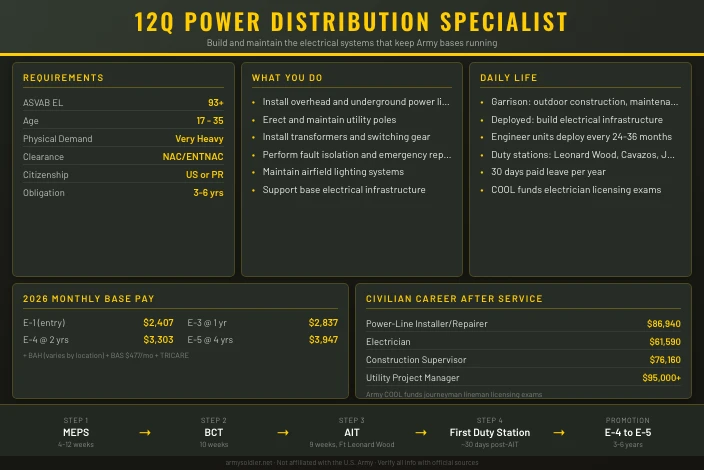
Power Distribution Specialists install and maintain Army electrical transmission and distribution systems to support power requirements at bases and operational areas. They erect utility poles, run overhead and underground distribution lines, install transformers and switching gear, and perform testing and scheduled maintenance to keep systems operational.
Daily Tasks
In garrison, the work follows a maintenance-and-inspection rhythm. Soldiers check distribution equipment, perform scheduled service on poles and components, and respond to outages or fault conditions. Deployed, the tempo shifts: you may be building a power infrastructure from scratch, supporting engineer construction teams, or troubleshooting a downed system that a headquarters unit depends on.
Typical daily tasks:
- Installing overhead and underground electrical distribution lines
- Erecting and maintaining utility poles and associated hardware
- Installing and testing transformers, switches, and circuit protection equipment
- Performing fault isolation and emergency repairs
- Conducting scheduled maintenance inspections on distribution systems
- Supporting airfield lighting installation and maintenance
Specific Roles
Within the 12Q MOS, progression tracks follow skill level designations:
| Code | Level | Primary Focus |
|---|---|---|
| 12Q1O | Skill Level 1 | Assist with installation of transmission and distribution systems, utility pole work |
| 12Q2O | Skill Level 2 | Install and maintain systems independently, testing and inspections |
| 12Q3O | Skill Level 3 | Supervise installation of underground and overhead systems, manage material staging |
Mission Contribution
Without reliable power distribution, modern Army operations grind down fast. Command post networks, medical facilities, maintenance shops, and aviation refueling all depend on stable electrical infrastructure. A 12Q’s work is often invisible when it’s done correctly and immediately visible when it’s not.
Technology and Equipment
Soldiers work with:
- Overhead line construction tools (cranes, pole setting equipment, climbing gear)
- Underground boring and cable laying equipment
- Distribution transformers, switching panels, and metering equipment
- Testing instruments (multimeters, meggers, ground resistance testers)
- Airfield lighting control systems
Salary and Benefits
Base Pay
Pay is set by the 2026 DFAS pay tables. Most soldiers enter at E-1 or E-3 depending on college credit or JROTC status.
| Rank | Time in Service | Monthly Base Pay |
|---|---|---|
| E-1 (PV1) | Entry | $2,407 |
| E-2 (PV2) | 6 months | $2,698 |
| E-3 (PFC) | 1 year | $2,837 |
| E-4 (SPC) | 2 years | $3,303 |
| E-5 (SGT) | 4 years | $3,947 |
| E-6 (SSG) | 8 years | $4,613 |
Allowances and Additional Benefits
Soldiers living off-post receive Basic Allowance for Housing (BAH), which varies by location and dependent status. All enlisted soldiers receive a Basic Allowance for Subsistence (BAS) of $476.95 per month in 2026.
Additional benefits include:
- TRICARE: No-cost medical, dental, and vision coverage for the soldier
- Tuition Assistance (TA): Up to $4,500 per year toward college courses while serving
- Post-9/11 GI Bill: Up to 36 months of education benefits post-service, including full in-state public university tuition and a monthly housing allowance
- Army COOL: Program that funds civilian licensing exams, including journeyman and master electrician certifications
Retirement
Soldiers under the Blended Retirement System (BRS) receive a pension worth 40% of high-36 average basic pay after 20 years, plus TSP government matching of up to 5% of basic pay starting in the third year of service.
Work-Life Balance
The Army grants 30 days of paid leave per year, accruing at 2.5 days per month. Garrison assignments typically follow regular duty hours with weekend availability. Field exercises and deployments disrupt this, but engineer units on standard garrison schedules provide reasonable predictability.
Qualifications and Eligibility
Requirements Table
| Requirement | Details |
|---|---|
| ASVAB Line Score | EL: 93 |
| Age | 17-35 (waiver possible to 39) |
| Citizenship | U.S. citizen or permanent resident alien |
| Education | High school diploma or GED |
| Physical Demand | Very Heavy |
| Security Clearance | Ability to obtain (favorable NAC/ENTNAC) |
| AFQT Minimum | 31 (HS diploma) or 50 (GED) |
The EL (Electronics) composite is calculated from GS + AR + MK + EI subtest scores. An EL of 93 requires strong performance across general science, arithmetic reasoning, math knowledge, and electronics information. Studying electronics fundamentals before the ASVAB pays off for this MOS.
Application Process
- Meet with a recruiter and take the ASVAB at MEPS
- Pass the physical exam; the Very Heavy physical demand rating means you’ll be assessed for lifting, climbing, and sustained physical output
- Confirm eligibility for a background check (favorable National Agency Check required)
- Request MOS 12Q during contract negotiation
Selection and Competitiveness
The EL 93 requirement is moderately competitive. Recruits with hands-on electrical, shop, or construction experience have an advantage, though the Army trains the specific power distribution skills from scratch in AIT.
Service Obligation
Standard enlistment options are 3, 4, or 6 years. Most soldiers completing AIT for a technical MOS sign a 4-year contract. The total training pipeline is roughly 19 weeks (BCT plus AIT) before reaching a first duty station.
See our ASVAB study guide for strategies to hit these line scores, or take the PiCAT from home if you are a first-time tester.
Work Environment
Setting and Schedule
This is an outdoor, physically active job most days. Garrison work involves climbing utility poles, digging trenches, and working with distribution equipment in all weather conditions. Deployed, the work environment can be more austere with less logistical support and faster operational timelines.
The “Very Heavy” physical demand rating reflects real daily requirements: carrying and handling cable reels, pole components, and heavy tools is standard. The job is not suited to someone who wants predominantly desk or indoor work.
Chain of Command
12Q soldiers work in engineer companies under NCO team leaders, reporting up through platoon sergeants to the company commander. At operational echelons, they may work alongside contractors or civilian engineers on base development projects.
Team Dynamics
Power distribution work is largely team-based. Installing a distribution line requires coordinated effort between pole setters, linemen, and ground crews. The work demands clear communication, especially when energized equipment is involved. Individual skill matters, but safe operations require tight team discipline.
Job Satisfaction
Soldiers who enjoy hands-on technical work and seeing immediate tangible results tend to thrive in this MOS. The direct connection between your labor and functioning power at a base or post is satisfying. The Very Heavy physical demand is also a significant factor: if you prefer technical work over manual labor, this may not be the right fit.
Training and Skill Development
Initial Training
| Phase | Location | Length | Focus |
|---|---|---|---|
| Basic Combat Training (BCT) | Various | 10 weeks | Soldier fundamentals, weapons, fitness |
| Advanced Individual Training (AIT) | Fort Leonard Wood, MO | 9 weeks | Power distribution systems, pole work, electrical installation and maintenance |
| First Duty Station | Varies | Ongoing | Hands-on construction and maintenance missions |
AIT covers the full spectrum of Army power distribution: overhead and underground line construction, pole and hardware installation, transformer testing, fault finding, and airfield lighting systems. The 9 weeks are technical and hands-on, combining classroom instruction with field practical exercises.
Advanced Training
Experienced 12Qs can pursue:
- Army COOL certifications: The program funds exams for Journeyman Lineman, OSHA electrical certifications, and related credentials that directly increase civilian earning potential
- NCOES courses: Primary Leadership Development Course (PLDC), Warrior Leader Course (WLC), and Advanced Leader Course (ALC) as the soldier promotes
- Engineer NCO courses at Fort Leonard Wood for advanced construction and utilities management skills
Everything starts with qualifying ASVAB scores — our study guide covers what to study first.
Career Progression and Advancement
Rank Progression
| Grade | Title | Typical Time in Grade | Key Milestone |
|---|---|---|---|
| E-1 to E-3 | Private / PFC | 0-18 months | Complete AIT, first unit assignment |
| E-4 | Specialist (SPC) | 18-36 months | Independent line work, crew qualification |
| E-5 | Sergeant (SGT) | 3-6 years | Lead small distribution work teams |
| E-6 | Staff Sergeant (SSG) | 6-10 years | Section-level supervision |
| E-7 | Sergeant First Class (SFC) | 10-15 years | Platoon Sergeant, project management |
| E-8 | Master Sergeant (MSG) | 15-20+ years | Senior technical advisor or 1SG |
Transfers and Flexibility
Soldiers can apply for lateral reclassification to related engineer MOS positions after completing their initial contract. The electrical skills built in 12Q also provide a foundation for warrant officer paths in engineering or facilities management. Some soldiers transition to 12R (Interior Electrician) for more building-focused electrical work.
Performance Evaluation
Like all Army NCOs, 12Qs are evaluated through the NCOER system. The criteria that stand out for this MOS: technical competence demonstrated on real construction and maintenance missions, safety record in high-hazard operations, and ability to lead crews efficiently in both garrison and deployed environments.
Physical Demands and Medical Evaluations
Fitness Standards
12Q is rated Very Heavy physical demand. The general AFT standard applies. Every soldier must pass the Army Fitness Test (AFT) with a minimum of 60 points per event.
| AFT Event | Description | Min Score |
|---|---|---|
| MDL | 3-Rep Max Deadlift | 60 pts |
| HRP | Hand Release Push-Up | 60 pts |
| SDC | Sprint-Drag-Carry | 60 pts |
| PLK | Plank | 60 pts |
| 2MR | Two-Mile Run | 60 pts |
| Total | 300 pts minimum |
Scores are sex- and age-normed. The physical demands of the job itself, however, are genuinely heavy: climbing, lifting, and sustained manual labor are daily realities that go beyond AFT event requirements.
Medical Evaluations
Standard annual physical exams are required. There are no MOS-specific medical screenings beyond the initial MEPS examination, but the physical nature of the job means musculoskeletal fitness is particularly important.
Deployment and Duty Stations
Deployment Details
Engineer units deploy in support of operations requiring base construction and sustainment. Deployment frequency varies by unit type: Active component engineer battalions may deploy every 24-36 months for 9-12 months. Reserve and National Guard 12Qs may be mobilized for base construction projects or disaster response.
During deployments, 12Q soldiers build and maintain the electrical infrastructure of new or expanding installations, often working long hours under mission pressure to bring systems online quickly.
Duty Stations
Power Distribution Specialists are assigned to engineer units at installations across the Army. Common stations include:
- Fort Leonard Wood, MO (major engineer training and home base)
- Fort Cavazos, TX
- Fort Campbell, KY
- Fort Stewart, GA
- Joint Base Lewis-McChord, WA
- OCONUS: Germany, Korea, Japan
Risk, Safety, and Legal Considerations
Job Hazards
Working with high-voltage electrical systems is inherently hazardous. Energized line work, pole climbing, and working in adverse weather all present risks. Electrical shock, arc flash, and falls from height are the primary hazards in this MOS.
Safety Protocols
The Army enforces strict Electrical Safety regulations and OSHA-equivalent standards on all power distribution work. All energized line work requires qualified supervision, personal protective equipment (PPE), and defined clearance procedures. These safety standards also make 12Q veterans well-prepared to meet civilian utility industry safety requirements.
Security Requirements
A favorable National Agency Check (NAC) or Entry National Agency Check (ENTNAC) is required. This is a background check but does not rise to the level of a full security clearance investigation. Disqualifying factors include serious criminal convictions and certain financial delinquencies.
Impact on Family and Personal Life
Family Considerations
Engineer units on garrison assignment offer predictable schedules that support family stability. Deployment and extended field exercise cycles disrupt this. The Very Heavy physical demand of the job also means soldiers need to maintain a high level of physical fitness, which takes time and energy outside of duty hours.
Army family support resources include Military OneSource, chaplain services, and unit Family Readiness Groups (FRGs) for deployment support. On-post housing or BAH for off-post housing reduces financial stress compared to many equivalent civilian jobs.
Relocation
PCS moves every 2-4 years are typical. Fort Leonard Wood is a common assignment for this MOS given the engineer training base there. Each move is funded by the Army with a dislocation allowance.
Reserve and National Guard
Component Availability
MOS 12Q Power Distribution Specialist is available in both the Army Reserve and Army National Guard, though the number of positions is more limited than common infantry or logistics MOSs. Reserve and Guard 12Q soldiers serve in engineer construction and utilities companies that provide power distribution support during both federal and state-level missions. The National Guard component can be particularly active in this MOS because power distribution skills are directly useful for state emergency response, including natural disasters where electrical infrastructure is damaged. Both components offer a viable part-time path for candidates who want to develop utility trade skills without committing to full-time active duty.
Drill Schedule and Training Commitment
Reserve and Guard 12Q soldiers follow the standard Battle Assembly schedule of one weekend per month plus two weeks of Annual Training per year. Because power distribution work involves high-voltage systems and evolving safety standards, units may require additional training days to maintain technical certifications and safety qualifications beyond the standard drill calendar. Annual Training often involves hands-on construction or maintenance exercises where soldiers practice the same overhead line work, transformer installation, and underground distribution tasks they performed in AIT. This practical focus keeps technical skills current even in a part-time status.
Part-Time Pay
An E-4 with approximately three years of service earns roughly $422 per drill weekend, covering four drill periods over a Battle Assembly. Twelve drill weekends per year produces about $5,064 in annual drill pay. The two-week Annual Training adds roughly $1,583. Compare that to the active-duty E-4 monthly base pay of $3,166. The math strongly favors active duty for income, but many 12Q soldiers working as civilian linemen or electricians earn well above the median and find Reserve or Guard service supplements that income meaningfully while maintaining benefits access.
Benefits Differences
Part-time service provides access to military benefits at reduced levels:
- Healthcare: Active duty TRICARE carries $0 premiums. Drilling reservists use Tricare Reserve Select at $57.88 per month for member-only coverage, or $286.66 per month for a family plan (2026 rates).
- Education: Federal Tuition Assistance provides up to $4,500 per year for courses taken while drilling. The Montgomery GI Bill Selected Reserve (MGIB-SR) pays roughly $416 per month during enrollment. The Post-9/11 GI Bill activates after 90 or more days of federal service – the benefit percentage scales with cumulative active time.
- State tuition waivers: National Guard members in many states qualify for full or partial tuition waivers at state schools. Army Reserve members do not have state tuition waivers since the Reserve is a federal component.
- Retirement: Reserve and Guard retirement is points-based. Pension draws at age 60, or earlier if qualifying mobilizations reduce the floor, with a minimum age of 50 for those with qualifying 90-day periods.
Deployment and Mobilization
Reserve and Guard 12Q soldiers are mobilized for both federal contingency operations and state emergencies. A Guard 12Q can be activated by the governor for disaster response when hurricanes, ice storms, or flooding destroy power distribution infrastructure – work that maps directly to the soldier’s military training. Federal Title 10 activations send Reserve and Guard units overseas in support of base construction and sustainment missions. Mobilization frequency is lower than active duty engineer units, but it is not uncommon – expect one significant mobilization every several years, with lengths ranging from 30 to 180 days depending on the mission.
Civilian Career Integration
This MOS has some of the strongest civilian career integration of any engineer MOS. Civilian linemen and electrical distribution technicians work with the same types of equipment they train on in the Army. Many 12Q soldiers drill one weekend per month while working full-time for utility companies, electrical contractors, or construction firms. The skills are directly interchangeable, and civilian employers often view Reserve or Guard status positively because it demonstrates ongoing technical training and reliability. USERRA protects your civilian job when you are called up for qualifying service.
| Feature | Active Duty | Army Reserve | Army National Guard |
|---|---|---|---|
| Commitment | Full-time | One weekend/month + 2 weeks/year | One weekend/month + 2 weeks/year |
| Monthly Pay (E-4, ~3 yrs) | $3,166/month | ~$422/drill weekend | ~$422/drill weekend |
| Healthcare | TRICARE, $0 premiums | TRS, $57.88/month (member) | TRS, $57.88/month (member) |
| Education | TA + Post-9/11 GI Bill | Federal TA, MGIB-SR; Post-9/11 after activation | Federal TA, MGIB-SR, state tuition waivers |
| Deployment | Periodic engineer deployments for base construction | Mobilization for contingency construction missions | State disaster response + federal activation |
| Retirement | BRS pension at 20 years | Points-based, age 60 | Points-based, age 60 |
Post-Service Opportunities
Electrical power distribution skills are in sustained demand across utility companies, construction firms, and government facilities. The civilian equivalent occupational categories include journeyman lineman, electrical power-line installer/repairer, and electrical construction supervisor.
| Civilian Job Title | Median Annual Salary | Job Outlook |
|---|---|---|
| Electrical Power-Line Installer/Repairer | $86,940 | +11% (2024-2034) |
| Electrician | $61,590 | +11% (2024-2034) |
| Construction Supervisor | $76,160 | +5% (est.) |
| Utility Project Manager | $95,000-$115,000 | Strong demand |
Salary data based on BLS Occupational Outlook Handbook (May 2024 data).
The Army COOL program funds journeyman lineman licensing exams while you’re still serving. Candidates with an apprenticeship waiver from military service can significantly shorten the civilian licensure pathway. Many power utility companies actively recruit veterans from military engineer and signal MOSs.
Is This a Good Job for You? The Right (and Wrong) Fit
Ideal Candidate
This MOS fits someone who:
- Likes hands-on, physical work with visible results
- Has an aptitude for electrical systems and troubleshooting
- Can work safely in high-hazard environments with proper training
- Wants a technical trade that leads to a well-paying union or utility career
- Is comfortable with outdoor work in varied weather conditions
Potential Challenges
The Very Heavy physical demand is real. Extended pole climbing, cable work, and outdoor construction in heat, cold, or rain require genuine physical endurance. If you’re looking for predominantly technical or analytical work, 12Y (Geospatial) or 25B (IT Specialist) may be a better fit. Deployments focus on construction and sustainment rather than combat operations, but austere conditions and operational tempo add significant stress.
Career and Lifestyle Alignment
If you want a technical trade, solid pay, and a direct path to a licensed civilian career in a consistently employed field, 12Q delivers that. Journeyman linemen and electrical power-line workers are among the better-compensated skilled trades. Combining the training, the veteran preference in hiring, and potential union membership makes the post-service financial picture strong.
More Information
A local Army recruiter can confirm current 12Q availability, bonus eligibility, and duty station options. You can reach Army recruiting at 1-888-550-ARMY (2769) or visit GoArmy.com to start the conversation online.
- Prepare for the ASVAB with our study guide to make sure your line scores qualify
This site is not affiliated with the U.S. Army or any government agency. Verify all information with official Army sources before making enlistment or career decisions.
Explore more Army engineer careers such as 12Y Geospatial Engineer and 12R Interior Electrician.