12R Interior Electrician
Electricians are some of the most in-demand tradespeople in the country right now, and the Army will train you to become one in six weeks. MOS 12R Interior Electrician puts you inside the wire, literally, installing and maintaining electrical systems that keep bases, hospitals, and operational facilities running. The skills transfer directly to a licensed civilian career that pays a median $62,350 a year and is growing at three times the national average.
Qualifying requires specific ASVAB line scores — our ASVAB study guide covers what to target and how to prepare.
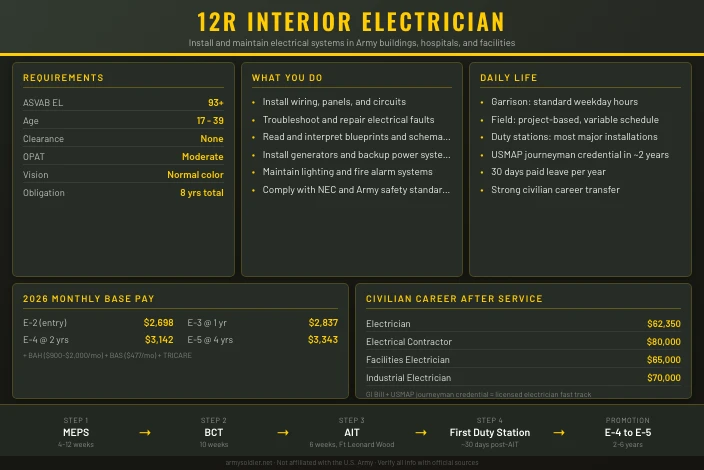
Job Role and Responsibilities
Army Interior Electricians install, maintain, and repair interior electrical systems and equipment on military installations. They work with generators, transformers, circuit breakers, service panels, junction boxes, and wiring up to 600 volts. At higher skill levels, they supervise teams and coordinate electrical installation projects across entire facilities.
Day-to-day work is hands-on from the start. You read blueprints, trace wiring diagrams, test circuits for faults, and replace failed components. When something goes wrong on post, Interior Electricians are the people who find the short and fix it before a hospital wing or communications center loses power.
Daily Tasks
- Installing and terminating electrical wiring in buildings and facilities
- Testing equipment with meters and diagnostic tools to locate faults
- Replacing circuit breakers, switches, outlets, and panel components
- Reading and interpreting electrical blueprints and wiring diagrams
- Performing preventive maintenance on generators and transformers
- Coordinating power shutdowns for safe maintenance work
- Inspecting completed work to verify code compliance
Specialized Roles
Interior Electricians advance through two primary MOS skill levels and can build additional qualifications through Army credentialing programs:
| Identifier | Type | Description |
|---|---|---|
| 12R1O | MOSC | Journeyman level; installs and maintains systems up to 600V |
| 12R2O | MOSC | Supervisory level; coordinates installation and maintenance projects |
| ASI codes | ASI | Additional Skill Identifiers added for specific equipment qualifications during career |
Mission Contribution
Military installations are small cities. They run hospitals, communications centers, fuel systems, barracks, and command posts around the clock. When a power system fails during a training exercise or a contingency operation, Interior Electricians are the soldiers who get the lights back on. That is not a support-from-a-distance role. It is essential infrastructure work that every other Army mission depends on.
Technology and Equipment
The job involves commercial-grade electrical tools and military-specific systems. You will work with multimeters, clamp meters, insulation testers, and conduit benders. Larger work includes distribution panels, motor control centers, and military standard generators. As installations modernize, Interior Electricians increasingly encounter energy management systems and smart building controls alongside traditional wiring work.
Salary and Benefits
The Army does not pay soldiers based on their MOS alone. Pay is based on rank and years of service, set by the DFAS pay table.
Base Pay
| Rank | Grade | Approx. Years | Monthly Base Pay |
|---|---|---|---|
| Private (PV2) | E-2 | Entry | $2,698 |
| Private First Class | E-3 | 1-2 years | $2,837 |
| Specialist | E-4 | 2-4 years | $3,142 |
| Sergeant | E-5 | 4-6 years | $3,343 |
| Staff Sergeant | E-6 | 6-10 years | $3,401 |
| Sergeant First Class | E-7 | 10-15 years | $3,932 |
Base pay is only part of the picture. Most soldiers also receive Basic Allowance for Housing (BAH), which varies by duty location, pay grade, and dependency status. At Fort Sam Houston, a single Specialist receives about $1,359 per month in BAH. Basic Allowance for Subsistence (BAS) adds $476.95 per month for food.
Additional Benefits
TRICARE covers medical, dental, vision, prescriptions, and hospitalization at no cost to active duty soldiers. Family members are enrolled at no cost for in-network care. The Army’s Blended Retirement System (BRS) combines a pension at 20 years (40% of your high-36 average basic pay) with a Thrift Savings Plan, where the government automatically contributes 1% of your pay and matches your contributions up to 4%.
Education benefits are significant. Tuition Assistance pays up to $4,500 per year for courses taken while on active duty. The Post-9/11 GI Bill, once earned, covers full in-state tuition at public universities plus a monthly housing allowance for 36 months.
Work-Life Balance
Active duty soldiers earn 30 days of paid leave per year, accruing at 2.5 days per month. Garrison duty follows a structured schedule; most 12R soldiers work standard duty hours in installation facilities, with on-call rotations for emergency repairs. Field exercises and deployments break that routine. The Army observes 11 federal holidays, and most installations offer recreational facilities, fitness centers, and family support programs at no or low cost.
Qualifications and Eligibility
Requirements Table
| Requirement | Standard |
|---|---|
| ASVAB Line Score | EL: 93 minimum |
| Age | 17-34 (Active Duty) |
| Citizenship | U.S. citizen or permanent resident |
| Education | High school diploma (AFQT 31+) or GED (AFQT 50+) |
| Color Vision | Normal color vision required |
| Physical Profile | PULHES 111221 |
| Security Clearance | Not required; routine background check |
| OPAT Category | Moderate |
The EL (Electronics) composite is calculated from four ASVAB subtests: General Science + Arithmetic Reasoning + Mathematics Knowledge + Electronics Information. A score of 93 is competitive but achievable with focused study, especially on the math and science sections.
Application Process
The full process from initial recruiter contact to shipping for BCT typically takes two to four months, depending on how quickly you complete MEPS and when a training slot opens.
Selection and Service Obligation
12R is not a highly competitive MOS in terms of slot scarcity, but the EL 93 cutoff does screen out applicants who have not prepared for the math and electronics portions of the ASVAB. Prior experience in electrical work, construction, or STEM coursework strengthens your application and makes training easier.
Soldiers enlisting for 12R typically sign a three- or four-year active duty contract, with a total service obligation (including inactive ready reserve) of eight years. Army Reserve and Army National Guard options are available with different obligation structures.
See our ASVAB study guide for strategies to hit these line scores, or take the PiCAT from home if you are a first-time tester.
Work Environment
Setting and Schedule
Interior Electricians work primarily indoors in installation facilities: barracks, administrative buildings, motor pools, hospitals, and maintenance bays. This is not a field combat MOS. Most work happens in and around permanent or semi-permanent structures. That said, deployed electricians work on forward operating bases where conditions are less predictable, and field exercises will take you into austere environments periodically.
A typical garrison day:
- 0600-0700: Physical training
- 0730-0830: Formation, work order review, crew assignments
- 0830-1200: Job site work (wiring, panel installs, troubleshooting)
- 1300-1700: Continue projects, equipment maintenance, PMCS
- On-call: Rotating emergency callout for power outages
Supervisory soldiers at the SSG and above level manage work order queues and assign crews to jobs.
Leadership and Communication
Newly trained 12Rs work under direct supervision of senior soldiers and NCOs. Skill level progression means more independent judgment faster than in combat arms MOSs. By the time a 12R reaches Sergeant (E-5), they are typically leading small teams of two or three junior soldiers on installation projects. Performance counseling follows the Army’s NCOER system, with documented evaluations at regular intervals.
Team Dynamics and Autonomy
Electrical work is inherently collaborative because shutting down power affects everyone in a facility. You coordinate with facility managers, unit leadership, and safety personnel before any significant maintenance. At the journeyman level (12R1O), you work alongside peers on larger jobs. At the supervisory level (12R2O), you assign work, verify quality, and sign off on completed projects.
Job Satisfaction
Re-enlistment rates in the 12R MOS reflect a trade that soldiers find genuinely useful. The skills are tangible, the work has clear outcomes, and soldiers know their civilian job prospects improve measurably with every year of experience. Veterans who leave the Army with journeyman credentials and a good NCOER file have strong hiring prospects in construction, facilities management, and government contracting.
Training and Skill Development
Initial Training Pipeline
| Phase | Location | Duration | Focus |
|---|---|---|---|
| Basic Combat Training (BCT) | Various | 10 weeks | Soldiering, fitness, weapons qualification, Army values |
| Advanced Individual Training (AIT) | Fort Leonard Wood, MO | 6 weeks | Electrical theory, wiring, safety, blueprint reading, practical exams |
| On-the-Job Training | First duty station | Ongoing | Unit-specific systems, equipment familiarization |
BCT is the same for all Army enlisted soldiers regardless of MOS. After BCT, 12R soldiers move to Fort Leonard Wood in Missouri, home of the U.S. Army Engineer School. Company B of the 169th Engineer Battalion runs the Interior Electrician AIT with Company B of the 1st Engineer Brigade.
AIT at Fort Leonard Wood
The six-week AIT is heavy on practical skills from day one. Early weeks cover electrical theory and safety, with emphasis on emergency response: the first thing instructors teach is how to rescue someone being electrocuted. Students then move into hands-on work with wiring, panel installation, and circuit testing.
The course culminates in a 52-hour practical exam. Soldiers wire multiple devices and a complete panel box, then energize and test every circuit before instructors sign off. There is no shortcut through this exam. About 250 soldiers graduate each year.
Advanced Training
After reaching the duty station, Interior Electricians can pursue advanced electrician certifications funded by the Army. The Army COOL program covers exam fees for credentials including the NCCER Electrical certification and state-level electrician licenses. Soldiers interested in project management can pursue the Army’s Non-Commissioned Officer Education System (NCOES) courses alongside technical training. Warrant Officer conversion is possible for senior NCOs who want to move into the 120A Construction Engineering Technician track.
Everything starts with qualifying ASVAB scores — our study guide covers what to study first.
Career Progression and Advancement
Rank Progression
| Rank | Grade | Typical Timeframe | Role |
|---|---|---|---|
| Private First Class | E-3 | 0-1 year | Basic installation work under supervision |
| Specialist | E-4 | 1-3 years | Independent journeyman tasks, 12R1O skill level |
| Sergeant | E-5 | 3-6 years | Team leader, supervises 2-3 soldiers |
| Staff Sergeant | E-6 | 6-10 years | Section sergeant, manages work orders |
| Sergeant First Class | E-7 | 10-15 years | Platoon sergeant, oversees multiple teams |
| Master Sergeant | E-8 | 15-20 years | Senior technical advisor or first sergeant track |
Promotion to Sergeant (E-5) and above is competitive and based on the Army-wide point system. Points come from NCOES completion, physical fitness scores, marksmanship, awards, and time in grade. Strong NCOER ratings and demonstrated technical competence accelerate advancement in a technical MOS like 12R.
Specialization and Transfers
Interior Electricians who want broader engineering opportunities can apply to lateral MOS reclassification after completing their initial contract. Common moves within CMF 12 include transitions to 12N (Horizontal Construction Engineer) or 12W (Carpentry and Masonry Specialist) for soldiers who want construction project work. Senior NCOs can apply for the Warrant Officer program to become 120A Construction Engineering Technicians, which opens up officer-level engineering project management roles.
Performance Evaluation
The Army evaluates enlisted soldiers through the Non-Commissioned Officer Evaluation Report (NCOER). Key performance areas for 12R soldiers include technical competence in electrical systems, leadership of assigned personnel, adherence to safety standards, and contributions to unit readiness. Strong NCOERs are the single most important factor in promotion beyond E-5.
Physical Demands and Medical Evaluations
Physical Requirements
The Army Fitness Test (AFT) replaced the ACFT on June 1, 2025. All soldiers must pass the AFT annually regardless of MOS. The test has five events scored 0-100 each, with a minimum of 60 points per event required.
| AFT Event | Abbreviation | What It Measures |
|---|---|---|
| 3 Repetition Maximum Deadlift | MDL | Lower body and core strength |
| Hand Release Push-Up | HRP | Upper body pushing endurance |
| Sprint-Drag-Carry | SDC | Anaerobic power and agility |
| Plank | PLK | Core stability |
| Two-Mile Run | 2MR | Aerobic endurance |
The general standard is a minimum total score of 300 (60 per event). Scores are sex- and age-normed. The AFT minimum standard applies to 12R because Interior Electrician is not among the 21 designated combat MOSs that require the higher 350-point combat specialty standard.
Daily Physical Demands
The OPAT category for 12R is Moderate. On the job, Interior Electricians regularly lift and carry electrical components, cable reels, and tools weighing up to 40 pounds. Climbing ladders, working in confined spaces, and spending extended periods on your feet are normal parts of the work. It is not as physically demanding as combat engineer or infantry work, but it is not a desk job.
Medical Evaluations
Beyond initial MEPS screening, soldiers complete an annual physical and periodic hearing tests appropriate for a low-noise work environment. Color vision is re-checked at MEPS and is a firm disqualifier if abnormal. Soldiers must maintain height-weight standards or pass a body fat assessment throughout their service.
Deployment and Duty Stations
Deployment Details
Interior Electricians deploy with engineer units and installation management commands. Deployments are common but not as frequent as combat arms MOSs. Most 12R soldiers deploy once every two to three years, with tours ranging from six to twelve months. Deployed work involves maintaining electrical infrastructure on forward operating bases, which can include austere environments with generator-dependent power systems.
Duty Station Options
The 12R MOS is available across a wide range of CONUS and OCONUS assignments. Common installation assignments include:
CONUS: Fort Campbell (KY), Fort Carson (CO), Fort Cavazos (TX), Fort Drum (NY), Fort Johnson (LA), Fort Liberty (NC), Fort Moore (GA), Fort Stewart (GA), Fort Belvoir (VA)
OCONUS: USAG Bavaria (Germany), USAG Hawaii, Naval Station Guantanamo Bay
Assignment preferences are submitted through the Army’s assignment system, but needs of the Army take priority. Germany and Hawaii are popular OCONUS picks for soldiers who want overseas experience or a warmer posting.
Risk, Safety, and Legal Considerations
Job Hazards
Electricity is inherently dangerous. Interior Electricians work with systems energized at up to 600 volts, and the first lesson in AIT is how to respond when a coworker is being electrocuted. Electrical burns, arc flash incidents, and falls from ladders are the primary occupational hazards. Deployed environments add the risks associated with combat zones, though 12R soldiers are not typically in direct contact roles.
Safety Protocols
The Army’s safety culture in electrical work mirrors NFPA 70E and OSHA standards from the civilian trades. Mandatory safety procedures include:
- Lockout/tagout before any maintenance on energized systems
- Arc flash PPE (suits, insulated gloves, face shields) for all live work
- Post-completion inspection and sign-off by a qualified soldier before energizing
- Buddy system for high-voltage work – no one works alone above 120V
All work must be inspected and approved by a qualified soldier at the appropriate skill level.
Security and Legal Requirements
12R does not require a security clearance. A routine National Agency Check with Local Agency and Credit Checks (NACLC) background investigation is standard for all soldiers. Legal obligations include your enlistment contract and the Uniform Code of Military Justice (UCMJ), which governs all active duty service members. Deployments to combat zones are directed by the chain of command and are part of the service obligation.
Impact on Family and Personal Life
Family Considerations
Garrison life as a 12R means mostly predictable hours, which is easier on families than combat arms MOSs with frequent field exercises. The on-call nature of the job means occasional evening or weekend callouts, but these are not the norm in garrison.
Key family support resources:
- BAH covers most or all of housing costs near most installations
- TRICARE provides zero-cost healthcare for the entire family
- Family Readiness Groups (FRGs) for unit-level peer support
- Military OneSource for free counseling and financial assistance
- On-post housing available at many installations
- Child Development Centers with subsidized rates
Relocation and Flexibility
PCS (Permanent Change of Station) moves happen every two to three years on average. The Army pays moving costs and provides a Dislocation Allowance (DLA) to offset the transition. Frequent moves are a reality of Army life, and families should be prepared for school changes and the social disruption that comes with relocating. Some soldiers stabilize their assignment by volunteering for longer tours or requesting assignment near family, though approval depends on Army needs.
Reserve and National Guard
Component Availability
MOS 12R Interior Electrician is available in both the Army Reserve and Army National Guard, and it is one of the more accessible engineer MOS options in the part-time components. Reserve and Guard 12R soldiers serve in engineer construction companies and installation support units across the country. The National Guard tends to have a steady need for 12R soldiers at the state level because installations, armories, and training facilities all require ongoing electrical maintenance. This MOS is a particularly good fit for the part-time path because the skills translate directly to civilian electrician work, which means many 12R soldiers are already working in the trade and can drill without conflict.
Drill Schedule and Training Commitment
The standard commitment is one Battle Assembly weekend per month plus two weeks of Annual Training per year. State electrical licensing requirements and OSHA safety standards evolve regularly, so units may schedule additional training days or safety recertifications beyond the minimum drill calendar. Annual Training for 12R soldiers often involves hands-on work – installation projects, maintenance jobs, or construction support for the unit’s home installation – which keeps the practical skills sharp. Some units near Army installations may have access to facilities where soldiers can complete USMAP journeyman hour documentation during Battle Assembly weekends, which directly builds toward civilian licensure.
Part-Time Pay
An E-4 with roughly three years of service earns approximately $422 per drill weekend (four drill periods). Over twelve weekends per year, that adds up to about $5,064 in annual drill pay. Annual Training adds roughly $1,583 for the two-week period. Active-duty monthly base pay for the same E-4 is $3,166. The income gap is real, but many 12R soldiers working as civilian electricians or journeymen earn $60,000 to $90,000 per year and treat drill pay as a supplement rather than a primary income. For a soldier already in the electrical trade, the math on Reserve or Guard service is often favorable.
Benefits Differences
Part-time service provides meaningful but narrower benefits than active duty:
- Healthcare: Active-duty TRICARE carries $0 premiums. Drilling members use Tricare Reserve Select at $57.88 per month for member-only or $286.66 per month for member plus family (2026 rates). For a civilian electrician without employer-sponsored health insurance, TRS is a competitive option.
- Education: Federal Tuition Assistance covers up to $4,500 per year for drilling members. The Montgomery GI Bill Selected Reserve (MGIB-SR) provides roughly $416 per month during enrollment. Post-9/11 GI Bill eligibility builds from federal activations of 90 or more days.
- State tuition waivers: National Guard members in many states qualify for full or partial state tuition waivers. Army Reserve members do not receive state tuition benefits since the Reserve is a federal component.
- Retirement: Reserve and Guard pension is points-based, with the annuity drawing at age 60. Soldiers who experience qualifying 90-day mobilizations can reduce that age floor to as low as 50.
Deployment and Mobilization
Reserve and Guard 12R soldiers are mobilized when construction or installation maintenance requirements exceed active-duty capacity. National Guard 12R soldiers may also be activated at the state level for disaster response missions – restoring electrical systems in flood-damaged facilities or maintaining critical infrastructure during grid outages. Federal Title 10 mobilizations send Reserve and Guard engineers overseas in support of base camp construction and sustainment missions, with typical lengths of 90 to 270 days depending on the mission. Mobilization frequency is lower than active-duty engineer units, but a deployed tour every few years is realistic if you stay in for six to twelve years.
Civilian Career Integration
The 12R MOS has one of the cleanest civilian skill transfers in the entire engineer career field. Soldiers who drill as Interior Electricians on weekends are doing essentially the same work in civilian shops the rest of the week. Many employers in the electrical contracting and facilities management industries see Reserve or Guard service as a positive – it means the soldier is maintaining technical currency and working under a structured accountability system. USERRA protects your position with a civilian employer during qualifying mobilizations, requiring the employer to restore your job when you return. A 12R soldier who documents USMAP hours during service can shorten the civilian licensure timeline significantly, making the combination of military and civilian work highly valuable.
| Feature | Active Duty | Army Reserve | Army National Guard |
|---|---|---|---|
| Commitment | Full-time | One weekend/month + 2 weeks/year | One weekend/month + 2 weeks/year |
| Monthly Pay (E-4, ~3 yrs) | $3,166/month | ~$422/drill weekend | ~$422/drill weekend |
| Healthcare | TRICARE, $0 premiums | TRS, $57.88/month (member) | TRS, $57.88/month (member) |
| Education | TA + Post-9/11 GI Bill | Federal TA, MGIB-SR; Post-9/11 after activation | Federal TA, MGIB-SR, state tuition waivers |
| Deployment | Deployments every 2-3 years, 6-12 months | Mobilization for base construction or disaster response | State electrical emergency response + federal activation |
| Retirement | BRS pension at 20 years | Points-based, age 60 | Points-based, age 60 |
Post-Service Opportunities
The civilian electrical trades are hiring aggressively. The BLS projects 9% employment growth for electricians from 2024 to 2034, roughly three times the average for all occupations, with about 81,000 job openings projected annually. That growth is driven by building construction, infrastructure upgrades, and the buildout of renewable energy systems.
Soldiers leaving the Army with 12R experience, a USMAP journeyman credential, and a solid service record are competitive candidates from day one. Many states grant military experience credit toward licensing requirements, shortening the path to a journeyman license.
Civilian Career Prospects
| Civilian Role | Median Annual Salary | Job Outlook (2024-2034) |
|---|---|---|
| Electrician | $62,350 | +9% (much faster than average) |
| Electrical and Electronics Installer and Repairer | $61,120 | +6% (faster than average) |
| Electrical and Electronic Engineering Technician | $67,550 | +5% (faster than average) |
| Facilities Maintenance Electrician | $58,000-$75,000 | Strong demand at government facilities |
Salary data from the Bureau of Labor Statistics, May 2024.
Transition Programs
The Army’s Transition Assistance Program (TAP) provides job search coaching, resume writing, and credential translation before separation. Veterans Affairs offers vocational rehabilitation for soldiers separating with service-connected conditions. The Post-9/11 GI Bill extends education benefits for soldiers who want to pursue an associate’s or bachelor’s degree in electrical engineering technology or facility management, opening paths to project management roles that pay significantly more than journeyman wages.
Government contracting and federal civilian service are also strong options. Many Army installations hire former 12R soldiers as Department of the Army (DA) civilians or contract electricians, leveraging their institutional knowledge.
Is This a Good Job for You? The Right (and Wrong) Fit
Ideal Candidate Profile
A good 12R candidate is detail-oriented and genuinely interested in how electrical systems work. You do not need to be an engineer, but you need to be comfortable with math, patient with troubleshooting, and serious about safety protocols. People who enjoy hands-on problem-solving, get satisfaction from fixing something that was broken, and want a skill that works for them long after they leave the Army are well-matched to this MOS.
Prior experience in construction, HVAC, or electronics repair is useful but not required. Strong ASVAB math and science scores suggest you have the aptitude to pick up electrical theory quickly. Comfort working in physically demanding conditions and tight spaces helps.
Potential Challenges
If you want combat or a physically intense MOS, 12R is not that. The job is technically demanding but not high-adrenaline. Garrison work can feel routine, and some soldiers find the day-to-day maintenance grind less exciting than they anticipated. Deployments break up the routine, but 12R soldiers are supporting infrastructure, not conducting combat operations.
Soldiers who dislike detail-oriented procedures may struggle. Electrical work requires following safety protocols consistently, not just when it is convenient. Cutting corners with electrical systems can kill people, and the Army treats that seriously.
Career and Lifestyle Alignment
12R suits soldiers who are thinking beyond their enlistment from the start. It is one of the Army MOSs with the clearest line between military service and a licensed civilian trade. If your goal is to exit the Army as a credentialed electrician with years of verified experience, this MOS delivers that path more directly than almost anything else in CMF 12.
It is a poor fit for soldiers whose main priority is combat experience, rapid promotion based on physical performance, or frequent field training rotations. There are Army jobs for those goals. 12R is not one of them.
More Information
Talk to an Army recruiter to confirm current ASVAB cutoff scores, check enlistment bonus availability, and review contract options for 12R. Scores and incentives can change with Army recruiting priorities, so get current information before you commit. Call 1-888-550-ARMY (2769) or visit goarmy.com to get started.
- Prepare for the ASVAB with our study guide to make sure your line scores qualify
This site is not affiliated with the U.S. Army or any government agency. Verify all information with official Army sources before making enlistment or career decisions.
Explore more Army engineer careers such as 12B Combat Engineer and 12W Carpentry and Masonry Specialist.