12W Carpentry and Masonry Specialist
Most people don’t think about who builds the barracks they sleep in or the bunkers they fight from. The 12W Carpentry and Masonry Specialist does that work. You frame walls, pour concrete, lay brick, and put up structural steel for everything from forward operating bases to stateside training facilities. If you like working with your hands and want a skill that pays well after the Army, this MOS delivers both.
Qualifying requires specific ASVAB line scores — our ASVAB study guide covers what to target and how to prepare.
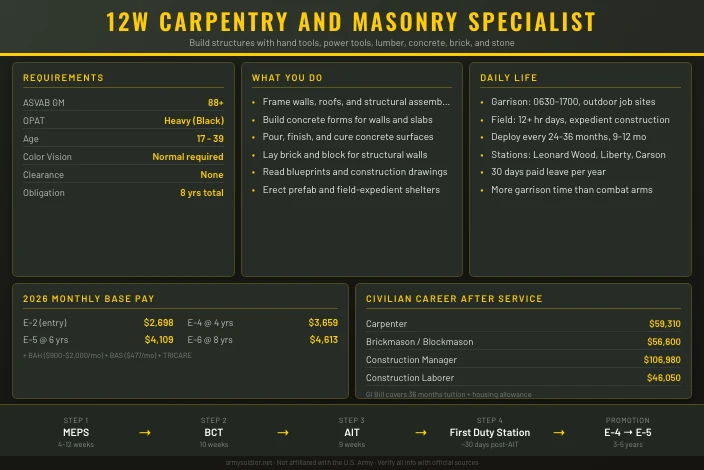
Job Role and Responsibilities
A 12W Carpentry and Masonry Specialist performs heavy carpentry, structural steel, and masonry work for the U.S. Army. You build, repair, and maintain structures using hand tools, power tools, lumber, concrete, brick, and stone. Your projects range from temporary field fortifications to permanent buildings on military installations.
Daily Tasks
Garrison days start with physical training at 0630, followed by work call around 0900. Most of your time goes to active construction projects on post. You read blueprints, cut and fit lumber, build concrete forms for walls and foundations, mix and pour concrete, and lay brick or block. Afternoons might shift to finishing work like edging, jointing, and curing concrete surfaces. Tool maintenance and material inventory round out the day.
In the field, the pace changes. You build fighting positions, overhead cover, observation posts, and defensive barriers using whatever materials are available. Expedient construction with local materials is a core skill. Sleep and meal schedules bend around the mission timeline.
On deployment, you construct or repair infrastructure that keeps the base running. That includes billeting structures, dining facilities, latrines, guard towers, and blast walls. Some projects require coordination with local contractors or host-nation workers.
Specialized Roles
The 12W is your primary MOS within CMF 12 (Engineers). Additional credentials come through skill identifiers earned at follow-on schools.
| Identifier | Code | Description |
|---|---|---|
| SQI | P | Parachutist (Airborne qualified) |
| SQI | G | Ranger qualified |
| SQI | 4 | Instructor |
| ASI | G9 | Air Assault |
| ASI | 2S | Battle Staff NCO |
These identifiers affect your assignment options. A 12W with an Airborne SQI can fill construction billets in the 82nd Airborne Division or other airborne-capable engineer units.
Mission Contribution
Engineer units shape the battlefield. While combat engineers breach obstacles and clear routes, 12W soldiers build the structures that sustain operations. Forward operating bases need hardened sleeping quarters, command posts, and ammunition storage. Training ranges need target houses and shoot houses. Every installation has buildings that need repair or expansion. Without construction specialists, the Army cannot maintain the infrastructure that keeps soldiers housed, fed, and mission-ready.
Tools and Equipment
You work with both hand tools and heavy equipment daily.
- Circular saws, table saws, miter saws, and reciprocating saws
- Concrete mixers, vibrators, and finishing tools
- Masonry trowels, levels, plumb bobs, and mortar mixers
- Power drills, pneumatic nail guns, and framing hammers
- Transit levels and laser levels for site layout
- Scaffolding, rigging devices, and fall protection equipment
Some projects involve prefabricated building systems where you assemble manufactured components on-site. Others require traditional stick-framing from raw lumber. The variety keeps the work from getting repetitive.
Salary and Benefits
Financial Benefits
Military pay depends on rank and time in service, not MOS. Most 12W soldiers enter at E-1 or E-2. Here is what you earn at key career points, based on 2026 DFAS pay tables.
| Rank | Pay Grade | Monthly Base Pay |
|---|---|---|
| Private (PV2) | E-2 | $2,698 |
| Private First Class (PFC) | E-3 (2 yrs) | $3,015 |
| Specialist (SPC) | E-4 (4 yrs) | $3,659 |
| Sergeant (SGT) | E-5 (6 yrs) | $4,109 |
| Staff Sergeant (SSG) | E-6 (8 yrs) | $4,613 |
Base pay is the starting point. BAH (Basic Allowance for Housing) adds $900 to $2,000+ per month depending on your duty station and dependent status. BAS (Basic Allowance for Subsistence) adds $476.95 per month for food. Soldiers in the barracks eat at the dining facility instead of collecting BAS.
Additional Benefits
TRICARE covers you and your family at zero cost for most care. That includes medical, dental, vision, mental health, and prescriptions. No premiums, no deductibles, no copays while on active duty.
Tuition Assistance pays up to $4,500 per year for college courses while you serve. After service, the Post-9/11 GI Bill covers up to 36 months of tuition at public universities (full in-state rate) or up to $29,920.95 per year at private schools, plus a monthly housing allowance and $1,000 annual book stipend.
The Blended Retirement System (BRS) gives you two paths to retirement savings:
- Pension: Serve 20 years and collect 40% of your high-36 average base pay for life
- TSP matching: The government matches up to 5% of your basic pay in your Thrift Savings Plan, starting at your second year of service
- You keep TSP contributions even if you leave before 20 years
Work-Life Balance
You earn 30 days of paid leave per year plus 11 federal holidays. Garrison work schedules run roughly 0630 to 1700, Monday through Friday. Field training and deployment cycles disrupt that schedule, but construction MOS soldiers spend more time in garrison than combat arms MOSs do. Most construction projects happen on established installations during normal duty hours.
Qualifications and Eligibility
Basic Qualifications
You need a minimum General Maintenance (GM) composite score of 88 on the ASVAB. The GM score combines General Science, Auto & Shop Information, Mathematics Knowledge, and Electronics Information subtests.
| Requirement | Details |
|---|---|
| Age | 17-39 (up to 42 with waiver) |
| Citizenship | U.S. citizen or permanent resident |
| Education | High school diploma or GED |
| AFQT (overall ASVAB) | 31 minimum (diploma) or 50 (GED) |
| GM line score | 88 minimum |
| GM formula | GS + AS + MK + EI |
| OPAT category | Heavy (Black) |
| Security clearance | None required |
| Color vision | Normal color vision required |
| Physical profile | Must meet engineer standards |
The OPAT Heavy category means you need to hit these minimums during processing: 160 cm standing long jump, 450 cm seated power throw, 160 lbs strength deadlift, and 43 shuttles on the interval aerobic run. This reflects the physical nature of daily construction work.
Application Process
Start at your local Army recruiting station. Your recruiter reviews your qualifications and walks you through Active Duty, Reserve, and National Guard options.
At MEPS (Military Entrance Processing Station), you take the ASVAB if you haven’t already, complete a full medical exam, take the OPAT, and go through a background screening. If your GM score hits 88 and you pass everything else, you select your MOS and ship date. The 12W contract falls under the engineer enlistment option.
Expect 4 to 12 weeks from your first visit to the recruiter until you ship to Basic Combat Training. Medical or legal issues can extend that timeline.
Selection Criteria and Competitiveness
A GM score of 88 is moderate by Army standards. It’s not the lowest threshold, but it’s well within reach for most applicants who study. Prior experience in construction, woodworking, or shop classes helps but is not required. The Army teaches you everything during AIT.
If you already hold civilian carpentry or masonry certifications, that won’t change your ASVAB requirement, but it may help you pick up skills faster during training.
Upon Accession into Service
You enter as E-1 (Private) unless you earned advanced rank through college credits, JROTC, or a referral program. The total military service obligation is 8 years, split between active duty (typically 3 to 6 years depending on your contract) and the Individual Ready Reserve (IRR) for the remainder.
See our ASVAB study guide for strategies to hit these line scores, or take the PiCAT from home if you are a first-time tester.
Work Environment
Setting and Schedule
Most of your work happens outdoors. You build and repair structures in heat, cold, rain, and dust. Construction sites on Army installations look a lot like civilian job sites: lumber stacks, concrete forms, scaffolding, and power tools spread across the work area.
Garrison hours typically run 0630 to 1700. During major construction pushes, overtime is common. Field training exercises and deployment construction can mean 12-hour days or longer with no weekends off.
Indoor work happens when you’re doing finish carpentry, interior framing, or working on building interiors. But plan on spending most of your career outside.
Leadership and Communication
Your chain of command starts with your team leader (E-5), then squad leader (E-6), platoon sergeant (E-7), and platoon leader (O-1 or O-2). Construction projects add a layer: the project NCO or officer in charge sets priorities and timelines for each job.
Communication on construction sites mixes verbal orders with written work orders and blueprints. You get daily tasking from your supervisor, and progress gets tracked against the project timeline. Feedback is direct and tied to measurable output. Either the wall is plumb or it isn’t.
Team Dynamics and Autonomy
Construction is team work. You pour concrete with your squad, not by yourself. Framing a building requires coordinated effort across multiple soldiers working different tasks simultaneously.
Autonomy grows with rank and experience. Junior soldiers cut lumber to spec and follow instructions. By E-5, you’re reading blueprints, estimating materials, and directing your team’s work. At E-6 and above, you plan construction phases, inspect completed work, and coordinate with other trades on complex projects.
Job Satisfaction and Retention
Construction soldiers point to two things they like: building something tangible and learning a trade that transfers directly to civilian jobs. Seeing a finished building you framed from scratch is satisfying in a way that paperwork never will be.
The Army has exceeded its overall retention goals for seven consecutive years. Engineer MOS retention tends to track near the Army average. Soldiers who leave often go straight into civilian construction at higher pay. Those who stay cite the stability, benefits, and promotion opportunities.
Training and Skill Development
Initial Training
The 12W training pipeline has two phases: Basic Combat Training (BCT) and Advanced Individual Training (AIT). They happen back-to-back, and you won’t go home between them.
| Phase | Location | Length | Focus |
|---|---|---|---|
| BCT | Fort Leonard Wood, MO | 10 weeks | Soldiering basics: drill, marksmanship, first aid, land navigation, Army values |
| AIT | Fort Leonard Wood, MO | 9 weeks | Carpentry, masonry, concrete technology, blueprint reading, structural framing |
BCT turns you into a soldier. You learn to shoot the M4A1, perform basic first aid, navigate with a map and compass, and operate as part of a team. The first few weeks are the hardest adjustment. By week 6, the rhythm clicks.
AIT teaches the trade. You start with concrete technology: mixing, pouring, forming, finishing, and curing. Then you move to carpentry: layout, framing, sheathing, roofing, and building trusses. Masonry covers brick and block laying, mortar mixing, and structural wall construction. You also learn to read construction drawings and interpret specifications.
By graduation, you can frame a building, pour a slab, lay a block wall, and build concrete forms for columns and footings. The training is hands-on from day one.
Advanced Training
After AIT, additional schools expand your capability.
- Airborne School (3 weeks, Fort Moore, GA) qualifies you for parachute operations and assignment to airborne engineer units
- Air Assault School (10 days, Fort Campbell, KY) covers helicopter operations, rappelling, and sling-load procedures
- Ranger School (61 days, multiple locations) is the Army’s premier leadership course; earns the Ranger Tab
- Advanced construction courses at Fort Leonard Wood cover specialized topics like structural steel erection, advanced concrete work, and project management
- Sapper Leader Course (28 days, Fort Leonard Wood, MO) builds combat engineer and leadership skills
The Army also funds civilian certifications through the Credentialing Assistance program. You can earn OSHA safety certifications, NCCER (National Center for Construction Education and Research) credentials, and other industry-recognized qualifications while serving.
Everything starts with qualifying ASVAB scores — our study guide covers what to study first.
Career Progression and Advancement
Career Path
Promotion through the junior enlisted ranks is mostly automatic if you meet time-in-service and time-in-grade requirements. E-5 and above require a promotion board, points, and a strong record.
| Rank | Pay Grade | Typical Time in Service | Typical Role |
|---|---|---|---|
| Private (PV1) | E-1 | 0 months | Trainee |
| Private (PV2) | E-2 | 6 months | Basic laborer, material handler |
| Private First Class (PFC) | E-3 | 12 months | Carpenter/mason, reads blueprints |
| Specialist (SPC) | E-4 | 24 months | Skilled tradesperson, mentors junior soldiers |
| Sergeant (SGT) | E-5 | 3-5 years | Team leader, project crew chief |
| Staff Sergeant (SSG) | E-6 | 6-9 years | Squad leader, project supervisor |
| Sergeant First Class (SFC) | E-7 | 10-14 years | Platoon sergeant, construction site manager |
At E-5, your job shifts from executing tasks to leading a construction team. You estimate materials, assign work, and inspect quality. By E-6, you supervise entire construction projects and coordinate with engineering officers on planning and scheduling.
Specialization Opportunities
Senior 12W NCOs can pursue Drill Sergeant duty, Recruiter duty, or instructor positions at the Engineer School. Some compete for the Sergeant Major Academy at E-8. Strong performers at E-7 and above may transition to the 12Z (Combat Engineering Senior Sergeant) MOS, which broadens your scope to all engineer operations.
Warrant officer is another path. The 120A (Construction Engineering Technician) warrant officer MOS draws heavily from experienced 12W soldiers. This puts you in a technical leadership role managing large-scale construction projects.
Role Flexibility and Transfers
Reclassifying to a different MOS requires leadership approval, an open slot, and meeting the new MOS qualifications. Common lateral moves for 12W soldiers include 12N (Horizontal Construction Engineer), 12R (Interior Electrician), or 12K (Plumber). Moving outside CMF 12 is possible but may require completing a new AIT.
Performance Evaluation
Enlisted evaluations happen through the NCOER (NCO Evaluation Report) at E-5 and above. Your rater and senior rater score you on leadership, technical competence, training effectiveness, and character.
What separates you: finishing projects on time, maintaining quality standards, keeping your team safe, scoring well on the AFT, and completing military education milestones. Civilian certifications earned through Army programs also strengthen your record.
Physical Demands and Medical Evaluations
Physical Requirements
This is physically demanding work. You lift lumber, carry bags of concrete mix (80 to 94 pounds each), climb scaffolding, and swing hammers for hours. Working overhead for extended periods is routine during framing and roofing. Kneeling on concrete during masonry work wears on your joints over time.
A typical day involves:
- Carrying materials and tools across construction sites
- Lifting and positioning heavy beams, forms, and blocks
- Climbing ladders and working on scaffolding at height
- Operating power tools that produce vibration and noise
- Working in heat, cold, and wet conditions without shelter
Every soldier takes the Army Fitness Test (AFT) at least once per year. The AFT replaced the ACFT in June 2025 and consists of five events scored 0 to 100 each, with a maximum total score of 500.
| Event | What It Tests | Minimum Score |
|---|---|---|
| 3-Rep Max Deadlift (MDL) | Lower body strength | 60 points |
| Hand-Release Push-Up (HRP) | Upper body endurance | 60 points |
| Sprint-Drag-Carry (SDC) | Anaerobic capacity, functional fitness | 60 points |
| Plank (PLK) | Core endurance | 60 points |
| Two-Mile Run (2MR) | Aerobic endurance | 60 points |
The general passing standard is 300 total with at least 60 per event. Scoring is sex- and age-normed. The 12W does not fall under the combat specialty 350-point standard, but strong AFT scores improve your promotion points and overall record.
Medical Evaluations
Annual Periodic Health Assessments (PHA) cover weight, blood pressure, vision, hearing, and a provider consultation. Construction-specific concerns include hearing loss from power tools and musculoskeletal strain from repetitive lifting. The Army tracks your medical readiness through MEDPROS, and your leadership checks it monthly.
Before deployment, you go through a separate medical clearance screening. Dental readiness is also required. Any unresolved medical issue gets addressed before you ship.
Deployment and Duty Stations
Deployment Details
Engineer units deploy on a rotational basis. The standard cycle targets 9 to 12 months deployed followed by 18 to 24 months at home station. Construction specialists deploy both to combat zones and to humanitarian assistance missions. Your work on deployment looks similar to garrison construction but with added urgency and austere conditions.
Recent deployment regions for engineer units include the Middle East (Kuwait, Iraq, Syria, Jordan), Europe (Poland, Romania, Germany for NATO infrastructure projects), the Pacific (South Korea, Japan), and Africa (various construction and advisory missions).
Duty Stations
The Army assigns your duty station based on its needs. You can submit a preference, but there are no guarantees. Expect to PCS (Permanent Change of Station) every 2 to 4 years.
Major engineer duty stations include:
- Fort Leonard Wood, MO – home of the U.S. Army Engineer School
- Fort Liberty, NC – XVIII Airborne Corps, 20th Engineer Brigade
- Fort Cavazos, TX – III Corps engineer units
- Fort Carson, CO – 4th Engineer Battalion, 4th Infantry Division
- Joint Base Lewis-McChord, WA – I Corps engineer units
- Fort Riley, KS – 1st Infantry Division engineer assets
- Schofield Barracks, HI – 25th Infantry Division engineers
- Overseas – Grafenwoehr (Germany), Camp Humphreys (South Korea)
Engineer units exist at every major Army installation. Your specific assignment depends on which units have 12W billets open when you complete AIT.
Risk, Safety, and Legal Considerations
Job Hazards
Construction carries inherent risks that mirror the civilian industry plus military-specific dangers.
On the job site:
- Falls from scaffolding, ladders, and roofs
- Struck-by injuries from falling materials or swinging loads
- Cuts and lacerations from power saws and hand tools
- Musculoskeletal injuries from heavy lifting and repetitive motion
- Hearing damage from sustained power tool use
- Heat injuries during summer construction and dust exposure
In deployed environments:
- Indirect fire (rockets, mortars) on base construction sites
- Working near unexploded ordnance in post-conflict areas
- Expedient construction under time pressure with less safety infrastructure
Safety Protocols
The Army follows OSHA-equivalent safety standards on construction projects. Hard hats, safety glasses, hearing protection, steel-toed boots, and fall protection harnesses are standard gear. Units conduct risk assessments before every project. Safety briefings happen daily on active construction sites. The Army Corps of Engineers EM 385-1-1 manual governs all military construction safety.
Security and Legal Requirements
No security clearance is needed for the 12W MOS. All soldiers are subject to the Uniform Code of Military Justice (UCMJ). Your enlistment contract is a legally binding agreement with a total service obligation of 8 years. In deployed environments, you follow the same rules of engagement and force protection measures as every other soldier on the installation.
Impact on Family and Personal Life
Family Considerations
Construction MOS soldiers spend less time in the field than combat arms, which helps with family stability. But deployments and PCS moves still disrupt your family’s routine. Expect to relocate every 2 to 4 years. Your spouse may need to find a new job at each duty station, and your kids switch schools.
The Army provides support at most installations:
- Family Readiness Groups (FRGs) connect families within your unit
- Military OneSource offers free counseling, financial planning, and legal help
- Army Community Service (ACS) provides employment assistance for spouses
- Exceptional Family Member Program (EFMP) ensures families with special needs get stationed where care is available
Relocation and Flexibility
Single soldiers in the junior ranks live in barracks on post. Married soldiers and E-6 and above can live off-post with BAH. The quality of barracks varies by installation. The Army pays for your move during each PCS, including shipping household goods and travel expenses.
On the positive side, many engineer duty stations are at larger installations with good schools, shopping, and community resources. Fort Carson, Joint Base Lewis-McChord, and Schofield Barracks consistently rank among soldiers’ preferred assignments.
Reserve and National Guard
Component Availability
MOS 12W Carpentry and Masonry Specialist is available in both the Army Reserve and Army National Guard. Both components maintain engineer construction companies that need 12W soldiers to support construction and repair missions. The National Guard is particularly active in this MOS – Guard units conduct construction projects at state training facilities, armories, and other installations that require carpentry and masonry work. This makes 12W one of the more practical part-time options in CMF 12, because soldiers can drill on weekends while working full-time in civilian construction during the week.
Drill Schedule and Training Commitment
The standard commitment is one Battle Assembly weekend per month plus two weeks of Annual Training per year. Annual Training for 12W soldiers is often project-focused, with units completing real construction work on military facilities or community construction missions under the Innovative Readiness Training (IRT) program. These projects keep hands-on skills sharp in a way that purely classroom-based training cannot. Soldiers who pursue Airborne or Air Assault qualifications may attend additional schools on top of the standard drill schedule, which expands assignment options to airborne-capable engineer units.
Part-Time Pay
An E-4 with approximately three years of service earns roughly $422 per drill weekend, covering four drill periods. Twelve drill weekends per year produces about $5,064 in annual drill pay. Annual Training adds roughly $1,583. The active-duty E-4 monthly base pay is $3,166. For a 12W soldier working as a civilian carpenter or mason – jobs that frequently pay $55,000 to $80,000 annually in skilled construction markets – the drill pay supplements civilian income while keeping military benefits active. Many construction workers in high-cost areas find the combination of civilian wages and Reserve or Guard pay genuinely attractive.
Benefits Differences
The benefits picture for Reserve and Guard 12W soldiers reflects the part-time nature of the commitment:
- Healthcare: Active-duty TRICARE costs $0 in premiums. Drilling members access Tricare Reserve Select at $57.88 per month for member-only or $286.66 per month for member plus family (2026 rates). For a construction worker without employer-sponsored health insurance, TRS is a significant benefit.
- Education: Federal Tuition Assistance provides up to $4,500 per year for drilling members taking college courses. The Montgomery GI Bill Selected Reserve (MGIB-SR) pays roughly $416 per month during enrollment. Post-9/11 GI Bill access requires 90 or more days of federal activation.
- State tuition waivers: National Guard members can qualify for state-funded tuition waivers at public universities – some states cover 100% of in-state tuition. Army Reserve members do not receive state tuition benefits.
- Retirement: Reserve and Guard retirement is points-based, with pension eligibility at age 60. Qualifying mobilizations of 90 or more days can reduce the minimum draw age to 50.
Deployment and Mobilization
Reserve and Guard 12W soldiers are mobilized for military construction missions that exceed active-duty capacity. Overseas construction projects for facilities in Europe, the Pacific, and the Middle East have included Reserve and Guard engineer participation over the past two decades. National Guard units have also been activated for domestic missions including hurricane recovery construction, flood barrier work, and facility rebuilds after natural disasters. Mobilization frequency varies by unit and operational tempo, but soldiers in engineer construction companies should expect at least one significant mobilization over a six-year enlistment. Lengths typically run 90 to 270 days.
Civilian Career Integration
This MOS has direct civilian application. A 12W soldier who drills on weekends and works in commercial construction during the week is building two parallel skill portfolios that reinforce each other. Many construction employers value military experience because it demonstrates reliability, safety discipline, and the ability to read and execute complex plans. The Army’s Credentialing Assistance program funds civilian certifications like NCCER credentials and OSHA safety cards while you serve, credentials that carry weight with civilian construction employers and union halls. USERRA protects your civilian job position when you are mobilized for qualifying service.
| Feature | Active Duty | Army Reserve | Army National Guard |
|---|---|---|---|
| Commitment | Full-time | One weekend/month + 2 weeks/year | One weekend/month + 2 weeks/year |
| Monthly Pay (E-4, ~3 yrs) | $3,166/month | ~$422/drill weekend | ~$422/drill weekend |
| Healthcare | TRICARE, $0 premiums | TRS, $57.88/month (member) | TRS, $57.88/month (member) |
| Education | TA + Post-9/11 GI Bill | Federal TA, MGIB-SR; Post-9/11 after activation | Federal TA, MGIB-SR, state tuition waivers |
| Deployment | Rotational deployments for construction missions | Mobilization for overseas military construction | State disaster response construction + federal activation |
| Retirement | BRS pension at 20 years | Points-based, age 60 | Points-based, age 60 |
Post-Service Opportunities
Transition to Civilian Life
The 12W is one of the most directly transferable MOS options in the Army. Every skill you learn translates to civilian construction work. Framing, concrete, masonry, blueprint reading, project supervision, and safety management are all high-demand skills in the civilian market.
The Transition Assistance Program (TAP) starts during your last 12 months on active duty. It covers resume writing, interview skills, benefits counseling, and career exploration. Many 12W soldiers use the GI Bill to earn degrees or certifications in construction management, which puts them on a path to supervisory and management roles.
Programs like SkillBridge let you intern with civilian construction companies during your last 6 months of service. Hiring Our Heroes and Helmets to Hardhats connect transitioning soldiers directly with union apprenticeships and construction employers.
Civilian Career Prospects
Here is what former 12W soldiers commonly move into, with data from the Bureau of Labor Statistics.
| Civilian Job | Median Annual Salary (2024) | 10-Year Outlook |
|---|---|---|
| Carpenter | $59,310 | +4% |
| Brickmason / Blockmason | $56,600 | +2% |
| Construction Manager | $106,980 | +9% |
| Construction Laborer | $46,050 | +7% |
Union carpenters and masons in high-cost-of-living areas earn well above the median. With a few years of experience and a GI Bill-funded construction management degree, the path to six-figure income as a construction manager is realistic.
Post-Service Policies
An honorable discharge gives you lifetime VA healthcare, disability compensation (if applicable), education benefits, and home loan guarantees. The VA home loan is especially valuable for construction professionals who understand what to look for in a house.
Is This a Good Job for You? The Right (and Wrong) Fit
Ideal Candidate Profile
The best 12W soldiers share a few traits.
You’ll do well if you:
- Like working with your hands and building things
- Don’t mind physical labor in outdoor conditions
- Can follow detailed plans and measure precisely
- Work well on a team but can handle tasks independently
- Want a skill that pays in or out of the Army
Prior experience in shop class, woodworking, home renovation, or construction helps but is not required. The Army teaches the trade from scratch.
Potential Challenges
This MOS may not fit if you:
- Prefer indoor, climate-controlled work environments
- Have chronic back, knee, or shoulder problems
- Dislike repetitive physical labor
- Want a job that involves computers or electronics more than hand tools
- Cannot handle heights (scaffolding and roof work are frequent)
The physical toll is real. Years of heavy lifting, kneeling, and working overhead accumulate. Protect your joints early. Use proper lifting technique and wear knee pads during masonry work. The soldiers who last longest in this MOS take care of their bodies outside of work.
Career and Lifestyle Alignment
If your goal is to learn a skilled trade, serve your country, and walk out of the Army with a career ready to go, 12W checks every box. The construction industry is short on skilled workers, and military-trained carpenters and masons are in demand.
The trade-off is that the work is hard on your body, the pay during service is modest compared to civilian union wages, and you’ll still deal with deployments and moves like every other soldier. But when you separate, you have a trade, certifications, a GI Bill to fund further education, and zero student debt. That combination is hard to beat.
More Information
Talk to an Army recruiter about the 12W Carpentry and Masonry Specialist. Ask about current enlistment bonuses, ship dates, and which duty stations have openings. If you can, request to talk with an engineer soldier at a nearby installation for an honest look at the job.
Take the MOS finder quiz at goarmy.com
Schedule an ASVAB at your nearest MEPS to see where your scores land
Check out Helmets to Hardhats for civilian construction career pathways
Prepare for the ASVAB with our study guide to make sure your line scores qualify
This site is not affiliated with the U.S. Army or any government agency. Verify all information with official Army sources before making enlistment or career decisions.
Explore more Army engineer careers such as 12B Combat Engineer and 12N Horizontal Construction Engineer.