36B Financial Management Technician
Every Army unit needs someone who can track where the money goes. The 36B Financial Management Technician is that person. You process military pay, manage government funds, handle travel vouchers, and make sure soldiers get paid correctly and on time. If you like working with numbers and want a military job that transfers directly to civilian accounting and finance, this MOS deserves a serious look.
Qualifying requires specific ASVAB line scores — our ASVAB study guide covers what to target and how to prepare.
Job Role and Responsibilities
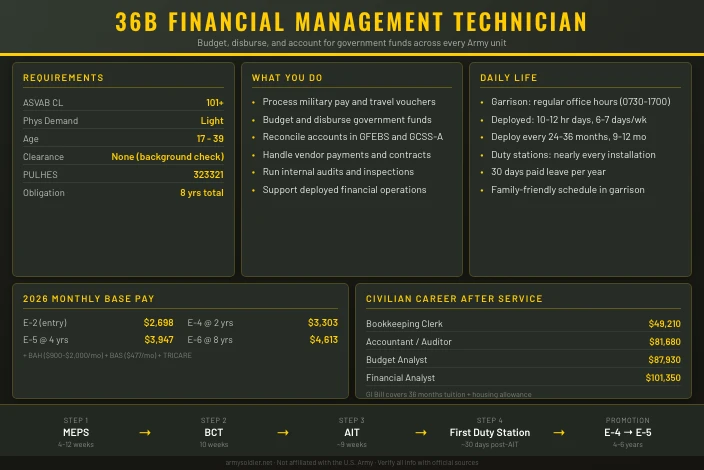
Financial Management Technicians handle the Army’s money at the unit level. You budget, disburse, and account for government funds. You process soldier pay, vendor payments, travel reimbursements, and foreign national employee compensation. You also run internal audits to catch errors before they become problems.
Every day looks different depending on your assignment. At a finance office on a stateside post, you might spend the morning reviewing travel vouchers from a unit that just returned from a training exercise. After lunch, you reconcile accounting records in the Global Combat Support System-Army (GCSS-A) and the General Fund Enterprise Business System (GFEBS). Before the end of the day, you answer questions from a sergeant who thinks his housing allowance got shorted.
In a deployed environment, the pace changes. You might set up a field finance office, process emergency payments, or handle currency exchanges for local vendor contracts. Deployed finance teams also manage large-scale disbursements for construction projects, host-nation support agreements, and contingency operations.
Specialized Roles
The Army breaks financial management into skill levels that correspond to your rank:
| Identifier | Skill Level | Rank Range | Duties |
|---|---|---|---|
| 36B10 | Level 1 | E-1 to E-4 | Post funding documents, process pay actions, prepare vouchers |
| 36B20 | Level 2 | E-5 | Supervise Level 1 technicians, review disbursement records |
| 36B30 | Level 3 | E-6 | Manage section operations, train junior finance soldiers |
| 36B40 | Level 4 | E-7 | Senior financial management advisor to commanders |
| 36B50 | Level 5 | E-8 to E-9 | Inspect financial management functions across commands |
Additional Skill Identifiers (ASIs) and Special Qualification Identifiers (SQIs) can open doors to niche roles. Airborne-qualified finance soldiers (SQI P) deploy with airborne units. Others pick up ASIs in disbursing or resource management.
How This Role Supports the Mission
Soldiers who don’t get paid on time lose trust in their chain of command. Units that can’t process vendor payments stall construction and logistics projects. Financial management technicians keep money flowing so the Army can focus on operations instead of paperwork disputes. During deployments, your team is often the only way to make emergency disbursements or handle currency conversions in remote locations.
Technology and Equipment
You spend most of your time on computers. GFEBS is the primary enterprise resource planning system for Army financial operations. GCSS-A handles tactical logistics and some financial transactions. You also work with the Defense Travel System (DTS) for travel vouchers and the Defense Finance and Accounting Service (DFAS) pay systems.
At the office level, you use standard government workstations, encrypted networks, and accounting software. Deployed finance teams carry ruggedized laptops and portable printers to set up field offices.
Salary and Benefits
Financial Benefits
Military pay is based on rank and time in service. Most 36B soldiers enter as E-1 or E-2 and promote to E-4 within a few years.
| Pay Grade | Rank | Typical Time in Service | 2026 Monthly Base Pay |
|---|---|---|---|
| E-2 | Private (PV2) | Entry (post-BCT) | $2,698 |
| E-4 | Specialist (SPC) | 2-3 years | $3,303 |
| E-5 | Sergeant (SGT) | 4-6 years | $3,947 |
| E-6 | Staff Sergeant (SSG) | 8 years | $4,613 |
Base pay is only part of the picture. BAH (Basic Allowance for Housing) adds $900 to $2,000+ per month depending on your duty station and dependent status. BAS (Basic Allowance for Subsistence) adds about $477 per month for food.
The 36B does not carry a standard enlistment bonus. Recruits who volunteer for the Ranger pipeline can qualify for a Ranger bonus ranging from $5,000 to $20,000, but that applies to the Ranger assignment, not the MOS itself. Bonus availability changes frequently, so check with your recruiter for the latest numbers.
Additional Benefits
TRICARE covers you and your family at zero cost for active-duty members. That includes medical, dental, vision, mental health, and prescriptions with no enrollment fees, deductibles, or copays.
Education benefits are strong. Tuition Assistance pays up to $4,500 per year for college classes while you serve. After separation, the Post-9/11 GI Bill covers up to 36 months of tuition at public universities (full in-state rate) or up to $29,921 per year at private schools, plus a monthly housing allowance and $1,000 annual book stipend.
Work-Life Balance
You earn 30 days of paid leave per year (2.5 days per month). Finance offices in garrison usually keep regular business hours, Monday through Friday. Field exercises and deployments disrupt that schedule, but 36B soldiers spend less time in the field than combat arms MOSs.
The retirement plan works through the Blended Retirement System (BRS). Serve 20 years and you get a pension worth 40% of your highest 36 months of base pay. The government also matches up to 5% of your Thrift Savings Plan (TSP) contributions starting in your third year of service.
Qualifications and Eligibility
Basic Qualifications
You need a minimum score of 101 on the Clerical (CL) composite of the ASVAB. The CL composite combines Verbal Expression, Arithmetic Reasoning, and Mathematics Knowledge. Strong math and reading comprehension skills are the foundation.
| Requirement | Details |
|---|---|
| Age | 17-39 (up to 42 with waiver) |
| Citizenship | U.S. citizen or permanent resident |
| Education | High school diploma or GED |
| AFQT | Minimum 31 (diploma) or 50 (GED) |
| Clerical (CL) | Minimum 101 |
| Security Clearance | None required; background check for financial access |
| Physical Demands | Light |
| PULHES | 323321 |
| Vision | No special requirements beyond standard |
| Moral Character | No criminal record involving financial crimes |
The physical demands rating for this MOS is “Light.” You won’t need to pass the OPAT at an elevated level, but you still need to meet the Army’s general fitness and medical standards.
Application Process
Start at your local recruiting station. The recruiter checks your ASVAB scores, runs a preliminary background review, and helps you decide between Active Duty, Reserve, or National Guard.
MEPS (Military Entrance Processing Station) is next. You take the ASVAB if you haven’t already, complete a full medical exam, and begin your background screening. If your CL score hits 101 and your medical results check out, the recruiter books a training slot.
From first recruiter visit to ship date, expect 4 to 12 weeks. Medical or background delays can stretch that timeline.
Selection Criteria and Competitiveness
The 36B is not a high-competition MOS. The Army consistently has slots open for financial management technicians across Active Duty, Reserve, and Guard components. That said, you still need that CL 101. Recruits with accounting coursework, bookkeeping experience, or civilian financial certifications stand out during the selection process.
Upon Accession into Service
Most recruits enter at E-1 (Private) and promote to E-2 after Basic Combat Training. College credits or certain programs like JROTC can bump your starting rank to E-2 or E-3. The standard service obligation is 8 years total, usually split between active duty and Reserve or Individual Ready Reserve time.
See our ASVAB study guide for strategies to hit these line scores, or take the PiCAT from home if you are a first-time tester.
Work Environment
Setting and Schedule
Finance offices look a lot like civilian accounting departments. You sit at a desk, work on a computer, and process transactions during regular business hours. Most garrison finance offices run 0730 to 1700 Monday through Friday, though month-end and fiscal year-end closings can mean late nights.
Deployed finance teams set up in trailers, tents, or whatever building is available. Hours stretch to match the operational tempo. During a deployment, 10 to 12 hour days six or seven days a week are normal for the first few months.
Leadership and Communication
Your chain of command runs through the finance detachment or battalion. A senior NCO (usually E-7 or E-8) supervises day-to-day operations, and a finance officer (usually a Captain or Major) leads the unit. Performance feedback comes through counseling sessions, usually quarterly, and formal evaluations once a year.
Communication matters in this job. You explain pay discrepancies to frustrated soldiers, brief commanders on budget status, and coordinate with DFAS for pay corrections. Clear writing and patience go a long way.
Team Dynamics and Autonomy
Junior 36Bs (E-1 through E-4) work under direct supervision. You follow established procedures, and a senior technician reviews your work before anything gets processed. As you gain experience and rank, the leash loosens. E-5s manage their own workload and supervise junior soldiers. E-6 and above run sections and make decisions that affect the entire unit’s financial operations.
During deployments, small finance teams often operate semi-independently. A team of 3 to 5 soldiers might handle all financial operations for a brigade, which means you make calls without waiting for higher approval.
Job Satisfaction and Retention
Finance soldiers generally re-enlist at rates comparable to other support MOSs. The biggest draw is the work schedule: regular hours in garrison, transferable skills, and a clear path to civilian careers. The biggest complaints are repetitive paperwork, outdated software systems, and the frustration of explaining pay issues that aren’t your fault.
Soldiers who stick around past their first term usually do so because they’ve earned enough rank and experience to move into supervisory roles where the work gets more interesting.
Training and Skill Development
Initial Training
Training breaks into two phases: Basic Combat Training (BCT) and Advanced Individual Training (AIT).
| Training Phase | Location | Duration | Focus |
|---|---|---|---|
| BCT | Fort Jackson, SC; Fort Moore, GA; Fort Leonard Wood, MO | 10 weeks | Soldier fundamentals: marksmanship, tactics, fitness, discipline |
| AIT | Fort Jackson, SC (Soldier Support Institute) | ~9 weeks | Financial management: accounting, pay systems, disbursing, voucher processing |
BCT makes you a soldier. You learn to shoot, navigate, work as a team, and meet Army fitness standards. Every MOS goes through this.
AIT at the Soldier Support Institute at Fort Jackson teaches you the finance trade. The curriculum covers accounting principles, military pay regulations, travel voucher processing, budget execution, and the computer systems you’ll use every day. You practice processing real-world financial transactions in a classroom environment before graduating.
After AIT, you report to your first duty station within about 30 days.
Advanced Training
Once you’re at your unit, on-the-job training fills in the gaps. Real pay problems are messier than classroom exercises, and learning the quirks of each unit’s financial operations takes time.
As you promote, the Army sends you to the Warrior Leader Course (E-5), Advanced Leader Course (E-6), and Senior Leader Course (E-7). These are general NCO development courses, but they include MOS-specific financial management instruction.
The Army Credentialing Assistance (CA) program and Army COOL (Credentialing Opportunities On-Line) help you earn civilian certifications while serving. Relevant credentials include the Certified Government Financial Manager (CGFM), Certified Management Accountant (CMA), and Certified Defense Financial Manager (CDFM). These certifications boost both your military career and your civilian job prospects.
Everything starts with qualifying ASVAB scores — our study guide covers what to study first.
Career Progression and Advancement
Career Path
Promotion through the junior enlisted ranks happens on a predictable timeline if you stay out of trouble and meet the requirements. The NCO ranks get competitive.
| Rank | Pay Grade | Typical Time in Service | Role |
|---|---|---|---|
| Private (PV2) | E-2 | 0-1 years | Entry-level finance technician |
| Private First Class (PFC) | E-3 | 1-2 years | Finance technician, increased responsibilities |
| Specialist (SPC) | E-4 | 2-3 years | Senior technician, processes complex transactions |
| Sergeant (SGT) | E-5 | 4-6 years | Team leader, supervises junior technicians |
| Staff Sergeant (SSG) | E-6 | 6-10 years | Section NCOIC, manages finance operations |
| Sergeant First Class (SFC) | E-7 | 10-14 years | Platoon sergeant, senior financial advisor |
| Master Sergeant (MSG) | E-8 | 14-18 years | Senior enlisted financial management leader |
| Sergeant Major (SGM) | E-9 | 18+ years | Command-level financial management advisor |
E-4 promotion is mostly automatic. E-5 requires passing a promotion board and earning enough points through military education, awards, and physical fitness scores. E-6 and above depend heavily on evaluation reports and available slots.
Role Flexibility and Transfers
The 36B has no duty station restrictions. Finance soldiers serve at nearly every installation worldwide, from the Pentagon to a forward operating base in the Middle East. That geographic flexibility is unusual for a support MOS.
If your interests change, you can request reclassification to another MOS. Common lateral moves include 42A (Human Resources Specialist) or 92Y (Unit Supply Specialist), since those share administrative skill sets. Any MOS change requires completing the new AIT and taking on a fresh service obligation.
Performance Evaluation
Enlisted soldiers at E-5 and above receive an annual NCOER (NCO Evaluation Report). Your rater and senior rater evaluate your leadership, technical competence, and overall performance. Strong NCOERs are the primary factor for promotion to E-6 and beyond.
What separates the top performers: zero pay errors in their section, passing financial inspections clean, earning civilian certifications, mentoring junior soldiers, and volunteering for deployments. Finance units track error rates and processing times, so your work product is measurable.
Physical Demands and Medical Evaluations
Physical Requirements
The 36B carries a “Light” physical demands rating. Most of your work happens at a desk. You won’t haul heavy equipment or march long distances as part of your daily job. That said, you’re still a soldier. Deployments mean wearing body armor, carrying a weapon, and working in austere conditions.
Every soldier takes the Army Fitness Test (AFT) at least once per year. The AFT has five events, each scored from 0 to 100 points. You need 60 points per event and 300 points total to pass.
| Event | Description | Minimum Passing (Ages 17-21) |
|---|---|---|
| 3-Rep Max Deadlift (MDL) | Maximum weight for 3 repetitions | Male: 140 lbs / Female: 80 lbs |
| Hand-Release Push-Up (HRP) | Push-ups with full arm extension at bottom | Male: 10 reps / Female: 10 reps |
| Sprint-Drag-Carry (SDC) | Five 50-meter shuttles with varied loads | Male: 2:40 / Female: 3:40 |
| Plank (PLK) | Front leaning rest, elbows on ground | Male: 2:00 / Female: 2:00 |
| Two-Mile Run (2MR) | Timed two-mile run | Male: 15:54 / Female: 18:54 |
These standards are sex- and age-normed and apply to all soldiers, not just finance technicians. The maximum score is 500. Scoring above 300 helps with promotion points.
Medical Evaluations
You complete an annual Periodic Health Assessment (PHA) that covers weight, blood pressure, vision, hearing, and a general health screening. Before deployments, you go through a more thorough medical clearance. Conditions that could limit your ability to serve in the deployment environment get addressed before you ship out, or you stay behind.
Deployment and Duty Stations
Deployment Details
Finance soldiers deploy with the units they support. The general rotation for active-duty units is 9 to 12 months deployed, followed by 24 to 36 months at home. That ratio depends on the Army’s operational tempo and your unit’s readiness status.
Deployed finance teams handle combat pay processing, vendor disbursements, currency exchange, and emergency payments. You set up wherever the unit goes. That could be a well-established base with a building and air conditioning, or a tent in a remote area.
Common deployment regions include the Middle East, Europe (Germany, Poland), and the Pacific (South Korea). Domestic mobilizations for natural disasters or national emergencies happen occasionally.
Location Flexibility
The 36B can be assigned almost anywhere. Every major installation has a finance office, which gives you more choice than most MOSs.
Common CONUS duty stations:
- Fort Liberty, NC
- Fort Cavazos, TX
- Fort Campbell, KY
- Fort Stewart, GA
- Fort Carson, CO
- Fort Drum, NY
- Fort Jackson, SC
- Joint Base Lewis-McChord, WA
- The Pentagon, Washington, D.C.
OCONUS assignments:
- Germany (multiple installations)
- South Korea (Camp Humphreys)
- Hawaii (Schofield Barracks)
- Alaska (Fort Wainwright, Joint Base Elmendorf-Richardson)
- Kuwait
You can submit a preference list during the assignment process, but the Army fills positions based on its needs first. Larger posts tend to have more finance billets and longer tour lengths (3 to 4 years).
Risk, Safety, and Legal Considerations
Job Hazards
This is one of the safer MOSs. In garrison, your biggest risks are ergonomic injuries from desk work and the general risks that come with being a soldier (vehicle accidents, training injuries). Eye strain and repetitive motion injuries from long hours on computers are real but manageable.
Deployed finance soldiers face the same risks as everyone else in a combat zone: indirect fire, IEDs during convoys, and the physical toll of austere living conditions. Finance teams usually operate inside established bases, so your exposure is lower than infantry or engineers, but the risk is never zero.
Safety Protocols
Standard Army safety protocols apply. In garrison, that means cybersecurity practices, proper workstation ergonomics, and physical security of financial documents. Deployed finance offices follow force protection procedures, including bunker drills, perimeter security, and convoy operations when moving between locations.
Financial documents and systems require strict access controls. You follow dual-control procedures for disbursements, keep physical currency locked in safes, and maintain audit trails for every transaction.
Security and Legal Requirements
The 36B does not require a security clearance for most assignments. You do go through a thorough background investigation because you handle government funds. Any history of financial crimes, fraud, or dishonesty is disqualifying.
Some assignments at higher headquarters or intelligence-adjacent units may require a Secret clearance. The investigation process takes 2 to 6 months and includes interviews with your references, credit checks, and a review of your criminal and financial history.
All soldiers follow the Uniform Code of Military Justice (UCMJ). Financial management technicians also face specific legal accountability for funds under their control. Mishandling government money, even through carelessness rather than theft, can result in pecuniary liability, adverse action, or court-martial.
Impact on Family and Personal Life
Family Considerations
The 36B is one of the more family-friendly MOSs. Garrison hours are predictable. Deployments happen, but less frequently and with fewer mid-cycle field exercises than combat arms jobs. Your spouse can plan around a relatively normal schedule most of the time.
That changes during deployments. Nine to 12 months away from home is hard on any family, regardless of your MOS. The Army provides support through:
- Family Readiness Groups (FRGs) for peer support within your unit
- Military OneSource for free counseling and family services
- Spousal employment assistance at each duty station
- Exceptional Family Member Program (EFMP) for families with special needs members
Relocation and Flexibility
Expect to move every 2 to 4 years. The Army pays for PCS (Permanent Change of Station) moves, but each relocation disrupts your spouse’s job and your kids’ school. The upside for 36B soldiers is that finance billets exist at nearly every installation, so you have a better chance of getting a preferred location than soldiers in more specialized MOSs.
Reserve and National Guard
Finance detachments exist in both the Army Reserve and the Army National Guard. Every state maintains National Guard finance elements tied to sustainment brigades and division support commands. The Army Reserve runs finance companies and detachments that support both Reserve and Active component units. This MOS is genuinely available in all three components, so you can start as a Guard or Reserve soldier and build the same core skill set without going full-time.
Drill Schedule and MOS-Specific Training
The standard part-time commitment is one weekend per month (four drill periods, typically Friday night through Sunday) plus two weeks of Annual Training each summer. For 36B soldiers, that baseline gets supplemented by additional requirements.
Finance units run fiscal year-end processing drills in September and October, when government accounts close and reconciliation workloads spike. DFAS system updates require periodic refresher training when the Army migrates to new software versions or changes pay system procedures. Annual audit readiness training is also standard because finance units can be selected for financial management assessments with little advance notice.
Budget roughly 40 to 50 days per year for a part-time 36B, compared to the 39 days (12 drill weekends plus 2 weeks AT) that many non-specialized Reserve and Guard jobs require.
Pay Comparison
Part-time drill pay is based on the same base pay tables as active duty, prorated per drill period. One drill weekend equals four drill periods.
An E-4 at four years of service earns $3,659 per month on active duty. That same E-4 earns approximately $488 for a standard four-period drill weekend in the Reserve or Guard. Annual Training at two weeks adds another $1,830 in base pay for that two-week period.
Most part-time 36Bs also hold civilian accounting or finance jobs, which means their total compensation picture often looks strong. The drill pay adds to civilian income rather than replacing it.
Benefits Comparison
Healthcare coverage is the biggest structural difference between active duty and part-time service.
Active-duty soldiers get TRICARE at no premium cost. Reserve and Guard soldiers who are not on active orders must enroll in Tricare Reserve Select. Member-only coverage runs $57.88 per month. Member-plus-family coverage runs $286.66 per month. Both figures are significantly below private-sector insurance rates, but the premium gap versus active-duty TRICARE is real.
On education, Reserve and Guard soldiers access MGIB-SR (Chapter 1606), which pays $493 per month for full-time enrollment. Federal Tuition Assistance (TA) is also available to drilling Reservists and Guardsmen at $250 per credit hour up to $4,500 per year. National Guard soldiers get the additional benefit of state tuition waivers, which vary widely, but many states offer 100% tuition coverage at in-state public colleges and universities.
Retirement works on a points-based system rather than a time-in-service threshold. Each drill period earns points, and Annual Training earns additional points. Mobilizations earn active-duty-equivalent points. The pension becomes payable at age 60, though that age can be reduced by three months for every 90 days of post-January 28, 2008 mobilization, down to a minimum age of 50. Active-duty soldiers vest in a 20-year pension with an immediate annuity at separation.
Deployment and Mobilization Patterns
Finance support is a deployment requirement, not an optional function. Every major overseas operation needs finance teams to process combat pay, travel vouchers, vendor contracts, and emergency disbursements. That means Reserve and Guard 36Bs get mobilized at meaningful rates during periods of sustained operations.
A typical Reserve or Guard finance soldier mobilizes for a 9 to 12 month operational deployment once every 4 to 7 years under sustained high-tempo conditions. Domestic support operations, including disaster relief activations and civil support missions, mobilize National Guard finance units more frequently, usually for shorter durations.
USERRA (Uniformed Services Employment and Reemployment Rights Act) protects your civilian job during any mobilization. Your employer must hold your position (or a comparable one), maintain your seniority, and restore you to your civilian role when you return. Finance professionals in accounting firms, corporate accounting departments, and government agencies are generally covered employers under USERRA.
Civilian Career Integration
The 36B skill set stacks directly on top of civilian accounting and finance careers. Part-time Reserve or Guard service is common among accountants, bookkeepers, financial analysts, budget analysts, and accounts payable or receivable clerks.
The Army COOL program helps you earn credentials like the Certified Government Financial Manager (CGFM) and Certified Defense Financial Manager (CDFM) while serving. These certifications are recognized by federal agencies and defense contractors. Pursuing a CPA license alongside Reserve service is a natural combination, since military finance experience covers many of the practical hours requirements.
| Feature | Active Duty | Army Reserve | Army National Guard |
|---|---|---|---|
| Duty Status | Full-time | Part-time (1 wknd/mo + 2 wks/yr) | Part-time (1 wknd/mo + 2 wks/yr) |
| Monthly Pay (E-4, 4 yrs) | $3,659/mo | ~$488/drill weekend | ~$488/drill weekend |
| Healthcare | TRICARE (no premium) | Tricare Reserve Select ($57.88/mo) | Tricare Reserve Select ($57.88/mo) |
| Education | Post-9/11 GI Bill, TA | MGIB-SR ($493/mo), TA | MGIB-SR ($493/mo), TA, state tuition waivers |
| Deployment | Per unit rotation | When mobilized | When mobilized |
| Retirement | 20-year pension | Points-based, age 60 | Points-based, age 60 |
Post-Service Opportunities
Transition to Civilian Life
Your military finance experience translates well to the civilian job market. You leave with hands-on experience in accounting, budgeting, financial reporting, and government financial systems. Many employers, especially federal agencies and defense contractors, value that background.
The Transition Assistance Program (TAP) provides resume help, interview coaching, and benefits counseling during your last year on active duty. Certifications you earned through Army COOL (CGFM, CDFM, CMA) give you a competitive edge.
The Post-9/11 GI Bill covers up to 36 months of tuition for accounting, finance, or business degrees. Combined with your military experience, a degree opens the door to higher-paying analyst and management positions.
Civilian Career Prospects
| Civilian Job | Median Annual Salary (2024) | 10-Year Outlook |
|---|---|---|
| Bookkeeping/Accounting Clerk | $49,210 | -6% (declining) |
| Accountant/Auditor | $81,680 | +5% |
| Budget Analyst | $87,930 | +1% |
| Financial Analyst | $101,350 | +6% |
Entry-level positions like bookkeeping clerks are accessible immediately after separation. With a degree and certifications, you can move into accountant, auditor, or budget analyst roles. Federal agencies (DoD, DHS, VA) hire former 36Bs regularly because they already understand government financial systems.
Post-Service Policies
An honorable discharge gives you access to VA healthcare, disability compensation (if applicable), education benefits, and home loan guarantees. Talk to your career counselor well before your ETS date to line up your next step. The 36B’s transferable skills make the civilian transition smoother than most MOSs.
Is This a Good Job for You?
Ideal Candidate Profile
You’ll do well as a 36B if you like structured work with clear rules. Accounting has right and wrong answers, and that appeals to people who prefer precision over ambiguity.
Traits that predict success:
- Comfortable working with numbers and spreadsheets for hours
- Detail-oriented enough to catch a $0.01 discrepancy in a ledger
- Patient when explaining pay issues to frustrated soldiers
- Self-disciplined with other people’s money
- Interested in accounting or finance as a civilian career
Prior experience with bookkeeping, QuickBooks, or basic accounting coursework helps but isn’t required. The Army teaches you everything from scratch in AIT.
Potential Challenges
This MOS may not fit you if:
- You need constant physical activity or outdoor work
- Repetitive data entry drives you crazy
- You struggle with math beyond basic arithmetic
- You want a high-adrenaline combat job
The work can feel monotonous during slow periods. Month-end and fiscal year-end closings bring stress and long hours. Deployed finance soldiers also deal with the isolation and discomfort of living in a combat zone while doing desk work, which is a strange combination that doesn’t suit everyone.
Career and Lifestyle Alignment
The 36B makes sense for people who want to serve in the Army and build a civilian career in finance at the same time. Your daily work translates directly to accounting and budgeting jobs outside the military. The GI Bill pays for a degree that multiplies your earning potential.
If you have a family, the predictable garrison schedule and wide range of duty stations help. You won’t spend as many nights in the field as infantry or artillery soldiers, and your skills are needed everywhere the Army operates.
The trade-off: this isn’t a glamorous MOS. Nobody makes movies about finance technicians. If that matters to you, look at other career fields. If you’d rather have marketable skills and a stable schedule, the 36B delivers.
More Information
Talk to an Army recruiter about the 36B Financial Management Technician. Ask about current training dates, available duty stations, and whether your ASVAB scores qualify. If you already have accounting experience or college credits, ask how that affects your starting rank and assignment options.
- Prepare for the ASVAB with our study guide to make sure your line scores qualify
This site is not affiliated with the U.S. Army or any government agency. Verify all information with official Army sources before making enlistment or career decisions.
Explore more Army finance careers.