42A Human Resources Specialist
Every Army unit needs someone who keeps personnel records straight, processes promotions, and makes sure soldiers get paid on time. That person is the 42A Human Resources Specialist. If you want a stable Army career with office-based work and direct civilian job crossover, this MOS is worth a close look.
Qualifying requires specific ASVAB line scores — our ASVAB study guide covers what to target and how to prepare.
Job Role and Responsibilities
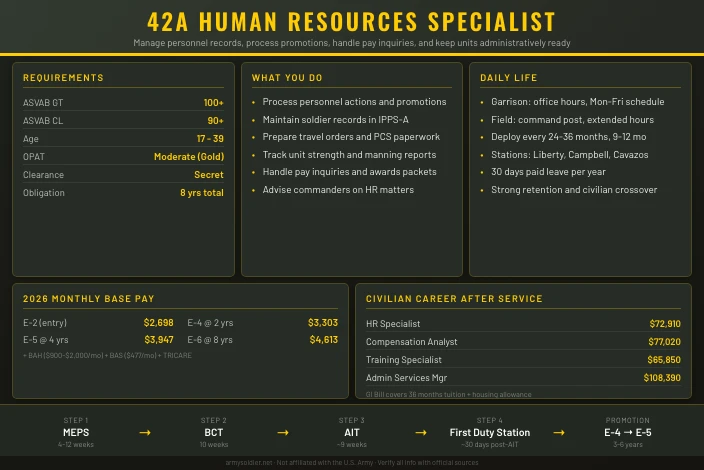
The 42A Human Resources Specialist manages personnel records, processes administrative actions, and provides HR support across Army units. You handle everything from promotion packets and travel orders to casualty reporting and pay inquiries. Commanders rely on you to keep their unit’s personnel strength accurate and their soldiers’ careers on track.
Daily Tasks
Most of your day happens behind a desk. You update personnel records in the Army’s human resources systems, process awards and decorations, prepare duty rosters, and answer questions from soldiers about their leave balances, pay issues, or assignment orders. When a soldier PCSes (permanent change of station), you process the paperwork. When someone gets promoted, you handle the orders.
You also maintain the unit’s strength reports. Commanders need accurate headcounts to plan missions, and those numbers come from your work. During field exercises or deployments, you track casualties and process emergency notifications.
The pace depends on your assignment. A battalion S1 (personnel office) at a busy infantry unit runs hot. A garrison HR office at a training post is steadier. Either way, attention to detail matters. One wrong digit on a pay document costs a soldier money.
Specific Roles
The 42A is the primary enlisted MOS in Career Management Field 42 (Adjutant General). Several specializations and additional identifiers are available as you progress.
| Identifier | Type | Description |
|---|---|---|
| 42A | Primary MOS | Human Resources Specialist |
| 420A | Warrant Officer MOS | Human Resources Technician |
| ASI 1B | Additional Skill Identifier | SHARP (Sexual Harassment/Assault Response and Prevention) |
| ASI P5 | Additional Skill Identifier | Master Fitness Trainer |
| ASI 2S | Additional Skill Identifier | Battle Staff |
| SQI 8 | Special Qualification Identifier | Instructor/Writer |
Mission Contribution
HR specialists keep the personnel system running so commanders can focus on operations. Without accurate records, soldiers miss promotions, don’t get paid correctly, and units deploy with wrong strength numbers. During combat operations, the S1 section tracks casualties and handles the notification process for families back home.
Technology and Equipment
You work primarily with the Integrated Personnel and Pay System - Army (IPPS-A), which replaced several older systems. You also use the Digital Training Management System (DTMS), Microsoft Office products, and Army correspondence software. The shift toward IPPS-A means 42A soldiers now handle tasks that used to require multiple systems and offices.
Salary and Benefits
Financial Benefits
Military pay follows a standard schedule based on rank and years of service. Most 42A soldiers enter as E-1 or E-2 and promote to E-4 within two to three years.
| Rank | Pay Grade | Years of Service: 2 | Years of Service: 4 | Years of Service: 6 | Years of Service: 8 |
|---|---|---|---|---|---|
| Private (PV2) | E-2 | $2,698 | $2,698 | $2,698 | - |
| Specialist (SPC) | E-4 | $3,303 | $3,659 | $3,816 | $3,816 |
| Sergeant (SGT) | E-5 | $3,599 | $3,947 | $4,109 | $4,299 |
| Staff Sergeant (SSG) | E-6 | $3,743 | $4,069 | $4,236 | $4,613 |
Source: DFAS 2026 pay tables. Figures reflect the 2026 pay raise.
Beyond base pay, you receive BAH (Basic Allowance for Housing), which varies by duty station and dependent status. A single E-4 receives roughly $900 to $2,000+ per month depending on location. BAS adds about $477 monthly for food. Some 42A soldiers qualify for enlistment or re-enlistment bonuses depending on Army manning needs.
Additional Benefits
TRICARE covers you and your family at zero cost for most services while on active duty. That includes medical, dental, vision, mental health, and prescriptions with no enrollment fee, no deductible, and no copay.
Education benefits are strong. Tuition Assistance pays up to $4,500 per year while you’re serving. After separation, the Post-9/11 GI Bill covers up to 36 months of tuition at public universities (full in-state rate) plus a monthly housing allowance and $1,000 per year for books.
The Blended Retirement System (BRS) gives you two retirement paths:
- A pension worth 40% of your base pay after 20 years of service
- Government matching on your Thrift Savings Plan (TSP) contributions, up to 5% of basic pay
- Continuation pay between years 7 and 12 of service
Work-Life Balance
You earn 30 days of paid leave per year (2.5 days per month). Most 42A assignments follow a regular weekday schedule with occasional late stays during high-ops periods like deployment preparation or unit relocations. Compared to combat arms MOSs, the work-life balance is predictable, though field exercises and deployments still disrupt the routine.
Qualifications and Eligibility
Basic Qualifications
The 42A requires two ASVAB composite scores:
- General Technical (GT): 100 minimum
- Clerical (CL): 90 minimum
The GT composite uses Verbal Expression and Arithmetic Reasoning. CL adds Mathematics Knowledge to those two. Both scores reflect your ability to process information, follow written procedures, and work with data, all skills this MOS uses daily.
You must be a U.S. citizen between 17 and 39, hold a high school diploma or GED, and pass a standard medical exam. GED holders need a minimum AFQT of 50; diploma holders need 31.
| Requirement | Details |
|---|---|
| Age | 17-39 years old |
| Citizenship | U.S. citizen or permanent resident |
| Education | High school diploma or GED |
| AFQT (ASVAB) | Minimum 31 (diploma) or 50 (GED) |
| General Technical (GT) | Minimum 100 |
| Clerical (CL) | Minimum 90 |
| OPAT Category | Moderate (Gold) |
| Security Clearance | Secret |
| Vision | Standard; correctable to 20/20 |
Application Process
Start at an Army recruiting station. Your recruiter walks you through the process, checks your qualifications, and helps you choose between Active Duty, Reserve, or National Guard.
You then visit MEPS (Military Entrance Processing Station) for the ASVAB (if you haven’t taken it), a full medical exam, and a background screening. If your GT and CL scores qualify, the recruiter books you a 42A training slot.
Expect 4 to 12 weeks between your first recruiter visit and your ship date. Background investigations for the Secret clearance sometimes add time, but most are completed during training.
Selection Criteria and Competitiveness
The 42A is moderately accessible. The GT 100 and CL 90 requirements are above average but not the highest in the Army. The MOS is one of the larger career fields, so slots are usually available. Prior office experience, strong typing skills, or an associate degree in business or HR can strengthen your application but aren’t required.
Upon Accession into Service
You enter at E-1 (Private) and typically promote to E-2 after Basic Combat Training. The standard service obligation is 8 years total: usually 3 to 6 years on active duty with the remainder in the Individual Ready Reserve. Enlistment bonuses, when offered, may come with a longer active-duty commitment.
See our ASVAB study guide for strategies to hit these line scores, or take the PiCAT from home if you are a first-time tester.
Work Environment
Setting and Schedule
The 42A is an office job. You spend most of your time at a desk in a climate-controlled building, working on computers. Standard hours run from around 0630 to 1700, Monday through Friday.
That changes during field exercises. You set up shop in a command post tent, maintain records on portable equipment, and work extended hours to support the unit. Deployments follow the same pattern but with longer durations and less predictable schedules.
Leadership and Communication
Your chain of command runs through the S1 section, typically led by a Captain (S1 Officer) with a senior NCO (usually an E-7) as the section NCOIC. You report to your immediate supervisor and interact daily with soldiers across the unit who need HR support.
Feedback comes through the NCOER (NCO Evaluation Report) system for E-5 and above, and counseling statements for junior enlisted. Most good leaders provide monthly or quarterly counseling sessions to track your progress.
Team Dynamics and Autonomy
In a small unit, you might be the only HR specialist. That means you handle everything yourself and answer directly to the commander. In larger organizations, you work alongside other 42A soldiers and divide tasks by function: awards, promotions, travel, strength management.
Junior soldiers follow established procedures with close supervision. As you gain experience and rank, you take on more responsibility and make decisions about how to prioritize competing personnel actions.
Job Satisfaction and Retention
The 42A has solid retention because the skills transfer directly to civilian HR work. Soldiers who stay tend to value the stable schedule, the career progression opportunities, and the clear path to civilian employment after service. The most common complaints involve repetitive paperwork, working under tight deadlines during deployment preparation, and the frustration of dealing with outdated systems during the IPPS-A transition.
Training and Skill Development
Initial Training
Training has two phases: Basic Combat Training (BCT) and Advanced Individual Training (AIT).
| Training Phase | Location | Duration | Focus |
|---|---|---|---|
| BCT | Fort Jackson, SC; Fort Moore, GA; Fort Leonard Wood, MO | 10 weeks | Soldier basics: marksmanship, tactics, fitness, discipline |
| AIT | Fort Jackson, SC (Soldier Support Institute) | ~9 weeks | HR systems, personnel actions, correspondence, records management |
BCT turns you into a soldier. Marksmanship, land navigation, squad tactics, and physical fitness. Every MOS does this.
AIT at the Soldier Support Institute covers the technical side of human resources. You learn how to operate Army personnel systems, process personnel actions, prepare military correspondence, interpret enlisted and officer record briefs, run ad hoc queries, and manage forms. The training mixes classroom instruction with hands-on exercises.
After graduating AIT, you report to your first duty station within about 30 days.
Advanced Training
Once you’re at your unit, several training paths open up:
- Airborne School at Fort Moore, GA (3 weeks) for soldiers assigned to airborne units
- Postal Operations Course for units that handle military mail
- Battle Staff Course for NCOs moving into operations roles
- Instructor certification (SQI 8) if you want to teach at the Soldier Support Institute
The Army also encourages 42A soldiers to earn civilian HR certifications. The Professional in Human Resources (PHR) and Certified Employment Support Professional (CESP) are common choices. Tuition Assistance and credentialing programs can cover the cost.
Everything starts with qualifying ASVAB scores — our study guide covers what to study first.
Career Progression and Advancement
Career Path
Promotion to E-4 (Specialist) happens within about 2 to 3 years and is mostly automatic if you meet time-in-service and time-in-grade requirements. E-5 (Sergeant) requires a promotion board and competitive points. At E-5, your role shifts from processing paperwork to supervising other HR specialists.
| Rank | Pay Grade | Typical Years | Role |
|---|---|---|---|
| Private (PV2) | E-2 | 0-1 | AIT graduate, processes basic personnel actions |
| Specialist (SPC) | E-4 | 2-3 | Handles complex actions, trains junior soldiers |
| Sergeant (SGT) | E-5 | 4-6 | Section leader, manages HR operations |
| Staff Sergeant (SSG) | E-6 | 6-9 | NCOIC of an S1 section, mentors NCOs |
| Sergeant First Class (SFC) | E-7 | 9-14 | Senior HR NCO, battalion or brigade level |
| Master Sergeant (MSG) | E-8 | 14-18 | Senior advisor, division or higher |
| Sergeant Major (SGM) | E-9 | 18+ | Top enlisted HR leader |
E-6 takes 6 to 9 years and requires strong NCOERs and military education (Warrior Leader Course, Advanced Leader Course). E-7 and above are highly competitive.
Role Flexibility and Transfers
Lateral moves within CMF 42 are possible. Some 42A soldiers transition to the 420A Warrant Officer track (Human Resources Technician), which requires a packet, board selection, and Warrant Officer Candidate School. This path keeps you in HR but shifts your focus to technical expertise and advisory roles at higher echelons.
Transferring to a completely different MOS requires approval, an open slot, and completion of that MOS’s training. Common moves include 36B (Financial Management Technician) and 25B (Information Technology Specialist), since those fields overlap with administrative skills.
Performance Evaluation
NCOs are rated through annual NCOERs. Your rater and senior rater evaluate you on leadership, training, technical competence, and character. Strong NCOERs are the single biggest factor in promotion to E-6 and above.
What sets top 42A soldiers apart: zero errors on personnel actions, meeting every deadline, knowing the regulations cold, and keeping soldiers informed about their records. The best HR specialists become the person commanders trust to handle anything administrative.
Physical Demands and Medical Evaluations
Physical Requirements
The 42A is rated Moderate (Gold) on the OPAT. Your daily work is office-based, so the physical demands are lighter than field MOSs. You sit at a desk, type, and walk between offices. During field exercises, you carry your personal gear and set up workstations in tents.
Every soldier takes the Army Fitness Test (AFT) at least once a year. The AFT has five events, each scored 0 to 100. You need 60 points per event and 300 total to pass. Standards are sex- and age-normed under the general standard.
| Event | Description |
|---|---|
| 3-Rep Max Deadlift (MDL) | Maximum weight for 3 repetitions |
| Hand-Release Push-Up (HRP) | Push-ups with full arm extension at bottom |
| Sprint-Drag-Carry (SDC) | 5x50m shuttle with sprint, sled drag, lateral, carry, and sprint |
| Plank (PLK) | Timed forearm plank hold |
| Two-Mile Run (2MR) | Timed 2-mile run |
The OPAT Moderate category requires: Standing Long Jump of 120 cm, Seated Power Throw of 350 cm, Strength Deadlift of 120 lbs, and 36 shuttles on the Interval Aerobic Run.
Medical Evaluations
You take an annual Periodic Health Assessment (PHA) that includes weight, blood pressure, vision, hearing, and a provider consultation. Before deployment, a separate medical screening clears you for the operational environment. Any unresolved condition gets addressed before you deploy.
Deployment and Duty Stations
Deployment Details
Active-duty 42A soldiers deploy with their units. The typical cycle is 9 to 12 months deployed, followed by 2 years at home station. During deployment, you operate from a forward operating base or command post, handling the same personnel functions but with added responsibilities like casualty tracking and emergency leave processing.
HR specialists deploy to every theater the Army operates in. That includes the Middle East, Europe, the Pacific, and Africa. The risk level depends on your unit type. A 42A assigned to an infantry brigade goes where the brigade goes. A 42A at a rear-area support command has more distance from the fight but still deploys.
Location Flexibility
Duty station assignments are based on Army needs. You can submit a preference list, but no assignment is guaranteed. Expect to PCS every 2 to 4 years.
Common 42A duty stations include:
- Fort Liberty, NC (XVIII Airborne Corps, 82nd Airborne)
- Fort Campbell, KY (101st Airborne)
- Fort Cavazos, TX (III Corps, 1st Cavalry)
- Fort Stewart, GA (3rd Infantry Division)
- Joint Base Lewis-McChord, WA (I Corps)
- Overseas: Germany, South Korea, Japan, Italy
Because every unit needs HR support, 42A soldiers have more location options than most MOSs.
Risk, Safety, and Legal Considerations
Job Hazards
The 42A is a low-risk MOS compared to combat arms. Your primary workplace hazard is ergonomic strain from long hours at a computer. During deployments, you face the same risks as other soldiers in the operational area: indirect fire, vehicle accidents, and environmental hazards.
Safety Protocols
Standard office ergonomics apply in garrison. Proper posture, regular breaks, and adjusted workstation height reduce repetitive strain. In the field and on deployment, you follow your unit’s force protection measures, wear required protective equipment, and follow the tactical SOP.
Security and Legal Requirements
All 42A soldiers must obtain and maintain a Secret security clearance. You handle personnel records, pay information, and casualty data, all of which are sensitive. Failing to maintain your clearance can result in involuntary reclassification to a different MOS.
The clearance investigation covers your financial history, criminal background, foreign contacts, and drug use. Most investigations take 2 to 4 months. The process starts during training, so most soldiers have their clearance by the time they reach their first unit.
All soldiers follow the Uniform Code of Military Justice (UCMJ). As an HR specialist, you also have specific obligations around records privacy and the handling of personally identifiable information (PII).
Impact on Family and Personal Life
Family Considerations
The 42A is one of the better MOSs for family stability. Regular hours in garrison, office-based work, and predictable schedules give families more consistency than combat arms jobs offer. Deployments still separate you for 9 to 12 months, and PCS moves every few years disrupt your spouse’s career and your kids’ schools.
Support resources at most installations:
- Family Readiness Groups (FRGs) for peer support through your unit
- Military OneSource for free counseling and family services
- Spousal employment assistance at each new duty station
- Exceptional Family Member Program (EFMP) for families with special needs
- Child Development Centers for affordable on-post childcare
Relocation and Flexibility
You will move. After AIT, the Army sends you where it needs you. Expect a new duty station every 2 to 4 years. The Army covers moving costs, but each PCS disrupts routines.
The upside: 42A soldiers have wide assignment options because every unit needs HR support. You have a better chance than many MOSs of getting stationed at a location that works for your family.
Reserve and National Guard
The 42A Human Resources Specialist is available in both the Army Reserve and Army National Guard. It is one of the most widely distributed support MOS in both components. Every battalion-level unit needs personnel support, so 42A billets exist in virtually every state and territory. The Army Reserve maintains numerous HR companies and detachments, and Guard states have 42A positions in unit headquarters and state Joint Force Headquarters.
Drill Schedule and Training Commitment
Standard commitment is one weekend per month (Battle Assembly) plus two weeks of Annual Training per year. Drill weekends for 42A soldiers include personnel action processing, awards and promotion packet preparation, eMILPO system training, and unit strength reporting. Annual Training typically involves supporting personnel operations during a larger exercise or processing real-world personnel actions at a mobilization site. The training commitment is standard with no unusual additional requirements.
Part-Time Pay
An E-4 with over 3 years of service earns about $464 per drill weekend (4 drill periods), totaling roughly $5,572 per year from drill pay plus about $1,741 for 15 days of Annual Training. Active-duty E-4 base pay is $3,482 per month. Many Reserve/Guard 42A soldiers work civilian HR jobs that pay competitively, making the drill pay supplemental income.
Benefits Differences
Tricare Reserve Select costs $57.88 per month for member-only or $286.66 per month for family coverage in 2026. Active-duty TRICARE Prime is free.
Education benefits include Federal Tuition Assistance ($250 per credit hour, up to $4,500 per year) and the Montgomery GI Bill-Selected Reserve at $493 per month for full-time students. Guard members may qualify for state tuition waivers. Mobilization of 90 or more days earns Post-9/11 GI Bill eligibility.
Reserve retirement is points-based, requiring 20 qualifying years. Collection starts at age 60, reduced by 3 months per 90-day mobilization after January 2008, minimum age 50.
Deployment and Mobilization
42A soldiers in Reserve/Guard units see moderate mobilization rates. Personnel support is needed in every deployment, and HR detachments are regularly activated for overseas rotations and mobilization processing. Typical mobilizations run 9 to 12 months. The large number of 42A billets spreads the mobilization burden across many soldiers, so individual deployment frequency is moderate.
Civilian Career Integration
The 42A is one of the most directly transferable MOS to civilian careers. Human resources, payroll processing, benefits administration, and personnel management skills are in demand across every industry. Many 42A soldiers work civilian HR jobs during the week, keeping both skill sets current. SHRM (Society for Human Resource Management) certification is available through Army COOL. USERRA protects your civilian job during activations, and employers must reinstate you with the seniority you would have earned.
| Feature | Active Duty | Army Reserve | Army National Guard |
|---|---|---|---|
| Commitment | Full-time | 1 weekend/month + 2 weeks/year | 1 weekend/month + 2 weeks/year |
| Monthly Pay (E-4, 3+ yrs) | $3,482 | ~$464/drill weekend | ~$464/drill weekend |
| Healthcare | TRICARE Prime ($0) | Tricare Reserve Select ($57.88/mo) | Tricare Reserve Select ($57.88/mo) |
| Education | Federal TA, Post-9/11 GI Bill | Federal TA, MGIB-SR ($493/mo) | Federal TA, MGIB-SR, state tuition waivers |
| Deployment Tempo | Regular rotations | Moderate mobilization | Moderate mobilization |
| Retirement | 20-year pension at age 40+ | Points-based, collect at age 60 | Points-based, collect at age 60 |
Post-Service Opportunities
Transition to Civilian Life
The 42A translates to civilian work more directly than most Army jobs. You leave with experience in HR systems, records management, personnel administration, benefits processing, and office technology. Civilian employers recognize those skills.
The Transition Assistance Program (TAP) starts 12 months before separation and includes resume workshops, interview coaching, and benefits counseling. The Post-9/11 GI Bill covers up to 36 months of tuition at public schools (full in-state rate) or up to $29,920.95 per year at private institutions, plus a housing allowance.
Many 42A veterans pursue bachelor’s degrees in human resources, business administration, or public administration using GI Bill benefits. The combination of military HR experience and a degree makes you competitive for mid-level civilian HR positions.
Civilian Career Prospects
| Civilian Job | Median Annual Salary (BLS, May 2024) | 10-Year Outlook (2024-2034) |
|---|---|---|
| Human Resources Specialist | $72,910 | +6% (faster than average) |
| Compensation/Benefits Analyst | $77,020 | +6% |
| Training and Development Specialist | $65,850 | +6% |
| Administrative Services Manager | $108,390 | +5% |
Civilian HR certifications boost your marketability. The PHR (Professional in Human Resources) and SHRM-CP (Society for Human Resource Management - Certified Professional) are industry standards. Federal government jobs also value military HR experience, and your veteran preference gives you a hiring edge.
Post-Service Policies
An honorable discharge grants lifetime access to VA healthcare, disability compensation (if applicable), and education benefits. You can separate after your service obligation ends or re-enlist for additional bonuses and career progression. Talk to your career counselor at least 12 months before your ETS date.
Is This a Good Job for You?
Ideal Candidate Profile
Good 42A soldiers are organized, detail-oriented, and patient. You spend your days working with data, following procedures, and helping people navigate a complicated personnel system.
Traits that predict success:
- Strong reading comprehension and attention to detail
- Comfortable working at a computer all day
- Patient with repetitive tasks and strict formatting rules
- Good at explaining regulations to people who don’t understand them
- Able to manage multiple priorities without losing track
If you’re the person who keeps a clean inbox, double-checks numbers, and actually reads the instructions, this MOS fits you.
Potential Challenges
This MOS is a poor fit if you:
- Need physical activity and outdoor work to stay motivated
- Get frustrated by paperwork and bureaucratic processes
- Want a job where every day looks different
- Dislike sitting at a desk for 8+ hours
The work can feel repetitive. Processing the 50th travel order of the week doesn’t excite everyone. And when the system goes down or a regulation changes mid-cycle, you’re the one who absorbs the extra work.
Career and Lifestyle Fit
The 42A is a practical choice for soldiers who want a stable career that converts to civilian employment. The office environment, regular hours, and direct HR skill transfer make it one of the most family-friendly enlisted MOSs.
The trade-off: lower adrenaline than combat arms, less technical depth than cyber or intelligence, and the reality that HR work isn’t glamorous. But if you want a steady Army career that sets up a solid civilian future, the 42A delivers.
More Information
Talk to an Army recruiter about the 42A. Ask about current bonuses, training dates, and whether your ASVAB scores qualify. If you can, ask to speak with a current 42A soldier for an honest look at daily life in the MOS.
Take the MOS Finder quiz at goarmy.com
Schedule an ASVAB at your nearest MEPS to see where your scores land
Talk to military families in your area for an honest picture of Army life
Prepare for the ASVAB with our study guide to make sure your line scores qualify
This site is not affiliated with the U.S. Army or any government agency. Verify all information with official Army sources before making enlistment or career decisions.
Explore more Army human resources careers.