42R Army Bandperson
The Army has had a band since 1775. Today, roughly 80 bands serve across active duty, Army Reserve, and Army National Guard components, performing at ceremonies, supporting troop morale, and representing the service at public events worldwide. If you are a trained instrumentalist or vocalist who wants to serve without giving up your craft, MOS 42R is the path that keeps music at the center of your career.
Qualifying requires specific ASVAB line scores — our ASVAB study guide covers what to target and how to prepare.
Job Role and Responsibilities
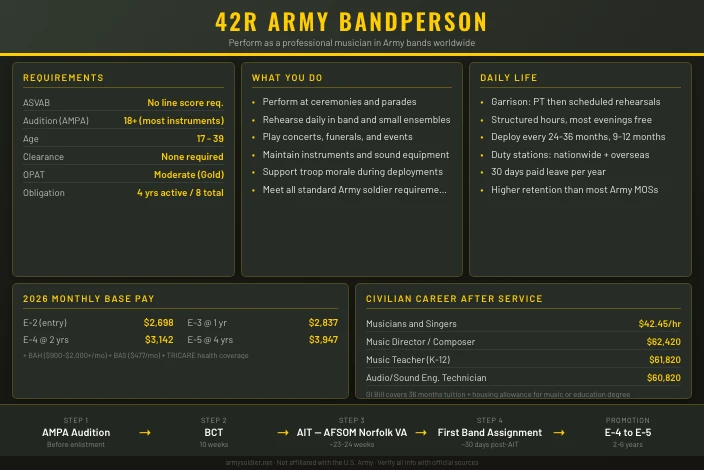
The 42R Army Bandperson performs as a musician in Army bands at military ceremonies, concerts, parades, and official functions. You rehearse and perform as a member of an ensemble, maintain your instrument and personal gear, and fulfill standard Army soldier requirements alongside your musical duties.
The word “bandperson” covers the full range of instruments and voice. You are not a music teacher, recording artist, or entertainment professional in the civilian sense. You are a soldier who happens to be a professional musician. That means you carry a weapon, pass physical fitness tests, and deploy with your unit just like any other soldier.
Daily Tasks
Most of your work week in garrison looks like this:
- Morning physical training with the unit
- Scheduled rehearsals (full band, section, or small ensemble)
- Individual practice on your primary instrument
- Maintenance of instruments and equipment
- Administrative duties common to all Army soldiers
- Public performances at ceremonies, sporting events, and community functions
Bands also perform at funerals for veterans and fallen soldiers, which is one of the more meaningful and emotionally demanding parts of the job. The pace of performances varies by assignment, location, and time of year. Presidential inauguration preparations, Army anniversaries, and holiday concerts can create stretches of heavy performance schedules.
Specialized Roles
Each 42R soldier earns an Additional Skill Identifier (ASI) tied to their specific instrument or performance specialty. These identifiers drive assignments and slot matching.
| ASI | Instrument / Specialty |
|---|---|
| 9B | Trumpet / Cornet |
| 9C | Baritone Horn |
| 9D | French Horn |
| 9E | Trombone |
| 9F | Tuba |
| 9G | Flute / Piccolo |
| 9H | Oboe |
| 9J | Clarinet |
| 9K | Bassoon |
| 9L | Saxophone |
| 9M | Percussion |
| 9N | Keyboard |
| 9T | Guitar |
| 9U | Electric Bass |
| 9V | Vocalist |
| 9X | Music Production Technician |
Your ASI stays with your personnel record and determines which band openings you are eligible to fill at assignment time. Soldiers who develop proficiency on a secondary instrument can earn a secondary ASI, which broadens their assignment options.
Mission Contribution
Army bands serve a function that goes beyond entertainment. Ceremonial music at change-of-command ceremonies, retirement parades, and state funerals carries institutional weight. During deployments, bands support troop morale with live performances in theater. At recruiting events and community outreach functions, the band is often the most visible, most approachable face of the Army. The mission is real, even if the uniform stays clean.
Technology and Equipment
You work with professional-grade acoustic instruments, sound reinforcement systems, and for 9X Music Production Technicians, digital audio workstations and recording equipment. Army bands perform in settings ranging from outdoor parade grounds to concert halls, so you adapt to different acoustics, amplification setups, and stage configurations regularly. Knowledge of audio mixing, microphone placement, and PA system operation is valued, especially at smaller band sections where everyone helps with setup.
Salary and Benefits
Financial Benefits
Pay follows the same Army enlisted pay tables as every other MOS. There is nothing special about band pay, but the combination of base pay, housing allowance, and other benefits makes it a stable career.
| Rank | Pay Grade | Typical Years | 2026 Monthly Base Pay |
|---|---|---|---|
| Private (PV2) | E-2 | 0-1 | $2,698 |
| Private First Class (PFC) | E-3 | 1-2 | $2,837 – $3,015 |
| Specialist (SPC) | E-4 | 2-4 | $3,142 – $3,659 |
| Sergeant (SGT) | E-5 | 4-6 | $3,947 – $4,109 |
| Staff Sergeant (SSG) | E-6 | 8-10 | $4,613 – $4,759 |
Pay data from DFAS 2026 pay tables. Base pay is supplemented by BAH (Basic Allowance for Housing), which varies by duty station and dependency status. A single E-4 earns roughly $900 to $2,000+ per month in BAH depending on location. BAS (Basic Allowance for Subsistence) adds $476.95 per month.
The 42R MOS does not currently list a standard signing bonus on the Army’s public bonus charts. Some instruments may qualify for specialty bonuses depending on current manning needs – your recruiter can pull the current bonus chart from HRC and check your specific ASI. Bonus availability changes frequently.
Additional Benefits
TRICARE health coverage is free for active duty soldiers and their enrolled dependents under TRICARE Prime. Coverage includes medical, dental, vision, mental health, and prescriptions.
Tuition Assistance covers up to $4,500 per year for college courses while you serve. The Post-9/11 GI Bill pays full in-state tuition at public universities for up to 36 months after separation, plus a monthly housing allowance and a $1,000 annual book stipend. The private school cap is $29,920.95 per academic year.
Retirement under the Blended Retirement System (BRS) provides a pension equal to 40% of your highest 36 months of base pay after 20 years of service. The government auto-contributes 1% to your Thrift Savings Plan and matches up to 4% more once you reach year three.
Work-Life Balance
Army bandpersons earn 30 days of paid leave per year. In garrison, band schedules tend to follow a predictable daily structure: PT in the morning, rehearsal during duty hours, and most evenings free. Performance-heavy periods, including holiday seasons, Army anniversaries, and deployment rotations, shift that balance. Bands deploy, and the work in theater is less predictable. Still, this MOS is widely regarded as one of the better work-life options in the Army compared to combat or operational MOSs.
Qualifications and Eligibility
Basic Qualifications
The 42R MOS has no minimum ASVAB line score requirement. Admission is based entirely on musical proficiency, assessed through a formal audition called the Army Musician Proficiency Assessment (AMPA).
You must meet standard Army enlistment requirements: U.S. citizenship or permanent legal resident status, age 17 to 39, and a high school diploma or GED. The minimum AFQT score for enlistment is 31 for HS diploma holders and 50 for GED holders. There is no security clearance requirement for this MOS.
| Requirement | Standard |
|---|---|
| ASVAB Line Score | None (no minimum line score) |
| AFQT Minimum | 31 (HS diploma) / 50 (GED) |
| Citizenship | U.S. citizen or permanent resident |
| Age | 17-39 at enlistment |
| Education | High school diploma or GED |
| Security Clearance | None required |
| AMPA Score | 18 minimum (most instruments) |
| AMPA Score (Oboe/Bassoon/Vocalist/9X) | 24 minimum |
| Service Obligation | 4 years active (typical) |
| OPAT Category | Moderate (Gold) |
The AMPA is a standardized audition form. A qualified Army musician evaluates your performance on prepared and sight-reading excerpts and rates you on a scale where 18 is the minimum for MOSQ (MOS qualification) for most instruments. Oboe (9H), Bassoon (9K), Vocalist (9V), and Music Production Technician (9X) require a score of at least 24.
Application Process
The process starts by contacting an Army recruiter and expressing interest in the 42R MOS. The recruiter connects you with a band audition coordinator. You prepare audition materials according to the current Audition Standards Manual, and a field audition is scheduled with senior Army musicians who administer and score the AMPA. If you pass, the recruiter identifies an open slot at a band with a need for your instrument before you sign a contract.
The total timeline from first contact to shipping date depends on slot availability. Some instruments have open seats quickly; others like oboe or bassoon may require waiting for an opening. Do not sign a general enlistment contract expecting to negotiate 42R later – the musical audition must happen before you are committed to this MOS.
Selection Criteria
Musical ability is the only specialized filter. The Army does not expect concert-hall performance standards at entry, but you need a solid foundation on your instrument before auditioning. Sight-reading ability matters. Ensemble experience helps. Candidates who audition and fall just below the AMPA cutoff are not automatically rejected for a career – they can prepare further and re-audition.
Service Obligation
Most 42R contracts run four years of active duty, with a total eight-year military service obligation (four active, four reserve). Some contracts may differ based on available slots or incentive terms.
See our ASVAB study guide for strategies to hit these line scores, or take the PiCAT from home if you are a first-time tester.
Work Environment
Setting and Schedule
Band duty is among the most garrison-focused assignments in the Army. You work and rehearse indoors most of the time, in a dedicated rehearsal hall or music facility on post. Performance venues include post chapels, parade fields, auditoriums, community stadiums, and outdoor festival settings. Travel for off-post performances is common.
Duty hours are structured. Rehearsals typically run during the standard Army duty day. Unlike many MOS fields, most band soldiers are not on rotating shift schedules in garrison. The exception is during high-tempo performance periods or deployment.
Leadership and Communication
Each Army band is commanded by a Warrant Officer (Bandmaster, 420A) or a commissioned officer (420C). NCO leadership runs through Staff Sergeants and Sergeants First Class who serve as section leads. Communication in a band functions much like any Army unit – through the NCO support channel – but with an additional layer of musical direction from the bandmaster, who sets the artistic and technical standards.
Performance feedback comes in two forms: formal Army counseling and professional musical feedback after rehearsals and performances. Both matter. A soldier who is technically excellent on their instrument but struggling with Army standards will face the same consequences as anyone else in the Army.
Team Dynamics and Autonomy
Playing in an ensemble requires both individual excellence and collective discipline. You are responsible for your own part, but the product is always a shared one. That dynamic carries into the broader unit culture. You will spend a lot of time with the same small group of people in a specialized environment. Band units tend to develop tight social cohesion.
Individual autonomy exists mainly within your practice and instrument maintenance. Section leaders make most of the musical decisions above your level. As you advance in rank, you take on more leadership responsibility within your section.
Job Satisfaction and Retention
Band soldiers who stay do so because they value the combination of professional music and stable employment. Re-enlistment rates in band units are generally higher than in many combat MOS fields, reflecting that soldiers have chosen this path deliberately and are satisfied with the lifestyle. Those who leave often find that civilian music careers are harder to sustain financially, which reinforces retention.
Training and Skill Development
Initial Training
| Phase | Location | Length | Focus |
|---|---|---|---|
| Basic Combat Training (BCT) | Various installations | 10 weeks | Soldier skills, weapons, physical fitness |
| Advanced Individual Training (AIT) | Armed Forces School of Music, Norfolk, VA | ~23-24 weeks | Ensemble performance, military music, sight-reading, small group leadership |
BCT is the same program all Army enlistees complete. You will qualify with the M4 rifle, complete land navigation, and build your physical baseline. BCT does not have any music component.
AIT takes place at the Armed Forces School of Music (AFSOM) in Norfolk, Virginia, near Virginia Beach. The Army, Navy, Marine Corps, and Coast Guard all train musicians at AFSOM, which makes it a joint-service training environment. The roughly 23-24 week program covers:
- Military ceremony and protocol music requirements
- Concert band literature and performance standards
- Small ensemble (jazz combo, brass quintet, etc.) performance
- Sight-reading at the professional level
- Army musician standards and AMPA requirements for skills progression
Unlike most Army AIT environments, AFSOM students spend the majority of their day doing what they were recruited to do: play music. The academic and administrative load exists, but the primary demand is musical. Students who arrive with strong fundamentals progress faster.
Advanced Training
After arriving at your first unit, your professional development continues through the Army’s NCOES (Noncommissioned Officer Education System) as you promote. Advanced Leaders Course (ALC) for 42R requires an AMPA score of at least 24. Senior Leaders Course (SLC) requires a score of 30.
The Army also offers opportunities for attendance at music-specific professional development courses, master classes, and joint-service training events. Some assignments include opportunities to audition for the premier Army ensembles, including The United States Army Field Band at Fort Meade, Maryland, which is the Army’s official touring band and one of the most competitive assignments in the MOS.
Everything starts with qualifying ASVAB scores — our study guide covers what to study first.
Career Progression and Advancement
Career Path
Promotion follows standard Army enlisted timelines. Band soldiers compete against peers in their MOS for promotions using the Army’s Promotion Point Worksheet (PPW) system through E-5/E-6, and by selection board for E-7 and above.
| Rank | Pay Grade | Typical Time | Role |
|---|---|---|---|
| Private First Class (PFC) | E-3 | 0-1 year | Entry-level band member |
| Specialist (SPC) | E-4 | 1-3 years | Full band member, developing skills |
| Sergeant (SGT) | E-5 | 3-6 years | Section member, junior NCO duties |
| Staff Sergeant (SSG) | E-6 | 6-10 years | Section leader or assistant section leader |
| Sergeant First Class (SFC) | E-7 | 10-15 years | Operations sergeant or senior section leader |
| Master Sergeant (MSG) | E-8 | 15-20 years | Senior enlisted advisor at band level |
| Sergeant Major (SGM) | E-9 | 20+ years | Senior enlisted advisor at installation or command level |
The warrant officer path is also available. The 420A Bandmaster warrant is the career track for experienced 42R NCOs who want to take on the musical and administrative leadership of an Army band. Warrant Officer Candidate School (WOCS) is the gateway, followed by the Bandmaster Officer Basic Course. Bandmasters typically progress from WO1 to CW4, commanding the musical direction and administrative operations of a full Army band.
Role Flexibility
Reclassification out of 42R is possible after your first enlistment, though it requires passing the ASVAB line scores for whichever MOS you want to move into. Moving into 42A (Human Resources Specialist) is a natural lateral within CMF 42. The broader Human Resources career field has more duty station options and a cleaner promotion pipeline, which attracts some 42R soldiers who want more flexibility later in their career.
Performance Evaluation
Junior soldiers receive counseling statements quarterly. E-5 and above fall under the NCOER system. Musical performance is evaluated informally through the bandmaster’s assessment and formally through the AMPA at key career milestones. A failed AMPA at ALC or SLC is a career blocker, which gives 42R soldiers a concrete musical standard to maintain throughout their service.
Physical Demands and Medical Evaluations
The 42R carries a Moderate (Gold) OPAT physical demand category. Physical demands on the job are generally low. You carry instruments, move equipment for performances, and stand during ceremonies – none of which is physically taxing. But you are still an Army soldier, and the Army’s fitness standards apply equally.
Army Fitness Test
All Army soldiers take the Army Fitness Test (AFT) once per year. The AFT replaced the ACFT on June 1, 2025, and has five events.
| Event | Abbreviation | Description |
|---|---|---|
| 3 Repetition Maximum Deadlift | MDL | Weighted hex bar deadlift |
| Hand Release Push-Up | HRP | Full arm extension at bottom of each rep |
| Sprint-Drag-Carry | SDC | Five-event shuttle with sled drag and farmer carry |
| Plank | PLK | Timed static plank hold |
| Two-Mile Run | 2MR | Timed two-mile run |
Minimum passing is 60 points per event, totaling at least 300 points. Scores are sex- and age-normed. The 42R is not a combat MOS, so the standard 300-point minimum applies.
Medical Evaluations
Hearing is critical for this MOS. The Army screens for hearing at MEPS and periodically throughout service. Sustained exposure to loud instruments – particularly brass, percussion, and amplified ensembles – means hearing protection is a real occupational health concern. Army bands are required to follow hearing conservation protocols, including the use of filtered earplugs during high-volume rehearsals.
Musicians are also susceptible to repetitive stress injuries in the hands, wrists, and shoulders. Army medical care covers treatment, but chronic injuries can threaten your ability to meet AMPA standards and continue serving in the MOS.
Deployment and Duty Stations
Deployment Details
Army bands deploy in support of theater operations. Deployed bands perform for soldiers in theater, support ceremonies and official functions at overseas installations, and travel to forward areas for morale missions. Tempo and duration mirror the deployment cycles of the broader Army: typically 9 to 12 months every 24 to 36 months for active duty soldiers, though this varies by unit and theater requirements.
Location Flexibility
Army bands are stationed at installations across the continental United States and at several overseas locations. When you enlist as a 42R, the Army typically offers a choice of two to five initial assignments based on available openings matching your ASI.
Active component band locations include installations such as:
- Fort Myer, Virginia (The U.S. Army Band “Pershing’s Own”)
- Fort Meade, Maryland (The United States Army Field Band)
- Joint Base Lewis-McChord, Washington
- Fort Liberty, North Carolina
- Fort Knox, Kentucky
- Fort Riley, Kansas
- Overseas: Germany (USAG Wiesbaden), South Korea (Camp Humphreys), Puerto Rico
The Army’s bands website at bands.army.mil maintains a current list of all active component, Reserve, and National Guard bands with their locations.
Risk, Safety, and Legal Considerations
Job Hazards
Occupational risks for band soldiers are modest compared to most Army jobs. The primary concerns are hearing loss from sustained loud instrument exposure and repetitive stress injuries from daily playing. Travel to performance venues and deployment carry the standard risks of military service.
Safety Protocols
Army bands follow hearing conservation programs that require regular audiograms and the use of appropriate hearing protection during high-volume rehearsals. Equipment transport, staging setup, and instrument handling have safety procedures attached. Deployed band soldiers operate under the same force protection measures as any soldier in theater.
Security and Legal Requirements
No security clearance is required for this MOS. The standard legal obligations of military service apply: adherence to the UCMJ, contractual service obligation, and compliance with Army regulations. Soldiers who fail to maintain AMPA proficiency standards or Army fitness requirements may be subject to separation or reclassification processes.
Impact on Family and Personal Life
Family Considerations
Band duty offers a more predictable garrison lifestyle than combat or operational MOSs, which many soldiers find easier on family life. Rehearsal schedules are structured, performances are usually planned well in advance, and field time is minimal in garrison.
Deployments and PCS moves still affect families in the same ways they affect all military households. The Army provides Military OneSource counseling, on-post childcare, school liaison services, and family readiness groups at most installations.
Relocation and Flexibility
PCS moves happen every two to three years. When you re-enlist, you can submit assignment preferences, and the Army tries to match you with a band that has an opening for your ASI. Musicians who play rare instruments like oboe or bassoon may have fewer assignment options simply because fewer bands have those slots. Trumpet and clarinet players typically have more choice.
Spouses or partners who are also musicians occasionally benefit from being near a major metropolitan area where freelance work is possible. Some duty stations – Northern Virginia, the Pacific Northwest, Germany – are more favorable for that than others.
Reserve and National Guard
The 42R Army Bandperson is available in both the Army Reserve and Army National Guard. Both components maintain band units, with the National Guard operating bands in most states and the Army Reserve maintaining several regional bands. The total number of 42R billets is limited because bands are small organizations, but they are well-distributed across the force. Auditions are required for all components, and the musical standards are consistent regardless of whether you serve active duty, Reserve, or Guard.
Drill Schedule and Training Commitment
Standard commitment is one weekend per month (Battle Assembly) plus two weeks of Annual Training per year. Drill weekends for 42R soldiers revolve around rehearsals, performances at military ceremonies, and community engagement events. Annual Training may include a concentrated performance tour, recording sessions, or supporting a large military event. Band members are expected to maintain individual musical proficiency between drills through personal practice. The schedule is predictable compared to most MOS, and deployments are rare.
Part-Time Pay
An E-4 with over 3 years of service earns about $464 per drill weekend (4 drill periods), totaling roughly $5,572 per year from drill pay plus about $1,741 for 15 days of Annual Training. Active-duty E-4 base pay is $3,482 per month. Many Reserve/Guard band members work as professional musicians, music educators, or in other arts careers during the week.
Benefits Differences
Tricare Reserve Select costs $57.88 per month for member-only or $286.66 per month for family coverage in 2026. Active-duty TRICARE Prime is free. TRS is a meaningful benefit for musicians, who frequently work freelance or gig-based jobs that do not offer employer health coverage.
Education benefits include Federal Tuition Assistance ($250 per credit hour, up to $4,500 per year) and the Montgomery GI Bill-Selected Reserve at $493 per month for full-time students. Guard members may qualify for state tuition waivers. Mobilization of 90 or more days earns Post-9/11 GI Bill eligibility.
Reserve retirement is points-based, requiring 20 qualifying years. Collection starts at age 60, reduced by 3 months per 90-day mobilization after January 2008, minimum age 50.
Deployment and Mobilization
42R soldiers in Reserve/Guard units see very low mobilization rates. Band units are rarely deployed to combat zones. When bands do deploy, they typically support morale and welfare operations or perform at official events in secure areas. Some individual band members have been mobilized to fill non-musical roles during large-scale activations, but this is uncommon.
Civilian Career Integration
The 42R pairs naturally with civilian music careers. Performance experience, ensemble skills, and professional discipline transfer directly to freelance performance, orchestra positions, music education, studio recording, and worship music roles. Reserve/Guard band service provides a steady part-time income and health benefits that stabilize the often-unpredictable civilian music career path. USERRA protects your civilian job during any activation, and employers must reinstate you with the seniority you would have earned.
| Feature | Active Duty | Army Reserve | Army National Guard |
|---|---|---|---|
| Commitment | Full-time | 1 weekend/month + 2 weeks/year | 1 weekend/month + 2 weeks/year |
| Monthly Pay (E-4, 3+ yrs) | $3,482 | ~$464/drill weekend | ~$464/drill weekend |
| Healthcare | TRICARE Prime ($0) | Tricare Reserve Select ($57.88/mo) | Tricare Reserve Select ($57.88/mo) |
| Education | Federal TA, Post-9/11 GI Bill | Federal TA, MGIB-SR ($493/mo) | Federal TA, MGIB-SR, state tuition waivers |
| Deployment Tempo | Rare | Very low | Very low |
| Retirement | 20-year pension at age 40+ | Points-based, collect at age 60 | Points-based, collect at age 60 |
Post-Service Opportunities
A career as a 42R builds professional performance skills and real performance experience, but the direct civilian career path depends heavily on what you do with that time. Army musicians who earn degrees while serving, build a portfolio of recordings, and develop teaching experience come out in the strongest position.
| Civilian Job Title | Median Annual Wage | BLS Job Outlook |
|---|---|---|
| Musicians and Singers | $42.45/hr (median hourly) | +1% (2024-2034, ~19,400 openings/yr) |
| Music Directors and Composers | $62,420 (median annual) | +3% (2023-2033) |
| Elementary/Secondary Music Teacher | $61,820 – $65,220 (median) | Stable, varies by region |
| Audio and Sound Engineering Technician | $60,820 (median annual) | +2% (2023-2033) |
Wage and outlook data from BLS Occupational Outlook Handbook. Civilian music careers involve significant self-employment and part-time work. Soldiers who augment band service with a music education degree or audio engineering certification are better positioned for stable employment after separation.
The Post-9/11 GI Bill makes completing a bachelor’s degree in music education, music performance, or audio technology financially achievable. Many 42R veterans use it to enter K-12 music teaching, which offers stability and summers off – not an unpleasant follow-on to military service.
Transition Programs
The Army Career Skills Program (CSP) includes opportunities in arts, media, and entertainment for soldiers nearing separation. The SkillBridge program allows eligible soldiers to work with civilian employers or education programs in the final 180 days of service. Separation from the Army comes with access to the VA’s career counseling and vocational rehabilitation services for those with service-connected conditions.
Is This a Good Job for You? The Right (and Wrong) Fit
Ideal Candidate Profile
This MOS is built for people who are already committed musicians. You should be playing your instrument seriously before you consider enlisting. The AMPA is a real professional screen, not a participation trophy. Candidates who pass comfortably are those who have been studying seriously for years, ideally with private instruction and ensemble experience.
People who thrive in 42R:
- Have a genuine love of performing and are good at it
- Want job security and benefits without leaving music behind
- Can handle the discipline and physical demands of military life
- Are comfortable with a structured schedule and limited artistic freedom
Potential Challenges
You will not choose what you play. The Army’s mission determines the repertoire, and military ceremony music is not the most adventurous material. If you need creative freedom to feel fulfilled as a musician, this structure may be frustrating.
The transition between BCT and AIT is jarring for many band soldiers. BCT is designed to strip away civilian identity and build a soldier. Coming out of that into a musical environment can be disorienting. Soldiers who struggle to balance the “musician” identity with the “soldier” requirement sometimes have a hard time finding their footing in band units.
Civilian music careers are genuinely difficult. Some 42R soldiers feel trapped when they get out and find the civilian market more competitive than expected. Planning your post-service path early – ideally before your second enlistment – reduces that risk.
Career and Lifestyle Alignment
If you want a military career that keeps you close to music while offering the benefits of military service – steady pay, healthcare, housing support, retirement – the 42R MOS is a strong match. If you are primarily drawn to music but not that interested in military life, the fit is harder. The soldier requirements are real, and they do not go away because you play tuba.
More Information
Your local Army recruiter is the right first contact. Be clear that you want the 42R MOS and that you need to schedule an AMPA audition before signing anything. The U.S. Army Bands website has current career information, and goarmy.com lists the MOS details. The Army School of Music page at AFSOM covers the AIT curriculum and program expectations.
- Prepare for the ASVAB with our study guide to make sure your line scores qualify
This site is not affiliated with the U.S. Army or any government agency. Verify all information with official Army sources before making enlistment or career decisions.
Explore more Army human resources careers such as 42A Human Resources Specialist.