11B Infantryman
The Army has over 150 jobs. Only one puts you at the front of every fight. The 11B Infantryman is the backbone of ground combat, the soldier who closes with and destroys the enemy through fire and maneuver. Every other MOS exists to support what you do. If you want a desk, stop reading. If you want to know what it takes to carry a rifle for a living, keep going.
Qualifying requires specific ASVAB line scores — our ASVAB study guide covers what to target and how to prepare.
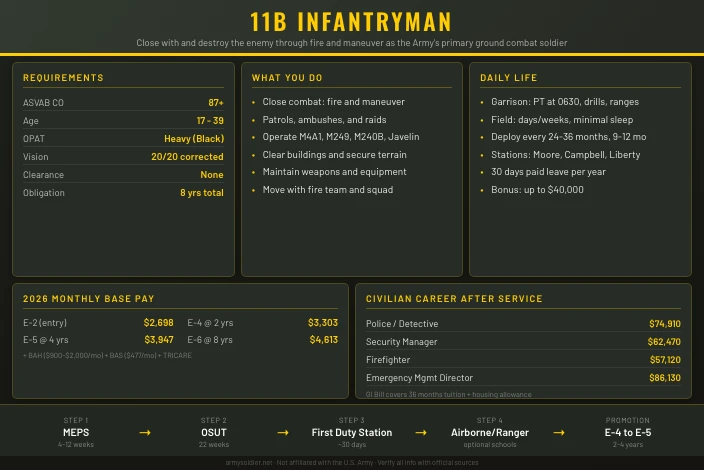
Job Role and Responsibilities
An 11B Infantryman engages enemy forces in close combat, executes patrols and ambushes, operates as part of a fire team and squad, and secures terrain. You are the ground combat element of the U.S. Army. Your job is to find, fix, and finish threats on foot, in vehicles, or from the air.
Daily Tasks
In garrison, your day starts with physical training at 0630. After that, you maintain weapons, rehearse battle drills, conduct land navigation exercises, and sit through classes on tactics, rules of engagement, and first aid. Sergeants run inspections on everything from your rifle to your room. Downtime goes to vehicle maintenance, range qualifications, and medical readiness checks.
In the field, routines disappear. You move to contact, set up ambushes, clear buildings, and pull security on observation posts for hours. Sleep comes when the mission allows. Field problems can last days or weeks.
On deployment, the pace intensifies. Mounted and dismounted patrols dominate your schedule. You operate checkpoints, respond to contact, and support partner forces. Every mission changes based on the threat.
Specialized Roles
The 11B is your primary MOS. Specialization comes through Additional Skill Identifiers (ASIs) and Special Qualification Identifiers (SQIs) earned at follow-on schools.
| Identifier | Code | Description |
|---|---|---|
| SQI | P | Parachutist (Airborne qualified) |
| SQI | G | Ranger qualified |
| SQI | V | Ranger and Parachutist qualified |
| SQI | 4 | Instructor |
| ASI | B4 | Sniper |
| ASI | 2S | Battle Staff NCO |
| ASI | F7 | Pathfinder |
| ASI | G9 | Air Assault |
These identifiers drive your assignment options. An 11B with a “V” SQI will land in an Airborne Ranger billet. An 11B with “P” goes to an Airborne unit like the 82nd Airborne Division. Without any qualifiers, you fill a standard infantry slot.
Mission Contribution
Infantry is the decisive arm. Every other branch exists to put you in position to win the close fight. Artillery softens the objective. Aviation moves you there. Engineers breach obstacles. Logistics keeps you fed and armed. But the 11B walks the last 300 meters and takes the ground.
Weapons and Equipment
You train on and carry a wide range of weapons systems. The M4A1 carbine is your primary weapon. Depending on your position in the squad, you may also operate:
- M249 Squad Automatic Weapon (SAW) or the newer XM250
- M240B medium machine gun
- M320 grenade launcher
- AT-4 anti-armor rocket
- Javelin anti-tank missile system
- M17/M18 sidearm
The Army is fielding the XM7 rifle and XM250 automatic rifle to infantry units as Next Generation Squad Weapons. These fire 6.8mm rounds and offer greater range and lethality than the 5.56mm systems they replace. Night vision devices, thermal optics, radios, and body armor round out your kit. A loaded combat load weighs 60 to 100 pounds.
Salary and Benefits
Financial Benefits
Military pay is based on rank and years of service. Most infantrymen start as E-1 or E-2 after enlisting. Here is what a typical 11B earns at key career milestones, based on 2026 pay tables from DFAS.
| Rank | Pay Grade | Years of Service: 2 | Years of Service: 4 | Years of Service: 6 | Years of Service: 8 |
|---|---|---|---|---|---|
| Private (PV2) | E-2 | $2,698 | $2,698 | $2,698 | - |
| Specialist (SPC) | E-4 | $3,303 | $3,659 | $3,816 | $3,816 |
| Sergeant (SGT) | E-5 | $3,599 | $3,947 | $4,109 | $4,299 |
| Staff Sergeant (SSG) | E-6 | $3,743 | $4,069 | $4,236 | $4,613 |
Source: DFAS 2026 pay tables. Figures reflect the 2026 pay raise.
Base pay is just the start. BAH (Basic Allowance for Housing) depends on your duty station and whether you have dependents. A single E-4 at Fort Campbell gets roughly $1,100 per month. The same rank at Fort Drum gets about $1,200. BAS adds $477 per month for food. Soldiers living in barracks get meals at the dining facility instead of BAS.
Enlistment bonuses for 11B have reached up to $40,000 depending on contract length and the Army’s current needs. Bonus amounts change frequently. Your recruiter will have the current number, and it must be written into your contract to be valid.
Additional Benefits
TRICARE covers you and your family at zero or minimal cost. That includes doctor visits, hospital stays, prescriptions, dental, vision, and mental health. While serving, Tuition Assistance pays up to $4,000 per year for college courses. After service, the Post-9/11 GI Bill covers up to 36 months of tuition at a public university (full in-state rate) plus a monthly housing allowance and book stipend.
The Blended Retirement System (BRS) works like this:
- Serve 20 years and collect a pension worth 40% of your base pay
- The government matches up to 5% of your Thrift Savings Plan (TSP) contributions starting at 60 days of service
- You keep TSP contributions even if you leave before 20 years
Work-Life Balance
You earn 30 days of paid leave per year. In garrison, most days run from 0630 to 1700 with occasional late nights for ranges or duty. Field rotations at NTC (National Training Center) or JRTC (Joint Readiness Training Center) eat 3 to 4 weeks at a stretch. Deployments run 9 to 12 months. The general rotation target is 2 years home for every 1 year deployed, but that shifts based on operational tempo.
Qualifications and Eligibility
Basic Qualifications
You need a minimum Combat (CO) composite score of 87 on the ASVAB. The CO score combines your Verbal Expression (Word Knowledge + Paragraph Comprehension), Auto & Shop Information, and Mechanical Comprehension subtests. That is one of the lower line score requirements in the Army, which means most people who pass the ASVAB can qualify.
| Requirement | Details |
|---|---|
| Age | 17-39 (up to 42 with waiver) |
| Citizenship | U.S. citizen or permanent resident |
| Education | High school diploma or GED |
| AFQT (overall ASVAB) | 31 minimum (diploma) or 50 (GED) |
| Combat (CO) line score | 87 minimum |
| CO formula | VE + AS + MC |
| OPAT category | Heavy (Black) |
| Security clearance | None required |
| Vision | Correctable to 20/20 in both eyes |
| Color vision | Must pass; some waivers available |
| Physical profile | Must meet combat arms standards |
The Occupational Physical Assessment Test (OPAT) places 11B in the Heavy (Black) category. You must hit these minimums: 160 cm standing long jump, 450 cm seated power throw, 160 lbs strength deadlift, and 43 shuttles on the interval aerobic run. No security clearance is needed for the basic 11B assignment.
Application Process
Start at your local Army recruiting station. Your recruiter checks your qualifications and explains your options between Active Duty, Reserve, and National Guard.
Next comes MEPS (Military Entrance Processing Station). You take the ASVAB (if you have not already), get a full medical exam, complete a background screening, and take the OPAT. If you qualify for 11B, you pick your contract and ship date. The 11B contract falls under the 11X (Infantry) enlistment option. You get assigned as either 11B (Infantryman) or 11C (Indirect Fire Infantryman) during OSUT.
The process from walking into the recruiting office to shipping out takes 4 to 12 weeks. Medical or legal issues can add time.
Selection Criteria and Competitiveness
The 11B is not hard to qualify for on paper. The CO score of 87 is among the lowest MOS thresholds. The real filter is physical. Not everyone can handle the OPAT Heavy standard, and OSUT pushes people harder than most training pipelines. Prior athletic experience, team sports, or outdoor skills help but are not required.
Upon Accession into Service
You enter as E-1 (Private) unless you earned advanced rank through college credits, JROTC, or a referral program. The standard total military service obligation is 8 years, split between active duty (typically 3 to 6 years depending on your contract) and the Individual Ready Reserve (IRR) for the remainder.
See our ASVAB study guide for strategies to hit these line scores, or take the PiCAT from home if you are a first-time tester.
Work Environment
Setting and Schedule
Infantrymen work in three settings.
Garrison is your home station. Physical training, weapons maintenance, classes, and administrative tasks fill the day. Hours run roughly 0630 to 1700, Monday through Friday. CQ (Charge of Quarters) and staff duty rotations mean occasional 24-hour shifts.
Field training puts you outdoors for days or weeks. You sleep in fighting positions, patrol bases, or the back of a Bradley. Hours follow the training plan, not a clock. Multi-week rotations at NTC (Fort Irwin, CA) or JRTC (Fort Johnson, LA) simulate full-scale combat operations.
Deployment is the real thing. Forward operating bases, patrol bases, or austere locations in any climate. Twelve-hour days minimum. The schedule depends on the mission, the threat, and your commander.
Leadership and Communication
Your chain of command starts with your team leader (E-5), moves to your squad leader (E-6), then platoon sergeant (E-7), and platoon leader (O-1 or O-2). The company commander (O-3) runs your company of about 120 soldiers.
Communication in the infantry is direct. Orders come face-to-face or over the radio. Feedback is constant and blunt. Your team leader will tell you what you did wrong before you get back to the wire. Annual evaluations formalize that process, but day-to-day correction is how infantry leaders develop soldiers.
Team Dynamics and Autonomy
You operate as part of a four-soldier fire team. Two fire teams make a squad. Three squads and a weapons squad make a platoon. Everything you do depends on the soldiers next to you. Trust is built through shared suffering in training and the field.
At the junior level, autonomy is limited. You follow orders and execute battle drills as rehearsed. As you gain rank and experience, you earn more freedom. A team leader decides how to position his soldiers. A squad leader plans the patrol route. By E-6, you are making calls that affect 30 to 40 soldiers.
Job Satisfaction and Retention
The Army has exceeded its overall retention goals for seven consecutive years. Infantry-specific retention runs lower than the Army average because the physical demands and deployment tempo burn people out. About 25% of soldiers recruited since 2022 have left before finishing their first contract.
Soldiers who stay talk about brotherhood, purpose, and pride. The ones who leave cite the physical grind, time away from family, and limited control over where they live. Both sides are telling the truth.
Training and Skill Development
Initial Training
The 11B does not have a separate Basic Combat Training (BCT) and Advanced Individual Training (AIT). Everything happens in a single 22-week block called One Station Unit Training (OSUT) at Fort Moore, Georgia.
| Phase | Weeks | Focus |
|---|---|---|
| Red Phase | 1-3 | Reception, in-processing, Army values, basic drill, first aid |
| White Phase | 4-7 | Rifle marksmanship (M4A1), hand grenades, land navigation, obstacle courses |
| Blue Phase | 8-10 | Squad tactics, field training exercises, basic patrolling |
| Black Phase | 11-14 | Advanced marksmanship, crew-served weapons (M249, M240B), urban operations |
| Gold Phase | 15-19 | Platoon live-fire exercises, combined arms training, mounted operations |
| Graduation Phase | 20-22 | Final field exercise, evaluations, graduation |
OSUT is a grind. You run, ruck, shoot, and operate on minimal sleep for 22 weeks straight. The first 10 weeks teach basic soldiering skills every MOS learns. Weeks 11 through 22 are infantry-specific: advanced weapons, room clearing, convoy operations, anti-armor tactics, and large-scale field exercises.
You graduate as a qualified 11B Infantryman and ship directly to your first duty station.
Advanced Training
After OSUT, the Army offers several schools that expand your capability and open assignment doors.
- Airborne School (3 weeks, Fort Moore, GA) teaches static-line parachute operations. Earns the SQI “P.”
- Air Assault School (10 days, Fort Campbell, KY) covers helicopter operations, rappelling, and sling-load procedures.
- Ranger School (61 days, multiple locations) is the Army’s premier leadership course. Three phases: Benning, Mountain, and Florida. Earns the Ranger Tab and SQI “G.”
- Sniper School (7 weeks, Fort Moore, GA) trains precision marksmanship, observation, and stalking.
- Pathfinder School (3 weeks, Fort Moore, GA) trains you to set up helicopter landing zones and drop zones.
- Bradley Infantry Fighting Vehicle course qualifies you to operate and fight from the M2 Bradley.
Strong performers can also compete for Special Forces Assessment and Selection (SFAS) after 2 years of service. Completing the Special Forces Qualification Course changes your MOS from 11B to 18-series.
The Army pays for all of this. Most schools happen during duty hours. College courses outside of training are covered by Tuition Assistance while you serve and the GI Bill after you leave.
Everything starts with qualifying ASVAB scores — our study guide covers what to study first.
Career Progression and Advancement
Career Path
Promotion through the junior enlisted ranks is mostly automatic if you meet time-in-service and time-in-grade requirements. E-5 (Sergeant) and above require a promotion board, points, and a strong record.
| Rank | Pay Grade | Typical Time in Service | Typical Role |
|---|---|---|---|
| Private (PV1) | E-1 | 0 months | Trainee in OSUT |
| Private (PV2) | E-2 | 6 months | Rifleman, fire team member |
| Private First Class (PFC) | E-3 | 12 months | Experienced rifleman, grenadier or SAW gunner |
| Specialist (SPC) | E-4 | 24 months | Senior fire team member, driver, gunner |
| Sergeant (SGT) | E-5 | 3-5 years | Fire team leader |
| Staff Sergeant (SSG) | E-6 | 6-9 years | Squad leader |
| Sergeant First Class (SFC) | E-7 | 10-14 years | Platoon sergeant |
E-5 is where your job fundamentally changes. You stop being the one who executes and become the one who leads. You are responsible for the training, discipline, and welfare of your fire team. By E-6, you run a 9-soldier squad and answer directly to the platoon sergeant.
Specialization Opportunities
Strong NCOs can pursue Drill Sergeant duty (ASI X5), Recruiter duty, or instructor positions at Fort Moore. Some compete for the Sergeant Major Academy at E-8. The 11B MOS feeds into the 11Z (Infantry Senior Sergeant) at the E-8 and E-9 level, which is a broadened leadership position overseeing all infantry operations at the battalion and brigade level.
Role Flexibility and Transfers
Reclassifying to a different MOS is possible but requires leadership approval, an open slot, and meeting the new MOS qualifications. Common lateral moves for infantrymen include 11C (Indirect Fire Infantryman), 19D (Cavalry Scout), or 18-series (Special Forces) for those who pass selection. Moving outside combat arms is harder and may require completing a full AIT for the new job.
Performance Evaluation
Enlisted evaluations happen through the NCOER (NCO Evaluation Report) at E-5 and above. Your rater and senior rater score you on leadership, competence, training effectiveness, and character. A pattern of strong NCOERs is the single most important factor in getting promoted beyond E-5.
What actually separates you: keeping your soldiers trained, maintaining equipment, scoring high on the AFT, completing military education on time, and earning badges and qualifications. The Expert Infantryman Badge (EIB) and Combat Infantryman Badge (CIB) carry real weight in an infantry career.
Physical Demands and Medical Evaluations
Physical Requirements
This is the most physically demanding job category in the Army. You carry 60 to 100 pounds of weapons, ammunition, body armor, water, and equipment over rough terrain in any weather. Foot marches of 12 miles with a 35-pound rucksack are routine. Urban operations require sprinting, climbing, and breaching under load. Casualty evacuation means dragging or carrying a 200-pound soldier.
Every soldier takes the Army Fitness Test (AFT) at least once per year. The AFT replaced the ACFT in June 2025 and consists of five events scored 0 to 100 each, with a maximum total score of 500.
| Event | What It Tests | Minimum Score |
|---|---|---|
| 3-Rep Max Deadlift (MDL) | Lower body strength | 60 points |
| Hand-Release Push-Up (HRP) | Upper body endurance | 60 points |
| Sprint-Drag-Carry (SDC) | Anaerobic capacity, functional fitness | 60 points |
| Plank (PLK) | Core endurance | 60 points |
| Two-Mile Run (2MR) | Aerobic endurance | 60 points |
The general passing standard is 300 total with at least 60 per event. Combat MOS soldiers, including 11B, must hit a 350 total minimum. This combat standard is sex-neutral and age-normed. If you cannot hold that standard, you cannot hold the job.
Beyond the AFT, infantry units run their own training: ruck marches, combatives (hand-to-hand fighting), obstacle courses, and squad physical training sessions that go well beyond the test requirements. Most platoons PT together five days a week.
Medical Evaluations
You get an annual Periodic Health Assessment (PHA) covering weight, blood pressure, vision, hearing, and a provider conversation. Before any deployment, you go through a separate medical clearance that screens for conditions that would be dangerous in an austere environment. Dental readiness is also required. Any unresolved issue gets treated first, or you stay behind.
The Army tracks your medical readiness through MEDPROS. Your leadership checks it monthly. If you fall out of compliance, expect to be at sick call until you are green across the board.
Deployment and Duty Stations
Deployment Details
Active-duty infantrymen deploy more often than most MOSs. The standard cycle is 9 to 12 months deployed followed by 18 to 24 months at home station. Units on the Global Response Force (GRF) can deploy within 96 hours of notification for anywhere from weeks to months.
Current and recent deployment regions include the Middle East (Iraq, Syria, Kuwait, Jordan), Europe (Poland, Romania, Germany for NATO deterrence), the Pacific (South Korea, Japan), and Africa (various advisory missions). Domestic deployments happen for natural disasters or civil support.
Infantry units in high-readiness divisions deploy most frequently. The 82nd Airborne Division, 101st Airborne Division, and 10th Mountain Division maintain the highest operational tempos.
Duty Stations
The Army assigns your duty station based on its needs, not your preference. You can submit a wish list, but there are no guarantees. Expect to PCS (Permanent Change of Station) every 2 to 4 years.
Major infantry duty stations include:
- Fort Moore, GA – home of the Infantry School, 3rd Infantry Division (Mech)
- Fort Liberty, NC – 82nd Airborne Division, XVIII Airborne Corps
- Fort Campbell, KY – 101st Airborne Division (Air Assault)
- Fort Drum, NY – 10th Mountain Division (Light Infantry)
- Fort Carson, CO – 4th Infantry Division (Mech)
- Fort Johnson, LA – JRTC and 3rd Brigade, 10th Mountain Division
- Joint Base Elmendorf-Richardson, AK – 4th Brigade, 25th Infantry Division (Airborne)
- Schofield Barracks, HI – 25th Infantry Division (Light)
- Overseas – Camp Humphreys (South Korea), various locations in Germany and Italy
Light infantry, mechanized infantry, airborne, and air assault units each have a different feel. Your duty station determines your training focus, deployment cycle, and quality of life.
Risk, Safety, and Legal Considerations
Job Hazards
The 11B is a combat job. The risks are real.
In training:
- Musculoskeletal injuries from rucking, running, and jumping (the leading cause of medical attrition)
- Live-fire range accidents
- Vehicle rollovers during mounted training
- Heat injuries in summer, cold weather injuries in winter
- Parachute malfunctions (Airborne units)
In combat:
- Direct and indirect enemy fire
- Improvised explosive devices (IEDs)
- Ambushes
- Traumatic brain injury from blast exposure
- Psychological stress from sustained combat operations
Safety Protocols
Body armor, helmets, eye protection, and hearing protection are worn during all tactical operations. Units conduct risk assessments before every training event and mission. Medics are embedded at every level. Casualty evacuation procedures and MEDEVAC assets are planned into every operation. The Army’s safety center tracks injury data and adjusts training guidance based on trends.
Security and Legal Requirements
No security clearance is required for standard 11B assignments. Soldiers assigned to specialized units or staff positions may need a Secret clearance, which takes 2 to 6 months to process. All soldiers are subject to the Uniform Code of Military Justice (UCMJ). Before combat deployments, you receive training on the Law of Armed Conflict and rules of engagement.
Your enlistment contract is a legally binding agreement. Breaking it has consequences ranging from administrative action to court-martial depending on the circumstances. The total service obligation is 8 years regardless of your active-duty contract length.
Impact on Family and Personal Life
Family Considerations
Infantry life is hard on families. Frequent field training takes you away for days or weeks at a time. Deployments mean 9 to 12 months apart. PCS moves uproot your spouse’s career and your kids’ schools every 2 to 4 years. Communication during deployment has improved with internet and phone access on most bases, but blackout periods happen after combat incidents.
The Army provides support systems at most installations:
- Family Readiness Groups (FRGs) connect families within your unit for peer support
- Military OneSource offers free counseling, financial planning, and legal help
- Army Community Service (ACS) provides employment assistance for spouses at each new duty station
- Exceptional Family Member Program (EFMP) ensures families with special needs get assigned to locations with appropriate medical care
Relocation and Flexibility
You will move. After OSUT, the Army sends you where it needs you. After that, expect a new duty station every 2 to 4 years. The Army pays for the move, but each PCS disrupts your family’s stability. Married soldiers can request joint-domicile assignments if both spouses serve, but the Army is not obligated to honor them.
Single soldiers in the junior ranks live in barracks on post. Married soldiers and E-6 and above can live off-post with BAH. The quality of barracks varies wildly from post to post. Some are recently renovated. Others are from the 1970s.
Reserve and National Guard
The 11B Infantryman is available in both the Army Reserve and Army National Guard. The National Guard maintains a large infantry force, with infantry battalions and brigade combat teams in most states. The Army Reserve has fewer 11B positions since its force structure emphasizes combat support and combat service support. If you want to serve part-time as an infantryman, the Guard is your primary option.
Drill Schedule and Training Commitment
Standard commitment is one weekend per month (Battle Assembly) plus two weeks of Annual Training per year. Infantry drill weekends are more physically demanding than most MOS. Expect field exercises, weapons qualification ranges, land navigation courses, and physical training. Annual Training for infantry units typically involves multi-day field exercises with live-fire maneuver, sometimes at a Combat Training Center rotation. MUTA 6 (Friday through Sunday) weekends are common for gunnery qualifications and squad-level training. The “one weekend a month” tagline undersells the actual time commitment for combat arms.
Part-Time Pay
An E-4 with over 3 years of service earns about $464 per drill weekend (4 drill periods), totaling roughly $5,572 per year from drill pay plus about $1,741 for 15 days of Annual Training. Active-duty E-4 base pay is $3,482 per month. The part-time pay is modest for the physical workload, but it supplements a civilian income and preserves access to military benefits.
Benefits Differences
Tricare Reserve Select costs $57.88 per month for member-only or $286.66 per month for family coverage in 2026. Active-duty TRICARE Prime is free. For soldiers in physically demanding civilian jobs, TRS provides affordable coverage for training injuries.
Education benefits include Federal Tuition Assistance ($250 per credit hour, up to $4,500 per year) and the Montgomery GI Bill-Selected Reserve at $493 per month for full-time students. Guard members may qualify for state tuition waivers, which can cover full tuition at state universities in some states. Mobilization of 90 or more days earns Post-9/11 GI Bill eligibility.
Reserve retirement is points-based, requiring 20 qualifying years. Collection starts at age 60, reduced by 3 months per 90-day mobilization after January 2008, minimum age 50.
Deployment and Mobilization
11B soldiers in Guard units see high mobilization rates. Infantry units have deployed repeatedly since 2001 to Iraq, Afghanistan, and other theaters. Guard infantry battalions rotate through combat deployments and overseas security missions. Typical mobilizations run 9 to 12 months including pre-deployment training. National Guard 11B soldiers are also activated for domestic emergencies, including civil unrest response, natural disasters, and border security missions.
Civilian Career Integration
The 11B has limited direct civilian career overlap. Infantry skills do not map to a specific civilian occupation the way medical or logistics MOS do. But the leadership experience, discipline, and security clearance eligibility that come with infantry service are valued by law enforcement agencies, federal security contractors, and emergency management organizations. Many Guard infantrymen work as police officers, firefighters, construction workers, or in trades during the week. USERRA protects your civilian job during activations, and employers must reinstate you with the seniority you would have earned.
| Feature | Active Duty | Army Reserve | Army National Guard |
|---|---|---|---|
| Commitment | Full-time | Limited 11B billets | 1 weekend/month + 2 weeks/year |
| Monthly Pay (E-4, 3+ yrs) | $3,482 | ~$464/drill weekend | ~$464/drill weekend |
| Healthcare | TRICARE Prime ($0) | Tricare Reserve Select ($57.88/mo) | Tricare Reserve Select ($57.88/mo) |
| Education | Federal TA, Post-9/11 GI Bill | Federal TA, MGIB-SR ($493/mo) | Federal TA, MGIB-SR, state tuition waivers |
| Deployment Tempo | Regular combat rotations | Low (few Reserve infantry billets) | High (frequent mobilizations + state missions) |
| Retirement | 20-year pension at age 40+ | Points-based, collect at age 60 | Points-based, collect at age 60 |
Post-Service Opportunities
Transition to Civilian Life
Infantry does not hand you a direct civilian certification the way a mechanic or medic MOS does. What it gives you is leadership under pressure, team management, operational planning, and the ability to perform when things go sideways. Employers in security, law enforcement, federal agencies, and emergency services value those skills.
The Transition Assistance Program (TAP) begins during your last 12 months on active duty. It covers resume writing, interview skills, benefits counseling, and career exploration. The Post-9/11 GI Bill covers up to 36 months of tuition at public universities (full in-state rate) or a capped amount at private schools, plus a monthly housing allowance and book stipend.
Programs like Soldier for Life, Hiring Our Heroes, and SkillBridge connect transitioning soldiers with employers and internships before separation. Many infantry veterans use the GI Bill to earn degrees in criminal justice, business, or emergency management and then enter the workforce at a higher level.
Civilian Career Prospects
Here is what former infantrymen commonly move into, with data from the Bureau of Labor Statistics:
| Civilian Job | Median Annual Salary (2024) | 10-Year Outlook |
|---|---|---|
| Police Officer / Detective | $77,270 | +3% |
| Security Guard | $38,370 | ~0% |
| Firefighter | $59,530 | +3% |
| Private Investigator | $52,370 | +6% |
| Emergency Management Director | $86,130 | +3% |
Federal agencies like CBP (Customs and Border Protection), the Secret Service, FBI, and DEA actively recruit combat veterans. Many offer veterans preference in hiring, which moves your application ahead of non-veteran candidates.
Post-Service Policies
An honorable discharge gives you lifetime VA healthcare, disability compensation (if applicable), education benefits, and home loan guarantees through the VA. You can separate after completing your active-duty contract if you choose not to re-enlist. Talk to your career counselor at least 12 months before your ETS date to understand your options.
A discharge other than honorable strips most VA benefits. Keep your record clean.
Is This a Good Job for You?
Ideal Candidate Profile
The best infantrymen thrive on physical challenge and don’t need external motivation to push through miserable conditions.
Traits that predict success:
- Competitive athlete or someone who trains hard without being told
- Comfortable outdoors in heat, cold, rain, and mud for extended periods
- Team-oriented but capable of independent action when isolated
- Quick decision-maker who stays calm under stress
- Mentally tough enough to handle boredom, exhaustion, and danger in the same week
You do not need prior military experience or specialized education. You need grit and the willingness to be coached hard by NCOs who already did what you are about to do.
Potential Challenges
This MOS is a poor fit if you:
- Need a predictable schedule and stable home life
- Have chronic joint, back, or knee problems
- Want a job that directly translates to a civilian license or certification
- Prefer working alone or in small, quiet environments
- Cannot handle sustained physical discomfort
Infantry veterans experience higher rates of PTSD, TBI, and musculoskeletal injuries than most other MOSs. The physical toll is cumulative. Knees, backs, and shoulders take damage over years of rucking and jumping that shows up later. Mental health support is available through the VA and Military OneSource, but you have to use it.
Career and Lifestyle Alignment
If you want to serve in a combat role and experience the most traditional form of soldiering the Army offers, this is it. The camaraderie in infantry units is unmatched. The shared hardship builds bonds that last decades.
The trade-off: the pay is modest, the hours are brutal, the living conditions range from average to awful, and the physical damage is real. If your long-term goal is a career in law enforcement, federal service, or emergency management, the infantry gives you a foundation that civilian programs cannot replicate. If your goal is a technical skill or certification, look at a different MOS.
This job works best for people who want to serve on the front line first and figure out the rest later. If that sounds right, talk to a recruiter.
More Information
Talk to an Army recruiter about the 11B Infantryman. Ask about current enlistment bonuses, OSUT ship dates, and which duty stations have openings. If you can, request to speak with an 11B soldier at a local installation so you hear what the job is really like.
Take the MOS finder quiz at goarmy.com
Schedule an ASVAB at your nearest MEPS to see where your scores land
Talk to infantry veterans in your area for an honest picture of the job
Prepare for the ASVAB with our study guide to make sure your line scores qualify
This site is not affiliated with the U.S. Army or any government agency. Verify all information with official Army sources before making enlistment or career decisions.
Explore more Army infantry careers such as 11C Indirect Fire Infantryman.