11C Indirect Fire Infantryman
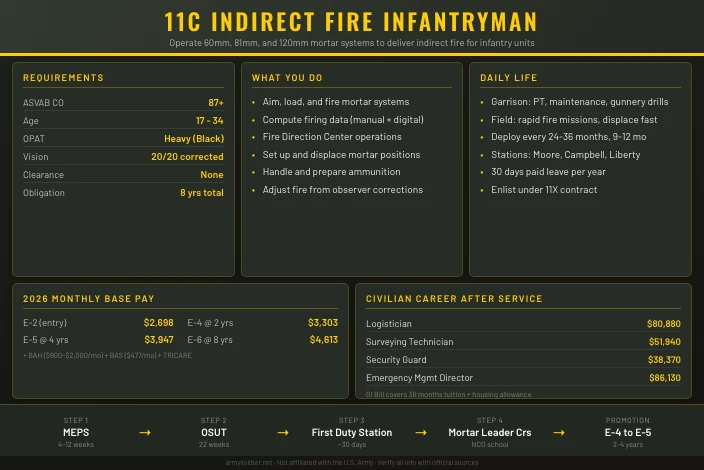
Mortars are the heaviest weapons an infantry battalion owns. The 11C Indirect Fire Infantryman is the person who aims, loads, and fires them. You drop high-explosive rounds on enemy positions from behind cover, sometimes miles away, giving your unit firepower that no rifle or machine gun can match. If you want a combat job where math, precision, and teamwork matter as much as physical toughness, the 11C puts you behind one of the most destructive tools on the battlefield.
Qualifying requires specific ASVAB line scores — our ASVAB study guide covers what to target and how to prepare.
Job Role and Responsibilities
As an 11C, you operate mortar systems ranging from 60mm to 120mm. You compute firing data, set up mortar positions, load and fire rounds, and adjust fire based on observer corrections. In the field, you suppress enemy positions, screen troop movements, and deliver illumination rounds for night operations. In garrison, you maintain your weapons, train on gunnery procedures, and stay ready to deploy at short notice.
A typical day in garrison starts with physical training at 0600, followed by weapons maintenance and classes on fire direction procedures. You spend time on the plotting board, practicing manual calculations that back up the digital systems. Afternoons usually mean hands-on drills: setting up the mortar, bore-sighting, breaking it down, and moving to a new position. Field training exercises happen several times a year and run for days or weeks straight.
In the field, the pace changes fast. You occupy a firing position, receive a call for fire over the radio, compute the data, and put rounds downrange. Then you displace before the enemy can locate you. Speed matters. A well-drilled crew can set up and fire in under a minute using the Mortar Fire Control System.
Mortar Systems
You train on three mortar platforms:
- M224A1 (60mm) – lightweight, man-portable company mortar. Weighs about 37.5 lbs. Used for close support at ranges up to 3,500 meters.
- M252A1 (81mm) – the battalion medium mortar. Heavier, longer range, more lethal. Effective out to about 5,600 meters.
- M120/M121 (120mm) – the heavy mortar. Mounted on carriers (M1064A3 or M1129 Stryker Mortar Carrier) or towed. Range exceeds 7,000 meters. This is the most destructive organic weapon in an infantry battalion.
Specialized Roles and Identifiers
Every 11C starts as an ammunition bearer or assistant gunner. As you gain experience, you move through specific crew positions.
| Identifier | Type | Description |
|---|---|---|
| 11C | MOS | Indirect Fire Infantryman (primary) |
| ASI B1 | Additional Skill Identifier | Awarded to NCOs completing the Infantry Mortar Leader Course |
| ASI 3Z | Additional Skill Identifier | Awarded to officers completing the Infantry Mortar Leader Course |
| SQI V | Special Qualification Identifier | Ranger-qualified (75th Ranger Regiment assignment) |
Fire Direction Center Operations
Not every 11C pulls the trigger. Some work in the Fire Direction Center (FDC), the brain of the mortar platoon. FDC personnel receive calls for fire from forward observers, compute firing data using the Lightweight Handheld Mortar Ballistic Computer (LHMBC) or M16/M19 plotting boards, and transmit commands to the gun line. The FDC also coordinates with the battalion fire support element to avoid friendly fire and synchronize with artillery.
This job requires a soldier who can handle physical labor and mental math under pressure. You carry heavy equipment, dig fighting positions, and move fast. Then you sit behind a plotting board and calculate deflection and elevation to the nearest mil. Both halves of the job matter equally.
Salary and Benefits
Financial Benefits
Military pay is based on rank and time in service. Most 11C soldiers enter as Private (PV2) after completing OSUT.
| Rank | Pay Grade | Years of Service: 2 | Years of Service: 4 | Years of Service: 6 | Years of Service: 8 |
|---|---|---|---|---|---|
| Private (PV2) | E-2 | $2,698 | $2,698 | $2,698 | - |
| Specialist (SPC) | E-4 | $3,303 | $3,659 | $3,816 | $3,816 |
| Sergeant (SGT) | E-5 | $3,599 | $3,947 | $4,109 | $4,299 |
| Staff Sergeant (SSG) | E-6 | $3,743 | $4,069 | $4,236 | $4,613 |
Source: DFAS 2026 pay tables. Figures reflect the 2026 pay raise.
On top of base pay, you receive allowances. BAH (Basic Allowance for Housing) depends on your duty station and dependent status. A single Specialist (SPC) gets roughly $900 to $2,000+ per month depending on location. BAS (Basic Allowance for Subsistence) adds about $477 monthly for food. Infantry soldiers who qualify may also receive enlistment bonuses. The Army bonus chart changes frequently, so ask your recruiter for the current amount. Bonuses for 11X contracts have ranged up to $50,000 depending on contract length and Army needs.
Additional Benefits
You and your dependents get TRICARE health coverage at little or no cost. That includes medical, dental, vision, prescriptions, and mental health services. Tuition Assistance pays up to $4,500 per year for college courses while on active duty. After separation, the Post-9/11 GI Bill covers up to 36 months of tuition at a public university (full in-state rate) plus a monthly housing allowance and book stipend.
Retirement works through the Blended Retirement System (BRS):
- Serve 20 years and receive a pension worth 40% of your base pay
- The government matches up to 5% of your Thrift Savings Plan (TSP) contributions
- Continuation pay bonus at the 12-year mark for those who commit to 20
Work-Life Balance
You earn 30 days of paid leave per year. In garrison, mortar platoons usually follow a standard duty day with occasional evening or weekend training. Field rotations and gunnery exercises break that routine for days or weeks at a time. Deployments mean 12 to 16 hour days with minimal time off.
The general rotation is about 9 to 12 months deployed, followed by 24 to 36 months at home station. That ratio shifts based on operational tempo.
Qualifications and Eligibility
Basic Qualifications
You enlist under an 11X Infantry contract. The Army assigns you to either 11B (Infantryman) or 11C (Indirect Fire Infantryman) based on its personnel needs at the time of your training. You can state a preference, but the Army decides.
The 11C requires a minimum Combat (CO) composite score of 87 on the ASVAB. The CO score is calculated from four subtests: Arithmetic Reasoning (AR), Coding Speed (CS), Auto & Shop Information (AS), and Mechanical Comprehension (MC).
| Requirement | Details |
|---|---|
| Age | 17-34 (up to 42 with waiver) |
| Citizenship | U.S. citizen or permanent resident |
| Education | High school diploma or GED |
| AFQT (ASVAB) | Minimum 31 (diploma) or 50 (GED) |
| Combat (CO) Score | Minimum 87 |
| Physical Profile | 111221 or better |
| OPAT Category | Heavy (Black) |
| Security Clearance | None required |
| Vision | Correctable to 20/20 |
| Moral Standards | No disqualifying criminal history or drug use |
OPAT Standards
Before shipping to OSUT, you must pass the Occupational Physical Assessment Test at the Heavy (Black) level:
- Standing Long Jump: 5 ft 3 in minimum
- Seated Power Throw: 14 ft 9 in minimum
- Strength Deadlift: 160 lbs minimum
- Interval Aerobic Run: 43 shuttles (10:14 mile pace) minimum
Application Process
Start at a local Army recruiting station. The recruiter checks your qualifications, explains the 11X option, and helps you choose between Active Duty, Reserve, or National Guard. You go to MEPS (Military Entrance Processing Station) for the ASVAB, a full medical exam, and a background check. If you qualify, your recruiter books a training slot.
The process from first meeting to swearing in typically takes 4 to 12 weeks. Medical waivers or background investigations can stretch that timeline.
Selection Criteria and Competitiveness
The 11C is not highly competitive from a test score standpoint. A CO score of 87 is within reach for most test takers. The real filter is physical. You need to pass the OPAT at the Heavy level before you ship, and OSUT washes out soldiers who cannot keep up physically or academically.
No prior certifications or experience are required. Prior athletic background, JROTC participation, or experience working on teams can help, but they are not mandatory.
Upon Accession into Service
You enter as E-1 (Private/PV1) and get promoted to E-2 (Private/PV2) during OSUT based on time in service. The standard obligation is 8 years total: typically 3 to 6 years active duty (depending on your contract) plus the remainder in the Reserve or Individual Ready Reserve.
See our ASVAB study guide for strategies to hit these line scores, or take the PiCAT from home if you are a first-time tester.
Work Environment
Setting and Schedule
Mortar crews work in three settings:
- Garrison – company motor pools, arms rooms, and training areas. Standard duty hours with occasional early mornings or late nights for maintenance and inventories.
- Field training – tactical assembly areas, firing points, and observation posts. Hours follow the training schedule. Expect 14 to 18 hour days during gunnery exercises.
- Deployment – forward operating bases, patrol bases, or mobile positions in armored carriers. Twelve to 16 hour days are normal. Sleep happens between fire missions.
Weather does not stop mortar operations. You train and fight in rain, snow, extreme heat, and darkness. The 120mm mortar and its ammunition weigh hundreds of pounds, and all of it has to move when the platoon displaces.
Leadership and Communication
Your chain of command runs through the mortar platoon leader (usually a Lieutenant) and platoon sergeant (E-7). Within your section, you answer to a squad leader (E-5 or E-6). During fire missions, the FDC relays commands from the fire support officer and forward observers. Communication is constant and fast. A misheard command or wrong calculation can put rounds on friendly troops.
Performance feedback comes through counseling sessions and annual evaluations. Your leaders watch everything: how fast you set up, how accurately you compute data, how you handle stress during live fire.
Team Dynamics and Autonomy
Mortar work is team-dependent. A crew of 3 to 5 soldiers operates each gun. Every position has a job, and if one person fails, the whole system slows down. You do not operate alone.
That said, individual skill matters. The gunner sets the data on the sight. The squad leader verifies. The ammo bearer prepares rounds. Each role requires technical knowledge that takes months to build. As you gain rank, you get more autonomy in calling corrections and managing your section.
Job Satisfaction and Retention
Infantry MOSs generally have lower retention rates than support jobs, partly because of the physical demands and deployment pace. The soldiers who stay tend to be those who find purpose in the precision of mortar gunnery and the brotherhood of a small crew. Mortar platoons are tight-knit. You eat, sleep, and train together for years. That bond keeps a lot of 11C soldiers in uniform past their first contract.
Training and Skill Development
Initial Training
All 11C soldiers complete 22 weeks of One Station Unit Training (OSUT) at Fort Moore, Georgia. OSUT combines Basic Combat Training and Advanced Individual Training into a single course. You stay with the same unit and cadre the entire time.
| Training Phase | Duration | Location | Focus |
|---|---|---|---|
| Phase I (Basic Soldier Skills) | ~7 weeks | Fort Moore, GA | Marksmanship, land navigation, first aid, physical fitness, drill and ceremony, squad tactics |
| Phase II (Mortar Training) | ~15 weeks | Fort Moore, GA | Mortar gunnery (60mm, 81mm, 120mm), FDC procedures, plotting board operations, aiming circle, live fire exercises, tactical employment, STX lanes |
Phase I turns you into a basic soldier. You learn to shoot an M4, read a map, move under fire, and function as part of a squad. Every infantry trainee does this.
Phase II is where you become a mortarman. You learn to set up, aim, and fire all three mortar systems. Classroom instruction covers ballistics, the mil-relation formula, and manual gunnery calculations. Field training puts you behind the gun for live fire exercises. Situational training exercises (STX) teach emergency, hasty, and deliberate occupation of mortar positions. You also learn to displace quickly, which means tearing down your position, loading everything, and moving before counter-fire arrives.
You earn your 11C MOS after graduating OSUT and report to your first unit within about a month.
Advanced Training
The primary advanced course for 11C soldiers is the Infantry Mortar Leader Course (IMLC) at Fort Moore. This course trains NCOs (Sergeant through Sergeant First Class) and officers (Second Lieutenant through Captain) to supervise and direct mortar fires. Instruction covers tactical employment of the mortar platoon, advanced fire direction procedures, mortar gunnery across all three calibers, and the Mortar Fire Control System. Graduates earn the ASI B1 (enlisted) or 3Z (officer).
Other training opportunities include:
- Airborne School – 3 weeks at Fort Moore. Jump qualification for assignment to airborne units.
- Ranger School – 62 days at Fort Moore and satellite locations. Earns the Ranger tab.
- Air Assault School – 10 days at Fort Campbell, KY. Sling load and rappelling certification.
- Combat Lifesaver Course – 40-hour certification for battlefield first aid.
- Master Gunner Course – for senior NCOs managing mortar training programs.
The Army pays for professional development through Tuition Assistance and the GI Bill. Many soldiers use these to start college coursework while still on active duty.
Everything starts with qualifying ASVAB scores — our study guide covers what to study first.
Career Progression and Advancement
Career Path
Promotion through the junior enlisted ranks is mostly automatic if you meet time-in-service and time-in-grade requirements. E-5 and above require a promotion board, strong evaluations, and military education.
| Rank | Pay Grade | Typical Time in Service | Role |
|---|---|---|---|
| Private (PV2) | E-2 | 0-1 years | Ammo bearer, assistant gunner |
| Private First Class (PFC) | E-3 | 1-2 years | Gunner, driver |
| Specialist (SPC) | E-4 | 2-3 years | Senior gunner, team leader |
| Sergeant (SGT) | E-5 | 4-6 years | Squad leader, section chief |
| Staff Sergeant (SSG) | E-6 | 6-9 years | Section sergeant, platoon FDC NCOIC |
| Sergeant First Class (SFC) | E-7 | 9-14 years | Mortar platoon sergeant |
At E-5, you shift from operating the mortar to leading a crew. You manage training, maintain accountability of equipment, and mentor junior soldiers. At E-6 and above, you run sections or the entire platoon FDC and shape how your unit trains and fights.
Specialization Opportunities
Beyond the standard 11C track, you can pursue:
- IMLC (ASI B1) – makes you competitive for section leader and platoon sergeant positions
- Ranger qualification (SQI V) – opens assignment to the 75th Ranger Regiment
- Airborne qualification (SQI P) – required for the 82nd Airborne Division and other airborne units
- Drill Sergeant (SQI X) – train the next generation of soldiers at OSUT
Role Flexibility and Transfers
You can reclass to a different MOS, but it requires leadership approval, an open slot in the new MOS, and completion of that job’s training. Common lateral moves for 11C soldiers include 11B (Infantryman), 13B (Cannon Crewmember), or 13F (Fire Support Specialist). Staying within combat arms is easier than crossing into a support field.
Any MOS change means a new training pipeline and possibly a new service obligation. Soldiers with strong evaluations have more options.
Performance Evaluation
Enlisted soldiers E-5 and above receive an NCOER (NCO Evaluation Report) annually. Your rater and senior rater assess your leadership, technical proficiency, training, and physical fitness. Strong NCOERs are the single biggest factor in getting promoted to E-6 and beyond.
What sets you apart: accuracy during live fire, speed during drills, ability to train your crew, and staying in top physical shape. Soldiers who earn the Expert Infantryman Badge (EIB) or complete advanced courses like Ranger School stand out on promotion boards.
Physical Demands and Medical Evaluations
Physical Requirements
This is one of the most physically demanding jobs in the Army. You carry mortar baseplates, bipods, tubes, and ammunition over rough terrain. A single 120mm mortar round weighs about 33 lbs. The baseplate alone weighs over 130 lbs. You lift, carry, and set up this equipment multiple times during a single training exercise or mission.
A standard combat load for a mortar crew member includes body armor, helmet, weapon, water, and mortar components. Expect to carry 70 to 100+ lbs during field operations. Ruck marches of 12 miles or more are routine training events.
Every soldier takes the Army Fitness Test (AFT) at least once a year. The AFT replaced the ACFT on June 1, 2025. Combat MOSs like 11C must meet the combat standard: 350 total points minimum, with at least 60 points per event. Scoring is sex-neutral and age-normed for combat specialties.
| AFT Event | Combat Standard (60 pts, ages 17-21) |
|---|---|
| 3-Rep Max Deadlift (MDL) | 150 lbs |
| Hand-Release Push-Up (HRP) | 15 reps |
| Sprint-Drag-Carry (SDC) | Varies by age/gender |
| Plank (PLK) | 2:00 |
| Two-Mile Run (2MR) | 19:57 (combat standard) |
Each event is scored 0 to 100. Maximum possible total is 500. The combat standard of 350 with no event below 60 applies to all 21 designated combat MOSs. Active-duty soldiers must meet this standard starting January 1, 2026. Reserve and National Guard have until June 1, 2026.
Daily Physical Demands
Beyond the AFT, mortar crews face specific physical challenges every day:
- Lifting mortar components overhead to load rounds into the tube
- Digging hasty fighting positions and mortar pits in hard ground
- Sprinting between positions during displacement drills
- Carrying ammunition cans (40 to 50 lbs each) over uneven terrain
- Operating in full body armor for 12+ hours in extreme heat or cold
Medical Evaluations
After enlistment, you get an annual Periodic Health Assessment: weight, blood pressure, vision, hearing, and a conversation with a provider. Before deployment, a separate medical screening clears you for the operational environment. Any condition that could limit your performance in the field gets addressed first, or you stay behind.
Hearing is a particular concern for mortar crews. Repeated exposure to blast overpressure can cause hearing loss over time. You wear hearing protection during live fire, but cumulative damage is a known risk. The Army tracks hearing through annual audiograms.
Deployment and Duty Stations
Deployment Details
Active-duty infantry units usually deploy every 24 to 36 months for 9 to 12 months. Units on high-readiness status go more often and with less notice. Mortar platoons deploy wherever their infantry battalion goes.
Deployment regions depend on global conditions. Recent and current rotation areas include:
- Middle East – Kuwait, Iraq, Syria, Jordan
- Europe – Poland, Romania, Germany (NATO rotations)
- Pacific – South Korea, Japan
- Africa – rotational advisory missions
Domestic deployments happen for natural disasters, border support, or civil unrest response.
Location Flexibility
The Army assigns your duty station based on its needs, not your preference. You can submit a wish list, but there are no guarantees. Expect to move every 2 to 4 years.
Major infantry duty stations with mortar platoons include:
- Fort Moore, GA – home of the Infantry School and training units
- Fort Liberty, NC – 82nd Airborne Division
- Fort Campbell, KY – 101st Airborne Division (Air Assault)
- Fort Drum, NY – 10th Mountain Division
- Fort Carson, CO – 4th Infantry Division
- Fort Riley, KS – 1st Infantry Division
- Joint Base Lewis-McChord, WA – 2nd Stryker Brigade (Stryker mortar carriers)
- Overseas – Germany, Italy, South Korea
Risk, Safety, and Legal Considerations
Job Hazards
Mortar crews face risks in every setting.
In training:
- Misfire and hang-fire incidents (a round that fails to leave the tube)
- Blast overpressure causing hearing damage
- Burns from hot tubes and propellant charges
- Injuries from lifting heavy equipment
- Vehicle accidents during convoy movements
In combat:
- Counter-battery fire (the enemy shoots back at your position)
- IEDs along movement routes
- Direct and indirect enemy fire
- Extreme temperatures and terrain hazards
Mortars draw attention. Enemy forces prioritize locating and destroying mortar positions because of the damage they inflict. Rapid displacement after firing is a survival skill, not just a tactical preference.
Safety Protocols
Every live fire exercise follows strict range safety procedures: safety fans, minimum safe distances, and a range safety officer monitoring every round. Misfire drills are rehearsed constantly. If a round does not fire, the crew follows a specific waiting period and clearing procedure before approaching the tube.
In the field, you wear body armor, helmet, eye protection, and hearing protection. Your crew rehearses immediate action drills for every failure mode. Equipment inspections happen before and after every mission.
Security and Legal Requirements
The 11C does not require a security clearance. Soldiers in specialized units or staff positions may need a Secret clearance later in their career, but entry-level mortarmen do not.
All soldiers follow the Uniform Code of Military Justice (UCMJ). Before deploying, you receive training on the Law of Armed Conflict and rules of engagement. As a mortar crewmember, you bear direct responsibility for where your rounds land. A miscalculation or failure to follow fire commands can have legal consequences.
Your service obligation is defined by your enlistment contract. Breaking that contract has serious legal and career repercussions.
Impact on Family and Personal Life
Family Considerations
Deployments of 9 to 12 months are the hardest part for most military families. Add in field training rotations, gunnery exercises, and weekend duty, and you are away from home more than a typical civilian job allows. Spouses and children adjust to a rhythm of separation and reunion that never fully becomes normal.
The Army provides support resources at most installations:
- Family Readiness Groups (FRGs) – unit-based peer support for spouses and families
- Military OneSource – free 24/7 counseling, financial planning, and family services
- Spouse Employment Assistance – job search help at each new duty station
- Exceptional Family Member Program (EFMP) – for families with special medical or educational needs
- Army Community Service (ACS) – relocation assistance, parenting programs, emergency aid
Relocation and Flexibility
You will move. After OSUT, the Army sends you where it needs you, and that is rarely close to home. Expect a new duty station every 2 to 4 years. The Army covers moving costs through PCS (Permanent Change of Station) orders, but each move disrupts your spouse’s career, your kids’ school, and your community connections.
You can request preferred locations through the Assignment Satisfaction Key (ASK) system, but the Army’s personnel needs override your preferences. Larger installations tend to offer 3 to 4 year tours. Overseas assignments may be shorter or accompanied (family comes with you) depending on the location.
Single soldiers in the junior ranks live in the barracks. Married soldiers or those above a certain rank receive BAH to live off-post.
Reserve and National Guard
The 11C Indirect Fire Infantryman is available in both the Army Reserve and Army National Guard. Like the 11B, most Reserve component 11C positions are in the National Guard, which maintains mortar sections within infantry battalion headquarters companies across many states. The Army Reserve has very few 11C billets since its structure emphasizes support and sustainment units.
Drill Schedule and Training Commitment
Standard commitment is one weekend per month (Battle Assembly) plus two weeks of Annual Training per year. Mortar crews require regular live-fire training to maintain proficiency, so drill weekends frequently include mortar gunnery exercises, fire direction center drills, and ammunition handling procedures. Annual Training typically involves multi-day live-fire qualifications at a range complex. MUTA 6 weekends are common for mortar table qualifications. The training tempo for 11C in the Guard is higher than most support MOS.
Part-Time Pay
An E-4 with over 3 years of service earns about $464 per drill weekend (4 drill periods), totaling roughly $5,572 per year from drill pay plus about $1,741 for 15 days of Annual Training. Active-duty E-4 base pay is $3,482 per month.
Benefits Differences
Tricare Reserve Select costs $57.88 per month for member-only or $286.66 per month for family coverage in 2026. Active-duty TRICARE Prime is free.
Education benefits include Federal Tuition Assistance ($250 per credit hour, up to $4,500 per year) and the Montgomery GI Bill-Selected Reserve at $493 per month for full-time students. Guard members may qualify for state tuition waivers. Mobilization of 90 or more days earns Post-9/11 GI Bill eligibility.
Reserve retirement is points-based, requiring 20 qualifying years. Collection starts at age 60, reduced by 3 months per 90-day mobilization after January 2008, minimum age 50.
Deployment and Mobilization
11C soldiers in Guard units see high mobilization rates, matching the infantry force as a whole. Mortar sections deploy with their battalions, and Guard infantry units have been activated repeatedly for combat rotations and overseas security missions. Typical mobilizations run 9 to 12 months. Guard 11C soldiers may also be called up for state emergencies alongside their infantry battalion.
Civilian Career Integration
The 11C has limited direct civilian career overlap. Mortar fire direction skills involve ballistic calculations and technical precision, but there is no direct civilian equivalent. Leadership, teamwork, and the ability to perform under pressure are the primary transferable skills. Many Guard mortarmen work in construction, trades, law enforcement, or emergency services during the week. USERRA protects your civilian job during activations, and employers must reinstate you with the seniority you would have earned.
| Feature | Active Duty | Army Reserve | Army National Guard |
|---|---|---|---|
| Commitment | Full-time | Very few 11C billets | 1 weekend/month + 2 weeks/year |
| Monthly Pay (E-4, 3+ yrs) | $3,482 | ~$464/drill weekend | ~$464/drill weekend |
| Healthcare | TRICARE Prime ($0) | Tricare Reserve Select ($57.88/mo) | Tricare Reserve Select ($57.88/mo) |
| Education | Federal TA, Post-9/11 GI Bill | Federal TA, MGIB-SR ($493/mo) | Federal TA, MGIB-SR, state tuition waivers |
| Deployment Tempo | Regular combat rotations | Low (minimal Reserve billets) | High (frequent mobilizations + state missions) |
| Retirement | 20-year pension at age 40+ | Points-based, collect at age 60 | Points-based, collect at age 60 |
Post-Service Opportunities
Transition to Civilian Life
The 11C teaches you precision under pressure, team leadership, logistics coordination, and equipment maintenance. Those skills translate to several civilian fields, though the direct transfer is less obvious than medical or technical MOSs. You will not find “mortar operator” on a civilian job board. What employers value is your ability to manage complex operations, lead small teams, and perform under stress.
The Transition Assistance Program (TAP) provides resume help, interview coaching, and benefits counseling during your last 12 months on active duty. The Post-9/11 GI Bill covers up to 36 months of tuition plus a housing allowance and book stipend. Many veterans use it to earn degrees that open higher-paying career paths.
The Army COOL program (Credentialing Opportunities On-Line) lists civilian certifications available to 11C soldiers, including project management, logistics, and security credentials.
Civilian Career Prospects
| Civilian Job | Median Annual Salary (2024) | 10-Year Outlook (2024-2034) |
|---|---|---|
| Logistician | $80,880 | +17% (much faster than average) |
| Surveying/Mapping Technician | $51,940 | +5% (faster than average) |
| Security Guard | $38,370 | Little or no change |
| Emergency Management Director | $86,130 | +3% (average) |
Veterans with infantry experience also find work in law enforcement, federal security (DHS, CBP, FEMA), private military contracting, and firearms instruction. The GI Bill makes it possible to train for higher-paying fields like project management, construction, or engineering technology.
Post-Service Policies
An honorable discharge gives you lifetime access to VA healthcare, disability compensation (if applicable), education benefits, and home loan guarantees through the VA. You can separate after your active-duty obligation if you choose not to re-enlist. Talk to your career counselor at least 12 months before your ETS date to understand your options.
Is This a Good Job for You?
Ideal Candidate Profile
The best 11C soldiers are precise, physically tough, and comfortable with repetition. Mortar gunnery rewards consistency. You do the same drills hundreds of times so that when rounds are flying and the radio is screaming, your hands know what to do.
Traits that predict success:
- Strong math skills (you will compute firing data manually and digitally)
- Calm under pressure (live fire is loud, fast, and consequential)
- Team player who can function in a 3 to 5 person crew for months straight
- Physically resilient (you carry heavy loads in bad conditions)
- Detail-oriented (a single mil of error can shift a round hundreds of meters)
This role fits people who want a hands-on combat job that requires brains as much as muscle. If you like the idea of destroying targets with precision fire from miles away, and you can handle the physical grind that goes with it, this MOS delivers.
Potential Challenges
This MOS is a poor fit if you:
- Need a predictable schedule with weekends off
- Cannot handle extreme physical labor in all weather
- Dislike math or struggle with spatial reasoning
- Want a job with obvious civilian equivalents
- Have hearing problems or are sensitive to loud noise
Combat arms life is hard on the body. Knee, back, and shoulder injuries are common from years of carrying heavy loads. Hearing loss is a documented occupational hazard for mortar crews. Deployments separate you from family for months. The pay is modest compared to civilian jobs with similar physical demands.
Career and Lifestyle Alignment
If your goal is a 3 to 6 year stint that pays for college and builds discipline, the 11C does that well. The GI Bill and tuition assistance can fund a degree in almost any field. Employers in logistics, emergency management, and law enforcement actively recruit infantry veterans.
If you plan to make the Army a career, the 11C offers a clear promotion path through mortar platoon leadership. Senior NCOs run platoons of 30+ soldiers and manage complex live fire training. That leadership experience is hard to find anywhere else at age 25 to 30.
The trade-off: you give up comfort, predictability, and time with family. You get purpose, brotherhood, and skills you cannot learn in a classroom.
More Information
Talk to an Army recruiter about the 11X Infantry option and ask specifically about 11C availability. Get your ASVAB scores, ask about current bonuses, and find out when the next OSUT class starts. If possible, request to speak with a current or former 11C soldier for an honest look at day-to-day life.
Take the career match quiz at goarmy.com
Schedule an ASVAB at your nearest MEPS to see where your scores land
Visit Fort Moore’s 11C OSUT page for training details straight from the source
Prepare for the ASVAB with our study guide to make sure your line scores qualify
This site is not affiliated with the U.S. Army or any government agency. Verify all information with official Army sources before making enlistment or career decisions.
Explore more Army infantry careers such as 11B Infantryman.