35F Intelligence Analyst
Every Army operation runs on intelligence. Before a commander moves a single soldier, someone has to answer the hard questions: Where is the enemy? What are they doing? What will they do next? That someone is a 35F Intelligence Analyst. You collect, process, and analyze information from every available source and turn it into products that drive real decisions in combat and peacetime.
Qualifying requires specific ASVAB line scores — our ASVAB study guide covers what to target and how to prepare.
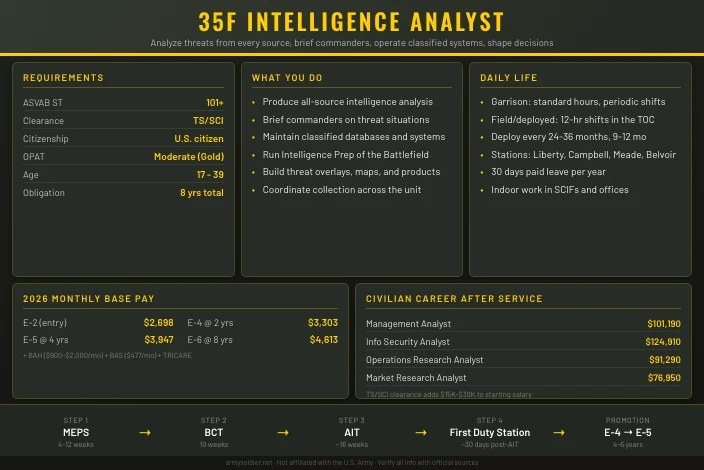
Job Role and Responsibilities
You analyze threat data from multiple intelligence sources, produce reports and briefings that commanders use to make operational decisions, maintain classified databases, and coordinate intelligence activities across your unit. In a tactical environment, you are the person who tells leadership what the enemy is doing and what they are likely to do next.
Your main job is all-source intelligence analysis. That means you pull together information from human intelligence (HUMINT), signals intelligence (SIGINT), imagery, open-source reporting, and other classified feeds. You fuse that data into a picture of the threat environment and present it to decision-makers.
On a typical garrison day, you spend most of your time at a computer. You update enemy order-of-battle databases, build and maintain threat files, and prepare intelligence products like situation maps, overlays, and briefing slides. When your unit has a meeting or planning session, you brief the intelligence portion.
Specialized Roles
The 35F is the base MOS, but you can earn Additional Skill Identifiers (ASIs) that open specialized positions:
| Identifier | Specialization |
|---|---|
| 2D | Police Intelligence Analyst |
| Q7 | Information Collection Planner |
| R7 | Army Reconnaissance |
| S1 | Source Handler |
| V4 | Advanced Source Handler |
| Y6 | Open-Source Intelligence (OSINT) Collector |
Each ASI requires formal training and is restricted to certain skill levels. The Q7 (Information Collection Planner) opens at skill level 2 and lets you plan and synchronize the collection of intelligence across an area of operations.
Mission Contribution
Intelligence analysts sit at the center of the military decision-making process. During planning, you run the Intelligence Preparation of the Battlefield (IPB), which maps out the terrain, weather, enemy forces, and likely courses of action. Your analysis feeds directly into the operations order that tells soldiers where to go and what to do. Bad intelligence gets people killed. Good intelligence saves lives and wins fights.
Technology and Equipment
You work with classified networks and software daily. DCGS-A (Distributed Common Ground System - Army) is the primary intelligence workstation. You also use ArcGIS for geospatial analysis, various intelligence databases, and collaboration tools on SIPRNet and JWICS. In tactical settings, you operate from command posts, vehicles, or field tents with portable systems. The Army continues to push new analytical tools and AI-assisted platforms into this MOS, so the tech changes regularly.
Salary and Benefits
Financial Benefits
Military pay is based on rank and time in service. Most 35F soldiers enter as E-2 or E-3 depending on education credits or other entry programs.
| Rank | Pay Grade | Typical Years | 2026 Monthly Base Pay |
|---|---|---|---|
| Private (PV2) | E-2 | 0-1 | $2,698 |
| Private First Class | E-3 | 1-2 | $2,837 - $3,015 |
| Specialist | E-4 | 2-4 | $3,142 - $3,659 |
| Sergeant | E-5 | 4-6 | $3,947 - $4,109 |
| Staff Sergeant | E-6 | 8-10 | $4,613 - $4,759 |
Base pay is just the start. BAH (Basic Allowance for Housing) varies by duty station and whether you have dependents. A single E-4 gets roughly $900 to $2,000+ per month depending on location. BAS (Basic Allowance for Subsistence) adds $476.95 monthly for food.
The 35F is currently eligible for a signing bonus of up to $7,500 for qualified recruits. Bonus amounts change frequently based on Army manning needs, so confirm the current figure with your recruiter.
Additional Benefits
TRICARE health coverage comes at zero cost for you and your family while on active duty. That covers doctor visits, hospital stays, prescriptions, dental, vision, and mental health.
Education benefits are strong. Tuition Assistance pays up to $4,500 per year for college courses while you serve. After separation, the Post-9/11 GI Bill covers up to 36 months of tuition at a public university (full in-state rate) plus a monthly housing allowance and $1,000 annual book stipend. The private school cap is $29,920.95 per academic year.
Retirement works through the Blended Retirement System (BRS). Serve 20 years and you get a pension worth 40% of your highest 36 months of base pay. The government also matches up to 5% of your Thrift Savings Plan contributions starting in your third year.
Work-Life Balance
You earn 30 days of paid leave per year. In garrison, most intelligence analysts work standard hours with occasional shift work during exercises or heightened operations. Field rotations and deployments change everything. Twelve-hour shifts in a tactical operations center are common during training exercises and real-world operations.
Qualifications and Eligibility
Basic Qualifications
The 35F requires a minimum Skilled Technical (ST) line score of 101 on the ASVAB. The ST composite adds your General Science, Verbal Expression, Mechanical Comprehension, and Math Knowledge subtest scores. High school graduates need at least a 31 AFQT; GED holders need a 50.
You must be a U.S. citizen. This is non-negotiable because of the TS/SCI clearance requirement. No waivers exist for citizenship on this MOS.
| Requirement | Details |
|---|---|
| Age | 17-39 years old |
| Citizenship | U.S. citizen (required for TS/SCI) |
| Education | High school diploma or GED |
| AFQT (ASVAB) | Minimum 31 (diploma) or 50 (GED) |
| Skilled Technical (ST) | Minimum 101 |
| OPAT Category | Moderate (Gold) |
| Security Clearance | Top Secret / SCI |
| Vision | Correctable to 20/20 |
| Color Vision | Normal color vision required |
The OPAT (Occupational Physical Assessment Test) requirement is Moderate, also called Gold. You need to hit minimums on the standing long jump (120 cm), seated power throw (350 cm), strength deadlift (120 lbs), and interval aerobic run (36 shuttles).
Application Process
Start at an Army recruiting station. Your recruiter checks your ASVAB scores, confirms your eligibility, and helps you pick between Active Duty, Reserve, or National Guard.
At MEPS (Military Entrance Processing Station), you take the ASVAB if you haven’t already, complete a physical exam, and begin the security clearance paperwork. If your ST score hits 101 and you pass the medical screening, your recruiter books a 35F training slot.
The timeline from first recruiter visit to ship date is typically 4 to 12 weeks. The TS/SCI investigation starts at MEPS but doesn’t have to be complete before you ship. You receive an interim clearance to begin training. Full adjudication must happen within 12 months of receiving the MOS.
Selection Criteria and Competitiveness
The 35F is one of the most popular intelligence MOSs and training slots fill quickly. A 101 ST is the minimum, but scoring higher makes you more competitive for a slot. College credits, foreign language skills, or prior analytical experience help. No civilian certifications are required to enlist, though they help once you’re in.
Upon Accession into Service
Most recruits enter as E-1 (Private) or E-2 depending on college credits or other qualifying programs like JROTC. The Eagle Scout/Gold Award bump to E-2 also applies. Standard service obligation is 8 years total, split between active duty (typically 3-6 years) and the Individual Ready Reserve.
See our ASVAB study guide for strategies to hit these line scores, or take the PiCAT from home if you are a first-time tester.
Work Environment
Setting and Schedule
Intelligence analysts work in three environments:
- Garrison – SCIFs (Sensitive Compartmented Information Facilities), intelligence offices, and headquarters buildings. Standard duty hours with periodic shift work.
- Field training – tactical operations centers (TOCs) in tents or vehicles. Twelve-hour shifts, sometimes longer during major exercises.
- Deployment – forward operating bases, brigade or battalion TOCs, or joint intelligence centers. Hours follow the mission. Expect 12-hour shifts for weeks straight.
The work is almost entirely indoors, which separates this MOS from most Army jobs. You spend most of your time at a computer, on classified networks, building intelligence products. The physical setting ranges from a modern office building in garrison to a cramped tent with a generator running in the field.
Leadership and Communication
Your chain of command runs through the S2 (intelligence staff section) at battalion or brigade level. The S2 officer (usually a Captain) leads the section, with an intelligence NCO (E-6 or E-7) running daily operations. You report to both.
Briefing is a core part of the job. You present intelligence updates to commanders, staff officers, and sometimes partner nations. Clear writing and confident public speaking matter here more than in most enlisted MOSs.
Team Dynamics and Autonomy
In garrison, you work as part of an intelligence section, usually 4 to 12 people depending on the unit. Collaboration is constant. You share databases, cross-check each other’s analysis, and produce team products.
During operations, junior analysts handle specific tasks like updating threat trackers or monitoring collection feeds. Senior analysts get more autonomy, running their own analysis projects and making assessments that go directly to commanders. The more you prove yourself, the more independent work you get.
Job Satisfaction and Retention
35F has moderate retention. Soldiers who enjoy the analytical work and the clearance-related pay bump on the civilian side tend to stay for one or two enlistments before transitioning to government agencies or defense contractors. The biggest complaints are garrison bureaucracy, PowerPoint fatigue, and the gap between the interesting analysis work and the routine administrative tasks that fill large chunks of the day.
Soldiers in tactical units at places like Fort Liberty or Fort Campbell report higher satisfaction because the work feels more connected to real operations. Those stuck in administrative headquarters assignments sometimes feel like they’re making slides nobody reads.
Training and Skill Development
Initial Training
Training has two phases: Basic Combat Training (BCT) and Advanced Individual Training (AIT).
| Training Phase | Location | Duration | Focus |
|---|---|---|---|
| BCT | Fort Jackson, SC; Fort Moore, GA; Fort Leonard Wood, MO | 10 weeks | Soldier basics: marksmanship, tactics, fitness, discipline |
| AIT | Fort Huachuca, AZ (305th MI Battalion) | ~16 weeks | Intelligence analysis: IPB, all-source fusion, DCGS-A, threat briefings |
BCT is the same 10-week course every soldier completes. You learn to shoot, move, communicate, and follow orders.
AIT at Fort Huachuca is where you become an intelligence analyst. The course covers the Intelligence Preparation of the Battlefield (IPB) process, threat analysis, order-of-battle development, intelligence report writing, and briefing techniques. You learn to operate DCGS-A and other classified analytical tools. The training mixes classroom instruction with practical exercises where you analyze scenarios and brief your findings.
The 305th Military Intelligence Battalion runs the 35F course at Fort Huachuca. The installation sits in southern Arizona, about 75 miles southeast of Tucson. It’s small and isolated compared to major Army posts.
Advanced Training
After AIT, your development continues at your first unit. Most intelligence sections run internal training programs to get new analysts up to speed on their specific area of operations.
Formal schools open up as you gain rank:
- Advanced Leaders Course (ALC) at Fort Huachuca for E-5s preparing for staff sergeant
- Senior Leaders Course (SLC) for E-6s moving toward platoon sergeant or senior analyst roles
- Sergeants Major Academy at Fort Bliss for E-8s selected for the senior enlisted ranks
You can also earn ASI qualifications through specialized courses. The Information Collection Planners Course (Q7) and the Source Handler Course (S1) are two of the most common paths for 35F soldiers. These courses expand what you can do in the intelligence field and make you more valuable to your unit.
The Army Credentialing Assistance (CA) program and Tuition Assistance can fund industry certifications like CompTIA Security+, Certified Defense All-Source Analysis Supervisor (CDASA), or project management credentials. These pay off both in service and after you separate.
Everything starts with qualifying ASVAB scores — our study guide covers what to study first.
Career Progression and Advancement
Career Path
Promotion timelines for 35F follow the standard enlisted track. Automatic promotions carry you to E-4 if you meet time-in-service requirements and stay out of trouble. E-5 and above require board selection.
| Rank | Pay Grade | Typical Time | Role |
|---|---|---|---|
| Private (PV2) | E-2 | 0-1 year | AIT graduate, entry-level analyst |
| Private First Class (PFC) | E-3 | 1-2 years | Analyst, building core skills |
| Specialist (SPC) | E-4 | 2-3 years | Experienced analyst, leads small tasks |
| Sergeant (SGT) | E-5 | 4-6 years | Team leader, supervises junior analysts |
| Staff Sergeant (SSG) | E-6 | 6-10 years | Section NCOIC, intelligence operations manager |
| Sergeant First Class (SFC) | E-7 | 10-14 years | Senior intelligence NCO, S2 NCOIC |
| Master Sergeant (MSG) | E-8 | 14-18 years | Senior enlisted advisor, intelligence staff |
At E-5, you transition from doing analysis to leading analysts. You run a team, review products, mentor junior soldiers, and manage your section’s workload. E-6 and above focus on operations management and training.
35F soldiers can also compete for warrant officer positions. The 350F (All-Source Intelligence Technician) warrant officer track is a natural progression for experienced analysts who want to stay technical rather than move into pure leadership. Warrant officers serve as the subject matter experts that commanders rely on for deep analytical capability.
Role Flexibility and Transfers
Lateral moves within CMF 35 are possible with leadership approval and available training seats. Common transitions include 35G (Geospatial Intelligence Imagery Analyst) or 35L (Counterintelligence Agent). Moving to 35L requires additional screening and a separate selection process.
For enlisted soldiers, reclassification is the standard path. You need your chain of command to support the move, and you have to meet the new MOS requirements.
Performance Evaluation
NCOs are rated through the NCOER (NCO Evaluation Report) annually. Your rater and senior rater evaluate your leadership, technical competence, and character. Strong NCOERs are the biggest factor in promotion to E-6 and above.
What actually separates top performers: producing intelligence that commanders use, developing junior analysts who can work independently, earning ASI qualifications, and volunteering for the tougher assignments. Analysts who can brief confidently and write clean intelligence products get noticed.
Physical Demands and Medical Evaluations
Physical Requirements
The 35F is not a physically demanding MOS compared to combat arms. Most of your work happens at a desk or in front of a computer. But you’re still a soldier, and the Army expects you to stay in shape.
Field exercises and deployments add physical requirements. You move equipment, set up communications gear, and sometimes relocate your workspace on short notice. In tactical environments, you may need to carry your gear and move with your unit.
Every soldier takes the Army Fitness Test (AFT) at least once a year. The AFT replaced the ACFT in June 2025. It has five events, each scored 0 to 100:
| Event | Minimum (Ages 17-21) |
|---|---|
| 3-Rep Max Deadlift (MDL) | 140 lbs (male) / 80 lbs (female) |
| Hand-Release Push-Up (HRP) | 10 reps (both) |
| Sprint-Drag-Carry (SDC) | 2:40 (male) / 3:40 (female) |
| Plank (PLK) | 2:00 (both) |
| Two-Mile Run (2MR) | 15:54 (male) / 18:54 (female) |
You need at least 60 points per event and 300 total to pass. The general standard is sex- and age-normed, so minimums adjust by age bracket. Intelligence MOSs use the 300-point general standard, not the 350-point combat standard.
Medical Evaluations
You get annual health screenings covering weight, blood pressure, vision, and hearing. The Periodic Health Assessment (PHA) is mandatory. Before deployments, a separate medical clearance process checks that you’re fit for the operational environment. Any condition that could limit your ability to work in a SCIF or handle the deployment tempo gets evaluated.
Normal color vision is required for this MOS. Some analytical tasks involve color-coded map products and imagery that require accurate color discrimination.
Deployment and Duty Stations
Deployment Details
Intelligence analysts deploy with their units. The standard rotation is roughly 9 to 12 months deployed, followed by 24 to 36 months at home station. Units at Fort Liberty or Fort Campbell deploy more frequently.
Deployed 35F soldiers work in brigade and battalion TOCs, joint intelligence centers, or combined facilities alongside partner nations. Most deployment work happens inside secured facilities, though some assignments place analysts closer to the fight.
Location Flexibility
The Army assigns duty stations based on its needs. You submit preferences, but the needs of the Army come first. Intelligence analysts have a wider spread of possible duty stations than many MOSs because every brigade and above has an intelligence section.
Common duty stations for 35F soldiers:
- Fort Liberty, NC (XVIII Airborne Corps, 82nd Airborne Division)
- Fort Campbell, KY (101st Airborne Division)
- Fort Moore, GA (Maneuver Center of Excellence)
- Fort Meade, MD (NSA, INSCOM)
- Fort Belvoir, VA (DIA, various intelligence organizations)
- Fort Huachuca, AZ (U.S. Army Intelligence Center of Excellence)
- Joint Base Lewis-McChord, WA (I Corps)
- Overseas: Germany, South Korea, Japan, Italy
Fort Meade and Fort Belvoir assignments put you near national-level agencies where the work skews strategic. Tactical units at Fort Liberty or Fort Campbell offer more deployment opportunities and hands-on operational experience.
Risk, Safety, and Legal Considerations
Job Hazards
The physical risks for a 35F are lower than combat arms MOSs. You work indoors most of the time. The main occupational hazards are sedentary work (long hours at a computer), eye strain, and the mental toll of processing disturbing intelligence about enemy activities, civilian casualties, or threats to friendly forces.
In deployed environments, the risks increase. Indirect fire (rockets, mortars) can hit any base. Vehicle movements between locations carry IED risk. The psychological stress of supporting combat operations, especially when things go wrong, is real and often underestimated.
Safety Protocols
SCIFs have strict security procedures: no personal electronic devices, controlled access, and constant monitoring. In field environments, you follow unit tactical SOPs for force protection. Body armor and helmets are required outside the wire on deployments.
The Army provides mental health resources through Military OneSource, embedded behavioral health teams, and chaplain services. Intelligence work involves exposure to sensitive and sometimes disturbing material. Using those resources is not a weakness.
Security and Legal Requirements
The 35F requires a Top Secret clearance with Sensitive Compartmented Information (TS/SCI) access. This is one of the highest clearance levels in the military and opens doors to work with national intelligence agencies.
The investigation covers your financial history, foreign contacts and travel, drug and alcohol use, criminal record, and personal conduct references.
You must maintain the clearance throughout your career. Any reportable incidents (arrests, new foreign contacts, financial problems) require immediate disclosure to your security manager. Failing to report can result in clearance revocation and removal from the MOS.
All soldiers follow the Uniform Code of Military Justice (UCMJ). Intelligence soldiers have additional obligations around information security. Unauthorized disclosure of classified information is a federal crime.
Impact on Family and Personal Life
Family Considerations
Military life means moves, deployments, and irregular hours. Intelligence analysts face the same family challenges as any soldier. Deployments run 9 to 12 months. PCS moves happen every 2 to 4 years.
The TS/SCI clearance adds complexity. You can’t talk about work at home. Your spouse and family members undergo background checks as part of the clearance investigation. Foreign-born spouses or significant foreign contacts can complicate or delay clearance processing.
Support resources at most installations:
- Family Readiness Groups (FRGs) for peer support through your unit
- Military OneSource for free counseling and family services
- Spousal employment assistance at each new duty station
- Exceptional Family Member Program (EFMP) for families with special needs
Relocation and Flexibility
Expect to move every 2 to 4 years. The Army pays for the move, but every PCS disrupts your family’s routine. The upside for 35F soldiers: duty station options are broader than many MOSs, so you have a better chance of landing a location that works for your family. Assignments near Fort Meade or Fort Belvoir put you in the DC metro area, which offers strong spousal employment opportunities.
Reserve and National Guard
The 35F Intelligence Analyst is available in both the Army Reserve and Army National Guard. It is the most common intelligence MOS in the Reserve components, with positions in military intelligence companies, brigade combat team intelligence sections, and theater-level analysis units across most states. You must maintain your TS/SCI clearance to drill, which adds some administrative overhead but keeps your clearance current for civilian employment.
Drill Schedule and Training Commitment
Standard commitment is one weekend per month (Battle Assembly) plus two weeks of Annual Training per year. Drill weekends for 35F soldiers include intelligence product development, analytical tool training, threat briefing exercises, and order-of-battle updates. Annual Training often involves supporting a division or corps-level exercise in the intelligence cell. You may have additional training days for classified system recertification, intelligence software updates, and professional military education courses.
Part-Time Pay
An E-4 with over 3 years of service earns about $464 per drill weekend (4 drill periods), totaling roughly $5,572 per year from drill pay plus about $1,741 for 15 days of Annual Training. Active-duty E-4 base pay is $3,482 per month. Many Reserve/Guard 35F soldiers earn significantly more in civilian intelligence or defense contractor roles, making the part-time military pay supplemental income rather than a primary salary.
Benefits Differences
Tricare Reserve Select costs $57.88 per month for member-only or $286.66 per month for family coverage in 2026. Active-duty TRICARE Prime is free.
Education benefits include Federal Tuition Assistance ($250 per credit hour, up to $4,500 per year) and the Montgomery GI Bill-Selected Reserve at $493 per month for full-time students. Guard members may qualify for state tuition waivers. Mobilization of 90 or more days earns Post-9/11 GI Bill eligibility.
Reserve retirement is points-based, requiring 20 qualifying years. Collection starts at age 60, reduced by 3 months per 90-day mobilization after January 2008, minimum age 50.
Deployment and Mobilization
35F soldiers in Reserve/Guard units see moderate to high mobilization rates. Intelligence analysts are needed in every theater, and Reserve component MI units have been activated regularly for rotations to the Middle East, Europe, and the Pacific. Individual augmentee deployments are also common, where a single 35F fills a slot at a combatant command or joint task force. Typical mobilizations last 9 to 12 months.
Civilian Career Integration
The 35F is one of the strongest Reserve/Guard MOS for civilian career overlap. An active TS/SCI clearance combined with analytical skills makes you competitive for positions at defense contractors, federal intelligence agencies (DIA, CIA, NSA), law enforcement fusion centers, and corporate security firms. Many Reserve/Guard 35F soldiers work intelligence jobs during the week and drill on weekends, keeping both skill sets sharp. USERRA protects your civilian job during activations, and employers must reinstate you with the seniority you would have earned.
| Feature | Active Duty | Army Reserve | Army National Guard |
|---|---|---|---|
| Commitment | Full-time | 1 weekend/month + 2 weeks/year | 1 weekend/month + 2 weeks/year |
| Monthly Pay (E-4, 3+ yrs) | $3,482 | ~$464/drill weekend | ~$464/drill weekend |
| Healthcare | TRICARE Prime ($0) | Tricare Reserve Select ($57.88/mo) | Tricare Reserve Select ($57.88/mo) |
| Education | Federal TA, Post-9/11 GI Bill | Federal TA, MGIB-SR ($493/mo) | Federal TA, MGIB-SR, state tuition waivers |
| Deployment Tempo | Regular rotations | Moderate-high (unit + individual) | Moderate-high (unit + individual) |
| Retirement | 20-year pension at age 40+ | Points-based, collect at age 60 | Points-based, collect at age 60 |
Post-Service Opportunities
Transition to Civilian Life
A 35F background with a TS/SCI clearance is one of the most marketable combinations in the military. Your clearance alone can add $15,000 to $30,000 to your starting salary compared to an equivalent position without one. Intelligence training translates directly to civilian roles in threat analysis, cybersecurity, data analysis, and risk management.
The Transition Assistance Program (TAP) helps with resume writing, interview prep, and benefits counseling during your last year on active duty. The Post-9/11 GI Bill covers up to 36 months of tuition plus a housing allowance. Many 35F veterans use it to finish degrees in intelligence studies, cybersecurity, or data science.
Civilian Career Prospects
| Civilian Job | Median Annual Salary (2024) | 10-Year Outlook |
|---|---|---|
| Management Analyst | $101,190 | +9% |
| Information Security Analyst | $124,910 | +29% |
| Operations Research Analyst | $91,290 | +21% |
| Market Research Analyst | $76,950 | +7% |
Salary data from the Bureau of Labor Statistics Occupational Outlook Handbook. The intelligence and cybersecurity fields are growing faster than most occupations, and cleared professionals command a premium.
Government agencies (CIA, DIA, NSA, FBI) and defense contractors (Booz Allen Hamilton, CACI, Leidos, Northrop Grumman) hire 35F veterans aggressively. Starting salaries for cleared analysts at these organizations typically range from $65,000 to $95,000 depending on location and experience.
Post-Service Policies
An honorable discharge gives you access to VA healthcare, disability compensation (if applicable), and education benefits. You can separate after your obligation ends or re-enlist for another term. Talk to your career counselor well before your ETS date to understand your options.
Your TS/SCI clearance stays active for a period after separation if you move into a position that requires it. Gaps in clearance usage may require reinvestigation, so lining up cleared employment before you separate saves time and money.
Is This a Good Job for You?
Ideal Candidate Profile
The best intelligence analysts are detail-oriented people who enjoy solving puzzles with incomplete information. You don’t need to be a genius, but you do need to think critically and communicate clearly.
Traits that predict success:
- Comfortable reading dense material and pulling out what matters
- Strong writing skills (you will write constantly)
- Able to present findings to a room of officers without freezing up
- Curious about world events, military history, or geopolitics
- Patient enough to spend hours cross-referencing databases
A background in debate, journalism, research, or competitive academics helps. So does genuine interest in foreign affairs, military operations, or data analysis.
Potential Challenges
This MOS is a poor fit if you:
- Need constant physical activity and hate desk work
- Struggle with reading comprehension or written communication
- Can’t handle classified information responsibly
- Have significant financial problems, drug history, or foreign ties that would prevent a TS/SCI clearance
- Get frustrated by bureaucracy and repetitive tasks
The gap between the exciting intelligence work you imagine and the daily reality of database maintenance, slide production, and administrative tasks catches a lot of new analysts off guard. The interesting work is real, but it doesn’t fill every hour of every day.
Career and Lifestyle Fit
If you want a military career that builds directly transferable skills for high-paying civilian jobs, the 35F is hard to beat. The TS/SCI clearance, analytical training, and intelligence community network give you options that most MOSs don’t.
The trade-off: you sit at a desk more than most soldiers. Deployments still happen. You move every few years. And the clearance investigation means your personal life gets examined under a microscope before you even start.
This job works well for people who are curious, analytical, and willing to deal with Army bureaucracy in exchange for real-world intelligence experience that pays off massively after service.
More Information
Talk to an Army recruiter about the 35F. Ask about current bonus amounts, training dates, and whether your ASVAB scores qualify. Request to speak with a current intelligence analyst so you can hear what the day-to-day work actually looks like.
Take the MOS Finder quiz at goarmy.com
Schedule an ASVAB at your nearest MEPS to see where your scores land
Research the intelligence community to understand where 35F veterans work after service
Prepare for the ASVAB with our study guide to make sure your line scores qualify
This site is not affiliated with the U.S. Army or any government agency. Verify all information with official Army sources before making enlistment or career decisions.
Explore more Army intelligence careers such as 35M Human Intelligence Collector and 35N Signals Intelligence Analyst.