35G Geospatial Intelligence Imagery Analyst
Satellite images don’t interpret themselves. Someone has to look at a photograph of a hillside in a denied area, figure out that a building has appeared overnight, and tell the commander what it means before troops move. That job belongs to the 35G Geospatial Intelligence Imagery Analyst.
This MOS is one of the most directly connected to national-level intelligence collection in the Army’s enlisted force. Analysts work with imagery from satellites, drones, and airborne systems, turning raw data into battlefield decisions. The work happens mostly at a workstation, but the consequences reach soldiers in the field.
If you’re sharp with spatial reasoning, comfortable with classified systems, and want a technical career that transitions cleanly into federal or defense contractor jobs, this MOS is worth a serious look.
Qualifying requires specific ASVAB line scores — our ASVAB study guide covers what to target and how to prepare.
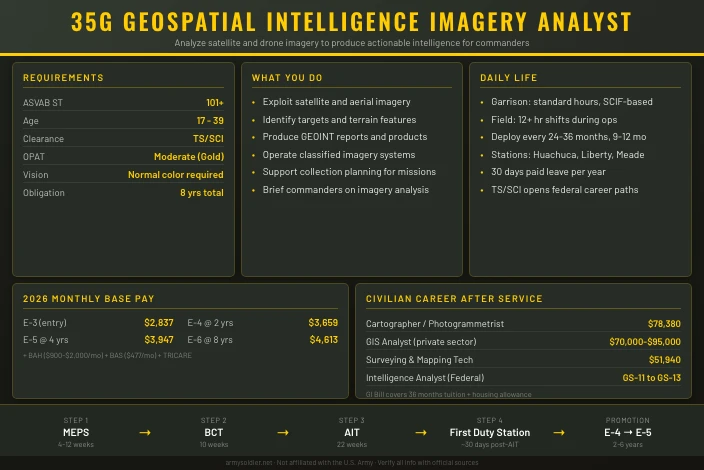
Job Role and Responsibilities
The 35G analyzes imagery from overhead and airborne collection systems to identify enemy forces, terrain features, infrastructure, and threats. Analysts produce geospatial intelligence (GEOINT) products used by commanders at every level to plan operations, assess battle damage, and support lethal and nonlethal targeting. This is a technical intelligence role requiring strong analytical judgment and attention to detail.
Daily Tasks
A typical day for a 35G involves working with multiple classified software systems to process and interpret imagery. Core daily activities include:
- Exploiting imagery from national, theater, and tactical collection systems
- Identifying, measuring, and reporting targets, equipment, and facilities
- Preparing maps, charts, overlays, and reports for command briefings
- Conducting battle damage assessments after strike operations
- Analyzing full motion video from drone feeds alongside still imagery
- Producing environmental and civil considerations reports for maneuver units
Specific Roles
The Army uses the MOS code 35G as the primary designation for this career field. Soldiers may earn Additional Skill Identifiers (ASIs) over time to denote specialized proficiency in targeting, imagery exploitation, or specific collection platforms.
| System | Code | Description |
|---|---|---|
| Primary MOS | 35G | Geospatial Intelligence Imagery Analyst |
| ASI | Various | Awarded for specialized skills in targeting, specific platforms, or advanced exploitation techniques |
Mission Contribution
The Army cannot maneuver without knowing what’s on the ground. The 35G provides that picture. Analysts support Intelligence, Surveillance, and Reconnaissance (ISR) operations from tactical brigade level up to theater and national agencies including the National Geospatial-Intelligence Agency (NGA). At deployed locations, a 35G’s product can determine whether a route is safe, whether a facility is armed, or whether a suspected target matches the pattern of life data in the system.
Technology and Equipment
Analysts work with a classified suite of imagery exploitation and geospatial software. This includes tools for measuring, annotating, and disseminating imagery products, plus full motion video exploitation platforms. At higher-echelon units and agencies like NGA, analysts also work with unclassified geospatial software packages that parallel industry GIS tools. The skills learned on classified systems transfer directly to commercial Geographic Information System (GIS) platforms used in the private sector.
Salary and Benefits
Pay comes from the same DFAS military pay table as every other Army soldier and depends on grade and time in service. The figures below reflect 2026 rates.
Base Pay
| Grade | Rank | Entry Pay (under 2 yrs) | Mid-Career Pay (4 yrs) | Pay at 8 yrs |
|---|---|---|---|---|
| E-3 | Private First Class (PFC) | $2,837/mo | $3,198/mo | $3,198/mo |
| E-4 | Specialist (SPC) | $3,142/mo | $3,659/mo | $3,816/mo |
| E-5 | Sergeant (SGT) | $3,343/mo | $3,947/mo | $4,299/mo |
| E-6 | Staff Sergeant (SSG) | $3,401/mo | $4,069/mo | $4,613/mo |
| E-7 | Sergeant First Class (SFC) | $3,932/mo | $4,663/mo | $5,105/mo |
Source: DFAS 2026 Military Pay Chart
Additional Allowances
Base pay is the floor, not the ceiling. Most soldiers receive additional tax-free allowances:
- BAS (Basic Allowance for Subsistence): $476.95/month flat rate for all enlisted soldiers in 2026
- BAH (Basic Allowance for Housing): Varies by duty location and dependency status. An E-4 at Fort Liberty, NC draws roughly $1,350 to $1,900 per month depending on dependents. Use the DoD BAH calculator for your specific station.
- No current enlistment bonus is advertised for this MOS as of early 2026. Check with a recruiter for the most current incentive status.
Additional Benefits
Every active duty soldier receives TRICARE Prime at no cost, which covers medical, dental, vision, mental health, and prescriptions with zero copays and no deductibles for the service member. Family members enroll at no cost with a $1,000 annual out-of-pocket cap for in-network care.
The Army’s retirement system is the Blended Retirement System (BRS). It combines a pension worth 40% of your high-36 average basic pay after 20 years with a Thrift Savings Plan (TSP) that includes automatic 1% government contributions and matching up to 4%. Soldiers who contribute 5% of basic pay to TSP receive the full government match.
Education benefits include Tuition Assistance while on active duty, covering up to $4,500 per year and $250 per semester hour, plus access to the Post-9/11 GI Bill after service, which covers full in-state tuition at public universities and up to $29,920.95 annually at private schools for the 2025-2026 academic year.
Work-Life Balance
Soldiers earn 30 days of paid leave per year, accruing at 2.5 days per month. Work schedules in garrison are generally consistent business hours, though operational requirements, exercises, and deployments break that rhythm. Intelligence units often work shift schedules at deployed locations to maintain 24-hour coverage.
Qualifications and Eligibility
Eligibility Table
| Requirement | Standard |
|---|---|
| ASVAB Line Score | ST: 101 minimum |
| Security Clearance | Top Secret / SCI (TS/SCI) |
| Citizenship | U.S. citizen required (no dual citizenship waivers for TS/SCI) |
| Age | 17-39 at enlistment |
| OPAT Category | Moderate (Gold) |
| Vision | Correctable to 20/20 |
| Color Vision | Required; color vision deficiency may disqualify |
Source: DA Pam 611-21, Army MOS 35G Specification
The ST (Skilled Technical) composite is calculated as: GS + VE + MK + MC. A score of 101 requires solid performance across General Science, Verbal Expression, Math Knowledge, and Mechanical Comprehension. Most candidates who score 101 or above on ST also pass the AFQT minimum without issue.
The OPAT
The Occupational Physical Assessment Test (OPAT) places 35G in the Moderate (Gold) physical demand category. This is not the most demanding category, which reflects the desk-based nature of the work. Recruits take the OPAT at MEPS before enlistment.
Application Process
- Meet with an Army recruiter and confirm you meet basic eligibility
- Take the ASVAB and achieve ST 101 or higher
- Complete OPAT at MEPS; qualify in the Moderate category
- Complete a medical examination at MEPS
- Sign an enlistment contract specifying 35G
- Begin background investigation paperwork for TS/SCI clearance
The background investigation is the longest step. Investigators contact references, review finances, and examine any foreign contacts. Candidates with complicated backgrounds should discuss their history with a recruiter before committing; some factors can be waived, others cannot.
Selection Criteria
This MOS is moderately competitive. The ST score cutoff is firm. The TS/SCI investigation is the real filter: candidates with significant debt, foreign contacts, or legal history may face denial or extended review. Strong analytical aptitude, a clean record, and no unexplained foreign travel are the best preparation.
Service Obligation
Most enlistment contracts run three to four years of active duty service. Total Military Service Obligation (MSO) is eight years, which may be served in a combination of active duty, Army Reserve, or Individual Ready Reserve (IRR).
See our ASVAB study guide for strategies to hit these line scores, or take the PiCAT from home if you are a first-time tester.
Work Environment
Most 35G duty assignments place soldiers inside secured facilities called Sensitive Compartmented Information Facilities (SCIFs). The work environment is climate-controlled, screen-intensive, and quiet. Days involve long stretches at a workstation with multiple monitors displaying classified imagery and geospatial data.
Setting and Schedule
Garrison assignments generally run standard duty hours Monday through Friday, with additional PT in the morning before work begins. Deployed environments shift to rotating watch schedules, often 12-hour shifts, to maintain continuous intelligence production. Some higher-echelon assignments at agencies like NGA operate 24-hour operations centers with fixed shift rotations.
Physical isolation from uncleared colleagues is normal. Analysts can’t discuss work with family or non-cleared friends. This is a consistent feature of the job, not an occasional inconvenience.
Leadership and Communication
The immediate chain of command for a junior 35G runs from the team or section NCO through the intelligence officer (35D or MI Officer). Performance counseling happens formally through the Non-Commissioned Officer Evaluation Report (NCOER) system for E-5 and above, and through developmental counseling for junior enlisted. Intelligence units tend to have tight NCO oversight because errors in analysis can have serious consequences.
Team Dynamics and Autonomy
Junior analysts work under supervision and have their products reviewed before dissemination. With experience, analysts at E-5 and above take on independent exploitation tasks and may lead all-source fusion efforts that combine imagery with signals and human intelligence products. Senior NCOs lead sections and mentor junior analysts through complex targeting problems.
Job Satisfaction and Retention
Soldiers who enjoy this MOS typically cite the intellectual engagement of the work, the classified access, and the clear civilian marketability. Analysts who want predictable schedules and no deployments find the operational tempo difficult. The re-enlistment rate varies by assignment; analysts at national-level agencies and high-demand units tend to stay longer because the work is more varied and the career advancement is faster.
Training and Skill Development
Initial Training
| Phase | Location | Length | Focus |
|---|---|---|---|
| BCT | Various Army installations | 10 weeks | Soldierization, fitness, weapons |
| AIT (35G) | Fort Huachuca, AZ | 22 weeks | Imagery exploitation, GEOINT analysis, reporting |
| TS/SCI Adjudication | Concurrent/post-AIT | 6-18 months | Background investigation |
The AIT at Fort Huachuca covers collection planning for overhead and airborne imagery, analysis of satellite and drone feeds, map and chart production, and target materials development. Students work on classified systems from the first weeks of training.
Advanced Training
After the initial assignment, experienced 35G analysts have access to advanced courses and specialized training:
- Geospatial Career Advancement Program (GCAP): Available to E-5 and E-6 soldiers with 5 to 12 years of service and strong performance records. Provides advanced analytic and leadership development.
- Advanced Imagery Analysis courses: Offered through the National Geospatial-Intelligence Agency and DIA for senior analysts.
- Joint and interagency assignments: Experienced 35Gs regularly serve at NSA, DIA, NGA, and SOCOM, gaining exposure to collection capabilities beyond the Army’s organic systems.
- Civilian certifications: The Army COOL program funds certifications relevant to this MOS, including GIS-related credentials from ASPRS (American Society for Photogrammetry and Remote Sensing) and GISP (GIS Professional) certification.
Everything starts with qualifying ASVAB scores — our study guide covers what to study first.
Career Progression and Advancement
Career Path
Promotion for 35G follows the Army-wide enlisted timeline. The MOS community is small enough that a solid record and willingness to take joint assignments accelerates advancement.
| Grade | Rank | Typical Timeframe | Role |
|---|---|---|---|
| E-1 to E-3 | PV1 to PFC | 0-18 months | AIT student; junior analyst under supervision |
| E-4 | Specialist (SPC) | 18-36 months | All-source exploitation; independent imagery tasks |
| E-5 | Sergeant (SGT) | 3-5 years | Team leader; leads exploitation section |
| E-6 | Staff Sergeant (SSG) | 5-8 years | Section NCOIC; senior analyst; joint assignments |
| E-7 | Sergeant First Class (SFC) | 8-14 years | Platoon Sergeant; MI Company intelligence section |
| E-8 | Master Sergeant (MSG) | 12-18 years | Senior intelligence NCO; battalion or brigade |
| E-9 | Sergeant Major (SGM) | 18-22 years | Senior advisory role; corps or division MI |
Specialization Opportunities
Soldiers can request assignment to joint agencies including the NGA, Defense Intelligence Agency (DIA), and National Security Agency (NSA) through the Intelligence Community Military Assignment Program. These positions require TS/SCI clearance and strong performance records. Joint assignments give analysts access to collection systems and analytic tools unavailable at most Army units, and they tend to open the door to high-value federal civilian or contractor positions after separation.
The warrant officer path is also open to experienced 35G soldiers. Warrant Officer MOS 350G (GEOINT Imagery Technician) is a direct technical progression for enlisted analysts who want to specialize further without taking the officer commissioning route.
Role Flexibility and Transfers
Army soldiers can request reclassification to a new MOS after their initial contract term. Intelligence soldiers with TS/SCI clearance are attractive candidates for other clearance-dependent MOSs like 35F, 35N, and 35P. Lateral moves within the intelligence community are common because the clearance is already in place.
Performance Evaluation
NCOs (E-5 and above) are evaluated through the Army’s Non-Commissioned Officer Evaluation Report (NCOER). Junior enlisted receive developmental counseling from their NCO chain quarterly. Intelligence units place heavy weight on product quality, timeliness of analysis, and demonstrated ability to learn new collection systems.
Success in this MOS comes from treating every product as if it will be used in a real operation, because most of them will be.
Physical Demands and Medical Evaluations
Physical Requirements
The 35G is not a physically demanding MOS day-to-day. The work is sedentary at a workstation. But Army fitness standards still apply, and all soldiers must pass the Army Fitness Test (AFT) regardless of MOS.
The AFT has five events scored 0-100 points each, with a maximum of 500 points total. All soldiers must score at least 60 points per event. The general standard for non-combat specialty MOSs is a minimum of 300 points total, scored on sex- and age-normed scales. The 35G falls under the general standard, not the combat specialty standard of 350 points.
| AFT Event | Abbreviation | Description |
|---|---|---|
| 3 Rep Max Deadlift | MDL | Measures lower body and core strength |
| Hand Release Push-Up | HRP | Measures upper body endurance |
| Sprint-Drag-Carry | SDC | Measures agility and anaerobic capacity |
| Plank | PLK | Measures core endurance |
| Two-Mile Run | 2MR | Measures aerobic endurance |
Source: Army Fitness Test (AFT), effective June 1, 2025
Medical Evaluations
Periodic health assessments are required throughout the career. Color vision is a meaningful requirement for imagery analysis; deficiency may disqualify applicants at MEPS. Soldiers must maintain fitness standards continuously; failing the AFT can result in initiation of a Physical Fitness Improvement Program and, if unresolved, administrative separation. The TS/SCI clearance also requires periodic re-investigation (typically every five years), which includes a review of medical history if relevant to judgment or reliability.
Deployment and Duty Stations
Deployment Details
Intelligence soldiers deploy with the units they support. A 35G assigned to a Brigade Combat Team (BCT) deploys when that brigade deploys, typically for 9 to 12 months. Deployment frequency varies by unit type: BCT soldiers may deploy every 18 to 36 months, while analysts at national-level agencies may have more predictable schedules with less frequent overseas deployments.
Deployments are predominantly overseas, supporting operations in the Middle East, Eastern Europe, the Pacific, and Korea. Some CONUS assignments involve limited overseas TDY (temporary duty) rather than full deployments.
Location Flexibility
Common duty stations for 35G include:
- Fort Liberty, NC (formerly Fort Bragg): Home to multiple airborne and special operations units with large MI elements
- Fort Belvoir, VA: Home to NGA headquarters; analysts here work directly in national-level intelligence production
- Fort Meade, MD: NSA proximity; some MI assignments
- Fort Huachuca, AZ: Training base; some permanent party assignments as instructors
- Camp Humphreys, South Korea: Significant overseas presence supporting Korea theater intelligence
- Wiesbaden, Germany: U.S. Army Europe intelligence assignments
Initial duty stations are assigned by the Army based on needs. Soldiers can submit preference statements, and some contracts include a duty station guarantee. Rank and performance history influence future assignment requests.
Risk, Safety, and Legal Considerations
Job Hazards
The 35G’s primary daily risk is not physical danger but information security risk. Working with Top Secret/SCI information under strict access controls is mandatory and legally binding. Unauthorized disclosure of classified information is a federal crime under the Espionage Act.
Deployed analysts face the same general physical risks as other soldiers in combat zones, including indirect fire, vehicle accidents, and environmental hazards. Work inside a SCIF at a forward operating base offers more physical protection than combat roles, but the environment is not without risk.
Safety Protocols
SCIFs have strict physical security requirements including access control, no unauthorized electronic devices, and clean desk policies. Analysts are trained in information security procedures during AIT and receive recurring training throughout their careers. Violations are investigated by unit security officers and can result in clearance revocation and criminal prosecution.
Security and Legal Requirements
The security clearance investigation covers the seven to ten years prior to application, examining finances, foreign travel, foreign contacts, employment history, and personal conduct. Candidates must be U.S. citizens; dual citizenship is not allowed for TS/SCI. The investigation can be expedited with a thorough, honest disclosure during the SF-86 application process.
The enlistment contract creates a legal obligation to serve for the agreed term. Breaking a service contract without legal grounds results in involuntary separation, which can affect access to education benefits and future federal employment.
Impact on Family and Personal Life
Family Considerations
Intelligence work affects family life in specific ways beyond general Army deployments. Analysts cannot discuss their work at home, which some family members find frustrating. Duty stations are concentrated at specific installations near intelligence commands, limiting geographic variety compared to other Army careers.
The Army provides family support through Military OneSource counseling, Family Readiness Groups (FRGs), and on-post family services. TRICARE covers the entire family at no cost, which represents real financial value for families with children.
Relocation and Flexibility
Army families move on average every two to three years. Intelligence assignments often cluster at specific installations (Fort Liberty, Fort Belvoir, Fort Meade, and overseas), so families can plan around a shorter list of likely locations. This can be an advantage for families who research and prefer specific areas, or a limitation for those with geographic ties.
Deployments run 9 to 12 months for most BCT assignments. The Army offers pre-deployment family preparation resources, rear detachment support during deployments, and reintegration programs after return.
Reserve and National Guard
The 35G Geospatial Intelligence Imagery Analyst is available in both the Army Reserve and Army National Guard. Positions exist in MI companies and geospatial analysis units, though the total number of 35G billets is smaller than 35F slots. You must maintain your TS/SCI clearance to drill, which keeps your clearance active for civilian employers. Some Reserve/Guard units have access to classified imagery systems during drill, while others use unclassified training tools for proficiency.
Drill Schedule and Training Commitment
Standard commitment is one weekend per month (Battle Assembly) plus two weeks of Annual Training per year. Drill weekends for 35G soldiers include imagery analysis exercises, GIS software training, terrain analysis products, and classified system refreshers when available. Annual Training often involves supporting a division exercise with geospatial products. Additional training days may be needed for classified system recertification and software updates.
Part-Time Pay
An E-4 with over 3 years of service earns about $464 per drill weekend (4 drill periods), totaling roughly $5,572 per year from drill pay plus about $1,741 for 15 days of Annual Training. Active-duty E-4 base pay is $3,482 per month. Civilian geospatial analysts with TS/SCI clearances earn well above active-duty enlisted pay, making Reserve/Guard service primarily a supplemental income and benefits source.
Benefits Differences
Tricare Reserve Select costs $57.88 per month for member-only or $286.66 per month for family coverage in 2026. Active-duty TRICARE Prime is free.
Education benefits include Federal Tuition Assistance ($250 per credit hour, up to $4,500 per year) and the Montgomery GI Bill-Selected Reserve at $493 per month for full-time students. Guard members may qualify for state tuition waivers. Mobilization of 90 or more days earns Post-9/11 GI Bill eligibility.
Reserve retirement is points-based, requiring 20 qualifying years. Collection starts at age 60, reduced by 3 months per 90-day mobilization after January 2008, minimum age 50.
Deployment and Mobilization
35G soldiers in Reserve/Guard units see moderate mobilization rates. Geospatial intelligence is in demand across all theaters, and individual augmentee fills are common. Unit mobilizations are less frequent than 35F but still occur. Typical tours run 9 to 12 months.
Civilian Career Integration
The 35G pairs directly with civilian geospatial intelligence, GIS analysis, and remote sensing careers. NGA (National Geospatial-Intelligence Agency), defense contractors, and commercial satellite companies hire 35G-trained analysts. An active TS/SCI clearance is a major advantage. USERRA protects your civilian job during activations, and employers must reinstate you with the seniority you would have earned.
| Feature | Active Duty | Army Reserve | Army National Guard |
|---|---|---|---|
| Commitment | Full-time | 1 weekend/month + 2 weeks/year | 1 weekend/month + 2 weeks/year |
| Monthly Pay (E-4, 3+ yrs) | $3,482 | ~$464/drill weekend | ~$464/drill weekend |
| Healthcare | TRICARE Prime ($0) | Tricare Reserve Select ($57.88/mo) | Tricare Reserve Select ($57.88/mo) |
| Education | Federal TA, Post-9/11 GI Bill | Federal TA, MGIB-SR ($493/mo) | Federal TA, MGIB-SR, state tuition waivers |
| Deployment Tempo | Regular rotations | Moderate (unit + individual) | Moderate (unit + individual) |
| Retirement | 20-year pension at age 40+ | Points-based, collect at age 60 | Points-based, collect at age 60 |
Post-Service Opportunities
Skills in imagery analysis and geospatial intelligence are in high demand in the federal government and defense contracting sector. Analysts with TS/SCI clearances and experience on classified platforms often receive job offers before they officially separate.
The clearance itself has market value independent of the technical skills. Defense contractors routinely pay $80,000 to $120,000 annually for cleared imagery analysts with military experience, though individual offers vary by clearance level, experience, and specific contractor.
Civilian Career Prospects
| Civilian Job Title | Median Annual Salary | Job Outlook |
|---|---|---|
| Cartographer / Photogrammetrist | $78,380 | +6% (2024-2034) |
| Surveying and Mapping Technician | $51,940 | +5% (2024-2034) |
| Intelligence Analyst (Federal) | Varies by agency/GS grade | Stable demand |
| GIS Analyst (private sector) | $70,000-$95,000 | Strong demand |
Source: Bureau of Labor Statistics Occupational Outlook Handbook
Federal agencies that routinely hire 35G veterans include the CIA, NGA, DIA, NSA, DHS, and the State Department’s Bureau of Intelligence and Research. Many continue doing essentially the same work they did in uniform, now as GS-13 or GS-14 civilians. GISP (GIS Professional) certification and credentials from the ASPRS are commonly pursued through the Army COOL program during service, which smooths the transition to private-sector GIS roles.
The Post-9/11 GI Bill covers up to 36 months of undergraduate or graduate tuition, supporting analysts who want to add a degree in geography, remote sensing, or data science to their practical experience.
Discharge and Transition Assistance
The Army Transition Assistance Program (TAP) provides mandatory career counseling, resume workshops, and employer connections before separation. The DoD SkillBridge program allows soldiers to intern with civilian employers during their last 180 days of active duty, which is particularly useful for analysts seeking to demonstrate skills to federal or contractor employers.
Is This a Good Job for You? The Right (and Wrong) Fit
Ideal Candidate Profile
This MOS suits people who are methodical, detail-focused, and comfortable working alone or in small groups on complex analytical problems for extended periods. Strong candidates tend to have:
- Genuine interest in geography, mapping, or spatial reasoning
- Patience for precise, systematic work
- Comfort working in classified, restricted environments
- Willingness to hold sensitive information strictly confidential
- Strong written communication skills for report production
The candidate who scores 110 on the ST composite, has no foreign travel complications, and can sit quietly in front of three monitors for eight hours is a natural fit.
Potential Challenges
Long hours at a screen become routine. The security restrictions mean that work stays at work, permanently. Analysts who want combat experience or frequent outdoor operations will find this MOS frustrating; the work is intelligence production, not field operations.
The TS/SCI investigation also creates a real pre-enlistment complication. Candidates must disclose all foreign contacts, travel, financial problems, and legal history honestly. Incomplete disclosure is a disqualifying factor, and investigators are good at finding inconsistencies.
Deployments happen but are not infantry-style. Analysts at deployed locations typically work inside the wire at a TOC (Tactical Operations Center) or SCIF rather than on patrol.
Career and Lifestyle Alignment
People who want a structured technical career with a clear path to six-figure federal or contractor employment after service get a strong return from this MOS. The job trains skills that don’t exist in most entry-level civilian programs, and the clearance is a credential that takes years and significant government investment to produce.
Those who want geographic flexibility, outdoor work, or combat arms experience should consider a different MOS. The 35G career track is narrow and specialized, which is a strength for career development but a limitation for soldiers who want to experience multiple roles.
More Information
Talk to an Army recruiter for current bonus status, available duty station options, and the latest training pipeline details. The MOS landscape changes more than the internet keeps up with, and a recruiter has access to current assignment availability and incentive programs. Call GoArmy.com or 1-888-550-ARMY (2769) to connect with a local recruiting office.
- Prepare for the ASVAB with our study guide to make sure your line scores qualify
This site is not affiliated with the U.S. Army or any government agency. Verify all information with official Army sources before making enlistment or career decisions.
Explore more Army intelligence careers such as the 35F Intelligence Analyst and the 35P Cryptologic Linguist.