35L Counterintelligence Agent
Foreign intelligence services target Army personnel, systems, and information every day. Someone has to hunt them. The 35L Counterintelligence Agent is the Army’s specialist for detecting, investigating, and countering those threats. This isn’t analysis work. It’s active fieldwork: running investigations, recruiting sources, and conducting interviews in environments that range from garrison offices to forward operating bases. The minimum age is 21, the training is one of the most demanding in the intelligence field, and the civilian payoff is real. If you want to chase spies for a living, read on.
Qualifying requires specific ASVAB line scores — our ASVAB study guide covers what to target and how to prepare.
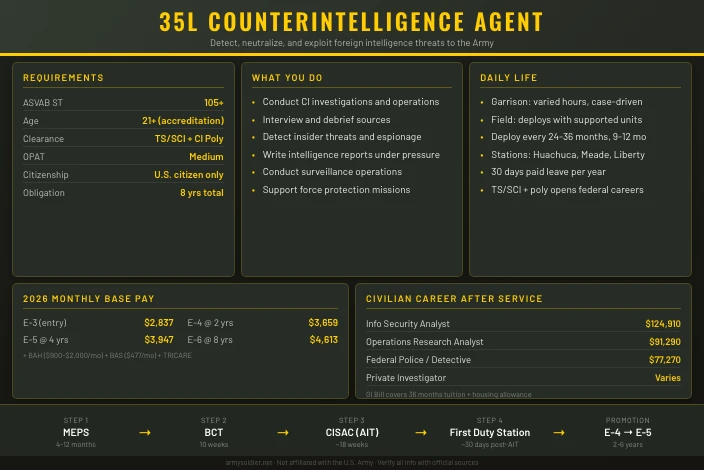
Job Role and Responsibilities
As a 35L Counterintelligence Agent, you conduct national security criminal investigations, plan and execute counterintelligence operations, collect and analyze intelligence on foreign intelligence entities and terrorist threats, and develop human sources who can provide access to those networks. Your work protects Army personnel, information, and installations from espionage, sabotage, and subversion.
The core function is investigation. When a soldier reports contact with a foreign national who asked suspicious questions, you open a case. You interview witnesses, collect evidence, write reports, and coordinate with the FBI, DIA, and other agencies when the case crosses jurisdictions.
Source operations are the other pillar of the job. You identify individuals with access to hostile networks and develop relationships that can produce intelligence. That requires patience, cultural awareness, and the ability to build trust with people who may be reluctant to talk.
Daily Tasks
Day-to-day work varies dramatically between garrison and deployed settings. In garrison, a typical day includes:
- Reviewing threat reporting and updating case files
- Conducting interviews of personnel who had foreign contacts
- Writing investigation reports and submitting them to headquarters
- Briefing unit commanders on local counterintelligence threats
- Coordinating with law enforcement and intelligence partners
On deployment or field exercises, you operate alongside tactical units. You assess local threats, screen personnel, conduct source operations, and provide real-time counterintelligence support to commanders who need it before they send soldiers into an area.
Specialized Roles
The 35L MOS branches into several specialized identifiers as you progress:
| Identifier | Specialization |
|---|---|
| Z5 | Special Mission Unit Support |
| L5 | HUMINT/CI Technician (warrant path) |
Experienced 35L agents can also compete for Joint Terrorism Task Force (JTTF) assignments, NATO counterintelligence positions, and special operations support billets. These require additional screening and are not guaranteed, but they are a natural career progression for agents who perform well.
Mission Contribution
Counterintelligence is a force multiplier. A commander who knows an adversary is targeting his supply chain makes different decisions than one operating blind. Your work shapes the security posture of every unit you support. A single successful investigation can prevent the compromise of classified programs worth billions of dollars.
Technology and Equipment
You work with classified databases on SIPRNet and JWICS, reporting systems specific to the intelligence community, and technical surveillance equipment used in source operations and investigations. Biometric collection tools, encrypted communications gear, and investigative software are part of the toolkit. You also train on polygraph administration and technical surveillance countermeasures (TSCM), though advanced TSCM work typically requires additional schooling beyond CISAC.
Salary and Benefits
Financial Benefits
Pay is based on rank and time in service. Since the minimum age for 35L accreditation is 21, most soldiers enter training as E-3 or E-4 rather than straight out of high school.
| Rank | Pay Grade | Typical Years | 2026 Monthly Base Pay |
|---|---|---|---|
| Private First Class (PFC) | E-3 | 1-2 | $2,837 - $3,015 |
| Specialist (SPC) | E-4 | 2-4 | $3,142 - $3,659 |
| Sergeant (SGT) | E-5 | 4-6 | $3,947 - $4,109 |
| Staff Sergeant (SSG) | E-6 | 8-10 | $4,613 - $4,759 |
| Sergeant First Class (SFC) | E-7 | 10-14 | $4,842 - $5,268 |
Pay figures from DFAS 2026 pay tables. Base pay is not the whole picture. BAH (Basic Allowance for Housing) adds roughly $900 to $2,000+ per month depending on duty station and dependency status. BAS (Basic Allowance for Subsistence) adds $476.95 monthly for food. Neither is taxed.
The 35L is eligible for an enlistment bonus. Goarmy.com indicates qualified recruits may be eligible for combinations of bonuses; the Army periodically offers up to $50,000 for qualified candidates on longer contracts. Bonus amounts change frequently based on Army manning needs. Confirm the current figure with a recruiter before making a decision.
Additional Benefits
TRICARE Prime covers medical, dental, vision, prescriptions, and mental health at no cost to you or your family while on active duty.
Education benefits include Tuition Assistance (up to $4,500 per year for courses taken while serving) and the Post-9/11 GI Bill after separation. The GI Bill covers full in-state tuition at public universities for up to 36 months, plus a monthly housing allowance and a $1,000 annual book stipend. The private school cap is $29,920.95 per academic year.
Retirement follows the Blended Retirement System (BRS). Serve 20 years and the pension pays 40% of your highest 36 months of base pay. The government matches up to 5% of Thrift Savings Plan (TSP) contributions starting in year three of service.
Work-Life Balance
You earn 30 days of paid leave per year. In garrison, CI agents generally work business hours, though active investigations don’t always respect the clock. During deployments or major exercises, expect extended hours. The work is mentally demanding rather than physically exhausting most of the time, but high-stakes investigations carry real stress.
Qualifications and Eligibility
Basic Qualifications
The 35L has a minimum ASVAB line score requirement of 105 in the Skilled Technical (ST) composite. The ST composite is calculated from General Science (GS), Verbal Expression (VE), Mechanical Comprehension (MC), and Math Knowledge (MK). High school graduates need a minimum AFQT of 31; GED holders need a 50.
The minimum age for accreditation as a CI Special Agent is 21. This is one of the few Army MOSs with a minimum age above 17. You can enlist younger and train, but you cannot be formally accredited until you turn 21.
| Requirement | Details |
|---|---|
| Age | Minimum 21 for CI accreditation |
| Citizenship | U.S. citizen (mandatory) |
| Education | High school diploma or GED |
| AFQT | Minimum 31 (diploma) or 50 (GED) |
| ST Score (ASVAB) | Minimum 105 |
| OPAT Category | Medium (physical demands rating) |
| Physical Profile | 222221 |
| Color Vision | Normal color vision required |
| Security Clearance | Top Secret (TS) with SCI eligibility |
| Polygraph | CI polygraph required |
Source: Fort Knox CI Agent requirements page.
Application Process
You start at an Army recruiting station. Your recruiter verifies your ASVAB scores and age, then submits a training slot request if you qualify. At MEPS (Military Entrance Processing Station), you complete a physical exam, begin the security clearance paperwork, and confirm your MOS selection.
Because 35L requires a polygraph and a thorough background investigation, the process takes longer than most MOSs. Expect 4 to 12 months from your first recruiter meeting to ship date, depending on how quickly the investigation clears. An interim clearance typically allows you to begin BCT and AIT while the full adjudication continues.
After CISAC graduation, you complete a one-year CI Probationary Program at your first field assignment. Full accreditation as a CI Special Agent happens after you successfully complete that probationary period.
Selection Criteria and Competitiveness
This MOS is selective. The ST 105 minimum filters out many applicants, and the CI polygraph eliminates additional candidates. A clean background is a practical requirement, not just a preference. Prior experience in law enforcement, investigations, or counterintelligence-related work strengthens your application, though no civilian certifications are required.
The Army wants candidates who can write clearly, think independently, and work without close supervision. Those skills are hard to fake in the selection process.
Upon Accession into Service
Most soldiers enter as E-1 or E-2 based on college credits or qualifying programs like JROTC. The standard total service obligation is 8 years split between active duty and the Individual Ready Reserve. Your recruiter will specify the active duty commitment based on your contract length and any bonuses accepted.
See our ASVAB study guide for strategies to hit these line scores, or take the PiCAT from home if you are a first-time tester.
Work Environment
Setting and Schedule
The 35L work environment is more varied than most intelligence MOSs. In garrison, you work in field offices or unit intelligence sections. SCIF access is common, but unlike the 35F who lives in the SCIF, CI agents spend significant time outside of it: interviewing people, meeting sources, and coordinating with partner agencies.
Three typical settings define the job:
- Field office assignments (902nd MI Group resident agencies): Structured investigative environment, regular hours, close coordination with civilian law enforcement and the FBI
- Tactical unit support: Embedded with brigades and divisions, providing direct CI support to commanders, more irregular hours, more operational tempo
- Deployed environments: Forward operating bases, joint intelligence centers, or austere locations in active theater. Extended hours, higher physical demands, and higher stakes
Leadership and Communication
Your chain of command runs through MI unit leadership, often at battalion or group level. In field office environments, a supervisory special agent (typically an E-7 or E-8) provides direct oversight. Tactical assignments put you closer to the S2 staff section.
Written and verbal communication are core skills you use constantly. Every investigation produces reports that reach senior leadership. Briefings to commanders, security officers, and partner agencies are routine. Poor writing is a career limiting problem in this MOS.
Team Dynamics and Autonomy
CI agents often work in small teams or even as the sole agent for a tactical unit. That autonomy is one of the draws of the job. You manage your own cases, develop your own sources, and make judgment calls without a supervisor looking over your shoulder on every decision.
But autonomy requires discipline. CI investigations involve classified information, legal constraints on what you can and can’t do, and potential legal consequences if you cut corners. The job demands someone who can self-direct without losing rigor.
Job Satisfaction and Retention
Retention among experienced CI agents is strong. The work is genuinely interesting, the clearance opens civilian doors, and agents who get good tactical or special operations assignments tend to stay longer. The main frustrations are administrative burden, report writing volume, and the occasional stretch of slow caseload in garrison assignments.
Training and Skill Development
Initial Training
Training has two phases before you reach your first assignment.
| Training Phase | Location | Duration | Focus |
|---|---|---|---|
| BCT | Fort Jackson, SC; Fort Moore, GA; Fort Leonard Wood, MO | 10 weeks | Soldier basics: marksmanship, tactics, fitness, discipline |
| CISAC (AIT) | Fort Huachuca, AZ (USAICoE) | ~18 weeks | CI investigations, source operations, report writing, interviewing |
BCT is the same 10-week course every enlisted soldier completes. You learn to shoot, move, communicate, and follow orders.
The Counterintelligence Special Agent Course (CISAC) at Fort Huachuca runs approximately 18 weeks and is organized into phases. Phases cover national security criminal investigations, source operations, interviewing and elicitation techniques, surveillance, crime scene processing, and report writing. The report writing instruction is unusually rigorous. Instructors build cases that require you to write clearly under pressure.
The course runs at a college-like pace for active duty students: standard business hours plus PT. National Guard and Reserve students attend a condensed 6-day-per-week schedule. Both populations complete the same core material.
After CISAC, you complete a one-year CI Probationary Program under the supervision of experienced agents before receiving full MOS accreditation.
Advanced Training
Once accredited, your development continues through formal schools and on-the-job experience:
- Advanced Leaders Course (ALC) at Fort Huachuca prepares E-5s for team leadership and staff sergeant responsibilities
- Senior Leaders Course (SLC) for E-6s moving into senior agent and supervisory roles
- Counterintelligence Special Agent Advanced Course for deeper technical skills in specific CI disciplines
- Polygraph Examiner Course at Fort Jackson for agents selected for that specialty
- Technical Surveillance Countermeasures (TSCM) training for agents supporting high-value protected environments
Army Credentialing Assistance and Tuition Assistance can fund civilian certifications. CompTIA Security+, Certified Fraud Examiner (CFE), and project management credentials all carry value both inside and after service.
Everything starts with qualifying ASVAB scores — our study guide covers what to study first.
Career Progression and Advancement
Career Path
The 35L career track moves from hands-on case agent through team leadership, supervisory, and staff roles. The MOS is smaller than 35F, which means fewer slots at the top but also a tighter professional community where reputation travels fast.
| Rank | Pay Grade | Typical Time | Role |
|---|---|---|---|
| Private First Class (PFC) | E-3 | 1-2 years | AIT / CISAC student, entering probationary period |
| Specialist (SPC) | E-4 | 2-4 years | Probationary agent, supervised case work |
| Sergeant (SGT) | E-5 | 4-6 years | Accredited agent, independent case management |
| Staff Sergeant (SSG) | E-6 | 6-10 years | Senior agent, team leader, section NCOIC |
| Sergeant First Class (SFC) | E-7 | 10-14 years | Supervisory agent, S2X/CI staff officer support |
| Master Sergeant (MSG) | E-8 | 14-18 years | Senior enlisted advisor, field office leadership |
| Sergeant Major (SGM) | E-9 | 18+ years | Senior CI NCO, command or staff level |
At E-5, you transition from supervised probationary work to independent case management. By E-6, you lead small teams and mentor junior agents. E-7 and above move into supervisory and advisory roles, often interfacing with senior commanders and partner agencies.
The 35L to 351L warrant officer path is a natural progression for agents who want to deepen their technical expertise rather than move into pure leadership. Warrant officers serve as senior technical advisors on CI matters at brigade level and above.
Role Flexibility and Transfers
Experienced 35L agents can compete for special assignments including:
- JTTF (Joint Terrorism Task Force) positions working alongside FBI
- Special operations support billets with SOCOM units
- NATO counterintelligence assignments in Europe
- Defense Intelligence Agency attaché support roles
Lateral moves to other CMF 35 MOSs (such as 35F or 35M) are possible with chain of command support and available training seats. Reclassification requires meeting the new MOS requirements and going through the appropriate course.
Performance Evaluation
NCOs at E-5 and above are rated annually through the NCOER (NCO Evaluation Report). Your rater assesses leadership, technical competence, and character. Senior rater comments carry significant weight for promotion.
What separates top performers: clean, complete investigation reports, productive source development, strong relationships with partner agencies, and the ability to brief complex findings clearly to non-intelligence audiences. Agents who work JTTF assignments or special operations billets tend to build stronger records because the operational tempo exposes them to more complex cases.
Physical Demands and Medical Evaluations
Physical Requirements
The 35L physical demands rating is Medium. The work is not physically grueling on most days, but deployments change the equation. You carry equipment, operate in austere environments, and sometimes need to move quickly under pressure.
Every soldier takes the Army Fitness Test (AFT) at least once per year. The AFT replaced the ACFT on June 1, 2025. It has five events, each scored from 0 to 100 points:
| Event | Minimum Score to Pass |
|---|---|
| 3-Rep Max Deadlift (MDL) | 60 points |
| Hand-Release Push-Up (HRP) | 60 points |
| Sprint-Drag-Carry (SDC) | 60 points |
| Plank (PLK) | 60 points |
| Two-Mile Run (2MR) | 60 points |
You need at least 60 points per event and 300 total to pass. Intelligence MOSs use the general standard (sex- and age-normed at 300), not the 350-point combat standard reserved for designated combat MOSs.
The OPAT (Occupational Physical Assessment Test) category for 35L is Medium. You need to meet minimums on the standing long jump, seated power throw, strength deadlift, and interval aerobic run at the Medium tier.
Medical Evaluations
A physical profile of 222221 is required. Normal color vision is mandatory because CI work involves analyzing documents, maps, and imagery where color coding matters.
Beyond initial screening, you complete annual Periodic Health Assessments (PHAs) and pre-deployment medical clearances. Any condition affecting cognitive function, security clearance eligibility, or ability to operate in austere environments gets evaluated. The CI polygraph program requires periodic reinvestigation, which includes health and lifestyle components.
Deployment and Duty Stations
Deployment Details
CI agents deploy with their parent units or as individual augmentees to theater-level CI organizations. Standard deployment rotations run 9 to 12 months, followed by dwell time at home station. Agents assigned to tactical combat units at places like Fort Liberty or Fort Campbell deploy more frequently than those in field office assignments.
Deployed work takes place in brigade and battalion intelligence sections, field office detachments, joint intelligence support elements, and occasionally in partnership with host nation security services. Assignments closer to the wire are more common for 35L agents than for 35F analysts, because the source operation and investigation work often requires face-to-face contact outside the wire.
Location Flexibility
The Army assigns duty stations based on its needs. You submit preferences, and the Army considers them, but the mission comes first. 35L agents have a somewhat narrower duty station spread than 35F because CI field office positions cluster at specific installations.
Common duty stations for 35L:
- Fort Meade, MD (902nd Military Intelligence Group headquarters, proximity to NSA and DIA)
- Fort Liberty, NC (XVIII Airborne Corps, 82nd Airborne Division)
- Fort Campbell, KY (101st Airborne Division)
- Fort Belvoir, VA (DIA, INSCOM support)
- Fort Sam Houston, TX (MEDCOM, Southern Command support)
- Joint Base Lewis-McChord, WA (I Corps)
- Overseas: Germany (USAREUR), South Korea, Japan, Italy
The 902nd Military Intelligence Group runs resident agencies across the continental United States. Field office assignments at these locations work differently from tactical MI unit assignments, offering a more structured investigative environment and closer integration with federal law enforcement.
Risk, Safety, and Legal Considerations
Job Hazards
The physical risks depend heavily on assignment type. Field office and garrison work is low-risk. Tactical and deployed assignments increase exposure to indirect fire, IED threats during movement, and the psychological toll of working in combat environments.
Source operations carry inherent risk. Developing relationships with individuals connected to hostile networks requires careful tradecraft. Mistakes in this area can compromise operations, endanger sources, or expose you to legal and security consequences.
Safety Protocols
SCIF security procedures, strict information handling requirements, and detailed legal guidelines on what CI agents can and cannot do are built into every phase of training. In deployed environments, you follow unit force protection SOPs, wear body armor outside the wire, and coordinate movements with the tactical operations center.
The mental health dimension is real. CI work involves exposure to hostile actors, national security threats, and occasionally disturbing case material. Army behavioral health resources are available at every installation. Using them is not a clearance risk when you self-refer.
Security and Legal Requirements
The 35L requires a Top Secret (TS) security clearance with access to Sensitive Compartmented Information (SCI). A CI polygraph is also required, making this one of the more stringent vetting processes in the enlisted Army.
The investigation covers financial history, foreign contacts and travel, drug and alcohol use, criminal record, and personal conduct. Any reportable events after clearance approval (arrests, new foreign contacts, financial problems) must be disclosed immediately to your security manager. Failing to report can result in clearance revocation.
CI agents operate under the authority of Army Regulation 381-20 and are bound by the Uniform Code of Military Justice (UCMJ), federal law, and Department of Defense Directive 5240.06. You work closely with the FBI on domestic cases and with partner agencies on overseas operations. Understanding the legal boundaries of what CI agents can collect and how they can use it is not optional knowledge.
Impact on Family and Personal Life
Family Considerations
Military life means moves, deployments, and irregular hours. CI agents face those same pressures, with the added complexity of a clearance investigation that examines family members. Foreign-born spouses or significant contacts with foreign nationals can complicate clearance processing and must be disclosed upfront.
Spouses and dependents do not hold the clearance, but they are interviewed during the investigation. The nature of the work also limits what you can share about your cases. That opacity is a real factor in long-term relationships. Spouses who don’t have a security background sometimes find the secrecy difficult.
Support systems at most installations include:
- Family Readiness Groups (FRGs) through your unit
- Military OneSource for counseling and family services
- Exceptional Family Member Program (EFMP) for families with special needs
- Spousal employment assistance at each new installation
Relocation and Flexibility
Expect to move every 2 to 4 years. The Army covers the cost, but every PCS disrupts school enrollments, spousal employment, and daily routines. Duty station options near Fort Meade or Fort Belvoir offer strong employment opportunities for spouses in the DC metro area. Overseas tours in Germany or South Korea add international experience but come with their own adjustment demands.
Reserve and National Guard
The 35L Counterintelligence Agent is available in both the Army Reserve and Army National Guard. Reserve component CI billets exist in MI battalions and brigade-level CI teams, though positions are fewer than other 35-series MOS. The Army Reserve holds a significant share of the CI force, and several Guard states maintain CI detachments. You must maintain your TS/SCI clearance and complete periodic CI-specific recertification to drill in this MOS.
Drill Schedule and Training Commitment
Standard commitment is one weekend per month (Battle Assembly) plus two weeks of Annual Training per year. Drill weekends for 35L soldiers include CI case management exercises, source screening drills, and threat awareness briefing development. Annual Training often involves supporting a larger exercise with CI coverage or conducting local threat assessments. CI agents may have additional training days for TSCM (Technical Surveillance Countermeasures) refreshers, investigative techniques updates, and mandatory CI recertification requirements.
Part-Time Pay
An E-4 with over 3 years of service earns about $464 per drill weekend (4 drill periods), totaling roughly $5,572 per year from drill pay plus about $1,741 for 15 days of Annual Training. Active-duty E-4 base pay is $3,482 per month. Most Reserve/Guard 35L soldiers work in civilian federal law enforcement or defense contractor CI positions, where salaries significantly exceed active-duty enlisted pay.
Benefits Differences
Tricare Reserve Select costs $57.88 per month for member-only or $286.66 per month for family coverage in 2026. Active-duty TRICARE Prime is free.
Education benefits include Federal Tuition Assistance ($250 per credit hour, up to $4,500 per year) and the Montgomery GI Bill-Selected Reserve at $493 per month for full-time students. Guard members may qualify for state tuition waivers. Mobilization of 90 or more days earns Post-9/11 GI Bill eligibility.
Reserve retirement is points-based, requiring 20 qualifying years. Collection starts at age 60, reduced by 3 months per 90-day mobilization after January 2008, minimum age 50.
Deployment and Mobilization
35L soldiers in Reserve/Guard units see moderate mobilization rates. CI agents deploy as both unit members and individual augmentees supporting combatant commands and joint task forces. The specialized nature of CI work means demand is steady but the pool of qualified soldiers is small. Typical tours run 9 to 12 months. Individual mobilizations are more common than full unit activations.
Civilian Career Integration
The 35L has some of the strongest civilian career crossover of any enlisted MOS. Federal agencies (FBI, NCIS, DIA, Army CID), defense contractors, and corporate security firms hire CI-trained investigators. An active TS/SCI clearance and CI investigative experience are high-value credentials. USERRA protects your civilian job during activations, and employers must reinstate you with the seniority you would have earned.
| Feature | Active Duty | Army Reserve | Army National Guard |
|---|---|---|---|
| Commitment | Full-time | 1 weekend/month + 2 weeks/year | 1 weekend/month + 2 weeks/year |
| Monthly Pay (E-4, 3+ yrs) | $3,482 | ~$464/drill weekend | ~$464/drill weekend |
| Healthcare | TRICARE Prime ($0) | Tricare Reserve Select ($57.88/mo) | Tricare Reserve Select ($57.88/mo) |
| Education | Federal TA, Post-9/11 GI Bill | Federal TA, MGIB-SR ($493/mo) | Federal TA, MGIB-SR, state tuition waivers |
| Deployment Tempo | Regular rotations | Moderate (individual + unit) | Moderate (individual + unit) |
| Retirement | 20-year pension at age 40+ | Points-based, collect at age 60 | Points-based, collect at age 60 |
Post-Service Opportunities
Transition to Civilian Life
A 35L background with an active TS clearance is one of the most marketable combinations in the defense sector. The clearance alone adds a measurable salary premium over uncleared equivalents. CI-specific experience is in direct demand at the FBI, CIA, DIA, DHS, and defense contractors who support national security programs.
The Transition Assistance Program (TAP) helps with resume writing, federal job application processes, and benefits counseling during your last year of active duty. Federal law enforcement positions (FBI Special Agent, DHS HSI) actively recruit CI veterans. So do defense contractors like Booz Allen Hamilton, SAIC, CACI, and Leidos for cleared investigative and analytical roles.
The Post-9/11 GI Bill covers up to 36 months of tuition if you pursue a degree in criminal justice, international relations, cybersecurity, or a related field after separation.
Civilian Career Prospects
| Civilian Job | Median Annual Salary (2024) | 10-Year Outlook |
|---|---|---|
| Police / Detectives (federal) | $77,270 | +3% |
| Information Security Analyst | $124,910 | +29% |
| Operations Research Analyst | $91,290 | +21% |
| Private Investigator | Varies | Competitive |
Salary data from the Bureau of Labor Statistics Occupational Outlook Handbook. Federal law enforcement roles (FBI, DHS, DEA) generally pay significantly above the police and detective median listed above, particularly at higher GS grades. Cleared CI veterans at defense contractors frequently start in the $80,000 to $120,000 range depending on location and scope of work.
One important note: when transitioning into federal law enforcement, 35L experience typically supports application under 0132 (Intelligence) or 1811 (Criminal Investigator) job series, depending on the agency and role. Your recruiter or a federal HR specialist can advise on which series fits your background best.
Post-Service Policies
An honorable discharge gives you access to VA healthcare, disability compensation if applicable, and education benefits. You can separate at the end of your enlistment or re-enlist for additional terms. Your clearance remains active for a period after separation if you move into a cleared position. Gaps in clearance usage may require reinvestigation, so lining up cleared employment before your ETS date saves time.
Is This a Good Job for You?
Ideal Candidate Profile
The best CI agents share a specific set of traits that go beyond ASVAB scores and physical fitness:
- Patience and persistence. Investigations rarely resolve quickly.
- Strong written communication. You will write reports constantly, and they will be reviewed carefully.
- Comfortable building relationships with strangers, including adversarial or reluctant ones.
- High integrity under pressure. The legal and ethical constraints of CI work require someone who won’t cut corners when a shortcut looks appealing.
- Intellectual curiosity about foreign threats, geopolitics, and human behavior.
A background in criminal justice, psychology, foreign languages, or competitive debate helps. So does any experience that required you to ask probing questions and listen carefully to the answers.
Potential Challenges
This MOS is a poor fit if you:
- Have a complicated financial history, extensive foreign contacts, or drug use that could prevent a TS clearance or fail a polygraph
- Are under 21 and unwilling to wait or take a different MOS first
- Prefer predictable hours and dislike working independently
- Struggle with writing or find detailed report documentation tedious
- Want frequent physical activity and dislike desk-intensive work
- Need to talk openly about your work with family and friends
The secrecy requirement is a real lifestyle factor. You will know things you cannot discuss. Over a long career, that shapes relationships in ways that aren’t always comfortable.
Career and Lifestyle Fit
For the right person, this MOS is hard to beat. You do consequential work, build a clearance that commands a premium in the civilian market, and operate with more autonomy than most enlisted soldiers ever see. The career track into federal law enforcement, defense contracting, or the intelligence community is well-established and well-traveled.
The trade-offs are real: a slow and intrusive selection process, minimum age requirements that push your timeline, and a smaller MOS community with fewer geographic options than larger MOSs. But for someone who genuinely wants to work counterintelligence, those constraints are worth accepting.
More Information
Talk to an Army recruiter about the 35L. Ask specifically about current bonus amounts, your ST score eligibility, and whether your background clears the initial screening criteria. You can also request contact with a current 35L agent to hear what the day-to-day work actually looks like. The recruiter can facilitate that connection.
Visit goarmy.com for the official MOS overview
Check the Army Counterintelligence Command for organizational context
Explore the COOL credentialing page for certifications that align with the 35L skill set
Prepare for the ASVAB with our study guide to make sure your line scores qualify
This site is not affiliated with the U.S. Army or any government agency. Verify all information with official Army sources before making enlistment or career decisions.
Explore more Army intelligence careers such as 35M Human Intelligence Collector and 35F Intelligence Analyst.