35M Human Intelligence Collector
Every Army unit needs eyes on the enemy. The 35M Human Intelligence Collector is the person who sits across the table from detainees, walks, and talks sources, and turns raw conversation into intelligence that commanders act on. You won’t spend your career behind a desk. This MOS puts you face-to-face with people who have information the Army needs, and your job is to get it.
Qualifying requires specific ASVAB line scores — our ASVAB study guide covers what to target and how to prepare.
Job Role and Responsibilities
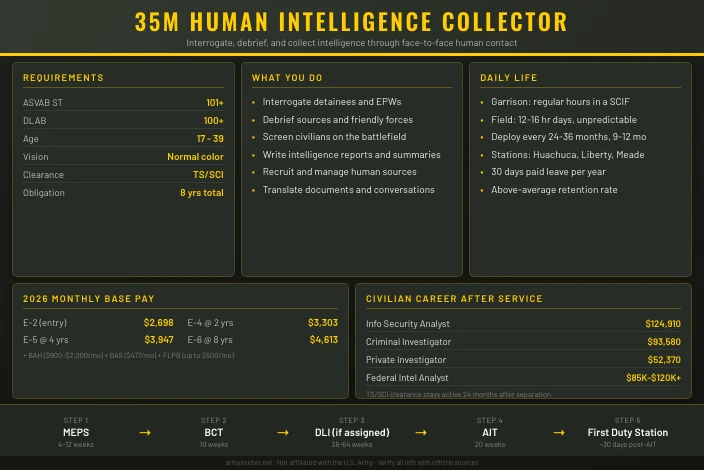
You collect intelligence through direct human contact. That means conducting interrogations, debriefing sources, screening documents, and reporting what you learn so commanders can make better decisions. You work in English and foreign languages, often in hostile or austere environments where information saves lives.
Your daily routine depends heavily on your assignment. In garrison, you spend time writing intelligence reports, studying area knowledge, practicing interview techniques, and maintaining your language skills. You attend briefings, review intelligence databases, and prepare for upcoming operations or training exercises.
In the field, everything shifts. You screen civilians on the battlefield, question enemy prisoners of war (EPWs) and detainees, and debrief friendly forces returning from patrols. Each conversation follows a structured approach, but adaptability matters more than scripts. People don’t cooperate on command.
Specialized Roles
The 35M has several sub-specializations tracked through Additional Skill Identifiers (ASIs):
| Identifier | Type | Specialization |
|---|---|---|
| N7 | ASI | Strategic Debriefing |
| S1 | ASI | Source Handler (Skill Levels 2-4) |
| V4 | ASI | Advanced Source Handler (Skill Levels 3-4) |
Source handlers run the most sensitive operations in the HUMINT world. That career track opens after your first enlistment if you perform well and earn the right ASI.
Mission Contribution
HUMINT fills gaps that satellites and signals intercepts can’t reach. A drone can show you a building, but it can’t tell you what’s being planned inside. Human intelligence collectors provide context, intentions, and early warnings that shape everything from tactical raids to theater-level strategy.
Technology and Equipment
You’ll use classified intelligence databases, biometric collection devices, tactical communications equipment, and digital reporting systems. Language translation tools supplement your skills, but the Army expects you to work directly in the target language whenever possible. In the field, you carry standard infantry gear alongside specialized HUMINT collection kits.
Salary and Benefits
Financial Benefits
Military pay is based on rank and time in service. Most 35Ms enter as E-1 or E-2 and promote steadily through their first enlistment.
| Rank | Pay Grade | Years of Service: 2 | Years of Service: 4 | Years of Service: 6 | Years of Service: 8 |
|---|---|---|---|---|---|
| Private (PV2) | E-2 | $2,698 | $2,698 | $2,698 | - |
| Specialist (SPC) | E-4 | $3,303 | $3,659 | $3,816 | $3,816 |
| Sergeant (SGT) | E-5 | $3,599 | $3,947 | $4,109 | $4,299 |
| Staff Sergeant (SSG) | E-6 | $3,743 | $4,069 | $4,236 | $4,613 |
Source: DFAS 2026 pay tables. Figures reflect the 2026 pay raise.
On top of base pay, you receive housing and food allowances. BAH (Basic Allowance for Housing) depends on your duty station and whether you have dependents. A single E-4 gets roughly $900 to $2,000+ per month depending on location. BAS adds about $477 monthly for food.
The 35M currently qualifies for enlistment bonuses up to $50,000, depending on contract length and language qualifications. Soldiers with proficiency in critical languages can earn the Foreign Language Proficiency Bonus (FLPB), which pays up to $500 per month per language based on your DLPT scores.
Additional Benefits
TRICARE covers you and your family at zero cost for active duty. That includes medical, dental, vision, mental health, and prescriptions. While serving, Tuition Assistance covers up to $4,500 per year for college courses. After separation, the Post-9/11 GI Bill pays up to 36 months of tuition at a public university (full in-state rate) plus a monthly housing allowance and $1,000 annual book stipend.
Retirement works through the Blended Retirement System (BRS):
- Serve 20 years and you get a pension worth 40% of your base pay
- The government matches up to 5% of your Thrift Savings Plan (TSP) contributions
- Continuation pay between years 8 and 12 provides 2.5x monthly base pay or more
Work-Life Balance
You earn 30 days of paid leave per year. In garrison, intelligence units usually work regular hours with occasional extended shifts during exercises. Deployments and field operations break that pattern. HUMINT collectors supporting combat units may work 12 to 16 hour days for weeks at a time, including nights, since source meetings and interrogations happen on the source’s schedule, not yours.
Qualifications and Eligibility
Basic Qualifications
You need to be a U.S. citizen between 17 and 39. High school grads need at least a 31 on the AFQT. GED holders need a 50. The 35M requires one ASVAB composite:
- Skilled Technical (ST): 101 minimum
The ST score combines General Science, Verbal Expression, Math Knowledge, and Mechanical Comprehension. A 101 is moderately competitive and sits in the upper tier of enlisted MOS requirements.
You also take the Defense Language Aptitude Battery (DLAB). A score of 100 or above qualifies you for language training at the Defense Language Institute. The DLAB measures your ability to learn new languages, not what you already speak.
| Requirement | Details |
|---|---|
| Age | 17-39 years old |
| Citizenship | U.S. citizen only (no permanent residents) |
| Education | High school diploma or GED |
| AFQT (ASVAB) | Minimum 31 (diploma) or 50 (GED) |
| Skilled Technical (ST) | Minimum 101 |
| DLAB | 100+ (for language training assignment) |
| Security Clearance | TS/SCI required |
| Vision | Normal color vision required |
| OPAT Category | Moderate (Gold) |
| Background | No disqualifying criminal history; must pass extensive background investigation |
Application Process
Start at your local Army recruiting station. The recruiter checks your qualifications and helps you decide between Active Duty, Reserve, or National Guard.
Next comes MEPS (Military Entrance Processing Station). You take the ASVAB and DLAB if you haven’t already, complete a full medical exam, and begin your background check. If you qualify, your recruiter books a training slot.
The process from first visit to ship date runs 4 to 12 weeks, but the TS/SCI investigation often takes longer. Some soldiers begin training before the clearance is fully adjudicated, but you can’t access classified material until it clears.
Selection Criteria and Competitiveness
The 35M is competitive. The Army needs HUMINT collectors, but the combination of a 101 ST score, DLAB requirement, and TS/SCI eligibility narrows the pool. Strong scores on the ASVAB and DLAB help. Prior language study, college coursework, or travel experience makes you a stronger candidate. No civilian certifications are required to enlist.
Upon Accession into Service
Most soldiers enter as E-1 (Private) and promote to E-2 after Basic Combat Training. College credits or referral bonuses can bump your entry rank to E-3 or E-4 under certain programs. The standard obligation is 8 years total: typically 3 to 6 years active duty (depending on your contract and language training length) plus the remainder in the Reserve or Individual Ready Reserve.
See our ASVAB study guide for strategies to hit these line scores, or take the PiCAT from home if you are a first-time tester.
Work Environment
Setting and Schedule
HUMINT collectors work in three main settings:
- Garrison – SCIFs (Sensitive Compartmented Information Facilities), offices, and intelligence centers. Normal hours with classified work requirements.
- Field training – tactical operations centers, screening sites, and forward collection points. Hours follow the exercise schedule.
- Deployment – forward operating bases, tactical sites, and partner nation facilities. Twelve-hour shifts are common. Source meetings happen at unpredictable times.
Your unit type shapes your daily life more than anything. Collectors assigned to Military Intelligence brigades work a more predictable schedule. Those attached to Special Forces groups, infantry brigade combat teams, or theater-level HUMINT operations work longer, deploy more often, and spend more time outside the wire.
Leadership and Communication
Your chain of command runs through the unit’s intelligence officer (S2) and a senior HUMINT NCO (typically E-6 or E-7). During operations, the collection management authority directs your priorities. You report findings up through intelligence channels, not just your company chain.
Performance feedback comes through annual evaluations and regular counseling sessions with your leadership.
Team Dynamics and Autonomy
HUMINT is one of the most autonomous enlisted MOSs. Once you’re trained and cleared, you often work in two-person teams or even alone. You decide how to approach a source, what questions to ask, and how to build rapport. Your team leader reviews reports and helps plan operations, but the conversation itself is yours to run.
That autonomy carries weight. A badly handled source can blow an entire operation. A well-run debrief can uncover threats that save hundreds of lives.
Job Satisfaction and Retention
Intelligence MOSs generally retain soldiers at above-average rates compared to combat arms. The work is mentally stimulating, the clearance and language skills translate directly to high-paying civilian jobs, and deployment conditions are usually better than Infantry or Armor. Soldiers who leave often cite family strain from deployments or the pull of six-figure contractor salaries in the private sector.
Training and Skill Development
Initial Training
The 35M training pipeline is one of the longest in the Army for enlisted soldiers, especially if language training is included.
| Training Phase | Location | Duration | Focus |
|---|---|---|---|
| BCT | Fort Jackson, SC; Fort Moore, GA; or Fort Leonard Wood, MO | 10 weeks | Soldier basics: marksmanship, tactics, fitness, discipline |
| DLI (if assigned) | Presidio of Monterey, CA | 36-64 weeks | Foreign language proficiency (varies by language difficulty) |
| AIT | Fort Huachuca, AZ | 20 weeks | HUMINT collection: interrogation, source operations, reporting |
BCT teaches you to be a soldier. Every MOS completes this phase.
If you’re assigned a language, you go to the Defense Language Institute (DLI) in Monterey, California, before AIT. Category I languages (Spanish, French) take about 36 weeks. Category IV languages (Arabic, Chinese, Korean) take up to 64 weeks. DLI is academically intense. Class runs 6 to 7 hours daily with several hours of homework. Soldiers who fail language testing may be reclassified to another MOS.
AIT at Fort Huachuca covers the core HUMINT skillset: approach techniques, questioning methodology, screening operations, report writing, and source operations. You run simulated interrogations with role players and learn to work with intelligence databases. The U.S. Army Intelligence Center of Excellence runs this training through the 111th Military Intelligence Brigade.
Advanced Training
After your first assignment, several paths open up:
- Strategic Debriefing Course (ASI N7) – advanced techniques for high-value source debriefings
- Source Handler Course (ASI S1) – trains you to recruit and manage human sources
- Advanced Source Handler (ASI V4) – the most demanding HUMINT specialization, reserved for experienced NCOs
- Airborne, Air Assault, or Ranger School – opens assignments with Special Operations or Airborne units
- Warrant Officer path – 351M Human Intelligence Collection Technician for experienced 35Ms who want to lead at the technical expert level
The Army also provides language maintenance training and may send you to immersion programs in-country to sharpen your skills. Tuition Assistance and the GI Bill cover degree programs in intelligence studies, foreign languages, or related fields.
Everything starts with qualifying ASVAB scores — our study guide covers what to study first.
Career Progression and Advancement
Career Path
Promotion to E-4 (Specialist) comes within 2 to 3 years and is mostly automatic. E-5 (Sergeant) requires passing a promotion board and demonstrates you can lead other collectors. At E-5, you shift from conducting interviews to managing collection operations and mentoring junior soldiers.
| Rank | Pay Grade | Typical Years | Typical Role |
|---|---|---|---|
| Private (PV2) | E-2 | 0-1 | AIT graduate, entry-level collector |
| Specialist (SPC) | E-4 | 2-3 | Journeyman collector, runs interviews independently |
| Sergeant (SGT) | E-5 | 4-6 | Team leader, manages collection operations |
| Staff Sergeant (SSG) | E-6 | 6-9 | Senior HUMINT NCO, plans and supervises operations |
| Sergeant First Class (SFC) | E-7 | 9-12 | HUMINT operations manager, platoon-level leader |
| Master Sergeant (MSG) | E-8 | 12+ | Senior intelligence leadership |
E-6 and above require strong NCOERs (NCO Evaluation Reports), military education (Basic and Advanced Leaders Courses), and proven operational performance. Language proficiency and ASIs weigh heavily in intelligence promotions.
Role Flexibility and Transfers
Lateral moves within CMF 35 are possible with leadership approval and an open slot. Common transitions for 35Ms include 35L (Counterintelligence Agent) and 35F (Intelligence Analyst). Moving outside the intelligence field is harder and requires retraining.
Experienced 35Ms can also apply for the 351M Warrant Officer MOS, which focuses on technical HUMINT expertise rather than command leadership.
Performance Evaluation
NCOs get rated through the NCOER once per year. Your rater and senior rater score you on leadership, technical proficiency, and training ability. Strong NCOERs are the single biggest factor in promotion to E-6 and above.
What sets HUMINT collectors apart: producing intelligence that commanders actually use, earning language proficiency bonuses, completing ASI courses, and building a reputation as someone who can get information from difficult sources.
Physical Demands and Medical Evaluations
Physical Requirements
The 35M falls under the Moderate (Gold) OPAT category. You won’t carry the loads an Infantryman does, but you need to be fit enough to deploy with combat units, wear body armor for extended periods, and operate in harsh environments. Field operations involve long hours on your feet, moving between collection points, and working in extreme heat or cold.
Every soldier takes the Army Fitness Test (AFT) once a year. Here are the minimum standards for ages 17 to 21:
| Event | Male Minimum | Female Minimum |
|---|---|---|
| 3-Rep Max Deadlift (MDL) | 140 lbs | 80 lbs |
| Hand-Release Push-Up (HRP) | 10 reps | 10 reps |
| Sprint-Drag-Carry (SDC) | 2:40 | 3:40 |
| Plank (PLK) | 2:00 | 2:00 |
| Two-Mile Run (2MR) | 15:54 | 18:54 |
Each event is scored 0 to 100. You need at least 60 per event and a 300 total to pass. The AFT standards are the same for all soldiers and do not vary by MOS.
Medical Evaluations
After enlistment, you get an annual physical: weight, blood pressure, vision, hearing, and a provider review. Before deployment, a separate medical clearance screens for any condition that could limit you in the field. Normal color vision is required for the 35M and is checked at MEPS and during periodic exams.
Deployment and Duty Stations
Deployment Details
HUMINT collectors deploy wherever the Army operates. Active-duty soldiers typically rotate every 9 to 12 months with 24 to 36 months between deployments, though this varies by unit. Collectors attached to Special Operations, Theater-level HUMINT, or rapid-deployment brigades go more often and with shorter notice.
Common deployment regions include the Middle East, Africa, Eastern Europe, and the Indo-Pacific. HUMINT collectors also support joint operations, multinational exercises, and security cooperation missions worldwide.
Location Flexibility
The Army assigns your duty station based on its needs. You can submit a preference, but there are no guarantees. Intelligence MOSs offer more variety in duty stations than many career fields because HUMINT support is needed across all unit types.
Common CONUS duty stations:
- Fort Huachuca, AZ
- Fort Liberty, NC
- Fort Meade, MD
- Fort Cavazos, TX
- Fort Campbell, KY
Common OCONUS duty stations:
- Germany (multiple installations)
- South Korea
- Japan (Camp Zama)
- Kuwait (Camp Arifjan)
- Italy
- Hawaii and Alaska
Expect to move every 2 to 4 years. The Army pays for each PCS (permanent change of station) move.
Risk, Safety, and Legal Considerations
Job Hazards
HUMINT collectors face a different risk profile than most intelligence MOSs. You meet sources in person, sometimes in unsecured locations. You work outside the wire with combat units. You handle information that hostile actors want to protect.
Operational risks:
- Direct enemy contact during forward collection operations
- IEDs and vehicle-borne threats during movement
- Threats from compromised or hostile sources
- Psychological stress from interrogation and debriefing operations
Garrison risks:
- Insider threat exposure in classified environments
- Mental fatigue from sustained analytical and interpersonal work
Safety Protocols
Standard force protection measures apply in all environments: body armor, tactical movement procedures, and communications protocols. When meeting sources, you follow approved operational security procedures that protect both you and the source. Counter-surveillance training is part of the HUMINT skillset.
Security and Legal Requirements
The 35M requires a TS/SCI (Top Secret / Sensitive Compartmented Information) clearance. The investigation reviews your entire personal history: finances, foreign contacts, criminal record, drug use, and social media activity. The process takes 6 to 18 months.
All soldiers follow the Uniform Code of Military Justice (UCMJ). HUMINT collectors also operate under specific legal authorities that govern interrogation, source operations, and intelligence collection. You receive training on the Law of Armed Conflict, Geneva Conventions, and Army Regulation 381-100 before conducting any collection operations. Violations carry severe consequences, including criminal prosecution.
Impact on Family and Personal Life
Family Considerations
The 35M puts real strain on families. Language training alone can last over a year at DLI, and your family may or may not join you in Monterey. Deployments range from 9 to 12 months. Between training schools and operational rotations, time at home station feels short.
Support resources at most installations:
- Family Readiness Groups (FRGs) – peer support through your unit
- Military OneSource – free counseling and family services
- Spousal employment assistance – job help at each new duty station
- Exceptional Family Member Program (EFMP) – support for families with special needs
Relocation and Flexibility
You will move. After training, you go where the Army sends you, and the intelligence community has slots everywhere from Maryland to Korea. Expect a new duty station every 2 to 4 years. Each PCS disrupts your spouse’s job, your kids’ school, and your community ties.
The upside: HUMINT collectors get stationed at some of the best duty locations in the Army, including overseas posts in Germany, Japan, and Hawaii. Those locations offer unique experiences for families willing to relocate.
Reserve and National Guard
The 35M Human Intelligence Collector is available in both the Army Reserve and Army National Guard. HUMINT billets exist in MI battalions and tactical HUMINT teams (THTs) in both components. The Army Reserve maintains a significant portion of the HUMINT force. National Guard MI units in several states also carry 35M positions. You must maintain your TS/SCI clearance to drill, and HUMINT-specific recertification requirements add some administrative overhead.
Drill Schedule and Training Commitment
Standard commitment is one weekend per month (Battle Assembly) plus two weeks of Annual Training per year. Drill weekends for 35M soldiers include source operations exercises, interrogation scenario training, debriefing drills, and report writing. Annual Training often involves supporting a field exercise with HUMINT collection operations. You may need additional training days for language maintenance (if language-qualified), HUMINT certification refreshers, and classified system recertification.
Part-Time Pay
An E-4 with over 3 years of service earns about $464 per drill weekend (4 drill periods), totaling roughly $5,572 per year from drill pay plus about $1,741 for 15 days of Annual Training. Soldiers with foreign language proficiency may earn Foreign Language Proficiency Pay (FLPP) during active duty periods. Active-duty E-4 base pay is $3,482 per month.
Benefits Differences
Tricare Reserve Select costs $57.88 per month for member-only or $286.66 per month for family coverage in 2026. Active-duty TRICARE Prime is free.
Education benefits include Federal Tuition Assistance ($250 per credit hour, up to $4,500 per year) and the Montgomery GI Bill-Selected Reserve at $493 per month for full-time students. Guard members may qualify for state tuition waivers. Mobilization of 90 or more days earns Post-9/11 GI Bill eligibility.
Reserve retirement is points-based, requiring 20 qualifying years. Collection starts at age 60, reduced by 3 months per 90-day mobilization after January 2008, minimum age 50.
Deployment and Mobilization
35M soldiers in Reserve/Guard units see moderate to high mobilization rates. HUMINT collectors are in constant demand across all theaters, and individual augmentee fills are common. Some 35M soldiers deploy more frequently than their peers in other intelligence MOS because HUMINT skills are difficult to replicate with technology. Typical tours run 9 to 12 months.
Civilian Career Integration
The 35M pairs with civilian careers in federal intelligence collection (DIA, CIA), law enforcement investigation, corporate security, and defense contractor intelligence positions. Interviewing, rapport-building, and source management skills transfer to any career that involves eliciting information from people. An active TS/SCI clearance adds significant civilian earning potential. USERRA protects your civilian job during activations, and employers must reinstate you with the seniority you would have earned.
| Feature | Active Duty | Army Reserve | Army National Guard |
|---|---|---|---|
| Commitment | Full-time | 1 weekend/month + 2 weeks/year | 1 weekend/month + 2 weeks/year |
| Monthly Pay (E-4, 3+ yrs) | $3,482 | ~$464/drill weekend | ~$464/drill weekend |
| Healthcare | TRICARE Prime ($0) | Tricare Reserve Select ($57.88/mo) | Tricare Reserve Select ($57.88/mo) |
| Education | Federal TA, Post-9/11 GI Bill | Federal TA, MGIB-SR ($493/mo) | Federal TA, MGIB-SR, state tuition waivers |
| Deployment Tempo | Regular rotations | Moderate-high (individual + unit) | Moderate-high (individual + unit) |
| Retirement | 20-year pension at age 40+ | Points-based, collect at age 60 | Points-based, collect at age 60 |
Post-Service Opportunities
Transition to Civilian Life
A TS/SCI clearance and HUMINT experience make you one of the most marketable veterans on the job market. Defense contractors, intelligence agencies, and federal law enforcement all recruit heavily from the 35M community. Many collectors walk into six-figure contract positions within months of separating.
The Transition Assistance Program (TAP) provides resume help, interview coaching, and benefits counseling during your final 12 months. The Post-9/11 GI Bill covers up to 36 months of tuition (full in-state rate at public schools, or up to $29,920.95 per year at private institutions) plus a housing allowance and book stipend.
Your language skills, analytical training, and experience working in ambiguous environments give you an edge in fields far beyond intelligence. Law enforcement, corporate security, journalism, diplomacy, and international business all value what HUMINT collectors bring.
Civilian Career Prospects
| Civilian Job | Median Annual Salary (BLS, May 2024) | 10-Year Outlook |
|---|---|---|
| Information Security Analyst | $124,910 | +29% (much faster than average) |
| Private Detective / Investigator | $52,370 | +6% (faster than average) |
| Criminal Investigator / Special Agent | $93,580 | +3% (about average) |
| Intelligence Analyst (federal) | $85,000-$120,000+ (GS scale) | Steady demand |
Federal agencies like the CIA, DIA, FBI, and NSA hire former 35Ms directly. Defense contractors such as Booz Allen Hamilton, CACI, and L3Harris offer HUMINT positions that pay $90,000 to $140,000+ depending on your clearance level and experience.
Post-Service Policies
An honorable discharge gives you lifetime access to VA healthcare, disability compensation (if applicable), and education benefits. You can separate after your total service obligation if you choose not to re-enlist. Talk to your career counselor about options well before your ETS date.
Your TS/SCI clearance remains active for up to 24 months after separation. Starting a cleared civilian job within that window means you skip the lengthy reinvestigation process.
Is This a Good Job for You?
Ideal Candidate Profile
The best HUMINT collectors are natural readers of people. They notice what someone isn’t saying as much as what they are.
Traits that predict success:
- Genuine curiosity about other cultures and languages
- Comfortable talking to strangers in high-pressure situations
- Patient enough to build rapport over days or weeks
- Sharp memory for names, dates, and details
- Able to think on your feet when a conversation goes sideways
This role fits people who prefer working with humans over machines. If you’d rather have a conversation than write code, the 35M might be your lane.
Potential Challenges
This MOS is a poor fit if you:
- Struggle with foreign languages or have no interest in learning one
- Need a predictable schedule with minimal travel
- Get uncomfortable with moral ambiguity or ethically gray situations
- Prefer working alone in a quiet environment with no interpersonal pressure
- Have issues in your background that would prevent a TS/SCI clearance
The training pipeline is long. If you draw a Category IV language, you could spend two years in training before reaching your first real assignment. That tests patience.
Career and Lifestyle Alignment
If you want a career in intelligence, law enforcement, or national security after the Army, the 35M is one of the strongest launching pads available. The clearance, language skills, and operational experience are worth more on the civilian market than almost any other enlisted MOS.
The trade-off: you’ll move often, deploy frequently, and carry the mental weight of working in sensitive operations. The pay during service is modest compared to what you’ll earn as a civilian contractor or federal employee afterward. Most 35Ms treat their Army years as an investment that pays off in the long run.
More Information
Talk to an Army recruiter about the 35M. Ask about current enlistment bonuses, available languages, and whether your ASVAB and DLAB scores qualify. If possible, request to speak with a current HUMINT collector to hear what the job looks like day-to-day.
Take the MOS Finder quiz at goarmy.com
Schedule an ASVAB at your nearest MEPS to see where your scores land
Start studying a foreign language now to get a head start on DLI
Prepare for the ASVAB with our study guide to make sure your line scores qualify
This site is not affiliated with the U.S. Army or any government agency. Verify all information with official Army sources before making enlistment or career decisions.
Explore more Army intelligence careers such as 35F Intelligence Analyst and 35N Signals Intelligence Analyst.