35P Cryptologic Linguist
The Army will pay you to learn a foreign language, give you a Top Secret clearance, and put you to work intercepting enemy communications. MOS 35P is the only enlisted job where language skills are the weapon. You spend up to 64 weeks at the Defense Language Institute before you ever touch signals intelligence equipment. The training is long, the clearance process is invasive, and the demand for qualified linguists never stops.
Qualifying requires specific ASVAB line scores — our ASVAB study guide covers what to target and how to prepare.
Job Role and Responsibilities
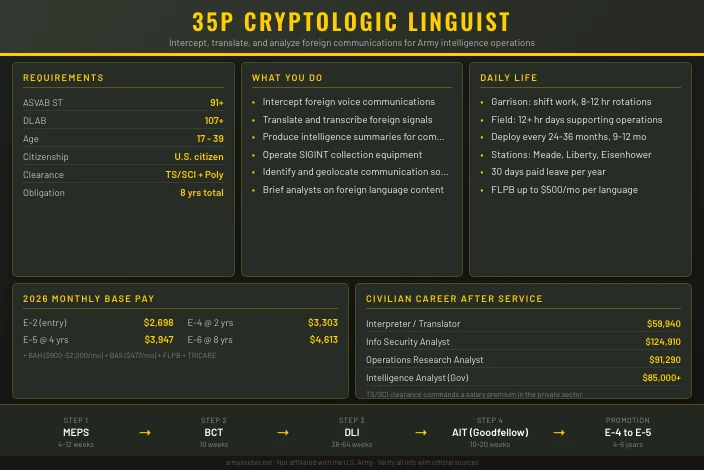
As a 35P Cryptologic Linguist, you intercept foreign voice communications, translate them into English, and produce intelligence summaries that commanders use to make decisions. You operate signals intelligence (SIGINT) collection systems, identify and geolocate communication sources, and brief analysts on what you find. In the field, your translations can change the course of an operation.
Foreign adversaries communicate by radio, phone, and digital channels. Your job is to monitor those channels, pull out what matters, and deliver it fast. A patrol might need to know what a target said 10 minutes ago. A brigade commander might need a pattern analysis covering six months of intercepts. You handle both.
What You Actually Do
Daily work depends on your assignment. At a fixed site, you sit at a workstation running collection software, listening to foreign transmissions, and writing reports. Attached to a tactical unit, you operate portable SIGINT equipment from a vehicle or field position and feed real-time intelligence to the unit commander.
- Intercept and record foreign voice and electronic communications
- Translate, transcribe, and summarize intercepted traffic
- Produce SIGINT reports and intelligence products
- Operate collection platforms and direction-finding equipment
- Identify communication networks and track changes over time
- Brief commanders and analysts on foreign language content
Specializations
The Army assigns you a target language based on its needs and your aptitude. Your language determines much of your career path, including where you get stationed and how often you deploy.
| Identifier | Description |
|---|---|
| MOS 35P | Base MOS: SIGINT Voice Interceptor |
| ASI L+ | Language identifier suffix (e.g., 35P1L for skill level 1 with language) |
| SQI P | Airborne-qualified linguist |
| SQI S | Special Operations support |
How This Fits the Mission
Intelligence wins fights before they start. Tactical commanders need to know what the enemy is planning, and foreign-language intercepts are one of the fastest ways to find out. Your work feeds into the larger intelligence cycle that includes imagery analysts, HUMINT collectors, and signals analysts. Without linguists, raw intercepts are just noise.
Equipment and Technology
You work with classified SIGINT collection systems that change depending on the mission. Fixed-site assignments use workstations running specialized software for monitoring, recording, and analyzing foreign transmissions. Tactical assignments use vehicle-mounted or man-portable collection platforms. You also use standard Army communication gear and computers with classified networks (SIPRNet, JWICS).
Salary and Benefits
Financial Benefits
Military pay is based on rank and time in service. Most linguists enter as E-1 or E-2 and advance to E-4 after completing DLI and AIT. The lengthy training pipeline means you accumulate time-in-service before reaching your first duty station.
| Rank | Pay Grade | Monthly Base Pay (2026) |
|---|---|---|
| Private (PV2) | E-2 | $2,698 |
| Specialist | E-4 (2 yrs) | $3,303 |
| Sergeant | E-5 (4 yrs) | $3,947 |
| Staff Sergeant | E-6 (8 yrs) | $4,613 |
On top of base pay, you receive BAH (Basic Allowance for Housing), which ranges from roughly $900 to $2,000+ per month depending on duty station and dependency status. BAS (Basic Allowance for Subsistence) adds about $477 per month.
The 35P also qualifies for Foreign Language Proficiency Bonus (FLPB) of up to $500 per month for one language and up to $1,000 per month for two or more. Maximum annual FLPB is $12,000. That’s money most MOSs never see.
Additional Benefits
TRICARE covers you and your family at zero cost for active duty. Doctor visits, hospital stays, dental, vision, prescriptions, and mental health are all included. Tuition Assistance pays up to $4,500 per year for college courses while serving. After separation, the Post-9/11 GI Bill covers up to 36 months of tuition at public universities (full in-state rate) plus a monthly housing allowance and $1,000 annual book stipend.
The Blended Retirement System (BRS) provides:
- A pension worth 40% of your highest 36 months of base pay after 20 years
- Government matching of up to 5% of your TSP contributions (Thrift Savings Plan)
- Continuation pay between years 8 and 12 of service
Work-Life Balance
You earn 30 days of paid leave per year. Garrison linguists on shift work typically get a set schedule with predictable days off. Deployed or field-attached linguists work longer hours with fewer breaks. Expect the standard active-duty rotation cycle between home station and deployment.
Qualifications and Eligibility
Basic Qualifications
The 35P has stricter entry requirements than most enlisted MOSs. You need a minimum Skilled Technical (ST) score of 91 on the ASVAB and a minimum score of 107 on the Defense Language Aptitude Battery (DLAB). The DLAB is a separate test that measures your ability to learn unfamiliar language structures. It’s not something you can cram for overnight.
You must be a U.S. citizen. Permanent residents don’t qualify. Immediate family members must also be U.S. citizens, though naturalized citizenship is acceptable under AR 380-67.
| Requirement | Details |
|---|---|
| Age | 17-39 years old |
| Citizenship | U.S. citizen required (not just permanent resident) |
| Family | Immediate family must be U.S. citizens |
| Education | High school diploma or GED |
| AFQT (ASVAB) | Minimum 31 (diploma) or 50 (GED) |
| Skilled Technical (ST) | Minimum 91 |
| DLAB | Minimum 107 |
| Security Clearance | Eligible for TS/SCI + Counterintelligence Scope Polygraph |
| OPAT | Moderate (Gold) physical demands category |
| Vision | Correctable to 20/20 |
Application Process
Visit your local Army recruiter and ask about the 35P. You’ll take the ASVAB at MEPS (Military Entrance Processing Station) if you haven’t already. If your ST score qualifies, you’ll schedule the DLAB separately. The DLAB takes about 2 hours and tests pattern recognition with artificial language structures.
After passing both tests, you get a medical exam and start the security clearance paperwork. The TS/SCI investigation is extensive. Investigators interview your neighbors, coworkers, and references. They review your financial records, criminal history, and foreign contacts. Once interim clearance is granted, you receive a training date.
The full process from recruiter’s office to shipping to BCT takes 4 to 12 weeks for most applicants. Security clearance delays can stretch that to several months.
Selection Criteria and Competitiveness
The 35P is one of the harder MOSs to qualify for. The DLAB alone disqualifies many applicants. Scoring well on both the ST and DLAB is the minimum. The background investigation eliminates candidates with undisclosed foreign contacts, heavy debt, or drug history.
Prior language study helps but isn’t required. Heritage speakers of target languages (Arabic, Korean, Chinese, Russian, Farsi) are in demand. Having an EMT cert or college credits won’t help here. What matters is your aptitude for languages and your ability to pass the clearance process.
Upon Accession into Service
You enter as E-1 (Private) and promote to E-2 after Basic. Because the DLI pipeline is 36 to 64 weeks, most linguists reach E-3 or E-4 by the time they finish AIT and arrive at their first duty station. Standard obligation is 8 years total: typically 4 to 6 years active duty plus the remainder in the Individual Ready Reserve.
See our ASVAB study guide for strategies to hit these line scores, or take the PiCAT from home if you are a first-time tester.
Work Environment
Setting and Schedule
Where you work depends on your unit type:
- Fixed-site SIGINT – climate-controlled facilities running 24/7 operations. You work 8 to 12 hour shifts on a rotating schedule. Most of your day involves listening to intercepts, writing reports, and coordinating with analysts.
- Tactical units – you deploy with military intelligence companies or battalions attached to brigade combat teams. Hours follow the operational tempo. During exercises or deployments, 12+ hour days are common.
- Special operations support – linguists with Airborne or Special Operations qualifications work alongside SOF units in austere environments with minimal support.
Garrison assignments at places like Fort Meade or Fort Eisenhower offer relatively predictable schedules. Tactical assignments at Fort Liberty or Fort Campbell are less predictable and involve more field time.
Leadership and Communication
Your immediate supervisor is usually an E-5 or E-6 senior linguist. The chain of command runs through the MI company commander and the battalion S-2 (intelligence officer). During tactical operations, you may work directly for a supported unit’s intelligence section.
Performance feedback comes through annual NCOERs and regular counseling sessions. Most MI units hold weekly or monthly analytic meetings where linguists share findings and discuss collection priorities.
Team Dynamics and Autonomy
SIGINT work blends individual focus with team coordination. You spend hours alone at a workstation listening and translating. But your products feed into a larger team effort. Analysts depend on your translations. Commanders depend on your assessments of what a communication means in context, not just what the words say.
At lower ranks, you follow established procedures and collection requirements. As you gain experience and rank, you get more latitude to prioritize targets and shape collection plans. Senior linguists often mentor junior soldiers and coordinate between multiple collection sites.
Job Satisfaction and Retention
Linguists who stay tend to cite the intellectual challenge, the clearance benefits for post-service careers, and the FLPB pay. Those who leave cite the shift work, stress of maintaining language proficiency, and the gap between training expectations and daily reality at some fixed sites.
Retention rates for intelligence MOSs generally track above average because the clearance and training investment makes lateral moves less attractive. Re-enlistment bonuses sweeten the deal when specific language skills are in short supply.
Training and Skill Development
Initial Training
The 35P has one of the longest training pipelines in the Army. Plan on 18 months to 2 years from BCT graduation to first duty station.
| Training Phase | Location | Duration | Focus |
|---|---|---|---|
| BCT | Fort Jackson, SC; Fort Moore, GA; Fort Leonard Wood, MO | 10 weeks | Soldier basics: marksmanship, fitness, tactics, discipline |
| DLI | Defense Language Institute, Presidio of Monterey, CA | 36-64 weeks | Foreign language acquisition to working proficiency |
| AIT | Goodfellow AFB, San Angelo, TX | 10-20 weeks | SIGINT operations, voice intercept techniques, reporting |
BCT is the same for every soldier. Ten weeks of marksmanship, land navigation, physical fitness, and basic soldiering.
DLI is where the real work begins. You move to the Presidio of Monterey in California and study your assigned language 6 to 7 hours per day, five days a week. Category I languages like Spanish and French take 36 weeks. Category IV languages like Arabic, Chinese, Korean, and Japanese take 64 weeks. Russian and Farsi fall in between at 48 weeks.
After DLI, you report to Goodfellow AFB in Texas for AIT. This phase teaches you how to operate SIGINT collection equipment, apply your language skills to real-world intercept scenarios, write intelligence reports, and follow Army SIGINT procedures. You graduate as a qualified 35P and ship to your first assignment.
Advanced Training
Once at your unit, you continue language maintenance through regular testing and study. The Defense Language Proficiency Test (DLPT) is administered annually. Your score directly affects your FLPB payments and promotion potential.
Other training opportunities include:
- Cryptologic Linguist Advanced Course at Goodfellow AFB for NCOs
- Airborne School at Fort Moore for jump-qualified assignments
- Special Operations Recruiting and Assessment for SOF support roles
- Warrant Officer path to 351L (Counterintelligence Technician) or 352N (SIGINT Analyst Technician)
The Army also funds advanced degrees through Tuition Assistance and the GI Bill. Many linguists pursue degrees in international relations, regional studies, or cybersecurity while serving.
Everything starts with qualifying ASVAB scores — our study guide covers what to study first.
Career Progression and Advancement
Career Path
Promotion through E-4 is largely automatic based on time in service. The long DLI pipeline means most linguists hit E-4 before they finish their initial training. E-5 requires passing a promotion board and demonstrating leadership ability.
| Rank | Pay Grade | Typical Timeline | Role |
|---|---|---|---|
| Private (PV2) | E-2 | 0-1 yr | BCT/DLI student |
| Private First Class | E-3 | 1-2 yrs | DLI/AIT student |
| Specialist | E-4 | 2-3 yrs | Journeyman linguist at first duty station |
| Sergeant | E-5 | 4-6 yrs | Senior linguist, team leader |
| Staff Sergeant | E-6 | 7-10 yrs | Section NCOIC, collection manager |
| Sergeant First Class | E-7 | 10-14 yrs | Platoon sergeant, senior language advisor |
| Master Sergeant | E-8 | 14+ yrs | Senior intelligence leadership |
Role Flexibility and Transfers
Lateral moves within CMF 35 (Military Intelligence) are possible with leadership approval. Common transitions include:
- 35N Signals Intelligence Analyst – less language-focused, more technical analysis
- 35M Human Intelligence Collector – face-to-face intelligence gathering using language skills
- 35L Counterintelligence Agent – investigative work requiring a different skill set
Any MOS change requires completing that job’s AIT and taking on a new service obligation. Your TS/SCI clearance transfers across MI jobs, which makes moving within the intelligence field easier than switching to an unrelated career track.
Performance Evaluation
NCOs are rated through the NCOER (NCO Evaluation Report) system. Your rater and senior rater assess leadership, technical proficiency, and mission impact.
What actually gets you promoted in the 35P: high DLPT scores, strong intelligence production (measured by report volume and quality), leadership of junior linguists, and completion of professional military education. Linguists who let their language skills atrophy hit a ceiling fast. The Army tracks DLPT scores closely, and low scores can result in loss of FLPB and reduced promotion potential.
Physical Demands and Medical Evaluations
Physical Requirements
The 35P falls under the Moderate (Gold) OPAT physical demands category. Compared to combat arms MOSs, the physical bar is lower. But you still need to pass the Army Fitness Test and maintain standards throughout your career.
Most garrison linguist work is sedentary. You sit at a desk or workstation for hours. Tactical assignments add rucking, vehicle operations, and field living to the mix. SOF-support linguists face the same physical demands as the units they support.
Every soldier takes the Army Fitness Test (AFT) at least once per year. Minimum passing standards for ages 17 to 21:
| Event | Male Minimum | Female Minimum |
|---|---|---|
| 3-Rep Max Deadlift (MDL) | 140 lbs | 80 lbs |
| Hand-Release Push-Up (HRP) | 10 reps | 10 reps |
| Sprint-Drag-Carry (SDC) | 2:40 | 3:40 |
| Plank (PLK) | 2:00 | 2:00 |
| Two-Mile Run (2MR) | 15:54 | 18:54 |
Each event scores 0 to 100 points. You need at least 60 per event and 300 total. These standards are sex- and age-normed for the general population. The AFT replaced the ACFT on June 1, 2025.
Medical Evaluations
You get an annual health assessment covering weight, blood pressure, hearing, and vision. Before deployment, a separate medical screening clears you for the operational environment. DLPT testing is annual but falls under career management, not medical.
Hearing is particularly relevant for linguists. Sustained headphone use in SIGINT facilities can affect hearing over time. The Army provides hearing conservation programs at most installations.
Deployment and Duty Stations
Deployment Details
Active-duty linguists typically deploy once every 24 to 36 months for 9 to 12 months. Your language determines where you go. Arabic linguists deploy to the Middle East. Korean linguists rotate through South Korea. Russian linguists may end up in Europe or work at stateside SIGINT facilities.
Tactical MI units attached to brigade combat teams deploy on the same rotation as their parent unit. Fixed-site linguists at NSA facilities or theater-level SIGINT operations may deploy less frequently but still support ongoing operations remotely.
Location Flexibility
The Army assigns your duty station based on language and unit needs. Your language narrows the list significantly.
Common CONUS duty stations:
- Fort Meade, MD – NSA headquarters; major SIGINT hub
- Fort Eisenhower, GA – Army Cyber Command; signals intelligence operations
- Fort Liberty, NC – XVIII Airborne Corps; tactical MI units
- Goodfellow AFB, TX – training assignments for experienced linguists
Common OCONUS duty stations:
- USAG Humphreys, South Korea – Korean linguists
- USAG Wiesbaden, Germany – European operations
- Schofield Barracks, HI – Pacific theater
- USAG Bavaria, Germany – tactical support
You can submit a preference list, but language requirements override personal preference. Korean linguists spend significant time overseas. Arabic linguists have the widest range of duty station options.
Risk, Safety, and Legal Considerations
Job Hazards
The biggest occupational hazards vary by assignment type.
Fixed-site risks:
- Repetitive strain from prolonged computer use
- Hearing degradation from extended headphone use
- Sedentary work-related health issues
- Psychological stress from exposure to disturbing content in intercepted communications
Tactical and deployed risks:
- IED and small arms threats when attached to maneuver units
- Vehicle accidents during convoy operations
- Extreme weather and austere living conditions
Safety Protocols
SIGINT facilities follow strict OPSEC (operational security) procedures. Hearing conservation programs are standard. Ergonomic assessments help prevent repetitive strain injuries at fixed sites. Deployed linguists wear body armor, follow force protection procedures, and train on individual weapons.
Security and Legal Requirements
Every 35P holds a Top Secret/SCI clearance with a Counterintelligence Scope Polygraph (CSP). This is one of the highest clearance levels in the military. The investigation covers your entire life history, finances, foreign contacts, and personal conduct.
You are subject to periodic reinvestigation every 5 years (or more frequently). Any changes in your personal situation – marriage to a foreign national, financial problems, foreign travel, arrests – must be reported immediately through your security manager.
The UCMJ (Uniform Code of Military Justice) governs all soldiers. As an intelligence professional, you also sign nondisclosure agreements and face additional legal consequences for unauthorized disclosure of classified information. These obligations continue after you leave the military.
Impact on Family and Personal Life
Family Considerations
The long training pipeline is the first challenge. BCT plus DLI plus AIT can total 18 months to 2 years away from home before you even start your first assignment. Married soldiers can bring family to DLI (Monterey has on-post housing), but the academic workload limits family time.
Once at a permanent station, shift work at SIGINT facilities means your schedule may not match your family’s. Deployments separate you for 9 to 12 months. PCS moves happen every 2 to 4 years.
Support resources:
- Family Readiness Groups (FRGs) – unit-level peer support
- Military OneSource – free counseling and family services
- Exceptional Family Member Program (EFMP) – support for families with special needs
- Spousal employment assistance – job placement at each new duty station
Relocation and Flexibility
Your language largely determines where you live. If you’re a Korean linguist, expect time in South Korea. Arabic linguists have more CONUS options but face more frequent Middle East deployments.
The Army pays for every PCS move, but each relocation disrupts your spouse’s career, your kids’ schools, and your community ties. Larger installations offer 3 to 4 year tours, while OCONUS assignments typically run 2 to 3 years.
Reserve and National Guard
The 35P Cryptologic Linguist is available in both the Army Reserve and Army National Guard. Billets exist in MI battalions and linguist units in both components, though positions are concentrated in units with a SIGINT or HUMINT mission. Maintaining language proficiency and your TS/SCI clearance are both requirements for continued service. You must pass the Defense Language Proficiency Test (DLPT) annually to retain your language qualification and associated Foreign Language Proficiency Pay.
Drill Schedule and Training Commitment
Standard commitment is one weekend per month (Battle Assembly) plus two weeks of Annual Training per year. Drill weekends for 35P soldiers include language maintenance exercises, translation drills, and intelligence analysis work. The biggest difference from other MOS is language upkeep: Reserve/Guard linguists are expected to maintain proficiency between drill weekends through self-study or language lab access. Annual Training may involve working at an intelligence facility or supporting a language-dependent exercise. Additional training days for DLPT preparation and language refresher courses are common.
Part-Time Pay
An E-4 with over 3 years of service earns about $464 per drill weekend (4 drill periods), totaling roughly $5,572 per year from drill pay plus about $1,741 for 15 days of Annual Training. Linguists who maintain qualifying DLPT scores earn Foreign Language Proficiency Pay (FLPP) up to $500 per month during active duty periods. Active-duty E-4 base pay is $3,482 per month.
Benefits Differences
Tricare Reserve Select costs $57.88 per month for member-only or $286.66 per month for family coverage in 2026. Active-duty TRICARE Prime is free.
Education benefits include Federal Tuition Assistance ($250 per credit hour, up to $4,500 per year) and the Montgomery GI Bill-Selected Reserve at $493 per month for full-time students. Guard members may qualify for state tuition waivers. Mobilization of 90 or more days earns Post-9/11 GI Bill eligibility.
Reserve retirement is points-based, requiring 20 qualifying years. Collection starts at age 60, reduced by 3 months per 90-day mobilization after January 2008, minimum age 50.
Deployment and Mobilization
35P soldiers in Reserve/Guard units see moderate to high mobilization rates. Linguists with critical languages (Arabic, Mandarin, Korean, Farsi, Russian) are in persistent demand and may be mobilized individually to fill theater requirements. Typical tours run 9 to 12 months. Individual mobilizations to NSA, combatant commands, and joint task forces are common.
Civilian Career Integration
The 35P has strong civilian career crossover. Linguists with TS/SCI clearances are recruited by NSA, CIA, DIA, FBI, and defense contractors for translation, interpretation, and SIGINT analysis roles. Federal government linguist positions often come with foreign language pay differentials on top of base salary. The combination of language skills, intelligence training, and a clearance puts 35P soldiers in high demand. USERRA protects your civilian job during activations, and employers must reinstate you with the seniority you would have earned.
| Feature | Active Duty | Army Reserve | Army National Guard |
|---|---|---|---|
| Commitment | Full-time | 1 weekend/month + 2 weeks/year | 1 weekend/month + 2 weeks/year |
| Monthly Pay (E-4, 3+ yrs) | $3,482 + FLPP | ~$464/drill weekend | ~$464/drill weekend |
| Healthcare | TRICARE Prime ($0) | Tricare Reserve Select ($57.88/mo) | Tricare Reserve Select ($57.88/mo) |
| Education | Federal TA, Post-9/11 GI Bill | Federal TA, MGIB-SR ($493/mo) | Federal TA, MGIB-SR, state tuition waivers |
| Deployment Tempo | Regular rotations | Moderate-high (individual fills) | Moderate-high (individual fills) |
| Retirement | 20-year pension at age 40+ | Points-based, collect at age 60 | Points-based, collect at age 60 |
Post-Service Opportunities
Transition to Civilian Life
A 35P walks out of the Army with three things most veterans don’t have: a foreign language, a TS/SCI clearance, and intelligence experience. That combination opens doors across the federal government and defense contracting.
The three-letter agencies – NSA, CIA, DIA, FBI – recruit directly from the 35P community. Defense contractors like Booz Allen Hamilton, Leidos, and CACI hire cleared linguists at salaries well above the civilian median. Your clearance alone can be worth a $20,000 to $30,000 salary premium over non-cleared positions.
The Transition Assistance Program (TAP) provides resume help, interview coaching, and benefits counseling during your last year on active duty. The Post-9/11 GI Bill covers 36 months of tuition plus housing and a book stipend for further education.
Civilian Career Prospects
| Civilian Job | Median Annual Salary (BLS, 2024) | 10-Year Outlook |
|---|---|---|
| Interpreter/Translator | $59,940 | +2% |
| Information Security Analyst | $124,910 | +29% |
| Operations Research Analyst | $91,290 | +21% |
| Intelligence Analyst (Federal) | $85,000+ | Stable |
Government linguist positions (GS-9 through GS-13) at NSA and other agencies pay $60,000 to $120,000+ depending on location and experience. Cleared contractor linguists in the D.C. metro area can earn $80,000 to $130,000.
Post-Service Policies
An honorable discharge gives you lifetime access to VA healthcare, disability compensation if applicable, and education benefits. You can separate after your active-duty obligation ends, but your nondisclosure agreements remain in effect permanently. Talk to your career counselor and security manager well before your end date.
Is This a Good Job for You?
Ideal Candidate Profile
The best cryptologic linguists share a specific set of traits that predict success in this MOS.
You’ll do well if you:
- Pick up languages quickly and enjoy studying grammar and vocabulary
- Can concentrate on audio for hours without losing focus
- Handle classified information responsibly and understand why it matters
- Work well independently with minimal supervision
- Score high on pattern recognition and abstract reasoning tests
Prior language study is a plus but not required. Heritage speakers with family ties to target-language countries face extra scrutiny during the clearance process, but many serve successfully. What matters most is aptitude: the DLAB tests whether your brain can learn languages fast, not whether you already speak one.
Potential Challenges
This MOS is a poor fit if you:
- Struggle with sustained academic study (DLI is college-level intensity for over a year)
- Need to live near family – your language dictates your duty station
- Have financial problems, unreported foreign contacts, or past drug use that would fail a polygraph
- Get restless sitting at a desk for 8 to 12 hour shifts
- Want immediate action – the training pipeline is long before you do the actual job
The DLI washout rate is real. Students who can’t maintain grades get reclassified to another MOS, often one they didn’t choose. The polygraph is another filter. Plenty of otherwise qualified soldiers fail it due to undisclosed issues.
Career and Lifestyle Alignment
If your long-term goal is working in national security, intelligence, or federal law enforcement, the 35P is one of the best enlisted starting points. The TS/SCI clearance, language skills, and intelligence experience transfer directly to high-paying civilian careers. GI Bill benefits cover graduate programs in international relations, area studies, or cybersecurity.
The trade-off: you give up location choice for the duration of your service. The training pipeline delays your career start by 1 to 2 years compared to most MOSs. And maintaining language proficiency requires ongoing study throughout your career, not just during DLI.
For someone who wants intellectual challenge, marketable skills, and a clear path to a well-paying civilian career, the 35P delivers. For someone who needs predictability and hates studying, look elsewhere.
More Information
Talk to an Army recruiter about the 35P. Ask about current DLAB testing dates, available languages, and signing bonus offers. Request to speak with a 35P soldier if possible. The recruiter can also tell you whether your ASVAB scores qualify or if you need to retest.
Take the DLAB at your nearest MEPS to find out if you qualify
Visit goarmy.com for the latest 35P information
Ask about the language bonus – it’s one of the best financial perks in the enlisted force
Prepare for the ASVAB with our study guide to make sure your line scores qualify
This site is not affiliated with the U.S. Army or any government agency. Verify all information with official Army sources before making enlistment or career decisions.
Explore more Army intelligence careers such as 35F Intelligence Analyst and 35N Signals Intelligence Analyst.