35T Military Intelligence Systems Maintainer/Integrator
Without working equipment, intelligence collection stops. Every sensor, network, and system that military intelligence soldiers depend on needs someone who can build it, fix it, and keep it running. That is the 35T. You are not an analyst – you are the person who makes analysis possible. If you have a technical mind and want a clearance that opens doors for the rest of your career, this MOS is worth a close look.
Qualifying requires specific ASVAB line scores — our ASVAB study guide covers what to target and how to prepare.
Job Role and Responsibilities
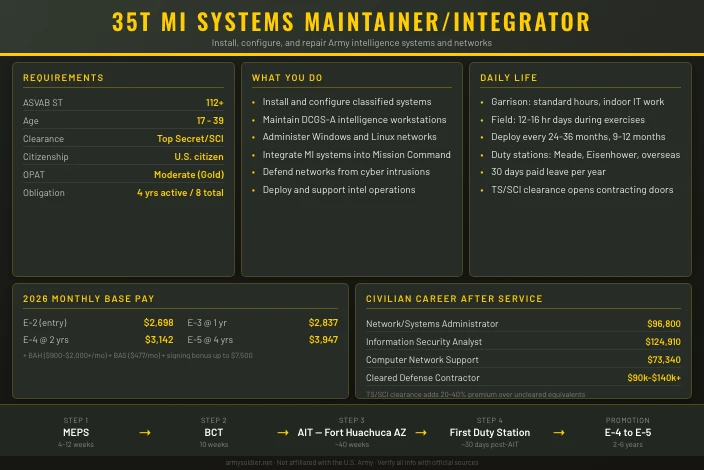
The 35T Military Intelligence Systems Maintainer/Integrator installs, configures, tests, and repairs the hardware and software systems used by Army intelligence units. You maintain computers, servers, networks, and communications equipment across ground-based and airborne intelligence platforms, and you integrate those systems into the Army’s Mission Command architecture.
Day-to-day work varies by assignment. On a garrison day, you might run diagnostics on a signals intelligence workstation, push software updates to a distributed common ground system, or troubleshoot a network connection that a 35F analyst needs to access classified databases. When your unit deploys or goes to the field, you set up and tear down the technical infrastructure that the entire intelligence cell runs on.
Daily Tasks
- Install and configure classified computer systems and intelligence workstations
- Test and repair hardware components including servers, routers, switches, and peripheral devices
- Administer Windows and Linux operating systems on military networks
- Install software on virtual machines and manage system images
- Integrate intelligence systems with Mission Command platforms and Army networks
- Conduct cybersecurity tasks including monitoring networks for intrusions and applying security patches
- Maintain technical documentation and operator manuals
Specialized Roles
The 35T base MOS qualifies you for several Additional Skill Identifiers (ASIs) that lead to specialized positions within Army intelligence. The most common identifiers earned at skill level 3 (Staff Sergeant) and above include technical integration management and network operations supervision.
| Identifier | Description |
|---|---|
| Y6 | Open-Source Intelligence systems support |
| L6 | Biometric systems integration |
| Q9 | Common Ground Station technical support |
Exact ASI availability changes with Army force structure. Your branch manager at HRC can confirm current identifiers aligned to 35T.
Mission Contribution
Intelligence only works when the equipment works. When a 35F analyst needs to pull data from a classified feed at 0200 during a tactical operation, a 35T made that connection possible. Your role sits at the intersection of IT support, systems engineering, and cybersecurity. Commanders depend on uninterrupted access to intelligence products, and you are the one who ensures that access never goes down.
Technology and Equipment
The systems you work with include DCGS-A (Distributed Common Ground System – Army), which is the Army’s primary intelligence processing and reporting workstation. You maintain hardware and software for the Trojan Spirit signals intelligence system, Prophet ground-based SIGINT collection platforms, and various airborne collection systems. Daily work involves SIPRNet (Secret Internet Protocol Router Network) and JWICS (Joint Worldwide Intelligence Communications System) terminal equipment. As Army intelligence adopts cloud-based platforms and AI-assisted analytical tools, 35T soldiers are the first to install and integrate those systems at the unit level.
Salary and Benefits
Financial Benefits
Army pay is based on rank and time in service. Most 35T soldiers enter as E-2 after completing BCT and AIT.
| Rank | Pay Grade | Typical Years | 2026 Monthly Base Pay |
|---|---|---|---|
| Private (PV2) | E-2 | 0-1 | $2,698 |
| Private First Class (PFC) | E-3 | 1-2 | $2,837 – $3,015 |
| Specialist (SPC) | E-4 | 2-4 | $3,142 – $3,659 |
| Sergeant (SGT) | E-5 | 4-6 | $3,947 – $4,109 |
| Staff Sergeant (SSG) | E-6 | 8-10 | $4,613 – $4,759 |
Base pay figures are from DFAS 2026 pay tables. On top of base pay, BAH (Basic Allowance for Housing) varies widely by duty station and dependency status. A single E-4 at a CONUS installation receives roughly $900 to $2,000+ per month in BAH depending on location. BAS (Basic Allowance for Subsistence) adds $476.95 per month for food costs.
The 35T qualifies for a signing bonus of up to $7,500 for qualified recruits. Bonus amounts shift with Army manning priorities, so verify the current figure with your recruiter.
Additional Benefits
TRICARE health coverage costs nothing for active duty soldiers or their dependents enrolled in TRICARE Prime. That includes medical, dental, vision, prescriptions, and mental health services.
Tuition Assistance covers up to $4,500 per year for college courses completed while you serve. After separation, the Post-9/11 GI Bill pays full in-state tuition at public universities for up to 36 months, plus a monthly housing allowance tied to the E-5 BAH rate at your school’s location and a $1,000 annual book stipend. The private school annual cap is $29,920.95 for the 2025-2026 academic year.
Retirement under the Blended Retirement System (BRS) provides a pension worth 40% of your high-36 average base pay after 20 years. The government auto-contributes 1% to your Thrift Savings Plan from day one and matches up to an additional 4% once you hit your third year of service.
Work-Life Balance
You accrue 30 days of paid leave per year. Garrison work is mostly standard duty hours, though shift work during exercises or elevated operational periods is common. Technical issues do not follow a clock, so on-call rotations are part of the job at most assignments.
Qualifications and Eligibility
Basic Qualifications
The 35T requires a minimum Skilled Technical (ST) line score of 112 on the ASVAB. The ST composite is calculated from your General Science, Verbal Expression, Math Knowledge, and Mechanical Comprehension subtest scores. That 112 threshold is among the highest in the Army enlisted force, which reflects the technical depth of this MOS.
You must be a U.S. citizen, at least 17 years old (with parental consent) or 18, and hold a high school diploma or GED. A minimum AFQT score of 31 is required for HS diploma holders; 50 for GED holders.
| Requirement | Standard |
|---|---|
| ASVAB Line Score | ST: 112 (minimum) |
| Citizenship | U.S. citizen required |
| Security Clearance | Top Secret / SCI |
| Age | 17-39 at enlistment |
| Education | High school diploma or GED |
| AFQT Minimum | 31 (HS diploma) / 50 (GED) |
| Service Obligation | 4 years active (typical) |
| OPAT | Moderate (Gold) |
The security clearance is the biggest gating factor. You will undergo a thorough background investigation that includes a polygraph examination. Prior drug use, foreign contacts, financial problems, and criminal history are all reviewed. Most applicants get a conditional clearance offer before shipping to BCT, but the full investigation can take several months to complete after arrival.
Application Process
Your recruiter submits your application after you take the ASVAB and confirm your ST score qualifies. A medical examination at MEPS (Military Entrance Processing Station) clears your physical. Once your recruiter identifies the 35T contract option, you sign and ship to BCT. The Top Secret investigation begins during BCT and continues through AIT. You cannot start classified work until an interim clearance is granted.
Selection Criteria
The ST:112 is a real screen. Most Army MOSs require scores in the 90s or below, so a 112 puts you in the upper tier of enlisted technical jobs. Prior IT experience, computer certifications like CompTIA A+ or Security+, and a clean personal history all strengthen your application. The security clearance investigation is thorough, and anything that complicates your background check can delay or disqualify you.
Service Obligation
Most 35T contracts are for four years of active duty with a total service commitment of eight years (active plus reserve). Some contracts with a larger signing bonus may require a longer active duty obligation. Confirm the exact terms with your recruiter before signing.
See our ASVAB study guide for strategies to hit these line scores, or take the PiCAT from home if you are a first-time tester.
Work Environment
Setting and Schedule
In garrison, you work primarily indoors at a facility with classified systems. Most assignments are on military installations with access to secure server rooms, intelligence operations centers, and maintenance bays. You may also work in forward operating environments during deployments, where your office is a tactical operations center (TOC) tent or a hardened building at an overseas base.
Shift work is common because intelligence operations run around the clock. At a major installation like Fort Meade, the workday may be structured. At a deployed brigade combat team, you work when the mission demands it, which can mean 12-16 hour days during combat operations or training exercises.
Leadership and Communication
You work within an intelligence battalion or brigade S2 section. Your direct leadership chain runs through a senior 35T noncommissioned officer. Performance counseling follows the Army’s NCOER (Non-Commissioned Officer Evaluation Report) system at E-5 and above, with quarterly or semi-annual counseling statements at lower grades. Communication flows through the unit S6 (signal) and S2 (intelligence) sections, and you coordinate with both to manage system connectivity and classification requirements.
Team Dynamics and Autonomy
Technical work gives you more individual autonomy than many Army jobs. You often receive a task – a broken system, a new equipment install – and own it from diagnosis to completion. But you also operate within a team. Most intelligence units have multiple 35T soldiers, and you coordinate with analysts (35F), SIGINT operators (35N/35S), and signal soldiers (25-series) regularly.
Job Satisfaction and Retention
Re-enlistment rates for technical intelligence MOSs are solid, partly because the skills are directly transferable to high-paying government contracting and defense industry jobs. Soldiers who earn a TS/SCI clearance early in their careers understand its value. Those who stay often do so for the clearance, the mission variety, and the promotable track for technical NCOs.
Training and Skill Development
Initial Training
| Phase | Location | Length | Focus |
|---|---|---|---|
| Basic Combat Training (BCT) | Various installations | 10 weeks | Soldier skills, weapons, physical fitness |
| Advanced Individual Training (AIT) | Fort Huachuca, AZ | ~40 weeks | MI systems hardware/software, networking, cybersecurity |
BCT is the same for all Army enlistees. You will qualify with the M4 rifle, complete land navigation, and build baseline physical fitness. AIT at Fort Huachuca runs approximately 40 weeks and is conducted by the U.S. Army Intelligence Center of Excellence. The coursework covers computer hardware repair, operating system administration, network configuration, intelligence system integration, and cybersecurity fundamentals. You will work on actual military systems, not just simulations.
Fort Huachuca is a relatively small installation near Sierra Vista, Arizona. The climate is dry and mild compared to much of the country. AIT there is demanding academically – expect to study in the evenings, especially during the software and networking modules.
Advanced Training
After reaching E-5 (Sergeant), you become eligible for the Warrior Leader Course (WLC) and can pursue the Advanced Leaders Course (ALC) for 35T at the Senior Enlisted level. The Army also sponsors industry certifications. CompTIA Security+ is a DoD 8570 requirement for anyone administering classified systems, so most 35T soldiers earn it during their first assignment. CompTIA Network+, Certified Ethical Hacker (CEH), and vendor certifications from Cisco or Microsoft are all achievable through Army-funded training programs.
Everything starts with qualifying ASVAB scores — our study guide covers what to study first.
Career Progression and Advancement
Career Path
Promotion in the Army follows a combination of time in service, performance, and available slots by rank. The 35T fills technical leadership roles as rank increases.
| Rank | Pay Grade | Typical Time | Role |
|---|---|---|---|
| Private First Class (PFC) | E-3 | 0-1 year | Entry-level systems maintenance |
| Specialist (SPC) | E-4 | 1-3 years | Independent maintenance tasks |
| Sergeant (SGT) | E-5 | 3-6 years | Team lead, technical oversight |
| Staff Sergeant (SSG) | E-6 | 6-10 years | Section sergeant, training NCO |
| Sergeant First Class (SFC) | E-7 | 10-15 years | Platoon sergeant, intelligence officer support |
| Master Sergeant (MSG) | E-8 | 15-20 years | Senior intelligence systems advisor |
| Sergeant Major (SGM) | E-9 | 20+ years | Senior enlisted advisor at battalion/brigade |
Warrant Officer is also a path for experienced 35T soldiers. The 351L (CI/HUMINT Warrant) and 350F (All-Source Intelligence Technician) warrants are common targets for high-performing 35T NCOs who want to specialize further. The Warrant Officer Candidate School (WOCS) at Fort Novosel, Alabama is the entry point.
Role Flexibility
If your interests shift, the Army has mechanisms to request a reclassification (reclass) after your first enlistment. 35T skills translate well to 25-series signal MOSs and cyber MOSs in the 17-series. You can also apply for the Ranger or Special Forces pipeline, where MI systems maintainers are valued at the unit level.
Performance Evaluation
Junior soldiers (E-1 through E-4) receive counseling statements from their direct supervisor. Sergeants (E-5) and above fall under the NCOER system, which evaluates performance across Army Values, competence, physical fitness, leadership, and responsibility. A strong NCOER at E-5 and E-6 is the primary driver of selection for the Sergeant First Class promotion board.
Physical Demands and Medical Evaluations
The 35T carries a Moderate (Gold) OPAT physical demand category. The Occupational Physical Assessment Test includes a standing long jump, seated power throw, strength deadlift, and interval aerobic run. The Moderate category is the least demanding of the three OPAT tiers.
On the job, physical demands are low to moderate. You lift equipment racks, server components, and cable runs, which can involve carrying loads over 40 pounds occasionally. You do not fill a direct combat role, but all Army soldiers serve in a deployable capacity.
Army Fitness Test
All soldiers take the Army Fitness Test (AFT) once per year. The AFT replaced the ACFT on June 1, 2025. It has five events scored 0-100 each, with a maximum of 500 points.
| Event | Abbreviation | Description |
|---|---|---|
| 3 Repetition Maximum Deadlift | MDL | Weighted hex bar deadlift |
| Hand Release Push-Up | HRP | Full arm extension at bottom |
| Sprint-Drag-Carry | SDC | 5-event shuttle with drag and farmer carry |
| Plank | PLK | Timed plank hold |
| Two-Mile Run | 2MR | Timed two-mile run |
The minimum passing score is 60 points per event, for a total of at least 300 points. Scores are sex- and age-normed. The 35T is not a designated combat MOS, so the standard 300-point general minimum applies (not the 350-point combat specialty standard).
Medical Evaluations
You need normal color vision for this MOS because system indicator lights and wiring color codes are part of daily maintenance work. A medical examination at MEPS screens for any disqualifying conditions before you enlist. Once in service, periodic medical readiness exams are required at regular intervals throughout your career.
Deployment and Duty Stations
Deployment Details
35T soldiers deploy with their parent intelligence unit. The typical cycle at a conventional Army unit follows a deployment rotation roughly every 24 to 36 months, with deployments lasting 9 to 12 months. Support operations in Europe, the Middle East, and the Pacific are the most common current theaters. At special operations support assignments, tempo can be significantly higher.
Location Flexibility
Major duty stations for 35T include:
- Fort Meade, Maryland (NSA/Central Security Service co-located)
- Fort Eisenhower, Georgia (formerly Fort Gordon; Army Cyber Command)
- Fort Huachuca, Arizona (Intelligence Center, training base)
- Joint Base Lewis-McChord, Washington
- Overseas: Germany (USAG Wiesbaden), South Korea (Camp Humphreys), Japan (Camp Zama)
Fort Meade is the most sought-after and also most common assignment because of its proximity to the intelligence community. The Army allows preference requests through the assignment system, but final decisions rest with HRC.
Risk, Safety, and Legal Considerations
Job Hazards
Day-to-day risk in garrison is low. Electrical safety around server equipment is the primary routine hazard. During deployment, you share the same risks as any soldier in a forward area: indirect fire, vehicle accidents, and the physical toll of sustained operations.
Safety Protocols
You follow standard Army electrical safety procedures and equipment grounding requirements. Classified system maintenance is governed by strict COMSEC (Communications Security) and OPSEC protocols. Unauthorized disclosure of classified information, even accidental, carries serious legal consequences under the Uniform Code of Military Justice (UCMJ).
Security and Legal Requirements
The Top Secret/SCI clearance requires periodic reinvestigation. You complete annual security training and periodic polygraph examinations depending on your assignment. The access comes with strict rules about foreign travel, foreign contacts, and outside employment. Violating those rules or mishandling classified material can result in clearance revocation, administrative action, or criminal prosecution.
Impact on Family and Personal Life
Family Considerations
Military family life involves frequent relocation, deployments, and periods of extended separation. The Army provides Military OneSource counseling, family support groups, on-post childcare, and access to school liaison officers who help children transition between schools during PCS moves.
The TS/SCI clearance can complicate communication during deployments. Some assignments have communication restrictions. Families should be prepared for periods where contact is limited or irregular.
Relocation and Flexibility
PCS (Permanent Change of Station) moves happen every two to three years on average. The Army pays for the move, but you are generally not free to choose your assignment without going through the preference and market system. Married soldiers with dependents are authorized BAH at the with-dependents rate, which significantly increases housing support.
Reserve and National Guard
The 35T Military Intelligence Systems Maintainer/Integrator is available in both the Army Reserve and Army National Guard. Billets exist in MI battalions and signal/intelligence companies in both components. The 35T is one of the more common technical MOS in the MI field because every MI unit needs someone to maintain its systems. You must maintain your TS clearance (some positions require TS/SCI) to drill.
Drill Schedule and Training Commitment
Standard commitment is one weekend per month (Battle Assembly) plus two weeks of Annual Training per year. Drill weekends for 35T soldiers include system maintenance checks, network troubleshooting exercises, and equipment configuration refreshers. Annual Training typically involves setting up, testing, and maintaining MI systems during a larger exercise. Additional training days may be needed for new system fieldings, software updates, and cybersecurity certification refreshers (Security+ or equivalent).
Part-Time Pay
An E-4 with over 3 years of service earns about $464 per drill weekend (4 drill periods), totaling roughly $5,572 per year from drill pay plus about $1,741 for 15 days of Annual Training. Active-duty E-4 base pay is $3,482 per month. Many 35T soldiers work civilian IT or defense contractor jobs that pay well above active-duty rates.
Benefits Differences
Tricare Reserve Select costs $57.88 per month for member-only or $286.66 per month for family coverage in 2026. Active-duty TRICARE Prime is free.
Education benefits include Federal Tuition Assistance ($250 per credit hour, up to $4,500 per year) and the Montgomery GI Bill-Selected Reserve at $493 per month for full-time students. Guard members may qualify for state tuition waivers. Mobilization of 90 or more days earns Post-9/11 GI Bill eligibility.
Reserve retirement is points-based, requiring 20 qualifying years. Collection starts at age 60, reduced by 3 months per 90-day mobilization after January 2008, minimum age 50.
Deployment and Mobilization
35T soldiers in Reserve/Guard units see moderate mobilization rates. MI systems maintenance is needed wherever MI units deploy. Both unit mobilizations and individual augmentee fills occur. Typical tours run 9 to 12 months. Deployment frequency is comparable to other MI MOS.
Civilian Career Integration
The 35T has strong civilian career crossover into IT systems administration, network engineering, and defense contractor technical support. CompTIA Security+, network maintenance experience, and a security clearance are all directly marketable. Companies like SAIC, Leidos, and Raytheon hire 35T-trained technicians. USERRA protects your civilian job during activations, and employers must reinstate you with the seniority you would have earned.
| Feature | Active Duty | Army Reserve | Army National Guard |
|---|---|---|---|
| Commitment | Full-time | 1 weekend/month + 2 weeks/year | 1 weekend/month + 2 weeks/year |
| Monthly Pay (E-4, 3+ yrs) | $3,482 | ~$464/drill weekend | ~$464/drill weekend |
| Healthcare | TRICARE Prime ($0) | Tricare Reserve Select ($57.88/mo) | Tricare Reserve Select ($57.88/mo) |
| Education | Federal TA, Post-9/11 GI Bill | Federal TA, MGIB-SR ($493/mo) | Federal TA, MGIB-SR, state tuition waivers |
| Deployment Tempo | Regular rotations | Moderate (individual + unit) | Moderate (individual + unit) |
| Retirement | 20-year pension at age 40+ | Points-based, collect at age 60 | Points-based, collect at age 60 |
Post-Service Opportunities
The TS/SCI clearance you earn in this MOS is genuinely valuable in the civilian job market. Government contractors, defense firms, and federal agencies actively recruit cleared candidates, and many 35T veterans find work without needing to start at an entry level.
| Civilian Job Title | Median Annual Wage | BLS Job Outlook |
|---|---|---|
| Network and Computer Systems Administrator | $96,800 | -4% (2024-2034, ~14,300 openings/yr) |
| Computer Network Support Specialist | $73,340 | -3% (2024-2034, ~50,500 openings/yr) |
| Information Security Analyst | $124,910 | +33% (2023-2033, fast growth) |
| Systems Administrator (TS/SCI cleared) | $90,000 – $140,000+ | High demand in defense sector |
Wage data from BLS Occupational Outlook Handbook. Cleared positions consistently earn 20-40% above uncleared equivalents.
The VA’s Vocational Rehabilitation program and the SkillBridge program (available 180 days before separation) both provide transition support. Many 35T veterans earn CompTIA Security+ and Network+ while still serving and walk out the door already credentialed.
Transition Programs
The Army Career Skills Program (CSP) includes apprenticeships and internships with defense contractors in the final months of service. The Post-9/11 GI Bill covers degree programs in computer science, cybersecurity, and information systems, which many 35T veterans use to move into software engineering or network architecture roles.
Is This a Good Job for You? The Right (and Wrong) Fit
Ideal Candidate Profile
This MOS fits people who are genuinely interested in how computer systems work, not just how to use them. If you have ever taken apart a computer, set up a home network, or troubleshot a server, you will recognize parts of the job quickly. You need strong attention to detail because classified system errors have real consequences. Patience matters too, since diagnostic work can be methodical and slow.
People who thrive in 35T:
- Have a natural aptitude for technology and systems
- Can work independently and document their work clearly
- Are comfortable with long training pipelines and academic study
- Want a security clearance as part of their long-term career plan
- Can meet the ST:112 ASVAB threshold without needing a calculator
Potential Challenges
The 40-week AIT is a real commitment. You are in a classroom or lab environment for most of that time, and the material gets technical quickly. If you struggled with math or computers in school, the ST:112 requirement will be a hard barrier. The clearance investigation can also be a source of anxiety for candidates with complicated backgrounds.
Operational tempo can spike during exercises and deployments. When a system goes down during a mission, you fix it under pressure with whatever you have on hand. That is satisfying for some people and stressful for others.
Career and Lifestyle Alignment
If your goal is a stable, well-paying civilian career in IT or cybersecurity, this MOS builds toward that. The clearance, the certifications, and the hands-on system experience are a strong foundation. If you want something more physically demanding or more field-oriented, you may prefer a different MOS. The 35T is fundamentally a technical specialist role, which means most of your career involves computers, not combat missions.
More Information
Talk to an Army recruiter to find out whether your ASVAB score qualifies, whether a 35T contract is currently available with a bonus, and what your assignment preferences look like. The Army’s official goarmy.com page for 35T has additional information, and the HRC MOS overview at hrc.army.mil covers career management details.
- Prepare for the ASVAB with our study guide to make sure your line scores qualify
This site is not affiliated with the U.S. Army or any government agency. Verify all information with official Army sources before making enlistment or career decisions.
Explore more Army intelligence careers such as 35F Intelligence Analyst and 35L Counterintelligence Agent.