27D Paralegal Specialist
Most Army jobs involve weapons, vehicles, or heavy equipment. The 27D Paralegal Specialist involves case files, legal research, and courts-martial. You support Army Judge Advocate General (JAG) attorneys in every area of military law, and when soldiers need legal help, you’re the first person they meet. The work is intellectually demanding, the clearance requirement opens doors, and the civilian translation is direct.
Qualifying requires specific ASVAB line scores — our ASVAB study guide covers what to target and how to prepare.
Job Role and Responsibilities
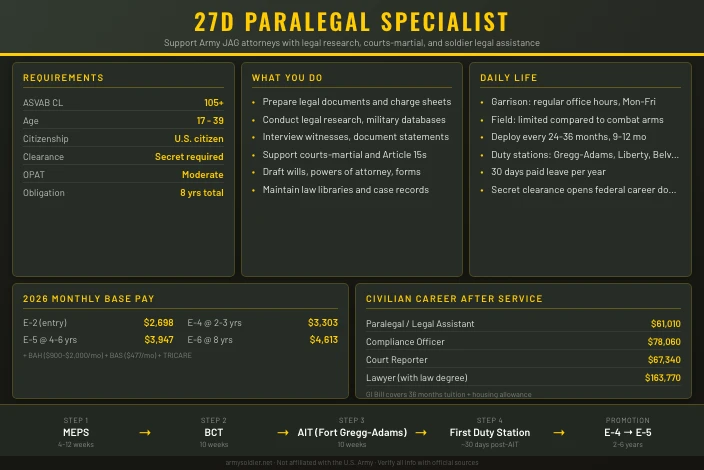
Paralegal Specialists assist Army lawyers, military judges, and unit commanders with legal matters across every area of military law. They prepare and review legal documents, conduct legal research, interview witnesses, support courts-martial proceedings, and administer legal assistance programs for soldiers and their families.
On a typical day at a garrison legal office, you might spend the morning preparing charge sheets for a courts-martial, then shift to drafting a power of attorney for a soldier deploying next week. In the afternoon, you pull case law from military legal databases to support a JAG attorney building a defense argument. Before the day ends, you might brief a commander on the procedural requirements for an Article 15 hearing.
The job spans a wide range of legal disciplines, none of which repeat the same tasks day after day.
Specialized Roles
The Army structures legal specialties by skill level tied to rank:
| Identifier | Skill Level | Rank Range | Primary Duties |
|---|---|---|---|
| 27D10 | Level 1 | E-1 to E-4 | Prepare legal documents, conduct research, process legal assistance cases |
| 27D20 | Level 2 | E-5 | Supervise junior paralegals, manage legal office operations |
| 27D30 | Level 3 | E-6 | NCOIC of legal sections, advise commanders on legal administrative matters |
| 27D40 | Level 4 | E-7 | Senior paralegal NCO, manage multi-section legal operations |
| 27D50 | Level 5 | E-8 to E-9 | Command-level legal advisor, inspect legal functions across units |
Additional Skill Identifiers (ASIs) are available for paralegals who qualify for specialized assignments, including airborne (SQI P) or assignments supporting special operations legal offices.
How This Role Supports the Mission
Army legal operations touch nearly every aspect of military service. Disciplinary actions under the Uniform Code of Military Justice (UCMJ), fiscal law reviews for contracts, international law compliance during overseas operations, and legal assistance for soldiers facing family law issues all flow through JAG offices. The 27D keeps those offices functional. Without trained paralegals, JAG attorneys couldn’t process the volume of legal work the Army generates.
Technology and Equipment
Legal research platforms are the primary tools. You work with the Judge Advocate General’s Legal Center and School (TJAGLCS) legal databases, the Army Legal Management System, and classified government networks. Standard office computing handles document drafting, case tracking, and correspondence. Deployed legal teams carry secure laptops and portable equipment to set up legal offices wherever the unit operates.
Salary and Benefits
Financial Benefits
Pay is based on rank and time in service. Most 27D soldiers enter as E-1 and reach E-4 within two to three years.
| Pay Grade | Rank | Typical Time in Service | 2026 Monthly Base Pay |
|---|---|---|---|
| E-2 | Private (PV2) | Entry (post-BCT) | $2,698 |
| E-4 | Specialist (SPC) | 2-3 years | $3,303 |
| E-5 | Sergeant (SGT) | 4-6 years | $3,947 |
| E-6 | Staff Sergeant (SSG) | 8 years | $4,613 |
Base pay is only part of your compensation. BAH (Basic Allowance for Housing) adds roughly $900 to $2,000+ per month depending on your duty station and whether you have dependents. BAS (Basic Allowance for Subsistence) adds $477 per month for food.
No standard enlistment bonus is currently attached to the 27D MOS. Bonus availability shifts with Army recruiting needs, so confirm current offers with your recruiter before signing.
Additional Benefits
TRICARE covers you and your dependents with no enrollment fees, deductibles, or copays on active duty. That includes medical, dental, vision, mental health, and prescriptions.
Tuition Assistance covers up to $4,500 per year for college courses while you serve. After separation, the Post-9/11 GI Bill covers up to 36 months of in-state tuition at public universities or up to $29,921 per year at private schools, plus a monthly housing allowance and $1,000 annual book stipend.
Work-Life Balance
You earn 30 days of paid leave per year. Legal offices in garrison operate on regular business hours, Monday through Friday. Field exercises and deployments disrupt that cadence, but 27D soldiers spend considerably less time in the field than combat arms MOSs.
The Blended Retirement System (BRS) governs retirement. Serve 20 years and receive a pension equal to 40% of your highest 36 months of base pay. Starting in year three, the government matches up to 5% of your Thrift Savings Plan (TSP) contributions.
Qualifications and Eligibility
Basic Qualifications
The 27D requires a minimum score of 105 on the Clerical (CL) composite of the ASVAB. The CL composite draws on Verbal Expression, Arithmetic Reasoning, and Mathematics Knowledge. Strong reading comprehension and writing skills matter as much as the math component for day-to-day legal work.
| Requirement | Details |
|---|---|
| Age | 17-39 (up to 42 with waiver) |
| Citizenship | U.S. citizen |
| Education | High school diploma or GED |
| AFQT | Minimum 31 (diploma) or 50 (GED) |
| Clerical (CL) | Minimum 105 |
| Security Clearance | Secret required |
| Physical Demands | Light / OPAT: Moderate |
| PULHES | 222121 |
| Vision | No special requirements beyond standard |
| Moral Character | Background investigation required for clearance |
Application Process
Start at your local recruiting station. The recruiter verifies your ASVAB scores and runs a preliminary suitability check. If you meet the CL 105 threshold and pass the initial screening, you go to MEPS (Military Entrance Processing Station) for your full medical examination, official ASVAB results, and background initiation.
Your Secret clearance investigation runs in parallel with your enlistment processing. It typically takes 2 to 6 months to complete. In many cases, you’ll ship to training under an interim clearance while the full investigation wraps up.
From first recruiter contact to ship date, expect 4 to 12 weeks absent any delays.
Selection Criteria and Competitiveness
The 27D is a moderately competitive MOS. The Army has consistent demand for legal paralegals across Active Duty, Reserve, and National Guard components, but the CL 105 threshold and the clearance requirement filter out a portion of applicants. Recruits with prior experience in administrative work, pre-law coursework, or any exposure to legal environments stand out.
Upon Accession into Service
Most recruits enter at E-1 (Private) and promote to E-2 automatically after BCT. College credits or JROTC participation can bump your starting grade to E-2 or E-3. The standard service obligation is 8 years total, typically structured as 3 to 4 years active duty followed by Reserve or Individual Ready Reserve (IRR) time.
See our ASVAB study guide for strategies to hit these line scores, or take the PiCAT from home if you are a first-time tester.
Work Environment
Setting and Schedule
Legal offices look and run like law firm support offices. You work at a desk, manage case files, write and review documents, and answer questions from soldiers who walk in needing legal help. Garrison hours are typically 0730 to 1700 Monday through Friday.
Deployed legal teams operate out of whatever space is available, from a dedicated office on a large base to a corner of a tent. Hours expand during high operational tempo periods, and you’ll support whatever legal needs arise in the deployment environment. That could include processing non-judicial punishment actions, reviewing local national contracts, or supporting command investigations.
Leadership and Communication
Your chain of command runs through the legal section or JAG detachment. A senior NCO (usually E-7 or E-8) manages day-to-day legal operations, and a Staff Judge Advocate (a JAG officer) leads the unit. Quarterly counseling and annual NCOERs (for E-5 and above) are the primary formal feedback mechanisms.
You communicate with everyone from privates seeking power of attorney to general officers receiving legal briefings. Writing quality matters in this job. Sloppy documents get sent back.
Team Dynamics and Autonomy
Junior paralegals (E-1 through E-4) work under direct NCO and attorney supervision. A senior technician reviews your documents before they go out. As you rank up, you manage your own caseload, supervise junior soldiers, and eventually run section operations.
Small deployed legal teams often work with limited oversight. A two-person team might handle all legal support for a brigade, which means you make judgment calls without waiting for back-and-forth with higher headquarters.
Job Satisfaction and Retention
Re-enlistment rates for legal soldiers track close to the Army’s administrative MOS average. The biggest draws are regular hours in garrison, intellectually varied work, and a clear path to civilian legal careers. The most common frustration is the volume of repetitive legal assistance work, particularly powers of attorney and wills during pre-deployment cycles.
Soldiers who make a career of 27D typically do so because they enjoy the legal environment and want to build toward civilian paralegal or law school careers.
Training and Skill Development
Initial Training
Training runs in two consecutive phases: Basic Combat Training (BCT) and Advanced Individual Training (AIT).
| Training Phase | Location | Duration | Focus |
|---|---|---|---|
| BCT | Fort Jackson, SC; Fort Moore, GA; Fort Leonard Wood, MO | 10 weeks | Soldier fundamentals: marksmanship, tactics, fitness, discipline |
| AIT | Fort Gregg-Adams, VA (TJAGLCS) | 10 weeks | Legal research, document preparation, military justice procedures, courts-martial support |
BCT is the same for every Army MOS. You learn to shoot, navigate, work as part of a team, and meet the Army’s fitness standards.
AIT runs at the Judge Advocate General’s Legal Center and School at Fort Gregg-Adams, Virginia. The curriculum covers military legal procedures, UCMJ application, legal document drafting, evidence handling, and how to support every type of legal proceeding the Army conducts. You practice on realistic scenarios before graduating.
The total pipeline from ship date to first duty station assignment runs approximately 22 to 24 weeks.
Advanced Training
Once at your unit, on-the-job experience fills in what the classroom can’t teach. Real courts-martial are messier than AIT exercises, and each legal office has its own caseload rhythms.
As you promote through the NCO ranks, the Army sends you to the Warrior Leader Course (E-5), Advanced Leader Course (E-6), and Senior Leader Course (E-7). The JAG Corps runs its own NCO Academy at TJAGLCS in Charlottesville, Virginia, which provides MOS-specific advanced instruction for paralegal NCOs.
The Army COOL (Credentialing Opportunities On-Line) program helps you earn civilian paralegal certifications while serving. Relevant credentials include the Certified Paralegal (CP) through the National Association of Legal Assistants (NALA) and the Registered Paralegal (RP) through the National Federation of Paralegal Associations (NFPA). These certifications directly increase your civilian market value after service.
Everything starts with qualifying ASVAB scores — our study guide covers what to study first.
Career Progression and Advancement
Career Path
Junior enlisted promotions follow a predictable timeline. The NCO ranks require board appearances, promotion points, and strong evaluation reports.
| Rank | Pay Grade | Typical Time in Service | Role |
|---|---|---|---|
| Private (PV2) | E-2 | 0-1 years | Entry-level legal support |
| Private First Class (PFC) | E-3 | 1-2 years | Legal technician with growing caseload |
| Specialist (SPC) | E-4 | 2-3 years | Independent case processing, senior technician tasks |
| Sergeant (SGT) | E-5 | 4-6 years | Team leader, supervises junior paralegals |
| Staff Sergeant (SSG) | E-6 | 6-10 years | Section NCOIC, manages legal operations |
| Sergeant First Class (SFC) | E-7 | 10-14 years | Senior paralegal advisor to commanders |
| Master Sergeant (MSG) | E-8 | 14-18 years | Senior legal NCO, multi-section oversight |
| Sergeant Major (SGM) | E-9 | 18+ years | Command-level legal NCO advisor |
E-4 promotion is largely automatic with time in service and no adverse action. E-5 requires a promotion board, promotion points, and meeting military education requirements. E-6 and above depend heavily on NCOERs and available slots Army-wide.
Role Flexibility and Transfers
Legal support positions exist at installations worldwide, giving 27D soldiers more geographic flexibility than soldiers in niche technical MOSs. Practically every brigade and division-level headquarters has a JAG section.
If your career goals shift, the most natural lateral move is 42A (Human Resources Specialist), which shares the administrative skill foundation. Any reclassification requires completing the new AIT and accepting a fresh service obligation.
Performance Evaluation
Soldiers at E-5 and above receive an annual NCOER evaluated by a rater and senior rater. The assessment covers leadership, technical proficiency, and contribution to the unit mission. Strong NCOERs are the primary promotion driver from E-6 upward.
What separates top performers in this MOS: zero documentation errors, clean legal inspections, completed civilian certifications, mentoring junior paralegals, and willingness to deploy when needed. JAG offices track caseload volume and document quality, so your output is measurable and visible to the attorneys you support.
Physical Demands and Medical Evaluations
Physical Requirements
The 27D carries a Light physical demands rating with a Moderate OPAT category. Most of your daily work happens at a desk. You won’t carry heavy equipment or run long distances as part of your regular job. Still, you’re a soldier first. Deployments mean wearing body armor, carrying a weapon, and living in austere conditions.
Every soldier takes the Army Fitness Test (AFT) at least once per year. The AFT replaced the ACFT on June 1, 2025, and has five events scored from 0 to 100 points each. You need at least 60 points per event and 300 points total to pass.
| Event | Description | Minimum Score to Pass |
|---|---|---|
| 3-Rep Max Deadlift (MDL) | Maximum weight for 3 repetitions | 60 points |
| Hand-Release Push-Up (HRP) | Push-ups with full arm extension at the bottom | 60 points |
| Sprint-Drag-Carry (SDC) | Five 50-meter shuttles with varied loads | 60 points |
| Plank (PLK) | Front leaning rest, elbows on ground | 60 points |
| Two-Mile Run (2MR) | Timed two-mile run | 60 points |
Scoring is sex- and age-normed. The maximum total is 500 points. Scores above the 300 minimum add to your promotion points, so performing well matters beyond just passing.
Medical Evaluations
Annual Periodic Health Assessments (PHAs) cover weight, blood pressure, vision, hearing, and general health screening. Pre-deployment medical clearances are more thorough. Any condition that limits your ability to serve in a deployment environment gets addressed before you ship, or you stay behind.
Deployment and Duty Stations
Deployment Details
Legal soldiers deploy with the units they support. For active-duty units, a typical rotation is 9 to 12 months deployed followed by 24 to 36 months at home station. Operational tempo and unit readiness status can shift that ratio.
Deployed JAG teams handle courts-martial in-theater, command investigations, fiscal law reviews for local contracts, and legal assistance for soldiers. You set up wherever the unit goes. Common deployment regions include the Middle East, Europe (Germany, Poland), and the Pacific (South Korea, Japan).
Location Flexibility
Legal offices exist at nearly every major Army installation. That gives 27D soldiers more assignment options than soldiers in narrower technical specialties.
Common CONUS duty stations:
- Fort Gregg-Adams, VA
- Fort Liberty, NC
- Fort Belvoir, VA
- Fort Campbell, KY
- Fort Cavazos, TX
- Fort Carson, CO
- Fort Drum, NY
- Fort Moore, GA
- The Pentagon, Washington, D.C.
OCONUS assignments:
- Germany (USAREUR-AF installations)
- South Korea (Camp Humphreys)
- Japan (Camp Zama)
- Hawaii (Schofield Barracks)
You submit a preference list during the assignment process, but the Army fills positions by need. Posts with larger JAG sections offer longer tour lengths and more case variety.
Risk, Safety, and Legal Considerations
Job Hazards
This is one of the lower-risk MOSs in garrison. Ergonomic injuries from desk work and the standard physical risks that come with soldier life are the primary concerns day-to-day. Eye strain and repetitive motion issues from prolonged computer use are real but manageable with standard precautions.
Deployed 27D soldiers face the same risks as anyone in a combat zone: indirect fire, vehicle accidents, and the physical toll of austere living. Legal teams typically operate inside established forward operating bases, so direct exposure to hostile contact is lower than combat arms, but the risk is never zero.
Safety Protocols
Cybersecurity practices govern how you handle legal information on government networks. Physical security of case files, evidence, and attorney-client privileged materials follows strict access controls. Deployed legal offices follow the same force protection procedures as any other unit element on the base.
Security and Legal Requirements
A Secret clearance is required before you begin performing 27D duties. The clearance process is covered in the Qualifications section above.
All soldiers operate under the Uniform Code of Military Justice (UCMJ). Paralegal specialists carry an additional obligation: you work with privileged legal communications. Mishandling attorney-client privileged materials or leaking information about ongoing cases can result in adverse action well beyond standard UCMJ violations.
Impact on Family and Personal Life
Family Considerations
The 27D is among the more predictable MOSs for family planning. Garrison hours follow a regular schedule, and legal specialists spend far fewer nights in the field than infantry or artillery soldiers. The job shares the family-friendliness of other administrative support MOSs.
Deployments change that picture. Nine to 12 months away from home is hard regardless of your MOS. The Army provides support through:
- Family Readiness Groups (FRGs) for peer connection within your unit
- Military OneSource for free counseling, financial advice, and family services
- Army Community Service (ACS) for spousal employment assistance and childcare referrals
- Exceptional Family Member Program (EFMP) for families with special needs dependents
Relocation and Flexibility
Expect a PCS (Permanent Change of Station) move every 2 to 4 years. The Army covers relocation costs, but each move disrupts family routines and spousal careers. The upside for legal soldiers is that JAG offices exist at most major installations, so preferred locations are more attainable than in technical specialties with few duty station options.
Reserve and National Guard
JAG (Judge Advocate General) units exist in both the Army Reserve and the Army National Guard. Every state maintains National Guard JAG elements attached to higher headquarters units. The Army Reserve operates legal support organizations that provide paralegal soldiers to support Reserve and Active component legal operations. The 27D MOS is available in all three components, and the legal work you perform as a part-time soldier is the same legal work active-duty paralegal specialists perform every day.
Drill Schedule and MOS-Specific Training
The standard part-time commitment is one weekend per month (four drill periods, Friday night through Sunday) plus two weeks of Annual Training each summer. For 27D soldiers, that baseline comes with additional training requirements.
JAG units run legal research update training when military justice procedures change or the Manual for Courts-Martial is revised. Military justice procedure refreshers are scheduled ahead of mobilization cycles, since deployed legal teams need current proficiency in courts-martial support and command investigation procedures. Paralegals who hold or pursue court reporter certification must maintain their certification currency through periodic continuing education.
Budget roughly 40 to 50 days per year for a part-time 27D. The legal field generates training requirements tied to procedural updates and case law changes that most non-legal Reserve and Guard MOSs don’t face.
Pay Comparison
Drill pay uses the same base pay tables as active duty, prorated per drill period. One drill weekend equals four drill periods.
An E-4 at four years of service earns $3,659 per month on active duty. That same E-4 earns approximately $488 for a standard four-period drill weekend in the Reserve or Guard. Two weeks of Annual Training adds roughly $1,830 in base pay for that period.
Most part-time 27D soldiers hold civilian jobs in law firms, corporate legal departments, or government agencies. Drill pay supplements civilian income rather than replacing it. For a paralegal earning $55,000 to $70,000 per year in a civilian role, Reserve or Guard service adds meaningful supplemental income plus benefits access.
Benefits Comparison
Healthcare is the clearest difference between active-duty and part-time service.
Active-duty soldiers receive TRICARE at no premium cost. Reserve and Guard soldiers not on active orders enroll in Tricare Reserve Select. Member-only coverage costs $57.88 per month. Member-plus-family coverage costs $286.66 per month. Both rates are well below average private-sector insurance premiums, but the gap compared to active-duty TRICARE is real.
On education, Reserve and Guard soldiers use MGIB-SR (Chapter 1606), which pays $493 per month for full-time enrollment. Federal Tuition Assistance is also available to drilling Reservists and Guardsmen at $250 per credit hour up to $4,500 per year. National Guard soldiers also benefit from state tuition waivers, which vary by state but frequently cover 100% of tuition at in-state public institutions.
Retirement follows a points-based system. Each drill period earns retirement points, Annual Training earns additional points, and mobilization periods earn active-duty-equivalent points. The pension becomes payable at age 60. That age can be reduced by three months for every 90 days of qualifying mobilization after January 28, 2008, down to a minimum age of 50. Active-duty soldiers receive an immediate annuity after 20 years, which is a meaningful structural difference for long-term financial planning.
Deployment and Mobilization Patterns
JAG teams deploy with division-level and higher headquarters whenever an operation is large enough to require legal support. Military justice actions don’t stop during deployments. Commanders need legal advisors for courts-martial in-theater, fiscal law reviews on local contracts, claims processing, and legal assistance for soldiers. This makes 27D soldiers a deployment requirement rather than a nice-to-have.
Reserve and Guard legal soldiers can expect mobilization for a 9 to 12 month operational deployment roughly once every 4 to 7 years under sustained high-tempo conditions. Domestic activations, including command support during natural disasters or civil emergency operations, typically involve shorter mobilizations with less frequency for legal MOS soldiers.
USERRA protects your civilian job when you mobilize. Your employer must hold your position or a comparable one, maintain your seniority, and restore you when you return from service. Law firms, corporate legal departments, and government agencies are all covered employers under USERRA. Many civilian legal employers view military service favorably and have experience accommodating paralegal staff who serve in the Reserve or Guard.
Civilian Career Integration
The 27D skill set maps directly onto civilian paralegal work. Part-time service fits well alongside careers as a paralegal, legal assistant, legal secretary, court reporter, or compliance officer. The military legal experience you build in the Reserve or Guard is credible and specific, not generic.
The Army COOL program helps you earn NALA’s Certified Paralegal (CP) or NFPA’s Registered Paralegal (RP) credential while serving. Both certifications translate directly to the civilian legal market. Soldiers pursuing pre-law coursework or planning to apply to law school benefit from the combination of academic preparation and hands-on legal experience that part-time 27D service provides.
| Feature | Active Duty | Army Reserve | Army National Guard |
|---|---|---|---|
| Duty Status | Full-time | Part-time (1 wknd/mo + 2 wks/yr) | Part-time (1 wknd/mo + 2 wks/yr) |
| Monthly Pay (E-4, 4 yrs) | $3,659/mo | ~$488/drill weekend | ~$488/drill weekend |
| Healthcare | TRICARE (no premium) | Tricare Reserve Select ($57.88/mo) | Tricare Reserve Select ($57.88/mo) |
| Education | Post-9/11 GI Bill, TA | MGIB-SR ($493/mo), TA | MGIB-SR ($493/mo), TA, state tuition waivers |
| Deployment | Per unit rotation | When mobilized | When mobilized |
| Retirement | 20-year pension | Points-based, age 60 | Points-based, age 60 |
Post-Service Opportunities
Transition to Civilian Life
Your military legal experience maps directly to civilian paralegal and legal support careers. You leave with hands-on experience in legal research, document drafting, evidence management, and litigation support. Federal agencies, defense contractors, and private law firms all value that background.
The Transition Assistance Program (TAP) provides resume help, interview coaching, and benefits orientation during your last year on active duty. Certifications earned through Army COOL (CP, RP) give you a competitive edge over civilian applicants without military experience.
The Post-9/11 GI Bill covers up to 36 months of tuition for a pre-law, criminal justice, or paralegal studies degree. That credential, combined with your service experience, positions you for mid-level legal support roles or even law school.
Civilian Career Prospects
| Civilian Job | Median Annual Salary (May 2024, BLS) | 10-Year Outlook |
|---|---|---|
| Paralegal / Legal Assistant | $61,010 | Little to no change |
| Legal Secretaries and Administrative Assistants | $54,030 | Declining |
| Court Reporter / Captioner | $67,340 | Growing |
| Compliance Officer | $78,060 | +5% |
| Lawyers (with law degree) | $163,770 | +8% |
Entry-level paralegal positions are accessible immediately after separation. Law firms, government agencies, corporations, and nonprofit organizations all hire. Federal agencies, particularly the Department of Justice, Department of Defense, and Department of Veterans Affairs, actively recruit veterans with legal background because they already understand government legal procedures.
Post-Service Policies
An honorable discharge unlocks VA healthcare, education benefits, disability compensation (if applicable), and the VA home loan guaranty. Plan your transition at least 12 months before your ETS date. The 27D’s transferable skills make the handoff to civilian work more direct than most administrative MOSs.
Is This a Good Job for You?
Ideal Candidate Profile
You’ll thrive as a 27D if you like precise written work and can hold sensitive information confidentially. Legal work has rigid rules, and people who prefer clear structure over ambiguity tend to do well.
Traits that predict success:
- Strong reading comprehension and writing ability
- Comfortable researching legal texts and regulations for hours
- Trustworthy handling of confidential information
- Patient when explaining legal processes to frustrated soldiers
- Interested in law, criminal justice, or public service as a career direction
Prior experience with legal work, formal writing, or administrative roles helps but isn’t required. The Army teaches the military legal system from scratch in AIT.
Potential Challenges
This MOS may not be right for you if:
- You need physical activity or outdoor work to stay engaged
- Confidentiality requirements feel restrictive rather than natural
- You’re drawn to high-adrenaline, combat-oriented roles
- Writing and research feel like punishment rather than work
The Secret clearance investigation can be a barrier. Financial issues, drug history, or foreign contacts may trigger delays or denials. The clearance requirement is non-negotiable for this job.
Who Should Consider the 27D
The 27D fits people who want to serve in the Army and build toward a legal career at the same time. The work translates directly. Your GI Bill can fund a paralegal certificate, criminal justice degree, or even law school. Many former 27D soldiers end up as paralegals in JAG-equivalent civilian roles, federal law enforcement support, or corporate compliance.
If you want a combat MOS or a physically demanding role, look elsewhere. But if you want intellectually varied work, predictable garrison hours, transferable credentials, and a direct line to civilian law careers, the 27D delivers.
More Information
Talk to an Army recruiter to confirm current 27D training dates, available duty stations, and your ASVAB eligibility. If you have prior legal or administrative experience, ask how it affects your starting rank and assignment options. The recruiter can also confirm whether any enlistment bonuses are currently attached to this MOS.
- Prepare for the ASVAB with our study guide to make sure your line scores qualify
This site is not affiliated with the U.S. Army or any government agency. Verify all information with official Army sources before making enlistment or career decisions.
Explore more Army legal careers.