91B Wheeled Vehicle Mechanic
Every unit in the Army moves on wheels. When a HEMTT breaks down in the middle of a field exercise or an MRAP stalls on a forward operating base, one person makes it roll again: the 91B Wheeled Vehicle Mechanic. This isn’t a desk job. You’ll work with your hands every day, troubleshoot complex systems under time pressure, and keep equipment running that other soldiers depend on for their lives. The Army trains you from scratch, pays you competitive wages, and hands you certifications on the way out that civilian employers hire for immediately. If working with engines sounds more interesting than sitting in a cubicle, read on.
Qualifying requires specific ASVAB line scores — our ASVAB study guide covers what to target and how to prepare.
Job Role and Responsibilities
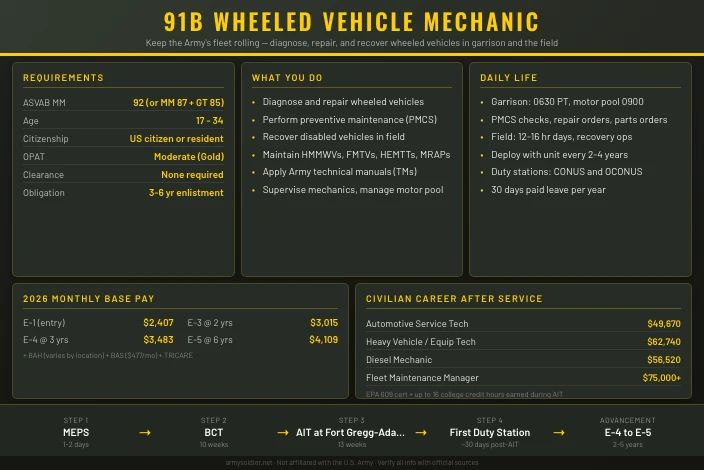
The 91B Wheeled Vehicle Mechanic supervises and performs field-level maintenance, repair, and recovery operations on Army wheeled vehicles including HMMWVs, FMTVs, HEMTTs, JLTVs, MRAPs, and select armored vehicles. Mechanics diagnose mechanical and electrical faults using Army diagnostic equipment, apply technical manuals to execute repairs, and recover disabled vehicles in both garrison and field environments. At senior grades, 91Bs manage motor pool operations, supervise junior mechanics, and advise commanders on fleet readiness.
Daily Tasks
A typical garrison day starts with Physical Readiness Training at 0630, then shifts to the motor pool by 0900. The bulk of the day involves Preventive Maintenance Checks and Services (PMCS) on assigned vehicles, processing open repair orders, and ordering parts through the Army’s supply system. Soldiers read and apply technical manuals for every procedure, from oil changes to engine overhauls.
In the field, the pace changes. Vehicles break at inconvenient times, often at night or under adverse conditions. You’ll perform roadside diagnostics, tow recovery operations, and battlefield damage assessments alongside your supported unit. When a vehicle can’t be repaired on site, you coordinate its evacuation to a higher-level maintenance facility.
- Diagnose faults using the Army’s electronic diagnostic tools (ET 912/915) and multimeters
- Perform engine, transmission, drivetrain, brake, steering, and suspension repairs
- Inspect and maintain air conditioning, electrical, hydraulic, and pneumatic systems
- Execute vehicle recovery operations using wrecker equipment and tow bars
- Maintain Army Property Book records and hand receipts for assigned equipment
- Train junior soldiers on proper PMCS procedures
Specific Roles
Within CMF 91 (Mechanical Maintenance), the 91B is the primary wheeled vehicle repair specialist. At advanced grades, soldiers can earn Additional Skill Identifiers (ASIs) for specific equipment platforms or supervisor roles.
| Classification | Code | Description |
|---|---|---|
| Primary MOS | 91B | Wheeled Vehicle Mechanic (all grades) |
| Warrant Officer | 915A | Automotive Maintenance Warrant Officer (WO1 to CW3) |
| Senior Warrant | 915E | Senior Automotive Maintenance Warrant Officer (CW4 to CW5) |
The 91B feeds directly into the 915A warrant officer pathway. A 915A Automotive Maintenance Warrant Officer manages maintenance programs at battalion and brigade level, advising commanders on readiness and overseeing multiple shops and mechanics.
Mission Contribution
The Army’s ability to project force depends entirely on vehicle readiness. Without functioning vehicles, infantry can’t move, artillery can’t reposition, and logistics can’t deliver food and ammunition. The 91B is the reason fleet readiness rates stay high enough for commanders to execute their missions. Every repaired vehicle is a direct contribution to the unit’s combat power.
Technology and Equipment
Training at the U.S. Army Ordnance School covers the full family of Army wheeled vehicles. You’ll work on the HMMWV series (M998 through M1151A1), the Family of Medium Tactical Vehicles (FMTV), the Heavy Expanded Mobility Tactical Truck (HEMTT), the Joint Light Tactical Vehicle (JLTV), and MRAP variants. Diagnostic tools include Army-specific electronic test equipment alongside commercial scan tools. Graduates also work with specialty lifting equipment, tow bars, and wrecker systems.
Salary and Benefits
The Army’s total compensation package goes well beyond base pay. When you add housing, food, healthcare, and education benefits, the value significantly outpaces the base pay number alone.
Base Pay (2026)
All figures below are 2026 monthly base pay rates per DFAS.
| Grade | Rank | Entry Pay | 4-Year Pay |
|---|---|---|---|
| E-1 | Private (PV1) | $2,407/mo | $2,407/mo |
| E-2 | Private (PV2) | $2,698/mo | $2,698/mo |
| E-3 | Private First Class (PFC) | $2,837/mo | $3,198/mo |
| E-4 | Specialist (SPC) | $3,142/mo | $3,659/mo |
| E-5 | Sergeant (SGT) | $3,343/mo | $3,947/mo |
| E-6 | Staff Sergeant (SSG) | $3,401/mo | $4,069/mo |
| E-7 | Sergeant First Class (SFC) | $3,932/mo | $4,663/mo |
Allowances and Benefits
On top of base pay, most soldiers collect two major tax-free allowances:
- Basic Allowance for Subsistence (BAS): $476.95/month flat rate for all enlisted soldiers
- Basic Allowance for Housing (BAH): Varies by duty location and dependency status. At Fort Sam Houston, an E-4 without dependents receives $1,359/month; with dependents, $1,728/month. High cost-of-living duty stations pay substantially more.
Healthcare is covered by TRICARE Prime at no cost to the soldier. That includes medical, dental, vision, mental health, and prescriptions with zero enrollment fees and zero copays. Family members are enrolled at no cost as well.
The Army’s education benefits are among the strongest in the service:
- Tuition Assistance: Up to $4,500/year while on active duty, covering $250 per semester hour
- Post-9/11 GI Bill: 36 months of benefits covering full in-state tuition at public universities, up to $29,920.95/year at private schools, plus a monthly housing allowance and $1,000/year for books
Work-Life Balance
Soldiers earn 30 days of paid leave per year (2.5 days per month). With 11 federal holidays, the total time off compares favorably with most civilian positions. Field exercises and deployments do compress schedules, but garrison life generally follows regular duty hours. You’re on a 24-hour availability model, not a 24-hour shift, outside of deployments and field training.
Qualifications and Eligibility
The 91B has straightforward requirements compared to many technical MOSs. The ASVAB composite score is the main filter.
Eligibility Requirements
| Requirement | Minimum Standard |
|---|---|
| Age | 17-34 (waiver possible to 39) |
| Citizenship | U.S. citizen or lawful permanent resident |
| Education | High school diploma (AFQT 31+) or GED (AFQT 50+) |
| ASVAB MM composite | 92, OR MM 87 combined with GT 85 |
| OPAT category | Moderate (Gold) |
| Security clearance | None required |
| Medical | Meets Army MEPS medical standards |
The MM (Mechanical Maintenance) composite measures your aptitude for mechanical work. It’s calculated from four ASVAB subtests: General Science (GS), Auto and Shop Information (AS), Mathematics Knowledge (MK), and Electronics Information (EI). If you score below 92 but combine an MM of 87 with a GT of at least 85, you still qualify.
Application Process
Selection Competitiveness
The 91B is consistently in demand. The Army maintains a large wheeled vehicle fleet across every installation worldwide, which means constant need for qualified mechanics. Applicants who demonstrate automotive interest through hobbies, vocational coursework, or prior work experience stand out during recruiter interviews. No prior mechanic experience is required, but it accelerates your learning curve once training starts.
The Army offers enlistment bonuses for certain contract lengths and tiers. As of the most recent HRC bonus charts, 91B has been listed as bonus-eligible. Exact amounts change based on Army recruiting needs, so confirm current figures with your recruiter before signing.
Service Obligation
Enlisted soldiers enter at E-1 (Private, PV1). Three-year contracts are the shortest available; most mechanics sign four-year agreements to maximize bonus eligibility. The total service obligation includes both active-duty time and time in the Individual Ready Reserve (IRR) after your contract ends.
See our ASVAB study guide for strategies to hit these line scores, or take the PiCAT from home if you are a first-time tester.
Work Environment
Setting and Schedule
Motor pools are the center of a wheeled vehicle mechanic’s world. In garrison, the motor pool operates on a standard duty day, roughly 0900 to 1700 on most installations. The work is physical: lifting components, crawling under vehicles, operating hydraulic equipment in all weather conditions. Heated bays and covered work areas exist at most CONUS installations, but field conditions are different.
During field exercises and deployments, the workday expands significantly. Maintenance support follows tactical operations, which means 12-to-16-hour days are common and downtime is scarce. You work alongside the units you support, which creates tight professional bonds but demands physical stamina.
Leadership and Communication
The 91B operates within a clear chain of command. At the unit level, a Motor Sergeant (typically an SSG or SFC) runs the maintenance section. Mechanics report through team leaders and section sergeants. Maintenance requests flow through the maintenance officer or warrant officer, who coordinates with the unit’s S4 logistics section.
Performance feedback comes through the Army’s Noncommissioned Officer Evaluation Report (NCOER) system for E-5 and above, and through counseling sessions at the squad level for junior enlisted soldiers. NCOs conduct monthly counseling at minimum; many do it more frequently.
Team Dynamics and Autonomy
Junior mechanics (E-1 through E-4) work under direct supervision until they demonstrate proficiency. By E-4, a capable specialist runs routine jobs independently. By E-5, you’re leading small teams and training junior soldiers yourself. At E-6 and above, you manage entire sections.
The job rewards mechanics who take initiative. A soldier who seeks out additional training, learns adjacent systems, and builds a reputation for thorough work tends to advance faster than the minimum promotion timelines suggest.
Job Satisfaction and Retention
Re-enlistment rates in CMF 91 hover in the moderate range. Soldiers who enjoy hands-on technical work and the structured environment tend to stay; those expecting a desk role or predictable civilian-style hours often find the field conditions challenging. The tradeable skill set is a significant retention incentive since mechanics know their training directly converts to civilian employment at any point.
Training and Skill Development
Initial Training
The 91B pipeline begins with Basic Combat Training and moves directly into Advanced Individual Training at Fort Gregg-Adams, Virginia.
| Phase | Location | Length | Focus |
|---|---|---|---|
| Basic Combat Training (BCT) | Various installations | 10 weeks | Soldiering fundamentals, physical fitness, weapons qualification |
| Advanced Individual Training (AIT) | Fort Gregg-Adams, VA | 13 weeks | Wheeled vehicle diagnostics, repair, and recovery operations |
AIT is conducted by the Wheel Maintenance Training Department at the U.S. Army Ordnance School. The curriculum covers automotive electrical systems, fuel and air systems, powertrains, hydraulics, brakes, steering, suspension, pneumatics, and air conditioning. Students operate MRAP vehicles, HMMWVs, JLTVs, HEMTT series trucks, and FMTV series vehicles during practical exercises.
Graduates earn up to 16 college credit hours through the American Council on Education (ACE) recommendation program. They also receive EPA 609 certification in automotive air conditioning service, a credential that carries direct civilian value.
Advanced Training
After AIT and initial assignment, 91Bs can pursue additional training throughout their careers:
- 91B10 Advanced Skills Course at Fort McCoy’s Regional Training Site-Maintenance: Covers advanced troubleshooting on specific vehicle platforms beyond the initial AIT scope
- Motor Pool Operations NCO Course: Prepares E-5 and E-6 soldiers to manage maintenance section operations
- Warrant Officer Candidate School (WOCS): The gateway to the 915A Automotive Maintenance Warrant Officer track
- Army COOL Program: Funds certification exams for credentials like ASE (Automotive Service Excellence) certifications, directly boosting civilian market value
- Unit-level cross-training: Many installations offer informal training on tracked vehicles and power generation equipment
The Army’s Tuition Assistance program covers coursework at accredited schools during off-duty hours, allowing soldiers to pursue associate or bachelor’s degrees while serving.
Everything starts with qualifying ASVAB scores — our study guide covers what to study first.
Career Progression and Advancement
Career Path
Advancement from E-1 to E-4 happens on a relatively fixed timeline. Promotion to E-5 Sergeant is competitive and requires passing the Army’s promotion board, meeting education and NCOER requirements, and accumulating promotion points.
| Grade | Rank | Typical Time in Service | Key Duty Position |
|---|---|---|---|
| E-1 | Private (PV1) | Entry | Student / trainee |
| E-2 | Private (PV2) | 6 months | Junior mechanic |
| E-3 | Private First Class (PFC) | 12 months | Mechanic, PMCS lead |
| E-4 | Specialist (SPC) | 24 months | Team mechanic, shop assistant |
| E-5 | Sergeant (SGT) | 3-5 years | Team leader, senior mechanic |
| E-6 | Staff Sergeant (SSG) | 6-10 years | Shop foreman, section sergeant |
| E-7 | Sergeant First Class (SFC) | 10-16 years | Maintenance ops NCO, motor sergeant |
| E-8 | Master Sergeant (MSG) | 16-22 years | Senior maintenance supervisor |
| E-9 | Sergeant Major (SGM) | 22+ years | Command maintenance advisor |
Specialization and Warrant Officer Path
The 915A Automotive Maintenance Warrant Officer is the natural career progression for ambitious 91Bs. Warrant officers manage maintenance programs at the battalion and brigade levels, advising commanders and overseeing both wheeled and tracked vehicle fleets. The 915A designation applies through CW3; at CW4, officers transition to the 915E Senior Automotive Maintenance Warrant Officer designation. Applicants typically need at least two years of 91B experience and a strong NCOER record before applying to WOCS.
Role Flexibility and Transfers
Lateral transfers within CMF 91 are possible with command approval. Soldiers interested in adjacent MOSs such as 91A (Abrams Tank Mechanic) or 91P (Artillery Mechanic) can reclassify, typically after completing their initial contract. The Army conducts periodic reclassification cycles based on force structure needs.
Performance Evaluation
Soldiers at E-1 through E-4 are evaluated through monthly counseling sessions and an annual DA Form 2166-9-1 (NCOER for E-5 and above). Junior enlisted evaluations use a separate DA Form. Evaluators assess performance across technical competence, leadership, professional development, Army values, and fitness. A strong evaluation record is the single biggest factor in competitive promotion.
Physical Demands and Medical Evaluations
Physical Requirements
The 91B has a Moderate (Gold) OPAT category, meaning recruits must pass the Occupational Physical Assessment Test at the Moderate threshold. The OPAT includes a standing long jump, seated power throw, strength deadlift, and interval aerobic run. The Moderate category is lower than combat MOSs but reflects the genuine physical demands of the job.
Day-to-day, the work involves frequent lifting of components weighing 25 to 60 pounds, prolonged standing on hard concrete, bending and crawling under vehicles, and operating manual tools that require grip strength and upper body endurance. Removing a HEMTT tire and wheel assembly, for example, requires coordinated team lifting of components exceeding 100 pounds.
Army Fitness Test
All soldiers must pass the Army Fitness Test (AFT), which replaced the ACFT on June 1, 2025. The AFT has five events scored 0 to 100 points each, for a maximum of 500 points.
| Event | Abbreviation | Description |
|---|---|---|
| 3 Rep Max Deadlift | MDL | Barbell lift, 3 repetitions |
| Hand Release Push-Up | HRP | Full arm extension between each rep |
| Sprint-Drag-Carry | SDC | 50-meter shuttle with drag and carry phases |
| Plank | PLK | Timed static hold |
| Two-Mile Run | 2MR | Timed run |
The general standard requires at least 60 points per event (300 total). Scores are sex- and age-normed. The 91B is not a designated combat MOS, so the 350-point combat specialty standard does not apply. Administrative enforcement for active-duty soldiers began January 1, 2026.
Medical Evaluations
MEPS conducts the initial medical screening before enlistment. Once in service, soldiers complete a periodic health assessment (PHA) annually. The 91B has no unusual visual acuity requirements beyond Army-wide standards, and color vision requirements are minimal compared to aviation or intelligence MOSs.
Deployment and Duty Stations
Deployment Details
Wheeled vehicle mechanics deploy with their supported units. Deployment frequency depends entirely on the unit of assignment. A 91B assigned to a brigade combat team at Fort Campbell may deploy every 24 to 36 months for rotations lasting 9 to 12 months. A soldier assigned to a training support unit or Reserve component unit may deploy less frequently. Support deployments to areas like Europe, the Pacific, or the Middle East are common.
Combat deployments involve vehicle recovery under fire, maintenance operations in austere environments, and extended duty hours with minimal downtime. Mechanics earn hazardous duty pay and hostile fire pay during qualifying deployments.
Location Flexibility
The Army assigns first-duty stations based on the needs of the force. Common 91B installations include:
- Fort Bragg (now Fort Liberty), North Carolina
- Fort Hood (now Fort Cavazos), Texas
- Fort Campbell, Kentucky
- Fort Wainwright, Alaska
- Camp Humphreys, South Korea (OCONUS)
- Grafenwoehr, Germany (OCONUS)
Soldiers can submit a “dream sheet” with location preferences, but assignments are not guaranteed. After an initial tour, soldiers can apply for specific duty stations during reenlistment negotiations, especially if they have a strong record.
Risk, Safety, and Legal Considerations
Job Hazards
Motor pool work carries genuine occupational risks. Soldiers work with pressurized hydraulic systems, high-voltage electrical systems, flammable fuels and lubricants, and heavy components that can cause crush injuries. Exhaust gases in enclosed bays require ventilation controls. Vehicle recovery operations near traffic or in field conditions add situational risk.
During deployments, mechanics work in tactical environments where indirect fire, vehicle-borne IEDs, and ambush risk are real possibilities. The 91B is not a combat MOS, but the job brings mechanics close to forward areas.
Safety Protocols
The Army enforces rigorous safety standards in motor pool environments. Soldiers must use personal protective equipment (PPE) including eye protection, gloves, and steel-toed boots. Lift equipment has rated load limits. Technical manuals specify torque values and lockout/tagout procedures. Units conduct formal safety briefings before field operations.
Security and Legal Requirements
The 91B does not require a security clearance. Soldiers sign an enlistment contract that specifies their MOS, duty station preferences (if any), and bonus terms. Active-duty service members are bound by the Uniform Code of Military Justice (UCMJ), which governs conduct standards beyond what civilian law requires.
Impact on Family and Personal Life
Family Considerations
Military life asks more of families than most civilian careers. Field exercises can separate soldiers from their families for weeks without much advance notice. Deployments lasting 9 to 12 months are a realistic possibility. At the same time, the Army provides an extensive support network: Family Readiness Groups (FRGs), Military OneSource counseling, on-post childcare through Child Development Centers, and installation schools for dependent children.
Soldiers’ families are enrolled in TRICARE Prime at no cost. Spouse employment programs exist on most major installations to help partners find work after a permanent change of station move.
Relocation and Flexibility
Permanent Change of Station (PCS) moves happen every two to three years on average. Each move comes with a Basic Allowance for Housing adjustment to the new duty location’s rate. The Army pays moving expenses through contracted moving companies. Frequent relocation is the most significant lifestyle adjustment for families, particularly when school-age children are involved.
Reserve and National Guard
The 91B Wheeled Vehicle Mechanic is one of the most widely available MOS in both the Army Reserve and the Army National Guard. Nearly every unit in both components operates wheeled vehicles, which means nearly every unit needs mechanics. If you want to wrench on military trucks and HMMWVs while keeping a full-time civilian job, 91B offers more part-time slots than almost any other maintenance MOS.
Drill Schedule and Training Commitment
The standard commitment is one weekend per month and two weeks of annual training. Drill weekends for 91B soldiers usually involve scheduled maintenance services, vehicle inspections, and parts replacement on the unit’s fleet. The workload fits the drill format well because vehicle maintenance tasks break cleanly into weekend-sized chunks. Annual vehicle inspection cycles may add a few extra training days per year, but 91B soldiers generally stick close to the baseline schedule.
Part-Time Pay and Benefits
An E-4 with about four years of service earns roughly $488 per drill weekend in 2026, totaling about $5,856 per year from drill pay alone. Annual training adds two weeks of active-duty pay. Active-duty E-4s earn $3,659 per month.
Tricare Reserve Select costs $57.88 per month for the member or $286.66 for a family plan. Active-duty soldiers pay nothing for TRICARE Prime. Both Reserve and Guard soldiers qualify for Federal Tuition Assistance and the Montgomery GI Bill-Selected Reserve (Chapter 1606). Guard members in many states receive state tuition waivers at public universities. Retirement is points-based, with payments starting at age 60 rather than immediately after 20 years.
Deployment and Mobilization
Because the 91B MOS is so common across all unit types, mobilization risk is spread across a large pool of soldiers. Individual 91B soldiers may be mobilized to backfill active-duty units, or their entire unit may deploy. Typical mobilization runs 9 to 12 months. The large number of 91B positions means any single soldier is less likely to be mobilized in a given cycle compared to low-density MOS. Guard soldiers may also be activated for state emergencies, where military vehicles and their mechanics are needed for disaster response.
Civilian Career Integration
The 91B MOS has one of the most direct civilian career paths in the Army. ASE (Automotive Service Excellence) certifications are available through Army COOL funding while you serve. Civilian employers in automotive repair, trucking, fleet maintenance, and dealership service departments recognize military mechanic training immediately. Many 91B soldiers work as civilian mechanics during the week and drill on weekends, which means their military and civilian skills reinforce each other. USERRA protects your civilian position during all military service obligations.
| Feature | Active Duty | Army Reserve | Army National Guard |
|---|---|---|---|
| Commitment | Full-time | One weekend/month, two weeks/year | One weekend/month, two weeks/year |
| Monthly Pay (E-4, ~4 yrs) | $3,659 | ~$488/drill weekend | ~$488/drill weekend |
| Healthcare | TRICARE Prime, $0 premiums | Tricare Reserve Select, $57.88/month | Tricare Reserve Select, $57.88/month |
| Education | Post-9/11 GI Bill | Federal TA, MGIB-SR | Federal TA, MGIB-SR, state tuition waivers |
| Deployment | Regular rotations | Mobilization-based | Mobilization-based, plus state activations |
| Retirement | 20-year pension, immediate | Points-based, age 60 | Points-based, age 60 |
Post-Service Opportunities
The hands-on technical training a 91B receives translates directly into civilian employment. Employers in the automotive, trucking, defense contracting, and fleet management industries actively recruit veterans with verified mechanic experience.
Civilian Career Prospects
| Civilian Job Title | Median Annual Salary | Job Outlook (2024-2034) |
|---|---|---|
| Automotive Service Technician | $49,670 | +4% (about as fast as average) |
| Heavy Vehicle & Equipment Service Tech | $62,740 | +6% (faster than average) |
| Diesel Service Technician / Mechanic | $56,520 | +4% (about as fast as average) |
| Industrial Machinery Mechanic | $61,420 | +11% (much faster than average) |
Salary data from the Bureau of Labor Statistics Occupational Outlook Handbook, May 2024 survey.
The EPA 609 certification earned during AIT is immediately recognized by civilian employers. ASE certifications, fundable through the Army COOL program, add further credibility. Veterans who complete a degree using the GI Bill often move into fleet management or maintenance supervision roles that pay well above the median technician wage.
The Transition Assistance Program (TAP) runs at every major installation and provides resume writing, job search tools, and employer connection events in the final months before separation.
Is This a Good Job for You?
Ideal Candidate Profile
This MOS works best for soldiers who find mechanical problems genuinely interesting. You don’t need to arrive knowing how to rebuild a transmission, but you should want to learn. The job requires patience with technical manuals, attention to detail when following diagnostic procedures, and the physical tolerance for outdoor and floor-level work in varying weather.
Strong candidates typically have:
- An aptitude for logical troubleshooting (if A doesn’t fix it, try B)
- Comfort working with their hands and operating power tools
- The ability to follow technical procedures without cutting corners
- Basic math comfort for calculating torque specs, fluid capacities, and parts measurements
Potential Challenges
The job’s biggest friction points are environmental. Motor pools are hot in summer, cold in winter, and perpetually grimy. Field exercises disrupt normal schedules without much warning. Some soldiers find that after several years, the physical wear adds up, particularly back and knee stress from repetitive bending and lifting.
Anyone who needs a highly predictable schedule or dislikes getting dirty should look at other MOS options. Deployment separations are also a real consideration for soldiers with young families or strong community ties at home.
Right Fit, Wrong Fit
If you’re drawn to the idea of being the person who keeps everything running, the 91B is likely a good match. The skills are genuinely marketable, the career progression is clear, and the warrant officer pathway offers a long-term technical leadership track for those who want to stay. If you’re looking for an office environment or a primarily administrative role, this isn’t it.
More Information
Talk to an Army recruiter about current 91B contract options, bonus availability, and training seat timelines. Recruiters have access to the current bonus chart and can walk you through what your specific ASVAB scores qualify you for. You can also find official MOS details at goarmy.com and the U.S. Army Ordnance Corps.
- Prepare for the ASVAB with our study guide to make sure your line scores qualify
This site is not affiliated with the U.S. Army or any government agency. Verify all information with official Army sources before making enlistment or career decisions.
Explore more Army maintenance careers such as 91C Utilities Equipment Repairer and 91D Tactical Power Generation Specialist.