91C Utilities Equipment Repairer
The Army doesn’t stop when the heat goes out or the refrigeration fails. Every forward operating base, hospital, dining facility, and command post depends on climate control systems running around the clock. The 91C Utilities Equipment Repairer is the soldier who makes that happen. If you can troubleshoot a broken system under pressure, read a technical manual, and get equipment back online fast, this MOS puts a verified skill set in your hands before most civilians finish their first semester of trade school.
Qualifying requires specific ASVAB line scores — our ASVAB study guide covers what to target and how to prepare.
Job Role and Responsibilities
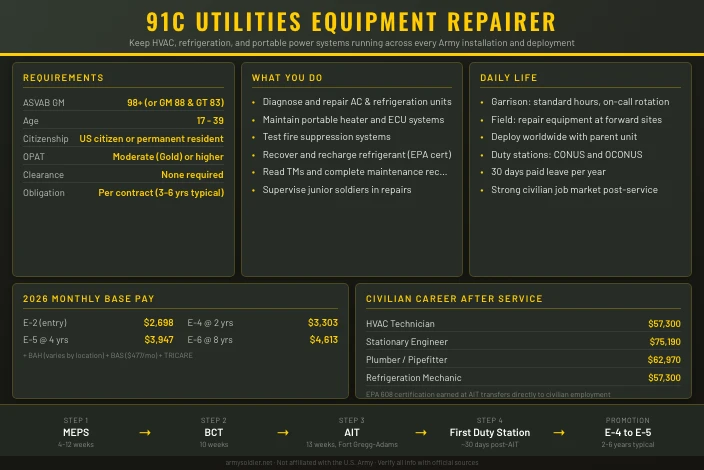
As a 91C Utilities Equipment Repairer, you supervise and perform maintenance on utilities equipment and environmental control systems – air conditioners, refrigeration units, portable heaters, and fire suppression systems – to keep them operational in garrison and in the field. You read technical manuals, run diagnostics, replace components, and complete maintenance records that document every repair.
Daily Tasks
The day-to-day work is hands-on and diagnostic. You won’t be at a desk. A typical day might include preventive maintenance checks on a facility HVAC system, troubleshooting an air conditioning unit that stopped cooling overnight, or recovering refrigerant from a system before component replacement. Work extends to electrical tasks: replacing wiring, soldering connections, and testing circuits with diagnostic tools.
Common daily responsibilities:
- Inspect and test environmental control units (ECUs) and air conditioning systems
- Diagnose failures in refrigeration units and portable heaters
- Recover, handle, and recharge refrigerants according to EPA protocols
- Perform electrical tests and repairs on utility system components
- Complete DA Form 5988-E maintenance records and equipment logbooks
- Supervise junior enlisted soldiers in maintenance operations as rank increases
Specific Roles
The 91C MOS falls under Career Management Field 91 (Mechanical Maintenance). The Army uses the following classification system for this specialty:
| System | Type | Purpose |
|---|---|---|
| MOS | 91C | Primary enlisted job designation |
| ASI | Additional Skill Identifiers | Specialized skills added after training |
| SQI | Special Qualification Identifier | Qualification-based markers (e.g., instructor) |
Mission Contribution
Utilities equipment keeps soldiers fed, medicated, and comfortable enough to fight. Refrigeration systems preserve blood products and medications at forward medical units. HVAC keeps electronics-dense command posts from overheating. When this equipment fails in a deployed environment, a 91C is often the only person with the training to fix it. The contribution is unglamorous, but losing climate control in a 110-degree environment is a readiness problem, not a comfort one.
Technology and Equipment
The systems you’ll work on include environmental control units fielded across Army brigades, commercial-type refrigeration equipment modified for military use, and portable heaters deployed to austere locations. Diagnostic equipment includes multimeters, refrigerant recovery machines, manifold gauge sets, and system analyzers. You’ll also work with the Global Combat Support System-Army (GCSS-A) to log maintenance data and pull parts through the Army’s supply chain.
Salary and Benefits
Pay Table
Base pay depends on rank and years of service. All 2026 figures come from DFAS.
| Rank | Grade | Years of Service | Monthly Base Pay |
|---|---|---|---|
| Private (PV2) | E-2 | Entry | $2,698 |
| Private First Class (PFC) | E-3 | 1-2 years | $2,837 |
| Specialist (SPC) | E-4 | 2-4 years | $3,303 |
| Specialist (SPC) | E-4 | 4 years | $3,659 |
| Sergeant (SGT) | E-5 | 4 years | $3,947 |
| Staff Sergeant (SSG) | E-6 | 8 years | $4,613 |
| Sergeant First Class (SFC) | E-7 | 10 years | $5,268 |
Additional Benefits
Pay is only part of the compensation picture. Active duty soldiers receive a flat monthly Basic Allowance for Subsistence (BAS) of $476.95 regardless of rank. Basic Allowance for Housing (BAH) varies by duty location, pay grade, and dependency status – a single E-4 at Fort Gregg-Adams, Virginia draws roughly $1,359/month, while rates at higher cost-of-living installations can exceed $2,000.
Healthcare is zero-cost through TRICARE Prime: no premiums, no deductibles, no copays for the soldier or immediate family. The Army also pays for dental and vision coverage.
Education Benefits
The Army covers up to $4,500 per year in tuition assistance while you’re on active duty, with a cap of $250 per semester hour. After service, the Post-9/11 GI Bill covers full in-state tuition at public schools with no dollar cap, or up to $29,920.95 per academic year at private institutions (AY 2025-2026 cap). Housing allowance and a $1,000 annual book stipend come with it.
Work-Life Balance
Soldiers earn 30 days of paid leave per year, accruing at 2.5 days per month, plus 11 federal holidays. In garrison, the schedule typically follows standard duty hours with an on-call rotation for emergency repairs. Field exercises and deployments disrupt that structure, but downtime and leave are protected by Army regulation in normal operating conditions.
Qualifications and Eligibility
Requirements Table
| Requirement | Standard |
|---|---|
| ASVAB line score | GM: 98 or (GM: 88 and GT: 83) |
| Age | 17-39 |
| Citizenship | U.S. citizen or permanent resident alien |
| Education | High school diploma or GED |
| OPAT category | Moderate (Gold) |
| Security clearance | None required |
| Medical | Physically and mentally qualified per Army standards |
The ASVAB General Maintenance (GM) composite measures your aptitude in general science, auto and shop information, mathematics knowledge, and electronics information – exactly the subjects that map to utilities repair work. The formula is: GM = GS + AS + MK + EI. A score of 98 satisfies the requirement alone; alternatively, a GM of 88 combined with a GT of 83 also qualifies.
The OPAT Moderate (Gold) category means you’ll need to demonstrate the ability to handle moderate physical demands during pre-enlistment testing. This reflects the actual job: lifting HVAC components, working in confined spaces, and carrying tools to equipment locations.
Application Process
Selection and Competitiveness
The 91C MOS is not a high-demand combat arms specialty, so it’s generally accessible to qualified applicants who hit the ASVAB threshold. That said, seat availability varies by recruiting cycle, and the Army may not always have open contracts for this job. Applicants with documented mechanical or electrical experience often move through MEPS more smoothly since the evaluators understand your baseline. No prior certifications or experience are required to enlist.
Service Obligation
New enlistees enter at E-1 (PV1) and typically promote to E-2 within six months. The service obligation depends on your contract length, most commonly three to six years for active duty. Reserve and National Guard contracts have different structures, with some as short as three years plus an inactive reserve commitment.
See our ASVAB study guide for strategies to hit these line scores, or take the PiCAT from home if you are a first-time tester.
Work Environment
Setting and Schedule
The 91C’s work environment shifts depending on the mission. In garrison, you’ll operate in maintenance bays, equipment rooms, and building mechanical spaces. In the field or on deployment, you repair equipment wherever it sits – inside a tent, on a flight line, or in a motor pool. Climate is not a variable you control: fixing air conditioners in 110-degree heat is part of the job.
Standard garrison schedules follow the installation’s duty hours, generally 0600 to 1700 with physical training starting the day. Emergency repairs don’t respect the clock, and you may be called after hours when a critical system fails. Field exercises stretch those hours further.
Leadership and Communication
Junior soldiers (E-1 through E-4) work under the direct supervision of NCOs. As you promote to Sergeant (E-5), you take on team leader responsibilities – supervising two or three junior soldiers, reviewing their maintenance documentation, and signing off on completed work orders. Feedback flows through the Non-Commissioned Officer Evaluation Report (NCOER) system for E-5 and above, and through Enlisted Record Briefs for junior soldiers. Counseling sessions with your chain of command happen at least quarterly.
Team Dynamics and Autonomy
Utilities repair is often a solo or two-person task. You’ll frequently work independently on a specific piece of equipment, diagnosing and fixing without constant oversight. That autonomy increases with experience. At the junior enlisted level, you work under supervision. By E-5, you’re the one directing the work and accountable for the outcome.
Job Satisfaction and Retention
Maintenance MOS soldiers tend to report high satisfaction with the practical skill development they receive. The work is measurable – either the equipment works or it doesn’t – and that clarity is satisfying for people who like solving concrete problems. The trade-off is that the work can be physically demanding and unglamorous. Deployments separate you from family, and field exercises mean extended periods away from home station even without a deployment.
Training and Skill Development
Training Pipeline
| Phase | Location | Length | Focus |
|---|---|---|---|
| Basic Combat Training (BCT) | Various installations | 10 weeks | Soldier skills, physical fitness, weapons qualification |
| Advanced Individual Training (AIT) | Fort Gregg-Adams, VA | 13 weeks | HVAC systems, refrigeration, electrical repair, EPA certification |
| First Duty Station | Varies | Ongoing | On-the-job experience under NCO supervision |
BCT covers the fundamentals every soldier needs: land navigation, first aid, weapons qualification, and Army values. It’s physically demanding and standardized across all MOSs.
AIT at Fort Gregg-Adams runs 13 weeks and is where the real technical training happens. The US Army Ordnance School operates the 91C course (course number 720-91C10). You’ll cover:
- Refrigeration theory and system components
- Air conditioning and environmental control unit repair
- Portable heater maintenance
- Fire suppression system inspection
- Electrical fundamentals and fault diagnosis
- EPA 608 Universal certification exam preparation and testing
Completing AIT earns you the EPA 608 Universal certification, which qualifies you to purchase, handle, and work with all types of refrigerants in the civilian market. This certification alone is worth money when you separate.
Advanced Training Opportunities
After time in the Army, 91Cs can pursue additional qualifications through military schools:
- Warrior Leader Course (WLC): Required for promotion to Sergeant (E-5); covers small-unit leadership skills
- Advanced Leader Course (ALC): Required for Staff Sergeant (E-6)
- Senior Leader Course (SLC): Required for Sergeant First Class (E-7)
- Unit-level technical training: Manufacturers of military-fielded equipment sometimes provide formal training on specific systems
The Army Credentialing Assistance program can fund civilian certifications that complement the 91C skill set, including additional HVAC certifications or trade licenses required in certain states for civilian employment.
Everything starts with qualifying ASVAB scores — our study guide covers what to study first.
Career Progression and Advancement
Career Path
| Rank | Grade | Typical Timeline | Role |
|---|---|---|---|
| Private (PV1/PV2) | E-1/E-2 | 0-12 months | Junior repairer under supervision |
| Private First Class (PFC) | E-3 | 12-18 months | Building competence in basic repairs |
| Specialist (SPC) | E-4 | 2-4 years | Qualified repairer, works more independently |
| Sergeant (SGT) | E-5 | 4-8 years | Team leader, supervises 2-4 soldiers |
| Staff Sergeant (SSG) | E-6 | 8-14 years | Section sergeant, manages maintenance section |
| Sergeant First Class (SFC) | E-7 | 14-18 years | Platoon sergeant, senior technical advisor |
| Master Sergeant (MSG) | E-8 | 18-24 years | Senior NCO at battalion level or higher |
| Sergeant Major (SGM) | E-9 | 20+ years | Senior enlisted advisor at brigade level or higher |
Promotion timelines below E-5 are mostly time-based, tied to completing required training and receiving satisfactory evaluations. Promotion to E-5 requires completing the Warrior Leader Course, receiving a recommendation from your chain of command, and meeting a point threshold through the Army’s semi-centralized promotion system. Above E-5, promotion becomes more competitive and requires strong evaluation reports and demonstrated leadership.
Specialization
Within CMF 91, soldiers can add skills through Additional Skill Identifiers (ASIs). Relevant options for 91Cs include unit instructor qualifications and specific equipment certifications. The CMF 91 Career Progression Plan, maintained by HRC, outlines long-term career milestones including positions such as utilities equipment warrant officer (if selected for the warrant officer program) or assignments to training base instruction positions at Fort Gregg-Adams.
Role Flexibility and Transfers
Transferring to a different MOS inside CMF 91 is possible after meeting time-in-service requirements and receiving approval from your chain of command. Lateral moves to related MOSs like 91B (Wheeled Vehicle Mechanic) or 91D (Power Generation Equipment Repairer) can happen when the Army’s needs and your skills align. Transfers outside CMF 91 require more justification and are generally less common.
Performance Evaluation
E-5 and above soldiers receive an annual NCOER rating from their rater (direct supervisor) and senior rater. The form evaluates character, presence, intellect, leads, develops, and achieves. Strong NCOERs are the single most important factor in competitive promotion above E-5. Junior soldiers below E-5 receive counseling-based performance feedback, which tracks whether they meet or exceed standards across soldier tasks, physical fitness, and military bearing.
Physical Demands and Medical Evaluations
Physical Requirements
The 91C OPAT category is Moderate (Gold), meaning you need to demonstrate capacity for frequent lifting and carrying of moderate loads. The day-to-day physical demands are real: HVAC equipment is heavy, access points are often cramped, and outdoor repair work happens in whatever weather is present. You’ll carry tools, move equipment, and work in awkward positions regularly.
The Army Fitness Test (AFT) replaced the ACFT on June 1, 2025. All soldiers must pass the AFT annually – there are no MOS-specific exemptions from the fitness test standard.
| AFT Event | Description | Minimum Score |
|---|---|---|
| 3 Repetition Maximum Deadlift (MDL) | Weighted deadlift, three reps | 60 points |
| Hand Release Push-Up (HRP) | Full arm extension at bottom | 60 points |
| Sprint-Drag-Carry (SDC) | 250-meter timed course | 60 points |
| Plank (PLK) | Timed static hold | 60 points |
| Two-Mile Run (2MR) | Timed two-mile run | 60 points |
| Total minimum | All five events | 300 points |
Scoring is sex- and age-normed for general MOSs. The maximum score per event is 100 points, with a total maximum of 500. Administrative enforcement for active duty began January 1, 2026.
Medical Evaluations
Medical standards for 91C follow standard Army enlistment criteria. No special vision, hearing, or medical requirements beyond general fitness apply to this MOS. Soldiers undergo periodic medical readiness assessments throughout their career, typically annually, and must maintain medical readiness status to deploy or attend schools.
Deployment and Duty Stations
Deployment Details
91C soldiers deploy with their parent unit, not as individual replacements. If your brigade deploys, you deploy. Deployment lengths vary by mission: nine to twelve months is typical for overseas rotations, with some shorter rotations for exercises and theater security cooperation missions. Utilities equipment fails more often in harsh environments, which means demand for 91Cs is high during deployments to hot or cold-weather locations. The deployment cycle for most active duty units runs roughly one deployment every two to four years, though operational tempo depends on Army-wide demand.
Location Flexibility
Duty station assignments flow through the Army’s assignments process managed by HRC. You submit a preference statement, but the Army’s needs drive the actual assignment. Active duty 91Cs serve at installations across the country and overseas, including installations in Germany, South Korea, and other OCONUS locations. Common active duty installations with utilities-intensive infrastructure include Fort Bragg (now Fort Liberty), Fort Campbell, Fort Bliss, and Fort Gregg-Adams itself.
Army Reserve and National Guard 91Cs serve at units in their home state with one weekend per month and two weeks per year typical training commitments, plus potential mobilization.
Risk, Safety, and Legal Considerations
Job Hazards
Utilities repair carries genuine physical hazards. Working with refrigerants requires proper recovery equipment – inhaling high concentrations can cause serious injury. Electrical work on systems that weren’t fully de-energized accounts for a share of maintenance injuries in any trade. Confined space entry for accessing mechanical rooms carries asphyxiation and entrapment risks. Working on heating systems involves fire and carbon monoxide exposure risk.
Safety Protocols
The Army enforces safety through Technical Manuals (TMs) that specify lockout/tagout procedures, PPE requirements, and refrigerant handling protocols. The EPA 608 certification you earn in AIT specifically covers safe refrigerant management. Commanders enforce Job Hazard Analysis (JHA) requirements, and soldiers are expected to stop work when conditions aren’t safe. Safety violations in maintenance environments are taken seriously because the consequences of cutting corners are immediate and physical.
Security and Legal Requirements
The 91C MOS does not require a security clearance. Your legal obligations are those of any Army enlistee: your service contract and the Uniform Code of Military Justice (UCMJ). Soldiers who separate before their contract ends without approval can face administrative or legal consequences. Honorable discharge maintains all VA benefits; other-than-honorable and dishonorable discharges affect benefit eligibility significantly.
Impact on Family and Personal Life
Family Considerations
Deployments are the hardest part of Army life for most families. A nine to twelve-month deployment with limited communication in remote locations puts real strain on relationships and parenting. The Army’s support system includes Family Readiness Groups (FRGs), which organize support for spouses and families of deployed soldiers, and Military OneSource, which provides counseling, financial advising, and referral services at no cost. TRICARE extends to dependents, covering healthcare without premiums or copays through in-network providers.
Base housing – if available – provides stable, free or low-cost housing on post. The wait list for on-post housing varies significantly by installation. BAH covers off-post housing when on-post isn’t available or preferred.
Relocation and Flexibility
Permanent Change of Station (PCS) moves happen roughly every two to four years. The Army pays moving costs and provides temporary housing assistance during transitions. Frequent moves complicate spouse employment, school stability for children, and maintaining community relationships. These are real costs that don’t appear in a pay chart. Soldiers who prefer geographic stability often transition to the National Guard or Army Reserve, which anchors them to a home state.
Reserve and National Guard
The 91C Utilities Equipment Repairer MOS is available in both the Army Reserve and the Army National Guard. Support and sustainment units in both components need soldiers who can repair HVAC, refrigeration, and environmental control systems. Positions are spread across forward support companies and maintenance battalions. The skill set is identical across components, with the same EPA Section 608 certification required for all 91C soldiers.
Drill Schedule and Training Commitment
Reserve and Guard 91C soldiers follow the standard one weekend per month and two weeks of annual training. Drill weekends typically involve hands-on maintenance of unit HVAC and environmental control equipment. The workload is manageable within the standard drill format. Some units schedule extra training days for EPA recertification or when new equipment enters the inventory. Expect 1 to 3 additional duty days per year in most units.
Part-Time Pay and Benefits
An E-4 with about four years of service earns roughly $488 per drill weekend in 2026, totaling about $5,856 per year from drill pay. Annual training adds two weeks of active-duty pay on top. Active-duty E-4s earn $3,659 per month.
Tricare Reserve Select costs $57.88 per month for the member or $286.66 for family coverage. Active-duty TRICARE Prime has no premiums. Federal Tuition Assistance and the Montgomery GI Bill-Selected Reserve (Chapter 1606) cover education expenses. Guard members in many states qualify for state tuition waivers at public colleges. Reserve and Guard retirement is points-based with payments starting at age 60.
Deployment and Mobilization
Support and sustainment units deploy less frequently than combat units, but they still mobilize for extended operations. 91C soldiers go where the Army needs HVAC and environmental control support, which includes deployed base camps and field hospitals. Typical mobilization runs 9 to 12 months. Guard soldiers may also be activated for state emergencies where portable heating, cooling, or water purification is needed for disaster relief shelters.
Civilian Career Integration
The 91C MOS maps directly to one of the highest-demand civilian trades. HVAC technicians, refrigeration mechanics, and facilities maintenance workers are consistently in short supply across the country. Your military EPA 608 certification is a federal credential recognized by every civilian employer. Many states offer reciprocal credit for military training toward state HVAC licensing. USERRA protects your civilian HVAC job during military service. Working as a civilian HVAC technician while drilling on weekends is a natural fit, since the skills reinforce each other in both directions.
| Feature | Active Duty | Army Reserve | Army National Guard |
|---|---|---|---|
| Commitment | Full-time | One weekend/month, two weeks/year | One weekend/month, two weeks/year |
| Monthly Pay (E-4, ~4 yrs) | $3,659 | ~$488/drill weekend | ~$488/drill weekend |
| Healthcare | TRICARE Prime, $0 premiums | Tricare Reserve Select, $57.88/month | Tricare Reserve Select, $57.88/month |
| Education | Post-9/11 GI Bill | Federal TA, MGIB-SR | Federal TA, MGIB-SR, state tuition waivers |
| Deployment | Regular rotations | Mobilization-based | Mobilization-based, plus state activations |
| Retirement | 20-year pension, immediate | Points-based, age 60 | Points-based, age 60 |
Post-Service Opportunities
Military utilities repair training maps directly onto civilian skilled trades. The EPA 608 certification you earn in AIT is a federal credential recognized nationwide. In most states, HVAC contractors must hold a state license in addition to the EPA certification – and many states offer reciprocal credit for military training toward those licenses.
Transitions to civilian employment are typically smooth for 91Cs because the skills are immediately recognizable to civilian employers in HVAC and refrigeration. The Army’s Transition Assistance Program (TAP) provides career coaching, resume writing, and interview preparation for separating soldiers.
Civilian Career Prospects
| Civilian Job Title | Median Annual Wage | Job Outlook (2024-2034) |
|---|---|---|
| HVAC Mechanic & Installer | $57,300 | 9% growth (faster than average) |
| Stationary Engineer / Boiler Operator | $75,190 | 1% growth (stable) |
| Plumber, Pipefitter, or Steamfitter | $62,970 | 4% growth (as fast as average) |
| General Maintenance & Repair Worker | $46,520 | 4% growth (as fast as average) |
Wage data from the Bureau of Labor Statistics. Experienced 91C veterans with EPA 608 certification and state licensure often earn above median in markets with high construction or commercial real estate activity.
The GI Bill’s Post-9/11 benefit covers additional trade schooling, apprenticeship programs, or associate degrees that round out civilian credentials. Apprenticeship-based HVAC programs qualify for GI Bill housing allowance, making them nearly cost-free to pursue after service.
Is This a Good Job for You? The Right (and Wrong) Fit
Ideal Candidate Profile
The 91C MOS fits people who think in systems. You’re looking at a broken machine, working backwards through what could cause that failure, and fixing it – then verifying it’s actually fixed. People who get satisfaction from that process, who don’t need constant external validation, and who can work independently thrive in this role.
Traits that align with this work:
- Strong mechanical and electrical aptitude (reflected in the GM composite score)
- Patience for technical documentation and maintenance recordkeeping
- Physical tolerance for heat, cramped spaces, and outdoor work in variable weather
- Interest in a skill set with direct civilian market value
- Preference for hands-on work over administrative or desk-based roles
The EPA certification exit ramp is a genuine draw. Soldiers who know they want to work in HVAC after service can treat their 91C contract as a paid apprenticeship that comes with health insurance, housing, and a salary.
Potential Challenges
This MOS is not for everyone. Deployment separations are part of the deal, and utilities equipment in deployed environments breaks down more often under operational stress. If predictable hours and geographic stability matter more to you than almost anything else, the active duty version of this MOS will frustrate you.
The work is also physically unglamorous. Crawling into mechanical spaces, working around refrigerants and exhaust gases, and spending long days in extreme temperatures is genuinely hard on the body over time. Soldiers who expect excitement or rapid career-defining events in this job will be disappointed.
Who This Job Fits
This job fits someone with a plan. The combination of EPA 608 certification, military discipline, and a proven maintenance track record puts 91C veterans in a strong position in the civilian trades market. If you want a structured path to a licensed HVAC trade career without paying trade school tuition upfront, the 91C pipeline delivers that. But you have to complete the service obligation first, and four to six years is a real commitment.
- Prepare for the ASVAB with our study guide to make sure your line scores qualify
This site is not affiliated with the U.S. Army or any government agency. Verify all information with official Army sources before making enlistment or career decisions.
Explore more Army maintenance careers to find other CMF 91 MOS options across mechanical and equipment maintenance specialties.