91D Tactical Power Generation Specialist
Every forward operating base, command post, and field hospital in the Army runs on electrical power. When a generator fails at 0200 in a combat zone, one MOS owns the fix: the 91D Tactical Power Generation Specialist. These soldiers keep the lights on for the entire force, from small patrol bases to multi-acre division support areas. If you have an aptitude for electrical systems and mechanical problem-solving, this is one of the Army’s most technically demanding and genuinely essential jobs.
Qualifying requires specific ASVAB line scores — our ASVAB study guide covers what to target and how to prepare.
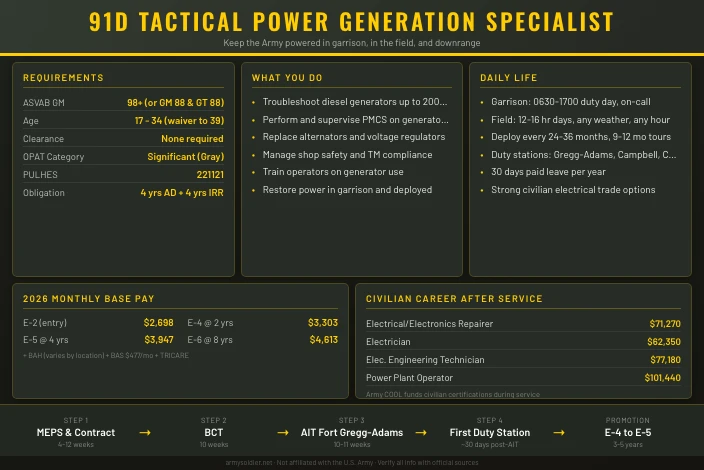
Job Role and Responsibilities
The 91D Tactical Power Generation Specialist performs and supervises field-level maintenance on military power generation equipment, including diesel generators, internal combustion engines, and associated electrical distribution systems. Soldiers in this role troubleshoot faults, conduct preventive maintenance, overhaul components, and restore power to supported units in garrison and deployed environments. The MOS covers equipment up to 200 kilowatts (kW) and requires mastery of both mechanical and electrical systems.
Daily Tasks
Day-to-day work varies with the mission cycle. In garrison, a typical week involves scheduled preventive maintenance checks and services (PMCS) on generator sets, inspecting oil levels, fuel systems, cooling components, and electrical connections. Soldiers run load tests on standby generators and document findings in maintenance management systems.
In field or deployed environments, the pace changes fast. A 91D might spend a morning diagnosing a shorted control panel on a 60kW generator and an afternoon instructing equipment operators on proper startup procedures. Emergency calls come at any hour.
Core daily responsibilities include:
- Troubleshoot electrical and mechanical faults using multimeters, oscilloscopes, and Army-issue diagnostic equipment
- Perform PMCS on tactical utility generators (TUGs), 5kW through 200kW
- Replace and rebuild alternators, starters, fuel injection systems, and voltage regulators
- Manage shop safety programs and ensure compliance with technical manuals
- Train equipment operators on generator operation and basic fault identification
- Coordinate with supply for repair parts and manage shop records in Army maintenance systems
Specific Roles
The Army uses the MOS code as the primary identifier for this specialty. Advanced soldiers pick up Additional Skill Identifiers (ASIs) that reflect special qualifications.
| System | Code | Description |
|---|---|---|
| Primary MOS | 91D | Tactical Power Generation Specialist (E1-E6) |
| Senior MOS | 91X | Maintenance Supervisor (SFC, E7) |
| Senior NCO MOS | 91Z | Senior Maintenance Supervisor (MSG/SGM, E8-E9) |
Mission Contribution
Power generation is not a support function in name only. Every system the Army depends on – radios, night-vision recharging stations, medical equipment, tactical operations centers, and refrigerated food storage – requires a working generator. A 91D deployed to a remote outpost is the single point of failure for the entire unit’s electrical infrastructure. The stakes are high and the technical responsibility is real.
Technology and Equipment
Soldiers work across a wide range of Army generator sets, including the Tactical Quiet Generator (TQG) family, which spans 5kW to 200kW. They also maintain mobile electric power (MEP) units, power distribution panels, load banks, and associated cabling. Advanced training introduces soldiers to hybrid and variable-frequency systems entering the Army inventory. The diagnostic tools include dedicated Army test equipment sets (TES) alongside commercial-grade multimeters and oscilloscopes.
Salary and Benefits
Base pay is set by pay grade and years of service. A new 91D typically enters as a Private (PV2, E-2) after completing training and reaches Specialist (SPC, E-4) within the first two years.
Base Pay Table (2026)
| Rank | Pay Grade | Monthly Base Pay |
|---|---|---|
| Private (PV2) | E-2 | $2,698 |
| Private First Class (PFC) | E-3 | $2,837 - $3,198 |
| Specialist (SPC) | E-4 | $3,142 - $3,816 |
| Sergeant (SGT) | E-5 | $3,343 - $4,422 |
| Staff Sergeant (SSG) | E-6 | $3,401 - $5,044 |
| Sergeant First Class (SFC) | E-7 | $3,932 - $5,537 |
Pay figures reflect 2026 DFAS military pay rates, which include a 3.8% across-the-board increase effective January 1, 2026.
Additional Allowances
Base pay is only part of the picture. Most soldiers receive two tax-advantaged allowances on top of their paycheck:
- Basic Allowance for Subsistence (BAS): $476.95 per month (flat national rate for enlisted, 2026)
- Basic Allowance for Housing (BAH): Varies by duty location, pay grade, and dependent status. A single E-4 at Fort Gregg-Adams, Virginia receives roughly $1,359 per month. Soldiers with dependents or stationed at high-cost installations receive considerably more.
Additional Benefits
Healthcare: Active duty soldiers and their families are covered under TRICARE Prime with no enrollment fees, no deductibles, and no copays for in-network care. Coverage includes medical, dental, vision, mental health, prescriptions, and hospitalization.
Education: The Army offers up to $4,500 per year in Tuition Assistance (TA) for college courses taken while on active duty, covering up to $250 per semester credit hour. After separation, the Post-9/11 GI Bill covers full in-state tuition at public schools plus a monthly housing allowance and up to $1,000 annually in book stipends for up to 36 months.
Retirement: The Blended Retirement System (BRS) combines a 20-year pension (40% of high-36 average base pay) with a Thrift Savings Plan (TSP). The Army auto-contributes 1% of base pay and matches up to an additional 4% once you begin contributing. Soldiers who reach the 8-to-12-year mark are also eligible for Continuation Pay, currently worth 2.5x or more of monthly basic pay for signing a 3-year extension.
Enlistment Bonus: MOS 91D has qualified for enlistment bonuses in recent bonus cycles. Exact amounts change quarterly based on Army needs. Ask your recruiter for the current chart before signing a contract.
Work-Life Balance
Soldiers earn 30 days of paid leave per year, accruing 2.5 days per month, with a maximum carryover of 60 days. Garrison schedules generally follow a 0630-1700 duty day, Monday through Friday, with physical training preceding the duty day. Field exercises, deployment preparations, and 24-hour duty rotations disrupt that structure periodically. Deployments typically run 9 to 12 months.
Qualifications and Eligibility
Requirements Table
| Requirement | Standard |
|---|---|
| Citizenship | U.S. citizen or permanent resident alien |
| Age | 17-34 (Active Duty; waivers available to 39) |
| Education | High school diploma or GED (AFQT 50+ required with GED) |
| AFQT Minimum | 31 (diploma); 50 (GED) |
| ASVAB Line Score | GM: 98 OR (GM: 88 AND GT: 88) |
| Security Clearance | None required |
| PULHES | 221121 |
| Physical Category (OPAT) | Significant (Gray) |
| Color Vision | Not required |
| Service Obligation | 4 years Active Duty (standard contract) |
The General Maintenance (GM) composite is calculated from General Science (GS) + Auto and Shop Information (AS) + Mathematics Knowledge (MK) + Electronics Information (EI). The General Technical (GT) composite is Verbal Expression (VE) + Arithmetic Reasoning (AR). Strong math and mechanical reasoning scores drive both composites.
Application Process
Selection Criteria
91D is moderately competitive. Candidates who score well above the minimum GM threshold, demonstrate mechanical aptitude on their application, and arrive with prior electrical or diesel engine experience will stand out. The Army does not require any prior certifications, but a background in shop classes, HVAC, or automotive repair is an asset.
Service Obligation
New enlistees typically serve a 4-year Active Duty contract. Total military service obligation (MSO) is 8 years, with the remaining time served in the Individual Ready Reserve (IRR) if the soldier does not reenlist. Soldiers who receive a bonus typically sign a longer contract (5 or 6 years) tied to the bonus agreement.
See our ASVAB study guide for strategies to hit these line scores, or take the PiCAT from home if you are a first-time tester.
Work Environment
Setting and Schedule
The work environment for a 91D is split between maintenance shops and field environments. In garrison, soldiers work in dedicated maintenance bays equipped with lifts, diagnostic benches, and power tool sets. The shop environment requires following strict hazmat procedures for battery acid, diesel fuel, and electrical systems.
Deployed or in field exercises, the environment shifts entirely. Soldiers work outdoors in any weather condition, often at night, often under time pressure. Generator failures don’t wait for daylight. Work schedules during deployments can run 12 to 16 hours a day for extended periods, with on-call requirements between shifts.
Leadership and Communication
The Army uses a formal chain of command structure. A junior 91D reports to a Team Leader (typically an E-5 or E-6 91D) who reports to the Maintenance Platoon Sergeant. Performance feedback comes through the Army’s Non-Commissioned Officer Evaluation Report (NCOER) system, conducted annually for E-5 and above. Junior soldiers receive counseling quarterly and upon significant events.
Team Dynamics and Autonomy
Maintenance work requires both team coordination and individual technical judgment. At the team level, soldiers collaborate on complex faults that require one person to test circuits while another operates controls. But at the equipment level, a 91D is often alone with a generator, a technical manual, and a deadline. The ability to work independently through a systematic fault diagnosis process is essential.
Senior specialists take on supervisory roles early. An E-5 SGT may oversee a team of two or three junior soldiers, managing work orders, parts requests, and quality control checks simultaneously.
Job Satisfaction and Retention
Soldiers in technical maintenance fields tend to report high job satisfaction when they value problem-solving and tangible outcomes. The direct connection between a repaired generator and a platoon that has hot food and working radios provides clear daily feedback. Retention within CMF 91 is competitive; experienced 91Ds with proven troubleshooting skills are valued at every unit.
Training and Skill Development
Initial Training Pipeline
| Phase | Location | Length | Focus |
|---|---|---|---|
| Basic Combat Training (BCT) | Various installations | 10 weeks | Soldiering fundamentals, fitness, weapons |
| Advanced Individual Training (AIT) | Fort Gregg-Adams, VA | ~10-11 weeks | Electrical theory, diesel engines, generator maintenance |
| First Duty Station | Unit assignment | Ongoing | On-the-job application, PMCS, work orders |
BCT is the same for all enlisted soldiers regardless of MOS. Physical conditioning, rifle qualification, land navigation, and Army Values form the backbone of those 10 weeks.
AIT for 91D takes place at the Tactical Support Equipment Training Department, U.S. Army Ordnance School at Fort Gregg-Adams, Virginia (formerly Fort Lee, renamed in 2023). The curriculum blends classroom instruction with hands-on lab work:
- Electricity fundamentals: Ohm’s Law, series and parallel circuits, AC/DC theory
- Engine systems: Diesel fuel injection, lubrication, cooling, and exhaust systems
- Generator sets: Assembly, operation, fault isolation, and component replacement across the TQG family
- Electrical safety: Lockout/tagout procedures, grounding, and shock prevention
Students spend the majority of AIT time in lab bays working directly on live generator sets under instructor supervision. The course pace is demanding: each week builds on the previous, and soldiers who struggle with electrical math early will fall behind fast.
Advanced Training
After reaching the rank of Sergeant (SGT, E-5), soldiers can attend the Advanced Leaders Course (ALC), which covers maintenance management, Army work order systems, and supervisory responsibilities for multi-generator power grids.
At the Staff Sergeant (SSG, E-6) level and above, soldiers become eligible for:
- Senior Leaders Course (SLC): Management-focused, prepares soldiers for Sergeant First Class duties
- Warrant Officer programs: Experienced 91Ds with strong technical records may pursue a commission as a Warrant Officer in the Maintenance branch (915A or 919A series)
- COOL program certifications: The Army COOL program funds civilian certifications directly tied to 91D skills, including certifications from the Electronics Technicians Association (ETA) and other credentialing bodies
- Instructor/writer assignments: Fort Gregg-Adams cadre positions allow experienced 91Ds to develop curriculum and teach the AIT course
The Army also opens special assignment opportunities at the Sergeant First Class level and above, including assignments to Security Force Assistance Brigades (SFABs), Special Operations support units, and Joint/Strategic billets that broaden a career beyond traditional maintenance roles.
Everything starts with qualifying ASVAB scores — our study guide covers what to study first.
Career Progression and Advancement
Rank Progression Table
| Rank | Pay Grade | Typical Time in Service | Key Duty Positions |
|---|---|---|---|
| Private / PV2 | E-1/E-2 | 0-6 months | Student (AIT) |
| Private First Class (PFC) | E-3 | 6-12 months | Apprentice generator repairer |
| Specialist (SPC) | E-4 | 1-2 years | Power generation equipment repairer |
| Sergeant (SGT) | E-5 | 3-5 years | Team leader, maintenance NCO |
| Staff Sergeant (SSG) | E-6 | 6-10 years | Senior generator repairer, section NCOIC |
| Sergeant First Class (SFC) | E-7 | 10-15 years | Reclassifies to MOS 91X (Maintenance Supervisor) |
| Master Sergeant (MSG) | E-8 | 15-20 years | Reclassifies to MOS 91Z (Senior Maintenance Supervisor) |
| Sergeant Major (SGM) | E-9 | 18-24 years | Senior NCO advisor, maintenance battalion |
One distinctive feature of CMF 91 is the controlled lateral MOS: at promotion to SFC, soldiers transition to MOS 91X (Maintenance Supervisor), a cross-functional supervisor role. At MSG, they transition to 91Z (Senior Maintenance Supervisor). This consolidates supervisory experience across all maintenance specialties at senior ranks.
Role Flexibility and Transfers
Soldiers who want to change MOS can apply through the Army’s reclassification process, subject to unit needs and Army quotas. Common lateral moves for experienced 91Ds include 91C (Utilities Equipment Repairer), 94 series signal equipment maintenance, or warrant officer programs. Reclassification generally requires meeting the new MOS’s ASVAB line scores and passing any required OPAT category.
Performance Evaluation
Junior enlisted soldiers (E-1 through E-4) are evaluated through the Army’s counseling system, with formal counseling required at least quarterly. NCOs (E-5 and above) receive annual NCOERs rating them on Army Values, competence, physical fitness, and leadership. A strong NCOER with documented accomplishments in maintenance productivity, training leadership, and innovation drives promotion board selection.
Soldiers who want to advance quickly should pursue additional duty positions early: motor pool NCO of the quarter competitions, Soldier of the Month boards, and volunteer assignments to training or special projects all signal initiative to promotion boards.
Physical Demands and Medical Evaluations
Physical Requirements
The 91D job is physically demanding in ways that differ from combat roles. The daily physical challenge comes from lifting generator sets, fuel cans, and heavy cable reels, often in awkward positions. Soldiers routinely lift and carry loads in the 40-to-100-pound range, crawl under equipment, and work in confined access panels.
The OPAT for this MOS falls in the Significant (Gray) category, requiring the ability to:
- Frequently lift and carry 41 to 99 pounds
- Occasionally move loads up to 100 pounds
- Sustain physical exertion over extended maintenance periods
Army Fitness Test (AFT) Standards
The Army Fitness Test (AFT) replaced the ACFT on June 1, 2025. All soldiers, regardless of MOS, must pass the AFT with a minimum of 60 points per event, totaling at least 300 points. The AFT is sex- and age-normed; standards vary by age group, not MOS. MOS 91D is not a designated combat specialty, so the 350-point combat standard does not apply.
| Event | Abbreviation | Description |
|---|---|---|
| 3-Rep Max Deadlift | MDL | Maximum weight lifted for 3 reps |
| Hand Release Push-Up | HRP | Full arm extension between each rep |
| Sprint-Drag-Carry | SDC | 250-meter combination course |
| Plank | PLK | Timed hold for core endurance |
| Two-Mile Run | 2MR | Timed distance run |
Minimum passing score is 60 points per event (300 total). Soldiers scoring 465 or above are exempt from Army body fat standards.
Medical Evaluations
Soldiers must meet the PULHES medical profile standard of 221121 for 91D. This allows minor physical limitations but requires adequate upper body strength, near-normal visual acuity (corrected is acceptable), and normal color vision is not required. Annual physical fitness tests and periodic medical readiness exams are required throughout service.
Deployment and Duty Stations
Deployment Details
Power generation support is needed wherever the Army deploys. A 91D can expect at least one overseas deployment during a typical four-year enlistment, with deployment lengths typically running 9 to 12 months. Rotational deployments to Europe, the Pacific, the Middle East, and Africa are all common for maintenance soldiers in the current force structure.
The deployment experience for a 91D is different from combat arms. These soldiers work in Forward Support Companies (FSCs) and Brigade Support Battalions (BSBs), maintaining generators for entire brigade combat teams. Contact with direct fire is lower than infantry or armor, but working in a deployed environment at remote outposts carries its own operational risks.
Location Flexibility
Major duty stations for CMF 91 maintenance soldiers include:
- Fort Gregg-Adams, Virginia (Ordnance School, training billets)
- Fort Campbell, Kentucky (101st Airborne Division)
- Fort Cavazos, Texas (1st Cavalry Division, III Corps)
- Fort Liberty, North Carolina (XVIII Airborne Corps, 82nd Airborne)
- Fort Stewart, Georgia (3rd Infantry Division)
- OCONUS: Germany (USAREUR-AF), Korea (Eighth Army), Hawaii (25th Infantry Division)
Assignment preferences can be submitted through the Assignment Satisfaction Key (ASK) system, though final placement is subject to Army needs and available slots.
Risk, Safety, and Legal Considerations
Job Hazards
Working with diesel generators presents several real hazards. High-voltage electrical systems (up to 600V on some distribution equipment) can cause electrocution if safety procedures are bypassed. Diesel fuel and hydraulic fluids present fire and chemical exposure risks. Generator exhaust produces carbon monoxide, which is lethal in enclosed spaces. Hearing protection is mandatory around running generator sets, which can exceed 85 decibels continuously.
Physical strain injuries from heavy lifting and repetitive mechanical work are an occupational reality across CMF 91. Back injuries, hand injuries from tool slippage, and burns from hot engine components are the most common job-related injuries.
Safety Protocols
The Army uses a layered safety system for maintenance operations:
- Technical Manuals (TMs): Every generator set has a corresponding TM governing PMCS and repair procedures
- Lockout/Tagout (LOTO): Mandatory electrical isolation before any maintenance on energized equipment
- Personal Protective Equipment (PPE): Rubber-insulated gloves, safety glasses, and hearing protection are standard
- Shop safety programs: NCOs are responsible for daily safety briefings and compliance tracking
- Risk Management (RM): Army DA Form 7566 is completed before high-risk maintenance tasks
Security and Legal Requirements
MOS 91D does not require a security clearance. Soldiers are subject to all Uniform Code of Military Justice (UCMJ) provisions throughout their service. The contractual obligation is the signed enlistment contract, which specifies MOS, station, and any bonus terms. Soldiers may face recoupment of enlistment bonuses if they voluntarily separate before the contract end date.
Impact on Family and Personal Life
Family Considerations
The Army’s family support infrastructure is extensive. Family Readiness Groups (FRGs) provide community connection during deployments. Military Family Life Counselors (MFLCs) offer confidential counseling for soldiers and family members. On-post child development centers, schools, and commissaries reduce the cost of living at most installations.
Frequent field exercises, deployment rotations, and occasional short-notice alerts create real stress on family relationships. Soldiers whose families have strong support networks and a tolerance for unpredictability tend to fare better. The Army’s 30 days of annual leave allows meaningful time at home during garrison periods.
Relocation and Flexibility
Permanent Change of Station (PCS) moves typically happen every 2 to 3 years. Each move includes a relocation allowance (Dislocation Allowance, or DLA) and reimbursement for household goods shipment. Families with children in school, spouses with careers, or homeowners face genuine disruption with each move. Requesting stabilization at a preferred installation is possible but not guaranteed and generally requires at least 2 years of service at the current station.
Reserve and National Guard
The 91D Tactical Power Generator Specialist MOS is available in both the Army Reserve and the Army National Guard. Every type of military unit needs electrical power, which means generator specialists are spread across both components in support companies, signal units, and maintenance battalions. The 91D is a consistently available MOS for soldiers who want part-time service.
Drill Schedule and Training Commitment
Reserve and Guard 91D soldiers follow the standard one weekend per month and two weeks of annual training. Drill weekends focus on generator maintenance, load testing, and troubleshooting electrical distribution systems. When new generator platforms enter the unit’s inventory, expect extra training days to get certified on the updated equipment. Most units stay close to the baseline drill schedule, with 1 to 3 additional duty days per year for equipment fielding or readiness inspections.
Part-Time Pay and Benefits
An E-4 with about four years of service earns roughly $488 per drill weekend in 2026. Twelve weekends produce about $5,856 per year, plus two weeks of active-duty pay during annual training. Active-duty E-4s earn $3,659 per month.
Tricare Reserve Select runs $57.88 per month for individual coverage or $286.66 for a family plan. Active-duty soldiers receive TRICARE Prime at no cost. Federal Tuition Assistance and the Montgomery GI Bill-Selected Reserve (Chapter 1606) fund education. Guard members in many states get state tuition waivers at public schools. Retirement follows a points-based system with payments beginning at age 60, versus active duty’s immediate pension after 20 years.
Deployment and Mobilization
Every deployed unit needs power generation support, so 91D soldiers face steady mobilization demand. When a unit deploys to a forward operating base, generators run 24 hours a day, and maintainers are essential. Mobilization cycles run 9 to 12 months. The demand is consistent but not as frequent as combat arms MOS. Guard members may also be activated for state emergencies where portable power is needed for shelters, command posts, and relief operations.
Civilian Career Integration
Generator maintenance skills transfer directly to the civilian power generation industry. Industrial generator companies, data center operators, hospitals, and commercial buildings all need technicians who can maintain backup and primary power systems. The civilian market for standby power has grown as businesses and facilities invest more in power reliability. Electrician apprenticeships and journeyman programs recognize military generator experience. USERRA protects your civilian position during military service, and many employers in the power industry value the disciplined maintenance habits that military technicians bring.
| Feature | Active Duty | Army Reserve | Army National Guard |
|---|---|---|---|
| Commitment | Full-time | One weekend/month, two weeks/year | One weekend/month, two weeks/year |
| Monthly Pay (E-4, ~4 yrs) | $3,659 | ~$488/drill weekend | ~$488/drill weekend |
| Healthcare | TRICARE Prime, $0 premiums | Tricare Reserve Select, $57.88/month | Tricare Reserve Select, $57.88/month |
| Education | Post-9/11 GI Bill | Federal TA, MGIB-SR | Federal TA, MGIB-SR, state tuition waivers |
| Deployment | Regular rotations | Mobilization-based | Mobilization-based, plus state activations |
| Retirement | 20-year pension, immediate | Points-based, age 60 | Points-based, age 60 |
Post-Service Opportunities
The technical skills developed as a 91D map directly onto high-demand civilian trades. Electrical and mechanical expertise translates across industries from commercial construction to energy generation to industrial manufacturing.
Civilian Career Table
| Civilian Job Title | Median Annual Salary | Job Outlook (2024-2034) |
|---|---|---|
| Electrical & Electronics Installer/Repairer | $71,270 | Little to no change; ~9,600 openings/yr |
| Electrician | $62,350 | 11% growth (faster than average) |
| Electrical & Electronics Engineering Technician | $77,180 | Varies by specialization |
| Diesel Service Technician | $57,660 | 0-3% (stable) |
| Power Plant Operator | $101,440 | Declining; specialized openings remain |
Salary data from Bureau of Labor Statistics Occupational Outlook Handbook (May 2024 figures).
Certifications and Licensing
The Army COOL program identifies civilian credentials aligned to 91D skills and funds exam fees for eligible soldiers. Relevant certifications include:
- Electronics Technicians Association (ETA) – Electronic Systems Technician (EST)
- OSHA 10 and OSHA 30 – Safety credentials valued by civilian employers
- State journeyman electrician licenses – Many states credit military electrical training toward apprenticeship hours
Veterans can also access the Transition Assistance Program (TAP) for resume writing, interview coaching, and job fair connections beginning 180 days before separation.
Education Pathway
The Post-9/11 GI Bill covers full in-state tuition at public universities plus a monthly housing allowance. Private school tuition is covered up to $29,920.95 per academic year (AY 2025-2026 cap). The book stipend is $1,000 per year. For veterans who complete a 4-year enlistment with at least 36 months of active service, the full 36 months of benefit is available.
Is This a Good Job for You?
Ideal Candidate Profile
The right fit for 91D is someone who can read a wiring diagram, follow a systematic diagnostic process, and stay calm when a generator has been down for three hours and a unit commander is waiting. Curiosity about how things work is more valuable than memorized facts. Strong candidates tend to:
- Enjoy mechanical and electrical problem-solving over procedural tasks
- Handle pressure without losing focus
- Read technical documents carefully and apply them accurately
- Work independently when needed and ask for help when genuinely stuck
Prior experience with generators, electrical wiring, automotive repair, or diesel engines is a real advantage, but the AIT curriculum starts from fundamentals. What matters most is raw aptitude and the discipline to grind through technical material.
Potential Challenges
The irregular hours are real. Deployments disrupt routines and strain relationships with anyone who depends on predictable schedules. Field exercises can run days or weeks with limited sleep. The physical demands of moving heavy equipment in austere conditions add up over a career.
Soldiers who need constant social interaction or dislike detailed paperwork often struggle. Army maintenance is partly technical and partly bureaucratic: work orders, parts requisitions, maintenance management reports, and equipment readiness logs follow every job. The paperwork matters operationally, and NCOs who skip it create downstream problems for their unit.
Who This Does Not Fit
If you want a combat-forward role with frequent direct contact with adversaries, 91D is not that job. It’s essential, but it sits inside the brigade support area, not the line platoons. If you need rigid predictability in your schedule and can’t adapt when a generator call comes in at midnight, this will be a difficult four years. And if you’re uncomfortable working around high-voltage equipment or enclosed spaces, the daily environment will create ongoing anxiety.
More Information
Talk to a recruiter about current ASVAB waivers, bonus availability, and station-of-choice options before you sign anything. Your local Army recruiter can run your practice ASVAB scores against current MOS eligibility and give you a realistic picture of what training and first duty station look like right now. You can find your nearest recruiting office at goarmy.com.
- Prepare for the ASVAB with our study guide to make sure your line scores qualify
This site is not affiliated with the U.S. Army or any government agency. Verify all information with official Army sources before making enlistment or career decisions.
Explore more Army maintenance careers such as 91B Wheeled Vehicle Mechanic and 91C Utilities Equipment Repairer.