91E Allied Trade Specialist
Most Army maintenance jobs fix existing parts. The 91E Allied Trade Specialist makes new ones. When a component fails and a replacement isn’t in the supply chain, the Allied Trade Specialist machines it from raw metal, welds it to spec, and returns the equipment to service. The training covers machining, welding, heat treatment, and fabrication at a level equal to a two-year technical degree. Soldiers who complete this 13-week AIT leave with skills that civilian manufacturers, fabricators, and defense contractors actively hire for.
Qualifying requires specific ASVAB line scores — our ASVAB study guide covers what to target and how to prepare.
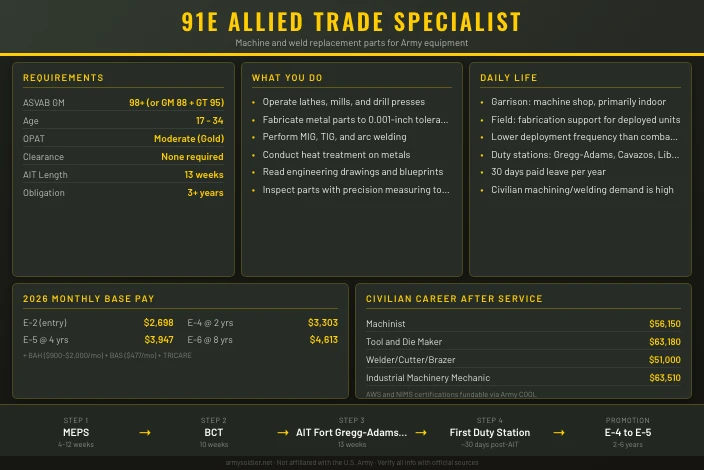
Job Role and Responsibilities
The 91E Allied Trade Specialist supervises and performs fabrication, repair, and modification of metallic and nonmetallic parts to keep Army equipment operational. Using lathes, milling machines, drills, grinders, and other machine shop equipment, these soldiers manufacture components to tolerances measured in thousandths of an inch. They also perform ferrous and nonferrous welding using gas, arc, MIG, and TIG processes, and conduct heat treatment operations on metals.
Daily Tasks
In a garrison maintenance shop, an Allied Trade Specialist typically starts by reviewing work orders and preparing raw materials. A typical morning might involve setting up a lathe to turn down a replacement shaft for a vehicle component, then switching to TIG welding to repair a cracked bracket. The precision required is high: many machined parts must meet tolerances of 0.001 inch or tighter.
Field fabrication work is less common but happens during deployments and extended exercises when supply channels can’t deliver a replacement part quickly enough. The ability to manufacture a functional part in austere conditions is the capability that makes this MOS irreplaceable.
- Set up and operate lathes, milling machines, drill presses, and surface grinders
- Fabricate replacement parts from ferrous and nonferrous metals and some plastics
- Perform gas, arc, MIG, and TIG welding on structural and precision components
- Conduct heat treatment processes including hardening and tempering
- Read and interpret engineering drawings, blueprints, and technical specifications
- Inspect finished parts using precision measurement tools including micrometers and calipers
- Maintain machine shop equipment and ensure calibration standards are met
Specific Roles
The 91E sits within CMF 91 (Mechanical Maintenance) as the Army’s primary precision fabrication specialist.
| Classification | Code | Description |
|---|---|---|
| Primary MOS | 91E | Allied Trade Specialist (all grades) |
| Warrant Officer | 915A | Automotive Maintenance Warrant Officer (WO1 to CW3) |
| Senior Warrant | 915E | Senior Automotive Maintenance Warrant Officer (CW4 to CW5) |
Mission Contribution
The Army’s supply chain is extensive, but it can’t stock every possible replacement part for every system in the inventory. The 91E fills that gap by manufacturing what the supply system can’t deliver. During extended operations or when a unique component fails on a legacy system, the Allied Trade Specialist is the soldier who keeps the mission from stopping because a single part is unavailable.
Technology and Equipment
The machine shop environment includes conventional lathes, CNC machines, vertical and horizontal milling machines, drill presses, surface grinders, and a full array of precision measurement tools. Welding equipment covers the standard processes: stick (SMAW), MIG (GMAW), and TIG (GTAW). Advanced shops at larger installations also have plasma cutting equipment and welding inspection tools.
Salary and Benefits
The Army’s compensation package combines base pay with tax-free allowances that collectively exceed what the base pay figure alone suggests.
Base Pay (2026)
All figures are 2026 monthly rates per DFAS.
| Grade | Rank | Entry Pay | 4-Year Pay |
|---|---|---|---|
| E-1 | Private (PV1) | $2,407/mo | $2,407/mo |
| E-2 | Private (PV2) | $2,698/mo | $2,698/mo |
| E-3 | Private First Class (PFC) | $2,837/mo | $3,198/mo |
| E-4 | Specialist (SPC) | $3,142/mo | $3,659/mo |
| E-5 | Sergeant (SGT) | $3,343/mo | $3,947/mo |
| E-6 | Staff Sergeant (SSG) | $3,401/mo | $4,069/mo |
| E-7 | Sergeant First Class (SFC) | $3,932/mo | $4,663/mo |
Allowances and Benefits
Most soldiers receive two major tax-free monthly allowances on top of base pay:
- Basic Allowance for Subsistence (BAS): $476.95/month flat for all enlisted soldiers
- Basic Allowance for Housing (BAH): Varies by duty location and dependency status. At Fort Sam Houston, a single E-4 receives $1,359/month; with dependents, $1,728/month.
TRICARE Prime covers the soldier and enrolled family members with no enrollment fees, no deductibles, and no copays for medical, dental, vision, mental health, and prescriptions.
Education support includes:
- Tuition Assistance: Up to $4,500/year while on active duty, covering $250 per semester hour
- Post-9/11 GI Bill: 36 months covering full in-state tuition at public universities, up to $29,920.95/year at private schools, plus a monthly housing allowance and $1,000/year for books
Work-Life Balance
Soldiers earn 30 days of paid leave per year. The machine shop environment is primarily a garrison function, so 91Es often experience more schedule predictability than combat-support MOSs. Field exercises and deployments do disrupt schedules, but the baseline is a standard duty day in garrison.
Qualifications and Eligibility
The 91E requires higher ASVAB scores than most CMF 91 MOSs, reflecting the precision and math-heavy nature of machining work.
Eligibility Requirements
| Requirement | Standard |
|---|---|
| Age | 17-34 (waiver possible to 39) |
| Citizenship | U.S. citizen or lawful permanent resident |
| Education | High school diploma (AFQT 31+) or GED (AFQT 50+) |
| ASVAB GM composite | GM 98, OR GM 88 combined with GT 95 |
| OPAT category | Moderate (Gold) |
| Security clearance | None required |
| Medical | Meets Army MEPS medical standards |
The GM (General Maintenance) composite draws from four ASVAB subtests: General Science (GS), Auto and Shop Information (AS), Mathematics Knowledge (MK), and Electronics Information (EI). The high GT requirement (95 when combined) reflects the mathematical precision machining demands. Test takers should focus preparation on Mathematics Knowledge and Auto and Shop Information.
Application Process
Selection Competitiveness
The 91E is one of the lower-density MOSs in CMF 91, meaning fewer total positions but also less competition for training seats at any given time. Applicants with vocational or shop class backgrounds, prior machining or welding experience, or strong math scores stand out. The higher GM requirement naturally screens the applicant pool.
Confirm current enlistment bonus status with your recruiter. Check HRC bonus charts for current figures, as they update throughout the fiscal year.
Service Obligation
Soldiers enter at E-1 (Private, PV1). Three-year contracts are the minimum; four-year agreements are standard for maximizing bonus eligibility. The total obligation includes active-duty time and time in the Individual Ready Reserve after the contract ends.
See our ASVAB study guide for strategies to hit these line scores, or take the PiCAT from home if you are a first-time tester.
Work Environment
Setting and Schedule
The Allied Trade Specialist works primarily in a machine shop environment. Garrison machine shops at division and corps support battalions are typically climate-controlled facilities with overhead lighting and ventilation systems for fumes and metal dust. The work is physically demanding in specific ways: sustained standing at machines, handling heavy stock material, and repetitive fine-motor precision tasks.
Deployed operations may involve less favorable conditions. Field fabrication is done with whatever equipment is available, which may mean a field-expedient welding setup rather than a precision machine shop.
Leadership and Communication
The 91E operates within the maintenance company chain of command. A Maintenance Warrant Officer or maintenance officer typically oversees the shop. NCO supervision provides day-to-day guidance on work order priorities and quality standards. At senior grades, 91Es lead shop teams and advise the warrant officer on equipment condition and fabrication capabilities.
Team Dynamics and Autonomy
Junior soldiers learn machine setup and basic operations under direct supervision. By E-4, a qualified specialist runs standard jobs independently. Senior soldiers at E-5 and above supervise junior machinists and welders, review work quality, and manage work order flow. The precision nature of the work means individual accountability is high – a part that doesn’t meet spec fails inspection regardless of how much effort went into making it.
Job Satisfaction and Retention
Soldiers who find precision craftsmanship satisfying tend to stay in this MOS. The ability to produce a finished, functional part from raw material provides clear, tangible feedback on your own skill. Those who prefer variety across many platforms sometimes find the specialized shop environment limiting. The civilian machining and welding industry is large enough that re-enlistment leverage through skill scarcity is real.
Training and Skill Development
Initial Training
The 91E pipeline begins with Basic Combat Training and continues at Advanced Individual Training at Fort Gregg-Adams, Virginia.
| Phase | Location | Length | Focus |
|---|---|---|---|
| Basic Combat Training (BCT) | Various installations | 10 weeks | Soldiering fundamentals, physical fitness, weapons qualification |
| Advanced Individual Training (AIT) | Fort Gregg-Adams, VA | 13 weeks | Machine shop operations, welding processes, fabrication, precision measurement |
AIT covers the full range of machining and welding disciplines. Students operate lathes, mills, drills, and grinders on real work orders. Welding instruction covers stick, MIG, and TIG processes on ferrous and nonferrous metals. The curriculum is equivalent to a two-year technical college program in manufacturing technology, according to GoArmy.
Graduates receive college credit recommendations through the American Council on Education program. Many institutions recognize this training as equivalent to vocational or technical degree coursework.
Advanced Training
Soldiers can build on their 91E training throughout their careers:
- Advanced machining and CNC courses available at select installations and through civilian community colleges via Tuition Assistance
- AWS (American Welding Society) certification is fundable through the Army COOL Program and carries immediate civilian value
- NIMS (National Institute for Metalworking Skills) credentials recognized by manufacturing employers nationwide
- Warrant Officer Candidate School (WOCS): Opens the 915A track for soldiers interested in managing maintenance programs at higher organizational levels
- Army COOL Program: Covers exam fees for machining and welding credentials that civilian employers recognize
Everything starts with qualifying ASVAB scores — our study guide covers what to study first.
Career Progression and Advancement
Career Path
Promotion from E-1 to E-4 is relatively automatic. Advancement to E-5 Sergeant requires passing the promotion board, meeting NCOER and education requirements, and accumulating promotion points.
| Grade | Rank | Typical Time in Service | Key Duty Position |
|---|---|---|---|
| E-1 | Private (PV1) | Entry | Student / trainee |
| E-2 | Private (PV2) | 6 months | Apprentice machinist/welder |
| E-3 | Private First Class (PFC) | 12 months | Machine operator |
| E-4 | Specialist (SPC) | 24 months | Journeyman machinist/welder |
| E-5 | Sergeant (SGT) | 3-5 years | Shop team leader |
| E-6 | Staff Sergeant (SSG) | 6-10 years | Shop section sergeant |
| E-7 | Sergeant First Class (SFC) | 10-16 years | Maintenance ops NCO |
| E-8 | Master Sergeant (MSG) | 16-22 years | Senior maintenance supervisor |
| E-9 | Sergeant Major (SGM) | 22+ years | Command maintenance advisor |
Specialization and Warrant Officer Path
Experienced 91Es who want to stay in the Army’s technical track can apply for the 915A Automotive Maintenance Warrant Officer program. Warrant officers at this designation manage maintenance programs at battalion and brigade levels, overseeing multiple shops. The 915E designation applies at CW4 and CW5 for senior technical leaders.
Role Flexibility and Transfers
Reclassification into adjacent CMF 91 MOSs is possible after completing the initial contract. Soldiers with machining skills who want broader platform exposure sometimes move to 91L (Construction Equipment) or stay in precision fabrication for the civilian transition value.
Performance Evaluation
E-1 through E-4 soldiers are evaluated through monthly counseling and annual DA Forms. E-5 and above fall under the full NCOER process. Technical competence, work quality, and the ability to train junior soldiers are the key factors that separate average from excellent evaluations in this MOS.
Physical Demands and Medical Evaluations
Physical Requirements
The 91E carries a Moderate (Gold) OPAT category. Daily work involves sustained standing at machines, handling metal stock that can weigh 25 to 75 pounds, and repetitive fine-motor operations using precision hand tools. Welding positions sometimes require awkward postures for extended periods.
The physical demands are real but less extreme than track vehicle maintenance MOSs. Upper body endurance and hand-eye coordination matter more than raw strength.
Army Fitness Test
All soldiers must pass the Army Fitness Test (AFT), which replaced the ACFT on June 1, 2025. Five events are each scored 0 to 100 points.
| Event | Abbreviation | Description |
|---|---|---|
| 3 Rep Max Deadlift | MDL | Barbell lift, 3 repetitions |
| Hand Release Push-Up | HRP | Full arm extension between each rep |
| Sprint-Drag-Carry | SDC | 50-meter shuttle with drag and carry phases |
| Plank | PLK | Timed static hold |
| Two-Mile Run | 2MR | Timed run |
The general standard requires at least 60 points per event (300 total minimum). Scores are sex- and age-normed. The 91E is not a designated combat MOS, so the 350-point combat specialty standard does not apply.
Medical Evaluations
MEPS conducts the initial medical screening before enlistment. Soldiers complete an annual Periodic Health Assessment once in service. Color vision requirements are standard for CMF 91; no unusual visual acuity thresholds apply.
Deployment and Duty Stations
Deployment Details
Allied Trade Specialists typically deploy with corps-level maintenance support battalions or theater-level sustainment commands rather than with brigade combat teams. Deployment frequency is generally lower than combat-support MOSs. When deployed, 91Es provide fabrication and welding support to the theater maintenance mission, often working in dedicated shop facilities at larger forward support bases.
Soldiers who deploy to combat zones earn hazardous duty pay and hostile fire pay for qualifying periods.
Location Flexibility
The 91E is assigned to maintenance support battalions across CONUS and OCONUS installations. Common locations include:
- Fort Gregg-Adams, Virginia
- Fort Cavazos (formerly Fort Hood), Texas
- Fort Campbell, Kentucky
- Fort Bragg (now Fort Liberty), North Carolina
- Camp Humphreys, South Korea (OCONUS)
- Grafenwoehr, Germany (OCONUS)
First-duty station follows Army needs. Reenlistment negotiations offer more choice after an initial strong-performance tour.
Risk, Safety, and Legal Considerations
Job Hazards
Machine shop work carries well-documented occupational hazards. Rotating equipment can cause severe injuries if clothing or extremities contact the machine. Metal chips and grinding sparks require eye protection at all times. Welding produces ultraviolet radiation, metal fumes, and ozone that require ventilation and proper respiratory protection. Solvents and cutting fluids used in machining are hazardous with prolonged skin contact.
Safety Protocols
Army machine shops operate under strict safety regulations. All personnel wear appropriate PPE: safety glasses, face shields for grinding operations, welding helmets and leathers for welding, and steel-toed boots. Machines have guards and emergency stops. Shop safety briefings are mandatory before operations begin.
Security and Legal Requirements
The 91E does not require a security clearance. Soldiers sign an enlistment contract covering MOS, duty preferences, and bonus terms. The Uniform Code of Military Justice governs conduct standards throughout service.
Impact on Family and Personal Life
Family Considerations
The 91E role involves deployment periods that separate soldiers from family. Deployments with sustainment commands tend to be less frequent but can still run nine to twelve months. The Army’s family support infrastructure is the same across all MOSs: Family Readiness Groups, Military OneSource counseling, Child Development Centers, and on-post schools.
TRICARE covers family members at no cost. Spouse employment support programs operate at most major installations.
Relocation and Flexibility
PCS moves occur every two to three years on average. The Army covers moving costs and adjusts BAH to the new duty location. Soldiers with strong records gain more latitude in requesting specific installations during reenlistment.
Reserve and National Guard
The 91E Allied Trade Specialist MOS is available in both the Army Reserve and the Army National Guard. Positions are found in maintenance support companies and field maintenance battalions across both components. Welding, machining, and metal fabrication skills are needed wherever units maintain heavy equipment in the field. The 91E is less common than some other maintenance MOS, but slots exist in most states.
Drill Schedule and Training Commitment
Reserve and Guard 91E soldiers follow the standard one weekend per month and two weeks of annual training. Drill weekends often include hands-on welding and machining tasks to maintain proficiency. AWS (American Welding Society) certifications require periodic requalification, and some units schedule extra training days for welding qualification tests. Expect 2 to 4 additional duty days per year to keep certifications current and maintain skill proficiency on shop equipment.
Part-Time Pay and Benefits
An E-4 with about four years of service earns roughly $488 per drill weekend in 2026, adding up to about $5,856 annually from drill pay. Two weeks of annual training adds active-duty pay on top. Active-duty E-4s earn $3,659 per month.
Tricare Reserve Select costs $57.88 per month for individual coverage or $286.66 for a family plan. Active-duty TRICARE Prime has no premiums. Both components offer Federal Tuition Assistance and the Montgomery GI Bill-Selected Reserve (Chapter 1606). Guard soldiers in many states receive state tuition waivers. Retirement follows a points-based system with payments beginning at age 60.
Deployment and Mobilization
Allied trade specialists deploy with maintenance units to provide welding, machining, and fabrication support in theater. When equipment breaks in the field and a part cannot be ordered, a 91E fabricates it. Mobilization cycles run 9 to 12 months. Demand is moderate, as every deployed maintenance company needs fabrication capability. Guard soldiers may also be activated for state emergencies where field welding or equipment repair is needed for disaster recovery.
Civilian Career Integration
The 91E skill set transfers directly to civilian welding and machining careers. AWS-certified welders are in high demand across construction, manufacturing, shipbuilding, pipeline, and energy sectors. Machinists with CNC and manual lathe experience find work in aerospace, automotive, and precision manufacturing. Army COOL funds civilian welding certifications while you serve. USERRA protects your civilian job during military service. Many 91E soldiers work as civilian welders or machinists and drill on weekends, building skills in both settings. Civilian welders with military backgrounds often command premium pay because employers trust their training discipline and quality standards.
| Feature | Active Duty | Army Reserve | Army National Guard |
|---|---|---|---|
| Commitment | Full-time | One weekend/month, two weeks/year | One weekend/month, two weeks/year |
| Monthly Pay (E-4, ~4 yrs) | $3,659 | ~$488/drill weekend | ~$488/drill weekend |
| Healthcare | TRICARE Prime, $0 premiums | Tricare Reserve Select, $57.88/month | Tricare Reserve Select, $57.88/month |
| Education | Post-9/11 GI Bill | Federal TA, MGIB-SR | Federal TA, MGIB-SR, state tuition waivers |
| Deployment | Regular rotations | Mobilization-based | Mobilization-based, plus state activations |
| Retirement | 20-year pension, immediate | Points-based, age 60 | Points-based, age 60 |
Post-Service Opportunities
The machining and welding skills from 91E training translate directly to civilian manufacturing, defense contracting, and industrial maintenance careers. Machinists and welders with verifiable precision experience are in demand across multiple industries.
Civilian Career Prospects
| Civilian Job Title | Median Annual Salary | Job Outlook (2024-2034) |
|---|---|---|
| Machinist | $56,150 | -2% (declining, but ~34,200 openings/yr) |
| Tool and Die Maker | $63,180 | -2% (declining, but strong replacement demand) |
| Welder, Cutter, Solderer | $51,000 | +2% (about as fast as average) |
| Industrial Machinery Mechanic | $63,510 | +13% (much faster than average) |
Salary data from the Bureau of Labor Statistics Occupational Outlook Handbook, May 2024 survey. The machinist decline in overall employment reflects automation trends, but annual openings from retirements remain substantial.
AWS welding certifications and NIMS credentials, fundable through Army COOL, add direct civilian market value. CNC machining skills are particularly in demand as manufacturers upgrade equipment.
Is This a Good Job for You?
Ideal Candidate Profile
This MOS suits soldiers who enjoy precision work and find satisfaction in producing something measurably correct. Strong math aptitude is necessary – the GM 98 requirement is not waiverable without a GT 95 backup. If you’ve enjoyed shop class, manufacturing courses, or working with precision tools, the training will feel natural.
What tends to predict success:
- Patience with precise, repetitive processes
- Strong attention to detail on measurements and tolerances
- Mathematical comfort with fractions, decimals, and basic geometry
- Ability to read technical drawings and specifications
Potential Challenges
The specialized shop environment isn’t for everyone. Some soldiers who expected broader maintenance exposure find the focus on a single trade limiting. Civilian demand for machinists has softened in some sectors due to automation, though experienced CNC operators and precision welders continue to find strong demand. Physical comfort with sustained fine-motor work and standing at machines all day matters over time.
Right Fit, Wrong Fit
If precision craftsmanship appeals to you and you want a direct pipeline to manufacturing or defense contracting careers, the 91E is a clear match. If you prefer working on complete systems and platforms rather than fabricating individual components, a different CMF 91 MOS may suit you better.
More Information
Talk to an Army recruiter about 91E contract options and current training seat availability. Official MOS details are at goarmy.com and the U.S. Army Ordnance Corps.
- Prepare for the ASVAB with our study guide to make sure your line scores qualify
This site is not affiliated with the U.S. Army or any government agency. Verify all information with official Army sources before making enlistment or career decisions.
Explore more Army maintenance careers such as 91B Wheeled Vehicle Mechanic and 91F Small Arms/Artillery Repairer.