91F Small Arms and Artillery Repairer
Every weapon in the Army’s inventory – from the M4 carbine a soldier carries daily to the towed howitzer a field artillery unit fires in support of ground troops – depends on one person to keep it functional: the 91F Small Arms and Artillery Repairer. These soldiers diagnose mechanical and electronic faults in weapons systems, apply technical manuals to restore function, and ensure that the units they support never go into the field with equipment that doesn’t work. The training is hands-on from day one. The civilian demand for this skill set is real and growing. If precision work with weapons and mechanical systems sounds like your kind of job, this MOS is worth a serious look.
Qualifying requires specific ASVAB line scores — our ASVAB study guide covers what to target and how to prepare.
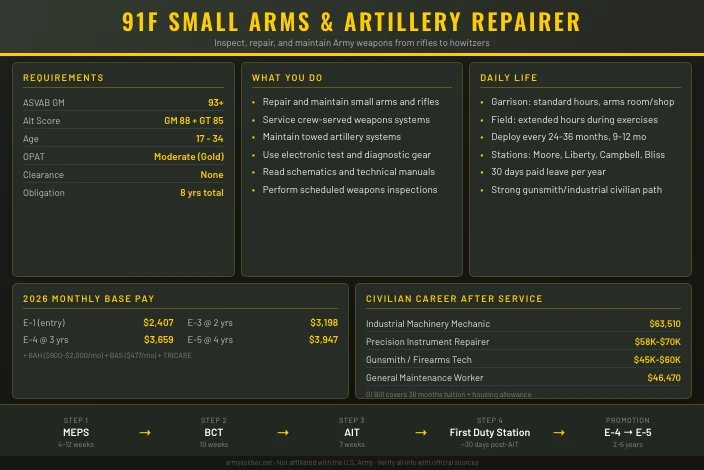
Job Role and Responsibilities
The 91F Small Arms and Artillery Repairer performs field and sustainment-level maintenance on small arms, other infantry weapons, and towed artillery systems. Soldiers diagnose malfunctions using electronic and mechanical test equipment, interpret technical manuals, schematics, and blueprints, and execute repairs on firing, recoil, and loading mechanisms. At senior grades, 91Fs supervise maintenance operations across armament systems and advise units on equipment readiness.
Daily Tasks
A garrison day for a 91F starts early, typically with Physical Readiness Training before 0700, then a shift to the armament shop. The bulk of each day involves preventive maintenance checks on assigned weapons, processing repair orders from supported units, and ordering replacement parts through the Army supply system. Precision is non-negotiable. A weapon that fails in the field can cost a soldier their life, so every repair is checked against technical manual specifications before the weapon goes back to the customer.
In the field or during support operations, the pace changes significantly. Weapons come in with battle damage, environmental fouling, or failures caused by sustained use under harsh conditions. You work under time pressure alongside the units you support, often with limited spare parts and basic tool kits. The ability to improvise within technical manual guidance becomes essential at this level.
- Perform direct and general support maintenance on M4/M16 rifles, M249 squad automatic weapons, M240B machine guns, M2 .50-caliber machine guns, M19 and M320 grenade launchers, and towed artillery pieces
- Use electronic and mechanical test equipment to isolate faults in firing, recoil, feeding, and loading systems
- Read and apply technical manuals, wiring diagrams, and schematics to diagnose and correct malfunctions
- Inspect weapons for wear, corrosion, and component failure before and after field operations
- Maintain property accountability records for all weapons passing through the armament shop
- Train unit armorers on proper preventive maintenance and care
Specific Roles
Within CMF 91 (Mechanical Maintenance), the 91F is the Army’s primary armament repair specialist.
| Classification | Code | Description |
|---|---|---|
| Primary MOS | 91F | Small Arms/Towed Artillery Repairer (all enlisted grades) |
| Warrant Officer | 915C | Small Arms/Artillery Maintenance Technician (WO1 to CW5) |
Senior 91Fs can apply to the 915C Warrant Officer program, which puts experienced armament maintainers into technical management roles at battalion and brigade level.
Mission Contribution
An infantry battalion that rolls to the range with malfunctioning weapons fails its training mission. A field artillery battery with a broken gun tube loses its ability to provide fire support. The 91F is the reason weapons systems are ready when units need them. This MOS sits directly behind every combat arms unit in the Army, and its readiness record shows in the operational results those units produce.
Technology and Equipment
The 91F works across a wide range of Army weapons platforms. Small arms include the M4/M16 family, M249 SAW, M240B/L machine guns, M2 .50-caliber machine gun, and various grenade launchers. Towed artillery systems include the M119 105mm howitzer and M777 155mm howitzer. Diagnostic tools range from electronic circuit testers and multimeters to specialized armorer gauges and function-check fixtures. You’ll also use precision measuring tools such as bore gauges and headspace gauges to verify specifications during repairs.
Salary and Benefits
Army compensation goes well beyond base pay. When you factor in housing, food, healthcare, and education benefits, the total package is substantially higher than the base pay figure suggests.
Base Pay (2026)
All figures below are 2026 monthly base pay per DFAS.
| Grade | Rank | Entry Pay | 4-Year Pay |
|---|---|---|---|
| E-1 | Private (PV1) | $2,407/mo | $2,407/mo |
| E-2 | Private (PV2) | $2,698/mo | $2,698/mo |
| E-3 | Private First Class (PFC) | $2,837/mo | $3,198/mo |
| E-4 | Specialist (SPC) | $3,142/mo | $3,659/mo |
| E-5 | Sergeant (SGT) | $3,343/mo | $3,947/mo |
| E-6 | Staff Sergeant (SSG) | $3,401/mo | $4,069/mo |
| E-7 | Sergeant First Class (SFC) | $3,932/mo | $4,663/mo |
Allowances and Benefits
Base pay is the starting point, not the full picture. Most soldiers also receive two major tax-free allowances:
- Basic Allowance for Subsistence (BAS): $476.95/month flat rate for all enlisted soldiers
- Basic Allowance for Housing (BAH): Varies by duty station and dependency status. At Fort Gregg-Adams, Virginia, an E-4 without dependents receives approximately $1,359/month; with dependents, $1,728/month. High cost-of-living duty stations pay substantially more.
Healthcare is provided through TRICARE Prime at no cost to the soldier. That covers medical, dental, vision, mental health, and prescriptions with zero enrollment fees and zero copays. Family members receive the same coverage at no additional cost.
Education benefits are among the strongest in any employer in the country:
- Tuition Assistance: Up to $4,500/year while on active duty, covering up to $250 per semester hour
- Post-9/11 GI Bill: 36 months of benefits covering full in-state tuition at public universities, up to $29,920.95/year at private schools, plus a monthly housing allowance and $1,000/year in book stipends
Work-Life Balance
Soldiers earn 30 days of paid leave per year, which accrues at 2.5 days per month. Garrison life generally follows standard duty hours. Field exercises and deployments compress schedules significantly, but the trade-off is a retirement pension that begins at 20 years of service under the Blended Retirement System (BRS) – something almost no civilian employer offers at that career stage.
Qualifications and Eligibility
Eligibility Requirements
| Requirement | Standard |
|---|---|
| Age | 17-34 (waiver possible to 39) |
| Citizenship | U.S. citizen or lawful permanent resident |
| Education | High school diploma (AFQT 31+) or GED (AFQT 50+) |
| ASVAB GM composite | 93, OR GM 88 combined with GT 85 |
| OPAT category | Moderate (Gold) |
| Security clearance | None required |
| Medical | Meets Army MEPS standards; normal color vision required |
The GM (General Maintenance) composite is the key qualifying score. It’s calculated from four ASVAB subtests: General Science (GS), Auto and Shop Information (AS), Mathematics Knowledge (MK), and Electronics Information (EI). If your GM falls between 88 and 92, you can still qualify by pairing it with a GT (General Technical) score of at least 85.
Application Process
Selection Competitiveness
The 91F is a consistent Army need. Every unit with assigned weapons – which is every unit – requires armament maintenance support. The Army maintains armament repair shops at installations worldwide, which creates sustained demand for trained 91Fs. Applicants who have prior experience with firearms, mechanical systems, or electronics stand out during the recruiter interview, but no prior experience is required to qualify. What matters most at selection is your ASVAB score and your ability to meet the physical and medical standards.
Service Obligation
Enlisted soldiers enter at E-1 (Private, PV1) regardless of education level. The minimum contract is three years; four to six-year contracts are more common and tend to carry better bonus eligibility. Your total service obligation includes active-duty time plus a period in the Individual Ready Reserve (IRR) after your contract ends, typically bringing the total to eight years.
See our ASVAB study guide for strategies to hit these line scores, or take the PiCAT from home if you are a first-time tester.
Work Environment
Setting and Schedule
The armament shop is the center of a 91F’s world in garrison. Shops are typically climate-controlled, well-lit facilities with organized workbenches, tool kits, and parts storage. This is precision work, not a motor pool environment. The pace is methodical: you follow technical manual steps in sequence, document every action, and verify function before releasing a weapon back to its owner.
Field conditions are different. You may operate from a containerized armament repair shop, a tent, or the back of a vehicle. The technical requirements don’t change, but the comfort level does. Lighting, parts availability, and workspace are all more limited in the field.
Leadership and Communication
The 91F operates within the unit’s maintenance chain. At the company level, a motor sergeant or maintenance section sergeant oversees the shop. Soldiers report repair status through their team leader, who coordinates with the unit’s armorer and the supporting maintenance officer or warrant officer. Communication with the customer unit matters: a commander needs to know when their weapons will be ready, and you need to communicate accurate timelines based on parts availability and workload.
Performance feedback flows through the standard Army system. Junior enlisted soldiers receive monthly counseling sessions. Sergeants (E-5 and above) are evaluated through the Noncommissioned Officer Evaluation Report (NCOER), which covers technical proficiency, leadership, and professional development.
Team Dynamics and Autonomy
Junior 91Fs (E-1 through E-4) work under direct supervision until they demonstrate competence on a range of weapon systems. By E-4, a capable specialist runs routine repair jobs independently. The precision nature of the work means you’re not improvising: every repair follows a documented procedure, and that structure applies across the career. Senior 91Fs at E-5 and above supervise junior repairers and manage shop operations.
Job Satisfaction and Retention
Soldiers who enjoy detailed, hands-on technical work tend to stay in this MOS. The skill set is directly transferable to civilian gunsmith positions, law enforcement armorer roles, and defense contractor jobs, which gives experienced 91Fs real leverage at re-enlistment time. Those who prefer field work over shop environments, or who want more direct engagement with combat units, sometimes find the pace of armament shop life less satisfying over time.
Training and Skill Development
Initial Training
The 91F pipeline runs from Basic Combat Training through a focused AIT at the U.S. Army Ordnance School at Fort Gregg-Adams, Virginia.
| Phase | Location | Length | Focus |
|---|---|---|---|
| Basic Combat Training (BCT) | Various installations | 10 weeks | Soldiering fundamentals, physical fitness, weapons qualification |
| Advanced Individual Training (AIT) | Fort Gregg-Adams, VA | 7 weeks | Small arms mechanics, artillery systems, electronic test equipment, schematics |
AIT combines classroom instruction and hands-on practical exercises. Students learn the internal mechanics of each Army weapon system, practice disassembly and assembly under time constraints, and use electronic and mechanical test equipment to diagnose faults. The curriculum covers small arms, crew-served weapons, and towed artillery systems. Students also learn to read and apply technical manuals, which are the foundational documents for every repair procedure in the Army.
Advanced Training
After AIT and initial assignment, 91Fs can pursue additional training and certifications throughout their career:
- Army COOL Program: Funds certification exams in areas such as Hydraulic Mechanics, Safety Certification, and commercial driver’s licenses (CDL). These credentials add promotion points and build civilian market value
- NCO Professional Military Education (PME): Basic Leader Course (BLC) for new sergeants, Advanced Leader Course (ALC) for SSGs, and Senior Leader Course (SLC) for SFCs build leadership and technical management skills
- Warrant Officer Candidate School (WOCS): The gateway to the 915C Small Arms/Artillery Maintenance Technician track, open to experienced 91Fs with a strong service record
- Sustainment Center of Excellence (SCoE) courses: Additional technical courses offered through the Ordnance School for specific weapon platforms and maintenance management
The Army’s Tuition Assistance program covers coursework at accredited institutions during off-duty hours, allowing soldiers to pursue associate or bachelor’s degrees in fields like mechanical technology, engineering technology, or business while they serve.
Everything starts with qualifying ASVAB scores — our study guide covers what to study first.
Career Progression and Advancement
Career Path
Promotion from E-1 to E-4 follows a relatively fixed timeline. Advancement to E-5 Sergeant is competitive and requires passing the Army’s promotion board, meeting education requirements, and accumulating promotion points. Senior NCO promotions become increasingly competitive at each level.
| Grade | Rank | Typical Time in Service | Key Duty Position |
|---|---|---|---|
| E-1 | Private (PV1) | Entry | AIT student |
| E-2 | Private (PV2) | 6 months | Junior repairer |
| E-3 | Private First Class (PFC) | 12 months | Armament repairer |
| E-4 | Specialist (SPC) | 24 months | Senior repairer, shop assistant |
| E-5 | Sergeant (SGT) | 3-5 years | Team leader, shop NCO |
| E-6 | Staff Sergeant (SSG) | 6-10 years | Shop foreman, section sergeant |
| E-7 | Sergeant First Class (SFC) | 10-16 years | Maintenance ops NCO, platoon sergeant |
| E-8 | Master Sergeant (MSG) | 16-22 years | Senior maintenance supervisor |
| E-9 | Sergeant Major (SGM) | 22+ years | Command maintenance advisor |
Specialization and Warrant Officer Path
The 915C Small Arms/Artillery Maintenance Technician is the natural next step for experienced 91Fs who want to move into technical management. Warrant officers at this designation manage armament maintenance programs at battalion and brigade level, advise commanders on weapons readiness, and oversee the work of junior 91Fs across multiple units. The 915C track runs from WO1 through CW5. Applicants typically need at least two years of strong 91F performance and solid NCOER records before applying to the warrant officer program.
Role Flexibility and Transfers
Lateral transfers within CMF 91 are possible with command approval. A 91F with interest in adjacent specialties such as 91B (Wheeled Vehicle Mechanic) or 91D (Power Generator Specialist) can reclassify, typically after completing an initial contract. The Army runs periodic reclassification cycles based on force structure and manning requirements. Soldiers who want to cross into combat arms from a maintenance background have that option as well, subject to qualifications for the target MOS.
Performance Evaluation
Junior enlisted soldiers at E-1 through E-4 receive monthly counseling from their immediate supervisor and an annual evaluation on DA Form 2166-9-1. Sergeants and above are evaluated through the NCOER system. Evaluators assess technical competence, leadership performance, Army values adherence, and physical fitness. A consistent record of strong evaluations is the single most important factor in competitive promotion at the NCO level.
Physical Demands and Medical Evaluations
Physical Requirements
The 91F carries an OPAT Moderate (Gold) physical demands rating. The job involves lifting weapons components, moving artillery parts, operating in confined shop spaces, and supporting maintenance in field environments. Day-to-day shop work is less physically demanding than combat MOSs, but field maintenance operations require stamina and strength.
All Army soldiers must pass the Army Fitness Test (AFT), which replaced the ACFT in June 2025. The AFT has five events scored 0-100 each, with a maximum total of 500 points.
| Event | Abbreviation | Standard |
|---|---|---|
| 3-Rep Max Deadlift | MDL | 60 pts minimum per event |
| Hand Release Push-Up | HRP | 60 pts minimum per event |
| Sprint-Drag-Carry | SDC | 60 pts minimum per event |
| Plank | PLK | 60 pts minimum per event |
| Two-Mile Run | 2MR | 60 pts minimum per event |
The general passing standard is 300 total points (60 per event), with scores normed by sex and age group. The 91F is not a designated combat MOS, so the combat specialty standard of 350 does not apply. Soldiers should aim above the minimum: a score near or above 400 builds promotion points and demonstrates physical readiness for deployment.
Medical Evaluations
MEPS conducts an initial physical examination covering vision, hearing, musculoskeletal function, and general health. Normal color vision is a firm requirement for 91F – the job requires distinguishing color-coded wiring diagrams and component markings. Annual physical fitness assessments continue throughout a soldier’s career. Soldiers who are pending medical evaluation or have existing conditions requiring treatment may face a medical hold at MEPS, so address known medical issues before the process begins.
Deployment and Duty Stations
Deployment Details
Every combat unit deploys with its weapons, and that means 91Fs deploy with them. Deployment frequency and duration vary by unit type and Army requirements. Brigade Combat Teams typically deploy on 9-to-12-month rotations, with home-station dwell time of 12 to 24 months between deployments. Support units attached to BCTs follow similar patterns. Reserve and National Guard 91Fs deploy less frequently but are subject to mobilization for operations and natural disaster support.
91Fs serve in both combat and non-combat deployments. During combat operations, armament shops operate close to forward positions to provide responsive maintenance support. During peacetime or overseas presence missions, the work is similar to garrison operations but in a different country and cultural context.
Location Flexibility
Duty stations span the Army’s global footprint. Installations with large infantry and armor formations have the highest concentrations of 91Fs. Common assignments include Fort Moore, Georgia; Fort Liberty, North Carolina; Fort Campbell, Kentucky; Fort Bliss, Texas; Fort Drum, New York; and overseas installations in Germany, South Korea, and Japan. Soldiers submit assignment preference requests through the Army’s Assignment Satisfaction Key (ASK) system, but the Army matches individuals to positions based on the needs of the force first.
Risk, Safety, and Legal Considerations
Job Hazards
Working with firearms and artillery systems carries inherent risks. Live ammunition handling during function checks and test firing procedures requires strict adherence to range safety protocols. Artillery components including propellant charges, projectiles, and fuzes require specialized handling procedures. Chemical cleaning solvents used in weapons maintenance present inhalation and skin exposure risks. Lifting heavy artillery components without proper technique causes musculoskeletal injuries.
Safety Protocols
The Army’s safety culture in armament shops is rule-based and non-negotiable. All weapons handling follows specific technical manual procedures, including clearing and safing steps before any maintenance begins. Range safety officers supervise any live-fire test procedures. Personal protective equipment – eye protection, hearing protection, and chemical-resistant gloves – is required during specific maintenance tasks. Soldiers receive formal safety training during AIT and refresher training throughout their careers.
Security and Legal Requirements
The 91F does not require a security clearance. Soldiers work with sensitive items – weapons are controlled property – but the clearance level is not above the standard needed for all enlisted soldiers. Access to weapons storage areas requires documented need-to-know and accountability. Every weapon passing through the shop is tracked by serial number on Army property records, and discrepancies trigger immediate investigation.
Service members are bound by the Uniform Code of Military Justice (UCMJ) for the duration of their contract. Enlistment contracts specify the duration of active service, the MOS, and any associated bonuses and their repayment conditions.
Impact on Family and Personal Life
Family Considerations
Army life affects families in predictable ways: deployments, field exercises, and duty station moves are part of the deal. 91F soldiers deploy at similar rates to other support MOSs. The 7-week AIT is one of the shorter training pipelines in CMF 91, which means soldiers get to their first unit and start the family relocation process earlier than many other MOS paths.
The Army provides extensive family support through Military Family Life Counselors (MFLCs), unit Family Readiness Groups (FRGs), and on-post services like childcare, schools, and commissaries. Military OneSource offers 24-hour support for family issues ranging from financial counseling to deployment resources.
Relocation and Flexibility
Permanent Change of Station (PCS) moves happen every two to three years on average. The Army covers moving expenses through the Dislocation Allowance (DLA) and contracted moving services. Soldiers who prefer assignment stability can apply for a stabilized tour at certain installations, though this is not guaranteed. Spouses who work in licensed professions can apply for interstate licensing reciprocity assistance through the Military Spouse JD Network and similar programs. The shorter training pipeline and broad geographic distribution of 91F billets give this MOS reasonable flexibility compared to more narrowly stationed specialties.
Reserve and National Guard
The 91F MOS is available in both the Army Reserve and National Guard. Every unit that carries weapons needs someone to keep them running. That means armorers and small arms repairers are in demand across nearly every type of unit in both components. If you want to serve part-time, this MOS gives you real options.
Drill Schedule and Training Commitment
The standard Reserve and Guard schedule is one weekend per month plus two weeks of Annual Training each year. For 91F soldiers, that baseline is usually enough to stay current on most weapons systems. Some units add extra armorer days before qualification ranges to ensure all weapons are inspected, certified, and ready for use. These extra training days are typically short and scheduled well in advance, so they are manageable alongside civilian work.
Annual weapons inspection certifications are a recurring requirement. You will renew these during AT or unit-arranged training events. The certification process is not complicated, but it does require hands-on time with the weapons you are responsible for maintaining.
Part-Time Pay and Benefits
Reserve and Guard soldiers serve part-time and are paid accordingly. An E-4 with about four years of service earns roughly $488 per drill weekend. Over a full year of 12 drill weekends, that comes to approximately $5,856. Annual Training adds two more weeks of pay at the daily active duty rate.
Healthcare works differently in the Reserve and Guard. You are not automatically covered. Tricare Reserve Select is available at $57.88 per month for member-only coverage or $286.66 per month for family coverage. Active duty soldiers pay $0 in TRICARE Prime premiums, so the cost difference is real. Factor it into your decision.
Education benefits are strong in the part-time components. Federal Tuition Assistance covers up to $4,500 per year for college courses and is available to both Reserve and Guard soldiers regardless of deployment status. Guard members also have access to state tuition waiver programs, which vary by state but can cover significant portions of in-state college costs. If you mobilize for more than 90 days on federal orders, you may qualify for Post-9/11 GI Bill benefits, which replace the Montgomery GI Bill-Selected Reserve (MGIB-SR).
Retirement under the Reserve and Guard system is points-based. You earn points for drill weekends, Annual Training, and any periods of active duty service. To receive a retirement benefit, you need at least 20 qualifying years, meaning 20 years where you earned 50 or more retirement points. You typically cannot draw that retirement pay until age 60, though each 90-day mobilization period can reduce your retirement age by three months, with a minimum retirement age of 50.
Deployment and Mobilization
Demand for 91F soldiers across deployment types is steady. Any unit that deploys carries weapons, and those weapons need an armorer. The 91F fills that role whether the unit is a support battalion, a military police company, or an infantry BCT. Mobilization tempo for Reserve and Guard 91F soldiers is moderate compared to combat arms, but it is not rare. Expect one or two deployments over a 20-year career if you stay active in a Reserve or Guard unit.
Deployments typically run 9 to 12 months including pre-mobilization training. USERRA protects your civilian job during that time. Your employer is required by law to reemploy you in the same or a comparable position when you return.
Civilian Career Integration
The 91F skillset opens a specific but real civilian market. Gunsmiths, firearms manufacturers, and law enforcement agencies all hire people with verified weapons maintenance experience. Defense contractors running small arms maintenance programs also recruit from this pool. The civilian gunsmith market is niche but has consistent demand, particularly for technicians who can work on a broad range of platforms rather than just one manufacturer’s products.
Some 91F veterans open their own gunsmithing businesses. A Federal Firearms License (FFL) is required, but the process is straightforward. Reserve or Guard service keeps your skills current while you build civilian credentials on the side. That combination is genuinely useful in this field.
| Feature | Active Duty | Army Reserve | Army National Guard |
|---|---|---|---|
| Commitment | Full-time | One weekend/month, two weeks/year | One weekend/month, two weeks/year |
| Monthly Pay (E-4, ~4 yrs) | $3,659 | ~$488/drill weekend | ~$488/drill weekend |
| Healthcare | TRICARE Prime, $0 premiums | Tricare Reserve Select, $57.88/month | Tricare Reserve Select, $57.88/month |
| Education | Post-9/11 GI Bill | Federal TA, MGIB-SR | Federal TA, MGIB-SR, state tuition waivers |
| Deployment | Regular rotations | Mobilization-based | Mobilization-based, plus state activations |
| Retirement | 20-year pension, immediate | Points-based, age 60 | Points-based, age 60 |
Post-Service Opportunities
Transition to Civilian Life
The 91F skill set translates directly to several civilian career paths. Gunsmiths and firearms technicians at retail gun stores, manufacturers, and law enforcement agencies perform work nearly identical to what a 91F does daily. Defense contractors supporting government weapons programs actively recruit veterans with armament maintenance backgrounds. Federal civil service positions – particularly with Army depots and arsenals – offer stable employment with preference points for veterans.
The Army’s Transition Assistance Program (TAP) provides pre-separation career counseling, resume assistance, and job placement resources. The Soldier for Life program connects transitioning soldiers with employer partners in manufacturing, law enforcement, and defense industries.
| Civilian Job Title | Median Annual Salary | Job Outlook (2024-2034) |
|---|---|---|
| Gunsmith / Firearms Technician | ~$45,000-$60,000* | Stable; varies by region |
| Industrial Machinery Mechanic | $63,510 | +13% (much faster than average) |
| General Maintenance and Repair Worker | $46,470 | +4% (as fast as average) |
| Precision Instrument Repairer | $58,000-$70,000* | Stable |
*Gunsmith and precision instrument salary ranges are estimates based on regional market data; the Bureau of Labor Statistics does not publish a separate detailed profile for this occupation. Industrial machinery mechanic and general maintenance data are from BLS May 2024.
Is This a Good Job for You? The Right (and Wrong) Fit
Ideal Candidate Profile
The 91F works best for someone who finds weapons systems genuinely interesting and has the patience for precision technical work. You’ll spend long hours following detailed procedures, verifying measurements against specifications, and documenting every step. If that sounds tedious, this MOS will feel like a grind. But if the idea of understanding exactly how a firearm cycles and being the person who fixes it when it doesn’t sounds satisfying, you’ll find the work rewarding.
Strong candidates tend to have:
- Interest in how mechanical and electronic systems work
- Good eye-hand coordination and comfort with precision tools
- Strong reading comprehension (technical manuals are dense)
- Attention to detail and a low tolerance for “close enough”
- Normal color vision (required, not waiverable)
Potential Challenges
Deployments with combat units mean you can find yourself in austere and dangerous environments even as a support soldier. The armament shop is not a rear-echelon sanctuary. Artillery maintenance involves handling heavy components and energetic materials, which carries physical risk that shop work with small arms does not. Soldiers who expected a strictly garrison-based, predictable schedule can find the operational demands of deployments difficult.
The 7-week AIT is one of the shorter in CMF 91, which some soldiers see as a positive. But it also means the curriculum moves quickly, and the learning curve continues at your first unit. Plan to spend your first year asking questions and studying technical manuals after hours.
Career and Lifestyle Alignment
The 91F is a good fit for someone who wants a technically demanding trade, values job stability, and is comfortable with the military’s structured lifestyle. The civilian demand for precision mechanical skills is strong and growing. Someone who plans to open a gunsmithing shop or work as a defense contractor after service will find the 91F background directly applicable.
It’s a poor fit for someone who wants high-adrenaline, direct-action work daily. The job is steady, methodical, and detail-oriented. It’s also not ideal for someone who dislikes shift-based accountability – armament shops track every item, every tool, and every repair in writing.
More Information
Contact your local Army recruiter to get current ASVAB score results, verify bonus eligibility, and confirm training seat availability for 91F. Recruiters have access to the most current incentive offers and can help you understand your specific qualifying score and what to expect in the MEPS process.
- Prepare for the ASVAB with our study guide to make sure your line scores qualify
This site is not affiliated with the U.S. Army or any government agency. Verify all information with official Army sources before making enlistment or career decisions.
Explore more Army maintenance careers such as the 91B Wheeled Vehicle Mechanic and the 91D Tactical Power Generator Specialist.