91H Track Vehicle Repairer
Tracked vehicles make the Army’s heaviest firepower mobile. The Bradley fighting vehicle, the M113 armored personnel carrier, the Paladin howitzer, the M88 recovery vehicle – none of them move when their mechanical systems fail. The 91H Track Vehicle Repairer is the soldier who fixes them. This MOS handles field-level and sustainment-level maintenance on tracked combat and combat-support vehicles, keeping armored formations ready to fight. The work is physically demanding, technically deep, and genuinely high-stakes. If working on complex mechanical systems in operational environments sounds appealing, this job produces skills that pay off both inside the Army and in the civilian trades.
Qualifying requires specific ASVAB line scores — our ASVAB study guide covers what to target and how to prepare.
Job Role and Responsibilities
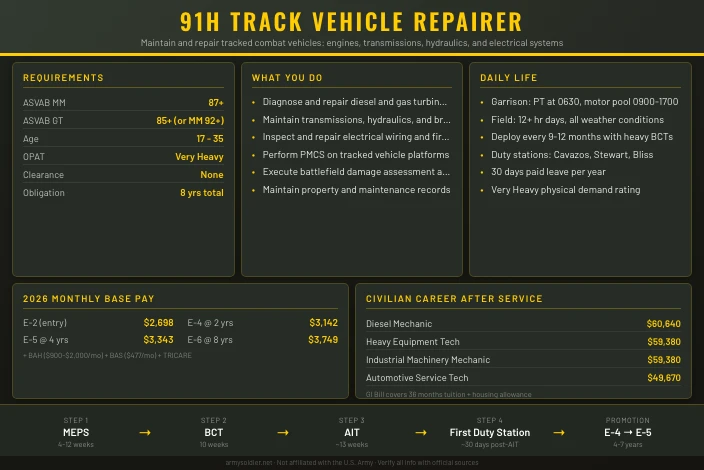
The 91H Track Vehicle Repairer supervises and performs maintenance on tracked military vehicles – covering engines, fuel systems, electrical systems, transmissions, steering mechanisms, hydraulics, brakes, and fire suppression systems. Soldiers in this MOS troubleshoot mechanical and electrical faults using technical manuals and Army diagnostic procedures, conduct battlefield damage assessments, execute preventive maintenance programs, and supervise junior mechanics at higher skill levels. The MOS covers tracked vehicles other than the M1 Abrams, M2 Bradley, and M109 Paladin family, which fall under different specialties.
Daily Tasks
In garrison, the day starts with Physical Readiness Training, then shifts to the motor pool. Most of the morning involves scheduled Preventive Maintenance Checks and Services (PMCS) on assigned vehicles – checking fluid levels, inspecting track tension, testing electrical systems, and logging findings in maintenance management records. Repair orders open throughout the day based on operator reports or inspection findings.
Field environments change the rhythm entirely. Vehicles break on training ranges, during convoys, and in deployed areas, often at night or in adverse weather. You’ll carry out roadside diagnostics, perform battlefield damage assessments, and coordinate recovery of vehicles that can’t be fixed on site.
Core daily tasks include:
- Diagnose faults in gas turbine and diesel power plants, transmission assemblies, and hydraulic systems
- Repair or replace fuel system components, air induction systems, and cooling systems
- Inspect and maintain electrical wiring harnesses and fire suppression systems
- Perform and supervise Preventive Maintenance Checks and Services
- Execute battlefield damage assessment and repair (BDAR) operations
- Maintain property accountability records for tools and equipment
Specific Roles
The 91H is the Army’s primary specialist for tracked vehicles outside the M1/M2/M109 platforms. As soldiers advance in rank, they take on supervisory and technical leadership roles within the CMF 91 career management field.
| Code | Classification | Description |
|---|---|---|
| 91H10 | Entry level | Performs maintenance under supervision; develops core repair skills |
| 91H20 | Journeyman | Performs maintenance and supervises junior soldiers |
| 91H30 | Senior | Supervises junior grades; provides technical guidance to the section |
| ASI H9 | Additional Skill Identifier | Tracked Vehicle Recovery Operations |
| 915A | Warrant Officer | Automotive Maintenance Warrant Officer (WO1 to CW3) |
Mission Contribution
The Army’s armored formations depend entirely on operational tracked vehicles. A Bradley that can’t move can’t support infantry. A recovery vehicle that breaks down leaves disabled equipment in the field. The 91H keeps these platforms mission-capable, directly enabling the maneuver and support elements that fight and sustain ground combat operations.
Technology and Equipment
Training at F Company, 16th Ordnance Battalion, U.S. Army Ordnance School covers tracked vehicle systems across multiple platforms. You’ll work with gas turbine engines, diesel power plants, and associated drive train components. Diagnostic work uses Army-issued test equipment alongside technical manuals (TMs). Advanced soldiers may qualify on the ASI H9 course, which covers tracked and wheeled vehicle recovery at both field and sustainment levels.
Salary and Benefits
Base pay is only part of the picture. Housing, food, healthcare, and education benefits add substantial value – especially for junior enlisted soldiers who pay nothing for medical coverage or on-post housing.
Base Pay (2026)
All figures reflect 2026 monthly base pay rates per DFAS.
| Grade | Rank | Entry Pay | 4-Year Pay |
|---|---|---|---|
| E-1 | Private (PV1) | $2,407/mo | $2,407/mo |
| E-2 | Private (PV2) | $2,698/mo | $2,698/mo |
| E-3 | Private First Class (PFC) | $2,837/mo | $3,198/mo |
| E-4 | Specialist (SPC) | $3,142/mo | $3,659/mo |
| E-5 | Sergeant (SGT) | $3,343/mo | $3,947/mo |
| E-6 | Staff Sergeant (SSG) | $3,401/mo | $4,069/mo |
| E-7 | Sergeant First Class (SFC) | $3,932/mo | $4,663/mo |
Additional Benefits
Most new soldiers qualify for the Basic Allowance for Housing (BAH), which varies by duty station, pay grade, and dependent status. At Fort Gregg-Adams, an E-4 without dependents receives approximately $1,359/month in BAH based on 2026 rates. Soldiers who live in the barracks don’t receive BAH but also pay no rent or utilities.
The Basic Allowance for Subsistence (BAS) is a flat $476.95/month for all enlisted soldiers in 2026. That covers food whether you eat in the dining facility or off-post.
TRICARE covers all active-duty soldiers at no cost – zero enrollment fees, zero co-pays, and zero deductibles for medical, dental, vision, and prescriptions. Family members are covered under TRICARE Prime as well.
On the education side, Army Tuition Assistance covers up to $4,500 per year and $250 per semester hour for college courses taken while on active duty. After separation, the Post-9/11 GI Bill pays full in-state tuition at public schools plus a monthly housing allowance for up to 36 months.
Retirement works through the Blended Retirement System (BRS). After 20 years, you receive 40% of your high-36 average base pay as a monthly pension for life. The Army also contributes up to 5% of your base pay to the Thrift Savings Plan (TSP), starting with automatic 1% contributions after 60 days of service.
Work-Life Balance
Active-duty soldiers earn 30 days of paid leave per year, accruing at 2.5 days per month. Federal holidays are observed. Field exercises, maintenance surges, and deployment can extend working hours significantly, but garrison schedules generally follow a standard duty day with PT in the morning.
Qualifications and Eligibility
Qualification Requirements
| Requirement | Standard |
|---|---|
| Citizenship | U.S. citizen or permanent resident alien |
| Age | 17-35 (waiver possible up to 42) |
| Education | High school diploma or GED |
| AFQT | Minimum 31 (diploma); 50 (GED) |
| ASVAB | MM: 87 and GT: 85, OR MM: 92 |
| OPAT | Very Heavy physical demand category |
| Security Clearance | None required |
| Medical | Meets Army enlistment medical standards (AR 40-501) |
| Gender | Open to all |
The ASVAB line score uses the Mechanical Maintenance (MM) composite, which combines scores from the Auto and Shop Information, Electronics Information, Mechanical Comprehension, and General Science subtests. The MM formula is: NO + AS + MC + EI. The General Technical (GT) composite is VE + AR. Soldiers who score MM 92 or higher qualify without needing the GT 85 threshold.
Application Process
The process runs through a Military Entrance Processing Station (MEPS):
Selection Criteria and Competitiveness
The 91H is not a top-tier competitive MOS. Soldiers who hit the ASVAB threshold and pass the OPAT for Very Heavy classification generally get the job. Physical fitness matters: this role requires consistent lifting, working in confined spaces around heavy components, and sustained physical exertion in field conditions. Demonstrating relevant mechanical experience or trade school background can help your recruiter advocate for your placement if slots are tight.
Service Obligation
New enlistees entering 91H commit to a standard enlistment term, typically 4 years active duty with 4 years in the Individual Ready Reserve (IRR). Entry rank is Private (E-1) for most enlistees. Prior college credit or other qualifying factors may allow an accelerated promotion to E-2 or E-3 at accession.
See our ASVAB study guide for strategies to hit these line scores, or take the PiCAT from home if you are a first-time tester.
Work Environment
Setting and Schedule
Track vehicle repairers work outdoors and indoors across all weather conditions. Motor pools are the primary work location – covered maintenance bays where possible, open-air lots when not. In the field, you work wherever the broken vehicle stopped, which might be a muddy range road at 0200 or a maintenance bay in a forward operating base. Exposure to grease, hydraulic fluid, diesel exhaust, loud machinery, and extremes of heat and cold is routine.
Garrison schedules follow a structured duty day: PT at 0630, work call around 0900, end of duty day in the late afternoon. Maintenance surges before field exercises or deployments push those hours longer. Field exercises and deployments disrupt routine entirely, with 12-hour or longer days common during high-tempo operations.
Leadership and Communication
At E-1 through E-4, you work under direct supervision of NCOs who assign tasks, review your work, and sign off on maintenance records. As you promote to E-5 and E-6, you take charge of small maintenance teams, assign work orders, and are held accountable for section productivity and maintenance record accuracy. Commanders receive daily readiness reports, and the 91H NCO is directly responsible for the numbers in those reports.
Performance feedback comes through the Army’s Non-Commissioned Officer Evaluation Report (NCOER) at E-5 and above. Below E-5, supervisors provide counseling statements that track professional development and performance against standards.
Team Dynamics and Autonomy
Junior soldiers work closely with NCO supervisors and rely on technical manuals for every procedure. The Army doesn’t encourage improvising on combat vehicle systems – you follow the TM. As you gain experience and rank, you get more latitude to manage your section, prioritize open work orders, and troubleshoot novel problems without step-by-step guidance. Experienced senior NCOs in 91H operate with significant professional autonomy within their maintenance sections.
Job Satisfaction and Retention
Track vehicle repair attracts soldiers who genuinely enjoy working with complex mechanical systems. The tangible nature of the work – a vehicle either starts or it doesn’t – provides clear feedback on performance. Soldiers who thrive in this role typically reenlist at reasonable rates; retention is supported by the strong civilian transferability of the skills. Those who struggle often cite physically demanding conditions and irregular hours during field exercises as friction points.
Training and Skill Development
Initial Training Pipeline
| Phase | Location | Length | Focus |
|---|---|---|---|
| Basic Combat Training (BCT) | Various Army installations | 10 weeks | Soldier skills, weapons, physical fitness, Army values |
| Advanced Individual Training (AIT) | Fort Gregg-Adams, VA (U.S. Army Ordnance School) | ~13 weeks | Track vehicle systems, engine repair, electrical/fuel systems, PMCS, technical manuals |
| First Duty Station | Varies | Ongoing | Applied maintenance, unit readiness operations |
BCT covers the foundational Army skills every soldier needs: rifle qualification, land navigation, physical fitness standards, first aid, and military customs. There’s no MOS-specific content in BCT.
AIT at the U.S. Army Ordnance School runs approximately 13 weeks under F Company, 16th Ordnance Battalion. The curriculum covers the full range of tracked vehicle systems: gas turbine and diesel engines, fuel and air induction systems, liquid and air cooling systems, transmission and transfer assemblies, hydraulic and brake systems, steering mechanisms, electrical wiring harnesses, and fire suppression systems. Practical exercises run on actual tracked vehicle platforms, not simulators. Soldiers also complete coursework in maintenance publications, tool use, and shop safety.
Advanced Training
After AIT and initial duty assignments, qualified soldiers can pursue:
- ASI H9 (Tracked Vehicle Recovery Operations): Additional Skill Identifier course covering tracked and wheeled vehicle recovery at field and sustainment levels. This significantly expands duty responsibilities and assignment options.
- Warrant Officer (915A/915E): High-performing 91H NCOs can apply for the Warrant Officer Candidate School (WOCS) pathway and commission as 915A Automotive Maintenance Warrant Officers. Warrants manage maintenance programs at battalion and brigade level.
- Unit-level Master Gunner or maintenance management courses: Available through unit quotas and NCO development pipelines.
- Civilian certifications: The Army COOL (Credentialing Opportunities On-Line) program funds certification exams aligned with 91H duties, including ASE certifications in diesel engines, drive trains, and electrical systems.
The Army pays for professional development courses taken during service, and many installations have education centers where soldiers can pursue college credits concurrently with their duties.
Everything starts with qualifying ASVAB scores — our study guide covers what to study first.
Career Progression and Advancement
Rank Progression
| Grade | Rank | Typical Time in Grade | Role |
|---|---|---|---|
| E-1 | Private (PV1) | 0-6 months | Entry; works under direct supervision |
| E-2 | Private (PV2) | 6-12 months | Developing basic repair competence |
| E-3 | Private First Class (PFC) | 12-24 months | Assigned independent tasks under supervision |
| E-4 | Specialist (SPC) | 24-48 months | Proficient mechanic; may act as team lead |
| E-5 | Sergeant (SGT) | 4-7 years | Section leader; NCOER rated |
| E-6 | Staff Sergeant (SSG) | 7-11 years | Maintenance section chief; supervises multiple teams |
| E-7 | Sergeant First Class (SFC) | 11-17 years | Platoon sergeant or maintenance control NCO |
| E-8 | Master Sergeant (MSG) | 17-22 years | Senior advisor; battalion-level maintenance |
| E-9 | Sergeant Major (SGM) | 22+ years | Senior maintenance NCO; brigade or higher |
Promotion to E-5 and above is competitive. It’s based on promotion points that come from NCOER ratings, military education, physical fitness scores, and civilian education credits. Soldiers who stagnate at E-4 without pursuing promotion points risk hitting a retention control point.
Role Flexibility and Transfers
Soldiers who want to cross-train into a related MOS – such as 91B (Wheeled Vehicle Mechanic) or 91D (Power Generation Specialist) – can apply for a reclassification through their unit S1 and HRC. The process requires a favorable recommendation from the chain of command, availability of a training seat, and sometimes a waiver depending on time remaining in service. Warrants can branch from 91H experience into the 915A pathway with competitive selection.
Performance Evaluation
At E-4 and below, NCOs provide written developmental counseling at a minimum quarterly. At E-5 and above, the NCOER is the primary evaluation tool, rated annually. NCOERs assess performance in five areas: character, presence, intellect, leads, and achieves. A strong maintenance section – high vehicle readiness rates, clean records, zero lost equipment – reflects well on the NCO in charge and directly supports competitive promotion scores.
Succeeding in 91H requires consistent technical competence and reliable follow-through on maintenance records. Commanders notice when vehicles fail readiness inspections. NCOs who maintain high fleet readiness rates and develop junior soldiers advance; those who let record-keeping or vehicle availability slide draw scrutiny fast.
Physical Demands and Medical Evaluations
Physical Requirements
Track vehicle maintenance is rated Very Heavy in physical demands. Daily tasks include lifting components that can exceed 50 pounds, working in confined spaces around vehicle hulls, pulling and repositioning heavy track sections, and sustained physical exertion during field maintenance operations. Soldiers who aren’t physically capable of sustained heavy lifting face real difficulty in this role.
The Army Fitness Test (AFT) replaced the ACFT on June 1, 2025. All soldiers must pass it regardless of MOS.
| Event | Abbreviation | Minimum Score |
|---|---|---|
| 3-Rep Maximum Deadlift | MDL | 60 points |
| Hand Release Push-Up | HRP | 60 points |
| Sprint-Drag-Carry | SDC | 60 points |
| Plank | PLK | 60 points |
| Two-Mile Run | 2MR | 60 points |
| Total (minimum passing) | 300 points |
Scores are sex- and age-normed. The AFT maximum is 500 points (100 per event). Soldiers score at least 60 points per event to pass. The 91H MOS is not one of the 21 designated combat MOSs requiring the higher 350-point combat standard, so the 300-point general standard applies.
The OPAT for 91H requires the Very Heavy demand category performance level. The four OPAT events are the standing long jump, seated power throw, strength deadlift, and interval aerobic run. Failing the OPAT at the required demand level disqualifies a candidate from 91H at MEPS.
Medical Evaluations
Soldiers complete a full MEPS medical screening at enlistment under AR 40-501 standards. Periodic physical exams occur throughout a career, and soldiers flag for medical review when physical limitations affect their ability to perform core duties. Color vision deficiency can be a disqualifying factor for some electrical system diagnostic work; confirm your specific color vision status with a recruiter if this applies.
Deployment and Duty Stations
Deployment Details
The 91H supports armored and mechanized units, which means duty stations and deployments align with where those units are assigned. Rotational deployments to Europe under Atlantic Resolve and Pacific deployments under Indo-Pacific Command commitments are realistic for soldiers assigned to heavy brigade combat teams (BCTs).
Deployment frequency varies by unit. Active-duty heavy BCTs deploy on 9-to-12-month rotations with roughly equal dwell time between deployments. Reserve Component soldiers activate for extended operational deployments less frequently but do mobilize. Track vehicle repairers deploy with their supported units; maintenance sections are not exempt from operational rotations.
Location Flexibility
Assignment locations follow unit needs. Heavy armored formations are concentrated at a handful of installations:
- Fort Cavazos, TX (1st Cavalry Division, III Corps)
- Fort Stewart, GA (3rd Infantry Division)
- Fort Bliss, TX (1st Armored Division)
- Fort Campbell, KY (101st Airborne – some tracked assets)
- Fort Wainwright, AK (Arctic mechanized units)
- Germany (USAREUR-AF) (rotational and permanent-party assignments)
Soldiers can submit a dream sheet of preferred locations during accession, but assignment branch at HRC makes final decisions based on unit vacancies. First-term soldiers generally have limited influence over their initial assignment.
Risk, Safety, and Legal Considerations
Job Hazards
Track vehicle maintenance carries real occupational hazards. Soldiers work around heavy moving components, hydraulic systems under pressure, fuel systems, and vehicles that weigh tens of thousands of pounds. Improper jack placement or failure to follow lockout/tagout procedures during maintenance can cause serious injury. Diesel exhaust in enclosed maintenance bays is a chemical exposure risk. Electrical systems on tracked vehicles carry hazardous voltages.
Noise exposure is significant. Tracked vehicle engines and drive train testing produce hearing-damaging sound levels. Army hearing protection standards and mandatory wear of personal protective equipment (PPE) mitigate risk but don’t eliminate it.
Safety Protocols
The Army’s safety program for maintenance operations requires compliance with applicable technical manuals, use of approved lifting devices and stands, mandatory PPE (eye protection, hearing protection, gloves), and lockout/tagout procedures before working on energized systems. Shop safety inspections are a regular part of unit operations. Supervisory NCOs are responsible for enforcing safety standards within their sections.
Security and Legal Requirements
The 91H MOS does not require a security clearance. Soldiers are bound by their enlistment contract and the Uniform Code of Military Justice (UCMJ) for the duration of their service obligation. Early separation requires Army approval and typically results in an adjusted DD-214 and potential recoupment of enlistment incentives.
Deployments in conflict zones are governed by theater rules of engagement. Track vehicle repairers in deployed environments are armed and expected to defend themselves and their equipment – maintenance soldiers are not rear-echelon bystanders.
Impact on Family and Personal Life
Family Considerations
Military life affects families primarily through relocation and deployment. New soldiers move to their first duty station within weeks of AIT graduation, often to a post they didn’t choose. Subsequent permanent change of station (PCS) moves typically come every 2-3 years. The Army provides on-post family housing or BAH to cover off-post rent, Family Readiness Groups (FRGs) at the unit level, and access to Military OneSource counseling and support services.
During deployments, the Family Readiness Officer and FRG serve as the primary points of contact for families at home. Soldiers can communicate by phone and internet during most deployments, though operational security requirements sometimes restrict communication timing.
Relocation and Flexibility
Heavy BCT assignments concentrate at a limited set of installations, so geographic flexibility is less than it would be for a more widely distributed MOS. Soldiers with family ties to specific regions should discuss assignment preferences with their recruiter honestly. Some assignment preference requests are honored; many are not, particularly for junior enlisted soldiers.
Reserve and National Guard
The 91H MOS is primarily available in the National Guard. Guard units operating M2 Bradleys, M113s, and engineer tracked vehicles need trained mechanics to keep those fleets running. The Army Reserve rarely maintains tracked vehicle fleets, so if this MOS is what you want in a part-time capacity, the Guard is typically your only path.
Drill Schedule and Training Commitment
Standard commitment is one weekend per month plus two weeks of Annual Training each summer. For 91H soldiers assigned to Guard infantry or armor BCTs with tracked vehicles, the schedule often includes additional maintenance training days. Units schedule these extra days before gunnery exercises and combat training center rotations, when tracked vehicles need to be in peak condition.
Annual tracked vehicle maintenance certifications are required to stay current. These are typically completed during AT or unit-scheduled training events. If your unit is preparing for an NTC rotation, expect a heavier training tempo in the months leading up to the event. That is normal and should not come as a surprise.
Part-Time Pay and Benefits
An E-4 with roughly four years of service earns approximately $488 per drill weekend. Twelve drill weekends per year puts annual drill pay at about $5,856. Annual Training adds two weeks of pay calculated at the daily active duty rate.
Healthcare requires separate enrollment. Tricare Reserve Select costs $57.88 per month for member-only coverage or $286.66 per month for family coverage. Active duty soldiers pay nothing for TRICARE Prime, so the gap is significant. Plan for this cost difference when comparing active and Guard service.
Education benefits remain strong. Federal Tuition Assistance is available to Guard members and covers up to $4,500 per year for college coursework. Most states also offer tuition waiver programs for Guard soldiers, which can substantially reduce or eliminate the cost of in-state public college. If you mobilize on federal orders for more than 90 days, you may earn eligibility for Post-9/11 GI Bill (Chapter 33) benefits, which are far more generous than the Montgomery GI Bill-Selected Reserve (MGIB-SR) available to non-mobilized soldiers.
Guard retirement is points-based. You need 20 qualifying years, each with at least 50 retirement points. Retirement pay typically begins at age 60. Each 90-day mobilization reduces that age by three months, with a floor of 50 years old.
Deployment and Mobilization
Guard infantry and armor BCTs with tracked vehicles deploy on multi-year rotation cycles. A typical mobilization runs 9 to 12 months, including pre-deployment training. Mobilization tempo for 91H soldiers in Guard BCTs is moderate. You will likely see at least one deployment over a 20-year Guard career, possibly two.
USERRA protects your civilian job during mobilization. Your employer must reemploy you in the same or a comparable position when you return, with your seniority, pay, and benefits intact. Understanding your USERRA rights before you deploy is worth the time.
Civilian Career Integration
Tracked vehicle experience transfers well to the civilian heavy equipment sector. Caterpillar and John Deere track-type machines, crawler dozers, and excavators share mechanical fundamentals with military tracked vehicles. Diesel technicians who understand how track systems, final drives, and hydraulic components work are consistently in demand.
Mining equipment operators and heavy civil construction firms also hire candidates with this background. Defense contractors maintaining military vehicle fleets specifically recruit veterans with documented 91H experience. Guard service keeps your skills current while you build civilian credentials in the heavy equipment field.
| Feature | Active Duty | Army Reserve | Army National Guard |
|---|---|---|---|
| Commitment | Full-time | One weekend/month, two weeks/year | One weekend/month, two weeks/year |
| Monthly Pay (E-4, ~4 yrs) | $3,659 | ~$488/drill weekend | ~$488/drill weekend |
| Healthcare | TRICARE Prime, $0 premiums | Tricare Reserve Select, $57.88/month | Tricare Reserve Select, $57.88/month |
| Education | Post-9/11 GI Bill | Federal TA, MGIB-SR | Federal TA, MGIB-SR, state tuition waivers |
| Deployment | Regular rotations | Mobilization-based | Mobilization-based, plus state activations |
| Retirement | 20-year pension, immediate | Points-based, age 60 | Points-based, age 60 |
Post-Service Opportunities
The skills 91H builds translate directly into the civilian workforce. Tracked vehicle systems overlap significantly with heavy construction equipment, mining machinery, and military contractor maintenance roles. Employers who service government fleets and defense contractors actively recruit veterans with hands-on mechanical experience and Army maintenance documentation skills.
Civilian Career Prospects
| Civilian Job Title | Median Annual Salary | Job Outlook (2024-2034) |
|---|---|---|
| Diesel Service Technician / Mechanic | $60,640 | +2% (26,500 openings/yr) |
| Heavy Vehicle & Mobile Equipment Technician | Varies by specialty | +6% (21,700 openings/yr) |
| Automotive Service Technician | $49,670 | +4% (70,000 openings/yr) |
| Industrial Machinery Mechanic | $59,380 | +11% (48,900 openings/yr) |
Salary and outlook figures from Bureau of Labor Statistics Occupational Outlook Handbook, May 2024 data.
Certifications and Transition Support
The Army COOL program identifies civilian credentials aligned with 91H duties. Relevant certifications include ASE (Automotive Service Excellence) tests in diesel engines, drive trains, manual transmissions, and electrical/electronic systems. The Army funds credentialing exams through COOL for eligible soldiers.
The Transition Assistance Program (TAP) provides pre-separation counseling, resume workshops, and connections to veteran hiring programs. The GI Bill covers apprenticeship programs as well as college, so veterans can use their education benefits to enter union apprenticeships in heavy equipment mechanics – a pathway that often pays better than a bachelor’s degree for a mechanical-track career.
If government contracting interests you, defense contractors maintaining tracked vehicles for the Army and allied nations hire former 91H soldiers specifically because of their platform knowledge and maintenance documentation standards.
Is This a Good Job for You? The Right (and Wrong) Fit
Ideal Candidate Profile
This MOS fits people who are hands-on problem solvers with mechanical intuition and the patience to follow detailed technical procedures. If you’ve worked on engines, heavy equipment, farm machinery, or construction vehicles, the learning curve in AIT will feel manageable. Physical capability matters: the Very Heavy OPAT category is a real bar, and the daily work backs it up.
People who succeed in 91H tend to:
- Prefer working with their hands over desk work
- Read and apply technical documentation without frustration
- Stay calm when equipment fails in inconvenient places
- Work independently within a structured framework
- Take physical fitness seriously as a professional standard
Potential Challenges
The physical demands are real and sustained. Lifting heavy components repeatedly in field conditions, in summer heat or winter cold, gets hard. Soldiers who underestimate this aspect often struggle after AIT. The duty station pool for armored-unit assignments is small, which limits geographic flexibility. Deployments with heavy BCTs happen on predictable rotational cycles, so extended periods away from home are an expected feature of the career, not an exception.
Track vehicle maintenance is detail-oriented. A missed PMCS item or an incomplete maintenance record can have consequences that come back to your section later. Soldiers who cut corners on documentation or maintenance procedures don’t last long in a well-run motor pool.
Career and Lifestyle Alignment
If your goal is a long-term Army career, the 91H pathway toward E-7/E-8 or into the 915A warrant officer track provides genuine upward mobility for technically skilled soldiers. If you plan to serve one term and transition, the civilian heavy equipment market is hiring and pays well for people with documented vehicle maintenance experience. The GI Bill bridges the gap to any additional certifications or apprenticeships you need.
This is not a good fit for someone who wants a desk job, dislikes physical work, or needs geographic stability near family. It’s a strong fit for someone who wants to learn a trade the Army will pay for, work on real equipment with real consequences, and leave service with credentials that employers recognize.
More Information
Talk to an Army recruiter to confirm current training seat availability for 91H, ask about any active enlistment incentives, and get answers specific to your background and eligibility. Recruiters can run a practice ASVAB assessment to show where you stand on the MM composite before you commit to anything. Contact the Army at 1-888-550-ARMY (2769) or visit goarmy.com.
- Prepare for the ASVAB with our study guide to make sure your line scores qualify
This site is not affiliated with the U.S. Army or any government agency. Verify all information with official Army sources before making enlistment or career decisions.
Explore more Army maintenance careers such as the 91B Wheeled Vehicle Mechanic and the 91D Tactical Power Generation Specialist.