91J Quartermaster and Chemical Equipment Repairer
Every Army unit in the field needs clean water, functional laundry systems, and working forced-air heaters. These capabilities come from quartermaster and chemical equipment, and the 91J keeps all of it running. This MOS covers a wide equipment portfolio: water purification units, field laundry systems, decontamination equipment, and various special-purpose machinery that other soldiers depend on daily in deployed environments. The training is six weeks at Fort McCoy and gives you practical skills in fluid systems, electronics, and mechanical maintenance that translate directly to industrial maintenance careers.
Qualifying requires specific ASVAB line scores — our ASVAB study guide covers what to target and how to prepare.
Job Role and Responsibilities
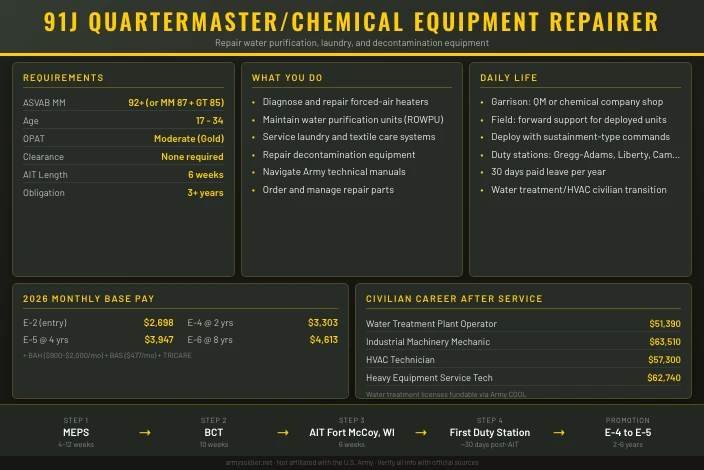
The 91J Quartermaster and Chemical Equipment Repairer supervises and performs maintenance, troubleshooting, and repair of chemical equipment, quartermaster machinery, forced-air heaters, decontamination units, and special-purpose field equipment. Duties include diagnosing mechanical and electronic faults, replacing components, and verifying repaired systems meet operational standards. At senior grades, 91Js manage maintenance sections, train junior soldiers, and coordinate parts and technical support for assigned equipment fleets.
Daily Tasks
In garrison, a 91J typically works through maintenance work orders on assigned equipment. A morning might involve troubleshooting a forced-air heater that won’t ignite, then shifting to a scheduled service on a Reverse Osmosis Water Purification Unit (ROWPU). The equipment spans mechanical, electrical, and fluid systems, so the work rarely repeats exactly.
Deployed operations are where this MOS shows its operational value. When a water purification unit goes down in a remote forward operating base, the 91J is the soldier who restores clean water production. That makes this an essential support function, not a peripheral one.
- Diagnose and repair forced-air heaters and combustion equipment
- Maintain and service Reverse Osmosis Water Purification Units (ROWPU)
- Troubleshoot laundry and textile care systems including dryer/tumbler units
- Repair decontamination equipment and chemical defense machinery
- Navigate Army technical manuals to execute repairs by the book
- Perform scheduled preventive maintenance on assigned equipment
- Coordinate with supply channels to order replacement parts
Specific Roles
The 91J operates within CMF 91 (Mechanical Maintenance) as the primary specialist for quartermaster and chemical support equipment.
| Classification | Code | Description |
|---|---|---|
| Primary MOS | 91J | Quartermaster and Chemical Equipment Repairer (all grades) |
| Warrant Officer | 915A | Automotive Maintenance Warrant Officer (WO1 to CW3) |
| Senior Warrant | 915E | Senior Automotive Maintenance Warrant Officer (CW4 to CW5) |
Mission Contribution
Deployed soldiers need clean water to survive. Field laundry prevents hygiene-related illness. Decontamination equipment is the first line of response after a chemical exposure event. The 91J’s equipment directly affects force health, sustainment, and CBRN readiness. When these systems fail in the field, the 91J restores them.
Technology and Equipment
Training covers a specific portfolio of systems. The ROWPU is the most technically complex piece of equipment, featuring electronics that manage valves, timing sensors, and water treatment processes. Other systems include the Laundry Advanced System (LADS), tactical shower units, M8A1/JCAD chemical agent detectors, M11 decontamination apparatuses, and various field heater models. Each system blends mechanical, electrical, and fluid components.
Salary and Benefits
Army compensation combines base pay with tax-free allowances and benefits that typically total well above what the base pay figure alone shows.
Base Pay (2026)
All figures are 2026 monthly rates per DFAS.
| Grade | Rank | Entry Pay | 4-Year Pay |
|---|---|---|---|
| E-1 | Private (PV1) | $2,407/mo | $2,407/mo |
| E-2 | Private (PV2) | $2,698/mo | $2,698/mo |
| E-3 | Private First Class (PFC) | $2,837/mo | $3,198/mo |
| E-4 | Specialist (SPC) | $3,142/mo | $3,659/mo |
| E-5 | Sergeant (SGT) | $3,343/mo | $3,947/mo |
| E-6 | Staff Sergeant (SSG) | $3,401/mo | $4,069/mo |
| E-7 | Sergeant First Class (SFC) | $3,932/mo | $4,663/mo |
Allowances and Benefits
Beyond base pay, most soldiers receive:
- Basic Allowance for Subsistence (BAS): $476.95/month flat rate for all enlisted soldiers
- Basic Allowance for Housing (BAH): Varies by location and dependency status. At Fort Sam Houston, a single E-4 receives $1,359/month; with dependents, $1,728/month.
TRICARE Prime covers the soldier and family members with no enrollment fees, no deductibles, and no copays for medical, dental, vision, mental health, and prescriptions.
Education support includes:
- Tuition Assistance: Up to $4,500/year on active duty at $250 per semester hour
- Post-9/11 GI Bill: 36 months covering full in-state tuition at public universities, up to $29,920.95/year at private schools, plus a monthly housing allowance and $1,000/year for books
Work-Life Balance
Soldiers earn 30 days of paid leave per year. The 91J’s home is typically a quartermaster or maintenance company, which often operates on a standard garrison duty schedule. Deployed operations change that picture, but the baseline garrison schedule is predictable compared to many combat-support roles.
Qualifications and Eligibility
The 91J has the same ASVAB composite requirements as several other mechanical maintenance MOSs, setting a moderate baseline for technical aptitude.
Eligibility Requirements
| Requirement | Standard |
|---|---|
| Age | 17-34 (waiver possible to 39) |
| Citizenship | U.S. citizen or lawful permanent resident |
| Education | High school diploma (AFQT 31+) or GED (AFQT 50+) |
| ASVAB MM composite | MM 92, OR MM 87 combined with GT 85 |
| OPAT category | Moderate (Gold) |
| Security clearance | None required |
| Medical | Meets Army MEPS medical standards |
The MM (Mechanical Maintenance) composite draws from Numerical Operations (NO), Auto and Shop Information (AS), Mechanical Comprehension (MC), and Electronics Information (EI). Studying Auto and Shop Information and practicing Mechanical Comprehension problems before the ASVAB gives you the best return on preparation time.
Application Process
Selection Competitiveness
The 91J fills a support role that every deployed Army element needs. Demand is steady across active, Reserve, and National Guard components. The GoArmy website indicates this MOS does not currently carry a standard enlistment bonus, but confirm with your recruiter since bonus availability changes throughout the fiscal year.
Service Obligation
Soldiers enter at E-1 (Private, PV1). Three-year contracts are the minimum; most soldiers opt for four-year agreements. The total obligation includes active-duty time plus time in the Individual Ready Reserve after the contract ends.
See our ASVAB study guide for strategies to hit these line scores, or take the PiCAT from home if you are a first-time tester.
Work Environment
Setting and Schedule
The 91J typically works in a maintenance bay or shop environment within a quartermaster company, chemical company, or corps support battalion. Garrison work follows a standard duty day. In the field, maintenance support accompanies tactical operations, which means longer hours and less predictable schedules.
The equipment portfolio is diverse enough that no two days are identical. Water purification systems have very different failure modes than forced-air heaters, which keeps the diagnostic work varied and technically engaging.
Leadership and Communication
The 91J operates within the unit maintenance chain. A maintenance warrant officer or officer coordinates shop-level work. NCO supervision provides daily guidance. At senior grades, 91Js lead small maintenance teams and act as the technical resource for their section’s equipment.
Team Dynamics and Autonomy
Junior soldiers work under close supervision initially. By E-4, a capable specialist handles routine maintenance independently. At E-5, you’re leading a team and training the soldiers below you. The small sections common to quartermaster units mean junior soldiers take on real responsibility earlier than in larger maintenance shops.
Job Satisfaction and Retention
Soldiers who enjoy working on diverse equipment types and seeing direct impact tend to find this MOS satisfying. The operational significance of the equipment – clean water and field sanitation directly affect unit health – gives the work real stakes. Those who prefer specializing on a single platform may find the variety more challenging than rewarding.
Training and Skill Development
Initial Training
The 91J pipeline begins with Basic Combat Training, then proceeds to Advanced Individual Training at Fort McCoy’s Regional Training Site-Maintenance in Wisconsin.
| Phase | Location | Length | Focus |
|---|---|---|---|
| Basic Combat Training (BCT) | Various installations | 10 weeks | Soldiering fundamentals, physical fitness, weapons qualification |
| Advanced Individual Training (AIT) | Fort McCoy, WI (RTS-Maintenance) | 6 weeks | Quartermaster and chemical equipment maintenance, technical manual navigation, water and laundry systems |
AIT runs in two three-week phases. Phase one covers basic principles, tool familiarization, heater maintenance, and decontamination unit operation. Phase two covers laundry and textile care systems, water purification equipment, and the ROWPU’s complex electronic control systems. The Regional Training Site-Maintenance at Fort McCoy trains both active-duty and reserve-component soldiers, and the instructor-to-student ratio is high, which translates to strong one-on-one instruction.
Graduates receive college credit recommendations through the American Council on Education program.
Advanced Training
After completing AIT and an initial assignment, 91Js can pursue additional development:
- Advanced maintenance courses at RTS-Maintenance facilities cover specific equipment upgrades and new system types
- CBRN cross-training: Because the equipment portfolio overlaps with chemical defense systems, 91Js often develop familiarity with CBRN operations
- Army COOL Program: Funds civilian certification exams relevant to HVAC, water treatment, and industrial maintenance credentials
- Warrant Officer Candidate School (WOCS): The gateway to the 915A track for soldiers who want to manage maintenance programs at higher organizational levels
Tuition Assistance covers off-duty coursework at accredited institutions while on active duty.
Everything starts with qualifying ASVAB scores — our study guide covers what to study first.
Career Progression and Advancement
Career Path
Advancement from E-1 to E-4 follows a standard timeline. E-5 Sergeant requires passing the promotion board, meeting education and NCOER requirements, and accumulating promotion points.
| Grade | Rank | Typical Time in Service | Key Duty Position |
|---|---|---|---|
| E-1 | Private (PV1) | Entry | Student / trainee |
| E-2 | Private (PV2) | 6 months | Junior repairer |
| E-3 | Private First Class (PFC) | 12 months | Equipment repairer |
| E-4 | Specialist (SPC) | 24 months | Senior repairer, independent work |
| E-5 | Sergeant (SGT) | 3-5 years | Team leader |
| E-6 | Staff Sergeant (SSG) | 6-10 years | Section sergeant |
| E-7 | Sergeant First Class (SFC) | 10-16 years | Maintenance ops NCO |
| E-8 | Master Sergeant (MSG) | 16-22 years | Senior maintenance supervisor |
| E-9 | Sergeant Major (SGM) | 22+ years | Command maintenance advisor |
Specialization and Warrant Officer Path
The 915A Automotive Maintenance Warrant Officer track is available to experienced CMF 91 soldiers, including 91Js. Warrant officers manage maintenance programs above the unit level and serve as the primary technical advisors to battalion and brigade commanders on equipment readiness.
Role Flexibility and Transfers
Reclassification to other CMF 91 MOSs is possible after completing the initial contract during Army reclassification cycles. Soldiers with an interest in broader equipment exposure can apply to move to 91B or 91L, or stay in the 91J specialty for the civilian water treatment and HVAC transition value.
Performance Evaluation
E-1 through E-4 soldiers are evaluated through monthly counseling and annual DA Forms. E-5 and above fall under the NCOER process. Technical accuracy, maintenance record quality, and the ability to train junior soldiers drive strong evaluations in this MOS.
Physical Demands and Medical Evaluations
Physical Requirements
The 91J carries a Moderate (Gold) OPAT category. Daily work involves lifting equipment components weighing 25 to 60 pounds, moving portable generators and water processing units, and working in confined spaces around fluid systems. Water purification equipment is large and requires team movement and setup.
Deployed environments add physical stress from heat, dust, and irregular schedules. The work is consistently physical but doesn’t reach the intensity level of track vehicle maintenance.
Army Fitness Test
All soldiers must pass the Army Fitness Test (AFT), which replaced the ACFT effective June 1, 2025. Five events are each scored 0 to 100 points.
| Event | Abbreviation | Description |
|---|---|---|
| 3 Rep Max Deadlift | MDL | Barbell lift, 3 repetitions |
| Hand Release Push-Up | HRP | Full arm extension between each rep |
| Sprint-Drag-Carry | SDC | 50-meter shuttle with drag and carry phases |
| Plank | PLK | Timed static hold |
| Two-Mile Run | 2MR | Timed run |
The general standard requires at least 60 points per event (300 total minimum). Scores are sex- and age-normed. The 91J is not a designated combat MOS, so the 350-point combat specialty standard does not apply.
Medical Evaluations
MEPS conducts the initial medical screening. Soldiers complete an annual Periodic Health Assessment once in service. The 91J has no unusual vision or color requirements beyond Army-wide standards.
Deployment and Duty Stations
Deployment Details
The 91J deploys with quartermaster or chemical companies and corps-level support elements. Deployment frequency varies by unit type. Reserve and National Guard 91Js may deploy less frequently than their active-duty counterparts, but quartermaster support is essential in any sustained operation, so deployment exposure remains a realistic expectation.
Deployed environments include forward operating bases where the 91J’s equipment directly supports troop health and sustainment. Combat zone service qualifies for hazardous duty pay and hostile fire pay.
Location Flexibility
Common duty stations for 91J soldiers include installations with active quartermaster or chemical battalions:
- Fort Lee (now Fort Gregg-Adams), Virginia
- Fort Bragg (now Fort Liberty), North Carolina
- Fort Campbell, Kentucky
- Fort Cavazos (formerly Fort Hood), Texas
- Camp Humphreys, South Korea (OCONUS)
First-duty station assignments follow Army needs. Strong performers gain more latitude in negotiating locations at reenlistment.
Risk, Safety, and Legal Considerations
Job Hazards
The equipment portfolio introduces specific hazards. Forced-air heaters involve open combustion and fuel systems. ROWPU units work with water treatment chemicals. Chemical decontamination equipment handles hazardous materials. Electrical systems in water purification units operate at potentially lethal voltages. Field operations add exposure to ambient risks.
Safety Protocols
Technical manuals specify safety procedures for every maintenance task. Personnel working with chemical agent detector equipment follow CBRN safety protocols. Fuel system work requires proper grounding and ventilation. Army standard PPE requirements apply across all maintenance activities.
Security and Legal Requirements
The 91J does not require a security clearance. Soldiers sign an enlistment contract covering MOS, duty preferences, and bonus terms. Active-duty service members operate under the Uniform Code of Military Justice throughout their service.
Impact on Family and Personal Life
Family Considerations
Deployments create separation periods that affect family life. Quartermaster unit deployments vary in length but can run nine to twelve months. The Army provides Family Readiness Groups, Military OneSource counseling, on-post childcare, and installation schools to support families during soldier absences.
TRICARE covers family members at no cost. Most major installations have spouse employment support programs.
Relocation and Flexibility
PCS moves average every two to three years. The Army pays relocation costs and adjusts BAH to the new duty location. Soldiers who demonstrate strong performance can negotiate preferred duty stations during reenlistment.
Reserve and National Guard
The 91J MOS is available in both the Army Reserve and National Guard. Sustainment and CBRN (Chemical, Biological, Radiological, Nuclear) support units in both components operate the quartermaster and chemical equipment that 91J soldiers maintain. If you want part-time service with a technically demanding skill set, this MOS offers genuine options in both components.
Drill Schedule and Training Commitment
The standard schedule is one weekend per month plus two weeks of Annual Training per year. For 91J soldiers, staying proficient is more complex than for a single-platform mechanic. You are responsible for maintaining water purification units, laundry and textile equipment, and chemical defense systems, which are very different machines with different maintenance requirements.
Some units schedule extra training days to cover the broader range of equipment types. These additional days are more common before Annual Training cycles where hands-on equipment maintenance exercises are planned. The variety keeps the work interesting, but it does require more self-directed study to stay current across all systems.
Certifications on the different equipment types must be renewed periodically. You will typically handle these during AT or unit-arranged events.
Part-Time Pay and Benefits
An E-4 with about four years of service earns approximately $488 per drill weekend. Over 12 drill weekends, that totals around $5,856 per year. Annual Training adds two weeks at the daily active duty rate.
Healthcare coverage is not automatic in the Reserve and Guard. Tricare Reserve Select is available at $57.88 per month for member-only coverage or $286.66 per month for family coverage. That is a real cost compared to the $0 premiums active duty soldiers pay for TRICARE Prime. Budget for it.
Education benefits are accessible for both Reserve and Guard soldiers. Federal Tuition Assistance covers up to $4,500 per year in college costs and does not require deployment. Guard soldiers typically have access to state tuition waiver programs that can cover in-state college costs on top of federal benefits. If mobilized on federal orders for more than 90 days, you may become eligible for the more generous Post-9/11 GI Bill (Chapter 33) rather than the MGIB-SR available to non-deployed soldiers.
Retirement in the Reserve and Guard is points-based. You need 20 qualifying years with at least 50 points each. Retirement pay is generally available at age 60, reduced by three months for each 90-day mobilization, with a minimum retirement age of 50.
Deployment and Mobilization
Sustainment units deploy for extended operations but typically less frequently than combat units. Mobilization tempo for 91J soldiers is low to moderate. A 20-year Reserve or Guard career might include one mobilization, possibly two if you serve in a unit that draws high-priority missions.
CBRN support units may activate in both federal and state contexts. Guard soldiers can be called up by the governor for domestic emergencies, including hazardous material incidents where chemical equipment knowledge is directly relevant. USERRA protects your civilian job during all periods of federal military service.
Civilian Career Integration
The 91J skill set touches multiple civilian industries. Water treatment equipment technicians are needed by municipal water systems and industrial facilities. Commercial laundry equipment repair is a niche but steady trade. Industrial equipment repair technicians who can work across multiple systems are more employable than specialists in a single product line.
HVAC-adjacent system knowledge from chemical equipment maintenance can support crossover into commercial refrigeration or industrial climate control work. Defense contractors running chemical defense equipment maintenance programs also recruit from this pool. The breadth of the 91J training is unusual, and it works in your favor when looking for civilian work.
| Feature | Active Duty | Army Reserve | Army National Guard |
|---|---|---|---|
| Commitment | Full-time | One weekend/month, two weeks/year | One weekend/month, two weeks/year |
| Monthly Pay (E-4, ~4 yrs) | $3,659 | ~$488/drill weekend | ~$488/drill weekend |
| Healthcare | TRICARE Prime, $0 premiums | Tricare Reserve Select, $57.88/month | Tricare Reserve Select, $57.88/month |
| Education | Post-9/11 GI Bill | Federal TA, MGIB-SR | Federal TA, MGIB-SR, state tuition waivers |
| Deployment | Regular rotations | Mobilization-based | Mobilization-based, plus state activations |
| Retirement | 20-year pension, immediate | Points-based, age 60 | Points-based, age 60 |
Post-Service Opportunities
The 91J’s training covers water treatment, HVAC-adjacent systems, chemical equipment, and industrial machinery maintenance. Each of those skill areas maps to civilian industries with genuine demand.
Civilian Career Prospects
| Civilian Job Title | Median Annual Salary | Job Outlook (2024-2034) |
|---|---|---|
| Water & Wastewater Treatment Plant Operator | $51,390 | +3% (about as fast as average) |
| Industrial Machinery Mechanic | $63,510 | +13% (much faster than average) |
| HVAC Technician | $57,300 | +9% (faster than average) |
| Heavy Vehicle & Mobile Equipment Service Tech | $62,740 | +6% (faster than average) |
Salary data from the Bureau of Labor Statistics Occupational Outlook Handbook, May 2024 survey.
Water treatment operator licenses, HVAC certifications, and industrial maintenance credentials are all fundable through Army COOL. The GI Bill covers degree programs in environmental technology, mechanical engineering technology, or industrial operations for soldiers who want to advance into management or engineering roles.
Is This a Good Job for You?
Ideal Candidate Profile
This MOS suits soldiers who want variety in their technical work and aren’t tied to a single platform. The equipment range from heaters to water systems to decontamination units means you’ll develop broad mechanical and electrical knowledge rather than deep expertise in one system. That diversity is either appealing or frustrating, depending on the soldier.
Strong candidates typically:
- Find satisfaction in fixing things and seeing direct impact
- Adapt well to diverse equipment types and changing work priorities
- Follow technical manuals carefully without cutting corners
- Work effectively with minimal supervision after initial training
Potential Challenges
The 91J doesn’t have the same platform prestige as an Abrams or Stryker maintainer. The equipment portfolio is unglamorous but essential. Soldiers motivated by high-profile systems may find the work less exciting. The six-week AIT is one of the shorter technical training pipelines, which means you build depth through on-the-job experience rather than initial schooling.
Right Fit, Wrong Fit
If you want a technically grounded MOS that leads naturally into civilian water treatment, HVAC, or industrial maintenance careers, the 91J delivers real transferable value. If you want specialized depth on a single combat system and want that to be your post-service selling point, a more platform-specific CMF 91 MOS may serve you better.
More Information
Talk to an Army recruiter about current 91J contract options and training availability. Official MOS details are at goarmy.com and the U.S. Army Ordnance Corps.
- Prepare for the ASVAB with our study guide to make sure your line scores qualify
This site is not affiliated with the U.S. Army or any government agency. Verify all information with official Army sources before making enlistment or career decisions.
Explore more Army maintenance careers such as 91B Wheeled Vehicle Mechanic and 91L Construction Equipment Repairer.