91L Construction Equipment Repairer
Army engineers build bridges, clear routes, and construct fighting positions using bulldozers, scrapers, graders, and excavators worth millions of dollars apiece. When one of those machines breaks down in a combat zone, one person makes it operational again: the 91L Construction Equipment Repairer. This MOS covers the full spectrum of heavy construction equipment maintenance, from diesel engines and hydraulic systems to powertrains and electrical circuits. Eight weeks of AIT at Fort Leonard Wood and you’ll have practical skills that civilian construction companies and equipment manufacturers compete to hire.
Qualifying requires specific ASVAB line scores — our ASVAB study guide covers what to target and how to prepare.
Job Role and Responsibilities
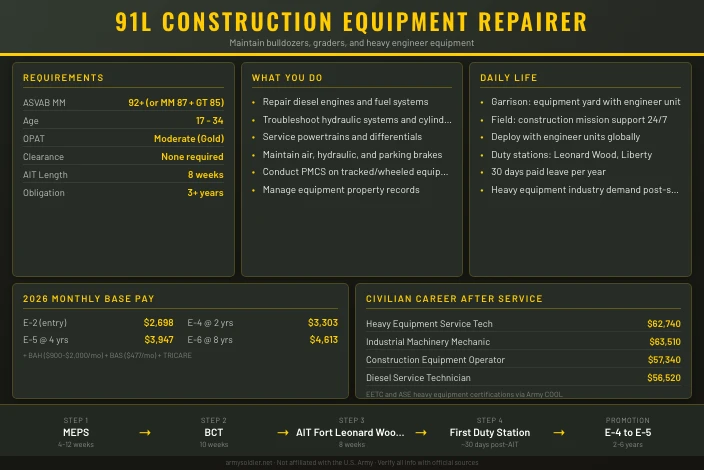
The 91L Construction Equipment Repairer performs and supervises field-level maintenance and repair on Army engineer construction equipment including bulldozers, graders, scrapers, excavators, cranes, and heavy trucks. Duties include diagnosing engine, hydraulic, powertrain, brake, and electrical system faults, executing repairs from Army technical manuals, and coordinating parts requests through supply channels. At senior grades, 91Ls manage maintenance sections and advise commanders on equipment readiness.
Daily Tasks
A garrison day typically begins with Physical Readiness Training, then shifts to the motor pool or equipment yard. The 91L’s morning might include Preventive Maintenance Checks and Services on a fleet of dozers, followed by working an open repair order on a hydraulic cylinder that’s leaking. The equipment is larger and heavier than wheeled tactical vehicles, and many components require specialized rigging to safely remove and replace.
In the field, engineer units operate equipment around the clock during construction operations. Breakdowns don’t wait for daylight. The 91L provides maintenance support wherever the equipment is operating, often in austere conditions far from a formal maintenance bay.
- Diagnose and repair diesel engines, fuel systems, and air systems on heavy construction equipment
- Troubleshoot and service hydraulic systems, cylinders, and control circuits
- Inspect and repair powertrains, differentials, and final drives
- Maintain brake systems including air, hydraulic, and parking brakes
- Execute PMCS on tracked and wheeled construction equipment
- Operate equipment-specific rigging and lifting devices to access components
- Manage Army property records and hand receipts for assigned equipment
Specific Roles
The 91L fills the construction equipment maintenance role within CMF 91 (Mechanical Maintenance).
| Classification | Code | Description |
|---|---|---|
| Primary MOS | 91L | Construction Equipment Repairer (all grades) |
| Warrant Officer | 915A | Automotive Maintenance Warrant Officer (WO1 to CW3) |
| Senior Warrant | 915E | Senior Automotive Maintenance Warrant Officer (CW4 to CW5) |
Mission Contribution
Army engineer missions depend entirely on equipment readiness. A non-mission-capable dozer means a route clearance stops. A broken crane means a bridge section stays on the ground. The 91L’s role in keeping engineer equipment operational directly affects the unit’s ability to support maneuver forces. Construction equipment maintainers make engineer missions possible.
Technology and Equipment
The equipment fleet includes a range of engineer systems: the D7 and D9 Bulldozer series, the 130G Motor Grader, the Scraper, the Crane series, the Rough Terrain Container Handler, and multiple tractor and truck variants used in engineer operations. Each platform has specific hydraulic systems, powertrains, and diagnostic requirements. The Army also fields Combat Engineer Vehicles with unique armored hulls alongside conventional construction machines.
Salary and Benefits
Army total compensation combines base pay with tax-free allowances and benefits that civilian heavy equipment positions rarely match.
Base Pay (2026)
All figures are 2026 monthly rates per DFAS.
| Grade | Rank | Entry Pay | 4-Year Pay |
|---|---|---|---|
| E-1 | Private (PV1) | $2,407/mo | $2,407/mo |
| E-2 | Private (PV2) | $2,698/mo | $2,698/mo |
| E-3 | Private First Class (PFC) | $2,837/mo | $3,198/mo |
| E-4 | Specialist (SPC) | $3,142/mo | $3,659/mo |
| E-5 | Sergeant (SGT) | $3,343/mo | $3,947/mo |
| E-6 | Staff Sergeant (SSG) | $3,401/mo | $4,069/mo |
| E-7 | Sergeant First Class (SFC) | $3,932/mo | $4,663/mo |
Allowances and Benefits
Beyond base pay, most soldiers receive:
- Basic Allowance for Subsistence (BAS): $476.95/month flat rate for all enlisted soldiers
- Basic Allowance for Housing (BAH): Varies by location and dependency status. At Fort Sam Houston, a single E-4 receives $1,359/month; with dependents, $1,728/month.
TRICARE Prime covers the soldier and enrolled family members with no enrollment fees, no deductibles, and no copays for medical, dental, vision, mental health, and prescriptions.
Education support includes:
- Tuition Assistance: Up to $4,500/year while on active duty at $250 per semester hour
- Post-9/11 GI Bill: 36 months covering full in-state tuition at public universities, up to $29,920.95/year at private schools, plus a monthly housing allowance and $1,000/year for books
Work-Life Balance
Soldiers earn 30 days of paid leave per year. The 91L typically works with an engineer battalion, which operates on a standard garrison schedule. Engineer units deploy on construction missions, which extend hours and disrupt schedules. But in garrison, the baseline is predictable.
Qualifications and Eligibility
The 91L requires solid mechanical aptitude and a moderate ASVAB composite score.
Eligibility Requirements
| Requirement | Standard |
|---|---|
| Age | 17-34 (waiver possible to 39) |
| Citizenship | U.S. citizen or lawful permanent resident |
| Education | High school diploma (AFQT 31+) or GED (AFQT 50+) |
| ASVAB MM composite | MM 92, OR MM 87 combined with GT 85 |
| OPAT category | Moderate (Gold) |
| Security clearance | None required |
| Medical | Meets Army MEPS medical standards |
The MM (Mechanical Maintenance) composite draws from Numerical Operations (NO), Auto and Shop Information (AS), Mechanical Comprehension (MC), and Electronics Information (EI). Preparation should focus on Auto and Shop Information and Mechanical Comprehension, which reflect the hands-on mechanical nature of the work.
Application Process
Selection Competitiveness
Engineer units maintain significant construction equipment fleets at installations worldwide, creating steady demand for qualified 91Ls. Applicants with farm equipment, diesel, or heavy construction backgrounds tend to progress faster through AIT. The GoArmy site does not currently list a standard bonus for this MOS, but confirm with your recruiter since bonus availability changes throughout the fiscal year.
Service Obligation
Soldiers enter at E-1 (Private, PV1). Three-year contracts are the minimum; four-year agreements are standard. Total obligation includes active-duty time plus time in the Individual Ready Reserve after the contract ends.
See our ASVAB study guide for strategies to hit these line scores, or take the PiCAT from home if you are a first-time tester.
Work Environment
Setting and Schedule
The 91L works in an equipment yard or motor pool environment, often alongside engineers who operate the machines. In garrison, maintenance operations follow a standard duty day. The equipment is substantially larger than wheeled tactical vehicles, and component removal sometimes requires cranes or special lifting equipment.
Field conditions vary widely by mission. Engineer units deploy to construction sites that may be remote, austere, and operating around the clock. Maintenance support follows the operational tempo of the construction mission.
Leadership and Communication
The 91L operates within the engineer unit’s maintenance section. A maintenance warrant officer or officer coordinates shop operations. NCO supervision provides daily work order management. At senior grades, 91Ls lead their maintenance section and advise the unit on equipment readiness.
Team Dynamics and Autonomy
Junior soldiers work under supervision initially. By E-4, a proficient specialist runs routine maintenance independently. At E-5, you’re leading small teams and training junior maintainers. The physical scale of the equipment means two-person and team lifts are common, making coordination and communication essential throughout.
Job Satisfaction and Retention
Soldiers who enjoy working on large, powerful machinery and seeing direct results tend to find this MOS rewarding. The equipment variety across the engineer fleet keeps the technical work interesting. Those who prefer smaller, more precise mechanical systems sometimes find the scale and physical demands of heavy equipment challenging over time.
Training and Skill Development
Initial Training
The 91L pipeline runs from Basic Combat Training to Advanced Individual Training at Fort Leonard Wood, Missouri.
| Phase | Location | Length | Focus |
|---|---|---|---|
| Basic Combat Training (BCT) | Various installations | 10 weeks | Soldiering fundamentals, physical fitness, weapons qualification |
| Advanced Individual Training (AIT) | Fort Leonard Wood, MO | 8 weeks | Heavy equipment diesel engines, hydraulics, powertrains, brake systems, PMCS |
AIT runs in two phases totaling 299 training hours. Phase one (120 hours) covers shop operations, basic electrical systems, and hydraulic systems. Phase two (179 hours) covers diesel systems, power train systems, brake systems, and preventive maintenance procedures. Students train on the actual equipment they’ll maintain at their first duty station.
Graduates receive college credit recommendations through the American Council on Education program.
Advanced Training
After AIT and initial assignment, 91Ls can pursue additional development:
- Advanced courses at Regional Training Site-Maintenance (RTS-M) locations provide instruction on specific new equipment types and system upgrades
- Army COOL Program: Funds civilian certification exams including those from the Equipment and Engine Training Council (EETC) and ASE heavy equipment certifications
- Warrant Officer Candidate School (WOCS): Opens the 915A track for soldiers who want to manage maintenance programs at higher organizational levels
- Tuition Assistance: Covers off-duty coursework at accredited institutions, supporting associate or bachelor’s degrees in diesel technology or construction management
Everything starts with qualifying ASVAB scores — our study guide covers what to study first.
Career Progression and Advancement
Career Path
Promotion from E-1 to E-4 follows a standard timeline. E-5 Sergeant requires passing the promotion board, meeting education and NCOER requirements, and accumulating promotion points.
| Grade | Rank | Typical Time in Service | Key Duty Position |
|---|---|---|---|
| E-1 | Private (PV1) | Entry | Student / trainee |
| E-2 | Private (PV2) | 6 months | Junior repairer |
| E-3 | Private First Class (PFC) | 12 months | Equipment repairer |
| E-4 | Specialist (SPC) | 24 months | Senior repairer |
| E-5 | Sergeant (SGT) | 3-5 years | Team leader |
| E-6 | Staff Sergeant (SSG) | 6-10 years | Shop foreman, section sergeant |
| E-7 | Sergeant First Class (SFC) | 10-16 years | Maintenance ops NCO |
| E-8 | Master Sergeant (MSG) | 16-22 years | Senior maintenance supervisor |
| E-9 | Sergeant Major (SGM) | 22+ years | Command maintenance advisor |
Specialization and Warrant Officer Path
The 915A Automotive Maintenance Warrant Officer track is open to experienced CMF 91 soldiers including 91Ls. Warrant officers manage maintenance programs above the company level, advising battalion and brigade commanders on equipment readiness across multiple vehicle types.
Role Flexibility and Transfers
Reclassification to other CMF 91 MOSs is possible after completing the initial contract. Soldiers who want to shift to wheeled vehicle or tracked vehicle maintenance can apply during Army reclassification cycles based on available slots.
Performance Evaluation
E-1 through E-4 soldiers are evaluated through monthly counseling and annual DA Forms. E-5 and above fall under the full NCOER process. Technical competence, safety adherence, maintenance record quality, and ability to train junior soldiers drive strong evaluations in this specialty.
Physical Demands and Medical Evaluations
Physical Requirements
The 91L carries a Moderate (Gold) OPAT category. But the work is physically demanding relative to many Moderate-category MOSs. Components on bulldozers and graders weigh significantly more than on wheeled tactical vehicles. Track tension adjustment, hydraulic cylinder removal, and engine work on large dozers require sustained heavy-duty physical effort.
Daily tasks involve frequent lifting of 50 to 100+ pound components, sustained bending and working in awkward positions under large equipment, and operating overhead cranes and chain falls to position components. Physical conditioning is not optional – your ability to perform the work safely depends on genuine strength and endurance.
Army Fitness Test
All soldiers must pass the Army Fitness Test (AFT), which replaced the ACFT effective June 1, 2025. Five events are each scored 0 to 100 points.
| Event | Abbreviation | Description |
|---|---|---|
| 3 Rep Max Deadlift | MDL | Barbell lift, 3 repetitions |
| Hand Release Push-Up | HRP | Full arm extension between each rep |
| Sprint-Drag-Carry | SDC | 50-meter shuttle with drag and carry phases |
| Plank | PLK | Timed static hold |
| Two-Mile Run | 2MR | Timed run |
The general standard requires at least 60 points per event (300 total minimum). Scores are sex- and age-normed. The 91L is not a designated combat MOS, so the 350-point combat specialty standard does not apply.
Medical Evaluations
MEPS conducts the initial screening before enlistment. Soldiers complete an annual Periodic Health Assessment once in service. No unusual vision or hearing requirements apply beyond Army-wide standards.
Deployment and Duty Stations
Deployment Details
Construction equipment maintainers deploy with engineer units. Deployment frequency depends on the unit. Engineer units support combat, stability, and humanitarian operations globally, meaning 91Ls can deploy to any theater. Deployments typically last nine to twelve months. Humanitarian and stability operations missions may involve less kinetic risk than combat deployments, but engineer units do operate in combat zones as well.
Deployed service in combat zones qualifies for hazardous duty pay and hostile fire pay.
Location Flexibility
Engineer units are stationed at installations across the Army:
- Fort Leonard Wood, Missouri
- Fort Bragg (now Fort Liberty), North Carolina
- Fort Campbell, Kentucky
- Fort Cavazos (formerly Fort Hood), Texas
- Camp Humphreys, South Korea (OCONUS)
- Grafenwoehr, Germany (OCONUS)
First-duty assignments follow Army needs. Reenlistment negotiations offer more location flexibility after an initial tour with a strong record.
Risk, Safety, and Legal Considerations
Job Hazards
Heavy construction equipment maintenance presents genuine safety risks. Component weight is the primary concern: removing a dozer’s final drive or a motor grader’s transmission requires precision rigging and lifting. Hydraulic systems operate at pressures that can cause injection injuries if a seal fails while pressurized. Diesel fuel and hydraulic fluid create slip hazards. Working near operating equipment adds crush and runover risk.
Safety Protocols
The Army enforces safety standards through mandatory PPE, equipment lockout/tagout procedures, and weight-rated lifting equipment with documented inspections. Technical manuals specify safe working procedures for every component removal task. Units conduct formal safety briefings before field operations.
Security and Legal Requirements
The 91L does not require a security clearance. Soldiers sign an enlistment contract covering MOS, duty preferences, and bonus terms. Active-duty service members operate under the Uniform Code of Military Justice throughout their service.
Impact on Family and Personal Life
Family Considerations
Engineer unit deployments create separation periods. Construction missions in support of combat or stability operations can last nine to twelve months. The Army provides Family Readiness Groups, Military OneSource counseling, Child Development Centers, and installation schools to support families during soldier absences.
TRICARE covers family members at no cost. Spouse employment programs operate at most major installations.
Relocation and Flexibility
PCS moves occur every two to three years on average. The Army pays relocation costs and adjusts BAH to the new location. Soldiers with strong records gain more latitude in requesting preferred installations during reenlistment.
Reserve and National Guard
The 91L MOS is available in both the Army Reserve and National Guard. Engineer units in both components operate heavy construction equipment, and those machines need qualified mechanics to keep them running. Whether you choose Reserve or Guard service, this MOS puts you in a unit where your skills matter from day one.
Drill Schedule and Training Commitment
The standard commitment is one weekend per month and two weeks of Annual Training each year. For 91L soldiers, the standard schedule usually covers most certification requirements. Annual Training often centers on hands-on equipment repair exercises, giving you real time wrenching on bulldozers, graders, scrapers, and other engineer equipment.
Heavy equipment maintenance certifications must be renewed periodically. Most are handled during AT cycles. Guard engineer units that receive training center rotations may schedule additional maintenance training days to ensure equipment readiness before those events.
Consistent attendance matters more in this MOS than in some others. Heavy equipment requires regular preventive maintenance regardless of training pace, and units rely on their 91L soldiers to keep that schedule on track.
Part-Time Pay and Benefits
An E-4 with about four years of service earns approximately $488 per drill weekend. Twelve drill weekends per year adds up to roughly $5,856. Annual Training contributes two additional weeks of pay at the daily active duty rate.
Healthcare is a real cost to factor in. Tricare Reserve Select is available at $57.88 per month for member-only coverage or $286.66 per month for family coverage. Active duty soldiers pay $0 in TRICARE Prime premiums. That difference matters if you are comparing the two options.
Education benefits are accessible whether you serve in the Reserve or Guard. Federal Tuition Assistance covers up to $4,500 per year in college tuition and does not require deployment. Guard soldiers have the additional option of state tuition waiver programs, which vary by state but can significantly reduce the cost of in-state public college. Mobilization for more than 90 days on federal orders may earn you eligibility for the Post-9/11 GI Bill, which is more generous than the MGIB-SR standard for non-deployed Reserve and Guard soldiers.
Retirement is points-based. You need 20 qualifying years with at least 50 retirement points each to be eligible. Pay typically begins at age 60, reduced by three months for each 90-day mobilization period, down to a minimum retirement age of 50.
Deployment and Mobilization
Engineer units deploy for construction and infrastructure projects in theater, which means 91L soldiers go where the work is. Guard engineer units also activate for domestic disaster response, including hurricane recovery, flood control, and wildfire support operations. That combination of federal deployment and state activation makes Guard 91L service busier than it might appear on paper.
Mobilization tempo for 91L soldiers is moderate. Expect at least one deployment over a full Guard or Reserve career. Federal mobilizations typically run 9 to 12 months. USERRA requires your employer to hold your position and restore your seniority and benefits when you return.
Civilian Career Integration
This is one of the most directly transferable maintenance MOS in the Army. Caterpillar, John Deere, and Komatsu dealerships actively recruit heavy equipment service technicians. Civil construction and mining companies hire candidates with verified heavy equipment maintenance credentials. The demand is real and the pay is competitive.
Guard and Reserve service keeps your skills current while you build a civilian career in the heavy equipment field. Many 91L soldiers move directly into equipment dealer service departments after leaving active duty, where Army-trained mechanics with documentation habits and systematic troubleshooting skills are valued. Some pursue Caterpillar or Komatsu dealership certifications that build on Army training.
| Feature | Active Duty | Army Reserve | Army National Guard |
|---|---|---|---|
| Commitment | Full-time | One weekend/month, two weeks/year | One weekend/month, two weeks/year |
| Monthly Pay (E-4, ~4 yrs) | $3,659 | ~$488/drill weekend | ~$488/drill weekend |
| Healthcare | TRICARE Prime, $0 premiums | Tricare Reserve Select, $57.88/month | Tricare Reserve Select, $57.88/month |
| Education | Post-9/11 GI Bill | Federal TA, MGIB-SR | Federal TA, MGIB-SR, state tuition waivers |
| Deployment | Regular rotations | Mobilization-based | Mobilization-based, plus state activations |
| Retirement | 20-year pension, immediate | Points-based, age 60 | Points-based, age 60 |
Post-Service Opportunities
Heavy construction equipment maintenance experience transfers directly to civilian construction, mining, and heavy equipment industries. Employers ranging from Caterpillar dealers to mining companies to civil construction firms actively recruit candidates with verified heavy equipment maintenance credentials.
Civilian Career Prospects
| Civilian Job Title | Median Annual Salary | Job Outlook (2024-2034) |
|---|---|---|
| Heavy Vehicle & Equipment Service Tech | $62,740 | +6% (faster than average) |
| Industrial Machinery Mechanic | $63,510 | +13% (much faster than average) |
| Construction Equipment Operator | $57,340 | +4% (about as fast as average) |
| Diesel Service Technician | $56,520 | +4% (about as fast as average) |
Salary data from the Bureau of Labor Statistics Occupational Outlook Handbook, May 2024 survey.
Army COOL funds Equipment and Engine Training Council (EETC) and ASE heavy equipment certifications that civilian employers recognize. Veterans who complete engineering technology degrees through the GI Bill often move into equipment dealer service management or civil construction supervision roles that pay well above median technician wages.
Is This a Good Job for You?
Ideal Candidate Profile
This MOS fits soldiers who want to work on large, powerful equipment and don’t mind physical work in all weather conditions. Farm equipment experience, diesel mechanic backgrounds, and construction industry exposure all translate well. No prior experience is required, but physical tolerance for outdoor labor and mechanical intuition are genuine assets.
Strong candidates tend to:
- Find large mechanical systems more interesting than small, precision work
- Adapt well to irregular schedules during field operations
- Work comfortably in outdoor environments in varying weather
- Follow systematic troubleshooting procedures on unfamiliar systems
Potential Challenges
The physical demands of heavy equipment maintenance are real and sustained. Back and knee stress from repeated heavy lifting accumulates over time. Field exercise and deployment schedules are irregular. The equipment scale means that some repairs require rigging expertise that has its own learning curve.
Soldiers who prefer climate-controlled environments, lighter physical work, or a more specialized platform focus may be better matched to other CMF 91 options.
Right Fit, Wrong Fit
If you want to work on heavy iron, build skills that civilian construction and mining companies specifically seek, and are comfortable with the physical demands of field maintenance, the 91L is a strong fit. If you prefer precision mechanical or electronic work over large-scale physical maintenance, look at 91E or 91D instead.
More Information
Talk to an Army recruiter about current 91L contract options and training seat availability. Official MOS details are at goarmy.com and the U.S. Army Ordnance Corps.
- Prepare for the ASVAB with our study guide to make sure your line scores qualify
This site is not affiliated with the U.S. Army or any government agency. Verify all information with official Army sources before making enlistment or career decisions.
Explore more Army maintenance careers such as 91B Wheeled Vehicle Mechanic and 91J Quartermaster and Chemical Equipment Repairer.