91M Bradley Fighting Vehicle Systems Maintainer
The Bradley Fighting Vehicle is one of the most complex ground combat platforms in the Army’s inventory. It carries infantry into battle, suppresses enemy positions with a 25mm chain gun, and fires anti-tank missiles – all while its crew depends on one thing: that the vehicle runs. The 91M Bradley Fighting Vehicle Systems Maintainer is the soldier who makes that happen. This isn’t general automotive work. You’ll specialize on one platform, learn it inside and out, and keep it combat-ready whether you’re in a motor pool in Georgia or a forward operating base overseas. The Army will pay you to train, hand you a signing bonus of up to $15,000, and build technical skills that translate directly to civilian careers paying well above the national median.
Qualifying requires specific ASVAB line scores — our ASVAB study guide covers what to target and how to prepare.
Job Role and Responsibilities
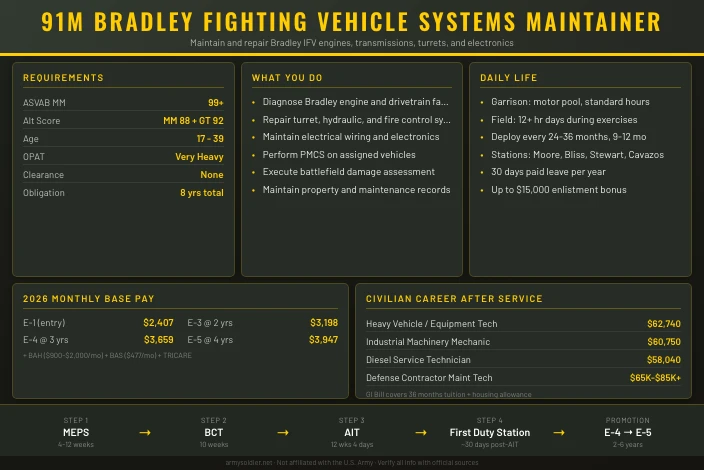
The 91M Bradley Fighting Vehicle Systems Maintainer diagnoses, repairs, and performs maintenance on the full range of Bradley Fighting Vehicle variants, including the M2 Infantry Fighting Vehicle and M3 Cavalry Fighting Vehicle. Responsibilities span the vehicle’s suspension, steering, fire control, armament, fire suppression, and electrical systems. At senior grades, 91Ms supervise maintenance operations, manage work order records in the Standard Army Maintenance System (SAMS), and advise commanders on vehicle readiness.
Daily Tasks
A garrison day typically starts with Physical Readiness Training, then shifts to the motor pool. You’ll open and close work orders, perform Preventive Maintenance Checks and Services (PMCS), order parts through the Army supply system, and execute repairs per technical manuals. Every procedure follows documented steps – improvising on a weapons platform isn’t an option.
In the field or on deployment, the pace is less predictable. Vehicles need repair during exercises, at night, and sometimes under fire. You’ll diagnose faults using diagnostic equipment and manual inspection, perform battlefield damage assessments, and coordinate the evacuation of vehicles that can’t be repaired on site. The job demands both technical precision and physical toughness.
- Diagnose and troubleshoot mechanical, electrical, and hydraulic malfunctions
- Repair and service suspension, steering, drivetrain, and track systems
- Maintain fire extinguisher, suppression, and armament systems
- Perform maintenance on the vehicle’s engine and cooling systems
- Supervise unit maintenance data, work orders, and SAMS records
- Train junior soldiers on proper maintenance procedures
Specific Roles
Within CMF 91 (Mechanical Maintenance), the 91M is the only MOS specifically qualified on Bradley Fighting Vehicles. Experienced 91Ms can move into the warrant officer pathway, which manages maintenance programs at battalion and brigade level.
| Classification | Code | Description |
|---|---|---|
| Primary MOS | 91M | Bradley Fighting Vehicle Systems Maintainer |
| Warrant Officer | 915A | Automotive Maintenance Warrant Officer (WO1-CW3) |
| Senior Warrant | 915E | Senior Automotive Maintenance Warrant Officer (CW4-CW5) |
Additional Skill Identifiers are available to 91Ms who complete specialized courses, including master gunner qualification, which broadens their role from maintenance into systems expertise.
Mission Contribution
Bradley vehicles serve as the backbone of Army mechanized infantry formations. An infantry platoon riding in a disabled Bradley is a platoon that can’t fight. The 91M’s contribution is direct: every vehicle returned to mission-ready status is a combat multiplier for the unit. High vehicle readiness rates are the difference between a battalion that can execute its mission and one that can’t.
Technology and Equipment
The Bradley platform is a tracked, medium-armored vehicle weighing around 25 tons, equipped with a 25mm M242 Bushmaster chain gun, a 7.62mm coaxial machine gun, and TOW missile launchers on many variants. Maintainers work on both analog legacy systems and modern digital fire control components. Tools include Army-specific diagnostic equipment, hydraulic lifts, track tools, and specialized armament maintenance gear. You’ll also use the Standard Army Maintenance System (SAMS) daily for work order management and parts accountability.
Salary and Benefits
Army compensation includes base pay, housing, food, healthcare, and education benefits. The combined value is substantially higher than the base pay number suggests.
Base Pay (2026)
All figures below reflect 2026 monthly base pay rates per DFAS.
| Grade | Rank | Entry Pay | 4-Year Pay |
|---|---|---|---|
| E-1 | Private (PV1) | $2,407/mo | $2,407/mo |
| E-2 | Private (PV2) | $2,698/mo | $2,698/mo |
| E-3 | Private First Class (PFC) | $2,837/mo | $3,198/mo |
| E-4 | Specialist (SPC) | $3,142/mo | $3,659/mo |
| E-5 | Sergeant (SGT) | $3,343/mo | $3,947/mo |
| E-6 | Staff Sergeant (SSG) | $3,401/mo | $4,069/mo |
Most 91Ms enter as E-1 or E-2. With normal promotion timelines, a soldier reaches Specialist within 18-24 months and Sergeant within 4-5 years.
Additional Allowances
On top of base pay, soldiers receive monthly allowances that are not taxed as income:
- BAS (Basic Allowance for Subsistence): $476.95/month for all enlisted soldiers, covering food costs
- BAH (Basic Allowance for Housing): Varies by duty location, pay grade, and dependency status. A single E-4 at Fort Moore, GA, for example, receives a location-based rate – use the DoD BAH rate lookup for exact figures at your assignment
- Enlistment bonus: Up to $15,000 for qualifying 91M contracts, paid in installments
Benefits Package
TRICARE Prime covers active-duty soldiers at no cost, including medical, dental, vision, mental health, prescriptions, and hospitalization. Family members are enrolled at no premium, with a $1,000 annual catastrophic cap for out-of-pocket costs.
Army Tuition Assistance covers up to $4,500 per year toward college courses while on active duty, capped at $250 per semester hour. After service, the Post-9/11 GI Bill provides up to 36 months of education benefits, covering full in-state tuition at public schools or up to $29,920.95 per year at private schools, plus a monthly housing stipend and up to $1,000 annually for books.
Retirement
The Blended Retirement System (BRS) combines a traditional pension with a Thrift Savings Plan (TSP). At 20 years, the pension pays 40% of your high-36 average basic pay. The Army automatically contributes 1% of your basic pay to TSP and matches your contributions up to 4% additional after your second year. Soldiers between 7 and 12 years of service may qualify for Continuation Pay, which offers a bonus of 2.5 to 13 times your monthly basic pay in exchange for a 3-year service extension.
Work-Life Balance
Active-duty soldiers earn 30 days of paid leave per year, accruing at 2.5 days per month. Federal holidays add another 11 days. Motor pool jobs in garrison typically follow a Monday-Friday schedule with occasional weekend or holiday duty for readiness requirements. Field exercises and deployments disrupt that schedule for weeks to months at a time.
Qualifications and Eligibility
Requirements Table
| Requirement | Details |
|---|---|
| Age | 17-39 (must enter by 35 for active duty; exceptions exist) |
| Citizenship | U.S. citizen or permanent resident alien |
| Education | High school diploma (AFQT 31+) or GED (AFQT 50+) |
| ASVAB | MM: 99, or MM: 88 and GT: 92 |
| Physical Demand | Very Heavy (OPAT Heavy category required) |
| PULHES | 222222 |
| Vision | Normal color vision required |
| Security Clearance | None required |
| Gender | Open to all |
ASVAB Details
The 91M line score requirement gives you two paths. You either score 99 or higher on the MM composite alone, or you combine an MM score of 88 with a GT score of 92. Either combination qualifies you. Soldiers who are close but fall short can request a retest after a mandatory waiting period – consult your recruiter for current retesting rules.
Application Process
The first step is contacting an Army recruiter, who will schedule you for the ASVAB at a Military Entrance Processing Station (MEPS). MEPS also includes a full physical examination to confirm your PULHES rating and medical eligibility. If you meet all requirements, your recruiter will work with you to contract for 91M. The entire MEPS-to-contract process typically takes between four and twelve weeks, depending on availability.
Waivers are available for some disqualifying factors such as minor medical conditions or prior legal issues. Approval is not guaranteed and depends on current Army accession needs.
Selection and Service Obligation
The 91M MOS is not highly competitive in the way that Special Forces or intelligence jobs are – most qualified applicants who meet the ASVAB and physical thresholds can contract for this MOS. What matters most is hitting the MM and GT scores and passing the MEPS physical with normal color vision confirmed. Standard active-duty service obligations are three to four years for initial contracts. Reserve and National Guard contracts vary.
Soldiers typically enter as Private (E-1) or Private (E-2), depending on prior credits such as college hours, JROTC participation, or Eagle Scout rank.
See our ASVAB study guide for strategies to hit these line scores, or take the PiCAT from home if you are a first-time tester.
Work Environment
Setting and Schedule
Motor pool work is the daily reality for most 91Ms. You’ll spend your days in a maintenance bay, outdoors around armored vehicles, or in the field during training exercises. The work is physical – Bradley components are heavy, track work is demanding, and working in cramped vehicle spaces is routine. Garrison schedules are generally structured around a normal duty day, but motor pool readiness requirements can extend hours before inspections and field exercises.
During brigade or division-level exercises, 91Ms deploy with their units to field sites and maintain vehicles around the clock. Shift work is common during major training events. On deployment, the schedule follows mission tempo, which can mean twelve-hour maintenance shifts for extended periods.
Leadership and Communication
The chain of command flows from the unit’s Maintenance Officer (usually a 91A Ordnance Warrant Officer) down through the motor sergeant (typically a Staff Sergeant or Sergeant First Class), to team leads, and individual maintainers. The motor sergeant is the primary day-to-day supervisor. Feedback is direct and frequent – vehicle readiness is tracked at every level of command, and problems surface quickly.
NCO Evaluation Reports (NCOERs) and Officer Evaluation Reports (OERs) are the formal performance review system. They’re completed annually and serve as the primary record for promotion board consideration.
Team Dynamics and Autonomy
Maintenance work is team-based, but junior soldiers work with substantial independence on individual repair tasks. Once you’ve qualified on a procedure, you own it. The senior mechanic or motor sergeant reviews completed work, but you’re expected to diagnose and execute repairs without hand-holding on routine tasks. As you gain rank, you transition from executing repairs to supervising them and managing the motor pool’s broader readiness picture.
Job Satisfaction and Retention
Soldiers who enjoy hands-on technical work tend to find this MOS satisfying. The feedback loop is direct – a vehicle either runs or it doesn’t. Those who re-enlist often do so for the training, the team environment, and the civilian career value. Soldiers who struggle with the role typically cite the physical demands of long maintenance days and field environments as the primary challenge. CMF 91 has solid retention rates driven partly by the enlistment bonus structure and partly by the fact that mechanical skills transfer well to well-paying civilian jobs.
Training and Skill Development
Training Pipeline
| Phase | Location | Length | Focus |
|---|---|---|---|
| BCT | Various Army installations | 10 weeks | General Army skills, fitness, weapons |
| AIT | Fort Moore, GA | 12 weeks, 4 days | Bradley systems theory, diagnostics, maintenance procedures |
| OJT | First duty station | Ongoing | Platform-specific proficiency, unit procedures |
Advanced Training
After initial qualification, 91Ms can pursue several advanced training paths:
Bradley Master Gunner: A highly specialized course that turns a maintainer into a systems expert qualified to train crews and troubleshoot fire control problems at a level above standard maintenance. Master Gunners are valued at the unit level and have strong career prospects.
Warrant Officer (915A/915E): Experienced 91Ms who meet the educational and service requirements can apply for Warrant Officer Candidate School (WOCS). The 915A Automotive Maintenance Warrant Officer manages entire maintenance programs at battalion and brigade level. This is a technical expert track, not a command track.
Noncommissioned Officer Education System (NCOES): As you progress to Sergeant and above, you’ll attend Basic Leader Course (BLC), Advanced Leader Course (ALC), and Senior Leader Course (SLC) through the Army’s NCO professional development system. These courses build leadership skills alongside technical knowledge.
Army COOL (Credentialing Opportunities On-Line) identifies civilian certifications that overlap with 91M skills. Relevant credentials include ASE certifications in diesel engines and medium/heavy truck systems.
Everything starts with qualifying ASVAB scores — our study guide covers what to study first.
Career Progression and Advancement
Rank Progression Table
| Grade | Rank | Typical Time-in-Service | Key Milestone |
|---|---|---|---|
| E-1 | Private (PV1) | 0-6 months | Entry |
| E-2 | Private (PV2) | 6 months | Automatic |
| E-3 | Private First Class (PFC) | 12 months | Automatic |
| E-4 | Specialist (SPC) | 18-24 months | Time and commander recommendation |
| E-5 | Sergeant (SGT) | 36-60 months | Promotion board, SSD1, BLC |
| E-6 | Staff Sergeant (SSG) | 6-10 years | Promotion board, ALC |
| E-7 | Sergeant First Class (SFC) | 10-15 years | Promotion board, SLC |
| E-8 | Master Sergeant (MSG) | 15-20 years | Centralized board |
| E-9 | Sergeant Major (SGM) | 20+ years | Centralized board |
Specialization Options
The 91M MOS is already specialized compared to broader maintenance roles, but further specialization is available. Master Gunner qualification is the most valued additional skill within the Bradley community. Soldiers can also cross-train to related tracked vehicle MOS codes if they transfer to units with different equipment requirements.
The warrant officer pathway (915A/915E) is the primary route for soldiers who want to advance beyond senior NCO roles in the maintenance field. The 915A manages maintenance programs, oversees multiple shops, and advises commanding officers on equipment readiness.
Role Flexibility
Transferring to a different MOS within the Army is possible but requires approval from your commander and a formal reclassification action. The process involves demonstrating a valid need and meeting the new MOS’s ASVAB requirements. Some soldiers transition to adjacent CMF 91 MOS codes such as 91B Wheeled Vehicle Mechanic when assigned to units without Bradley fleets. Others pursue warrant officer accession to stay in the maintenance career field at a higher level.
Performance Evaluation
The NCOER (for E-5 and above) rates performance in six competency areas: Character, Presence, Intellect, Leads, Develops, and Achieves. Annual counseling sessions establish expectations, and quarterly counseling tracks progress. Performance in the motor pool is highly observable – vehicle readiness rates, work order completion times, and inspection results all factor into your evaluation.
Physical Demands and Medical Evaluations
Physical Requirements
The 91M carries a Very Heavy physical demand rating. Occasional lifts over 100 pounds and frequent lifts of 50 pounds are part of the job. Track installation, engine work, and moving Bradley components all require sustained physical effort. Working in confined vehicle spaces and maneuvering in and around a 25-ton vehicle is daily reality at an active unit.
The OPAT (Occupational Physical Assessment Test) requires the Heavy category for this MOS. OPAT is assessed at MEPS before enlistment and measures strength, endurance, and power through four events. Failing to meet the Heavy standard disqualifies a candidate from the 91M MOS.
Army Fitness Test (AFT)
The Army Fitness Test replaced the ACFT on June 1, 2025. All soldiers – regardless of MOS – must pass the same five-event AFT annually. Minimum passing score is 60 points per event (300 total), with sex- and age-normed scoring tables.
| Event | Abbreviation | Description |
|---|---|---|
| 3-Rep Max Deadlift | MDL | Measures lower body and core strength |
| Hand Release Push-Up | HRP | Measures upper body and endurance |
| Sprint-Drag-Carry | SDC | Measures functional fitness and power |
| Plank | PLK | Measures core stability |
| Two-Mile Run | 2MR | Measures aerobic capacity |
The AFT general standard requires a minimum of 300 total points (60 per event), scored against sex- and age-normed tables. Soldiers who fail an event are placed on a fitness improvement program and must retest within a set window.
Medical Evaluations
The 91M requires a PULHES rating of 222222, meaning no significant physical limitations in any category. Normal color vision is mandatory – electrical and fire control work requires distinguishing wire colors and indicator lights. Annual medical readiness assessments confirm continued fitness for duty. Soldiers with service-related injuries may seek MOS retention reviews through the Army Physical Disability Evaluation System (APDES).
Deployment and Duty Stations
Deployment Details
Bradley units deploy more frequently than many support MOS careers. Mechanized infantry and cavalry units – the formations that operate Bradleys – are regularly tasked for combat deployments, rotational training deployments, and NATO commitments in Europe. Deployment lengths typically run 9 to 12 months for combat rotations and 6 to 9 months for rotational assignments.
The 91M deploys with the supported unit. You don’t stay behind. Your vehicle is in theater, and so are you. This is a fundamental reality of the MOS that candidates should understand before contracting.
Duty Stations
Bradley Fighting Vehicles are assigned to specific types of units: Infantry Brigade Combat Teams (IBCTs) and Armored Brigade Combat Teams (ABCTs). Installations that host these formations include:
- Fort Moore, GA (home of Armor and Infantry training; several ABCT and IBCT units)
- Fort Bliss, TX (1st Armored Division elements)
- Fort Campbell, KY (101st Airborne formations)
- Fort Stewart, GA (3rd Infantry Division)
- Fort Wainwright, AK (arctic operations; Stryker and ABCT formations)
- Germany (USAREUR-AF) (V Corps and forward-stationed ABCTs in Poland and Germany)
Duty station assignments are based on Army needs, unit vacancies, and – to a limited extent – soldier preference through the Army’s Assignment Satisfaction Key (ASK) system.
Risk, Safety, and Legal Considerations
Job Hazards
Maintenance on a combat vehicle carries genuine risk. Heavy components can cause crush injuries. Hydraulic systems under pressure are dangerous when improperly handled. Working on armament systems – including the vehicle’s guns and missile launchers – requires strict adherence to safety procedures. Bradley fuel and hydraulic fluid are flammable, and fire suppression system maintenance involves compressed agents that can cause injury if mishandled.
Soldiers who deploy with their units face the risks inherent to combat theater operations. The 91M works in environments where indirect fire, vehicle accidents, and operational hazards are real.
Safety Protocols
All maintenance tasks follow Army Technical Manuals (TMs) that specify safety steps for each procedure. Lockout/tagout procedures prevent electrical accidents. Proper lifting techniques and mechanical assistance equipment (hoists, jacks, stands) are required for heavy component work. Safety briefings before field exercises and deployments cover theater-specific hazards. Units conduct periodic safety stand-downs to review near-miss incidents and update procedures.
Security and Legal Requirements
The 91M MOS does not require a security clearance. Standard Army confidentiality obligations apply to all soldiers regardless of clearance level. Soldiers accessing Bradley technical manuals, some of which contain controlled information, handle that material according to Army publication and distribution policies.
Service members are subject to the Uniform Code of Military Justice (UCMJ) throughout their enlistment. The Army’s stop-loss authority means the Army can extend a soldier’s contract during periods of national emergency, though this authority is used selectively.
Impact on Family and Personal Life
Family Considerations
Military family life with this MOS involves periodic separation. Field exercises typically last two to six weeks, occurring several times per year at an active unit. Deployments of nine to twelve months are realistic for soldiers assigned to heavy units. Families stationed near major installations have access to Army support services including Military Family Life Counseling, Army Community Service, Child and Youth Services, and the Family Readiness Group (FRG) network.
TRICARE Prime enrollment extends to family members at no premium cost. Servicemembers Group Life Insurance (SGLI) provides up to $500,000 in coverage.
Relocation and Flexibility
The Army will move your household at government expense (Permanent Change of Station, or PCS) to each new duty station, typically every two to four years. The disruption is real – new schools, new communities, new friends – but the Army relocation allowance (Dislocation Allowance, or DLA) partially offsets the cost. Soldiers can submit preferences through ASK but should not count on receiving their top choice. Overseas assignments to Europe or Korea are possible and bring additional pay (COLA, SOFA-related allowances) and unique experiences.
Reserve and National Guard
The 91M MOS is primarily available in the National Guard. Guard infantry BCTs equipped with M2/M3 Bradley IFVs need trained Bradley maintainers, and the Guard fields a significant portion of the Army’s Bradley inventory. The Army Reserve rarely operates Bradley fleets, so if you want to serve part-time in this specialty, the Guard is almost always your path.
Drill Schedule and Training Commitment
Standard Guard commitment is one weekend per month plus two weeks of Annual Training per year. For 91M soldiers, the schedule regularly extends beyond that baseline. Guard units schedule additional Bradley-specific maintenance training days before gunnery exercises and combat training center rotations. These events require vehicles to be in peak operational condition, which means more wrenching time than a standard drill weekend allows.
Bradley system certifications cover the turret, 25mm chain gun, fire control systems, TOW launcher, and hydraulic systems. Each area requires periodic recertification. Most certifications are handled during AT or unit-scheduled extra training days. If your unit rotates to the NTC or JRTC, expect a heavier training schedule in the months before the rotation.
Part-Time Pay and Benefits
An E-4 with about four years of service earns approximately $488 per drill weekend. Twelve drill weekends per year totals roughly $5,856. Annual Training adds two weeks of pay at the daily active duty rate.
Healthcare is not included automatically. Tricare Reserve Select costs $57.88 per month for member-only coverage or $286.66 per month for family coverage. Compare that to the $0 premiums active duty soldiers pay for TRICARE Prime. If healthcare is important to your family, this cost difference is worth a hard look before choosing Guard over active duty.
Education benefits are available. Federal Tuition Assistance covers up to $4,500 per year in college tuition without requiring deployment. Guard soldiers get access to state tuition waiver programs that vary by state but can offset a significant portion of in-state college costs. Mobilization on federal orders for more than 90 days may qualify you for Post-9/11 GI Bill (Chapter 33) eligibility, which is more valuable than the MGIB-SR typically available to non-mobilized Guard soldiers.
Guard retirement is points-based. You need 20 qualifying years with at least 50 points each. Retirement pay generally begins at age 60, reduced three months for each 90-day mobilization period, with a minimum retirement age of 50.
Deployment and Mobilization
Guard infantry BCTs with Bradleys deploy on multi-year rotation cycles. A typical mobilization runs 9 to 12 months, including pre-deployment training. Over a 20-year Guard career, you should expect at least one deployment, possibly two depending on the unit’s rotation cycle.
Guard soldiers also respond to state activations. While Bradley maintainers are not the primary asset in domestic emergency response, unit-level activations still require soldiers to be available. USERRA protects your civilian job during all federal mobilizations. Your employer must restore your position, seniority, and benefits when you return from active service.
Civilian Career Integration
Bradley experience transfers to multiple civilian sectors. Heavy vehicle mechanics and diesel technicians with hydraulic systems knowledge are consistently in demand. Industrial maintenance roles requiring turret-style mechanical systems and fire control electronics knowledge exist at defense contractors and manufacturing plants.
BAE Systems, which builds the Bradley, and other defense contractors running vehicle maintenance programs specifically recruit veterans with 91M experience. Hydraulic systems knowledge from Bradley maintenance applies to construction equipment, industrial presses, and other heavy machinery. Guard service keeps your Bradley skills current and your certifications valid, making you competitive in both the defense contractor market and the broader heavy equipment sector.
| Feature | Active Duty | Army Reserve | Army National Guard |
|---|---|---|---|
| Commitment | Full-time | One weekend/month, two weeks/year | One weekend/month, two weeks/year |
| Monthly Pay (E-4, ~4 yrs) | $3,659 | ~$488/drill weekend | ~$488/drill weekend |
| Healthcare | TRICARE Prime, $0 premiums | Tricare Reserve Select, $57.88/month | Tricare Reserve Select, $57.88/month |
| Education | Post-9/11 GI Bill | Federal TA, MGIB-SR | Federal TA, MGIB-SR, state tuition waivers |
| Deployment | Regular rotations | Mobilization-based | Mobilization-based, plus state activations |
| Retirement | 20-year pension, immediate | Points-based, age 60 | Points-based, age 60 |
Post-Service Opportunities
Civilian Career Transition
Bradley maintainers leave the Army with a specific, verified skill set that civilian employers in heavy equipment industries value. Defense contractors who maintain Bradley fleets under contract are a natural first landing spot – companies like BAE Systems (the Bradley’s manufacturer) and AM General hire veteran maintainers. Government civilian positions maintaining military equipment also draw heavily from the MOS community.
Beyond defense contractors, the mechanical skills transfer broadly:
- Mobile heavy equipment mechanics repair bulldozers, cranes, and construction equipment using the same hydraulic and electrical diagnostic skills
- Diesel mechanics specialize in heavy-duty truck and fleet maintenance
- Industrial machinery mechanics maintain manufacturing equipment with overlapping skill sets
The VA’s Vocational Rehabilitation and Employment (VR&E) program can fund additional training or education for veterans with service-connected conditions. The Army’s Transition Assistance Program (TAP) provides resume writing, interview coaching, and job search resources starting 180 days before separation.
Post-Service Civilian Careers Table
All salary data from the Bureau of Labor Statistics, based on May 2024 figures.
| Civilian Job Title | Median Annual Salary | Job Outlook (2024-2034) |
|---|---|---|
| Heavy Vehicle & Mobile Equipment Service Technician | $62,740 | +6% (faster than average) |
| Diesel Service Technician / Mechanic | $58,040 | +2% |
| Industrial Machinery Mechanic | $60,750 | +11% (much faster than average) |
| Defense Contractor Maintenance Technician | $65,000-$85,000+ | Steady, driven by defense budget |
The GI Bill’s 36 months of education benefits can fund an associate’s or bachelor’s degree in mechanical engineering technology, diesel technology, or related fields that pair well with hands-on experience to accelerate civilian career progression.
Is This a Good Job for You? The Right (and Wrong) Fit
Ideal Candidate Profile
The best 91M candidates are mechanically inclined before they enlist. You don’t need formal training – the Army provides that – but people who’ve worked on cars, motorcycles, farm equipment, or construction machinery as a hobby tend to pick up the material faster. Patience matters too. Diagnosing a fault that three other mechanics have already tried to fix takes methodical thinking, not guesswork.
Physical fitness is a genuine requirement, not a formality. You need to pass the OPAT at the Heavy level and sustain that fitness throughout your career. Soldiers who stay physically strong throughout their enlistment find this MOS much more manageable than those who see PT as a check-in-the-box exercise.
Key traits that fit this MOS well:
- Mechanical aptitude and interest in how systems work
- Attention to detail (every procedure in a TM exists for a reason)
- Physical stamina for heavy lifting and confined-space work
- Tolerance for irregular hours during field exercises and deployment
- Interest in staying on one platform and becoming a deep expert
Potential Challenges
The specialization cuts both ways. You’ll become highly skilled on Bradley systems, but if the Army assigns you to a unit that doesn’t operate Bradleys, that specific expertise has less day-to-day application. Soldiers in that situation sometimes find themselves cross-training or transitioning to adjacent maintenance roles.
Deployment frequency is higher than many support MOS careers. If predictable garrison duty is a priority, this probably isn’t the right MOS. Mechanized and armored units operate on aggressive training and deployment cycles, and the 91M goes wherever the vehicle goes.
The physical demands don’t ease up with seniority at the junior levels. A Staff Sergeant still gets dirty and lifts heavy parts. That’s the nature of the work, and it’s not for everyone.
Career and Lifestyle Alignment
If you want a technical specialty with a clear civilian career path, this MOS delivers. The skills transfer directly to heavy equipment, defense contracting, and diesel industries that pay above the national median wage for mechanics. If you want to stay Army and advance, the NCO track is well-defined and the warrant officer pathway is a serious option for soldiers with the drive.
If you’re looking for a desk job, predictable hours, and minimal physical risk, the 91M is the wrong fit. If you want to work on one of the Army’s most capable combat vehicles, earn a marketable trade skill, and potentially qualify for a $15,000 signing bonus, it’s worth serious consideration.
More Information
Contact a local Army recruiter to confirm current 91M contract availability, bonus amounts, and training seat timelines. You can also call 1-888-550-ARMY or visit goarmy.com to review current job details and start the process. Recruiter offices are free and carry no obligation – ask specifically about ASVAB prep resources if your MM or GT scores need work before you test.
- Prepare for the ASVAB with our study guide to make sure your line scores qualify
This site is not affiliated with the U.S. Army or any government agency. Verify all information with official Army sources before making enlistment or career decisions.
Explore more Army maintenance careers such as the 91B Wheeled Vehicle Mechanic and the 91D Tactical Power Generator Specialist.