91P Self-Propelled Artillery Systems Maintainer
The M109A7 Paladin fires a 155mm projectile 30 kilometers with GPS precision. It weighs 37 tons and carries a crew of four. When it can’t fire or move, field artillery missions stop. The 91P Self-Propelled Artillery Systems Maintainer keeps it mission-ready. This isn’t general track vehicle maintenance – the Paladin has high-voltage electronics, a digital fire control system, a unique hydraulic traverse system, and an armored hull that require specialized training beyond standard CMF 91 courses. The 15-week AIT at Fort Gregg-Adams certifies you to Level I operator and Level II maintainer standards on a system that few civilians have ever worked on, creating real scarcity value in the defense contracting market.
Qualifying requires specific ASVAB line scores — our ASVAB study guide covers what to target and how to prepare.
Job Role and Responsibilities
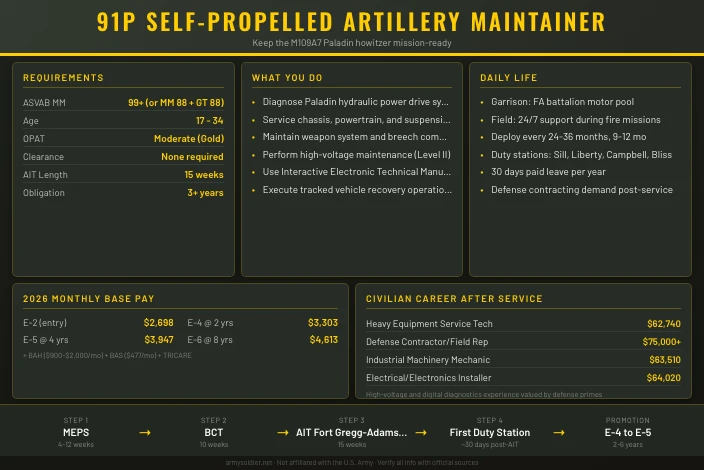
The 91P Self-Propelled Artillery Systems Maintainer performs and supervises unit-level and selected field-level maintenance and recovery on all self-propelled field artillery cannon weapon systems, including the M109A7 Paladin and associated M992A3 Carrier Ammunition Tracked. Duties include diagnosing and repairing hydraulic, electrical, powertrain, and weapon system components, using interactive electronic technical manuals, and executing recovery operations when systems are non-mission capable.
Daily Tasks
In garrison, the 91P works in a motor pool supporting a field artillery battalion. A typical day starts with PMCS on assigned Paladin systems, checking fluid levels, track tension, hydraulic system pressure, and the status of the digital fire control computer. Open maintenance work orders require diagnosing specific faults, which on the A7 variant means using digital diagnostics before picking up a wrench.
Field operations change the pace. Artillery units fire at all hours, and the mechanical stress of repeated firing cycles accelerates component wear. When a Paladin goes down during a fire mission, the 91P responds immediately regardless of the time or conditions.
- Diagnose and repair the Paladin’s hydraulic power drive system
- Troubleshoot and service the chassis, powertrain, and suspension
- Maintain and repair the vehicle’s weapon system components and breech
- Service electrical systems and the onboard digital fire control computer
- Perform high-voltage system maintenance to Level II (maintainer) standards
- Execute track vehicle recovery operations
- Maintain Army property records and work order documentation
Specific Roles
The 91P operates within CMF 91 (Mechanical Maintenance) as the platform specialist for self-propelled artillery systems.
| Classification | Code | Description |
|---|---|---|
| Primary MOS | 91P | Self-Propelled Artillery Systems Maintainer (all grades) |
| Warrant Officer | 915A | Automotive Maintenance Warrant Officer (WO1 to CW3) |
| Senior Warrant | 915E | Senior Automotive Maintenance Warrant Officer (CW4 to CW5) |
Mission Contribution
Self-propelled howitzers provide the deep fires that ground commanders rely on. A battalion of Paladins can suppress enemy formations, destroy hardened positions, and provide suppressive fire across a wide area. If those systems aren’t operational, that fires capability disappears. The 91P’s maintenance work directly determines whether the field artillery battalion can execute its core mission.
Technology and Equipment
The M109A7 Paladin represents a significant upgrade over earlier variants. It features an automatic gun loader, updated armor protection, an auxiliary power unit, and a digital architecture that connects to the Advanced Field Artillery Tactical Data System (AFATDS). The high-voltage gun drive and digital fire control system require specific training beyond standard track vehicle maintenance. The M992A3 Carrier Ammunition Tracked (CAT) is the resupply vehicle that the 91P also maintains. Students at the U.S. Army Ordnance School use Interactive Electronic Technical Manuals (IETMs) alongside hands-on systems to learn the platform.
Salary and Benefits
Army total compensation goes well beyond base pay when you account for tax-free allowances and benefits.
Base Pay (2026)
All figures are 2026 monthly rates per DFAS.
| Grade | Rank | Entry Pay | 4-Year Pay |
|---|---|---|---|
| E-1 | Private (PV1) | $2,407/mo | $2,407/mo |
| E-2 | Private (PV2) | $2,698/mo | $2,698/mo |
| E-3 | Private First Class (PFC) | $2,837/mo | $3,198/mo |
| E-4 | Specialist (SPC) | $3,142/mo | $3,659/mo |
| E-5 | Sergeant (SGT) | $3,343/mo | $3,947/mo |
| E-6 | Staff Sergeant (SSG) | $3,401/mo | $4,069/mo |
| E-7 | Sergeant First Class (SFC) | $3,932/mo | $4,663/mo |
Allowances and Benefits
Beyond base pay, most soldiers receive:
- Basic Allowance for Subsistence (BAS): $476.95/month flat for all enlisted soldiers
- Basic Allowance for Housing (BAH): Varies by location and dependency status. A single E-4 at Fort Sam Houston receives $1,359/month; with dependents, $1,728/month.
TRICARE Prime covers the soldier and enrolled family members with no enrollment fees, no deductibles, and no copays for medical, dental, vision, mental health, and prescriptions.
Education support:
- Tuition Assistance: Up to $4,500/year on active duty at $250 per semester hour
- Post-9/11 GI Bill: 36 months covering full in-state tuition at public universities, up to $29,920.95/year at private schools, plus a monthly housing allowance and $1,000/year for books
Work-Life Balance
Soldiers earn 30 days of paid leave per year. Artillery battalions train hard, and fire mission exercises run around the clock. Garrison schedules are more regular, but field exercises and training events are frequent for field artillery units.
Qualifications and Eligibility
The 91P has higher ASVAB composite requirements than most CMF 91 MOSs, reflecting the platform’s electronic and mechanical complexity.
Eligibility Requirements
| Requirement | Standard |
|---|---|
| Age | 17-34 (waiver possible to 39) |
| Citizenship | U.S. citizen or lawful permanent resident |
| Education | High school diploma (AFQT 31+) or GED (AFQT 50+) |
| ASVAB MM composite | MM 99, OR MM 88 combined with GT 88 |
| OPAT category | Moderate (Gold) |
| Security clearance | None required |
| Medical | Meets Army MEPS medical standards |
The MM (Mechanical Maintenance) composite draws from Numerical Operations (NO), Auto and Shop Information (AS), Mechanical Comprehension (MC), and Electronics Information (EI). The GT 88 backup requirement reflects the digital and technical nature of the Paladin’s systems. Studying Mechanical Comprehension and Auto and Shop Information gives the best score improvement per hour of preparation.
Application Process
Selection Competitiveness
Field artillery is a core Army branch and Paladin units are stationed at multiple installations. The higher ASVAB threshold limits the applicant pool, but motivated candidates who prepare adequately clear it reliably. Applicants with electrical or mechanical vocational training backgrounds tend to advance faster through AIT.
Service Obligation
Soldiers enter at E-1 (Private, PV1). Three-year contracts are the minimum; four-year agreements are standard. The total obligation includes active-duty time and time in the Individual Ready Reserve after the contract ends.
See our ASVAB study guide for strategies to hit these line scores, or take the PiCAT from home if you are a first-time tester.
Work Environment
Setting and Schedule
The 91P works in a motor pool environment within a field artillery battalion. Garrison maintenance follows a standard duty day for most of the week, but artillery units conduct frequent fire mission exercises that extend into nights and weekends. Equipment stress from live-fire operations means maintenance requirements are more demanding than in units that train less intensively.
Field conditions during training rotations at combat training centers like the National Training Center can run 24/7 for weeks. The 91P works alongside the gun crews, not separate from them.
Leadership and Communication
The maintenance section operates under a maintenance warrant officer or officer. The Motor Sergeant (typically SSG or SFC) manages daily operations. At senior grades, 91Ps supervise maintenance teams and advise the battery commander on system readiness.
Team Dynamics and Autonomy
Junior soldiers work under supervision initially. By E-4, a capable specialist handles routine maintenance independently. The Paladin’s complexity means senior soldiers develop real technical depth on a specific system, which translates well to expert roles in civilian defense contracting.
Job Satisfaction and Retention
Soldiers who are drawn to technically complex, high-stakes maintenance work tend to find this MOS satisfying. Keeping a weapons system mission-ready for fire missions is tangibly meaningful. Those who prefer broad platform variety sometimes find the Paladin-specific focus limiting, though the system’s complexity means there’s always more to learn.
Training and Skill Development
Initial Training
The 91P pipeline runs from Basic Combat Training to Advanced Individual Training at Fort Gregg-Adams, Virginia.
| Phase | Location | Length | Focus |
|---|---|---|---|
| Basic Combat Training (BCT) | Various installations | 10 weeks | Soldiering fundamentals, physical fitness, weapons qualification |
| Advanced Individual Training (AIT) | Fort Gregg-Adams, VA | 15 weeks | Paladin hydraulics, chassis, weapon systems, high-voltage electronics, digital diagnostics |
AIT at the U.S. Army Ordnance School covers the Paladin platform in depth. Students begin with IETMs and systems overview before progressing to hands-on maintenance exercises. High-voltage awareness training is mandatory: all graduates must achieve Level I (operator) and Level II (maintainer) certification before completing the course. The M992A3 CAT resupply vehicle is also covered in the curriculum.
Graduates receive college credit recommendations through the American Council on Education program.
Advanced Training
After AIT and initial assignment, 91Ps can pursue additional development:
- New Equipment Training (NET): As new Paladin variants field, maintainers receive formal NE courses on system changes and upgrades
- Army COOL Program: Funds civilian credential exams relevant to high-voltage systems, electronic diagnostics, and heavy equipment maintenance
- Warrant Officer Candidate School (WOCS): Opens the 915A track for soldiers who want to manage maintenance programs at battalion and brigade levels
- Tuition Assistance: Covers off-duty coursework at accredited institutions while on active duty
Everything starts with qualifying ASVAB scores — our study guide covers what to study first.
Career Progression and Advancement
Career Path
Promotion from E-1 to E-4 follows a standard timeline. E-5 Sergeant requires passing the promotion board, meeting education and NCOER requirements, and accumulating promotion points.
| Grade | Rank | Typical Time in Service | Key Duty Position |
|---|---|---|---|
| E-1 | Private (PV1) | Entry | Student / trainee |
| E-2 | Private (PV2) | 6 months | Junior mechanic |
| E-3 | Private First Class (PFC) | 12 months | Platform mechanic |
| E-4 | Specialist (SPC) | 24 months | Senior mechanic |
| E-5 | Sergeant (SGT) | 3-5 years | Team leader |
| E-6 | Staff Sergeant (SSG) | 6-10 years | Shop foreman, section sergeant |
| E-7 | Sergeant First Class (SFC) | 10-16 years | Motor sergeant, maintenance ops NCO |
| E-8 | Master Sergeant (MSG) | 16-22 years | Senior maintenance supervisor |
| E-9 | Sergeant Major (SGM) | 22+ years | Command maintenance advisor |
Specialization and Warrant Officer Path
The 915A Automotive Maintenance Warrant Officer track is open to experienced CMF 91 soldiers. Warrant officers at this designation manage maintenance programs above the company level. The 915E designation applies at CW4 and CW5 for senior technical leaders overseeing multiple maintenance functions.
Role Flexibility and Transfers
Reclassification into other CMF 91 MOSs is possible after completing the initial contract. The Paladin’s technical complexity means experienced 91Ps are competitive for defense contractor positions that require specific system knowledge, often making the civilian transition path more direct than reclassification to another MOS.
Performance Evaluation
E-1 through E-4 soldiers are evaluated through monthly counseling and annual DA Forms. E-5 and above fall under the NCOER process. Technical competence on the Paladin platform, maintenance record accuracy, and junior soldier development drive strong evaluations.
Physical Demands and Medical Evaluations
Physical Requirements
The 91P carries a Moderate (Gold) OPAT category. The Paladin is a tracked vehicle with components that require sustained physical effort to access and replace. Track-related work – adjusting tension, replacing road wheels, and removing track blocks – involves components that can exceed 100 pounds. Engine and powertrain work requires working in confined spaces with sustained physical effort.
The high-voltage systems training adds a safety dimension beyond pure physical demands: you need the focus and discipline to follow electrical safety procedures carefully every time.
Army Fitness Test
All soldiers must pass the Army Fitness Test (AFT), which replaced the ACFT effective June 1, 2025. Five events are each scored 0 to 100 points.
| Event | Abbreviation | Description |
|---|---|---|
| 3 Rep Max Deadlift | MDL | Barbell lift, 3 repetitions |
| Hand Release Push-Up | HRP | Full arm extension between each rep |
| Sprint-Drag-Carry | SDC | 50-meter shuttle with drag and carry phases |
| Plank | PLK | Timed static hold |
| Two-Mile Run | 2MR | Timed run |
The general standard requires at least 60 points per event (300 total minimum). Scores are sex- and age-normed. The 91P is not a designated combat MOS, so the 350-point combat specialty standard does not apply.
Medical Evaluations
MEPS conducts the initial medical screening. Soldiers complete an annual Periodic Health Assessment once in service. High-voltage work requires color vision adequate to distinguish indicator lamp colors, but no unusual visual acuity thresholds apply beyond Army-wide standards.
Deployment and Duty Stations
Deployment Details
Self-propelled artillery maintainers deploy with field artillery battalions. Paladin units have deployed to Europe for Atlantic Resolve exercises, the Pacific theater, and the Middle East. Field artillery is a core combined-arms element, making 91Ps relevant in any sustained operation. Deployments typically run nine to twelve months, and some units rotate more frequently on shorter theater-security-package deployments.
Combat zone service qualifies for hazardous duty pay and hostile fire pay.
Location Flexibility
Field artillery units are stationed at installations across the Army:
- Fort Sill, Oklahoma (field artillery center)
- Fort Bragg (now Fort Liberty), North Carolina
- Fort Campbell, Kentucky
- Fort Bliss, Texas
- Camp Humphreys, South Korea (OCONUS)
- Grafenwoehr, Germany (OCONUS)
First-duty assignments follow Army needs. Reenlistment provides more location choice after a strong initial tour.
Risk, Safety, and Legal Considerations
Job Hazards
The Paladin’s high-voltage gun drive system is the primary electrical hazard, and the mandatory Level II certification exists because untrained contact with energized components is fatal. Hydraulic systems operate at high pressure. Track vehicle maintenance involves heavy component handling with crush risk. Combat deployments expose the 91P to indirect fire, convoy operations, and forward area risks.
Safety Protocols
High-voltage procedures follow strict Army standards, including isolation, lockout/tagout, and verification of de-energization before any component contact. All maintenance follows technical manual procedures. Standard PPE requirements apply across all motor pool activities.
Security and Legal Requirements
The 91P does not require a security clearance. Soldiers sign an enlistment contract covering MOS, duty preferences, and bonus terms. Active-duty service members operate under the Uniform Code of Military Justice throughout their service.
Impact on Family and Personal Life
Family Considerations
Field artillery units train intensively, which creates irregular schedules even in garrison. Live-fire exercises, gunnery certifications, and National Training Center rotations keep soldiers in the field for weeks at a time. Deployments add nine to twelve months of separation. The Army’s support infrastructure – Family Readiness Groups, Military OneSource, Child Development Centers, and installation schools – is available to all Army families.
TRICARE covers family members at no cost.
Relocation and Flexibility
PCS moves occur every two to three years. The Army pays relocation costs and adjusts BAH. Strong performers gain more latitude in requesting specific installations at reenlistment.
Reserve and National Guard
The 91P MOS is available in the Army National Guard, where it aligns most naturally with field artillery brigades that operate the M109 Paladin self-propelled howitzer. Army Reserve presence is limited. If you want to serve part-time as a 91P, the Guard is your primary path.
Guard units that run Paladins are concentrated in states with field artillery missions. You will need to find a unit near you that operates the system. Not every state has one.
Drill Schedule and Training Commitment
Standard Reserve and Guard commitment is one weekend per month (four drill periods) plus two weeks of annual training each summer. For 91P soldiers, there is more on top of that.
Guard artillery units schedule extra maintenance days before live-fire exercises. The Paladin requires hydraulic system checks, fire control system validation, and turret function tests before each exercise. You will likely attend additional unit training events beyond the standard drill calendar, especially in the months leading up to annual training. Paladin-specific certifications and hydraulic and fire control system recurrency training add to the total time commitment.
Plan for 30 to 40 training days per year, not just the minimum 24.
Part-Time Pay and Benefits
A Guard or Reserve 91P at the E-4 level with around four years of service earns roughly $488 per drill weekend (four drill periods). Over 12 drill weekends, that adds up to about $5,856 per year, plus pay for annual training.
Healthcare in the part-time component means Tricare Reserve Select. Member-only coverage runs $57.88 per month. Family coverage is $286.66 per month. That is a step down from active duty TRICARE Prime, which costs nothing in premiums. You will need civilian health coverage to fill the gap or pay the Reserve Select premium.
Education benefits depend on your service history. Before mobilization, you can access Federal Tuition Assistance and the Montgomery GI Bill-Selected Reserve (Chapter 1606). After a qualifying mobilization of 90 or more consecutive days, you may earn Post-9/11 GI Bill (Chapter 33) benefits, which are significantly more generous. Many Guard members also qualify for state tuition waivers. Check your state’s education assistance program.
Retirement in the Guard is points-based. You earn points for each drill period, annual training day, and active duty day. Retirement pay becomes available at age 60, though each 90-day mobilization period can reduce that floor by three months, down to a minimum age of 50. To qualify, you need 20 years with at least 50 retirement points earned per year.
Deployment and Mobilization
Guard artillery units deploy on multi-year cycles. When a 91P Guard soldier mobilizes, the deployment typically runs 9 to 12 months. Paladin maintainers are essential to field artillery readiness, so demand during mobilization is steady. You should expect at least one deployment cycle during a Guard career of 10 or more years.
Your civilian employer is protected under USERRA (Uniformed Services Employment and Reemployment Rights Act). You keep your job, seniority, and benefits when you return from deployment.
Civilian Career Integration
The 91P skill set maps directly to several civilian trades. Heavy equipment mechanics work with hydraulic systems and diesel powertrains that share many principles with Paladin maintenance. Hydraulic systems technicians find demand in construction, oil and gas, and agriculture. Diesel technicians are in consistent demand across transportation and heavy industry.
Defense contracting is the most direct translation. BAE Systems supports the Paladin production and sustainment program. Veterans with documented 91P experience and turret systems knowledge are competitive candidates for field service representative and depot maintenance roles. Turret hydraulics and fire control experience also transfers to industrial machinery that uses similar precision hydraulic systems.
| Feature | Active Duty | Army Reserve | Army National Guard |
|---|---|---|---|
| Commitment | Full-time | One weekend/month, two weeks/year | One weekend/month, two weeks/year |
| Monthly Pay (E-4, ~4 yrs) | $3,659 | ~$488/drill weekend | ~$488/drill weekend |
| Healthcare | TRICARE Prime, $0 premiums | Tricare Reserve Select, $57.88/month | Tricare Reserve Select, $57.88/month |
| Education | Post-9/11 GI Bill | Federal TA, MGIB-SR | Federal TA, MGIB-SR, state tuition waivers |
| Deployment | Regular rotations | Mobilization-based | Mobilization-based, plus state activations |
| Retirement | 20-year pension, immediate | Points-based, age 60 | Points-based, age 60 |
Post-Service Opportunities
Paladin experience is specific enough that defense contractors who support the system seek veterans with documented 91P training. General track vehicle and high-voltage skills also transfer to broader heavy equipment and industrial maintenance careers.
Civilian Career Prospects
| Civilian Job Title | Median Annual Salary | Job Outlook (2024-2034) |
|---|---|---|
| Heavy Vehicle & Equipment Service Tech | $62,740 | +6% (faster than average) |
| Industrial Machinery Mechanic | $63,510 | +13% (much faster than average) |
| Defense Contractor / Field Service Rep | $75,000-$95,000+ | Varies by contract |
| Electrical & Electronics Installer (Industrial) | $64,020 | +5% (faster than average) |
Salary data from the Bureau of Labor Statistics Occupational Outlook Handbook, May 2024 survey. Defense contractor figures represent market ranges for artillery system support roles.
Army COOL funds certification exams for high-voltage, heavy equipment, and electronic systems credentials. The GI Bill supports degree programs in electrical or mechanical engineering technology for soldiers interested in advancing to engineer or program management roles.
Is This a Good Job for You?
Ideal Candidate Profile
This MOS suits soldiers who want to specialize deeply on a specific high-technology weapons platform. The combination of mechanical, hydraulic, and high-voltage electronic systems makes the Paladin more technically complex than most track vehicle MOSs. Strong candidates have genuine mechanical and electrical aptitude, not just one or the other.
What tends to predict success:
- Comfort with both mechanical systems and electronics
- Ability to follow precise technical and safety procedures without shortcuts
- Tolerance for the high-operational-tempo environment of field artillery units
- Interest in the technical detail of a specific weapons system
Potential Challenges
Field artillery units train hard and deploy frequently. The operational tempo is higher than support units. The Paladin-specific specialization means your civilian options lean toward defense contracting rather than broad industrial maintenance. Soldiers who want general mechanical skills applicable to a wide range of civilian employers sometimes find platform-specific training limiting.
Right Fit, Wrong Fit
If you want to become a technical expert on a specific high-technology weapons system and are interested in defense contracting as a post-service path, the 91P is a natural fit. If you want broader platform exposure or a less demanding training and operational tempo, look at 91B or 91H instead.
More Information
Talk to an Army recruiter about current 91P contract options and training seat availability. Official MOS details are at goarmy.com and the U.S. Army Ordnance Corps.
- Prepare for the ASVAB with our study guide to make sure your line scores qualify
This site is not affiliated with the U.S. Army or any government agency. Verify all information with official Army sources before making enlistment or career decisions.
Explore more Army maintenance careers such as 91A M1 Abrams Tank System Maintainer and 91H Track Vehicle Repairer.