94F Computer/Detection Systems Repairer
Army units rely on computer-controlled fire control systems, detection equipment, and electronic warfare tools that most soldiers never touch but everyone depends on. When those systems malfunction, the 94F Computer/Detection Systems Repairer is the soldier who puts them back in service. This MOS spans battlefield surveillance technology, detection systems, and computerized military equipment that sits at the intersection of hardware maintenance and digital systems. A Secret clearance is required, the ASVAB threshold is high, and the training pipeline runs 20 weeks. For someone who wants a technical career with genuine defense industry value after service, 94F delivers.
Qualifying requires specific ASVAB line scores — our ASVAB study guide covers what to target and how to prepare.
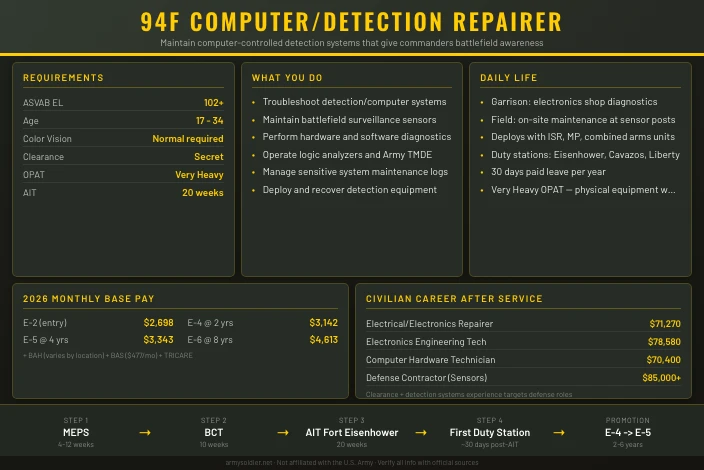
Job Role and Responsibilities
The 94F Computer/Detection Systems Repairer performs field and sustainment maintenance on computer-controlled detection systems, special electronic devices, and battlefield surveillance equipment. Soldiers diagnose hardware and software faults in military computer systems and detection equipment, apply technical manuals to isolate and repair defects, and use Army test, measurement, and diagnostic equipment (TMDE) to verify system performance. Senior 94Fs supervise maintenance sections and serve as technical advisors on detection and computerized systems.
Daily Tasks
Garrison work centers on the electronics shop. You’ll run scheduled maintenance on assigned systems, process work orders from supported units, and troubleshoot hardware faults in detection and computer-controlled equipment. Diagnostic tasks require reading circuit diagrams, operating specialized TMDE, and documenting every maintenance action in Army maintenance management systems.
Field operations can take the work forward to operational sites where detection systems are deployed. Systems that go down at a surveillance site or in a field command post need on-site attention, which means the 94F sometimes works in tactical environments rather than controlled shop conditions.
- Troubleshoot and repair computer-controlled military detection and surveillance systems
- Maintain special electronic devices including battlefield sensors and monitoring equipment
- Operate Army TMDE including logic analyzers, oscilloscopes, and computerized test sets
- Perform hardware and software diagnostics on military computer systems
- Manage maintenance documentation and parts requisitions for classified and sensitive systems
- Inspect and verify system functionality before returning equipment to units
Specific Roles
The 94F falls under Career Management Field 94. Progression through skill levels adds supervisory scope and system breadth.
| Classification | Code | Description |
|---|---|---|
| Entry Level | 94F10 | Basic maintenance tasks under supervision |
| Journeyman | 94F20 | Independent field-level maintenance on detection and computer systems |
| Senior | 94F30 | Leads maintenance teams and manages section operations |
| Senior NCO | 94F40 | Advises commanders; manages computer and detection system maintenance at battalion and above |
Additional Skill Identifiers (ASIs) are available for soldiers who complete specialized courses. The Ranger support ASI carries separate bonus eligibility in active recruiting cycles.
Mission Contribution
Detection systems give Army commanders situational awareness they would not otherwise have. Battlefield surveillance equipment that identifies enemy positions, monitors perimeters, or supports counter-IED operations creates the intelligence picture that drives tactical decisions. When those systems fail, the operational picture degrades. The 94F restores that awareness and keeps detection capabilities functional across the unit’s area of operations.
Technology and Equipment
The 94F works with a range of military computer and detection technologies. Systems include battlefield surveillance sensors, chemical and biological detection equipment, counter-IED electronic systems, and computer-controlled fire support devices. Diagnostic work uses Army TMDE including logic analyzers, spectrum analyzers, and system-specific built-in test equipment. 94Fs also interact with Army digital maintenance management systems for work order tracking and equipment records.
Salary and Benefits
Base pay for the 94F follows the Army’s standard enlisted pay scale. Tax-free allowances add substantially to total compensation.
Base Pay (2026)
All figures reflect 2026 monthly base pay per DFAS.
| Grade | Rank | Entry Pay | 4-Year Pay |
|---|---|---|---|
| E-1 | Private (PV1) | $2,407/mo | $2,407/mo |
| E-2 | Private (PV2) | $2,698/mo | $2,698/mo |
| E-3 | Private First Class (PFC) | $2,837/mo | $3,198/mo |
| E-4 | Specialist (SPC) | $3,142/mo | $3,659/mo |
| E-5 | Sergeant (SGT) | $3,343/mo | $3,947/mo |
| E-6 | Staff Sergeant (SSG) | $3,401/mo | $4,069/mo |
| E-7 | Sergeant First Class (SFC) | $3,932/mo | $4,663/mo |
Allowances and Benefits
Tax-free allowances supplement base pay at every rank:
- Basic Allowance for Subsistence (BAS): $476.95/month for all enlisted soldiers
- Basic Allowance for Housing (BAH): Varies by duty station and dependency status. At Fort Sam Houston, an E-4 without dependents receives $1,359/month; with dependents, $1,728/month. Higher-cost installations pay more.
TRICARE Prime provides comprehensive healthcare for soldiers and enrolled family members at no enrollment cost. Coverage includes medical, dental, vision, mental health, and prescriptions with no copays for in-network care.
Education benefits run the career’s full length:
- Tuition Assistance: Up to $4,500/year while on active duty, at $250 per semester hour
- Post-9/11 GI Bill: 36 months of benefits covering full in-state tuition at public universities, up to $29,920.95/year at private schools, monthly housing allowance, and $1,000/year for books
Work-Life Balance
Soldiers earn 30 days of paid leave per year, accruing at 2.5 days monthly, plus 11 federal holidays. In garrison, detection systems maintenance generally follows a standard duty schedule. Field exercises and deployment preparation extend hours. Combat zone tours add tax benefits and special pays that increase effective compensation during those periods.
Qualifications and Eligibility
The 94F requires the same EL score as 94A and 94E, placing it among the more selective enlisted maintenance MOSs. The Secret clearance applies throughout the career because of regular access to sensitive systems.
Eligibility Requirements
| Requirement | Standard |
|---|---|
| Age | 17-34 (waiver possible to 39) |
| Citizenship | U.S. citizen required |
| Education | High school diploma (AFQT 31+) or GED (AFQT 50+) |
| ASVAB EL composite | 102 minimum |
| Physical demand category | Very Heavy |
| Security clearance | Secret |
| Color vision | Normal color vision required |
| Other | One year HS algebra and general science recommended |
The EL composite is GS + AR + MK + EI. A score of 102 demands solid marks across all four subtests. The Army recommends completing at least one year of high school algebra and general science before attending AIT.
The Secret clearance process runs a National Agency Check with Local Agency and Credit Checks (NACLC). Financial history, employment record, education, references, and any criminal background are all examined. The investigation typically runs three to six months, often concurrently with BCT and AIT.
Application Process
Selection Competitiveness
The EL 102 requirement and Secret clearance eligibility limit the pool compared to lower-threshold maintenance MOSs. Applicants with electronics coursework, computer hardware experience, or any background with detection or sensor systems have a meaningful training advantage. Ask your recruiter about current bonus availability – 94F has carried Ranger bonus eligibility in prior recruiting cycles.
Service Obligation
Soldiers enter at E-1 (Private, PV1). Standard enlistments run three to six years, followed by time in the Individual Ready Reserve. The Secret clearance carries continuing post-separation obligations to protect classified information.
See our ASVAB study guide for strategies to hit these line scores, or take the PiCAT from home if you are a first-time tester.
Work Environment
Setting and Schedule
The 94F works in electronics maintenance shops supporting intelligence, surveillance, and reconnaissance units, military police units that use detection equipment, and combined arms formations with sophisticated electronic systems. In garrison, work happens primarily indoors in maintenance bays and controlled workspaces. Field operations take maintenance support to deployed detection sites and field command posts.
The physical environment ranges from climate-controlled electronics shops to austere forward positions. Some detection systems require deployment to specific locations, so the 94F may work outdoors in the field more than typical bench-focused maintenance MOSs.
Leadership and Communication
Detection system maintenance sections operate within the supported unit’s maintenance structure. An officer or warrant officer typically oversees the broader maintenance program; the 94F section NCOIC, usually an SSG or SFC, runs daily operations. Communication with supported unit S2s, military police leadership, or counter-IED teams about system status and repair timelines is a regular part of the job.
The NCOER governs formal performance feedback for E-5 and above. Junior soldiers receive monthly counseling from their immediate NCO.
Team Dynamics and Autonomy
New 94Fs work under close supervision until they prove competency on each system type. Detection systems used in operational contexts carry high consequences if incorrectly cleared as serviceable. Quality control reviews completed maintenance before systems go back to units.
By E-4 and E-5, experienced 94Fs work with significant autonomy on familiar systems. Senior soldiers manage parts coordination, serve as the technical authority on detection and computer systems, and train junior soldiers on diagnostic procedures.
Job Satisfaction and Retention
Soldiers who have genuine interest in both electronics and digital/computer systems tend to find 94F engaging. The breadth of system types – from chemical sensors to surveillance electronics to computer-controlled fire support tools – keeps the work varied. The defense contracting market for personnel with detection system experience and Secret clearances is consistently active.
Training and Skill Development
Initial Training
The 94F pipeline runs through BCT then AIT at Fort Eisenhower, Georgia (formerly Fort Gordon).
| Phase | Location | Length | Focus |
|---|---|---|---|
| Basic Combat Training (BCT) | Various installations | 10 weeks | Soldiering fundamentals, physical fitness, weapons qualification |
| Advanced Individual Training (AIT) | Fort Eisenhower, GA | 20 weeks | Computer systems maintenance, detection system electronics, digital diagnostics |
The AIT curriculum covers electrical and electronics theory, digital systems and logic, computer hardware maintenance, and hands-on work with Army detection and surveillance equipment. Students learn to use Army TMDE for both analog circuit and digital logic diagnostics. The program is more intensive on digital systems content than many other CMF 94 courses, reflecting the computer-controlled nature of the systems 94Fs maintain.
Graduates leave AIT ready to work independently on field-level maintenance tasks. The combination of analog electronics and digital systems knowledge is a broad technical foundation that supports both Army career progression and post-service employment.
Advanced Training
Development continues after AIT and the initial assignment:
- System-specific courses: New detection platforms and upgraded computer-controlled systems require formal training; soldiers attend fielding courses when their units receive new equipment
- Advanced Leader Course (ALC): Required for SSG promotion; expands leadership and maintenance management alongside technical content
- Senior Leader Course (SLC): Required for SFC; adds operational planning and staff skills
- Army COOL Program: Funds exam fees for CompTIA A+, CompTIA Security+, and other certifications with direct post-service value
- Warrant Officer pathway: Experienced CMF 94 NCOs can pursue warrant officer programs in electronic systems maintenance specialties
Tuition Assistance supports off-duty coursework at accredited schools, making it practical to pursue a degree in information technology or electronics engineering technology while serving.
Everything starts with qualifying ASVAB scores — our study guide covers what to study first.
Career Progression and Advancement
Career Path
Promotions through E-4 follow semi-automatic timelines. E-5 and above requires competitive boards, education requirements, and promotion points.
| Rank | Grade | Typical Time-in-Grade | Role |
|---|---|---|---|
| Private (PV1) | E-1 | 0-6 months | Initial entry, training |
| Private (PV2) | E-2 | 6 months | Completing BCT/AIT |
| Private First Class (PFC) | E-3 | 12 months | First duty station, supervised maintenance |
| Specialist (SPC) | E-4 | 24 months | Independent maintenance on assigned systems |
| Sergeant (SGT) | E-5 | 4-6 years | Team leader, supervises section tasks |
| Staff Sergeant (SSG) | E-6 | 7-10 years | Section NCOIC, manages workload and training |
| Sergeant First Class (SFC) | E-7 | 10-15 years | Platoon Sergeant, advises maintenance officer |
| Master Sergeant (MSG) | E-8 | 16-22 years | Senior maintenance manager, battalion advisor |
| Sergeant Major (SGM) | E-9 | 22+ years | Command-level advisor on detection and computer system readiness |
Specialization Options
CMF 94 provides lateral movement paths between related specialties. Warrant officer programs in electronic systems maintenance are accessible to experienced 94F NCOs. The skill level progression through 94F40 positions soldiers for senior roles in sustainment commands and program support activities for detection systems programs.
Role Flexibility and Transfers
After the initial obligation, soldiers can request MOS transfers. Moves within CMF 94 are more accessible than cross-CMF reclassifications. The Secret clearance opens options in intelligence, signal, and other technical MOSs when Army manning needs support individual requests.
Performance Evaluation
NCO evaluations assess Character, Presence, Intellect, Leads, and Develops. For a 94F, demonstrated technical proficiency across both analog and digital systems, maintenance documentation quality, and the effectiveness of junior soldier training carry significant weight in how supervisors assess performance.
Physical Demands and Medical Evaluations
Physical Requirements
The 94F carries a Very Heavy physical demand category. In addition to standard electronics maintenance demands, detection system work can involve deploying and recovering heavy sensor equipment, carrying systems to remote monitoring positions, and working in field conditions where detection equipment is positioned. You’ll regularly lift items in the 50 to 80-pound range and work in varied environments.
Normal color vision is required for wiring diagram interpretation and component identification.
Army Fitness Test (AFT) Standards
All soldiers must pass the Army Fitness Test (AFT), which replaced the ACFT on June 1, 2025. Five events scored 0-100 each produce a maximum of 500 points. The passing standard is 300 total (60 per event minimum), normed by sex and age. The 94F is not a designated combat MOS, so the 350-point combat specialty standard does not apply.
| Event | Abbreviation | Description |
|---|---|---|
| 3 Repetition Maximum Deadlift | MDL | Lower body and core strength |
| Hand Release Push-Up | HRP | Upper body muscular endurance |
| Sprint-Drag-Carry | SDC | Anaerobic capacity and functional movement |
| Plank | PLK | Core endurance |
| Two-Mile Run | 2MR | Aerobic capacity |
Minimum per-event score is 60 points. The Very Heavy OPAT category requires demonstrated strength at MEPS before assignment.
Medical Evaluations
Periodic medical readiness assessments continue throughout the career. Normal color vision is non-waivable and checked at MEPS. The Secret clearance requires ongoing self-reporting of events that could affect eligibility.
Deployment and Duty Stations
Deployment Details
The 94F deploys with the units that operate detection and surveillance systems. Intelligence, surveillance, and reconnaissance assets, military police units with detection equipment, and combined arms formations all have 94F requirements. Deployment lengths typically run nine to twelve months. Dwell time is generally around two years at home station.
Location Flexibility
Detection and computer systems maintenance requirements exist across the Army’s major combat and support formations. Common duty stations for 94Fs include:
- Fort Eisenhower, GA (Signal/Intelligence support)
- Fort Cavazos, TX (III Corps units)
- Fort Stewart, GA (3rd Infantry Division)
- Fort Bragg (Fort Liberty), NC (XVIII Airborne Corps units)
- Joint Base Lewis-McChord, WA (I Corps)
- Germany (Grafenwoehr / Wiesbaden) (USAREUR)
- Korea (Camp Humphreys) (2nd Infantry Division)
Assignment preferences go through HRC career managers, weighed against Army manning requirements.
Risk, Safety, and Legal Considerations
Job Hazards
Detection systems include chemical and biological sensors that, by design, operate in contaminated environments. Training and equipment protocols govern handling procedures. High-voltage electronics in computer-controlled systems require power-down procedures before maintenance begins. Field deployments of detection equipment can place soldiers in contested or hostile environments depending on the unit mission.
Safety Protocols
Technical manual procedures govern every maintenance action. No improvisation is authorized on sensitive detection or computer systems. Quality control inspections review completed maintenance before systems return to operational status. Chemical detector maintenance follows specific decontamination procedures to protect maintenance personnel.
Security and Legal Requirements
The Secret clearance requires self-reporting of life events that could affect eligibility. Soldiers must report foreign travel, foreign national contacts, financial hardship, and legal issues to their security officer. Failure to report is a clearance violation. Post-separation obligations to protect classified information continue under federal law.
Impact on Family and Personal Life
Family Considerations
Detection and computer systems maintenance operations are generally predictable in garrison, though field exercises and deployment preparation create extended-hours periods. Families benefit from on-installation support resources and FRG networks at major Army posts.
TRICARE Prime covers family members at no enrollment cost. BAH covers housing on or off post. Military OneSource and on-post family services are available at most larger installations.
Relocation and Flexibility
PCS moves happen every two to three years. Detection and computer systems maintenance specialties are present across a broad range of Army installations, giving 94Fs more location flexibility than some CMF 94 specialties. OCONUS tours in Germany and Korea include overseas incentive pays.
Reserve and National Guard
The 94F MOS is available in both the Army Reserve and the Army National Guard. Units with computer-based detection and sensor systems need 94F soldiers to maintain them, and those units exist across both components. Geographic coverage is reasonably broad, which gives you more location flexibility than some CMF 94 specialties when looking for a unit with open billets.
If you work in IT, electronics repair, or a technical field during the week, this MOS pairs well with civilian employment. The skill sets overlap more than most combat arms specialties.
Drill Schedule and Training Commitment
Standard Reserve and Guard commitment is one weekend per month (four drill periods) plus two weeks of annual training each summer. Technology changes add training days beyond that baseline.
Detection and sensor systems are updated more frequently than many Army platforms. When new systems are fielded, 94F soldiers need transition training to learn the hardware and diagnostic procedures for the updated equipment. Computer systems certifications also require periodic recurrency. Plan for additional training days in years when your unit fields new platforms or receives significant system updates. Annual training commitments of 30 or more days are realistic in active fielding years.
Your unit will schedule these training days, but you should understand the commitment before signing.
Part-Time Pay and Benefits
A Guard or Reserve 94F at the E-4 level with around four years of service earns roughly $488 per drill weekend (four drill periods). Over 12 drill weekends, that totals about $5,856 per year, plus pay for annual training and any additional duty events.
Healthcare in the part-time components is Tricare Reserve Select. Member-only coverage costs $57.88 per month. Family coverage is $286.66 per month. Active duty TRICARE Prime runs $0 in premiums. Most Guard and Reserve soldiers carry civilian employer health insurance as their primary plan and use Reserve Select as secondary coverage if at all.
Education benefits before mobilization include Federal Tuition Assistance and Montgomery GI Bill-Selected Reserve (Chapter 1606). After a qualifying mobilization of 90 or more consecutive days, Post-9/11 GI Bill (Chapter 33) eligibility may be available. Guard soldiers often qualify for state tuition waivers. Check your state’s program before assuming what is available.
Reserve and Guard retirement uses a points system. Drill periods, annual training days, and active duty days all earn points. Retirement pay starts at age 60, reduced by three months for each 90-day mobilization period, with a floor of age 50. Twenty qualifying years, each with at least 50 retirement points, is the requirement.
Deployment and Mobilization
Sensor and detection systems are used across a wide range of deployments, from base security and counter-IED operations to command post protection. 94F soldiers are needed wherever those systems operate. Mobilization demand is steady. A typical activation runs 9 to 12 months. Over a 10-plus year career in the Guard or Reserve, expect at least one deployment.
USERRA protects your civilian job, pay, seniority, and benefits for the duration of any mobilization. Your employer cannot terminate you or reduce your benefits because of military service.
Civilian Career Integration
The 94F builds skills that transfer directly into civilian IT and electronics careers. Computer repair technicians and IT hardware specialists work with diagnostic tools and hardware maintenance that closely mirrors Army computer systems work. Electronics technicians in manufacturing, defense, and telecommunications use similar troubleshooting methods.
Defense contracting is a particularly strong path. Companies supporting Army surveillance, counter-IED, and battlefield sensor programs recruit 94F veterans for field service, depot maintenance, and contractor support roles. A Secret clearance is a significant differentiator for these positions. Outside defense, the hardware troubleshooting and diagnostic documentation skills from the MOS apply to IT support, embedded systems repair, and industrial sensor maintenance.
| Feature | Active Duty | Army Reserve | Army National Guard |
|---|---|---|---|
| Commitment | Full-time | One weekend/month, two weeks/year | One weekend/month, two weeks/year |
| Monthly Pay (E-4, ~4 yrs) | $3,659 | ~$488/drill weekend | ~$488/drill weekend |
| Healthcare | TRICARE Prime, $0 premiums | Tricare Reserve Select, $57.88/month | Tricare Reserve Select, $57.88/month |
| Education | Post-9/11 GI Bill | Federal TA, MGIB-SR | Federal TA, MGIB-SR, state tuition waivers |
| Deployment | Regular rotations | Mobilization-based | Mobilization-based, plus state activations |
| Retirement | 20-year pension, immediate | Points-based, age 60 | Points-based, age 60 |
Post-Service Opportunities
Transition to Civilian Life
The 94F leaves service with a combination of digital systems experience, electronics maintenance skills, and a Secret clearance that applies directly to defense contracting and government support positions. Employers supporting Army detection and surveillance programs, counter-IED technology, and battlefield sensor programs actively recruit separating soldiers with 94F backgrounds.
The Transition Assistance Program (TAP) at the soldier’s final installation provides resume preparation and employer connections. The Army COOL program funds certification exam fees for credentials with post-service value.
Civilian Career Prospects
| Civilian Job | Median Annual Salary | Job Outlook |
|---|---|---|
| Electrical/Electronics Repairer | $71,270 | Stable, ~9,600 openings/year |
| Electronics Engineering Technician | $78,580 | 2% growth, 2024-2034 |
| Computer Hardware Technician | $70,400 | 2% growth, 2024-2034 |
| Defense Contractor (Sensor/Detection Systems) | $85,000-$115,000+ | Strong demand with clearance |
Salary data from the Bureau of Labor Statistics (May 2024). Defense roles for cleared personnel with detection system backgrounds consistently exceed standard BLS figures.
Is This a Good Job for You? The Right (and Wrong) Fit
Ideal Candidate Profile
The 94F suits someone who is comfortable working with both analog electronics and digital computer systems. The diagnostic work crosses hardware and software boundaries, which requires broader thinking than purely analog repair work. Soldiers who enjoy problem-solving at the intersection of electronics and computing, and who are meticulous about procedure, tend to excel.
A background in computer hardware, electronics, or any experience with sensor or detection technology is a meaningful advantage in training. The Secret clearance means a solid financial history matters at the application stage.
Potential Challenges
The Very Heavy OPAT category surprises some recruits who focus on the technical side without thinking about the physical demands of detection system deployment and recovery in the field. The strength requirements are real and tested at MEPS.
AIT runs 20 weeks, and the curriculum moves through both analog and digital systems content at a pace that requires consistent effort. Students who arrive without algebra and basic science preparation hit the hardest sections faster.
The Secret clearance investigation creates timeline uncertainty. Applicants with financial complications or foreign national family connections should discuss their situation with a recruiter before assuming qualification.
Career and Lifestyle Alignment
This MOS fits well for someone who wants a technical specialty with broad applicability – both the analog electronics skills and the digital systems background are valued in defense contracting. It aligns well with post-service careers in sensor technology, electronic warfare support, and defense IT.
The wrong fit is someone without genuine interest in either electronics or computer systems. The breadth of the curriculum is an asset for motivated learners but a burden for soldiers going through the motions.
More Information
Talk to an Army recruiter to check your ASVAB scores against 94F requirements and get current bonus information for CMF 94 specialties. Recruiters can also walk you through the clearance pre-screening process. Start online at goarmy.com or visit your nearest recruiting station.
- Prepare for the ASVAB with our study guide to make sure your line scores qualify
This site is not affiliated with the U.S. Army or any government agency. Verify all information with official Army sources before making enlistment or career decisions.
Explore more Army maintenance careers such as 94E Radio and Communications Security Repairer and 94H TMDE Support Specialist.