94H Test, Measurement, and Diagnostic Equipment Support Specialist
Every piece of Army maintenance equipment – every voltmeter, every torque wrench, every pressure gauge – must be calibrated to a known standard before another soldier trusts the readings it gives. The 94H Test, Measurement, and Diagnostic Equipment Support Specialist is responsible for that calibration. This is a precision-focused MOS with the highest EL score requirement in CMF 94, the longest AIT pipeline in the series at 33 weeks, and a direct pathway to careers in metrology and precision measurement that are consistently short on qualified personnel. No security clearance is required, which means the application process is more straightforward than most CMF 94 specialties – but the technical threshold is the highest in the field.
Qualifying requires specific ASVAB line scores — our ASVAB study guide covers what to target and how to prepare.
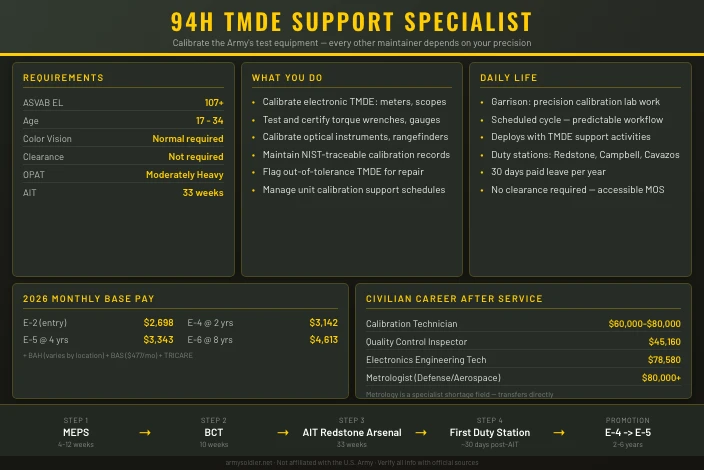
Job Role and Responsibilities
The 94H Test, Measurement, and Diagnostic Equipment Support Specialist maintains the U.S. Army TMDE calibration program, performing calibration and repair of Army test, measurement, and diagnostic equipment to national standards. Soldiers test and calibrate electronic, optical, mechanical, and physical measurement instruments used across all Army maintenance specialties. Senior 94Hs manage TMDE support programs, calibrate Army-peculiar TMDE, and advise commanders on equipment measurement accuracy and calibration status.
Daily Tasks
The 94H works differently from most CMF 94 repairers. Instead of maintaining weapons or communication systems, you maintain the equipment that other maintainers use to do their jobs. A voltmeter that reads two percent low, a pressure gauge that’s drifted out of spec, or a torque wrench that delivers less force than the display shows – each of these creates errors throughout the maintenance system. You find and correct those errors.
Daily work includes receiving TMDE from supported units, comparing measurements against calibration standards traceable to the National Institute of Standards and Technology (NIST), adjusting instruments to bring them back within tolerance, and issuing calibration stickers that verify the equipment’s accuracy status.
- Calibrate electronic test equipment including multimeters, oscilloscopes, and signal generators
- Test and certify mechanical measurement tools including torque wrenches and pressure gauges
- Calibrate optical instruments such as riflescopes and rangefinders
- Maintain calibration records for every instrument serviced
- Operate primary calibration standards and metrology support equipment
- Identify TMDE that cannot be brought into tolerance and process it for repair or disposal
Specific Roles
The 94H falls under Career Management Field 94 and is distinct from other CMF 94 specialties in that it supports the Army’s calibration program rather than direct weapon or communication system maintenance.
| Classification | Code | Description |
|---|---|---|
| Entry Level | 94H10 | Performs calibration tasks under supervision using established procedures |
| Journeyman | 94H20 | Executes independent calibration across instrument types |
| Senior | 94H30 | Leads calibration teams; manages TMDE support programs |
| Senior NCO | 94H40 | Advises commanders on TMDE calibration readiness; manages metrology programs |
Mission Contribution
Maintenance readiness across the entire Army depends on accurate measurement tools. An avionic technician who torques a fastener to the wrong value, a mechanic who reads a fuel pressure gauge that’s drifted out of calibration, or a signals technician whose power meter shows incorrect output – all of these downstream errors trace back to uncalibrated TMDE. The 94H is the quality control layer under every other maintenance specialty. When calibration is good, the whole system works correctly.
Technology and Equipment
The 94H works with the widest range of measurement equipment of any Army MOS. Electronic TMDE includes digital multimeters, frequency counters, signal generators, power meters, and oscilloscopes. Mechanical TMDE includes torque wrenches, micrometers, pressure gauges, and flow meters. Optical instruments include riflescope adjusters, night vision calibration equipment, and rangefinders. Primary measurement standards used for calibration are traceable to NIST and are maintained at Army Primary Standards Laboratories. The Army TMDE Activity manages the program at the enterprise level.
Salary and Benefits
The 94H earns the same base pay as all enlisted soldiers, with identical allowances stacked on top.
Base Pay (2026)
All figures reflect 2026 monthly base pay per DFAS.
| Grade | Rank | Entry Pay | 4-Year Pay |
|---|---|---|---|
| E-1 | Private (PV1) | $2,407/mo | $2,407/mo |
| E-2 | Private (PV2) | $2,698/mo | $2,698/mo |
| E-3 | Private First Class (PFC) | $2,837/mo | $3,198/mo |
| E-4 | Specialist (SPC) | $3,142/mo | $3,659/mo |
| E-5 | Sergeant (SGT) | $3,343/mo | $3,947/mo |
| E-6 | Staff Sergeant (SSG) | $3,401/mo | $4,069/mo |
| E-7 | Sergeant First Class (SFC) | $3,932/mo | $4,663/mo |
Allowances and Benefits
Tax-free allowances significantly increase total compensation:
- Basic Allowance for Subsistence (BAS): $476.95/month for all enlisted soldiers
- Basic Allowance for Housing (BAH): Varies by duty station and dependency status. At Fort Sam Houston, an E-4 without dependents receives $1,359/month; with dependents, $1,728/month. Higher-cost installations pay more.
TRICARE Prime provides healthcare for soldiers and enrolled family members at no enrollment cost, covering medical, dental, vision, mental health, and prescriptions with no in-network copays.
Education support runs the full career:
- Tuition Assistance: Up to $4,500/year on active duty at $250 per semester hour
- Post-9/11 GI Bill: 36 months of benefits including full in-state tuition at public schools, up to $29,920.95/year at private schools, monthly housing allowance, and $1,000/year for books
Work-Life Balance
Soldiers earn 30 days of paid leave per year, at 2.5 days per month, plus 11 federal holidays. TMDE support activities operate on a relatively predictable schedule in garrison compared to direct combat support MOSs. Calibration work follows the Army’s TMDE support cycle, which is systematic rather than demand-driven by operational emergencies. Field exercises and deployment preparation affect hours, but the work pace is more consistent than weapons or aviation maintenance.
Qualifications and Eligibility
The 94H carries the highest EL score requirement in CMF 94. No security clearance is required, which removes that filter from the application process and makes this MOS more accessible for applicants with complicated backgrounds.
Eligibility Requirements
| Requirement | Standard |
|---|---|
| Age | 17-34 (waiver possible to 39) |
| Citizenship | U.S. citizen required |
| Education | High school diploma (AFQT 31+) or GED (AFQT 50+) |
| ASVAB EL composite | 107 minimum |
| Physical demand category | Moderately Heavy |
| Security clearance | Not required |
| Color vision | Normal color vision required |
| Other | One year HS algebra and general science recommended |
The EL composite formula is GS + AR + MK + EI. An EL of 107 is at the upper end of enlisted technical requirements across all Army MOSs. The Army recommends one year each of high school algebra and general science before attending AIT.
Application Process
Selection Competitiveness
The EL 107 requirement is the primary filter. Fewer applicants qualify at that score level than for the EL 102 MOSs. Applicants with a genuine math and science background – especially any exposure to measurement, precision instruments, or physics – are better prepared for AIT content. Ask your recruiter about current bonus availability for CMF 94 positions.
Service Obligation
Soldiers enter at E-1 (Private, PV1). Standard enlistments run three to six years, followed by time in the Individual Ready Reserve.
See our ASVAB study guide for strategies to hit these line scores, or take the PiCAT from home if you are a first-time tester.
Work Environment
Setting and Schedule
The 94H works primarily in TMDE support activities and calibration facilities. These are climate-controlled, precision environments where temperature and humidity stability matter for accurate calibration. The work is bench-focused and methodical. Unlike field maintenance MOSs, the 94H operates in facilities specifically designed for precision measurement work.
TMDE activities typically operate on regular duty hours. The calibration cycle for supported units runs on a scheduled basis, so the workflow is predictable compared to on-demand repair work. Field exercises and deployments can take the work into forward support configurations, but even deployed calibration support operates in structured, controlled environments when possible.
Leadership and Communication
TMDE support activities operate as specialized maintenance units under the Army’s maintenance support system. Section NCOs manage daily workload and maintain calibration records. 94Hs communicate with maintenance officers and NCOIC personnel at supported units about calibration status, overdue TMDE, and out-of-tolerance findings that could have affected previous maintenance actions.
The NCOER governs formal feedback for E-5 and above. Junior soldiers receive monthly counseling from their immediate NCO. Calibration sections are small and specialized, so individual accuracy and attention to detail are consistently observable.
Team Dynamics and Autonomy
The precision nature of calibration work requires strict adherence to procedure. A calibration technician who shortcuts a procedure or estimates a reading instead of using the correct standard creates errors that propagate to every user of that instrument. The work culture in TMDE activities emphasizes procedural discipline above speed.
New 94Hs work under supervision while learning calibration procedures for each instrument class. By E-4 and E-5, proficient soldiers work independently across their calibration specialty. Senior NCOs manage the support activity’s schedule, ensure measurement traceability, and oversee the quality of subordinates’ work.
Job Satisfaction and Retention
Soldiers who enjoy precision work and find satisfaction in verifying accuracy tend to stay in this field. The civilian metrology job market is consistently short on qualified technicians, which gives 94Hs a clear post-service path. The job is less physically demanding than most CMF 94 specialties and more intellectually focused on measurement science, which suits a specific type of technical mind.
Training and Skill Development
Initial Training
The 94H pipeline runs through BCT then one of the longest AIT courses in CMF 94 at Redstone Arsenal, Alabama.
| Phase | Location | Length | Focus |
|---|---|---|---|
| Basic Combat Training (BCT) | Various installations | 10 weeks | Soldiering fundamentals, physical fitness, weapons qualification |
| Advanced Individual Training (AIT) | Redstone Arsenal, AL | 33 weeks | Metrology, calibration standards, electronic and mechanical TMDE calibration |
The 33-week AIT is the longest in CMF 94 and reflects the breadth of instrument types a 94H must certify to calibrate. The curriculum covers measurement science fundamentals, unit conversion and measurement uncertainty, primary and secondary calibration standards, electronic test equipment calibration procedures, mechanical and optical instrument calibration, and Army TMDE management and documentation requirements.
Students work extensively with actual calibration equipment and instruments throughout training. The metrology content – covering standards traceability, measurement uncertainty, and tolerance analysis – is genuinely academic and requires the math aptitude that the EL 107 threshold reflects.
Advanced Training
After AIT and the initial assignment, 94Hs have several development paths:
- Instrument class qualifications: 94Hs can become certified on additional instrument classes beyond their initial training, expanding their calibration authority
- Army Primary Standards Laboratory: Top-tier 94Hs can be assigned to primary standards labs that support the entire Army metrology program
- Advanced Leader Course (ALC): Required for SSG; adds TMDE program management and leadership content
- Senior Leader Course (SLC): Required for SFC; covers operational-level maintenance support planning
- Army COOL Program: Funds exam fees for credentials including ASQ Measurement and Inspection Technician and other metrology certifications with direct post-service value
- NCSL International membership and certification: Professional metrology credentials available to experienced calibration technicians
Tuition Assistance supports off-duty coursework for soldiers pursuing engineering technology or applied science degrees relevant to measurement and calibration careers.
Everything starts with qualifying ASVAB scores — our study guide covers what to study first.
Career Progression and Advancement
Career Path
Early rank progression follows semi-automatic timelines. E-5 and above enters competitive territory requiring boards, education milestones, and promotion points.
| Rank | Grade | Typical Time-in-Grade | Role |
|---|---|---|---|
| Private (PV1) | E-1 | 0-6 months | Initial entry, training |
| Private (PV2) | E-2 | 6 months | Completing BCT/AIT |
| Private First Class (PFC) | E-3 | 12 months | First TMDE assignment, supervised calibration |
| Specialist (SPC) | E-4 | 24 months | Independent calibration across certified instrument classes |
| Sergeant (SGT) | E-5 | 4-6 years | Team leader, supervises section calibration work |
| Staff Sergeant (SSG) | E-6 | 7-10 years | Section NCOIC, manages calibration schedule and records |
| Sergeant First Class (SFC) | E-7 | 10-15 years | TMDE support activity NCOIC, advises maintenance commanders |
| Master Sergeant (MSG) | E-8 | 16-22 years | Senior metrology advisor, manages Army TMDE programs |
| Sergeant Major (SGM) | E-9 | 22+ years | Command advisor on Army-wide calibration program readiness |
Specialization Options
The 94H skill level progression through 94H40 positions soldiers for senior roles in Army primary standards laboratories and TMDE support activities at sustainment command level. The relatively small 94H population means senior NCOs carry significant program management responsibility at a younger career stage than larger CMF populations.
Role Flexibility and Transfers
Transfers within CMF 94 are possible after the initial obligation. The high EL score makes 94Hs strong candidates for reclassification into other technical specialties. The lack of a clearance requirement is not a barrier to moving into clearance-requiring MOSs – it simply means the clearance investigation would begin at reclassification.
Performance Evaluation
NCO evaluations cover Character, Presence, Intellect, Leads, and Develops. For a 94H, the accuracy and completeness of calibration records, the quality of subordinate training, and the TMDE activity’s calibration program health carry significant weight in supervisor assessments.
Physical Demands and Medical Evaluations
Physical Requirements
The 94H carries a Moderately Heavy physical demand category – the lowest in CMF 94. Daily work is bench-focused and involves handling instruments, moving calibration standards, and operating test equipment. Regular lifting is in the 20 to 40-pound range. The work is primarily indoor and does not involve the heavy equipment handling of Very Heavy OPAT MOSs.
Normal color vision is required for instrument panel reading and color-coded identification.
Army Fitness Test (AFT) Standards
All soldiers must pass the Army Fitness Test (AFT), which replaced the ACFT on June 1, 2025. Five events scored 0-100 each produce a maximum of 500 points. The passing standard is 300 total (60 per event minimum), normed by sex and age. The 94H is not a designated combat MOS, so the 350-point combat specialty standard does not apply.
| Event | Abbreviation | Description |
|---|---|---|
| 3 Repetition Maximum Deadlift | MDL | Lower body and core strength |
| Hand Release Push-Up | HRP | Upper body muscular endurance |
| Sprint-Drag-Carry | SDC | Anaerobic capacity and functional movement |
| Plank | PLK | Core endurance |
| Two-Mile Run | 2MR | Aerobic capacity |
Minimum per-event score is 60 points.
Medical Evaluations
Standard periodic medical readiness assessments apply throughout the career. Normal color vision is required and is checked at MEPS. No security clearance-related reporting obligations apply for this MOS.
Deployment and Duty Stations
Deployment Details
The 94H deploys with Army TMDE support activities and sustainment commands. Every deployed force needs calibrated test equipment, so TMDE support elements deploy to theater to maintain calibration support for forward units. Deployment lengths typically run nine to twelve months. The deployment frequency is generally lower than direct combat support MOSs, but TMDE support does deploy to active theaters.
Location Flexibility
TMDE support activities exist at major Army installations and sustainment commands. Common duty stations for 94Hs include:
- Redstone Arsenal, AL (Army TMDE Activity, home of the 94H career field)
- Fort Campbell, KY (101st Airborne Division support)
- Fort Cavazos, TX (III Corps sustainment)
- Fort Stewart, GA (3rd Infantry Division sustainment)
- Fort Drum, NY (10th Mountain Division support)
- Tobyhanna Army Depot, PA (Depot-level TMDE maintenance)
- Germany / Korea (OCONUS TMDE support activities)
Assignment preferences go through HRC career managers, weighed against Army manning needs.
Risk, Safety, and Legal Considerations
Job Hazards
Calibration work involves handling high-voltage test equipment and operating RF signal sources that require power-down and safety procedures. Radiation safety training applies to 94Hs who work with certain frequency measurement standards. Physical hazards in the calibration laboratory are lower than in field maintenance, but electrical safety discipline is constant.
Safety Protocols
Calibration procedures in technical manuals govern every measurement action. Standards traceability must be documented for all calibrations. Electrical safety training and lockout/tagout procedures apply when working on energized test equipment.
Security and Legal Requirements
No security clearance is required for the 94H. Standard UCMJ obligations apply throughout service. Calibration records are controlled documents that must be maintained accurately – falsifying calibration records is a UCMJ violation with downstream consequences for any maintenance work that relied on incorrectly documented equipment.
Impact on Family and Personal Life
Family Considerations
TMDE support activities operate on more predictable schedules than combat support maintenance units. The calibration cycle is systematic and less subject to emergency call-ins than weapons or vehicle maintenance. Families generally experience more schedule stability at TMDE assignments than at combat arms-heavy installations.
TRICARE Prime covers family members at zero enrollment cost. BAH covers housing on or off post. On-installation support resources are available at major Army posts.
Relocation and Flexibility
PCS moves happen every two to three years. TMDE support activities are present at most major installations, which gives 94Hs reasonable location flexibility. The Redstone Arsenal area in Alabama is the heart of the 94H career field, and multiple assignment windows there are common for NCOs over a career.
Reserve and National Guard
The 94H TMDE Support Specialist MOS is available in both the Army Reserve and the Army National Guard. Calibration support teams exist in maintenance battalions across both components. Every military unit depends on accurately calibrated test equipment, so the need for 94H soldiers is consistent. Positions are less common than general mechanic MOS, but calibration slots exist in most states.
Drill Schedule and Training Commitment
Reserve and Guard 94H soldiers follow the standard one weekend per month and two weeks of annual training. Drill weekends typically involve calibrating test equipment, updating calibration records, and maintaining lab standards. Calibration work fits the drill format well because individual instrument calibrations are discrete tasks. Some units schedule extra training days when new TMDE enters the inventory or when lab accreditation reviews are due. Expect 1 to 3 additional duty days per year beyond the standard schedule.
Part-Time Pay and Benefits
An E-4 with about four years of service earns roughly $488 per drill weekend in 2026, totaling about $5,856 per year from drill pay. Annual training adds two weeks of active-duty pay. Active-duty E-4s earn $3,659 per month.
Tricare Reserve Select costs $57.88 per month for member-only coverage or $286.66 for a family plan. Active-duty soldiers pay nothing for TRICARE Prime. Federal Tuition Assistance and the Montgomery GI Bill-Selected Reserve (Chapter 1606) fund education. Guard members in many states receive tuition waivers at state universities. Retirement is points-based, with payments beginning at age 60 rather than immediately after 20 years.
Deployment and Mobilization
TMDE support deploys with maintenance battalions to provide calibration services in theater. Every forward operating base with a maintenance shop needs calibrated equipment. Mobilization cycles typically run 9 to 12 months. The deployment tempo for 94H soldiers is lower than combat arms MOS but steady, since calibration is always needed wherever maintenance happens. Guard soldiers may also be activated for state emergencies, though calibration specialists are less likely to be called for domestic missions than other MOS.
Civilian Career Integration
Metrology and calibration is one of the best-paying civilian paths available from a maintenance MOS. Commercial calibration laboratories, aerospace manufacturers, pharmaceutical companies, and defense contractors all hire qualified calibration technicians. ASQ (American Society for Quality) certifications are attainable through Army COOL, and they carry weight with civilian employers. Calibration technicians are in short supply across manufacturing, medical device, and aerospace industries. USERRA protects your civilian calibration job during military service. Many 94H soldiers work in civilian calibration labs during the week and drill on weekends, keeping their precision measurement skills sharp in both settings.
| Feature | Active Duty | Army Reserve | Army National Guard |
|---|---|---|---|
| Commitment | Full-time | One weekend/month, two weeks/year | One weekend/month, two weeks/year |
| Monthly Pay (E-4, ~4 yrs) | $3,659 | ~$488/drill weekend | ~$488/drill weekend |
| Healthcare | TRICARE Prime, $0 premiums | Tricare Reserve Select, $57.88/month | Tricare Reserve Select, $57.88/month |
| Education | Post-9/11 GI Bill | Federal TA, MGIB-SR | Federal TA, MGIB-SR, state tuition waivers |
| Deployment | Regular rotations | Mobilization-based | Mobilization-based, plus state activations |
| Retirement | 20-year pension, immediate | Points-based, age 60 | Points-based, age 60 |
Post-Service Opportunities
Transition to Civilian Life
Metrology and calibration is a specialized technical field where demand consistently exceeds supply. Commercial calibration laboratories, aerospace manufacturers, pharmaceutical companies, and defense contractors all need qualified calibration technicians. The experience and credentials a 94H builds directly map to these civilian roles without the retraining that many other MOSs require.
The Transition Assistance Program (TAP) at the soldier’s final installation provides resume preparation and employer connections. The Army COOL program funds exam fees for metrology and measurement certifications including ASQ-recognized credentials that are valued in civilian calibration work.
Civilian Career Prospects
| Civilian Job | Median Annual Salary | Job Outlook |
|---|---|---|
| Calibration Technician | $60,000-$80,000 | Stable demand, specialist shortage |
| Quality Control Inspector | $45,160 | 4% growth, 2024-2034 |
| Electronics Engineering Technician | $78,580 | 2% growth, 2024-2034 |
| Metrologist (Defense/Aerospace) | $80,000-$110,000+ | Strong demand, limited supply |
Salary ranges for calibration specialists are from industry sources and BLS occupational data. Bureau of Labor Statistics data represents general electronics repair roles; specialized metrology positions command a premium in aerospace and defense sectors.
Is This a Good Job for You? The Right (and Wrong) Fit
Ideal Candidate Profile
The 94H is built for someone who is genuinely drawn to precision and accuracy – someone who finds satisfaction in knowing that a measurement is exactly right rather than approximately right. Metrology rewards careful, methodical workers who can follow detailed procedures without shortcuts and who understand why measurement accuracy matters beyond just passing an inspection.
Strong candidates often have a background in physics, math, or any work requiring precise measurements. An EL of 107 signals the aptitude level needed, but the actual AIT requires sustained intellectual engagement with measurement science principles that go beyond pure electronics skills.
The lack of a clearance requirement is a feature for applicants who have financial or background complications that could complicate clearance investigations on other CMF 94 specialties.
Potential Challenges
The 33-week AIT is the longest in CMF 94. That is a long time at a training installation before reaching a first duty station. The metrology content – measurement uncertainty, standards traceability, tolerance analysis – is more academic than the hands-on repair focus of other CMF 94 AIT courses. Students who struggle with abstract measurement concepts in the classroom will find the later phases of training difficult.
The 94H population is smaller than most CMF 94 specialties, which limits the mentorship network and makes career management more dependent on individual initiative to find development opportunities.
Career and Lifestyle Alignment
This MOS fits someone who wants a technical precision career that transfers directly to a specialized civilian niche. Calibration technicians are sought in every industry that uses measurement equipment – which is nearly all of them. The post-service transition is often smoother for 94Hs than for specialties with more narrowly military skill sets.
The wrong fit is someone who wants variety, field operations, and frequent unit deployments as the primary driver of job satisfaction. TMDE work is methodical, indoor, and more lab-like than most Army maintenance jobs. That’s a feature for some people and a problem for others.
More Information
Talk to an Army recruiter about your ASVAB scores and whether 94H is within reach. The EL 107 requirement is the highest in CMF 94, so knowing your score before the conversation is useful. Connect at goarmy.com or visit your nearest recruiting station.
- Prepare for the ASVAB with our study guide to make sure your line scores qualify
This site is not affiliated with the U.S. Army or any government agency. Verify all information with official Army sources before making enlistment or career decisions.
Explore more Army maintenance careers such as 94F Computer/Detection Systems Repairer and 94M Radar Repairer.