94M Radar Repairer
Army artillery and air defense units cannot fight effectively without radar. The SENTINEL Ground Based Sensor and FIREFINDER radar systems locate enemy mortar and artillery fire, enabling immediate counterbattery response that saves lives. When those radars go down, the 94M Radar Repairer is the soldier who puts them back up. The shortest AIT in CMF 94 at roughly 11 weeks, a Secret clearance requirement, and a high EL threshold combine to make this a selective MOS with a clear path into the civilian radar and electronic systems maintenance market. The job is genuinely rare – radar-specific electronics experience is difficult to find outside of military and specialized defense contractor environments.
Qualifying requires specific ASVAB line scores — our ASVAB study guide covers what to target and how to prepare.
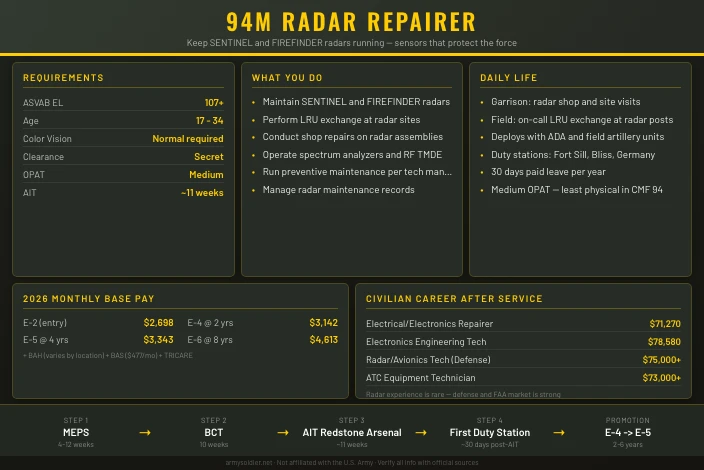
Job Role and Responsibilities
The 94M Radar Repairer performs unit, direct support, and general support maintenance on SENTINEL (Ground Based Sensor) and FIREFINDER radar electronic assemblies and associated equipment. Soldiers troubleshoot faults in radar transmitters, receivers, signal processors, display systems, and associated power and cooling systems. Senior 94Ms supervise maintenance sections and advise air defense and field artillery commanders on radar system readiness.
Daily Tasks
The day-to-day work centers on the maintenance shop and the radar site. In garrison, you’ll process work orders from SENTINEL and FIREFINDER operators, run diagnostic procedures using Army TMDE, and perform scheduled maintenance on radar electronic assemblies. Radar systems are large and complex – the SENTINEL radar alone has multiple line replaceable units (LRUs) that can be exchanged in the field, with removed LRUs going back to the shop for deeper repair.
At the radar site, when a system throws a fault or goes offline, the 94M diagnoses at the system level, identifies the failed assembly, performs the exchange, and verifies system performance before returning the radar to operational status. Speed matters – a radar site that is down is a gap in coverage.
- Troubleshoot SENTINEL and FIREFINDER radar electronic assemblies to the LRU level
- Perform field-level maintenance and LRU exchange at operational radar sites
- Conduct depot-level repair of returned radar assemblies in the maintenance shop
- Operate Army TMDE including spectrum analyzers and RF test sets for radar diagnostics
- Perform preventive maintenance services on radar systems per technical manual schedules
- Manage maintenance documentation and parts requisitions for radar support
Specific Roles
The 94M is part of Career Management Field 94, with a focused specialization in ground-based radar systems supporting artillery and air defense missions.
| Classification | Code | Description |
|---|---|---|
| Entry Level | 94M10 | Performs maintenance tasks under supervision |
| Journeyman | 94M20 | Executes independent field and shop maintenance on radar systems |
| Senior | 94M30 | Leads maintenance teams; manages radar maintenance section |
| Senior NCO | 94M40 | Advises commanders; manages radar maintenance programs at battalion and above |
Mission Contribution
FIREFINDER radars track incoming artillery, mortar, and rocket fire, computing the origin point so that friendly forces can engage the firing position. SENTINEL radars provide short-range air defense coverage by tracking low-altitude threats. Both functions are critical to force protection. A radar system that is not operational is a window of vulnerability – enemy indirect fire goes undetected, or an aircraft threat passes untracked. The 94M’s work directly determines whether those gaps exist.
Technology and Equipment
The primary radar systems in the 94M portfolio are the AN/TPQ-36 and AN/TPQ-37 FIREFINDER radars (countermortar and counterartillery), and the AN/MPQ-64 SENTINEL air surveillance radar. Maintenance work spans radar transmitters, traveling wave tube amplifiers, receivers, signal processors, antenna mechanical systems, display units, and IFF (Identification Friend or Foe) equipment. Diagnostic tools include spectrum analyzers, power meters, and radar-specific TMDE. The Army Air and Missile Defense Command oversees the broader radar systems portfolio.
Salary and Benefits
The 94M earns standard Army enlisted base pay, with allowances that substantially increase total compensation.
Base Pay (2026)
All figures reflect 2026 monthly base pay per DFAS.
| Grade | Rank | Entry Pay | 4-Year Pay |
|---|---|---|---|
| E-1 | Private (PV1) | $2,407/mo | $2,407/mo |
| E-2 | Private (PV2) | $2,698/mo | $2,698/mo |
| E-3 | Private First Class (PFC) | $2,837/mo | $3,198/mo |
| E-4 | Specialist (SPC) | $3,142/mo | $3,659/mo |
| E-5 | Sergeant (SGT) | $3,343/mo | $3,947/mo |
| E-6 | Staff Sergeant (SSG) | $3,401/mo | $4,069/mo |
| E-7 | Sergeant First Class (SFC) | $3,932/mo | $4,663/mo |
Allowances and Benefits
Tax-free allowances add meaningfully to base pay:
- Basic Allowance for Subsistence (BAS): $476.95/month for all enlisted soldiers
- Basic Allowance for Housing (BAH): Varies by duty station and dependency status. At Fort Sam Houston, an E-4 without dependents receives $1,359/month; with dependents, $1,728/month. High-cost installations pay more.
TRICARE Prime covers the soldier and enrolled family members at zero cost, with no enrollment fees and no copays for in-network care covering medical, dental, vision, mental health, and prescriptions.
Education benefits are available throughout service:
- Tuition Assistance: Up to $4,500/year on active duty, at $250 per semester hour
- Post-9/11 GI Bill: 36 months of benefits covering full in-state tuition at public schools, up to $29,920.95/year at private schools, monthly housing allowance, and $1,000/year for books
Work-Life Balance
Soldiers earn 30 days of paid leave per year, at 2.5 days monthly, plus 11 federal holidays. Air defense and field artillery units operate radar systems continuously in many tactical configurations, which means maintenance support can involve irregular hours when systems go down during operational periods. Garrison maintenance follows a more regular schedule, though readiness requirements at air defense units can compress available downtime.
Qualifications and Eligibility
The 94M requires the same EL score as 94H – the highest in CMF 94 – plus a Secret clearance. The relatively short AIT makes this one of the faster paths through the CMF 94 pipeline despite the high entry threshold.
Eligibility Requirements
| Requirement | Standard |
|---|---|
| Age | 17-34 (waiver possible to 39) |
| Citizenship | U.S. citizen required |
| Education | High school diploma (AFQT 31+) or GED (AFQT 50+) |
| ASVAB EL composite | 107 minimum |
| Physical demand category | Medium |
| Security clearance | Secret |
| Color vision | Normal color vision required |
| Medical | Meets Army MEPS standards (PULHES 222221) |
The EL composite formula is GS + AR + MK + EI. At 107, this is tied with 94H for the highest EL requirement in CMF 94. The Medium OPAT category is the least physically demanding in the series.
The Secret clearance process runs a National Agency Check with Local Agency and Credit Checks (NACLC). Financial history, employment record, education, references, and criminal background are all examined. The process typically takes three to six months.
Application Process
Selection Competitiveness
The EL 107 requirement is the highest threshold in CMF 94, so the qualified applicant pool is smaller than for lower-threshold specialties. Applicants with physics coursework, electronics experience, or any background in RF systems have a training advantage. Ask your recruiter about current bonus availability for CMF 94 positions – radar specialties have carried bonus eligibility in prior cycles depending on Army manning priorities.
Service Obligation
Soldiers enter at E-1 (Private, PV1). Standard enlistments run three to six years, followed by the Individual Ready Reserve period. The Secret clearance carries post-separation information protection obligations.
See our ASVAB study guide for strategies to hit these line scores, or take the PiCAT from home if you are a first-time tester.
Work Environment
Setting and Schedule
The 94M works in radar maintenance shops and at operational radar sites. Air defense and field artillery units operate radar systems at fixed and semi-permanent sites as well as in deployed configurations. Maintenance work splits between the shop – where detailed repairs happen at the component level – and the field site, where LRU exchanges restore systems to operational status quickly.
Radar sites operate continuously in many configurations, so maintenance support can require response outside normal duty hours. Shop operations in garrison follow more regular schedules, but air defense units with high readiness requirements can generate after-hours maintenance calls.
Leadership and Communication
Radar maintenance sections operate within air defense or field artillery units. A Maintenance Officer or Air Defense Artillery (ADA) Warrant Officer oversees maintenance programs; the section NCOIC, typically an SSG or SFC, manages daily work. The 94M communicates regularly with radar operators, ADA officers, and field artillery fire direction personnel about system status and maintenance priorities.
The NCOER governs formal performance feedback at E-5 and above. Junior soldiers receive monthly counseling from their immediate NCO. Radar maintenance sections are small, specialized groups where individual performance is closely observable.
Team Dynamics and Autonomy
Radar maintenance demands competency before autonomy. New 94Ms work under supervision until they demonstrate proficiency on SENTINEL and FIREFINDER systems. A radar cleared as serviceable by a 94M is immediately returned to operational status – there is no second check before it goes live.
Experienced E-4 and E-5 soldiers work independently on familiar systems. Senior NCOs manage the section’s workload, coordinate with supported units on readiness priorities, and provide the radar-specific technical authority that ADA and field artillery officers rely on.
Job Satisfaction and Retention
Soldiers who enjoy electronics combined with the operational urgency of radar systems – where a repair directly enables the unit’s fire support or force protection capability – tend to find this field engaging. Radar-specific experience is rare enough in the civilian market that 94Ms with solid backgrounds can be selective about post-service opportunities.
Training and Skill Development
Initial Training
The 94M pipeline runs through BCT then AIT at Redstone Arsenal, Alabama.
| Phase | Location | Length | Focus |
|---|---|---|---|
| Basic Combat Training (BCT) | Various installations | 10 weeks | Soldiering fundamentals, physical fitness, weapons qualification |
| Advanced Individual Training (AIT) | Redstone Arsenal, AL | ~11 weeks | Radar theory, SENTINEL and FIREFINDER system maintenance, RF diagnostics |
AIT covers radar fundamentals including transmitter and receiver theory, antenna systems, signal processing, IFF electronics, and hands-on maintenance of SENTINEL and FIREFINDER radar assemblies. The shorter pipeline compared to other CMF 94 courses focuses the training on the specific radar platforms in the Army’s inventory rather than broad electronics theory. Graduates leave prepared to perform LRU exchange and basic shop repair from their first assignment.
Advanced Training
Post-AIT development accelerates a 94M’s capabilities:
- Radar upgrade courses: New radar variants and system upgrades require formal training; soldiers attend fielding courses when their units receive upgraded systems
- AN/TPQ-53 Firefinder training: The AN/TPQ-53 “Firefinder” is the Army’s next-generation counterfire radar; 94Ms supporting units that field this system attend dedicated training
- Advanced Leader Course (ALC): Required for SSG; adds maintenance management and leadership content
- Senior Leader Course (SLC): Required for SFC; covers operational-level maintenance support planning
- Army COOL Program: Funds exam fees for electronics certifications with civilian applicability
Tuition Assistance supports off-duty coursework for soldiers pursuing technical degrees while serving.
Everything starts with qualifying ASVAB scores — our study guide covers what to study first.
Career Progression and Advancement
Career Path
Early promotions follow semi-automatic timelines. E-5 and above requires competitive boards, education requirements, and promotion points.
| Rank | Grade | Typical Time-in-Grade | Role |
|---|---|---|---|
| Private (PV1) | E-1 | 0-6 months | Initial entry, training |
| Private (PV2) | E-2 | 6 months | Completing BCT/AIT |
| Private First Class (PFC) | E-3 | 12 months | First duty station, supervised radar maintenance |
| Specialist (SPC) | E-4 | 24 months | Independent LRU exchange and shop repairs |
| Sergeant (SGT) | E-5 | 4-6 years | Team leader, supervises section maintenance |
| Staff Sergeant (SSG) | E-6 | 7-10 years | Section NCOIC, manages radar maintenance schedule |
| Sergeant First Class (SFC) | E-7 | 10-15 years | Platoon Sergeant, advises ADA/FA maintenance officer |
| Master Sergeant (MSG) | E-8 | 16-22 years | Senior radar maintenance advisor, battalion level |
| Sergeant Major (SGM) | E-9 | 22+ years | Command advisor on radar system readiness |
Specialization Options
Senior 94Ms with strong technical backgrounds can pursue warrant officer programs in electronic systems maintenance. The CMF 94 progression through 94M40 positions soldiers for senior roles in ADA and field artillery sustainment commands. The small 94M population means senior NCOs carry substantial program responsibility.
Role Flexibility and Transfers
Transfers within CMF 94 are accessible after the initial obligation. The high EL score supports reclassification into other electronics and technical specialties. The Secret clearance is already in place for moves into clearance-requiring MOSs.
Performance Evaluation
NCO evaluations assess Character, Presence, Intellect, Leads, and Develops. For a 94M, radar system readiness rates for supported units, accuracy of maintenance documentation, and effectiveness of subordinate training carry the most weight in supervisor assessments.
Physical Demands and Medical Evaluations
Physical Requirements
The 94M carries a Medium physical demand category – the least demanding in CMF 94. Daily work involves handling radar line replaceable units, transporting TMDE to field sites, and working on electronic assemblies. Regular lifting is in the 20 to 50-pound range. The work is primarily electronics-focused and does not involve the heavy component handling of Very Heavy OPAT specialties.
Normal color vision is required for wiring diagram interpretation and component identification.
Army Fitness Test (AFT) Standards
All soldiers must pass the Army Fitness Test (AFT), which replaced the ACFT on June 1, 2025. Five events scored 0-100 each produce a maximum of 500 points. The general passing standard is 300 total (60 per event minimum), normed by sex and age. The 94M is not a designated combat MOS, so the 350-point combat specialty standard does not apply.
| Event | Abbreviation | Description |
|---|---|---|
| 3 Repetition Maximum Deadlift | MDL | Lower body and core strength |
| Hand Release Push-Up | HRP | Upper body muscular endurance |
| Sprint-Drag-Carry | SDC | Anaerobic capacity and functional movement |
| Plank | PLK | Core endurance |
| Two-Mile Run | 2MR | Aerobic capacity |
Minimum per-event score is 60 points.
Medical Evaluations
Standard periodic medical readiness assessments apply throughout the career. Normal color vision is required and checked at MEPS. The Secret clearance requires ongoing reporting of events that could affect clearance eligibility.
Deployment and Duty Stations
Deployment Details
The 94M deploys with air defense and field artillery units that operate SENTINEL and FIREFINDER radars. These systems deploy to every major theater of operations. ADA units in particular have been consistently forward deployed in support of force protection requirements in Europe, the Middle East, and the Pacific. Typical deployment lengths run nine to twelve months, with around two years dwell time at home station.
Location Flexibility
ADA and field artillery units with radar equipment concentrate at specific installations. Common duty stations for 94Ms include:
- Fort Sill, OK (Fires Center of Excellence, home of ADA and Field Artillery)
- Fort Bliss, TX (Air Defense Artillery Brigade)
- Fort Campbell, KY (101st Airborne ADA)
- Fort Liberty (formerly Fort Bragg), NC (XVIII Airborne Corps ADA)
- Germany (Grafenwoehr / Ansbach) (USAREUR ADA units)
- Korea (Camp Humphreys) (2nd Infantry Division ADA)
- Fort Wainwright, AK (11th Airborne Division ADA)
Assignment preferences go through HRC, weighed against Army requirements.
Risk, Safety, and Legal Considerations
Job Hazards
Radar systems generate high-power RF emissions that require strict power-down procedures before maintenance. Non-ionizing radiation exposure is a real hazard around active radar transmitters. High-voltage power systems in radar electronics present shock risk. Working at radar sites in forward operational areas exposes soldiers to the tactical environment.
Safety Protocols
Radiation safety training is mandatory for all personnel working on radar systems. Technical manual procedures govern every maintenance action, and no work is done on energized radar assemblies without proper isolation procedures. All completed maintenance is verified against system performance standards before the radar returns to operational status.
Security and Legal Requirements
The Secret clearance requires self-reporting of life events that could affect eligibility. Soldiers must report foreign travel, foreign national contacts, financial changes, and legal issues to their security officer. Post-separation obligations to protect classified information continue under federal law.
Impact on Family and Personal Life
Family Considerations
ADA units with radar systems maintain high readiness standards that can generate irregular duty hours when systems go down or during extended operational periods. Families at ADA-heavy installations such as Fort Sill and Fort Bliss benefit from established military community infrastructure and family support programs.
TRICARE covers family members at zero enrollment cost. BAH covers housing on or off post. Military OneSource and FRG networks provide additional support resources.
Relocation and Flexibility
PCS moves occur every two to three years. ADA and field artillery units concentrate at Fort Sill and a handful of other installations, which limits assignment flexibility somewhat compared to Army-wide specialties. OCONUS tours in Germany and Korea are common and include overseas incentive pays.
Reserve and National Guard
The 94M Radar Repairer MOS is found primarily in the Army National Guard. Guard air defense artillery (ADA) and field artillery units operate most of the Army’s ground-based radar systems, including the AN/TPQ-36 and AN/TPQ-37 Firefinder radars. Some Army Reserve positions exist, but the Guard carries the majority of part-time 94M slots. If you want to maintain radar systems while serving part-time, the Guard is the most likely path.
Drill Schedule and Training Commitment
Guard 94M soldiers follow the standard one weekend per month and two weeks of annual training. Radar systems are complex electronics platforms, so drill weekends often include diagnostic training, software updates, and hands-on troubleshooting. When a new radar platform enters the unit or a major software update rolls out, expect extra training days. Plan for 2 to 4 additional duty days per year beyond the standard schedule, especially during live-fire exercise preparation when radar systems must be fully operational.
Part-Time Pay and Benefits
An E-4 with about four years of service earns roughly $488 per drill weekend in 2026. Over 12 weekends, that totals about $5,856 per year from drill pay alone. Annual training and extra training days add more. Active-duty E-4s earn $3,659 per month.
Tricare Reserve Select costs $57.88 per month for individual coverage or $286.66 for a family plan. Active-duty TRICARE Prime has no premiums. Federal Tuition Assistance and the Montgomery GI Bill-Selected Reserve (Chapter 1606) cover education. Guard members in many states get state tuition waivers. Retirement is points-based with payments starting at age 60.
Deployment and Mobilization
Guard ADA and field artillery units with radar systems deploy for air defense and counter-fire missions. Mobilization cycles typically run every 3 to 5 years for 9 to 12 months. Radar operators and repairers are needed wherever the Army sets up fire detection or air surveillance, so demand is consistent during deployments. Guard soldiers may also be activated for state missions, though radar specialists are less commonly called for domestic emergencies.
Civilian Career Integration
Radar repair experience opens doors to specialized civilian positions. The FAA hires radar maintenance technicians for air traffic control facilities. The National Weather Service needs radar technicians for its NEXRAD weather radar network. Defense contractors like Raytheon/RTX and Northrop Grumman recruit veterans with radar maintenance backgrounds for field service and depot-level positions. A Secret clearance, which most 94M soldiers hold, adds hiring value in the defense sector. USERRA protects your civilian job during Guard service, and employers in the radar and electronics fields value the hands-on systems knowledge that military radar repairers bring.
| Feature | Active Duty | Army Reserve | Army National Guard |
|---|---|---|---|
| Commitment | Full-time | One weekend/month, two weeks/year | One weekend/month, two weeks/year |
| Monthly Pay (E-4, ~4 yrs) | $3,659 | ~$488/drill weekend | ~$488/drill weekend |
| Healthcare | TRICARE Prime, $0 premiums | Tricare Reserve Select, $57.88/month | Tricare Reserve Select, $57.88/month |
| Education | Post-9/11 GI Bill | Federal TA, MGIB-SR | Federal TA, MGIB-SR, state tuition waivers |
| Deployment | Regular rotations | Mobilization-based | Mobilization-based, plus state activations |
| Retirement | 20-year pension, immediate | Points-based, age 60 | Points-based, age 60 |
Post-Service Opportunities
Transition to Civilian Life
Radar technician experience is genuinely rare outside of military and aerospace environments. Defense contractors supporting Army radar programs, FAA air traffic control facilities, weather radar maintenance organizations, and aerospace manufacturers all hire radar-experienced technicians. The combination of Secret clearance and radar-specific technical background is a strong package in the defense market.
The Transition Assistance Program (TAP) provides resume preparation and employer connections during the final six months of service. The Army COOL program funds certification exam fees for electronics credentials with civilian value.
Civilian Career Prospects
| Civilian Job | Median Annual Salary | Job Outlook |
|---|---|---|
| Electrical/Electronics Repairer | $71,270 | Stable, ~9,600 openings/year |
| Electronics Engineering Technician | $78,580 | 2% growth, 2024-2034 |
| Radar/Avionics Technician (Defense) | $75,000-$100,000+ | Strong demand with clearance |
| Air Traffic Control Equipment Tech | $73,000-$95,000 | FAA and contract demand |
Salary data from the Bureau of Labor Statistics (May 2024). Defense contractor and FAA roles for cleared radar technicians typically exceed BLS medians.
Is This a Good Job for You? The Right (and Wrong) Fit
Ideal Candidate Profile
The 94M fits someone who can achieve a high EL score and is genuinely interested in radar – how it works, why it matters, and how RF energy becomes situational awareness. The diagnostic work requires understanding of radar fundamentals, not just component swapping. Soldiers who read about RF systems voluntarily and find the physics of radar engaging will get more out of this MOS than those who treat it as just another electronics job.
A clean background for the clearance is important. The Medium OPAT category makes the physical demands accessible to a wider range of candidates than the Very Heavy specialties.
Potential Challenges
The EL 107 threshold is real. Applicants who score in the mid-90s on the electronics composite will need to retake the ASVAB to qualify. Preparation specifically targeting GS, AR, MK, and EI subtests is worth the investment.
Radar systems are specialized enough that if your unit doesn’t operate SENTINEL or FIREFINDER, your day-to-day work may involve more general electronics maintenance than radar-specific tasks. Assignment to an ADA unit is the fastest way to build genuine radar expertise.
The Secret clearance adds timeline uncertainty. Address any background complications early in the process.
Career and Lifestyle Alignment
This MOS fits a long-term career in electronics maintenance at the technical frontier of air defense and counterfire systems. The skillset applies to both ADA and FA units, and the post-service options in radar and aerospace electronics are strong. The shorter AIT compared to other CMF 94 specialties means faster arrival at a first duty station, which appeals to candidates who want to get into the operational environment quickly.
The wrong fit: someone who wants to avoid the clearance process or who isn’t prepared to score at the high end of electronics aptitude testing. The barriers to entry are real, but they also protect the value of the credential once you have it.
More Information
Talk to an Army recruiter to check whether your ASVAB scores meet the 94M EL 107 requirement. If you’re close, discuss a retest timeline and targeted study plan. Connect online at goarmy.com or visit your nearest recruiting station.
- Prepare for the ASVAB with our study guide to make sure your line scores qualify
This site is not affiliated with the U.S. Army or any government agency. Verify all information with official Army sources before making enlistment or career decisions.
Explore more Army maintenance careers such as 94H TMDE Support Specialist and 94P Multiple Launch Rocket System Repairer.