94P Multiple Launch Rocket System Repairer
The M270 Multiple Launch Rocket System and the M142 HIMARS are among the most effective artillery systems the U.S. Army fields. They can place a precision rocket on a target 40 miles away or saturate a grid with unguided fire in seconds. Keeping them ready to do that requires a maintainer who understands both the heavy mechanical systems of a self-propelled launcher and the electronics that control fire direction and guidance. That’s the 94P. This MOS has the lowest EL threshold in CMF 94, a 19-week AIT at Redstone Arsenal, a Secret clearance requirement, and Very Heavy physical demands. If you’re drawn to large weapons systems and don’t mind physically demanding maintenance work, 94P puts you on some of the most capable fire support platforms the Army operates.
Qualifying requires specific ASVAB line scores — our ASVAB study guide covers what to target and how to prepare.
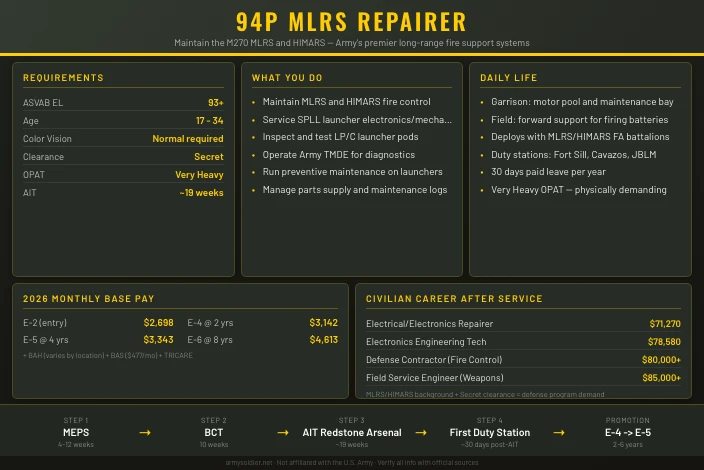
Job Role and Responsibilities
The 94P Multiple Launch Rocket System Repairer performs direct support and general support maintenance on the M270 MLRS, M270A1, HIMARS (M142), Self-Propelled Launcher Loader (SPLL), Launcher Pod/Container (LP/C) trainer, and Test Support Group equipment. Soldiers troubleshoot electronic and electromechanical faults in fire control systems, launcher electronics, and associated test equipment, and perform maintenance on launcher structural and mechanical components within their authority. Senior 94Ps supervise maintenance sections and advise field artillery commanders on MLRS and HIMARS readiness.
Daily Tasks
MLRS and HIMARS maintenance covers more physical ground than most CMF 94 specialties. The launcher vehicles are large tracked or wheeled platforms, and maintenance involves working at height on the launcher cradle, inside the cab electronics, and on the fire control systems that aim and launch the rockets.
In garrison, a typical day runs through scheduled maintenance services, work order processing, and diagnostic checks on launchers and fire control systems. You’ll coordinate with MLRS crews on symptoms, pull technical manuals, and systematically isolate faults before executing repairs or replacing components.
Field operations push you forward to the firing batteries. MLRS and HIMARS fire missions happen on unpredictable schedules, and a launcher that goes down between missions needs fast turnaround to stay in the fight.
- Troubleshoot and repair fire control electronics on M270, M270A1, and HIMARS platforms
- Maintain and repair SPLL launcher electronics and mechanical assemblies within maintenance authority
- Service and inspect LP/C launchers and training devices
- Operate Army TMDE for electronic system diagnostics on launcher platforms
- Perform preventive maintenance services per MLRS and HIMARS technical manuals
- Manage work orders, parts requisitions, and maintenance documentation
Specific Roles
The 94P is part of Career Management Field 94, focused on the Army’s rocket artillery systems – both the tracked M270 and the wheeled HIMARS that has seen extensive use in recent operations.
| Classification | Code | Description |
|---|---|---|
| Entry Level | 94P10 | Performs maintenance tasks under supervision |
| Journeyman | 94P20 | Executes independent maintenance on MLRS/HIMARS platforms |
| Senior | 94P30 | Leads maintenance sections; manages MLRS maintenance programs |
| Senior NCO | 94P40 | Advises commanders; manages battalion-level MLRS readiness |
Mission Contribution
MLRS and HIMARS have been centerpieces of U.S. and allied fires capability in recent conflicts. HIMARS systems fired GMLRS precision rockets that have been decisive in multiple theaters, and the systems’ range and mobility make them priorities for adversaries to target and counter. A firing battery with degraded launchers cannot execute the fire missions that maneuver commanders depend on. The 94P is the maintenance link between a launcher that can shoot and one that sits on the flight line waiting for parts.
Technology and Equipment
The 94P works across the M270 family (tracked, belt-fed launcher that carries two pods of six rockets or two ATACMS missiles) and the M142 HIMARS (wheeled, carries one pod, faster and more deployable). Fire control systems on both platforms include digital fire control computers, position/navigation systems, and launcher positioning electronics. The M270A1 variant adds improved fire control and compatibility with precision munitions. TMDE used in diagnostics includes system-specific electronic test equipment and standard Army diagnostic tools.
Salary and Benefits
The 94P earns standard Army enlisted base pay. Allowances substantially increase total compensation beyond the base figure.
Base Pay (2026)
All figures reflect 2026 monthly base pay per DFAS.
| Grade | Rank | Entry Pay | 4-Year Pay |
|---|---|---|---|
| E-1 | Private (PV1) | $2,407/mo | $2,407/mo |
| E-2 | Private (PV2) | $2,698/mo | $2,698/mo |
| E-3 | Private First Class (PFC) | $2,837/mo | $3,198/mo |
| E-4 | Specialist (SPC) | $3,142/mo | $3,659/mo |
| E-5 | Sergeant (SGT) | $3,343/mo | $3,947/mo |
| E-6 | Staff Sergeant (SSG) | $3,401/mo | $4,069/mo |
| E-7 | Sergeant First Class (SFC) | $3,932/mo | $4,663/mo |
Allowances and Benefits
Two tax-free allowances add substantially to take-home pay:
- Basic Allowance for Subsistence (BAS): $476.95/month for all enlisted soldiers
- Basic Allowance for Housing (BAH): Varies by duty station and dependency status. At Fort Sam Houston, an E-4 without dependents receives $1,359/month; with dependents, $1,728/month. High-cost installations pay significantly more.
TRICARE Prime covers the soldier and enrolled family members at zero enrollment cost, with no copays for in-network medical, dental, vision, mental health, and prescriptions.
Education benefits:
- Tuition Assistance: Up to $4,500/year on active duty at $250 per semester hour
- Post-9/11 GI Bill: 36 months of benefits including full in-state tuition at public universities, up to $29,920.95/year at private schools, monthly housing allowance, and $1,000/year for books
Work-Life Balance
Soldiers earn 30 days of paid leave per year, at 2.5 days monthly, plus 11 federal holidays. Field artillery units operate on training cycles tied to gunnery tables and live-fire exercises, which generate extended maintenance periods before and after major events. Maintenance sections in MLRS battalions can have long days during high-tempo training periods and before deployment. Combat deployments add tax benefits and special pays.
Qualifications and Eligibility
The 94P has the lowest EL threshold in CMF 94 at 93, combined with a Secret clearance requirement and Very Heavy physical demands. The combination is different from other CMF 94 specialties – more accessible on the ASVAB, more demanding physically.
Eligibility Requirements
| Requirement | Standard |
|---|---|
| Age | 17-34 (waiver possible to 39) |
| Citizenship | U.S. citizen required |
| Education | High school diploma (AFQT 31+) or GED (AFQT 50+) |
| ASVAB EL composite | 93 minimum |
| Physical demand category | Very Heavy |
| Security clearance | Secret |
| Color vision | Normal color vision required |
| Medical | Meets Army MEPS standards (PULHES 222221) |
The EL composite formula is GS + AR + MK + EI. At 93, this is the most accessible EL threshold in CMF 94, though it still requires solid electronics aptitude. The Very Heavy OPAT category means physical strength is tested and required at MEPS.
The Secret clearance runs a National Agency Check with Local Agency and Credit Checks (NACLC). Financial history, employment, education, references, and criminal background are examined. The process typically runs three to six months.
Application Process
Selection Competitiveness
The 94P’s lower EL threshold makes it accessible to more applicants than other CMF 94 specialties, but the Very Heavy OPAT and Secret clearance are real filters. Applicants who are physically strong and have clean backgrounds for clearance are well-positioned. Check with your recruiter for current bonus availability – MLRS specialties have carried enlistment bonus eligibility in prior recruiting cycles.
Service Obligation
Soldiers enter at E-1 (Private, PV1). Standard enlistment runs three to six years, followed by time in the Individual Ready Reserve. The Secret clearance carries post-separation information protection obligations.
See our ASVAB study guide for strategies to hit these line scores, or take the PiCAT from home if you are a first-time tester.
Work Environment
Setting and Schedule
The 94P works in maintenance bays and motor pools supporting MLRS and HIMARS firing batteries. The launcher vehicles require maintenance in conditions ranging from climate-controlled bays to open motor pools in hot Texas summers or cold European winters. Electronic maintenance often happens inside the cab and fire control compartments; mechanical work happens on the launcher cradle and chassis.
Field artillery units run to training and readiness cycles. Pre-gunnery periods involve intensive maintenance to bring all launchers to full readiness. Post-gunnery involves recovery maintenance. The cycle can compress available personal time significantly around major training events.
Leadership and Communication
MLRS and HIMARS maintenance sections operate within field artillery battalions. A Field Artillery Warrant Officer or Maintenance Officer oversees the maintenance program; the section NCOIC, typically an SSG or SFC, manages daily work. The 94P communicates with firing battery crews, Fire Direction Centers, and the battalion S4 about launcher status and readiness reporting.
The NCOER governs formal performance feedback at E-5 and above. Junior soldiers receive monthly counseling from their immediate NCO.
Team Dynamics and Autonomy
New 94Ps work under close supervision on launcher systems. MLRS and HIMARS maintenance carries direct consequences for fire support capability – a launcher cleared as serviceable that has a latent fault could fail at a critical moment. Quality control inspections review completed maintenance before systems return to operational status.
Experienced E-4 and E-5 soldiers work with substantial autonomy on maintenance tasks within their technical proficiency. Senior NCOs manage the maintenance section’s workload, ensure parts supply, and serve as the battalion’s technical authority on MLRS and HIMARS electronics.
Job Satisfaction and Retention
Soldiers who are drawn to large weapons platforms and enjoy the combination of electronic and mechanical maintenance tend to stay in this field. The HIMARS system in particular has high operational relevance – soldiers who maintain it know they’re supporting a system that has seen real-world use in major operations. The clearance and weapons system experience together create a post-service profile that defense contractors value.
Training and Skill Development
Initial Training
The 94P pipeline runs through BCT then AIT at Redstone Arsenal, Alabama.
| Phase | Location | Length | Focus |
|---|---|---|---|
| Basic Combat Training (BCT) | Various installations | 10 weeks | Soldiering fundamentals, physical fitness, weapons qualification |
| Advanced Individual Training (AIT) | Redstone Arsenal, AL | ~19 weeks | MLRS/HIMARS electronics, fire control systems, launcher mechanical systems, TMDE operations |
AIT covers MLRS and HIMARS system fundamentals including fire control electronics, launcher positioning systems, electrical system maintenance, and mechanical systems within the 94P’s maintenance authority. Practical exercises include fault diagnosis on actual launcher systems and fire control equipment. The curriculum is heavier on systems-level maintenance than fundamental electronics theory, reflecting the specific platform focus of the MOS.
Graduates leave AIT ready to support MLRS and HIMARS units from their first assignment, executing scheduled maintenance and responding to unscheduled maintenance as part of the battery’s operational cycle.
Advanced Training
Development continues after AIT and initial assignment:
- M270A1 and HIMARS upgrade courses: Platform variants and upgrades require formal training; soldiers attend fielding courses when their units transition to new variants or receive updated fire control systems
- Advanced Leader Course (ALC): Required for SSG promotion; adds maintenance management and leadership content alongside technical skills
- Senior Leader Course (SLC): Required for SFC; covers operational-level maintenance support planning in FA units
- Army COOL Program: Funds exam fees for electronics certifications applicable to post-service employment
- Warrant Officer pathway: Experienced CMF 94 NCOs with strong technical backgrounds can pursue electronic systems maintenance warrant officer programs
Tuition Assistance supports off-duty coursework at accredited institutions.
Everything starts with qualifying ASVAB scores — our study guide covers what to study first.
Career Progression and Advancement
Career Path
Early rank progression follows semi-automatic timelines. E-5 and above requires competitive promotion boards, education requirements, and accumulated promotion points.
| Rank | Grade | Typical Time-in-Grade | Role |
|---|---|---|---|
| Private (PV1) | E-1 | 0-6 months | Initial entry, training |
| Private (PV2) | E-2 | 6 months | Completing BCT/AIT |
| Private First Class (PFC) | E-3 | 12 months | First duty station, supervised launcher maintenance |
| Specialist (SPC) | E-4 | 24 months | Independent maintenance on MLRS/HIMARS systems |
| Sergeant (SGT) | E-5 | 4-6 years | Team leader, supervises section maintenance |
| Staff Sergeant (SSG) | E-6 | 7-10 years | Section NCOIC, manages maintenance schedule and supply |
| Sergeant First Class (SFC) | E-7 | 10-15 years | Platoon Sergeant, advises FA maintenance officer |
| Master Sergeant (MSG) | E-8 | 16-22 years | Senior MLRS maintenance manager, battalion advisor |
| Sergeant Major (SGM) | E-9 | 22+ years | Command advisor on MLRS/HIMARS readiness |
Specialization Options
Senior 94Ps can pursue warrant officer programs in electronic systems maintenance to manage MLRS/HIMARS readiness programs at battalion and above. The skill level progression through 94P40 positions soldiers for senior maintenance roles in field artillery sustainment commands and Army materiel commands supporting the MLRS/HIMARS program.
Role Flexibility and Transfers
After the initial obligation, MOS transfers are possible. Movement within CMF 94 is accessible and the Secret clearance supports reclassification into other electronics and technical specialties. Cross-CMF transfers to field artillery maintenance positions are also possible given the platform overlap.
Performance Evaluation
NCO evaluations assess Character, Presence, Intellect, Leads, and Develops. For a 94P, launcher readiness rates for supported firing batteries, parts management efficiency, and subordinate development carry significant weight in supervisor assessments.
Physical Demands and Medical Evaluations
Physical Requirements
The Very Heavy OPAT category reflects real daily physical demands. MLRS and HIMARS launcher maintenance involves lifting heavy electronic assemblies and mechanical components, climbing on large vehicles, working overhead on launcher cradles, and moving equipment around motor pools and field sites. Regular lifting is in the 60 to 80-pound range, with some tasks exceeding that. This is the most physically demanding technical MOS in CMF 94.
Normal color vision is required for wiring diagram interpretation and component identification.
Army Fitness Test (AFT) Standards
All soldiers must pass the Army Fitness Test (AFT), which replaced the ACFT on June 1, 2025. Five events scored 0-100 each produce a maximum of 500 points. The passing standard is 300 total (60 per event minimum), normed by sex and age. The 94P is not a designated combat MOS, so the 350-point combat specialty standard does not apply.
| Event | Abbreviation | Description |
|---|---|---|
| 3 Repetition Maximum Deadlift | MDL | Lower body and core strength |
| Hand Release Push-Up | HRP | Upper body muscular endurance |
| Sprint-Drag-Carry | SDC | Anaerobic capacity and functional movement |
| Plank | PLK | Core endurance |
| Two-Mile Run | 2MR | Aerobic capacity |
Minimum per-event score is 60 points. The Very Heavy OPAT category means you’ll need to demonstrate strength at MEPS before assignment.
Medical Evaluations
Standard periodic medical readiness assessments apply throughout the career. Normal color vision is required and checked at MEPS. The Secret clearance requires ongoing reporting of events that could affect eligibility.
Deployment and Duty Stations
Deployment Details
The 94P deploys with MLRS and HIMARS battalions in field artillery brigades. These units have been among the most actively deployed in recent operations, particularly in support of partner forces and coalition missions where HIMARS has been a critical enabler. Standard deployment lengths run nine to twelve months. Dwell time is typically around two years at home station, though operational demands have driven higher optempo for some fire support units.
Location Flexibility
MLRS and HIMARS units concentrate at field artillery installations. Common duty stations for 94Ps include:
- Fort Sill, OK (Fires Center of Excellence, multiple FA brigades)
- Fort Cavazos, TX (III Corps FA units)
- Fort Lewis (Joint Base Lewis-McChord), WA (I Corps FA)
- Fort Bragg (Fort Liberty), NC (XVIII Airborne Corps FA)
- Fort Campbell, KY (101st Airborne FA)
- Germany (Grafenwoehr) (USAREUR FA units)
- Korea (Camp Humphreys) (2nd Infantry Division FA)
Assignment preferences go through HRC career managers, weighed against Army manning requirements.
Risk, Safety, and Legal Considerations
Job Hazards
MLRS and HIMARS are energetic weapons systems. Launcher pod containers hold live rockets in storage and transit configurations, and maintenance procedures involving loaded pods or post-firing systems require strict weapons safety compliance. High-voltage electronics in fire control systems present shock risk. Working on or around large tracked and wheeled vehicles carries crush and fall hazards. Field operations place maintenance soldiers in the same operational environment as the firing battery.
Safety Protocols
All maintenance on launcher systems follows Army technical manuals and weapons safety regulations. No improvisation is authorized on components that interface with the weapons firing system. Weapons safety training for MLRS and HIMARS is mandatory before performing maintenance. Quality control inspections verify completed work before launchers return to operational status.
Security and Legal Requirements
The Secret clearance requires self-reporting of events that could affect eligibility throughout service. Post-separation obligations to protect classified information continue under federal law. UCMJ applies throughout service, and maintenance errors involving weapons systems are subject to JAG investigation if they contribute to mishaps.
Impact on Family and Personal Life
Family Considerations
Field artillery units operate on demanding training cycles tied to gunnery exercises and deployment rotations. Extended hours around gunnery tables and before deployments are a regular feature of life in MLRS and HIMARS battalions. Families at Fort Sill and Fort Cavazos benefit from well-established military communities with strong FRG networks and on-post resources.
TRICARE covers family members at zero enrollment cost. BAH covers housing on or off post. Military OneSource provides counseling and support services at no cost.
Relocation and Flexibility
PCS moves happen every two to three years. Field artillery units are present at several major installations, which gives 94Ps reasonable geographic options over a career. OCONUS tours in Germany and Korea are common and include overseas incentive pays.
Reserve and National Guard
The 94P MLRS Repairer MOS is available in both the Army Reserve and the Army National Guard. Guard field artillery brigades operate MLRS and HIMARS launchers in several states, creating a steady demand for 94P soldiers in the Guard. Some Reserve units also maintain rocket launcher systems. The recent increase in HIMARS production and fielding has expanded the number of part-time slots for this MOS across both components.
Drill Schedule and Training Commitment
Reserve and Guard 94P soldiers follow the standard one weekend per month and two weeks of annual training. Drill weekends focus on launcher system maintenance, fire control diagnostics, and electronics troubleshooting. Before live-fire exercises, units typically schedule extra maintenance training days to ensure launchers are fully operational. Expect 2 to 4 additional duty days per year. Annual training often includes field exercises where 94P soldiers maintain launchers under simulated combat conditions.
Part-Time Pay and Benefits
An E-4 with about four years of service earns roughly $488 per drill weekend in 2026, totaling about $5,856 per year from weekend drills. Annual training and extra duty days add more paid time. Active-duty E-4s earn $3,659 per month.
Tricare Reserve Select costs $57.88 per month for individual coverage or $286.66 for a family plan. Active-duty TRICARE Prime has no premiums. Federal Tuition Assistance and the Montgomery GI Bill-Selected Reserve (Chapter 1606) fund education costs. Guard soldiers in many states receive state tuition waivers. Retirement is points-based with payments starting at age 60.
Deployment and Mobilization
HIMARS has been one of the most in-demand weapons systems in recent operations, which has increased mobilization frequency for Guard and Reserve rocket artillery units. Mobilization typically runs 9 to 12 months. 94P soldiers deploy wherever MLRS or HIMARS launchers go, providing field maintenance that keeps launchers operational. The demand for HIMARS support shows no signs of slowing down, so 94P soldiers should expect a higher mobilization tempo than many other maintenance MOS.
Civilian Career Integration
MLRS/HIMARS maintenance experience transfers to defense contractor positions with companies like Lockheed Martin, which builds the HIMARS system. Field service representative roles, depot maintenance positions, and international military sales support are common civilian paths. A Secret clearance, which most 94P soldiers hold, increases hiring value. Electronics troubleshooting skills also transfer to broader industrial electronics repair. USERRA protects your civilian job during military service, and defense contractors who build and support Army weapons systems actively recruit from the Reserve and Guard workforce.
| Feature | Active Duty | Army Reserve | Army National Guard |
|---|---|---|---|
| Commitment | Full-time | One weekend/month, two weeks/year | One weekend/month, two weeks/year |
| Monthly Pay (E-4, ~4 yrs) | $3,659 | ~$488/drill weekend | ~$488/drill weekend |
| Healthcare | TRICARE Prime, $0 premiums | Tricare Reserve Select, $57.88/month | Tricare Reserve Select, $57.88/month |
| Education | Post-9/11 GI Bill | Federal TA, MGIB-SR | Federal TA, MGIB-SR, state tuition waivers |
| Deployment | Regular rotations | Mobilization-based | Mobilization-based, plus state activations |
| Retirement | 20-year pension, immediate | Points-based, age 60 | Points-based, age 60 |
Post-Service Opportunities
Transition to Civilian Life
The 94P leaves service with a combination of weapons electronics maintenance experience, MLRS/HIMARS-specific system knowledge, and a Secret clearance. Defense contractors supporting Army fire support programs – including PEO Missiles and Space, the MLRS/HIMARS program office, and international military sales programs – actively recruit soldiers with this background. The combination of large systems electronics maintenance and clearance is a strong starting point in the defense industrial base.
The Transition Assistance Program (TAP) at the soldier’s final installation helps with resume preparation and employer connections. The Army COOL program funds certification exam fees for electronics credentials applicable after service.
Civilian Career Prospects
| Civilian Job | Median Annual Salary | Job Outlook |
|---|---|---|
| Electrical/Electronics Repairer | $71,270 | Stable, ~9,600 openings/year |
| Electronics Engineering Technician | $78,580 | 2% growth, 2024-2034 |
| Defense Contractor (Fire Control Systems) | $80,000-$110,000+ | Strong demand with clearance |
| Field Service Engineer (Weapons Systems) | $85,000-$120,000+ | Program-dependent demand |
Salary data from the Bureau of Labor Statistics (May 2024). Defense roles for cleared technicians with weapons system backgrounds routinely exceed BLS medians.
Is This a Good Job for You? The Right (and Wrong) Fit
Ideal Candidate Profile
The 94P is a strong fit for someone who is physically capable (Very Heavy OPAT is a real threshold), has a solid electronics aptitude in the EL 93 range, and wants to work on one of the Army’s premier fire support platforms. The combination of electronics and mechanical systems on MLRS and HIMARS suits soldiers who like variety in their technical work rather than pure bench repair.
An interest in weapons systems and fire support – understanding how a HIMARS fires a GMLRS rocket and why the fire control system accuracy matters – helps sustain motivation through the training pipeline and garrison maintenance cycles.
Potential Challenges
The Very Heavy OPAT category is a genuine barrier for physically smaller or less conditioned candidates. Start a strength training program before visiting the recruiter if your current physical baseline is questionable.
The combination of physical demands and electronics maintenance is uncommon. Some soldiers who expected a purely technical job find the physical requirements of working on launcher vehicles more demanding than anticipated. The reverse is also possible – mechanically-minded applicants who are strong physically may find the electronics content more academic than expected.
AIT runs about 19 weeks at Redstone Arsenal. It covers both electronic fire control systems and launcher-specific mechanical content, which makes it more technically diverse than single-system AIT courses but also longer.
Career and Lifestyle Alignment
This MOS fits someone who wants to be close to the operational edge of what Army field artillery can do. HIMARS is arguably one of the most relevant platforms the Army operates in current and future conflict scenarios, and maintaining it carries genuine strategic weight. The clearance and weapons electronics background create options in defense contracting and government support work after service.
The wrong fit: someone who wants a purely bench-based, predictable maintenance job. MLRS and HIMARS units operate in demanding environments, and the maintenance section lives in the same rhythm as the firing battery.
More Information
Talk to an Army recruiter to check whether your ASVAB and physical fitness baseline qualify you for 94P. If your EL score is below 93, a targeted ASVAB study plan can close that gap relatively quickly. Ask about current bonus availability for CMF 94 specialties. Connect at goarmy.com or visit your nearest recruiting station.
- Prepare for the ASVAB with our study guide to make sure your line scores qualify
This site is not affiliated with the U.S. Army or any government agency. Verify all information with official Army sources before making enlistment or career decisions.
Explore more Army maintenance careers such as 94A Land Combat Electronic Missile System Repairer and 94M Radar Repairer.