94R Avionic and Survivability Equipment Repairer
Most soldiers never get close to the electronics that protect Army aircraft from enemy missiles. The 94R does. Avionic and Survivability Equipment Repairers maintain the navigation, flight control, radar, and survivability systems that keep Army aviation alive in contested airspace. The work is hands-on and technical, the pay is competitive, and the electronics skills you build transfer directly into one of the best-paying civilian trade fields in the country. If you score well on electronics aptitude and want a career that involves complex systems rather than routine wrenching, this MOS is worth a hard look.
Qualifying requires specific ASVAB line scores — our ASVAB study guide covers what to target and how to prepare.
Job Role and Responsibilities
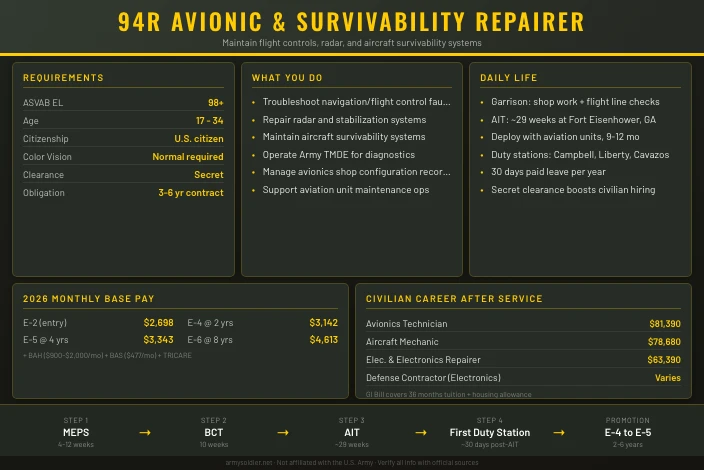
The 94R Avionic and Survivability Equipment Repairer performs field and sustainment-level maintenance on avionic navigation and flight control systems, stabilization systems, radar equipment, and aircraft survivability systems. At the unit level, 94Rs troubleshoot faults using test, measurement, and diagnostic equipment (TMDE), apply technical manuals to isolate and correct defects, and manage avionics maintenance operations. Senior soldiers supervise maintenance sections, coordinate with aviation units on readiness issues, and provide intermediate maintenance support for airborne radar equipment.
Daily Tasks
In garrison, a 94R’s day typically begins with Physical Readiness Training and then moves to the avionics shop. Work involves scheduled inspections and preventive maintenance on aircraft electronics systems, processing incoming work orders, and managing parts through the Army supply system. Diagnostic tasks require reading wiring diagrams, operating specialized test equipment, and documenting findings in Army maintenance forms.
Field operations demand a different tempo. Aviation units fly missions on irregular schedules, so maintenance support sometimes runs through the night. You’ll troubleshoot systems at the flight line, coordinate with crew chiefs and pilots on symptoms, and determine whether a fix is within field-level authority or requires evacuation to a sustainment-level facility.
- Troubleshoot avionic navigation and flight control faults using Army TMDE
- Perform field-level repairs on radar, stabilization, and survivability systems
- Inspect aircraft survivability equipment including radar warning receivers and countermeasure systems
- Manage avionics maintenance shops and configuration control records
- Provide technical guidance to supported aviation units
- Document all maintenance actions in Army systems of record
Specific Roles
The 94R falls under Career Management Field (CMF) 94, which covers Land Combat Electronic Missile Systems and related maintenance specialties. Soldiers progress through four skill levels, each expanding their scope of work and supervisory responsibility.
| Classification | Code | Description |
|---|---|---|
| Entry Level | 94R10 | Performs individual maintenance tasks under supervision |
| Journeyman | 94R20 | Executes field-level maintenance independently |
| Senior | 94R30 | Leads teams and manages maintenance sections |
| Senior NCO | 94R40 | Advises commanders; manages avionics maintenance at battalion or higher |
Additional Skill Identifiers (ASIs) are available for 94Rs who complete specialized courses, including Lean Six Sigma certification and Air Assault qualification. These designators are added to the soldier’s MOSC and appear on personnel records.
Mission Contribution
Army aviation only works when its electronic systems work. A Blackhawk with a faulty flight control stabilizer or a degraded radar warning receiver is a liability, not an asset. The 94R is the soldier who keeps those systems in the fight. Aircraft survivability equipment matters most in contested environments where enemy air defense systems are a real threat. Without functional countermeasures and warning receivers, aircrew face substantially greater risk. This MOS sits directly in the chain between serviceable equipment and mission success.
Technology and Equipment
The 94R works with avionic systems across the Army’s rotary-wing fleet, which includes UH-60 Black Hawks, CH-47 Chinooks, AH-64 Apache attack helicopters, and OH-58 Kiowas where still in service. Survivability systems include radar warning receivers, laser warning systems, missile approach warning systems, and countermeasure dispensers. Navigation and flight control work spans inertial navigation units, GPS receivers, and digital automatic flight control systems. Diagnostic work uses Army TMDE such as the AN/USM-459 universal test set alongside aircraft-specific built-in test equipment.
Salary and Benefits
The Army pays 94Rs the same base pay scale as all enlisted soldiers, with the same allowances on top. Total compensation is substantially higher than the base pay figure alone suggests.
Base Pay (2026)
All figures below reflect 2026 monthly base pay rates per DFAS.
| Grade | Rank | Entry Pay | 4-Year Pay |
|---|---|---|---|
| E-1 | Private (PV1) | $2,407/mo | $2,407/mo |
| E-2 | Private (PV2) | $2,698/mo | $2,698/mo |
| E-3 | Private First Class (PFC) | $2,837/mo | $3,198/mo |
| E-4 | Specialist (SPC) | $3,142/mo | $3,659/mo |
| E-5 | Sergeant (SGT) | $3,343/mo | $3,947/mo |
| E-6 | Staff Sergeant (SSG) | $3,401/mo | $4,069/mo |
| E-7 | Sergeant First Class (SFC) | $3,932/mo | $4,663/mo |
Allowances and Benefits
On top of base pay, soldiers receive two major tax-free allowances:
- Basic Allowance for Subsistence (BAS): $476.95/month flat for all enlisted soldiers
- Basic Allowance for Housing (BAH): Varies by duty location and dependency status. At Fort Sam Houston, an E-4 without dependents receives $1,359/month; with dependents, $1,728/month. High cost-of-living installations pay substantially more.
Healthcare is provided through TRICARE Prime at no cost to the soldier. Coverage includes medical, dental, vision, mental health, and prescriptions, with zero enrollment fees and zero copays. Family members enroll at no additional cost.
Education benefits are among the strongest in the service:
- Tuition Assistance: Up to $4,500/year on active duty, covering $250 per semester hour
- Post-9/11 GI Bill: 36 months of benefits covering full in-state tuition at public universities, up to $29,920.95/year at private schools, plus a monthly housing allowance and $1,000/year for books
Work-Life Balance
Soldiers earn 30 days of paid leave per year (2.5 days per month), plus 11 federal holidays. Garrison life at most installations follows a regular duty day. Aviation maintenance operations can involve irregular hours when aircraft are scheduled for early flights or when maintenance backlogs build up during high-tempo operations. Deployments compress the schedule further, but they also come with combat-zone tax exclusions and additional pays depending on the mission.
Qualifications and Eligibility
The 94R has a higher electronics aptitude threshold than most maintenance MOSs. The Secret security clearance requirement also adds a background investigation to the process.
Eligibility Requirements
| Requirement | Standard |
|---|---|
| Age | 17-34 (waiver possible to 39) |
| Citizenship | U.S. citizen required |
| Education | High school diploma (AFQT 31+) or GED (AFQT 50+) |
| ASVAB EL composite | 98 minimum |
| OPAT category | Moderately Heavy |
| Security clearance | Secret |
| Color vision | Normal color vision required |
| Medical | Meets Army MEPS medical standards (PULHES 222221) |
The EL (Electronics) composite is calculated from four ASVAB subtests: General Science (GS), Arithmetic Reasoning (AR), Mathematics Knowledge (MK), and Electronics Information (EI). An EL of 98 places this MOS in the upper tier of enlisted technical requirements. Study Electronics Information and General Science specifically – those subtests carry the most weight in the formula.
The Secret clearance involves a National Agency Check with Local Agency and Credit Checks (NACLC). Common disqualifiers include significant financial issues, foreign contacts or dual citizenship complications, and drug history. Minor issues don’t automatically disqualify you, but they will be investigated. The clearance process typically takes three to six months from application submission.
Application Process
Selection Competitiveness
The 94R requires a high EL score and a clean enough background for a Secret clearance, so the pool of qualified applicants is smaller than for lower-threshold MOSs. Applicants with electronics coursework, amateur radio experience, or any hands-on electrical background have a clear advantage in training, though none of it is required at entry.
Check current bonus availability with your recruiter. CMF 94 specialties have carried enlistment bonuses in prior cycles depending on Army manning priorities. Confirm current figures before signing – amounts and eligibility criteria change based on recruiting conditions.
Service Obligation
Soldiers enter at E-1 (Private, PV1). Standard enlistment terms run three to six years. The total service obligation includes active-duty time plus a period in the Individual Ready Reserve (IRR) after your contract ends. Soldiers who receive the Secret clearance have an additional obligation to protect classified information even after separation.
See our ASVAB study guide for strategies to hit these line scores, or take the PiCAT from home if you are a first-time tester.
Work Environment
Setting and Schedule
The 94R works primarily in avionics shops attached to aviation units. In garrison, these shops operate during standard duty hours, but aviation maintenance tempo tracks with the flight schedule. Early morning flights mean early morning maintenance checks. Night vision training flights mean late-night turnarounds.
The physical environment involves indoor shop work for most diagnostic and repair tasks, with frequent trips to the flight line for installation, testing, and troubleshooting. Weather affects outdoor work at the flight line but not shop operations. You will crawl into aircraft bays, work overhead in confined spaces, and handle components that require careful tool control procedures to prevent foreign object damage (FOD) to aircraft.
Leadership and Communication
Avionics sections operate within the aviation unit’s maintenance structure. A Maintenance Officer or Warrant Officer typically leads the overall maintenance effort; within the avionics section, an SSG or SFC runs day-to-day operations. The 94R communicates directly with pilots and crew chiefs to gather symptom information before diagnostics and to report system status before aircraft release.
The Army’s Noncommissioned Officer Evaluation Report (NCOER) governs formal performance feedback for E-5 and above. Below that, junior soldiers receive monthly counseling from their immediate NCO. Aviation maintenance sections tend to be small, tight-knit groups where individual performance is visible.
Team Dynamics and Autonomy
Junior 94Rs work under close supervision until they demonstrate proficiency on specific systems. The job carries significant responsibility quickly – a missed defect or an incorrect repair can create a flight safety hazard. The Army mitigates this through a quality control review process, where completed maintenance is inspected before aircraft are returned to service. This creates a culture of thoroughness rather than speed.
By E-4 and E-5, experienced 94Rs work with substantial autonomy on familiar systems. Senior NCOs manage the section’s workload, handle parts and supply coordination, and serve as the unit’s technical authority on avionic systems questions.
Job Satisfaction and Retention
The 94R is a specialized MOS with a relatively small population. Soldiers who enjoy technical work and can tolerate the irregular pace of aviation maintenance tend to stay. The field credibility that comes with Secret clearance and avionics-specific training is a meaningful career asset, both inside the Army and outside it. The civilian avionics job market is strong enough that experienced 94Rs rarely struggle to find work after separation.
Training and Skill Development
Initial Training
The 94R pipeline runs through BCT and then directly into AIT at Fort Eisenhower, Georgia (formerly Fort Gordon).
| Phase | Location | Length | Focus |
|---|---|---|---|
| Basic Combat Training (BCT) | Various installations | 10 weeks | Soldiering fundamentals, physical fitness, weapons qualification |
| Advanced Individual Training (AIT) | Fort Eisenhower, GA | ~29 weeks | Avionic systems, flight controls, radar, survivability equipment maintenance |
AIT is conducted by the Ordnance Electronics Maintenance Training Department at the U.S. Army Ordnance School. The program is one of the longer enlisted AIT courses in the Army, reflecting the depth of technical content. Students cover electrical theory, circuit analysis, digital systems, avionic navigation systems, radar fundamentals, and aircraft survivability equipment operation and maintenance. Practical work involves hands-on troubleshooting on actual aircraft systems and training simulators.
The AIT curriculum builds progressively. Early weeks cover electrical theory and test equipment operation. Later phases move into aircraft-specific systems including navigation computers, inertial measurement units, and countermeasure systems. Graduates are expected to work independently on field-level maintenance tasks from their first assignment.
Advanced Training
Once at their first duty station, 94Rs can pursue additional technical development:
- System-specific courses: Many aviation units and sustainment commands send 94Rs to manufacturer and Army training on specific aircraft platforms or newly fielded survivability systems
- 94R Advanced Leader Course (ALC): Required for promotion to SSG; covers maintenance management and supervisory skills in addition to technical content
- Senior Leader Course (SLC): Required for SFC; adds operational-level maintenance planning and staff skills
- Warrant Officer pathway (948B): The Electronic Systems Maintenance Warrant Officer track is a direct fit for experienced CMF 94 NCOs
- Army COOL Program: Funds certification exams for civilian credentials including CompTIA A+, CompTIA Network+, and FAA Airframe and Powerplant certifications relevant to avionics work
The Army’s Tuition Assistance program supports coursework at accredited institutions during off-duty hours, making it practical to pursue an associate or bachelor’s degree in electronics engineering technology while serving.
Everything starts with qualifying ASVAB scores — our study guide covers what to study first.
Career Progression and Advancement
Career Path
Advancement from E-1 through E-4 follows semi-automatic timelines. Promotion to E-5 Sergeant enters competitive territory and requires passing an Army promotion board, meeting education requirements, and accumulating promotion points.
| Rank | Grade | Typical Time-in-Grade | Role |
|---|---|---|---|
| Private (PV1) | E-1 | 0-6 months | Initial entry, training |
| Private (PV2) | E-2 | 6 months | Completing BCT/AIT |
| Private First Class (PFC) | E-3 | 12 months | First duty station, supervised work |
| Specialist (SPC) | E-4 | 24 months | Independent field-level repairs |
| Sergeant (SGT) | E-5 | 4-6 years | Team leader, supervises 2-5 soldiers |
| Staff Sergeant (SSG) | E-6 | 7-10 years | Section NCOIC, manages workload and training |
| Sergeant First Class (SFC) | E-7 | 10-15 years | Platoon Sergeant, advises maintenance officer |
| Master Sergeant (MSG) | E-8 | 16-22 years | Senior enlisted advisor, senior maintenance manager |
| Sergeant Major (SGM) | E-9 | 22+ years | Command-level advisor on avionics readiness |
Specialization Options
CMF 94 offers lateral moves into related specialties for soldiers who want to broaden their technical portfolio. The 948B Electronic Systems Maintenance Warrant Officer (WO1 to CW5) is the primary officer path for experienced 94Rs who want to manage maintenance programs at battalion and above. The 94R skill level progression through 94R40 also positions soldiers for senior maintenance technician roles in sustainment commands.
Role Flexibility and Transfers
Soldiers can request MOS transfers after completing their initial enlistment obligation, though transfers within CMF 94 are more straightforward than cross-CMF moves. The Secret clearance makes 94Rs eligible for MOS reclassification into other intelligence-adjacent or electronics specialties. Commanders and career managers evaluate manning needs against individual requests.
Performance Evaluation
The Army evaluates NCOs through the NCOER system. Raters assess performance across five categories: Character, Presence, Intellect, Leads, and Develops. For a 94R, technical proficiency scores heavily in the Intellect and Develops categories. Soldiers who complete additional training, mentor junior soldiers effectively, and maintain high personal physical fitness scores advance ahead of those who simply meet minimum standards.
Physical Demands and Medical Evaluations
Physical Requirements
The 94R carries a Moderately Heavy OPAT physical demand category (PULHES 222221). Day-to-day work involves lifting and carrying avionics components and test equipment, working overhead on aircraft systems, and moving between shop environments and flight lines. Specific tasks require normal color vision for reading wiring diagrams and identifying wire insulation color codes.
The daily physical workload is lower than combat arms MOSs but meaningfully more demanding than pure desk work. You’ll routinely lift equipment in the 40 to 60-pound range, crouch and kneel inside aircraft bays, and handle components requiring fine motor precision under tool-control protocols.
Army Fitness Test (AFT) Standards
All soldiers must pass the Army Fitness Test (AFT), which replaced the ACFT on June 1, 2025. The AFT has five events scored 0-100 each, for a maximum of 500 points. The general passing standard is 300 total (60 per event minimum), with scores normed by sex and age. The 94R is not a designated combat MOS, so the 350-point combat specialty standard does not apply.
| Event | Abbreviation | Description |
|---|---|---|
| 3 Repetition Maximum Deadlift | MDL | Measures lower body and core strength |
| Hand Release Push-Up | HRP | Measures upper body muscular endurance |
| Sprint-Drag-Carry | SDC | Measures anaerobic capacity and functional movement |
| Plank | PLK | Measures core endurance |
| Two-Mile Run | 2MR | Measures aerobic capacity |
Scores are normed by sex and age group. Minimum passing score per event is 60 points.
Medical Evaluations
Beyond MEPS entry standards, soldiers undergo periodic medical readiness assessments throughout their career. Aviation maintenance personnel may face additional medical reviews if they perform duties in or around aircraft that trigger flight physical standards. Normal color vision is a hard requirement – this is checked at MEPS and is non-waivable for this MOS. The Secret clearance also requires ongoing reporting of any events that could affect clearance eligibility, including financial changes, foreign contacts, and legal issues.
Deployment and Duty Stations
Deployment Details
The 94R deploys with aviation units. Army aviation has been a constant presence in operations across the Middle East, Eastern Europe, and the Pacific, which means 94Rs see deployment cycles on par with aviation units broadly. Standard deployment lengths run nine to twelve months, with typical dwell time of roughly two years at home station between deployments. Deployment frequency depends heavily on the unit’s alignment – aviation brigades within the 82nd Airborne Division or 101st Airborne Division deploy more frequently than training support units.
Location Flexibility
Aviation units are concentrated at specific installations. Common duty stations for 94Rs include:
- Fort Campbell, KY (101st Airborne Division – Air Assault)
- Fort Bragg (Fort Liberty), NC (82nd Airborne Division)
- Hunter Army Airfield, GA (3rd Infantry Division aviation)
- Fort Wainwright, AK (11th Airborne Division)
- Fort Hood (Fort Cavazos), TX (1st Cavalry Division aviation)
- Germany (Ansbach / Wiesbaden) (USAREUR aviation units)
- Korea (Camp Humphreys) (2nd Infantry Division aviation)
Soldiers can submit assignment preferences through their career manager at HRC. Preferences are considered but not guaranteed. Married soldiers may request concurrent travel for dependents on most OCONUS assignments.
Risk, Safety, and Legal Considerations
Job Hazards
Aviation maintenance carries specific hazards beyond general military service. Foreign Object Damage (FOD) is a constant concern – tools and hardware that enter aircraft intake paths can destroy engines and kill crew. The Army enforces strict tool accountability procedures throughout aviation maintenance sections. High-voltage systems in some aircraft avionics present electrical shock risk. Radar systems produce non-ionizing radiation that requires personnel to observe power-down procedures before working near antennas. Working on or around aircraft also involves fall risk when accessing components at height.
Safety Protocols
The Army mitigates these risks through mandatory training, quality control inspections, and established technical manual procedures. No maintenance action on aircraft is done from memory – technical manuals govern every procedure, and deviations require approval. A Quality Control (QC) NCO or officer reviews completed maintenance before aircraft are returned to the flight status. Personnel working around radar systems complete mandatory radiation safety training. Fall protection equipment is required when working at height.
Security and Legal Requirements
The Secret clearance is obtained through a National Agency Check with Local Agency and Credit Checks (NACLC). The investigation examines your financial history, employment, education, references, and any criminal record. Soldiers must self-report certain life events (arrests, foreign travel, marriage to a foreign national, financial hardship) to their security officer after clearance is granted. Failure to report is itself a clearance violation. Access to classified systems creates legal obligations under federal law that persist after military separation.
Soldiers are subject to the Uniform Code of Military Justice (UCMJ) throughout their service. For aviation maintenance personnel, maintenance errors that lead to mishaps are subject to JAG investigation and potentially Article 32 proceedings if negligence is suspected.
Impact on Family and Personal Life
Family Considerations
Aviation unit schedules are less predictable than some other Army assignments. Flight operations run on weather and mission requirements, which can generate early morning call-ins or extended days with little notice. Families who adapt best to Army aviation life tend to build strong connections within the unit’s Family Readiness Group (FRG) and develop realistic expectations for schedule variability.
The Army provides substantial family support through on-installation resources including childcare, family counseling services, and Military OneSource. TRICARE Prime covers family members at zero enrollment cost. BAH covers housing regardless of whether a soldier lives on or off post.
Relocation and Flexibility
A 94R can expect to move every two to three years as Permanent Change of Station (PCS) orders arrive. Aviation units are concentrated at a smaller number of installations than the broader Army, which means the range of duty stations is narrower. OCONUS assignments in Germany and Korea are common and include additional incentive pays. Soldiers can request assignment preferences but should expect the Army’s manning needs to take precedence.
Reserve and National Guard
The 94R Avenger System Repairer MOS is found primarily in the Army National Guard. The Guard operates most of the Army’s Avenger short-range air defense (SHORAD) systems, with Avenger batteries spread across multiple states. Army Reserve availability is very limited. If you want to maintain Avenger systems part-time, the Guard is where the positions are.
Drill Schedule and Training Commitment
Guard 94R soldiers follow the standard one weekend per month and two weeks of annual training. SHORAD units schedule drill weekends around Avenger system maintenance, Stinger missile system checks, and fire control diagnostics. Before air defense live-fire exercises, expect extra training days for system verification and launcher preparation. Plan for 3 to 5 additional duty days per year. Annual training typically includes field exercises where 94R soldiers maintain Avenger systems under simulated tactical conditions.
Part-Time Pay and Benefits
An E-4 with about four years of service earns roughly $488 per drill weekend in 2026, adding up to about $5,856 per year from drill pay. Extra training days and annual training increase the total. Active-duty E-4s earn $3,659 per month.
Tricare Reserve Select costs $57.88 per month for individual coverage or $286.66 for a family plan. Active-duty TRICARE Prime has no premiums. Federal Tuition Assistance and the Montgomery GI Bill-Selected Reserve (Chapter 1606) cover education. Guard soldiers in many states qualify for state tuition waivers at public universities. Retirement is points-based with payments starting at age 60.
Deployment and Mobilization
The renewed focus on short-range air defense has increased mobilization frequency for Guard SHORAD units. Avenger batteries have deployed for air defense missions in the Middle East and Europe. Mobilization cycles typically run 9 to 12 months. As the Army invests more in air defense capability, 94R soldiers should expect steady mobilization demand. Guard soldiers also respond to state activations, though SHORAD repairers are less commonly called for domestic emergencies.
Civilian Career Integration
Avenger maintenance experience transfers to defense contractor positions with companies like Boeing and Raytheon/RTX, which build and support the Avenger and Stinger systems. Electronics repair skills also apply to broader civilian electronics technician roles in telecommunications, manufacturing, and aerospace. A Secret clearance adds hiring value for defense industry positions. USERRA protects your civilian job during Guard service. The niche nature of air defense electronics means that defense contractors specifically target Guard SHORAD soldiers for field service and depot maintenance roles.
| Feature | Active Duty | Army Reserve | Army National Guard |
|---|---|---|---|
| Commitment | Full-time | One weekend/month, two weeks/year | One weekend/month, two weeks/year |
| Monthly Pay (E-4, ~4 yrs) | $3,659 | ~$488/drill weekend | ~$488/drill weekend |
| Healthcare | TRICARE Prime, $0 premiums | Tricare Reserve Select, $57.88/month | Tricare Reserve Select, $57.88/month |
| Education | Post-9/11 GI Bill | Federal TA, MGIB-SR | Federal TA, MGIB-SR, state tuition waivers |
| Deployment | Regular rotations | Mobilization-based | Mobilization-based, plus state activations |
| Retirement | 20-year pension, immediate | Points-based, age 60 | Points-based, age 60 |
Post-Service Opportunities
Transition to Civilian Life
The skills that a 94R builds over a military career align directly with high-demand civilian occupations. Avionics technicians in commercial aviation, defense contracting, and aerospace manufacturing are consistently sought after. The Secret clearance adds value in defense industry hiring. Many defense contractors specifically target separating soldiers with active clearances and avionics maintenance backgrounds.
The Army’s Transition Assistance Program (TAP) helps soldiers prepare resumes, understand VA benefits, and connect with employment resources during the final six months of service. The Army Career Skills Program (CSP) offers internship opportunities with defense and aviation employers during terminal leave.
The FAA Airframe and Powerplant (A&P) certificate is a major credential in commercial aviation maintenance. Soldiers with significant hands-on aircraft maintenance experience may qualify for some test waivers through the FAA, though the specific pathways depend on individual work history. The Army COOL program funds certification exam fees for eligible credentials including FAA testing.
Civilian Career Prospects
| Civilian Job | Median Annual Salary | Job Outlook |
|---|---|---|
| Avionics Technician | $81,390 | 5% growth, 2024-2034 |
| Aircraft Mechanic / Service Technician | $78,680 | 5% growth, 2024-2034 |
| Electrical and Electronics Repairer | $63,390 | 2% growth, 2024-2034 |
| Defense Contractor (Electronics Technician) | Varies by clearance/level | Strong demand |
Salary data from the Bureau of Labor Statistics (May 2024). The avionics and aircraft mechanics fields project approximately 13,100 openings per year across the decade, driven by growth in passenger air travel and increasing system complexity requiring more specialized maintenance personnel.
Is This a Good Job for You? The Right (and Wrong) Fit
Ideal Candidate Profile
The 94R is built for someone who genuinely enjoys electronics and can think through complex systems methodically. The diagnostic work requires patience – you’ll chase intermittent faults that don’t always present themselves on demand. The job rewards people who read technical manuals carefully, follow procedures precisely, and maintain attention to detail in high-stakes environments.
Strong candidates typically have an existing interest in electronics, circuits, or aircraft. Some come in with amateur radio licenses, vocational electronics coursework, or experience with automotive electrical systems. None of that is required, but it signals the kind of mind the job needs.
The Secret clearance requirement means a history of financial responsibility and straightforward background matters. Applicants with significant debt problems, foreign national family complications, or any criminal history should discuss their situation honestly with a recruiter before assuming they’ll qualify.
Potential Challenges
Aviation maintenance is not a predictable job. Flight schedules shift, maintenance discovers problems late in the process, and aircraft AOG (Aircraft on Ground) situations create pressure to turn repairs quickly. Soldiers who need a strict nine-to-five schedule will find aviation units frustrating.
The AIT pipeline is nearly 29 weeks long. That’s a significant period away from home, and the curriculum is demanding. Students who arrive without a solid foundation in basic math and science often struggle in the electronics portions. The Army provides the training, but you need the aptitude baseline to absorb it.
Deployments put soldiers in forward operating areas with aviation units. While 94Rs are not infantry, they work and live in the same operational environment as the crews they support.
Career and Lifestyle Alignment
This MOS fits well for someone planning a career in aviation or defense electronics, since the training and clearance combination is genuinely rare and valuable. It also fits soldiers who want a technical, physically moderate job that doesn’t involve the constant field exposure of combat arms. The longer initial training commitment is worth it for those who use the skills aggressively, whether in the Army or after separation.
The wrong fit: someone who picked 94R primarily because the recruiter described it favorably, without genuine interest in electronics or aviation. The training is long and the work demands real engagement. Soldiers who are going through the motions in this field burn out faster than in MOSs with shorter learning curves.
More Information
Talk to an Army recruiter to find out whether you qualify for 94R and whether current bonus options apply to your situation. Your local Army Recruiting Station can schedule an ASVAB practice test, walk you through the clearance pre-screening, and answer questions about specific duty station opportunities. You can also visit goarmy.com to explore the full range of CMF 94 positions and connect with a recruiter online.
- Prepare for the ASVAB with our study guide to make sure your line scores qualify
This site is not affiliated with the U.S. Army or any government agency. Verify all information with official Army sources before making enlistment or career decisions.
Explore more Army maintenance careers such as 91B Wheeled Vehicle Mechanic and 91D Tactical Power Generator Specialist.