94S Patriot System Repairer
The Patriot missile system is one of the most complex weapons the Army operates. Every battery that protects a forward operating base or allied capital from ballistic missiles depends on a small team of 94S Soldiers to keep that system alive. If you have strong electronics aptitude and want to work on hardware that genuinely matters, this MOS puts you at the center of it.
Qualifying requires specific ASVAB line scores — our ASVAB study guide covers what to target and how to prepare.
Job Role and Responsibilities
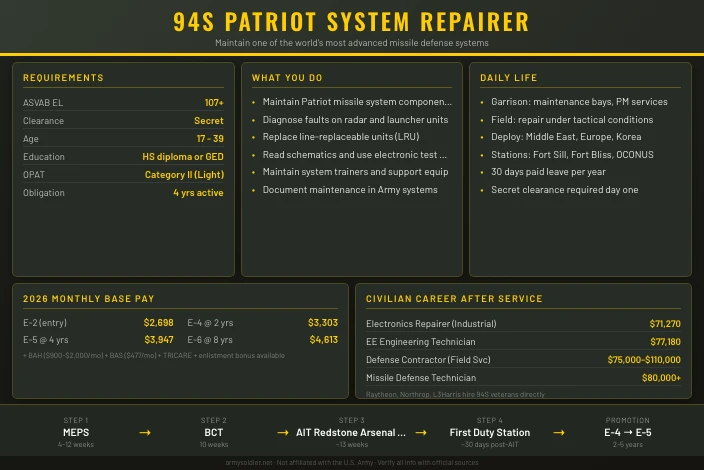
The 94S Patriot System Repairer performs field-level maintenance on the MIM-104 Patriot surface-to-air missile system and all associated equipment. This includes diagnosing faults, replacing line-replaceable units, verifying system operability, and maintaining the trainers used to prepare crews. The role blends electronics troubleshooting, mechanical work, and systems-level thinking into one job.
Daily Tasks
A typical day depends on whether the unit is in garrison or deployed. In garrison, you run scheduled services and preventive maintenance checks on radar groups, engagement control stations, and launcher units. You read technical manuals, run diagnostic software, swap components, and document everything in the maintenance management system.
In the field, the pace accelerates. You work alongside Patriot crews to correct faults during tactical exercises or actual air defense missions. When the system goes down, you find out why and fix it fast, because an inoperable Patriot is a gap in the air defense umbrella.
Specific Roles
| Identifier | Type | Description |
|---|---|---|
| 94S | Primary MOS | Patriot System Repairer |
| ASIs | Additional Skill Identifiers | Awarded for specific system or maintenance qualifications |
Mission Contribution
Patriot batteries protect high-value assets, airfields, and allied forces from ballistic missiles, cruise missiles, and aircraft. Without qualified repairers, a battery cannot maintain readiness. The 94S Soldier is directly responsible for keeping that protective layer operational, which is why the Army invests heavily in training this MOS.
Technology and Equipment
The Patriot system consists of several major components: the AN/MPQ-65 or AN/MPQ-53 radar, engagement control stations, power generation units, and launching stations. You work with advanced electronic test equipment, oscilloscopes, signal analyzers, and system-level diagnostic tools. The hardware has been continuously upgraded, so expect to learn new variants throughout your career.
Salary and Benefits
Base pay is determined by rank and years of service. All figures are 2026 rates from DFAS.
| Rank | Grade | Monthly Base Pay (entry) |
|---|---|---|
| Private (PV2) | E-2 | $2,698 |
| Private First Class | E-3 | $2,837 |
| Specialist | E-4 | $3,142 |
| Sergeant | E-5 | $3,343 |
| Staff Sergeant | E-6 | $3,401 |
On top of base pay, every Soldier receives Basic Allowance for Subsistence (BAS) of $476.95 per month in 2026. If you live off-post, Basic Allowance for Housing (BAH) is added based on your duty location and dependency status. At an installation like Fort Sill, a single E-4 can expect roughly $1,200 to $1,500 per month in BAH.
The 94S MOS has carried enlistment bonuses in recent cycles. Check with your recruiter for the current amount, as bonus levels change with recruiting needs.
Additional Benefits
Healthcare through TRICARE Prime covers you and your family at no cost for enrollment, deductibles, or copays at military treatment facilities. The Army pays 100% of the premium. Education benefits include Tuition Assistance at up to $4,500 per year while on active duty, and the Post-9/11 GI Bill covers 36 months of in-state tuition plus a monthly housing allowance after you separate.
Retirement under the Blended Retirement System (BRS) combines a pension at 20 years (40% of your high-36 average basic pay) with automatic and matched contributions to the Thrift Savings Plan.
Work-Life Balance
Soldiers earn 30 days of paid leave per year, accruing at 2.5 days per month. Schedules in garrison typically follow a Monday through Friday pattern with some weekend duties for training events. Deployed schedules are irregular and mission-driven.
Qualifications and Eligibility
TABLE REQUIRED. Current requirements for 94S:
| Requirement | Standard |
|---|---|
| ASVAB Line Score | EL: 107 |
| Citizenship | U.S. citizen or permanent resident |
| Age | 17-39 |
| Education | High school diploma or GED |
| Security Clearance | Secret |
| Physical Profile | PULHES 222221 or better |
| OPAT | Light (Category II minimum) |
The EL (Electronics) composite is calculated from General Science + Arithmetic Reasoning + Mathematics Knowledge + Electronics Information. A score of 107 is competitive; plan to study all four subtests.
A Secret clearance is required because you handle classified system documentation and work with sensitive missile defense hardware. The investigation looks at your financial history, foreign contacts, and personal conduct. No disqualifying criminal history or significant financial problems are the baseline expectations.
Application Process
You start at a Military Entrance Processing Station (MEPS) for your physical, ASVAB testing, and job selection. Your recruiter submits your MOS request, and a background investigation begins concurrently. Expect six to twelve months from enlistment contract to reporting for duty.
Selection Criteria
The EL score of 107 screens out applicants without strong math and science foundations. Beyond the score, the clearance investigation is the primary gate. Applicants with foreign family members in sensitive countries should discuss this with their recruiter early in the process.
Service Obligation
The 94S MOS typically carries a four-year active duty obligation, though enlistment contracts vary. You enter service as an E-1 (Private) and may be promoted before completing training based on college credits or prior JROTC participation.
See our ASVAB study guide for strategies to hit these line scores, or take the PiCAT from home if you are a first-time tester.
Work Environment
Setting and Schedule
Patriot repairers work in a mix of indoor maintenance bays and outdoor tactical environments. In garrison at a Patriot battalion, you maintain equipment in covered facilities with proper tools and lighting. During field exercises, you work wherever the launcher or radar is positioned, which means working in rain, cold, dust, and heat.
Night work is common during tactical exercises. Deployed Patriot batteries often run 24-hour operations with rotating shifts for maintenance personnel.
Leadership and Communication
You work within an Ordnance maintenance section attached to an Air Defense Artillery battalion. Your direct supervisor is typically a senior 94S Noncommissioned Officer (NCO). Performance counseling happens at least quarterly through the Army’s NCOER system at SGT and above, and through developmental counseling for junior enlisted Soldiers.
Team Dynamics and Autonomy
Junior 94S Soldiers work closely with senior repairers and are closely supervised on complex fault isolation. As you gain experience and reach the SGT or SSG level, you take on independent fault diagnosis and may supervise junior technicians during maintenance actions. The work is collaborative, but technical decision-making increasingly falls to you as you advance.
Job Satisfaction
Air defense electronics is genuinely interesting work. Soldiers in this MOS frequently cite the complexity of the system as a retention factor. The downside is that Patriot is a niche system with a limited number of units, so your assignment options are more constrained than those of a broader MOS. Re-enlistment rates in CMF 94 are above the Army average, partly due to bonuses and partly due to strong civilian demand for the skill set.
Training and Skill Development
Initial Training
| Phase | Location | Length | Focus |
|---|---|---|---|
| Basic Combat Training (BCT) | Various | 10 weeks | Army fundamentals, physical fitness, weapons |
| Advanced Individual Training (AIT) | Redstone Arsenal, AL | ~13 weeks | Patriot system electronics, maintenance procedures |
BCT is ten weeks and covers basic soldiering skills, physical conditioning, and weapons qualification. It is the same for all Army enlisted Soldiers regardless of MOS.
AIT at Redstone Arsenal runs approximately thirteen weeks and is taught by the Ordnance School. You learn basic electronics theory, how to read Patriot technical manuals, how to use Army test equipment, and how to perform field-level maintenance on each major component of the system. The course combines classroom instruction with hands-on work on actual Patriot hardware.
Advanced Training
After initial assignment, experienced 94S Soldiers can attend:
- Patriot Phase II training at Redstone Arsenal, which extends the pipeline to approximately 52 weeks total for new entrants through some contract structures
- Master Gunner courses at the Air Defense Artillery School
- Warrant Officer Candidate School if selected for the 94-series Warrant Officer path
- Manufacturer-supported technical courses at Raytheon facilities, which the Army sometimes sponsors for key personnel
The Army also funds civilian college credits through Tuition Assistance and supports credentialing programs through Army COOL, which maps 94S skills to civilian electronics certifications.
Everything starts with qualifying ASVAB scores — our study guide covers what to study first.
Career Progression and Advancement
Career Path
| Rank | Grade | Typical Time in Grade | Key Milestone |
|---|---|---|---|
| Private First Class | E-3 | 0-1 year | Complete AIT |
| Specialist | E-4 | 1-3 years | First duty assignment |
| Sergeant | E-5 | 3-5 years | Team leader, NCO responsibilities |
| Staff Sergeant | E-6 | 5-9 years | Section NCOIC |
| Sergeant First Class | E-7 | 9-15 years | Platoon Sergeant |
| Master Sergeant / First Sergeant | E-8 | 15-22 years | Senior technical advisor |
| Sergeant Major | E-9 | 22+ years | Battalion/Brigade level |
Promotion to E-4 and E-5 is semi-automatic early in your career based on time and performance. Promotion to SGT requires passing a promotion board and meeting point thresholds. Above SSG, the Army uses a centralized selection board.
Specialization Opportunities
Experienced 94S Soldiers can pursue Additional Skill Identifiers (ASIs) tied to specific system variants and can reclassify into related electronic maintenance MOSs. The warrant officer path for air defense electronics offers another progression track for technically strong NCOs.
Role Flexibility
Lateral reclassification is possible after completing your initial service obligation. Within CMF 94, moves to other electronic maintenance MOSs are common. Officers and warrant officers in Air Defense Artillery work alongside 94S Soldiers, so the relationships you build create visibility for those paths.
Performance Evaluation
NCOs are rated through the Non-Commissioned Officer Evaluation Report (NCOER) system. Junior enlisted Soldiers receive developmental counseling from their chain of command. Technical performance, leadership, and physical fitness all factor into evaluations.
Physical Demands and Medical Evaluations
The 94S job is physically moderate. You lift equipment, carry tool kits, and work in confined spaces. During field exercises, you may need to set up or displace launcher units and power generation equipment, which involves significant physical effort. The role does not require airborne or Ranger qualifications.
Army Fitness Test Standards
The Army Fitness Test (AFT) replaced the ACFT on June 1, 2025. It has five events scored 0-100 each with a 500-point maximum. All Soldiers must pass with at least 60 points per event and a minimum of 300 total points (sex- and age-normed).
| Event | Abbreviation |
|---|---|
| 3 Repetition Maximum Deadlift | MDL |
| Hand Release Push-Up | HRP |
| Sprint-Drag-Carry | SDC |
| Plank | PLK |
| Two-Mile Run | 2MR |
The 94S is not a designated combat MOS, so the general standard of 300 total points applies. That said, physically fit Soldiers advance faster and face fewer career obstacles.
Medical Evaluations
You need normal color vision to read electronic schematics and wiring diagrams. The PULHES standard of 222221 also requires adequate hearing, since you work around generator equipment. Periodic medical evaluations continue throughout your career.
Deployment and Duty Stations
Deployment Details
Patriot batteries deploy regularly to support theater air defense missions. Germany, South Korea, Japan, the Middle East, and Eastern Europe have all hosted Patriot units in recent years. Deployments typically run 9 to 12 months. Given the global demand for Patriot coverage, 94S Soldiers can expect at least one deployment per enlistment and often more.
Location Flexibility
Patriot units are stationed at a limited number of installations. Major CONUS assignments include:
- Fort Sill, OK (ADA school and training units)
- Fort Bliss, TX (1st ADA Brigade)
- Fort Campbell, KY (some ADA elements)
OCONUS assignments in Germany, South Korea, and Japan are common and often come with additional pay and allowances. Soldiers can submit assignment preferences through the Army’s assignment request system, but needs of the Army govern final decisions.
Risk, Safety, and Legal Considerations
Job Hazards
You work around high-voltage electronics, missile systems, and industrial power generation equipment. Improper handling of launcher systems or failure to follow lockout/tagout procedures can cause serious injury. Missile fuel and propellant have their own handling requirements.
Safety Protocols
The Army’s technical manuals include detailed safety warnings and procedural steps for every maintenance task. Units enforce lockout/tagout and personal protective equipment standards rigorously. Safety inspections are a regular part of unit operations.
Security and Legal Requirements
The Secret clearance requires ongoing compliance with security protocols. You sign nondisclosure agreements regarding classified Patriot system documentation. Any change in your personal circumstances (financial problems, foreign contacts, legal issues) must be self-reported to your security manager.
Impact on Family and Personal Life
Family Considerations
Deployments to the Middle East and Europe are a reality for most 94S Soldiers. Families have access to Army Family Readiness Groups (FRGs), installation support services, Military OneSource counseling, and on-post schools and childcare. Frequent communication during deployment is generally available, though operations security limits what you can discuss.
Relocation and Flexibility
Patriot units are concentrated at a small number of posts, so you won’t have the wide assignment variety available to broader MOSs. Permanent Change of Station (PCS) moves happen every two to three years on average, which affects families with school-age children and working spouses.
Reserve and National Guard
The 94S Patriot System Repairer MOS is available in the Army National Guard, which operates Patriot missile defense battalions in several states. Some active component Patriot units also feed into Guard manning. Army Reserve availability for 94S is limited. Patriot is one of the Army’s highest-priority air and missile defense systems, and Guard Patriot battalions maintain a high operational tempo even in part-time status.
Drill Schedule and Training Commitment
Patriot systems are complex, and maintaining proficiency requires more training time than most maintenance MOS. Guard 94S soldiers follow the standard one weekend per month and two weeks of annual training, but expect significant extra training days. Patriot units run system certification exercises, radar proficiency checks, and tactical evaluations that add 5 to 10 additional duty days per year beyond the standard drill schedule. The training load is heavier than most part-time MOS, which reflects the system’s complexity and operational importance.
Part-Time Pay and Benefits
An E-4 with about four years of service earns roughly $488 per drill weekend in 2026. The extra training days common in Patriot units add substantial additional pay beyond the baseline $5,856 per year from 12 drill weekends. Active-duty E-4s earn $3,659 per month.
Tricare Reserve Select costs $57.88 per month for individual coverage or $286.66 for a family plan. Active-duty TRICARE Prime has no premiums. Federal Tuition Assistance and the Montgomery GI Bill-Selected Reserve (Chapter 1606) cover education costs. Guard members in many states receive state tuition waivers. Retirement is points-based with payments starting at age 60. The extra training days in Patriot units help accumulate retirement points faster than lower-tempo MOS.
Deployment and Mobilization
Patriot units are among the most frequently deployed air defense assets in the Army. Guard Patriot battalions have maintained a high operational tempo for missile defense missions worldwide, including rotations to the Middle East, Europe, and the Pacific. Mobilization typically runs 9 to 12 months. 94S soldiers should expect a higher mobilization frequency than most Guard MOS. The demand for Patriot coverage globally keeps these units on a steady rotation cycle.
Civilian Career Integration
Patriot experience is a direct pipeline to defense contractor jobs. Raytheon/RTX is the prime contractor for the Patriot system and actively recruits Guard 94S soldiers for field service representative roles, depot maintenance, and systems integration positions. Civilian salaries for Patriot-experienced technicians often range from $70,000 to $90,000 or more. A Secret clearance, which all 94S soldiers hold, is required for most of these positions. USERRA protects your civilian job during Guard service. Many 94S soldiers transition to defense contractor roles while continuing to drill with their Guard Patriot unit, effectively working on the same system in both their civilian and military careers.
| Feature | Active Duty | Army Reserve | Army National Guard |
|---|---|---|---|
| Commitment | Full-time | One weekend/month, two weeks/year | One weekend/month, two weeks/year |
| Monthly Pay (E-4, ~4 yrs) | $3,659 | ~$488/drill weekend | ~$488/drill weekend |
| Healthcare | TRICARE Prime, $0 premiums | Tricare Reserve Select, $57.88/month | Tricare Reserve Select, $57.88/month |
| Education | Post-9/11 GI Bill | Federal TA, MGIB-SR | Federal TA, MGIB-SR, state tuition waivers |
| Deployment | Regular rotations | Mobilization-based | Mobilization-based, plus state activations |
| Retirement | 20-year pension, immediate | Points-based, age 60 | Points-based, age 60 |
Post-Service Opportunities
The Patriot system is built and supported by defense contractors who actively recruit former military maintainers. Raytheon Technologies (now RTX), Northrop Grumman, and L3Harris all hire 94S veterans for technical field service representative roles, depot maintenance positions, and systems integration work.
Beyond defense contracting, the electronics fundamentals you build translate directly to civilian maintenance and engineering technician careers.
| Civilian Job Title | Median Annual Salary (May 2024, BLS) | Job Outlook |
|---|---|---|
| Electrical/Electronics Repairer (Industrial) | $71,270 | Stable |
| Electrical/Electronics Engineering Technician | $77,180 | +4% (2024-34) |
| Defense Contractor Field Service Rep | $75,000-$110,000 (varies) | Strong demand |
The Post-9/11 GI Bill supports 36 months of college tuition plus a monthly housing allowance, which many 94S veterans use to earn an associate’s or bachelor’s degree in electrical engineering technology.
Credentialing: Army COOL maps 94S training to civilian certifications including the Electronics Technician Association (ETA) Certified Electronics Technician credential, which employers recognize across the defense and industrial sectors.
Is This a Good Job for You? The Right (and Wrong) Fit
Ideal Candidate Profile
Strong candidates for 94S score well on the math and science portions of the ASVAB, enjoy figuring out why complex systems fail, and can work methodically through long technical manuals. Patience matters here. Fault isolation on a Patriot system is not quick. You need to be comfortable sitting with an unsolved problem until the evidence points to an answer.
An interest in missile defense, radar, or air defense technology helps sustain motivation. The clearance requirement means a clean background is non-negotiable from day one.
Potential Challenges
Patriot units are relatively small and stationed at a limited number of posts. If you want to serve in many different locations throughout your career, this MOS constrains your options more than broader maintenance MOSs. The training pipeline is long, and the system is complex enough that underperforming students may be reclassified to a different MOS.
Deployments to forward-deployed Patriot sites can be austere and remote. You may be at a small FOB in the Middle East or a remote site in Eastern Europe, far from the amenities of a major installation.
Career and Lifestyle Alignment
If you want to enter the defense electronics industry after service, few Army MOSs give you a better foundation. Patriot experience is directly marketable to a narrow but well-paying sector. If your goal is to stay in the Army long-term, the technical depth of this MOS creates clear paths to senior NCO positions and warrant officer opportunities.
More Information
Talk to an Army recruiter to confirm current ASVAB cutoffs, bonus availability, and assignment options for 94S. Requirements change, and a recruiter can pull your specific situation into the conversation. Visit goarmy.com for the official job overview.
- Prepare for the ASVAB with our study guide to make sure your line scores qualify
This site is not affiliated with the U.S. Army or any government agency. Verify all information with official Army sources before making enlistment or career decisions.
Explore more Army maintenance careers such as 94R Avenger System Repairer and 91H Track Vehicle Repairer.