94Y Automatic Test Systems Operator and Maintainer
Most people never hear of the 94Y MOS. That is partly because the job title changed from “IFTE Operator/Maintainer” to Automatic Test Systems Operator and Maintainer, and partly because the work happens behind the scenes. But every Army weapons system that gets tested at the depot level runs through the equipment these Soldiers maintain. If you want a deep electronics career with strong civilian demand and a clear path into the defense industry, this MOS deserves serious consideration.
Qualifying requires specific ASVAB line scores — our ASVAB study guide covers what to target and how to prepare.
Job Role and Responsibilities
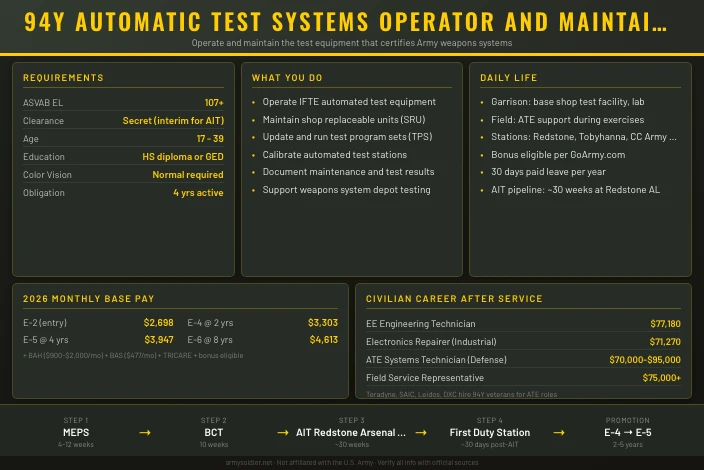
The 94Y Automatic Test Systems Operator and Maintainer is responsible for maintaining the base shop test facility, performing electronic maintenance on shop replaceable units (SRUs), system-supported line replaceable units (LRUs), and test program sets (TPS). These Soldiers keep the automated test systems that diagnose and verify Army weapons systems and electronic components in full working order.
Daily Tasks
In garrison, the job looks like a high-end electronics lab. You operate and maintain automatic test equipment (ATE) including the Integrated Family of Test Equipment (IFTE) platform. Daily tasks include running diagnostics on failed components, updating test program sets, calibrating equipment, and documenting maintenance actions in the Army’s maintenance information systems.
When units deploy or field new systems, 94Y Soldiers support the technical testing process to confirm that repaired components meet serviceability standards before they go back on a weapons system. The job sits at the intersection of depot maintenance and field support.
Specific Roles
| Identifier | Type | Description |
|---|---|---|
| 94Y | Primary MOS | Automatic Test Systems Operator and Maintainer |
| ASIs | Additional Skill Identifiers | Awarded for specific ATE platform qualifications |
Mission Contribution
The Army’s maintenance pipeline depends on verified, serviceable components. Before a repaired circuit card or electronic assembly goes back into an aircraft, missile system, or ground vehicle, it passes through an automated test station. The 94Y keeps those stations running accurately. A miscalibrated test system can pass a failed component, which creates risk for the Soldiers using the end system downstream.
Technology and Equipment
You work with the Integrated Family of Test Equipment (IFTE), which includes the Base Shop Test Facility (BSTF), the Army Maintenance Support Activity (AMSA) systems, and associated test program sets. You use oscilloscopes, signal generators, spectrum analyzers, and the diagnostic software suites that control automated test sequences. The platforms are updated as the Army fields new weapons systems, so continuous learning is built into the job.
Salary and Benefits
All pay figures are 2026 rates from DFAS.
| Rank | Grade | Monthly Base Pay (entry) |
|---|---|---|
| Private (PV2) | E-2 | $2,698 |
| Private First Class | E-3 | $2,837 |
| Specialist | E-4 | $3,142 |
| Sergeant | E-5 | $3,343 |
| Staff Sergeant | E-6 | $3,401 |
Basic Allowance for Subsistence (BAS) adds $476.95 per month for all enlisted Soldiers. Basic Allowance for Housing (BAH) varies by installation and dependency status. At Redstone Arsenal in Huntsville, Alabama, where AIT is conducted, a single E-4 can expect roughly $1,100 to $1,400 monthly in BAH.
Based on GoArmy.com data, the 94Y MOS is listed as bonus-eligible. Confirm the current amount with your recruiter since bonus levels shift with Army recruiting cycles.
Additional Benefits
TRICARE Prime covers you and your dependents with zero enrollment fees or copays at military treatment facilities. While on active duty, Tuition Assistance pays up to $4,500 per year toward college courses. After separation, the Post-9/11 GI Bill provides 36 months of in-state tuition coverage plus a monthly housing stipend.
The Blended Retirement System (BRS) provides a pension worth 40% of your average high-36 basic pay at 20 years, combined with TSP matching contributions starting in year three of service.
Work-Life Balance
Soldiers earn 30 days of paid leave per year. Garrison schedules in an electronics maintenance unit are generally regular Monday through Friday, with some weekend duty for training events and maintenance cycles. The technical nature of this job makes it less likely to involve constant field time compared to combat arms MOSs.
Qualifications and Eligibility
| Requirement | Standard |
|---|---|
| ASVAB Line Score | EL: 107 |
| Citizenship | U.S. citizen or permanent resident |
| Age | 17-39 |
| Education | High school diploma or GED |
| Security Clearance | Secret (interim required to attend AIT) |
| Physical Profile | PULHES 222221 or better |
| Color Vision | Required (normal color perception) |
The EL (Electronics) composite is built from General Science + Arithmetic Reasoning + Mathematics Knowledge + Electronics Information. A score of 107 is the same threshold as 94S, reflecting that both MOSs require real electronics depth.
A Secret clearance is required because you work with classified test program sets and defense system documentation. You receive an interim clearance to attend AIT and receive provisional MOS award, with final award contingent on obtaining the full clearance.
Application Process
You enlist through MEPS, take the ASVAB, and select the MOS based on your score and available slots. Your security investigation begins after enlistment. Expect six to twelve months from contract to reporting for AIT, depending on training seat availability.
Selection Criteria
The primary screen is the EL score. Applicants without a strong mathematics and science background will struggle to reach 107. Course attrition at the AIT level is real; students who cannot keep up with the electronics curriculum may be reclassified.
Service Obligation
The standard enlistment for this MOS is four years active duty. You enter as an E-1 or E-2, depending on prior college credits or JROTC participation.
See our ASVAB study guide for strategies to hit these line scores, or take the PiCAT from home if you are a first-time tester.
Work Environment
Setting and Schedule
The 94Y environment is primarily an indoor maintenance facility. Base shop test facilities are temperature-controlled and well-equipped. Unlike combat arms or wheeled vehicle mechanics, you’re rarely working in the rain or mud as part of routine duties. That said, field exercises do happen, and supporting units during collective training can take you out of the shop.
Shift work is possible at larger maintenance activities. Some depot-level maintenance operations run extended hours, and you may work rotating shifts as a result.
Leadership and Communication
You work within an Ordnance maintenance company or support battalion. Your section leader is typically a senior 94Y NCO. The chain of command in a maintenance unit follows standard Army structure, with daily operations managed at the company and platoon level.
Team Dynamics and Autonomy
This is a small-team job. A base shop test facility typically has a handful of technicians working the same equipment. Junior Soldiers shadow senior technicians until they demonstrate competence on the test platforms. As you advance in rank, you take on more independent work and eventually supervise the facility.
Job Satisfaction
Electronics technicians who like systematic problem-solving tend to find this work satisfying. The variety of components you test changes as the Army fields new systems. The drawback is that the job can feel removed from the field Army’s operations, which frustrates Soldiers who want to see the direct results of their maintenance work.
Training and Skill Development
Initial Training
| Phase | Location | Length | Focus |
|---|---|---|---|
| Basic Combat Training (BCT) | Various | 10 weeks | Army fundamentals, physical fitness, weapons |
| Advanced Individual Training (AIT) | Redstone Arsenal, AL | ~30 weeks | IFTE platforms, ATE operations, electronics maintenance |
BCT is standard across all Army MOSs. AIT for 94Y at Redstone Arsenal is approximately 30 weeks, which reflects the depth of technical content in this course. The Armament and Electronics Training Department at Redstone runs the program, covering electronics theory, ATE system operation, test program set development, and practical exercises on actual IFTE hardware.
Students receive an interim Secret clearance before starting course content that touches classified material. Failure to maintain clearance eligibility results in course removal and likely MOS reclassification.
Advanced Training
After your initial assignment:
- System-specific ATE courses for platforms added to the Army inventory
- Army COOL credentialing programs that map 94Y skills to civilian electronics certifications
- Warrant Officer Candidate School for technically strong NCOs who want the 94-series WO path
- Civilian college coursework through Tuition Assistance toward an electronics engineering technology degree
The Army’s modernization push means new test equipment is introduced regularly, and the Army invests in keeping 94Y personnel current through follow-on training.
Everything starts with qualifying ASVAB scores — our study guide covers what to study first.
Career Progression and Advancement
Career Path
| Rank | Grade | Typical Time in Grade | Key Milestone |
|---|---|---|---|
| Private First Class | E-3 | 0-1 year | Complete AIT |
| Specialist | E-4 | 1-3 years | First duty assignment |
| Sergeant | E-5 | 3-5 years | Section team leader |
| Staff Sergeant | E-6 | 5-9 years | Section NCOIC |
| Sergeant First Class | E-7 | 9-15 years | Platoon Sergeant |
| Master Sergeant / First Sergeant | E-8 | 15-22 years | Company-level advisor |
| Sergeant Major | E-9 | 22+ years | Brigade/Division level |
Promotion to SGT requires passing a promotion board and accumulating sufficient promotion points. Technical certifications, college credits, and physical fitness scores all contribute to points. The AIT length for this MOS means you start accruing experience and points later than shorter-pipeline Soldiers, so plan accordingly.
Specialization Opportunities
Additional Skill Identifiers within CMF 94 recognize proficiency on specific ATE platforms. Senior 94Y NCOs sometimes serve as technical inspectors or master mechanics in larger maintenance organizations.
Role Flexibility
CMF 94 contains several related electronic maintenance MOSs. Voluntary reclassification after your initial service obligation is possible, and the electronics foundation transfers well. Soldiers interested in intelligence or signals can petition for lateral moves, though MOS needs govern approval.
Performance Evaluation
NCOs receive annual Non-Commissioned Officer Evaluation Reports (NCOERs). Junior enlisted Soldiers receive developmental counseling. Technical competence, leadership potential, and physical fitness form the core of evaluations at all levels.
Physical Demands and Medical Evaluations
The 94Y is a technical job, not a physically demanding one by Army standards. You lift equipment components, carry tool kits, and stand for extended periods. Field exercises add some physical demand, but this MOS is not considered physically intense relative to combat or field MOSs.
Army Fitness Test Standards
The Army Fitness Test (AFT) is the current physical fitness standard, replacing the ACFT on June 1, 2025. It has five events scored on a 0-100 scale per event with a 500-point total maximum. Soldiers must pass each event with at least 60 points and a 300-point minimum total (sex- and age-normed).
| Event | Abbreviation |
|---|---|
| 3 Repetition Maximum Deadlift | MDL |
| Hand Release Push-Up | HRP |
| Sprint-Drag-Carry | SDC |
| Plank | PLK |
| Two-Mile Run | 2MR |
The general standard of 300 points applies to 94Y. Meeting the standard without struggling frees up energy for the technical demands of the MOS.
Medical Evaluations
Normal color vision is required for reading wiring diagrams and component markings. The hearing standard is important given exposure to generator and facility noise. Periodic physical examinations continue throughout your service, and security clearance reinvestigation happens periodically as well.
Deployment and Duty Stations
Deployment Details
Depot-level and theater maintenance support activities deploy with combat formations during large-scale operations. 94Y Soldiers support corps and division maintenance activities and may serve at forward support companies or direct support maintenance companies during deployments. Deployment lengths typically run 9 to 12 months.
Demand for this MOS during peacetime often places 94Y Soldiers at major maintenance facilities in CONUS, with deployment tied to Army operation tempo.
Location Flexibility
Major assignments for 94Y Soldiers include:
- Redstone Arsenal, AL (training and supporting units)
- Tobyhanna Army Depot, PA (large electronics maintenance facility)
- Corpus Christi Army Depot, TX (aviation electronics support)
- Various maneuver divisions with organic maintenance battalions
OCONUS assignments in Germany and South Korea are possible. Assignment requests can be submitted, with needs of the Army as the final arbiter.
Risk, Safety, and Legal Considerations
Job Hazards
High-voltage electronic systems are the primary hazard. Automated test equipment can carry dangerous current levels. Improper grounding, static discharge, and failure to follow lockout/tagout procedures are the main risk scenarios.
Safety Protocols
Technical manuals for ATE platforms include explicit safety warnings and step-by-step procedures. Units enforce electrostatic discharge (ESD) practices, personal protective equipment standards, and proper power-down procedures before component handling.
Security and Legal Requirements
The Secret clearance requires ongoing compliance with security reporting obligations. You handle classified test program sets, and any exposure, loss, or compromise must be reported immediately. Financial problems, foreign contacts, and legal issues require self-reporting to your unit security manager.
Impact on Family and Personal Life
Family Considerations
Maintenance units are generally garrison-heavy compared to combat arms, which means more predictable schedules for families. Deployments still happen but tend to be less frequent than in Patriot or combat arms units. TRICARE covers family medical needs, and installation support programs cover childcare, education, and family counseling.
Relocation and Flexibility
PCS moves happen every two to three years. Maintenance-focused installations like Redstone Arsenal and Tobyhanna are not traditional Army towns, but both offer reasonable quality of life. The Army’s assignment preferences system lets Soldiers express location desires, though approval is not guaranteed.
Reserve and National Guard
The 94Y Automatic Test Systems Operator/Maintainer MOS is available in both the Army Reserve and the Army National Guard. Positions exist in maintenance support units that operate automated test equipment (ATE) for diagnosing and repairing electronic components. The 94Y is a low-density MOS, meaning fewer slots overall, but both components maintain ATE capability in their maintenance battalions.
Drill Schedule and Training Commitment
Reserve and Guard 94Y soldiers follow the standard one weekend per month and two weeks of annual training. Drill weekends focus on operating ATE stations, running diagnostic programs, and maintaining test equipment software and hardware. The workload fits the drill format well because automated test runs are structured and repeatable. Extra training days are uncommon for this MOS unless new ATE platforms are fielded or software updates require hands-on retraining. Expect 1 to 2 additional duty days per year at most.
Part-Time Pay and Benefits
An E-4 with about four years of service earns roughly $488 per drill weekend in 2026, totaling about $5,856 per year from drill pay. Annual training adds two weeks of active-duty pay. Active-duty E-4s earn $3,659 per month.
Tricare Reserve Select costs $57.88 per month for individual coverage or $286.66 for a family plan. Active-duty TRICARE Prime has no premiums. Federal Tuition Assistance and the Montgomery GI Bill-Selected Reserve (Chapter 1606) cover education costs. Guard members in many states get state tuition waivers at public colleges. Retirement is points-based with payments starting at age 60.
Deployment and Mobilization
ATE support deploys with higher-echelon maintenance units. The mobilization tempo for 94Y soldiers is lower than most combat system maintenance MOS because automated test equipment is primarily used at depot and intermediate maintenance levels. Mobilization runs 9 to 12 months when it occurs. Guard soldiers may be activated for state emergencies, but ATE operators are rarely called for domestic missions.
Civilian Career Integration
Automated test equipment skills transfer directly to semiconductor manufacturing, aerospace, and defense industries. Companies like Teradyne, Keysight Technologies, and National Instruments hire technicians who can operate and maintain ATE platforms. Quality assurance and production testing roles in electronics manufacturing are natural civilian fits. The ability to run diagnostic software, interpret test results, and troubleshoot electronic systems at the component level is valued across multiple industries. USERRA protects your civilian job during military service, and employers in the electronics testing field recognize military ATE experience as directly relevant training.
| Feature | Active Duty | Army Reserve | Army National Guard |
|---|---|---|---|
| Commitment | Full-time | One weekend/month, two weeks/year | One weekend/month, two weeks/year |
| Monthly Pay (E-4, ~4 yrs) | $3,659 | ~$488/drill weekend | ~$488/drill weekend |
| Healthcare | TRICARE Prime, $0 premiums | Tricare Reserve Select, $57.88/month | Tricare Reserve Select, $57.88/month |
| Education | Post-9/11 GI Bill | Federal TA, MGIB-SR | Federal TA, MGIB-SR, state tuition waivers |
| Deployment | Regular rotations | Mobilization-based | Mobilization-based, plus state activations |
| Retirement | 20-year pension, immediate | Points-based, age 60 | Points-based, age 60 |
Post-Service Opportunities
Defense contractors who build and support Army electronics test equipment hire extensively from this MOS. Companies like Teradyne, SAIC, Leidos, and DXC Technology look for technicians with ATE experience. Field service representative roles, depot-level maintenance positions, and systems engineering support are common paths.
| Civilian Job Title | Median Annual Salary (May 2024, BLS) | Job Outlook |
|---|---|---|
| Electrical/Electronic Engineering Technician | $77,180 | +4% (2024-34) |
| Electrical/Electronics Repairer (Industrial) | $71,270 | Stable |
| Computer/Electronics Hardware Technician | Varies | Growing |
The GI Bill supports degree completion in electronics engineering technology, computer engineering, or information technology, all of which are marketable in the defense sector. Army COOL maps 94Y training to the ETA Certified Electronics Technician credential and others.
Is This a Good Job for You? The Right (and Wrong) Fit
Ideal Candidate Profile
The best 94Y candidates have high scores in math and science, enjoy methodical troubleshooting, and can sustain focus through long technical procedures. You don’t need prior electronics experience, but a natural curiosity about how electronic systems work helps you absorb the AIT curriculum faster.
Patience with documentation is also important. Maintenance tracking, test records, and equipment history logs are central to the job. Sloppy recordkeeping creates problems for the technicians who come after you.
Potential Challenges
The 30-week AIT pipeline is long, and Redstone Arsenal is not a high-energy assignment location for a young Soldier. Washouts from the course are real, and students who fall behind in the electronics theory blocks face a difficult recovery path. If the ASVAB math and science sections gave you trouble, this is not the MOS to push through without serious preparation.
The job is also relatively quiet operationally. Soldiers who want constant field time, physical challenge, or a combat-arms feel will find 94Y too sedentary for their taste.
Career and Lifestyle Alignment
If your goal is a direct path into the defense electronics industry after service, or if you want to build a technical foundation for engineering school on the GI Bill, 94Y is one of the better Army options. It demands more of you intellectually than many MOSs and pays it back in civilian marketability.
More Information
Your Army recruiter can confirm the current ASVAB cutoff, bonus status, and available training seats for 94Y. Requirements and incentives change annually. Visit the goarmy.com 94Y page for the official overview.
- Prepare for the ASVAB with our study guide to make sure your line scores qualify
This site is not affiliated with the U.S. Army or any government agency. Verify all information with official Army sources before making enlistment or career decisions.
Explore more Army maintenance careers such as 94S Patriot System Repairer and 91B Wheeled Vehicle Mechanic.