68A Biomedical Equipment Specialist
The ventilator keeping a soldier alive in a forward surgical team runs on calibrated electronics. The defibrillator in the battalion aid station has to fire correctly the first time. The 68A Biomedical Equipment Specialist is the soldier who makes sure none of that fails. It’s one of the most technically demanding jobs in Army medicine, and it pays dividends long after you leave service.
Qualifying requires specific ASVAB line scores — our ASVAB study guide covers what to target and how to prepare.
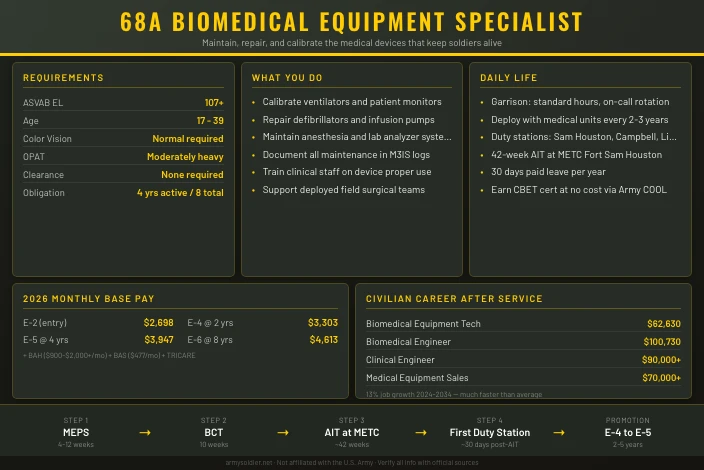
Job Role and Responsibilities
The 68A Biomedical Equipment Specialist inspects, maintains, troubleshoots, and repairs a wide range of medical equipment used across Army medical treatment facilities and in the field. You keep ventilators, patient monitors, defibrillators, surgical instruments, anesthesia machines, and diagnostic imaging systems operational. If a piece of medical hardware fails and a patient is on it, you’re the one who fixes the problem.
Your days in garrison split between scheduled preventive maintenance and reactive repair calls. Scheduled maintenance follows a strict calendar: every device in the facility has a required inspection interval, and you document every visit with calibration records. A patient monitor that fails its safety check comes off the floor until you clear it. Failure isn’t an abstract concept in this job.
Repairs get more interesting. You diagnose an anesthesia machine by interpreting alarm codes, testing gas delivery valves, and checking electronic control boards. An infusion pump that delivers the wrong dose can kill a patient. You test it, repair it, verify it, and sign off on it. That signature means something.
Core Daily Tasks
- Perform scheduled and unscheduled maintenance on ventilators, monitors, defibrillators, and surgical equipment
- Calibrate diagnostic instruments and document all work in facility maintenance logs
- Identify and replace defective electronic, mechanical, and hydraulic components
- Coordinate equipment downtime with clinical staff so patient care isn’t interrupted
- Manage equipment inventory, track lifecycle status, and submit supply requests
- Train unit personnel on proper use and basic care of medical devices
Specific Roles and Identifiers
68As can earn Additional Skill Identifiers (ASIs) that reflect specialized competencies developed through training and experience.
| Code | Type | Description |
|---|---|---|
| 68A | Primary MOS | Biomedical Equipment Specialist |
| P1 | ASI | Radiology Equipment Maintenance |
| P2 | ASI | Clinical Laboratory Equipment Maintenance |
Mission Contribution
Army medical readiness depends on equipment readiness. A surgeon without a working electrosurgical unit can’t operate. An ICU without functioning ventilators can’t sustain critical patients. The 68A sits at the intersection of electronics, mechanics, and patient safety – when equipment fails, soldiers die. That stakes level is real and it drives how 68As approach every maintenance cycle.
Technology and Equipment
The equipment list is broad. You’ll work on patient monitoring systems, infusion pumps, surgical lasers, anesthesia delivery systems, ultrasound machines, X-ray units, sterilizers, centrifuges, and laboratory analyzers. The gear comes from commercial manufacturers like GE, Philips, Draeger, and Medtronic. You learn to read proprietary service manuals, use specialized test equipment like electrical safety analyzers, and interact with hospital information systems for device tracking.
Salary and Benefits
Financial Benefits
Military pay is based on rank and years of service, set by Congress and published annually by DFAS. Most 68As complete AIT at roughly the 14-month mark and begin their first duty assignment as an E-4.
| Rank | Time in Service | Monthly Base Pay |
|---|---|---|
| E-2 (PV2) | Entry | $2,698 |
| E-3 (PFC) | ~1 year | $2,837 |
| E-4 (SPC) | ~2 years | $3,303 |
| E-5 (SGT) | ~4 years | $3,947 |
| E-6 (SSG) | ~8 years | $4,613 |
| E-7 (SFC) | ~12 years | $5,537 |
Base pay is only part of your compensation. BAH (Basic Allowance for Housing) varies by duty station and dependent status. A single E-4 receives roughly $900 to $2,000+ per month depending on location. BAS adds $476.95 monthly for food. When the Army faces shortages in technical specialties, 68As may qualify for re-enlistment bonuses. Check current bonus availability with your recruiter, as amounts and eligibility windows change each fiscal year.
Additional Benefits
TRICARE covers you and your family at no enrollment cost on active duty. It includes medical, dental, vision, mental health, and prescriptions. Tuition Assistance lets you take college courses while serving, covering up to $4,500 per year in tuition. After separation, the Post-9/11 GI Bill pays full in-state tuition at public universities for up to 36 months, plus a monthly housing allowance.
Retirement uses the Blended Retirement System (BRS):
- Serve 20 years and collect a pension worth 40% of your high-36 average base pay
- The government contributes up to 5% of your Thrift Savings Plan (TSP) automatically
- Continuation Pay at 8-12 years adds a lump-sum bonus in exchange for a service extension
Work-Life Balance
You earn 30 days of paid leave per year. Garrison life for 68As tends to follow normal duty hours, typically 0600-1700 with an on-call rotation for urgent equipment failures outside business hours. Field exercises and deployments disrupt that schedule significantly. Larger medical facilities may run shift coverage for 24-hour operations.
Qualifications and Eligibility
Basic Qualifications
You must be a U.S. citizen between 17 and 39 years old. High school graduates need a minimum AFQT of 31. GED holders need at least a 50. The 68A requires one ASVAB line score:
- Electronics (EL): 107 minimum
The EL composite combines General Science (GS), Arithmetic Reasoning (AR), Mathematics Knowledge (MK), and Electronics Information (EI). A score of 107 is genuinely competitive – you need solid math and science fundamentals, not just a passing grade. Study time pays off here.
| Requirement | Details |
|---|---|
| Age | 17-39; waivers possible up to 42 |
| Citizenship | U.S. citizen |
| Education | High school diploma or GED |
| AFQT minimum | 31 (diploma) or 50 (GED) |
| Electronics (EL) | 107 minimum |
| OPAT category | Moderately heavy |
| Security clearance | None required |
| Color vision | Normal required; waiver may be available |
| Background | No disqualifying criminal history |
No security clearance is needed for this MOS, which simplifies the entry process and means you start training on schedule. Color vision standards are strict because equipment calibration and cable identification rely on accurate color discrimination.
Application Process
Start at your local Army recruiting station. Your recruiter will verify your ASVAB scores, review your medical history, and help you select your MOS. You then go to MEPS (Military Entrance Processing Station) for a full physical exam and background check. If your EL score meets the 107 threshold and your physical qualifies you, your recruiter locks in a training seat.
Selection Criteria
68A seats fill based on available training slots and contract timing. It’s not a highly competitive selection like Special Forces, but EL 107 filters out a large share of applicants. Prior experience in electronics, IT, or biomedical repair makes you a stronger candidate and gives you a real head start in AIT. The OPAT physical assessment tests your strength and endurance at the “moderately heavy” level, reflecting the physical demands of moving and servicing large equipment in tight spaces.
Service Obligation
Active Duty contracts for 68A are typically 4 years. The total military service obligation is 8 years (combination of active and reserve time). You enter service as an E-1 (PV1) and are typically promoted to E-2 shortly after starting Basic Combat Training.
See our ASVAB study guide for strategies to hit these line scores, or take the PiCAT from home if you are a first-time tester.
Work Environment
Setting and Schedule
Most 68As work inside medical treatment facilities: hospitals, clinics, dental facilities, and field surgical teams. The workspace can be a well-lit biomedical engineering shop in a large post hospital or the back of a vehicle in a deployed medical unit. Physical surroundings vary, but the work is consistently detail-oriented and technical.
Garrison 68As typically work standard duty hours with an on-call rotation for after-hours equipment failures. Deployed or field-exercise environments add unpredictability. You may be responsible for keeping a surgical suite operational 24 hours a day with no backup technician.
Leadership and Communication
68As work under the medical maintenance officer and senior NCOs within the medical unit or hospital. You’ll brief clinical staff on equipment downtime, coordinate with supply personnel on repair parts, and document maintenance actions through the Medical Maintenance Management Information System (M3IS). Performance counseling follows the standard Army NCOER (Non-Commissioned Officer Evaluation Report) process for E-5 and above.
Team Dynamics and Autonomy
Junior 68As work alongside experienced technicians and learn through hands-on mentorship. By mid-career (E-5 to E-6), you take on individual responsibility for specific equipment categories and may supervise junior soldiers. The job requires good independent judgment. A broken ventilator needs a decision now, not after a lengthy chain-of-command approval.
Job Satisfaction and Retention
Technical MOS careers in biomedical equipment tend to retain experienced soldiers longer than some combat arms jobs because the civilian salary trajectory is strong. Soldiers who earn the CBET certification during service typically see faster promotion into well-paying civilian roles, which creates both incentive to stay and a clear off-ramp when ready.
Factors that drive retention in this MOS:
- Civilian salary premium for certified BMETs rewards staying long enough to earn credentials
- Assignments at large hospital installations offer more stability than infantry-heavy units
- The 670A warrant officer track gives career-minded soldiers a clear path to officer pay
- Technical work stays mentally challenging across all ranks, which reduces burnout compared to repetitive jobs
Training and Skill Development
Initial Training
Training has two phases. Basic Combat Training comes first, followed immediately by the MOS-specific Advanced Individual Training.
| Phase | Location | Length | Focus |
|---|---|---|---|
| Basic Combat Training (BCT) | Various installations | 10 weeks | Soldiering fundamentals, weapons qualification, tactics |
| Advanced Individual Training (AIT) | JBSA-Fort Sam Houston, TX (METC) | ~42 weeks | Biomedical theory, electronics diagnostics, equipment-specific maintenance courses |
AIT for 68A is one of the longest in the Army at roughly 42 weeks. It takes place at the Medical Education and Training Campus (METC) at Joint Base San Antonio-Fort Sam Houston, alongside Navy and Air Force biomedical technicians. The curriculum rotates through multiple equipment-specific modules, roughly every 17 days per course block, covering clinical equipment, radiology systems, laboratory analyzers, and diagnostic devices.
Advanced Training
After AIT, 68As continue building skills throughout their careers. The Army COOL (Credentialing Opportunities On-Line) program funds civilian certifications at no cost to the soldier.
Key certifications 68As pursue:
- CBET (Certified Biomedical Equipment Technician) – the foundational credential recognized across the industry
- CLES (Certified Laboratory Equipment Specialist) – for soldiers focused on lab analyzer maintenance
- CRES (Certified Radiology Equipment Specialist) – for those specializing in imaging equipment
- CHTM (Certified Healthcare Technology Manager) – advanced credential for senior leaders
- CompTIA A+, Network+, Security+ – IT credentials that pair well with networked medical devices
Senior NCOs (E-6 and above) attend the Biomedical Equipment Technology Manager course and leadership schools as part of their professional development requirements under the CMF 68 Career Progression Plan.
Everything starts with qualifying ASVAB scores — our study guide covers what to study first.
Career Progression and Advancement
Career Path
Promotion in the Army follows time-in-service benchmarks, with performance reports and board results driving advancement at the senior NCO level.
| Rank | Grade | Typical Time in Service | Milestone |
|---|---|---|---|
| Private (PV1) | E-1 | Entry | BCT entry |
| Private (PV2) | E-2 | 6 months | Automatic after BCT |
| Private First Class (PFC) | E-3 | 12 months | Automatic with performance |
| Specialist (SPC) | E-4 | 24-36 months | First duty station |
| Sergeant (SGT) | E-5 | 36-60 months | NCO corps entry; board-eligible |
| Staff Sergeant (SSG) | E-6 | 6-10 years | Equipment category lead |
| Sergeant First Class (SFC) | E-7 | 10-16 years | Shop NCOIC |
| Master Sergeant (MSG) | E-8 | 16-22 years | Senior technical advisor |
| Sergeant Major (SGM) | E-9 | 22+ years | Senior medical maintenance leader |
Warrant Officer Path
Experienced 68As can apply for the 670A Health Services Maintenance Technician warrant officer program. The 670A manages medical maintenance operations at the unit, facility, and command level. Warrant officers earn significantly higher pay and carry technical authority that most enlisted NCOs don’t have. This is the most direct advancement path for 68As who want to stay in the technical track long-term.
Role Flexibility
Lateral transfers to other CMF 68 MOSs are possible but uncommon because the 68A skill set is specialized. Many 68As instead pursue ASIs to expand their equipment expertise without changing their primary MOS. The Army also offers voluntary inter-branch transfers for soldiers with strong records who want to explore different career fields.
Performance Evaluation
Soldiers E-5 and above are evaluated through the Non-Commissioned Officer Evaluation Report (NCOER). The NCOER rates performance in specific competencies: character, presence, intellect, leads, develops, achieves. Technical proficiency and maintenance records directly support your “achieves” ratings. Strong NCOERs determine who gets promoted at the board.
To succeed as a 68A: earn your CBET early, build a spotless maintenance record, volunteer for technical additional duties, and pursue the warrant officer program if you want the highest upside. Soldiers who stall at E-5 or E-6 typically haven’t pursued certifications or haven’t attended the right leadership schools on time.
Physical Demands and Medical Evaluations
Physical Requirements
The 68A sits in the “moderately heavy” OPAT category. That reflects what the job actually demands. You regularly lift and move equipment that weighs 50 to 100 pounds, work in confined equipment spaces, and carry repair kits and test equipment over distance. It’s not a field combat role, but it’s not a desk job either.
The OPAT tests four physical performance areas before you contract:
- Standing long jump (power)
- Seated power throw (upper body strength)
- Interval aerobic run (aerobic capacity)
- Occupational activity (strength and endurance)
Army Fitness Test (AFT)
All soldiers take the Army Fitness Test (AFT) twice per year. The AFT replaced the ACFT on June 1, 2025. It has five events scored on a 0-100 scale each, for a maximum of 500 points.
| Event | Abbreviation | What It Tests |
|---|---|---|
| 3 Rep Max Deadlift | MDL | Lower body and core strength |
| Hand Release Push-Up | HRP | Upper body endurance |
| Sprint-Drag-Carry | SDC | Functional fitness and speed |
| Plank | PLK | Core stability |
| Two-Mile Run | 2MR | Aerobic capacity |
Minimum passing score: 60 points per event, 300 points total (sex- and age-normed for general MOSs). The 68A is not one of the 21 designated combat MOSs, so the general 300-point standard applies. Failure to pass triggers a recovery program and can affect promotion eligibility.
Medical Evaluations
Beyond the initial MEPS physical, soldiers receive annual Periodic Health Assessments (PHAs) throughout their career. 68As working with X-ray or radiation-emitting equipment must comply with dosimetry monitoring requirements. Hearing conservation programs apply because of exposure to equipment alarms and test equipment. No additional medical standards beyond the standard Army requirements apply to this MOS.
Deployment and Duty Stations
Deployment Details
68As deploy with medical units, forward surgical teams, and combat support hospitals. Deployment frequency depends on your unit’s rotation cycle. Medical support units deploy regularly – often on 9-12 month rotations with roughly 2 years between deployments in active-duty force structure. The work overseas mirrors garrison work, but the environment is less predictable and repair parts availability is more constrained.
Deployed 68As have served in Europe, the Middle East, the Pacific, and on humanitarian missions. The equipment still needs maintenance whether the unit is at Fort Sam Houston or a deployed medical facility in Poland.
Location Flexibility
Major duty stations with significant medical unit presence include:
- JBSA-Fort Sam Houston, TX – largest Army medical center, home of METC
- Fort Stewart, GA – 3rd Infantry Division medical support
- Fort Campbell, KY – 101st Airborne Division
- Fort Wainwright, AK – Pacific-facing medical support
- Fort Liberty, NC – XVIII Airborne Corps medical assets
- Landstuhl, Germany – Landstuhl Regional Medical Center (LRMC), the largest overseas Army hospital
Duty station assignments factor in Army needs first, then soldier preferences. First-term soldiers often have limited input on their initial assignment, but requests carry more weight with subsequent PCS moves.
Risk, Safety, and Legal Considerations
Job Hazards
Working around medical equipment brings specific hazards that don’t exist in most other Army jobs. High-voltage systems in defibrillators, imaging equipment, and surgical generators can cause electrocution if not properly discharged before servicing. Laser equipment in surgical suites requires eye protection. Compressed gas cylinders for anesthesia and oxygen present explosion and asphyxiation risks if handled incorrectly.
Primary hazard categories for 68As:
- Electrical: High-voltage defibrillators, electrosurgical units, and imaging systems require lockout/tagout before any internal work
- Radiation: X-ray and fluoroscopy service requires dosimetry monitoring and dose-tracking records
- Chemical: Sterilization agents including ethylene oxide are carcinogenic with chronic exposure; PPE and ventilation are mandatory
- Mechanical: Heavy equipment movement and confined workspace increase risk of musculoskeletal injury
Safety Protocols
Lockout/Tagout (LOTO) procedures govern all high-energy equipment servicing. Personal protective equipment requirements are specific to each equipment category. Army medical maintenance follows both Army regulations and Joint Commission safety standards, since facilities that see both military and civilian patients must meet civilian hospital accreditation requirements. Those dual standards create a higher baseline than what you’d find in a purely tactical maintenance environment.
Security and Legal Requirements
No security clearance is required for 68A. Your legal obligations are those of any active-duty soldier: follow the Uniform Code of Military Justice (UCMJ), complete your service contract, and comply with the Army’s regulations on maintenance documentation. Falsifying maintenance records is a serious UCMJ offense with career-ending consequences. Equipment failures traced to improper documentation can result in investigations.
Impact on Family and Personal Life
Family Considerations
Army family life as a 68A shares all the standard challenges of military service: regular PCS moves, deployments, and irregular duty hours during field exercises. The advantage 68As have over combat arms MOS is predictability. Most of your career happens in fixed medical facilities with regular hours. The job rarely puts you in the kind of daily physical danger that some other Army specialties carry.
The Army’s support infrastructure for families is substantial. Military OneSource provides counseling, financial advising, and relocation support. Army Community Service (ACS) offers programs for spouses and children. EFMP (Exceptional Family Member Program) assists families with members who have special medical or educational needs.
Relocation and Flexibility
PCS moves typically happen every 2-3 years. Frequent moves are the standard reality of Army service. Military families often develop a tolerance for relocation that civilian families don’t, but it requires planning and communication. Spouses of 68As may find it easier than most military families to maintain their own careers because assignments tend to concentrate at major installations with strong job markets and good education options.
Reserve and National Guard
The 68A Biomedical Equipment Specialist exists in both the Army Reserve and the Army National Guard, though positions are limited. Reserve and Guard units typically attach biomedical equipment specialists to combat support hospitals and medical detachments, where they keep field medical equipment mission-ready during training periods and mobilizations. This is one of the stronger part-time options in the medical field because the civilian job market for biomedical equipment technicians is strong enough that the skills stay sharp outside drill weekends.
If you’re looking at the Reserve or Guard path, expect to compete for a smaller number of available slots compared to enlisted medical MOSs with higher headcounts. Units with surgical capability or Level III treatment facilities are the most likely places to find an authorized 68A billet. Your recruiter can pull the current vacancy list.
Drill schedule and extra training requirements
The standard Reserve and Guard schedule is one weekend per month and two weeks per year for Annual Training. For 68As, that baseline gets supplemented. You’ll need to stay current on calibration certifications, and manufacturers regularly release updated training on new equipment systems. That means some years carry more training days than the standard schedule suggests. Expect to put in time outside drill weekends to maintain the proficiency your civilian BMET employer also expects of you.
Pay comparison
The part-time pay picture looks different from active duty. An E-4 with four years of service earns $3,659 per month on active duty, with BAH and BAS layered on top. As a Reserve or Guard soldier, a drill weekend generates about $488 – covering four individual drill periods at current rates. For a year’s worth of drills plus Annual Training, you’re looking at roughly $5,000 to $7,000 in military pay. That supplements your civilian BMET salary rather than replacing it.
Benefits differences
Active-duty TRICARE coverage costs nothing for the service member. Tricare Reserve Select runs $57.88 per month for the member only, or $286.66 per month for member and family. That’s still competitive compared to many civilian employer health plans, particularly if your civilian employer doesn’t offer coverage.
Education benefits differ too. Active-duty soldiers use Tuition Assistance at $250 per credit hour up to $4,500 per year and access the Post-9/11 GI Bill after service. Reserve and Guard soldiers use the Montgomery GI Bill Selected Reserve (MGIB-SR, Chapter 1606) while actively drilling, which pays $493 per month for full-time students. National Guard members may also have access to state tuition waivers – many states cover 100% of tuition at in-state public universities for Guard members, which stacks on top of federal benefits.
Retirement follows a points-based system rather than a years-of-service system. Each drill weekend earns retirement points, and the pension activates at age 60, reduced by three months for every 90 days of post-2008 mobilization if you’ve deployed.
Mobilization frequency
68As in Reserve and Guard units deploy at moderate frequency. When a combat support hospital activates, its biomedical equipment personnel go with it. Humanitarian missions, overseas medical exercises, and stateside disaster support also generate mobilization orders. This is not a zero-deployment component option for this MOS.
Civilian career integration and USERRA
The 68A civilian career pairing is unusually strong. Hospitals, equipment manufacturers, and third-party biomedical service companies all hire for Biomedical Equipment Technician roles, and military training translates directly. As a Reserve or Guard soldier, USERRA (Uniformed Services Employment and Reemployment Rights Act) protects your civilian job during any mobilization. Your employer cannot legally terminate or demote you for military service, and you return to your position with the seniority you would have accumulated.
For 68As, the Reserve or Guard path works particularly well because you’re building civilian BMET experience and military readiness simultaneously. The certifications you earn through Army COOL – CBET, CLES, CRES – count in both worlds.
| Feature | Active Duty | Army Reserve | Army National Guard |
|---|---|---|---|
| Duty Status | Full-time | Part-time (1 wknd/mo + 2 wks/yr) | Part-time (1 wknd/mo + 2 wks/yr) |
| Monthly Pay (E-4, 4 yrs) | $3,659/mo | ~$488/drill weekend | ~$488/drill weekend |
| Healthcare | TRICARE (no premium) | Tricare Reserve Select ($57.88/mo) | Tricare Reserve Select ($57.88/mo) |
| Education | Post-9/11 GI Bill, TA | MGIB-SR ($493/mo), TA | MGIB-SR ($493/mo), TA, state tuition waivers |
| Deployment | Per unit rotation | When mobilized | When mobilized |
| Retirement | 20-year pension | Points-based, age 60 | Points-based, age 60 |
Post-Service Opportunities
Transition to Civilian Life
The 68A skill set translates directly to the civilian biomedical equipment technician market with no additional education required. Hospitals, outpatient surgery centers, equipment manufacturers, and third-party service companies all hire for this role. Soldiers who earned their CBET while serving can step into mid-level civilian positions immediately after separation.
The Army’s Transition Assistance Program (TAP) provides resume writing, job search skills, and industry contact resources before separation. The Army COOL program ensures your certifications are in hand before you leave.
Civilian employers specifically seek veterans for biomedical roles because of their documentation discipline, safety awareness, and ability to work under pressure. VA hospitals in particular are consistent employers of veteran 68As transitioning out.
Civilian Career Prospects
The Bureau of Labor Statistics classifies this work under Medical Equipment Repairers.
| Civilian Job Title | Median Annual Salary | Job Outlook |
|---|---|---|
| Medical Equipment Repairer (BMET) | $62,630 | +13% (2024-2034) |
| Biomedical Engineer | $100,730 | +10% (2024-2034) |
| Clinical Engineer | $90,000-$120,000 est. | Growing |
| Medical Equipment Sales Specialist | $70,000-$110,000 est. | Growing |
About 7,300 medical equipment repairer openings are projected annually through 2034. The 13% growth rate is well above the average for all occupations. An aging population requires more medical equipment, and hospitals face ongoing technician shortages.
Higher-level roles like clinical engineer or healthcare technology manager typically require a bachelor’s degree, but the GI Bill covers that path. Some 68As pursue associate’s or bachelor’s degrees in biomedical technology while still serving using Tuition Assistance, then step into those roles immediately at separation.
Is This a Good Job for You?
Ideal Candidate Profile
The 68A is a strong fit if you score well in math and science, like working with your hands on technical problems, and want a career skill that stays valuable outside the Army. You should be comfortable with documentation and accountability, because every maintenance action gets logged and signed.
Characteristics that predict success:
- Strong math and science aptitude (EL 107 is a real bar, not a formality)
- Patience and methodical thinking under pressure
- Ability to work independently with limited supervision
- Genuine interest in electronics and how medical devices function
- Detail orientation – a missed calibration step has patient safety implications
Potential Challenges
AIT is 42 weeks long. That’s over nine months of intensive technical school before you reach your first unit. Some soldiers struggle with the extended time in training before real-world experience begins. The curriculum is demanding, and soldiers who came in expecting a typical Army job sometimes find the academic workload heavier than expected.
Deployed environments can be resource-constrained. You may need to improvise repairs with limited parts, work in austere conditions, and make judgment calls about whether equipment is safe to return to service. That responsibility is significant for a young specialist.
The moderately heavy physical demand category and the OPAT requirement mean this isn’t a purely office job. If you’re looking for minimal physical demands, this MOS isn’t the right fit.
Is the Fit Right?
If your goal is a post-service career in healthcare technology, hospital systems administration, or biomedical engineering, the 68A gives you the technical credential, work history, and certifications to make that transition competitive. If you want a desk job or a low-responsibility technical role, this isn’t it. The job carries real accountability, and the soldiers who thrive are the ones who want that.
More Information
Talk to an Army recruiter about current 68A availability, enlistment bonuses, and preferred duty station options. Recruiters have access to the latest training schedules, bonus tables, and unit vacancy lists. You can start that conversation at goarmy.com or call 1-888-550-ARMY.
- Prepare for the ASVAB with our study guide to make sure your line scores qualify
This site is not affiliated with the U.S. Army or any government agency. Verify all information with official Army sources before making enlistment or career decisions.
Explore more Army medical careers such as 68K Medical Laboratory Specialist and 68P Radiology Specialist.